Chapter 11 Mass Society and Democracy Lesson 1


- Slides: 20
Chapter 11 Mass Society and Democracy Lesson 1 The Growth of Industrial Prosperity
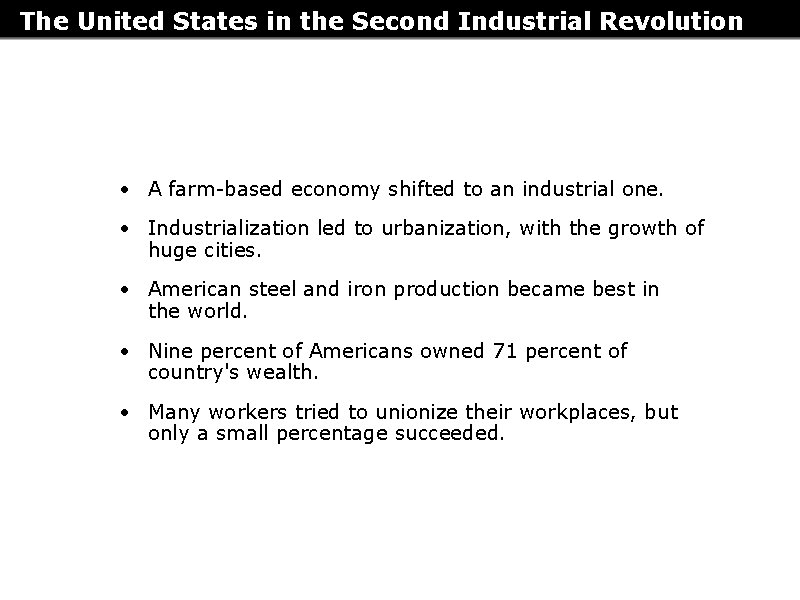
The United States in the Second Industrial Revolution • A farm-based economy shifted to an industrial one. • Industrialization led to urbanization, with the growth of huge cities. • American steel and iron production became best in the world. • Nine percent of Americans owned 71 percent of country's wealth. • Many workers tried to unionize their workplaces, but only a small percentage succeeded.
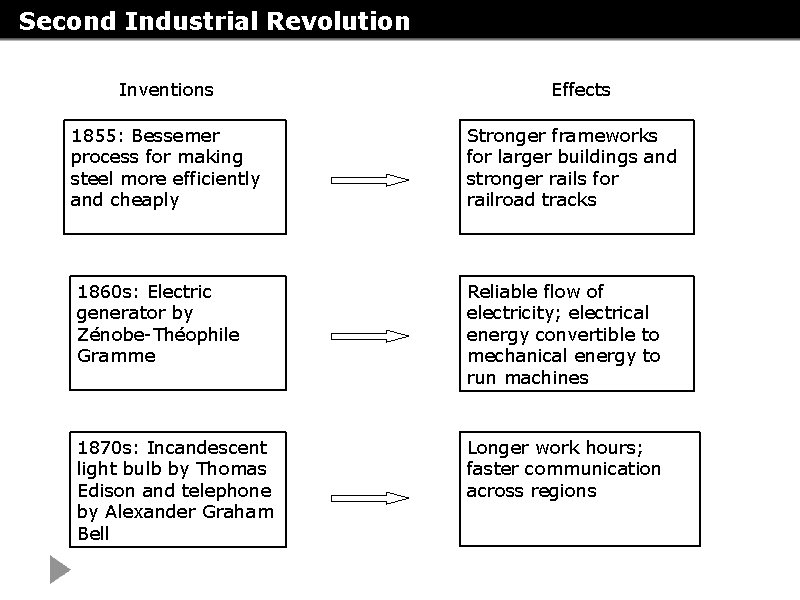
Second Industrial Revolution Inventions 1855: Bessemer process for making steel more efficiently and cheaply Effects Stronger frameworks for larger buildings and stronger rails for railroad tracks 1860 s: Electric generator by Zénobe-Théophile Gramme Reliable flow of electricity; electrical energy convertible to mechanical energy to run machines 1870 s: Incandescent light bulb by Thomas Edison and telephone by Alexander Graham Bell Longer work hours; faster communication across regions
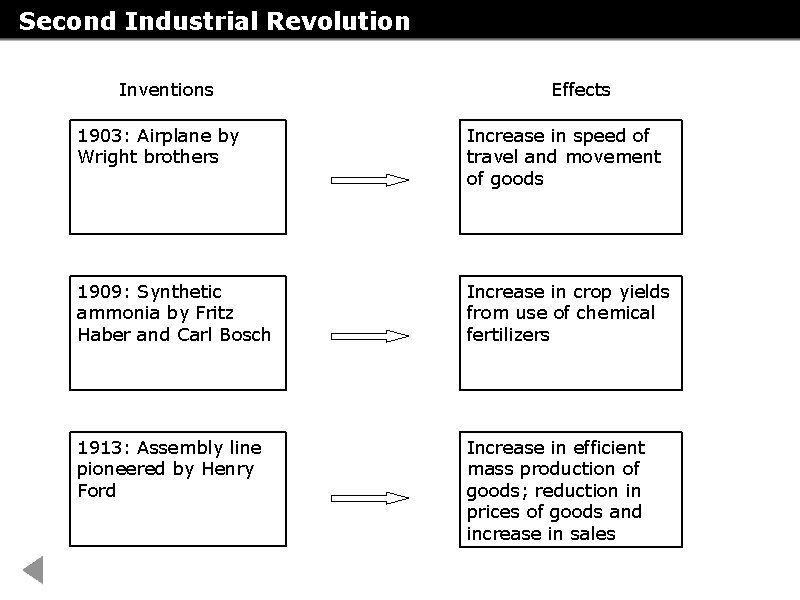
Second Industrial Revolution Inventions Effects 1903: Airplane by Wright brothers Increase in speed of travel and movement of goods 1909: Synthetic ammonia by Fritz Haber and Carl Bosch Increase in crop yields from use of chemical fertilizers 1913: Assembly line pioneered by Henry Ford Increase in efficient mass production of goods; reduction in prices of goods and increase in sales
Chapter 11 Lesson 2 The Emergence of Mass Society
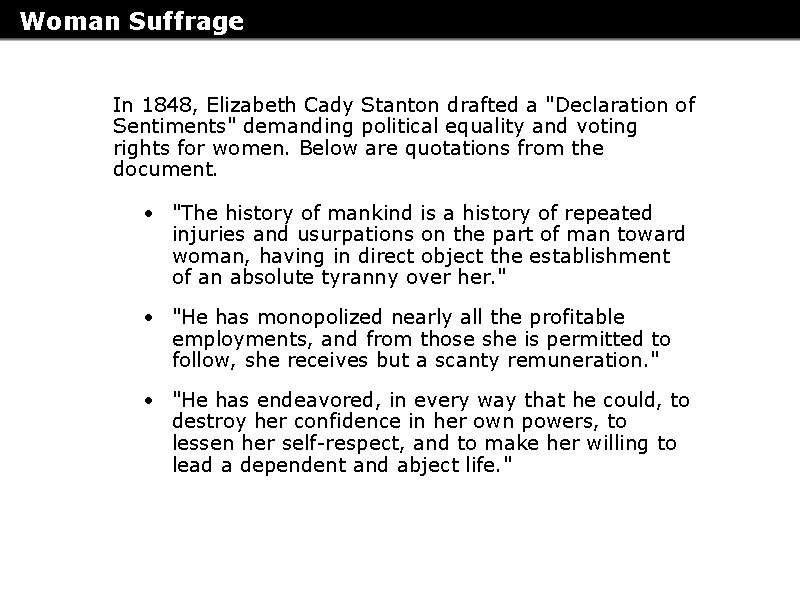
Woman Suffrage In 1848, Elizabeth Cady Stanton drafted a "Declaration of Sentiments" demanding political equality and voting rights for women. Below are quotations from the document. • "The history of mankind is a history of repeated injuries and usurpations on the part of man toward woman, having in direct object the establishment of an absolute tyranny over her. " • "He has monopolized nearly all the profitable employments, and from those she is permitted to follow, she receives but a scanty remuneration. " • "He has endeavored, in every way that he could, to destroy her confidence in her own powers, to lessen her self-respect, and to make her willing to lead a dependent and abject life. "
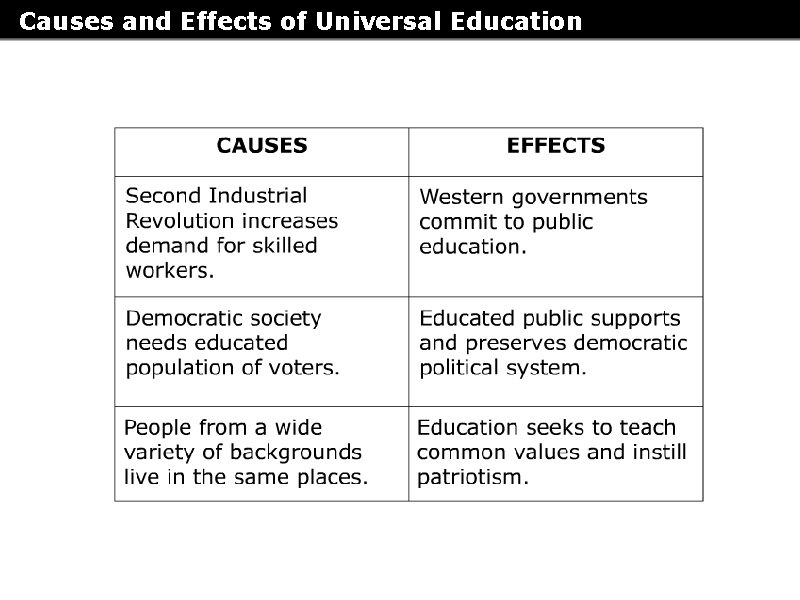
Causes and Effects of Universal Education
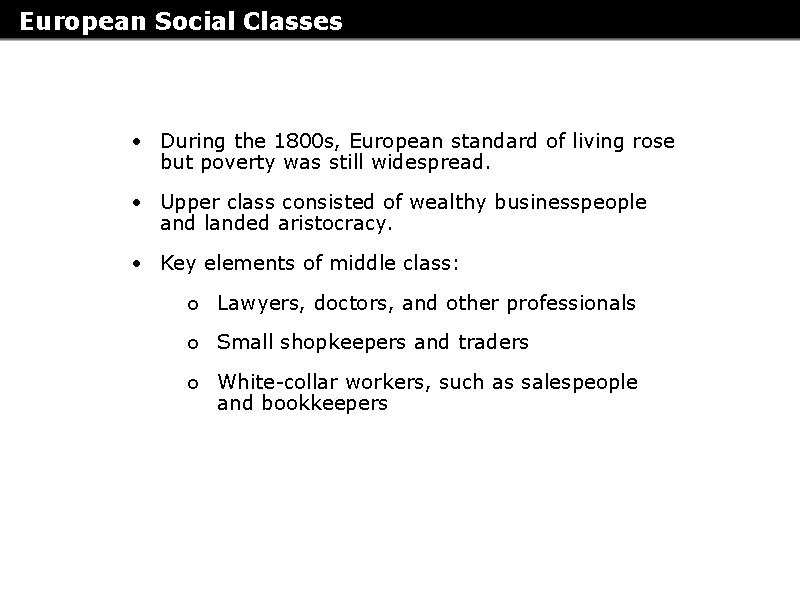
European Social Classes • During the 1800 s, European standard of living rose but poverty was still widespread. • Upper class consisted of wealthy businesspeople and landed aristocracy. • Key elements of middle class: o Lawyers, doctors, and other professionals o Small shopkeepers and traders o White-collar workers, such as salespeople and bookkeepers
Chapter 11 Lesson 3 The National State and Democracy
The Expansion of Democracy in Western Europe • Democracy expanded in Western Europe in the late 1800 s. o Universal male suffrage laws were passed. o Prime ministers became responsible to parliaments rather than to monarchs. o Mass political parties formed. • A new Labour Party formed in Britain in 1900 and dedicated itself to interests of the working class. • In 1875, France became a constitutional republic with a president and a two-house legislature. • Italy granted universal male suffrage in 1912.
Central and Eastern European Governments in the Late 1800 s Germany • Otto von Bismarck set up a two-house legislature in 1871. • Government ministers were responsible to the emperor, not to the parliament. • The emperor controlled the armed forces, foreign policy, and the bureaucracy.
Central and Eastern European Governments in the Late 1800 s Austria-Hungary • Austria's defeat in a war with Prussia in 1866 resulted in its agreeing to a union with Hungary in 1867. • Austria and Hungary adopted constitutions that set up parliamentary systems. • The emperor ignored these systems in Austria, appointing and dismissing ministers himself and issuing laws when parliament was not in session.
Central and Eastern European Governments in the Late 1800 s Russia • Czar Nicholas II created a legislative assembly called the Duma. • Within a couple of years, Nicholas curtailed the power of the Duma. • Nicholas used the army and the bureaucracy to rule Russia.
Chapter 11 Lesson 4 Modern Ideas and Uncertainty
Homework: Artistic Movements Recall what you have learned about the innovative art movements that arose between 1870 and 1914. • modernism • postimpressionism • naturalism • realism • symbolism • cubism • impressionism • functionalism
Sigmund Freud • Viennese doctor who proposed theories about the human mind • Devised therapy process known as psychoanalysis • Believed that human behavior is determined by past experiences and unrecognized or unconscious internal forces • Promoted exploration of repressed thoughts to promote mental healing
Anti-Semitism and Zionism • Prevalent in Europe since the Middle Ages, hostility toward Jews increased in the late 1800 s. • To win votes, political parties in Germany and Austria-Hungary blamed problems on Jews. • Persecution and pogroms—organized massacres of Jews—were widespread in Russia. • To escape persecution, about 25, 000 Jews moved to Palestine, the land of ancient Israel. • This brought about Zionism, a movement for the establishment of a Jewish state in Palestine.
Social Darwinism and Racism Social Darwinism: Herbert Spencer's application of theory of natural selection to modern human societies • Used to justify Western dominance in the late nineteenth century • Used by extreme nationalists to justify war as survival of "fittest" nations • Equivalent of "junk science"
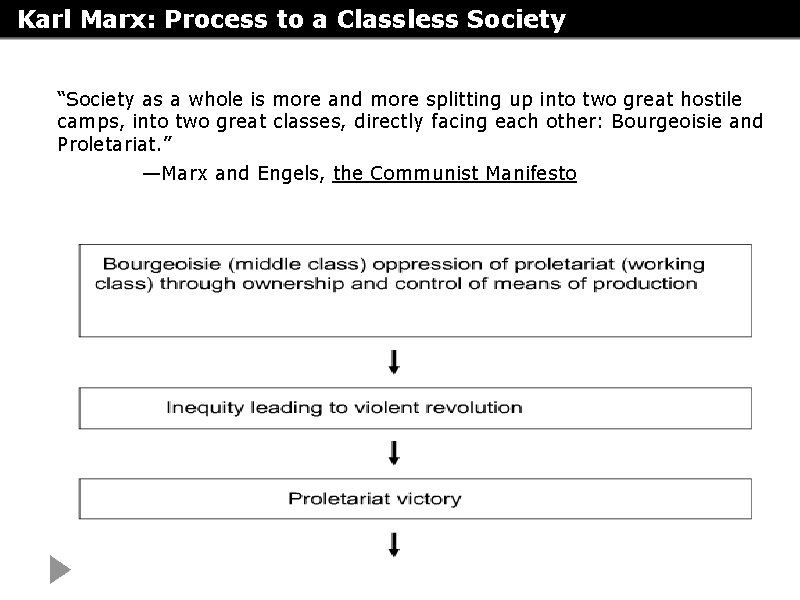
Karl Marx: Process to a Classless Society “Society as a whole is more and more splitting up into two great hostile camps, into two great classes, directly facing each other: Bourgeoisie and Proletariat. ” —Marx and Engels, the Communist Manifesto
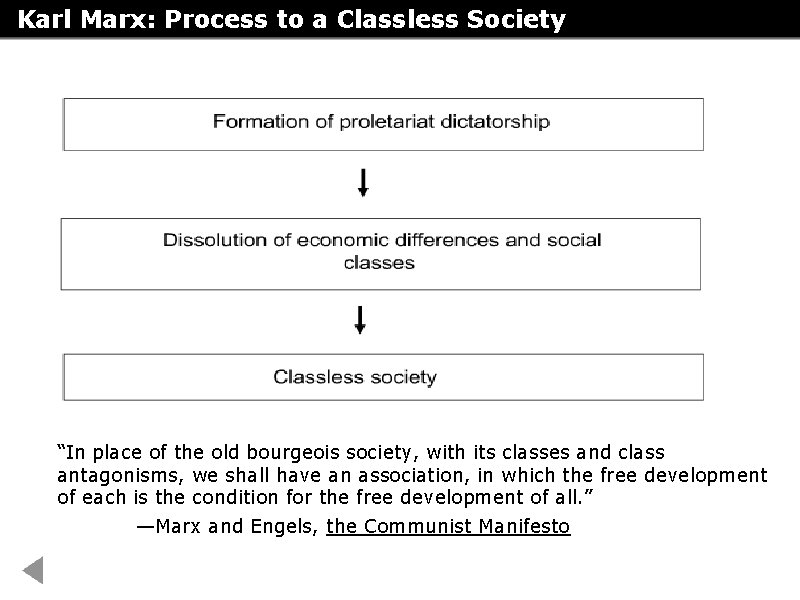
Karl Marx: Process to a Classless Society “In place of the old bourgeois society, with its classes and class antagonisms, we shall have an association, in which the free development of each is the condition for the free development of all. ” —Marx and Engels, the Communist Manifesto