
CHAPTER 12 Lesson 1 Jacksonian Democracy New Parties
- Slides: 20
CHAPTER 12
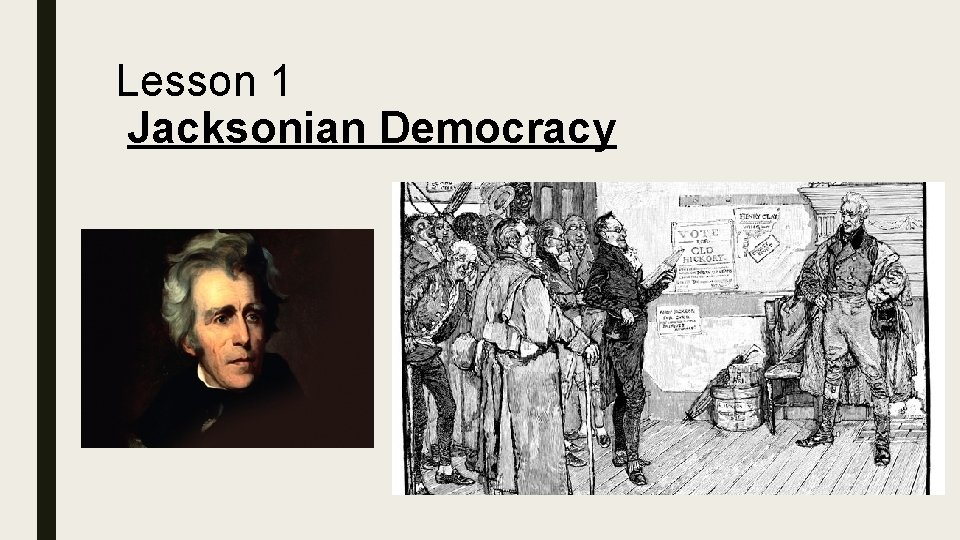
Lesson 1 Jacksonian Democracy
■ New Parties emerge ■ From 1816 to 1824, the United States had the only one major political party, this was the Democratic Republican Party. ■ In 1824, four Democratic Republican candidates competed for the presidency. ■ Jackson, of Tennessee, was a hero of the war of 1812. ■ John Quincy Adams of Massachusetts, was the son of former president John Adams. ■ The party was far from united.
■ The House Chooses a President ■ In the election, Jackson received a plurality of the popular vote. ■ No candidate received a majority, or more than half of the electoral votes. ■ As the house prepared to vote, Clay met with Adams, Clay agreed to use his influence as Speaker to defeat Jackson. ■ Clay helped John Quincy Adams to defeat Jackson. John Quincy Adams was chosen for president, and quickly he named Clay to be Secretary of the State. ■ Jackson’s followers accused the two men of making a “corrupt bargain” and stealing the election.
■ Adams as president ■ Adams and Clay denied any wrongdoing. No one ever uncovered any evidence of bargain. Still, the change cast a shadow over Adams presidency. ■ In his message to Congress, Adams announced his plans, improving roads, and waterways, he also wanted to build a national university and scientist research. ■ Adams proposals upset his opponents, the would not spend money in such project. ■ Government finally approved finds for improving rivers, harbors, and roads, but this was far less than Adams proposals.
■ The Election of 1828 ■ By 1828, the Democratic Republican Party has split. ■ The National Republicans wanted strong central government, they supported building roads and national banks to facilitate economic growth. ■ During the campaign, both sides resorted to mudslinging. ■ In the election, Jackson received most votes cast in the frontier States, he also received many votes in the South (He was more popular). ■ John C. Calhoun who had been Adams Vice President, switched parties to run with Jackson. ■ Shortly after the election, Jackson's supporters officially formed the Democratic Party.
■ Jackson as President ■ Jackson was a patriot, a self-made man, and war hero. ■ Thousands of ordinary people came to Washington for his inauguration. ■ President Andrew Jackson promised “equal protection and equal benefits”. ■ In the early years, only men who had property or pay taxes could vote. By the 1820 s, many states had loosened these requirements. ■ By 1828, nearly all states let voters to choose presidential electors.
■ Making Government more Democratic ■ Democrats argued that ordinary citizens could do most Government job. ■ Soon, after taking office in 1829, Jackson fired many federal workers and replaced them with his supporters. ■ One Jackson's said “ To the victors belong the spoils”. ■ Jackson's Supporters also abandoned the unpopular caucus system, instead, parties began using nominated conventions. ■ The Tariff Debate ■ Tariffs made European goods more expensive. ■ In 1828, Congress had passed a very high tariff law, Vice President Calhoun claimed that the state had the right to nullify. ■ President Jackson disagreed with his reasoning. ■ In 1830, Thomas Jefferson’s birthday, Jackson had a chance to make his feelings on nullification known. ■ Congress passed the Maysville Road bill, The bill provided federal funds for the building of roads in Kentucky. ■ Jackson vetoed the bill. ■ In 1832 Congress passed a lower tariff. ■ South Carolina passed the Nullification Act, declaring it would no pay “illegal” tariffs. ■ Jackson asked Congress to pass the Force bill, it allowed him to enforce federal laws. ■ South Carolina accepted the new tariff but nullified the Force bill
Lesson 2 ■ The five civilized tribes that lived in the East of the nation, were successful farming communities that were much like many other American communities. ■ Americans did not respect the rights of the 5 civilized tribes and they wanted the federal government to force these eastern native Americans to relocate to lands west of the Mississippi River so they can take there lands for themselves. ■ In 1830, President Jackson pushed the Indian removal act through congress that announced the federal government to pay Native Americans to move
Lesson 2 ■ The treaty of 1838 forcefully removed the Cherokee from their homes to the west. On the journey about 14 of the Cherokee people died from huger and exposure. The Cherokee came to can this journey trail where they cried and historians can it “ the trail of tears ”. ■ Instead I December 1835 a group of Seminole attacked troops led by Major Francis Dade as they marched across the center Florida. ■ Between 1835 and 1842 about 3000 seminole and African Americans known as Black Seminoles fought some 30000 U. S. ■ Together the Seminoles and Black Seminoles attacked White settlement along the Florida coast. ■ War broke out again in 1855 over what little land in Florida the Seminole had left.
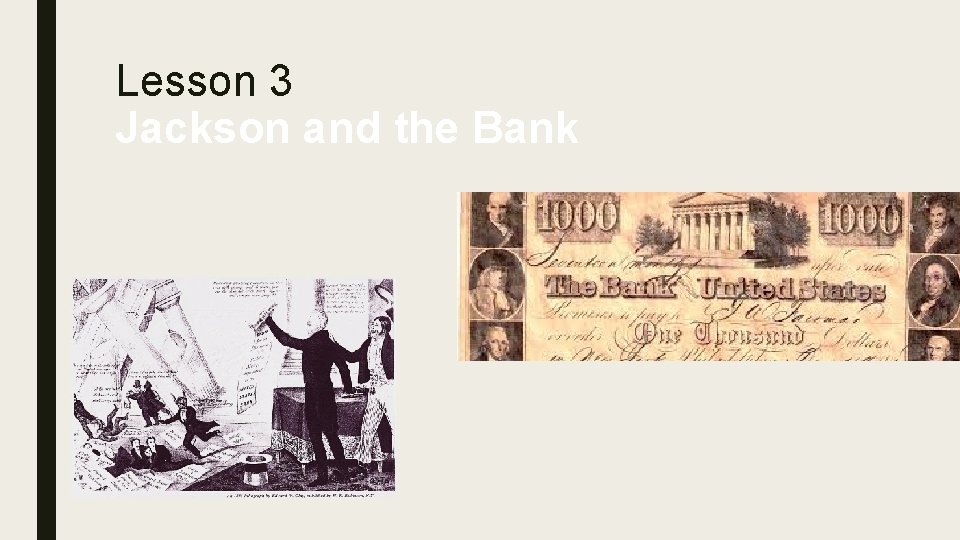
Lesson 3 Jackson and the Bank
Lesson 3 ■ Jackson v. s. the Bank ■ ■ President Andrew Jackson was not satisfied with the Second Bank of the United States. ■ The bank was created by congress to hold federal government’s money and control the country’s money supply. ■ Nicholas biddle, who was President of the bank, was despised by Andrew Jackson. ■ Additionally the Bank’s assigned duties made it a powerful institution. ■ Andrew Jackson had viewed the bank as a monopoly for wealthy Easterners and would limit western economic growth.
■ The Bank and Election of 1832 ■ Andrew Jackson’s enemies tried to sabotage him in the 1832 presidential campaign. The senators, Henry Clay and Daniel Webster, persuaded Biddle to apply for government permit to run the bank. They thought Andrew Jackson would take action. ■ Henry C. And Daniel W. Thought if Andrew Jackson was to try to veto the bank, no one would vote for him. ■ When the bill to renew the bank’s charter, he told the secretary “The bank is trying to kill me, but i will it it. ” ■ Instead of Webster and Clay sabotaging Andrew Jackson, people actually agreed with Jackson and he was elected.
■ Panic of 1837 ■ Andrew Jackson thought it would be best to not run for a third term. ■ The Democrats at that time had chosen to vote for Van Buren, who was Andrew Jackson’s vice president during his second term. ■ A new party called The Whigs included former Republicans and other anti-Jackson groups, they were the opposition.
■ The Whigs had nominated 3 candidates, all three had supported a different part of the nation. ■ The Whigs had hoped that this strategy would keep Van Buren from getting the majority of votes. ■ The Whigs were in control of the House of Representatives, who were electing the president at that time. ■ The Whigs’ tactic had failed meaning that Van Buren had gotten the majority of electoral and popular votes.
■ Van Buren had barely taken office due to a financial panic in the nation. ■ The panic was the effect of Andrew Jackson’s victory over the Bank of the United States. ■ After the bank had ceased all operations, control over the states banks had shortly vanished. ■ A few of these banks began distributing large amounts are banknotes. ■ The government was concerned that these banknotes had little to no value, they quickly stopped accepting them as payment for purchasing public land. ■ Citizens began questioning the value of their banknotes, which led to the economic panic. ■ This panic led to an economic depression. Land values dropped tremendously and banks failed.
■ Large amounts of businesses closed, many workers lost their jobs, and many farmers lost their lands. ■ In the cities all throughout the nation a larger amount of people couldn’t afford food or rent. ■ President Van Buren did very little to help this situation. ■ President Van Buren believed that the government should do very little in interfering with the nation's economy. ■ Van Buren did persuade Congress to create an independent federal treasury. ■ The independent federal treasury meant that the government no longer had to deposit its money into private banks. ■ The new system prevented state and private banks from using the governments money to back the banknotes. It helped prevent further bank crisis. ■ Van Buren and his supporters held the passing of the federal treasury and called it the second declaration of independence. ■ Many Whigs and even Democrats criticized the passing ■ This split is what let the Whigs win the presidential election in 1840.
■ The Log Cabin Campaign ■ The Whigs wanted to ran against Van Buren, so they united their candidate, William Henry Harrison. They needed workers and farmers to vote so he can win, so the Whigs told everyone that William Henry Harrison was frontiersman, not a wealthy Ohioan. ■ He died of pneumonia 32 days after he served the shortest term.
■ John Tyler’s Presidency ■ John Tyler became Vice President as a Whig, but did not follow every policy. He was put on the election ballot to attract the southerns. ■ Since John Tyler wasn’t completely a Whig, is vetoed many bill sponsored by the whigs. Having all his cabinet members furious, they resigned, and expelled Tyler from the Whig party. ■ After John Tyler betrayed the Whig party, the couldn’t agree on their goals, so the voted by region. ■ After 4 years, Whigs had no power. The tried one more president, Zachary Taylor, but he died in office. Now the Whig party is all separated, it nearly disappeared. But few left and started a new party, the Republican Party.
QUESTION S 1. What tactics were used in the election of 1828? 2. 3. 4. 5. 6. 7. 8. What made Europeans goods more expensive? Jackson, of Tennessee, was a hero of which war? In what year did the Democratic-Republican Party split? -Who supported the white settlers that wanted to remove Natives from their land? -What was the purpose of the Indian Removal Act? What was the ‘Trial of Tears’? -What effect did the Native Americans' use of surprise attacks have on the Seminole Wars? 9. Who plotted to renew the Bank charter during the election of 1832? 10. Who was the President of the Bank of the United States? 11. What did Andrew Jackson say when the charter to renew the bank came? 12. Why did Tyler’s policies differ from those of the Whig Party? 13. What happened to William Henry Harrison a few days after his inauguration as President?