Chapter 1 Marketing Scope of Marketing Everything around
- Slides: 32
Chapter 1 Marketing
Scope of Marketing �Everything around you Think of purchases you have (or have not) made How does a business influence your purchases? ▪ Southwest Airlines �Marketing The process of planning, pricing promoting, selling and distributing ideas, goods, or services to create exchanges that satisfy customers ▪ An ongoing process – why?
Ideas, Goods, and Services �Ideas generally ideals, thoughts ▪ Politicians, environmentalists ▪ Got Chocolate Milk? �Goods Tangible items that have monetary value and satisfy your needs and wants ▪ Examples? �Services Intangible items that have monetary value and satisfy your needs and wants ▪ Examples?
Foundations of Marketing � Practice of marketing depends on 4 key areas of knowledge: 4 foundations of marketing Business, management, entrepreneurship ▪ Understanding these areas affect decision making Communication and interpersonal skills ▪ Interact effectively with others Economics ▪ Economic principles Professional Development ▪ Career exploration, development and growth
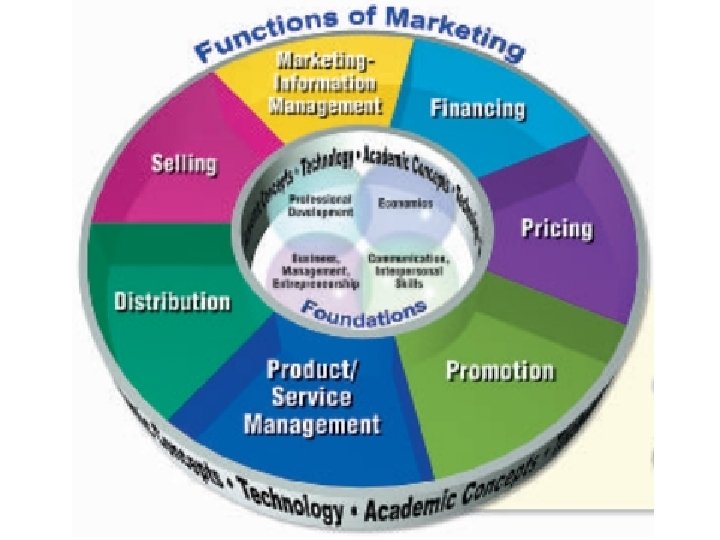
7 Functions of Marketing Product/Service Management 1. Obtaining, developing, maintaining, and improving a product or a product mix in response to market opportunities ▪ Marketing research = determining needs/wants Pricing 2. How much to charge for goods and services in order to make a profit ▪ ▪ ▪ Costs Competition price Customers willingness and ability to pay
7 Functions of Marketing Continued… Promotion 3. Effort to inform, persuade, or remind potential customers about a business’s product or services ▪ ▪ Examples of promotion? Other than product and services promotion, what else can a company promote? Distribution 4. The process of deciding how to get goods in customers’ hand ▪ Transportation, storing, tracking
7 Functions of Marketing Continued… Marketing Information Management 5. Gathering information, storing it, and analyzing the information Why? ▪ ▪ How would you gather information? ▪ ▪ Apple example Nielsen – Consumer and Consumer behavior (watch and buy) J D Power & Associates – primarily customer surveys How often?
7 Functions of Marketing Continued… Financing 6. Getting the money necessary to pay for setting up and running a businesses Loans, selling shares of stock, issuing bonds ▪ Helping others obtain your product/service Extending credit to customers Payment options ▪ ▪ ▪ Term payments, credit cards, etc. Selling 7. Providing customers with goods and services they want Directly to the customer or business ▪ Techniques and activities
Marketing Concept �Marketing Concept The idea that a business should strive to satisfy customers’ needs and wants while generating a profit for the firm Where is the focus? Success comes when all 7 functions support the marketing concept idea �Customer Relationship Management (CRM) An aspect of marketing that combines customer information with customer service and marketing communications ▪ Meaningful one-on-one communications via customer intelligence
Review and critical thinking… �On a piece of paper, answer the following (page 7, 1 -3 and 5): Name 2 ideas that can be marketed Where do exchanges take place? What is the main difference between consumers and industrial users List at least 3 ways the Internet has changed marketing functions
The Importance of Marketing
Economic Benefits of Marketing �Marketing has an important role in the economy Provides the means for competition to take place ▪ Businesses try to create new or improved products at lower prices than their competitors ▪ How does this affect the consumers? ▪ How does this affect businesses to have such competition? New and improved products ▪ Continuing to look at ways to satisfy customers ▪ How has competition shaped the personal computer industry?
Economic Benefits of Marketing Continued… �Lower prices What happens in the marketplace when prices drop? What happens to production when demand increases? ▪ Overall unit costs go down ▪ Fixed costs �Rent, insurance, etc. stay the same regardless of production ▪ Variable costs �Costs that change given the amount of production �Labor, materials, etc. ▪ Example: $20, 000 in fixed costs, Quantity produced is 10, 000 units. How much per unit does it cost the company? ▪ How much per unit would it cost the company if they produced 200, 000 units?
Added Value and Utility �The functions of marketing add value to a product Utility ▪ An attribute of a product or service that makes it capable of satisfying consumers’ wants and needs ▪ 5 economic utilities �Place �Time �Possession �Information �Form (not directly related to marketing; however, the research and product design makes it a crucial part of the marketing process
Utility �Form Utility Involves changing raw materials or putting parts together to make them more useful ▪ Deals with making or producing things ▪ Taking things of little value and putting them together to create more value ▪ Special features or ingredients in a product add value and increases its form utility ▪ Example: Automobiles
Utility Continued… �Place Utility Involves having a product where customers can buy it. ▪ Businesses study consumers shopping habits to determine the most convenient and efficient locations to sell products ▪ Direct approach ▪ Catalogs ▪ Internet ▪ Retail stores (considered an intermediary)
Utility Continued… �Time Utility Having a product available at a certain time of year or a convenient time of day Increases the value of the products by having them available when consumers want them Examples? ▪ 24 hour super stores ▪ Coffee shops ▪ Extended hours during holiday shopping seasons
Utility Continued… �Possession Utility � When legal ownership of a product changes hands How do you come into possession of the items you want? What exchanges are made? ▪ How does this add value? Possession utility also includes providing payment options
Utility Continued… �Information Utility Involves communication with the consumer Examples: ▪ Labeling ▪ Advertising ▪ Web Assist and Manuals ▪ How do these add value? �Provide information to customers by explaining the features and benefits of the products
Review �The added value to a product that marketing provides is called __________ �How does marketing help to lower prices? �In what way is marketing related to form utility? �Which utility is added by drive-through windows at fast-food restaurants? �In a business-to-business transaction, the seller offers the buyer a 2% discount for paying a bill early. Assuming the buyer took advantage of this offer, how much would be discounted on a $10, 000 invoice?
Fundamentals of Marketing
Market �Can you make your product appeal to everyone? What considerations do we need to make? �Market All people who share similar needs and wants and who have the ability to purchase your products
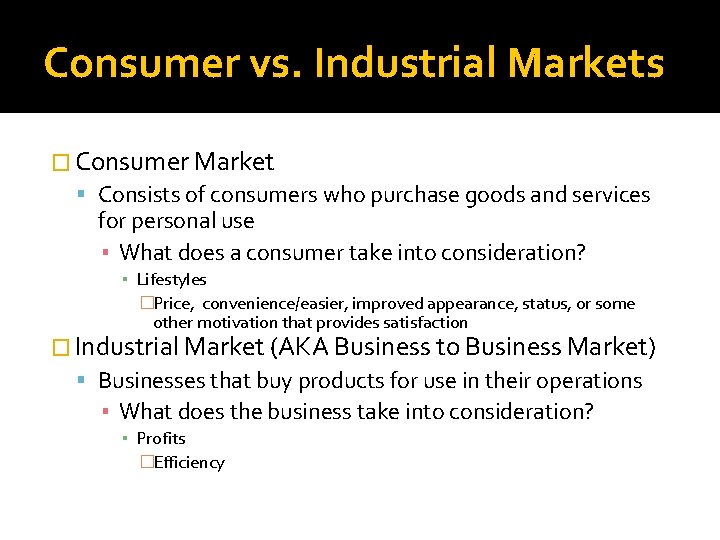
Consumer vs. Industrial Markets � Consumer Market Consists of consumers who purchase goods and services for personal use ▪ What does a consumer take into consideration? ▪ Lifestyles �Price, convenience/easier, improved appearance, status, or some other motivation that provides satisfaction � Industrial Market (AKA Business to Business Market) Businesses that buy products for use in their operations ▪ What does the business take into consideration? ▪ Profits �Efficiency
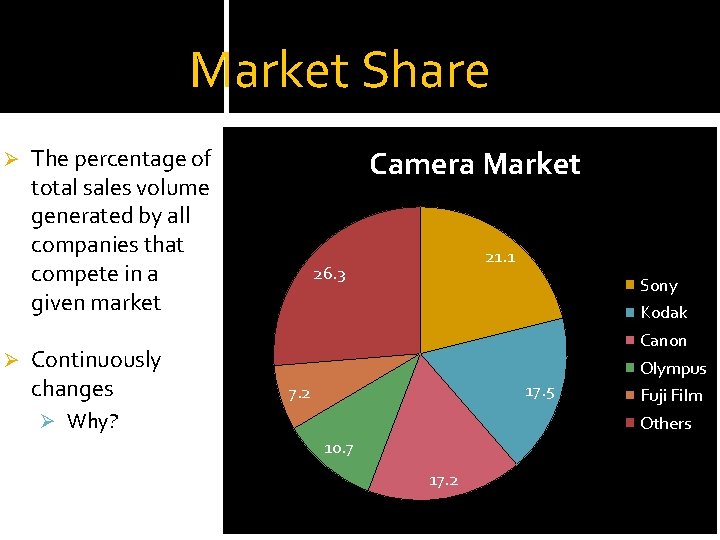
Market Share Ø Ø The percentage of total sales volume generated by all companies that compete in a given market Continuously changes Camera Market 21. 1 26. 3 Sony Kodak Canon Olympus 17. 5 7. 2 Ø Why? Fuji Film Others 10. 7 17. 2
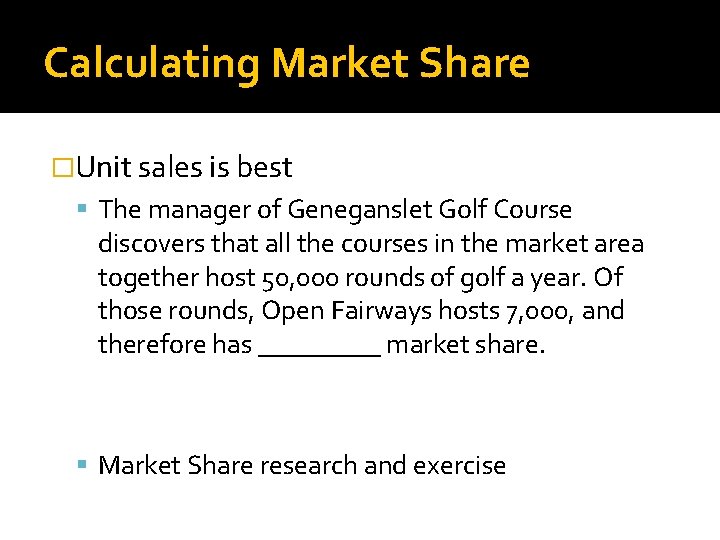
Calculating Market Share �Unit sales is best The manager of Geneganslet Golf Course discovers that all the courses in the market area together host 50, 000 rounds of golf a year. Of those rounds, Open Fairways hosts 7, 000, and therefore has _____ market share. Market Share research and exercise
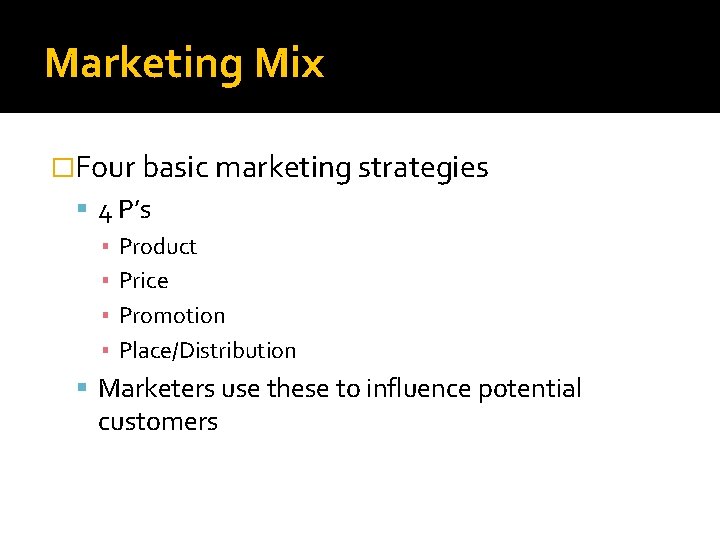
Marketing Mix �Four basic marketing strategies 4 P’s ▪ Product ▪ Price ▪ Promotion ▪ Place/Distribution Marketers use these to influence potential customers
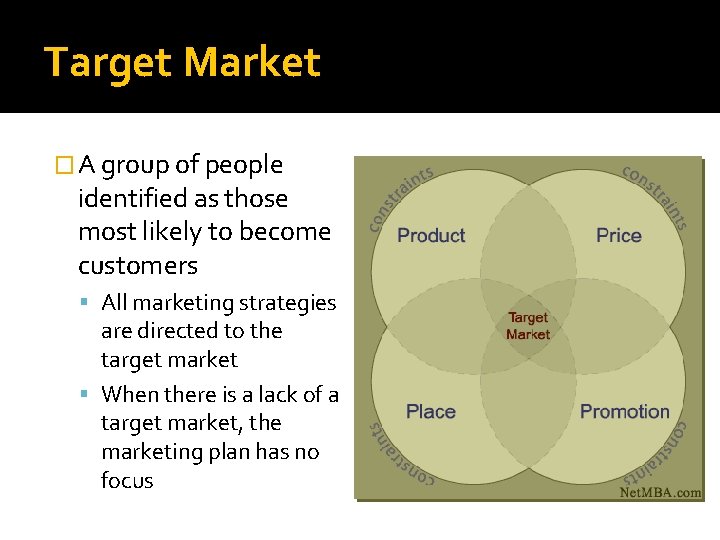
Target Market � A group of people identified as those most likely to become customers All marketing strategies are directed to the target market When there is a lack of a target market, the marketing plan has no focus
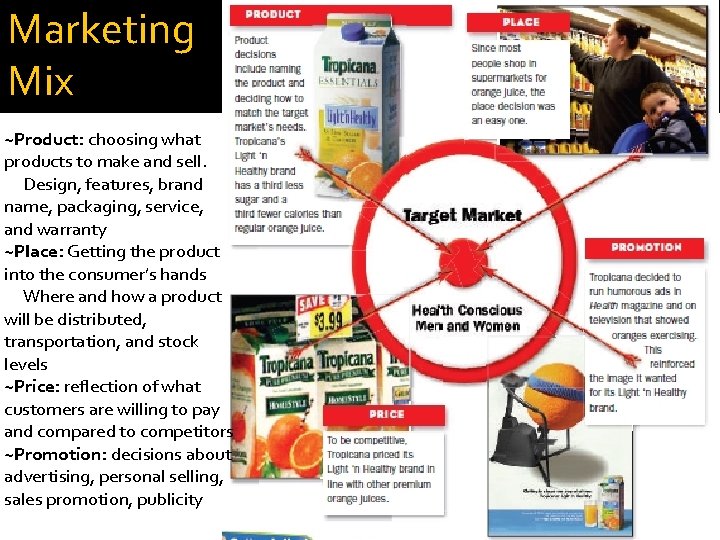
Marketing Mix ~Product: choosing what products to make and sell. Design, features, brand name, packaging, service, and warranty ~Place: Getting the product into the consumer’s hands Where and how a product will be distributed, transportation, and stock levels ~Price: reflection of what customers are willing to pay and compared to competitors ~Promotion: decisions about advertising, personal selling, sales promotion, publicity
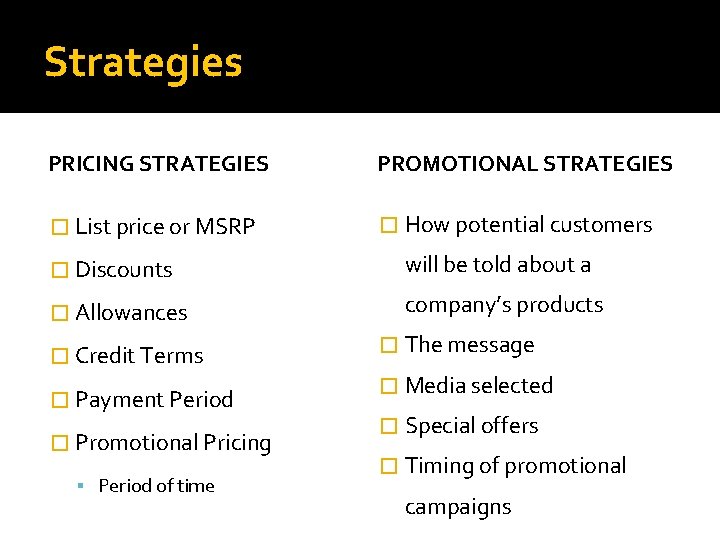
Strategies PRICING STRATEGIES PROMOTIONAL STRATEGIES � List price or MSRP � How potential customers � Discounts will be told about a � Allowances company’s products � Credit Terms � Payment Period � Promotional Pricing Period of time � The message � Media selected � Special offers � Timing of promotional campaigns
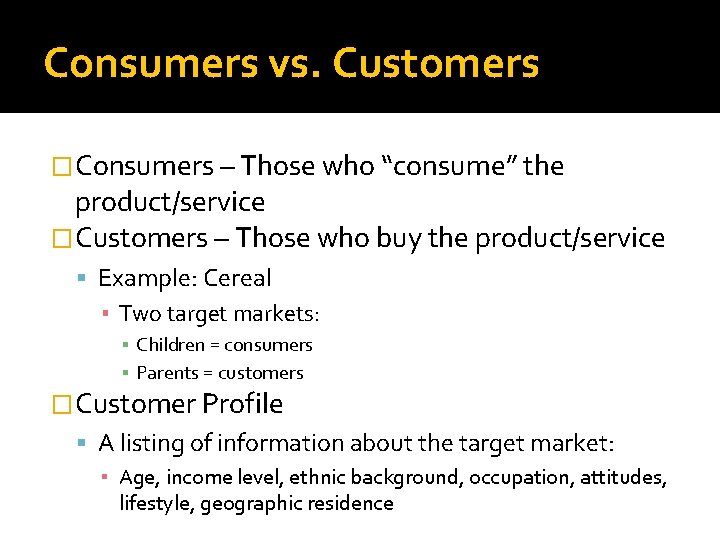
Consumers vs. Customers �Consumers – Those who “consume” the product/service �Customers – Those who buy the product/service Example: Cereal ▪ Two target markets: ▪ Children = consumers ▪ Parents = customers �Customer Profile A listing of information about the target market: ▪ Age, income level, ethnic background, occupation, attitudes, lifestyle, geographic residence
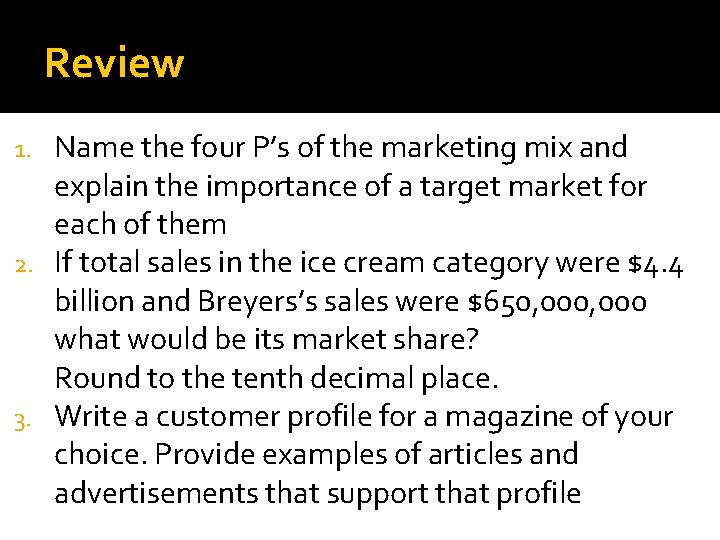
Review Name the four P’s of the marketing mix and explain the importance of a target market for each of them 2. If total sales in the ice cream category were $4. 4 billion and Breyers’s sales were $650, 000 what would be its market share? Round to the tenth decimal place. 3. Write a customer profile for a magazine of your choice. Provide examples of articles and advertisements that support that profile 1.