CEDAW AND THE PROTECTION OF RIGHTS OF WOMEN


- Slides: 25
CEDAW AND THE PROTECTION OF RIGHTS OF WOMEN WHO USE DRUGS INTERNATIONAL WOMEN’S RIGHTS ACTION WATCH ASIA PACIFIC Umyra Ahmad & Ishita Dutta EHRN Regional Conference on Harm Reduction 6 April 2017, Vilnius, Lithuania
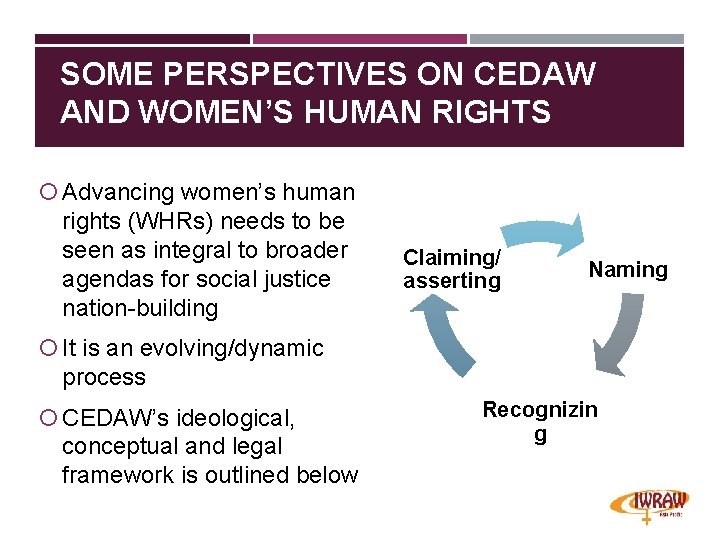
SOME PERSPECTIVES ON CEDAW AND WOMEN’S HUMAN RIGHTS Advancing women’s human rights (WHRs) needs to be seen as integral to broader agendas for social justice nation-building Claiming/ asserting Naming It is an evolving/dynamic process CEDAW’s ideological, conceptual and legal framework is outlined below Recognizin g
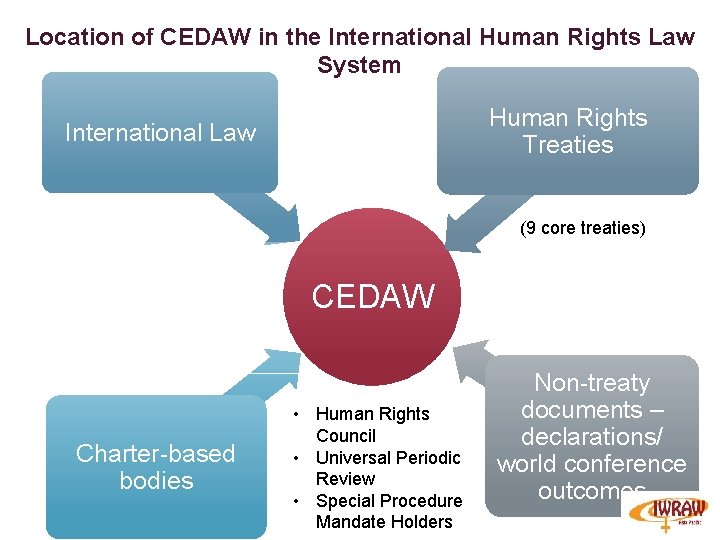
Location of CEDAW in the International Human Rights Law System Human Rights Treaties International Law (9 core treaties) CEDAW Charter-based bodies • Human Rights Council • Universal Periodic Review • Special Procedure Mandate Holders Non-treaty documents – declarations/ world conference outcomes
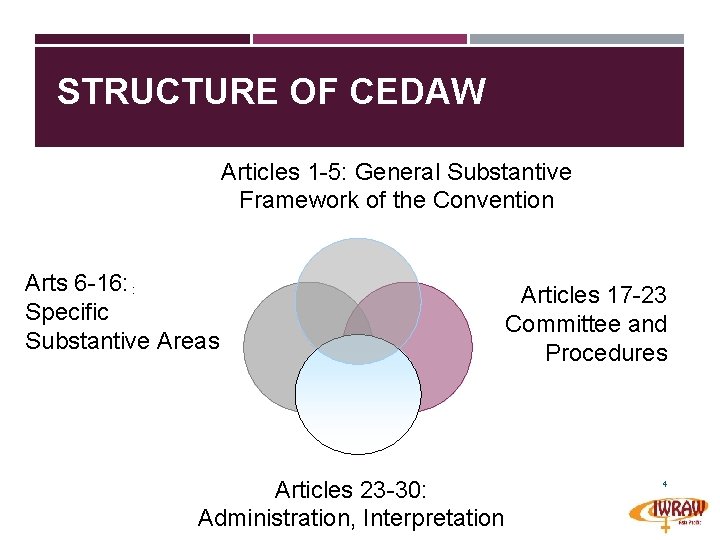
STRUCTURE OF CEDAW Articles 1 -5: General Substantive Framework of the Convention Arts 6 -16: : Specific Substantive Areas Articles 23 -30: Administration, Interpretation Articles 17 -23 Committee and Procedures 4
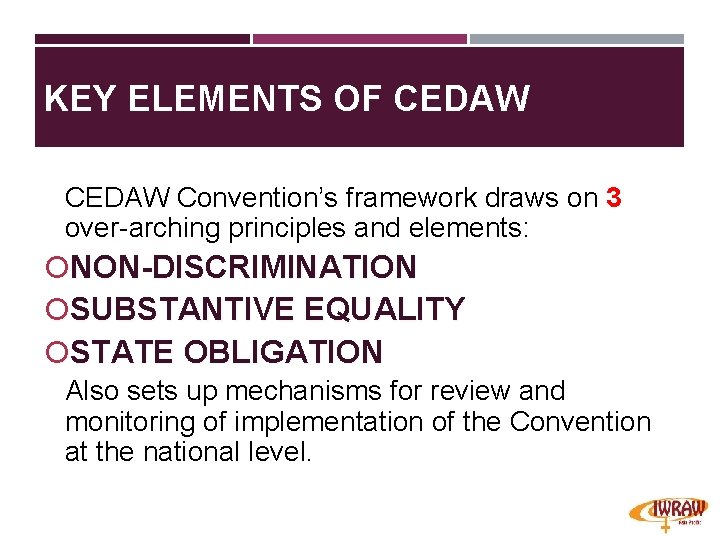
KEY ELEMENTS OF CEDAW Convention’s framework draws on 3 over-arching principles and elements: NON-DISCRIMINATION SUBSTANTIVE EQUALITY STATE OBLIGATION Also sets up mechanisms for review and monitoring of implementation of the Convention at the national level.
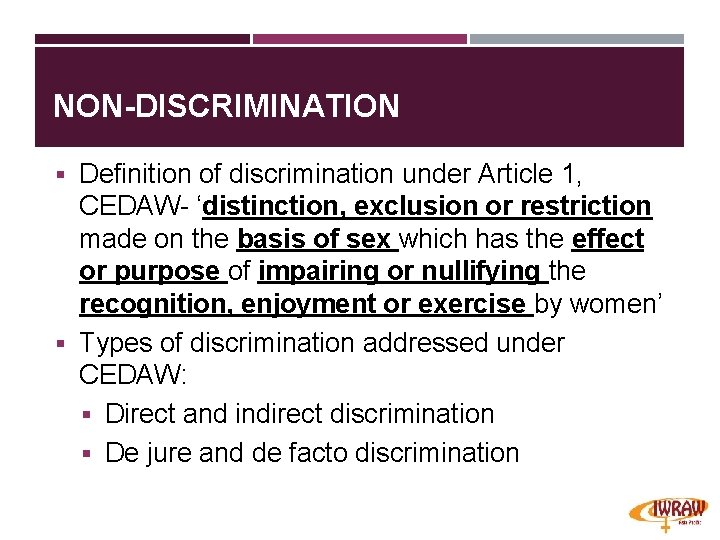
NON-DISCRIMINATION § Definition of discrimination under Article 1, CEDAW- ‘distinction, exclusion or restriction made on the basis of sex which has the effect or purpose of impairing or nullifying the recognition, enjoyment or exercise by women’ § Types of discrimination addressed under CEDAW: § Direct and indirect discrimination § De jure and de facto discrimination
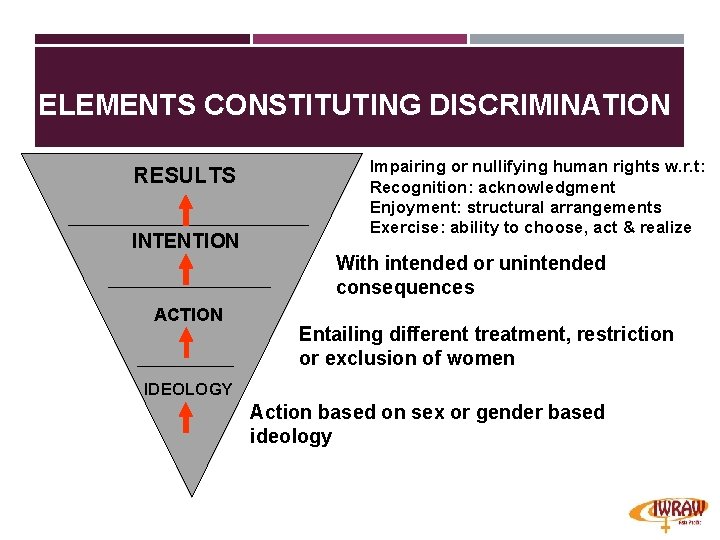
ELEMENTS CONSTITUTING DISCRIMINATION RESULTS INTENTION ACTION Impairing or nullifying human rights w. r. t: Recognition: acknowledgment Enjoyment: structural arrangements Exercise: ability to choose, act & realize With intended or unintended consequences Entailing different treatment, restriction or exclusion of women IDEOLOGY Action based on sex or gender based ideology
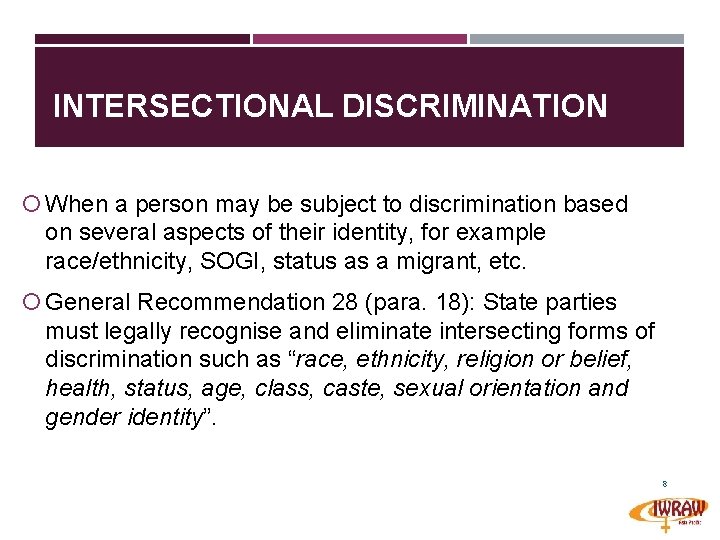
INTERSECTIONAL DISCRIMINATION When a person may be subject to discrimination based on several aspects of their identity, for example race/ethnicity, SOGI, status as a migrant, etc. General Recommendation 28 (para. 18): State parties must legally recognise and eliminate intersecting forms of discrimination such as “race, ethnicity, religion or belief, health, status, age, class, caste, sexual orientation and gender identity”. 8
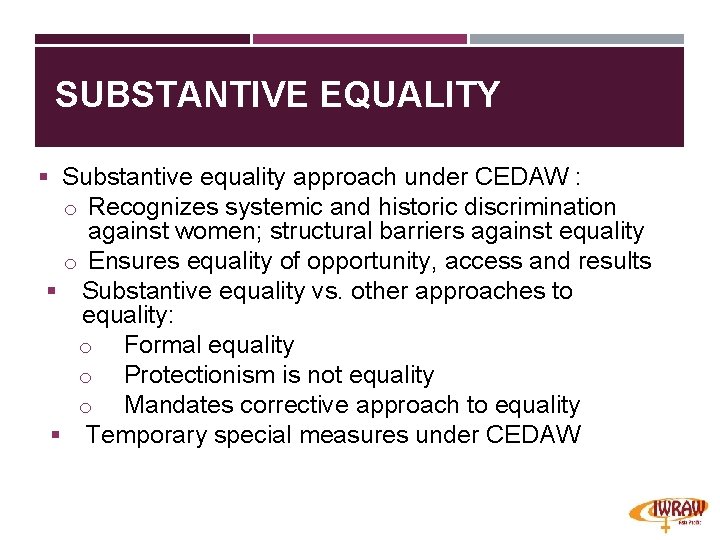
SUBSTANTIVE EQUALITY § Substantive equality approach under CEDAW : o Recognizes systemic and historic discrimination against women; structural barriers against equality o Ensures equality of opportunity, access and results § Substantive equality vs. other approaches to equality: o Formal equality o Protectionism is not equality o Mandates corrective approach to equality § Temporary special measures under CEDAW 9
STATE OBLIGATION § States have a legally binding obligation to respect, protect, promote and fulfill the realization of substantive equality of women within their jurisdictions § State obligations extend to acts of private actors so that States are to act with due diligence in holding private actors accountable § State obligations extends to all individuals within state jurisdiction and applies extraterritorially
ADDRESSING THE RIGHTS OF WOMEN WHO USE DRUGS UNDER CEDAW Issues prioritized by advocacy groups re rights of WUDs Legal status of WUDs in relation to criminal laws/public order laws/narcotics laws Inequality and discrimination as the basis for law and policy responses Stigma and discrimination; violence against WUDs § Public health policy: importance of a harm reduction approach & access to OST services in all settings § Right to social welfare and services: access to healthcare, SRHR, education, housing, etc. § Rights to family life: child custody, guardianship & adoption
CEDAW IN PRACTICE: Overview of Processes & Procedures 12
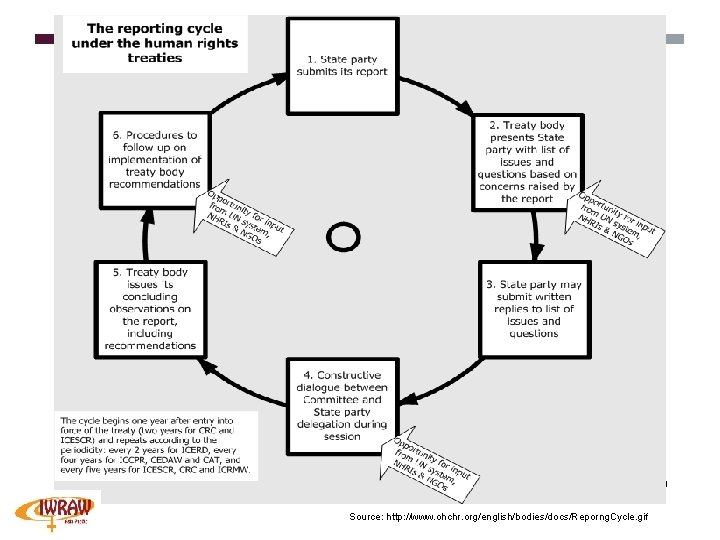
13 Source: http: //www. ohchr. org/english/bodies/docs/Reporng. Cycle. gif
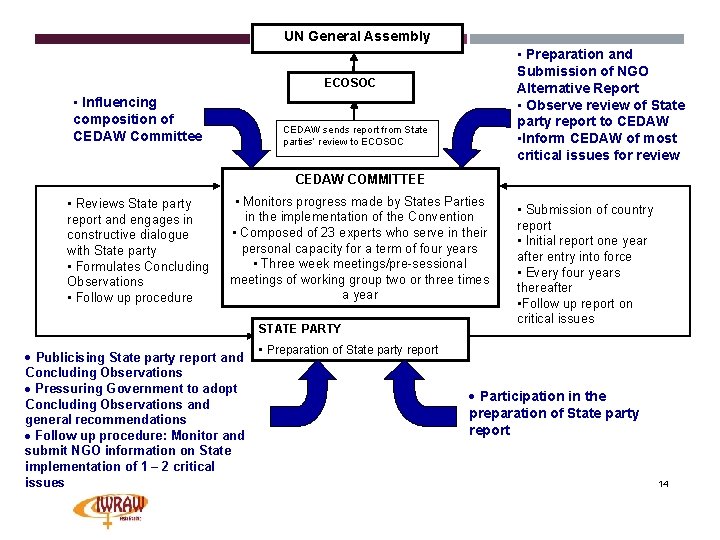
UN General Assembly • Preparation and Submission of NGO Alternative Report • Observe review of State party report to CEDAW • Inform CEDAW of most critical issues for review ECOSOC • Influencing composition of CEDAW Committee CEDAW sends report from State parties’ review to ECOSOC CEDAW COMMITTEE • Reviews State party report and engages in constructive dialogue with State party • Formulates Concluding Observations • Follow up procedure • Monitors progress made by States Parties in the implementation of the Convention • Composed of 23 experts who serve in their personal capacity for a term of four years • Three week meetings/pre-sessional meetings of working group two or three times a year STATE PARTY Publicising State party report and Concluding Observations Pressuring Government to adopt Concluding Observations and general recommendations Follow up procedure: Monitor and submit NGO information on State implementation of 1 – 2 critical issues • Submission of country report • Initial report one year after entry into force • Every four years thereafter • Follow up report on critical issues • Preparation of State party report Participation in the preparation of State party report 14
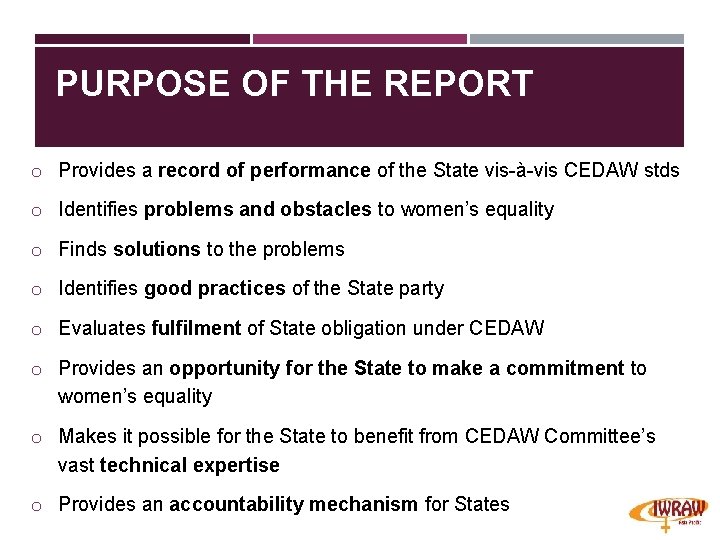
PURPOSE OF THE REPORT o Provides a record of performance of the State vis-à-vis CEDAW stds o Identifies problems and obstacles to women’s equality o Finds solutions to the problems o Identifies good practices of the State party o Evaluates fulfilment of State obligation under CEDAW o Provides an opportunity for the State to make a commitment to women’s equality o Makes it possible for the State to benefit from CEDAW Committee’s vast technical expertise o Provides an accountability mechanism for States
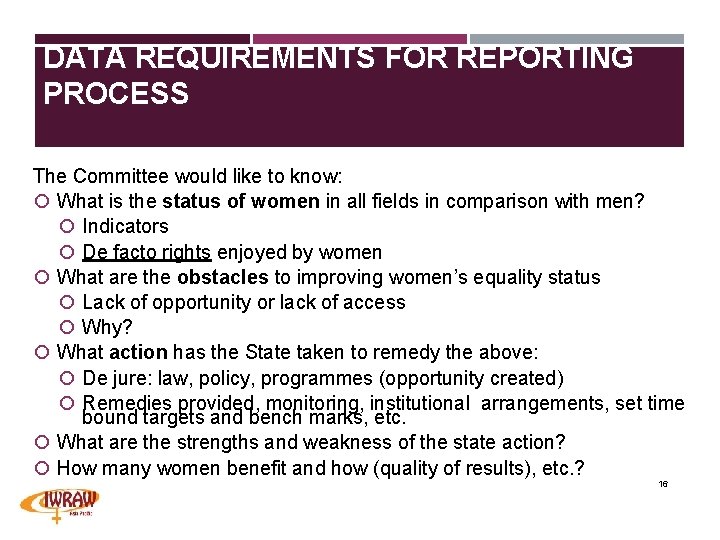
DATA REQUIREMENTS FOR REPORTING PROCESS The Committee would like to know: What is the status of women in all fields in comparison with men? Indicators De facto rights enjoyed by women What are the obstacles to improving women’s equality status Lack of opportunity or lack of access Why? What action has the State taken to remedy the above: De jure: law, policy, programmes (opportunity created) Remedies provided, monitoring, institutional arrangements, set time bound targets and bench marks, etc. What are the strengths and weakness of the state action? How many women benefit and how (quality of results), etc. ? 16
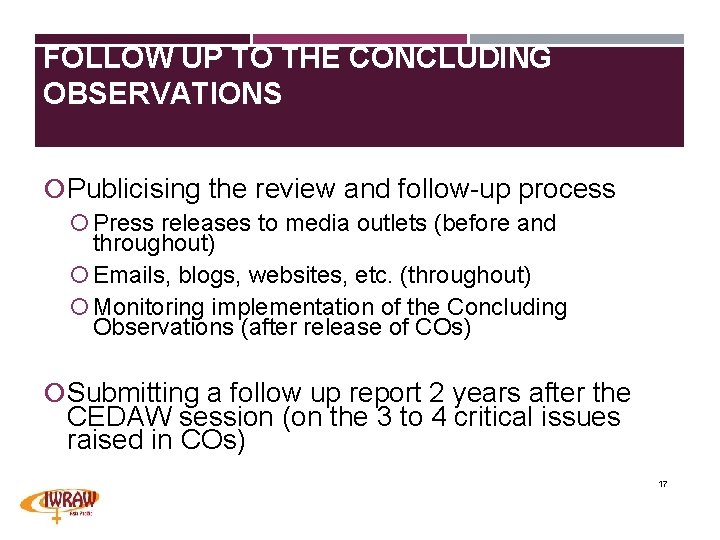
FOLLOW UP TO THE CONCLUDING OBSERVATIONS Publicising the review and follow-up process Press releases to media outlets (before and throughout) Emails, blogs, websites, etc. (throughout) Monitoring implementation of the Concluding Observations (after release of COs) Submitting a follow up report 2 years after the CEDAW session (on the 3 to 4 critical issues raised in COs) 17
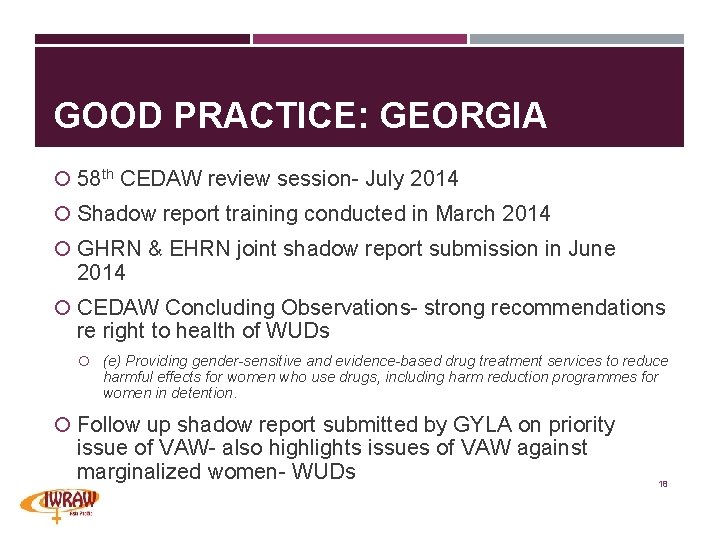
GOOD PRACTICE: GEORGIA 58 th CEDAW review session- July 2014 Shadow report training conducted in March 2014 GHRN & EHRN joint shadow report submission in June 2014 CEDAW Concluding Observations- strong recommendations re right to health of WUDs (e) Providing gender-sensitive and evidence-based drug treatment services to reduce harmful effects for women who use drugs, including harm reduction programmes for women in detention. Follow up shadow report submitted by GYLA on priority issue of VAW- also highlights issues of VAW against marginalized women- WUDs 18
WHAT IS THE OP-CEDAW? A separate treaty that supplements CEDAW It does not create new substantive rights but creates procedures for redress For States to be bound by obligations under the Optional Protocol, States must have ratified BOTH CEDAW and OP-CEDAW It provides for: A complaints procedure An inquiry Procedure 19
COMMUNICATIONS PROCEDURE Individuals and groups of individuals can file a complaint/communication before the CEDAW Committee for specific violations of rights in CEDAW after exhaustion of domestic remedies 20
INQUIRY PROCEDURE Enables the CEDAW Committee to launch on its own initiative, on the basis of reliable information, inquiries into grave and systematic violations of the rights of women in the Convention Confidential Opt Out Clause 21
EVOLVING PRACTICE Pattern of discrimination against sex workers by state authorities in accessing services and seeking redress for rights violations Incident of mass arrest and forced STI testing of sex workers Technical support provided on use of OP CEDAW Inquiry procedure Training on OP CEDAW Consultation with community Technical input into submission 22
CROSS MOVEMENT ALLIANCE BUILDING Collective advocacy with allies pivotal to effectiveness of campaigns Branching out to seek partners within our group and other movements Key- building bridges based on common issues e. g. with women’s rights movement on issue of right to bodily integrity e. g. with sex workers’ rights movement on issue of right to health e. g. with LGBT rights movement on issue of right to 23 equality and non-discrimination
GOOD PRACTICE: KYRGYZSTAN 60 th CEDAW review session- February 2015 Shadow report submitted by group of NGOs including Tais Plus and Asteria Covered issues relating to women who use drugs, women sex workers and LBT women Strong CEDAW Concluding Observations on all issues Joint advocacy enabled groups to advocate strongly with other WROs and with CEDAW Committee 24
WORKING WITH OTHER TREATY BODIES: CEDAW & ICESCR- treaty on economic, social & cultural rights Uses substantive equality approach Requires a right to health approach to drug use vs. criminalization Addresses gender impact of ESC rights violations, including right to health (general comment 16) Advocacy with CESCR Committee to dialogue with CEDAW on women’s ESC rights Processes & procedures Reporting process Optional protocol 25