CASE TAKING Dr HAHNEMANNS INSTRUCTONS DR CHANDRA HASAN
- Slides: 26
CASE TAKING Dr. HAHNEMANN’S INSTRUCTONS DR. CHANDRA HASAN. C. M, MD(Hom), ASSOCIATED PROFESSOR, DEPT OF REPERTORY, SARADA KRISHNA HOMOEPATHIC MEDICAL COLLEGE, KULASEKHARAM
Dr. Hahnemann mentioned the instructions about case taking in aphorisms 83 to 104 in the Organon of medicine. In aphorisms 83 to 93 , it is mentioned about general directions of case taking and recording. In aphorisms 94 to 98, it is mentioned directions about performing case taking in chronic cases. In aphorisms 99 to 102, it is mentioned directions about performing case taking in acute diseases including epidemic and sporadic diseases. In aphorisms 103 to 104, it is mentioned about how to obtain anti-miasmatic totality and medicine, portrait and obstracts obtaining and how to perform during follow up treatment. Aphorism 83: (general directions for case taking) Mentioned about general directions to physicians about idividualizing examination of a case of disease, what are the instructions
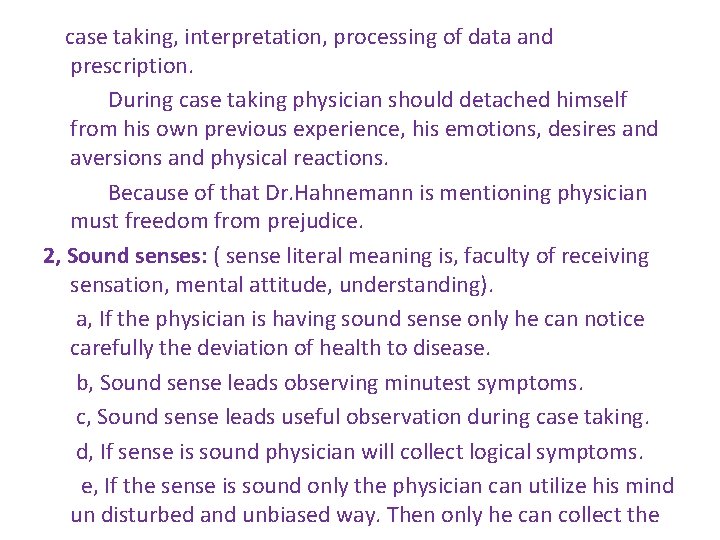
bear in mind during case taking. We must know why Dr. Hahnemann mentioned ‘Individualizing examination of a case of disease’. Mentioning the following to be bear in mind of physician during case taking (qualities of physician). 1, Freedom from prejudice. 2, Sound senses. 3, Attention in observing. 4, Fidelity in tracing the picture of the disease. 1, Freedom from prejudice: Here you have to know the meaning of prejudice (i. e. ) using preconceived notions or already known facts. Here Hahnemann is mentioning don’t interfere the present case taking with previously known facts. Physician should not use his own yardsticks or measuring and parameters or standards to understand the individual case, in
case taking, interpretation, processing of data and prescription. During case taking physician should detached himself from his own previous experience, his emotions, desires and aversions and physical reactions. Because of that Dr. Hahnemann is mentioning physician must freedom from prejudice. 2, Sound senses: ( sense literal meaning is, faculty of receiving sensation, mental attitude, understanding). a, If the physician is having sound sense only he can notice carefully the deviation of health to disease. b, Sound sense leads observing minutest symptoms. c, Sound sense leads useful observation during case taking. d, If sense is sound physician will collect logical symptoms. e, If the sense is sound only the physician can utilize his mind un disturbed and unbiased way. Then only he can collect the
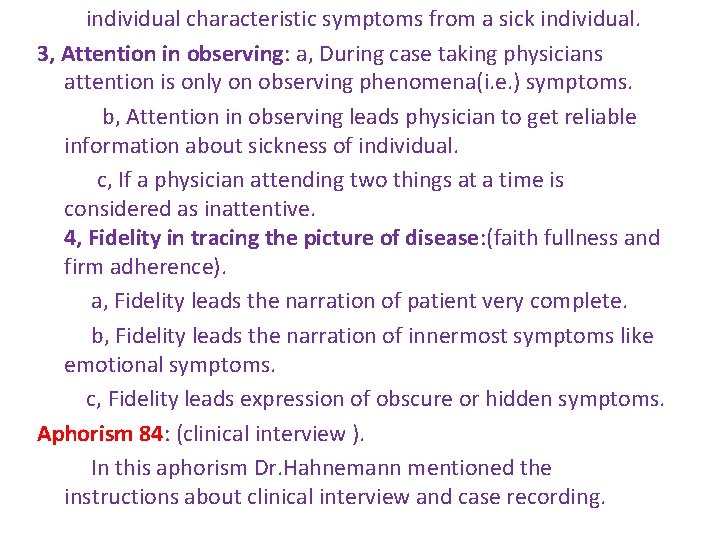
individual characteristic symptoms from a sick individual. 3, Attention in observing: a, During case taking physicians attention is only on observing phenomena(i. e. ) symptoms. b, Attention in observing leads physician to get reliable information about sickness of individual. c, If a physician attending two things at a time is considered as inattentive. 4, Fidelity in tracing the picture of disease: (faith fullness and firm adherence). a, Fidelity leads the narration of patient very complete. b, Fidelity leads the narration of innermost symptoms like emotional symptoms. c, Fidelity leads expression of obscure or hidden symptoms. Aphorism 84: (clinical interview ). In this aphorism Dr. Hahnemann mentioned the instructions about clinical interview and case recording.
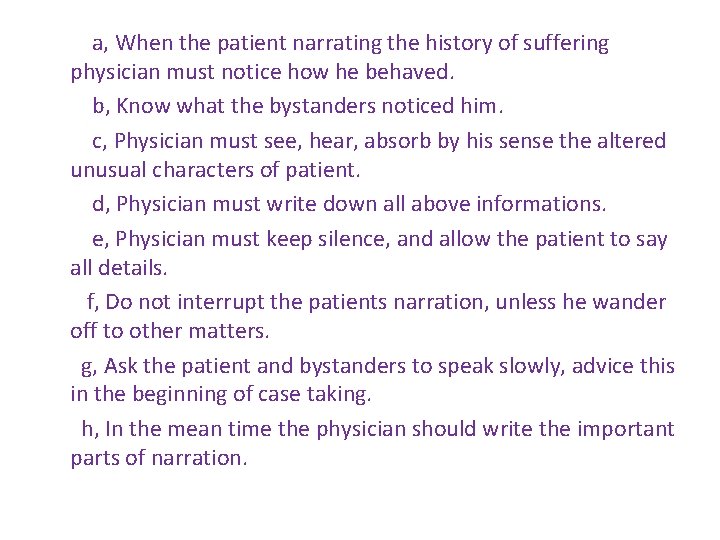
a, When the patient narrating the history of suffering physician must notice how he behaved. b, Know what the bystanders noticed him. c, Physician must see, hear, absorb by his sense the altered unusual characters of patient. d, Physician must write down all above informations. e, Physician must keep silence, and allow the patient to say all details. f, Do not interrupt the patients narration, unless he wander off to other matters. g, Ask the patient and bystanders to speak slowly, advice this in the beginning of case taking. h, In the mean time the physician should write the important parts of narration.
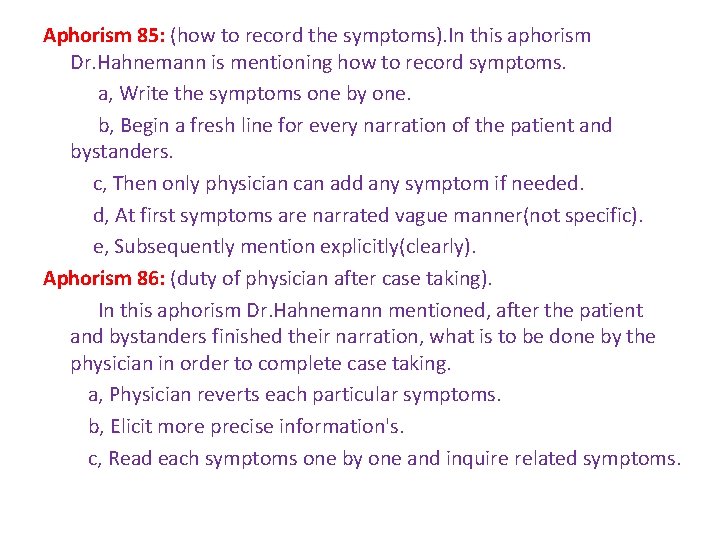
Aphorism 85: (how to record the symptoms). In this aphorism Dr. Hahnemann is mentioning how to record symptoms. a, Write the symptoms one by one. b, Begin a fresh line for every narration of the patient and bystanders. c, Then only physician can add any symptom if needed. d, At first symptoms are narrated vague manner(not specific). e, Subsequently mention explicitly(clearly). Aphorism 86: (duty of physician after case taking). In this aphorism Dr. Hahnemann mentioned, after the patient and bystanders finished their narration, what is to be done by the physician in order to complete case taking. a, Physician reverts each particular symptoms. b, Elicit more precise information's. c, Read each symptoms one by one and inquire related symptoms.
In this aphorism Dr. Hahnemann mentioned examples of precise details to be collected. What period did this symptom occur, is the symptom occurred before medication, or during taking medicine, only some days after leaving medicine, what kind of pain, what sensation exactly, was it occurred on this spot, where was precise spot, did the pain occur in first and by itself at various times, or it was continued with out intermission, how long did it lost, on what time of the day it was worse or ceased entirely. Like that way the symptoms are obtained elaboratedly. Aphorism 87: (question formulation). In this aphorism Dr. Hahnemann mentioned, on what way questions are formulated, during collecting precise information's about the symptoms narrated. Inorder to get the individualizing symptoms.
a, Framing the questions with out suggest the answer to the patient. b, If asked answer suggesting questions (leading questions or direct questions) patient will answer 'yes’ or ‘no’, avoid multiple choice questions. c, If such types of questions are formulated patient will say untrue, half true or not strictly correct symptoms, either from indolence (indisposed to activity) or to please(satisfy) his interrogator. d, From which we will get false picture of disease and an unsuitable mode of treatment results. Aphorism 88: (precise information of physical and mental generals). In this aphorism Dr. Hahnemann mentioned, in the voluntary details (i. e. ) the patient’s narration, if nothing has been mentioned respecting several facts or functions of the
body or mental state. It is the duty of the physician to collect precise information about the functions of the body, the state of his disposition and mind. a, In the patients narration physical generals and mental generals are not mentioned, notice it. b, Ask detaildly about the functions of the body, (i. e. ) physical general symptoms. c, Collect detailed mental general symptoms. d, In order to get the details physician must ask general questions. Aphorism 89 : (special questions). In this aphorism Dr. Hahnemann mentioned, after finishing the questioning of the physician and narrating answer by the patient, the physician will get perfect picture of the individual’s symptoms, after that what the physician have to do.
a, The physician must read the symptoms recorded. b, If the physician felt any lack in the information, and decided to get more information to complete the picture. c, The physician can ask precise and more special questions about sickness. Aphorism 90 : (physician’s observations) In this aphorism Dr. Hahnemann mentioned about physician’s observations and recording them. a, After obtaining subjective symptoms, physician should record the observations done by him from the patient. b, Physician should identify how much the physical findings are important in this patient. c, Physician should asses weather the physical findings are the part of disease condition or part of healthy state (constitution).
Aphorism 91: (chronic case under treatment) In this aphorism Dr. Hahnemann mentioned about the case taking and management of patient , those who previously under treatment or presently under treatment in chronic cases. a, If the patient is previously under treatment do not furnish the true picture of sickness. b, The symptoms appeared before treatment , and the symptoms appearing several days after the discontinuation of the treatment give us the original form of disease. c, If the patient is under treatment till the patient approaching the physician, leave the patient quite with out medicine for some days or administer some thing non medicinal substance , i. e. , placebo for some days. d, After few days the patient is under non medicinal substance or leave with out medicine, the original signs and
symptoms will reappear, which were present before medication. e, Now the physician will get, pure, permanent, uncontaminated symptoms of old affection and faith full picture of disease. Aphorism 92: (rapid course of disease under treatment) In this aphorism Dr. Hahnemann mentioned how to obtain symptoms from a rapid course of disease, i. e. , patient is under serious illness and is under medicinal treatment. a, Physician must content (satisfied) him self with observing the morbid condition which is at present time. b, The morbid condition may be due to the original disease or the medicine applied and or both, consider both the symptoms available. c, The combination of original disease symptoms and the symptoms appeared due to medicine applied is known as conjoint malady.
d, The symptoms and disease produced by the medicine used is dangerous than the original disease. e, So select a similimum remedy homoeopathically according to the totality of conjoint malady. Aphorism 93 : (obvious causes) In this aphorism Dr. Hahnemann mentioned about obtaining the symptoms and conditions in obvious cause , i. e. , symptoms of hidden nature. a, If the disease has been brought on a short time or in the case of chronic affection, affection is considerable time previously by some obvious cause, the patient and bystanders are interrogated or questioned privately. b, If privately and carefully interrogated they will mention spontaneously the hidden conditions.
Aphorism 94 : (enquiring chronic case) In this aphorism Dr. Hahnemann mentioned, while enquiring about chronic case , what are the circumstances of the individual to be considered. a, The individual’s occupation situation. b, Individual’s usual mode of living. c, Individual’s diet habit. d, Individual’s domestic situation. In order to identify the cause, which maintains the disease. By removing this recovery is possible. Aphorism 95 : (accessory symptoms are important) In this aphorism Dr. Hahnemann mentioned, during chronic disease investigation, minutest particulars and lesser accessory symptoms are ascertained clearly
a, In chronic case investigation minutest symptoms also to be elicited, because some times these symptoms are the characteristic individualizing symptoms of that sick individual. b, Due to long suffering the patient will not pay importance and attention to accessory symptoms. Accessory symptoms are importantly ascertained because they are useful in determining the choice of the remedy. c, The accessory symptoms may be lesser or greater deviations from the healthy state, but these may have connection with patient’s principal malady. Aphorism 96: (hypochondriac and sensitive patients) In this aphorism Dr. Hahnemann mentioned about hypochondriac (morbid anxiety about health) great sensitive patient (hyper sensitive) and impatient of suffering. a, Some patients themselves differ so much in narrating their disposition. Some may hypochondriac, others great
sensitive, and impatient of suffering. This type of patients exaggerate the expresions, inorder to attract physicians attention and induce them to provide relief. Aphorism 97 : (patients of opposite character) In this aphorism Dr. Hahnemann mentioned about the patient those who are having opposite character, they do not mention the sickness and symptoms properly. The patient will not mention their symptoms exactly because : a, Due to indolence (indisposed to activity or reduced activity). b, Due to false modesty (un necessary assuming). c, Due to mildness of disposition (not to trouble others by telling complaints).
d, Due to weakness of mind (lack of capacity to describe their complaints). e, Refrain (burden) from mentioning a number of their symptoms. f, Describe symptoms in vague terms (lacking sharpness) or allege (declare) some of them to be no consequence (less importance). Aphorism 98 : (patients narration are important and instructions to physician in chronic case taking). In this aphorism Dr. Hahnemann mentioned, provide more importance to patients description of suffering and sensations, in order to get complete symptom picture in chronic disease, what are things to be considered by the physician during case taking. a, Physician should listen particularly the patient’s description of suffering and sensations.
b, Credence (believe) the patient’s own expressions he endeavors (try hard) to make the physician to understand his ailments. c, The narration of patient’s friends and attendants usually altered and eronimously stated. In order to get complete picture, and peculiar symptoms Dr. Hahnemann demands the physician to adapt the following. a, Especial circumspection (looking around on all sides, watch fully and cautiously). b, Tact (keenness of understanding or peculiar skill in doing exactly what is required by circumstances). c, Knowledge of human nature. d, Caution (alarming) in conducting the inquiry. e, Patience in an eminent degree.
Aphorism 99 : (about acute disease) In this aphorism Dr. Hahnemann mentioned about investigation of acute disease. a, Acute diseases are existing a short time. b, Eliciting the symptoms in acute disease condition are easiest for the physician, because all the phenomena and deviations from health are very recent one. c, Because of the freshesness of symptoms it is freshly in the memory of the patient and bystanders still novel and striking one. d, In acute case also physician needs all details of deviation from health. e, But less inquiry is needed because the patient and bystanders spontaneously mention the symptoms because of its freshness.
Aphorism 100 : (epidemic and sporadic diseases) In this aphorism Dr. Hahnemann mentioned about how case taking is to be done in epidemic and sporadic diseases, even though they are previously known one. a, While investigating the totality of symptoms of epidemic and sporadic diseases, even though the similar disease condition are known by the world before, under the same name or any other name. If the peculiarity of the disease of that kind is not differ in treatment and examination. b, The physician must consider the prevailing the epidemic or sporadic disease presently as new and unknown one and investigate it thoroughly. c, While thoroughly investigating the prevailing epidemic or sporadic disease , physician must examine all it’s phases (cause, onset, course and end).
d, While examining the cases it shows the presently prevailing disease is unique in many respects and phenomena, and differing vastly from previous epidemics and sporadics. Aphorism 101 : (epidemic totality) In this aphorism Dr. Hahnemann mentioned on what way symptoms are obtained in epidemic disease in order to erecting epidemic totality. a, Physician will not get complete picture of a epidemic disease after examining single case. b, After closely observing several cases only he will get collective symptoms, and convert them in to totality. c, A carefully observing physician will arrive nearly the true state of a characteristic portrait in his mind after examining first and second patient and even succeed in finding out a suitable Homoeopathic remedy.
Aphorism 102 : (genus epidemicus) In this aphorism Dr. Hahnemann mentioned about how to select genus epidemicus. a, The physician will get complete symptom picture of an epidemic disease after examining several patients. b, From this symptom picture physician will get characteristic features, general symptoms, and marked rare and peculiar symptoms, these will collectively form the characteristics of this malady and totality of symptoms and selection of most suitable Homoeopathic remedy. c, In epidemic diseases totality of symptom cannot be obtained from single patient, but ascertained from the sufferings of several patients of different constitutions and age groups.
Aphorism 103: (obtaining miasmatic totality and anti miasmatic remedy) In this aphorism Dr. Hahnemann mentioned how the symptoms are obtained for miasmatic totality and anti miasmatic remedy. a, Like wise the epidemic disease, which is having acute character. The chronic maladies also ascertained. b, If consider the miasmatic condition psora , if we study a single patient we will get the partial picture of psora. c, In order to get exact picture of psora, and the whole sphere of symptoms , the symptoms were collected from several patients of same malady. The each and every individual patient express their own peculiarity. d, The peculiarities collected from each and every individual collectively form the total true picture of the chronic malady especially psora , and help in selecting the
Homoeopathic medicine capable of curing the same malady psora (i. e) antipsoric remedy. Aphorism 104 : (erecting the totality or portrait, selecting the similimum, application of similimum and follow up treatment) In this aphorism Dr. Hahnemann mentioned about obtaining the totality or portrait of the case, how to select the similimum, application of the similimum remedy, and follow up treatment. a, During case taking, by carefull investigation physician will get the relevant data of the particular sick individualize, the picture of disease. By this the most difficult task was over. b, If it is a chronic disease condition , analyze and evaluate the relevant datas obtained , then only the physician can pick up characteristic symptoms which are needed to erect totality.
c, Using the above totality physician can select a suitable most similimum Homoeopathic remedy. d, During treatment i. e. , after application of homoeopathic remedy, ascertain the effect of the medicine applied and note the changes occurred in the patient’s state after stipulated period. e. During follow up visit examination of the patient is done as a fresh one, and strike out the symptoms which were ameliorated from the list, i. e, case record and mark what still remaining. Add any new symptoms appeared. THANK YOU