
Mock Research Ethics Board Engaging Students Chandra Kavanagh
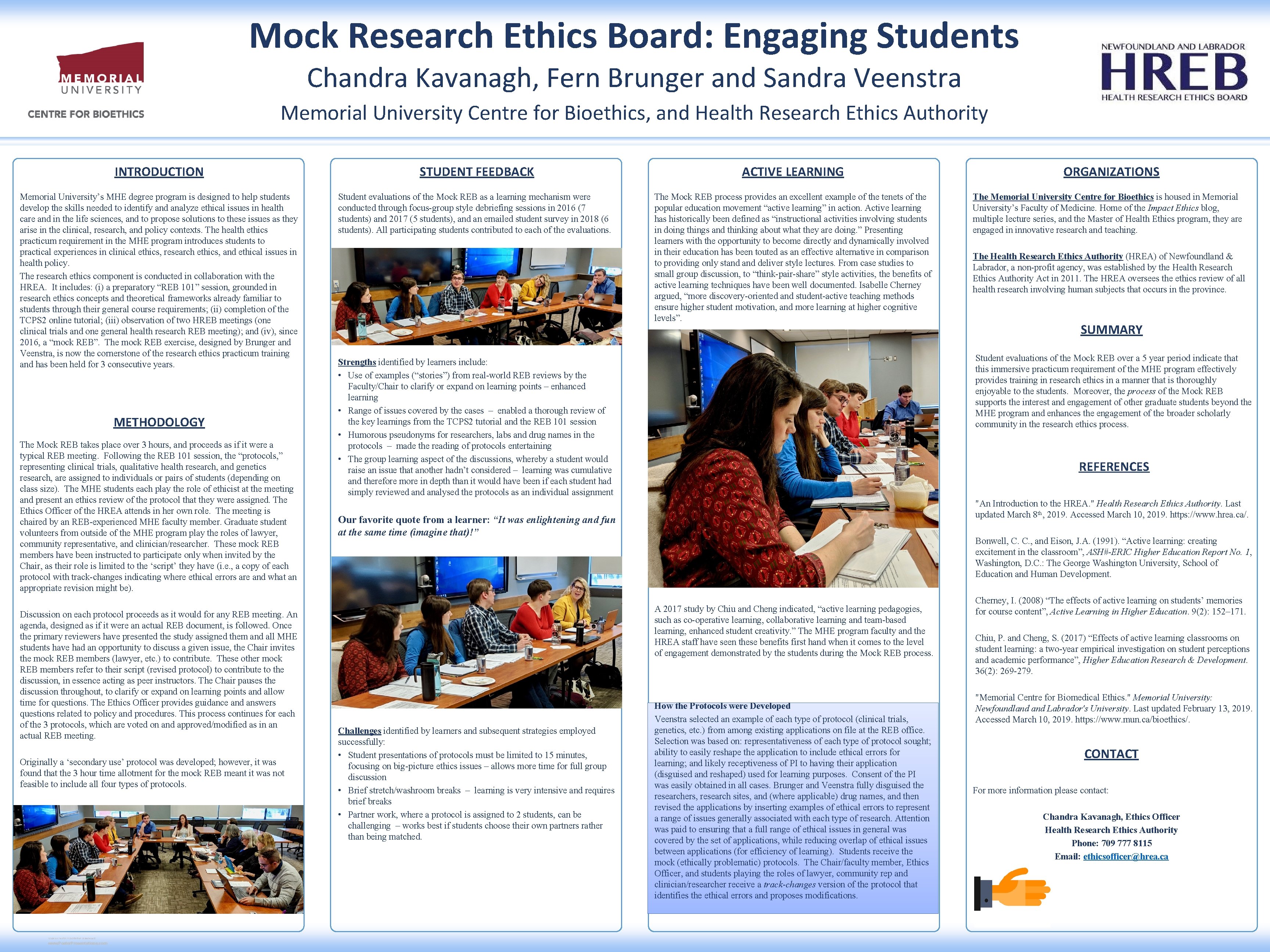
Mock Research Ethics Board: Engaging Students Chandra Kavanagh, Fern Brunger and Sandra Veenstra Memorial University Centre for Bioethics, and Health Research Ethics Authority INTRODUCTION STUDENT FEEDBACK ACTIVE LEARNING ORGANIZATIONS Memorial University’s MHE degree program is designed to help students develop the skills needed to identify and analyze ethical issues in health care and in the life sciences, and to propose solutions to these issues as they arise in the clinical, research, and policy contexts. The health ethics practicum requirement in the MHE program introduces students to practical experiences in clinical ethics, research ethics, and ethical issues in health policy. The research ethics component is conducted in collaboration with the HREA. It includes: (i) a preparatory “REB 101” session, grounded in research ethics concepts and theoretical frameworks already familiar to students through their general course requirements; (ii) completion of the TCPS 2 online tutorial; (iii) observation of two HREB meetings (one clinical trials and one general health research REB meeting); and (iv), since 2016, a “mock REB”. The mock REB exercise, designed by Brunger and Veenstra, is now the cornerstone of the research ethics practicum training and has been held for 3 consecutive years. Student evaluations of the Mock REB as a learning mechanism were conducted through focus-group style debriefing sessions in 2016 (7 students) and 2017 (5 students), and an emailed student survey in 2018 (6 students). All participating students contributed to each of the evaluations. The Mock REB process provides an excellent example of the tenets of the popular education movement “active learning” in action. Active learning has historically been defined as “instructional activities involving students in doing things and thinking about what they are doing. ” Presenting learners with the opportunity to become directly and dynamically involved in their education has been touted as an effective alternative in comparison to providing only stand deliver style lectures. From case studies to small group discussion, to “think-pair-share” style activities, the benefits of active learning techniques have been well documented. Isabelle Cherney argued, “more discovery-oriented and student-active teaching methods ensure higher student motivation, and more learning at higher cognitive levels”. The Memorial University Centre for Bioethics is housed in Memorial University’s Faculty of Medicine. Home of the Impact Ethics blog, multiple lecture series, and the Master of Health Ethics program, they are engaged in innovative research and teaching. The Health Research Ethics Authority (HREA) of Newfoundland & Labrador, a non-profit agency, was established by the Health Research Ethics Authority Act in 2011. The HREA oversees the ethics review of all health research involving human subjects that occurs in the province. METHODOLOGY The Mock REB takes place over 3 hours, and proceeds as if it were a typical REB meeting. Following the REB 101 session, the “protocols, ” representing clinical trials, qualitative health research, and genetics research, are assigned to individuals or pairs of students (depending on class size). The MHE students each play the role of ethicist at the meeting and present an ethics review of the protocol that they were assigned. The Ethics Officer of the HREA attends in her own role. The meeting is chaired by an REB-experienced MHE faculty member. Graduate student volunteers from outside of the MHE program play the roles of lawyer, community representative, and clinician/researcher. These mock REB members have been instructed to participate only when invited by the Chair, as their role is limited to the ‘script’ they have (i. e. , a copy of each protocol with track-changes indicating where ethical errors are and what an appropriate revision might be). Discussion on each protocol proceeds as it would for any REB meeting. An agenda, designed as if it were an actual REB document, is followed. Once the primary reviewers have presented the study assigned them and all MHE students have had an opportunity to discuss a given issue, the Chair invites the mock REB members (lawyer, etc. ) to contribute. These other mock REB members refer to their script (revised protocol) to contribute to the discussion, in essence acting as peer instructors. The Chair pauses the discussion throughout, to clarify or expand on learning points and allow time for questions. The Ethics Officer provides guidance and answers questions related to policy and procedures. This process continues for each of the 3 protocols, which are voted on and approved/modified as in an actual REB meeting. Originally a ‘secondary use’ protocol was developed; however, it was found that the 3 hour time allotment for the mock REB meant it was not feasible to include all four types of protocols. RESEARCH POSTER PRESENTATION DESIGN © 2015 www. Poster. Presentations. com Student evaluations of the Mock REB over a 5 year period indicate that this immersive practicum requirement of the MHE program effectively provides training in research ethics in a manner that is thoroughly enjoyable to the students. Moreover, the process of the Mock REB supports the interest and engagement of other graduate students beyond the MHE program and enhances the engagement of the broader scholarly community in the research ethics process. Strengths identified by learners include: • Use of examples (“stories”) from real-world REB reviews by the Faculty/Chair to clarify or expand on learning points – enhanced learning • Range of issues covered by the cases – enabled a thorough review of the key learnings from the TCPS 2 tutorial and the REB 101 session • Humorous pseudonyms for researchers, labs and drug names in the protocols – made the reading of protocols entertaining • The group learning aspect of the discussions, whereby a student would raise an issue that another hadn’t considered – learning was cumulative and therefore more in depth than it would have been if each student had simply reviewed analysed the protocols as an individual assignment REFERENCES Our favorite quote from a learner: “It was enlightening and fun at the same time (imagine that)!” A 2017 study by Chiu and Cheng indicated, “active learning pedagogies, such as co-operative learning, collaborative learning and team-based learning, enhanced student creativity. ” The MHE program faculty and the HREA staff have seen these benefits first hand when it comes to the level of engagement demonstrated by the students during the Mock REB process. Challenges identified by learners and subsequent strategies employed successfully: • Student presentations of protocols must be limited to 15 minutes, focusing on big-picture ethics issues – allows more time for full group discussion • Brief stretch/washroom breaks – learning is very intensive and requires brief breaks • Partner work, where a protocol is assigned to 2 students, can be challenging – works best if students choose their own partners rather than being matched. SUMMARY How the Protocols were Developed Veenstra selected an example of each type of protocol (clinical trials, genetics, etc. ) from among existing applications on file at the REB office. Selection was based on: representativeness of each type of protocol sought; ability to easily reshape the application to include ethical errors for learning; and likely receptiveness of PI to having their application (disguised and reshaped) used for learning purposes. Consent of the PI was easily obtained in all cases. Brunger and Veenstra fully disguised the researchers, research sites, and (where applicable) drug names, and then revised the applications by inserting examples of ethical errors to represent a range of issues generally associated with each type of research. Attention was paid to ensuring that a full range of ethical issues in general was covered by the set of applications, while reducing overlap of ethical issues between applications (for efficiency of learning). Students receive the mock (ethically problematic) protocols. The Chair/faculty member, Ethics Officer, and students playing the roles of lawyer, community rep and clinician/researcher receive a track-changes version of the protocol that identifies the ethical errors and proposes modifications. "An Introduction to the HREA. " Health Research Ethics Authority. Last updated March 8 th, 2019. Accessed March 10, 2019. https: //www. hrea. ca/. Bonwell, C. C. , and Eison, J. A. (1991). “Active learning: creating excitement in the classroom”, ASH#-ERIC Higher Education Report No. 1, Washington, D. C. : The George Washington University, School of Education and Human Development. Cherney, I. (2008) “The effects of active learning on students’ memories for course content”, Active Learning in Higher Education. 9(2): 152– 171. Chiu, P. and Cheng, S. (2017) “Effects of active learning classrooms on student learning: a two-year empirical investigation on student perceptions and academic performance”, Higher Education Research & Development. 36(2): 269 -279. "Memorial Centre for Biomedical Ethics. " Memorial University: Newfoundland Labrador's University. Last updated February 13, 2019. Accessed March 10, 2019. https: //www. mun. ca/bioethics/. CONTACT For more information please contact: Chandra Kavanagh, Ethics Officer Health Research Ethics Authority Phone: 709 777 8115 Email: ethicsofficer@hrea. ca
- Slides: 1