ATI R 3 x 0 Pixel Shaders Jason
- Slides: 35
ATI R 3 x 0 Pixel Shaders Jason L. Mitchell 3 D Application Research Group Lead ATI Research
Outline • Architectural Overview – Vertex & Pixel • Focus on pixel shader – Precision – Co-issue – Case Study: Real-time Überlight • Choosing correct frequency of evaluation • Vectorizing ATI R 3 x 0 Pixel Shaders - SIGGRAPH 2003 Hardware Shading Course
R 3 x 0 Shaders • Vertex Shader – Longer programs than previous generation – Static flow control • Pixel Shader – Floating point – Longer programs than previous generation ATI R 3 x 0 Pixel Shaders - SIGGRAPH 2003 Hardware Shading Course
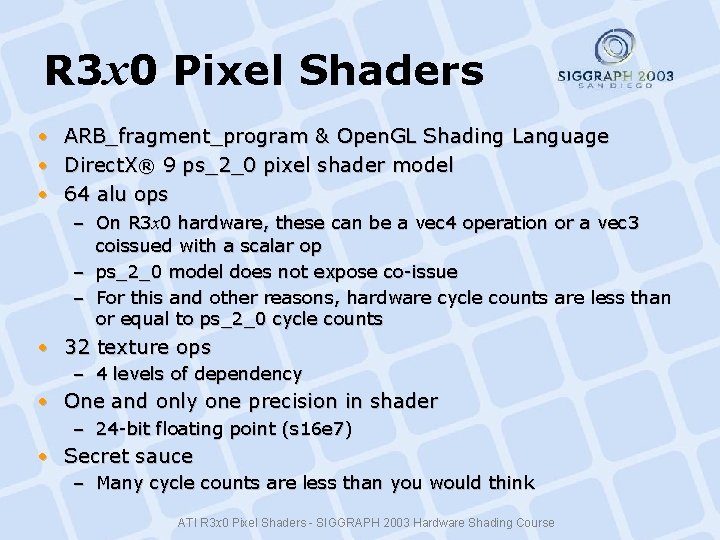
R 3 x 0 Pixel Shaders • • • ARB_fragment_program & Open. GL Shading Language Direct. X® 9 ps_2_0 pixel shader model 64 alu ops – On R 3 x 0 hardware, these can be a vec 4 operation or a vec 3 coissued with a scalar op – ps_2_0 model does not expose co-issue – For this and other reasons, hardware cycle counts are less than or equal to ps_2_0 cycle counts • 32 texture ops – 4 levels of dependency • One and only one precision in shader – 24 -bit floating point (s 16 e 7) • Secret sauce – Many cycle counts are less than you would think ATI R 3 x 0 Pixel Shaders - SIGGRAPH 2003 Hardware Shading Course
Why retain co-issue? • Engineering answer – Scalar and vec 3 operations are common – Allows us to do some vectorization of scalar code • Marketing answer – In the marketplace, a new chip must not only be the best at new features but speed up old ones – Co-issue is out there • Used often by shipping games and must not run slower on new hardware than on old • Microsoft High Level Shading Language (HLSL) compiler does a good job of generating co-issue when compiling for legacy shader models, hence co-issue will continue to be used for those models ATI R 3 x 0 Pixel Shaders - SIGGRAPH 2003 Hardware Shading Course
Precision • Single 24 -bit floating point data format for the pixel pipeline • Classic speed and die-area tradeoff • Interpolated texture coordinates are higher precision but everything else operates at this one specific precision • Programmers don’t have to worry about datatypes with varying precision and performance characteristics – Just high performance all the time • Having a single hardware model used to support all pixel shading models significantly simplifies the driver: – Legacy multitexture – Direct. X 8. x pixel shading – Direct. X 9 pixel shading ATI R 3 x 0 Pixel Shaders - SIGGRAPH 2003 Hardware Shading Course
Überlight • Will now illustrate the value of these architectural properties with an example: Überlight – Intuitive enough to cover here – Complex enough to be interesting – Scalar-heavy but vectorizable – Requires reasonable precision ATI R 3 x 0 Pixel Shaders - SIGGRAPH 2003 Hardware Shading Course
What is Überlight? • Intuitive light described by Ronen Barzel in “Lighting Controls for Computer Cinematography” in the Journal of Graphics Tools, vol. 2, no. 1: 1 -20 • See also Chapter 14 in Advanced Render. Man® by Apodaca and Gritz • Überlight is procedural and has many intuitive controls: – light type, intensity, light color, cuton, cutoff, near edge, falloff, falloff distance, max intensity, parallel rays, shearx, sheary, width, height, width edge, height edge, roundness and beam distribution • There’s a good Render. Man® sl version in the public domain written by Larry Gritz ATI R 3 x 0 Pixel Shaders - SIGGRAPH 2003 Hardware Shading Course
Überlight Overview • For each light – Transform P to light space – Smooth clip to procedural volume • Near, far and nested superellipses – Distance falloff – Beam distribution – Ray direction – Blockers – Projective textures • Shadow, noise & cookies • Today, I’ll talk about one light and ignore blockers ATI R 3 x 0 Pixel Shaders - SIGGRAPH 2003 Hardware Shading Course
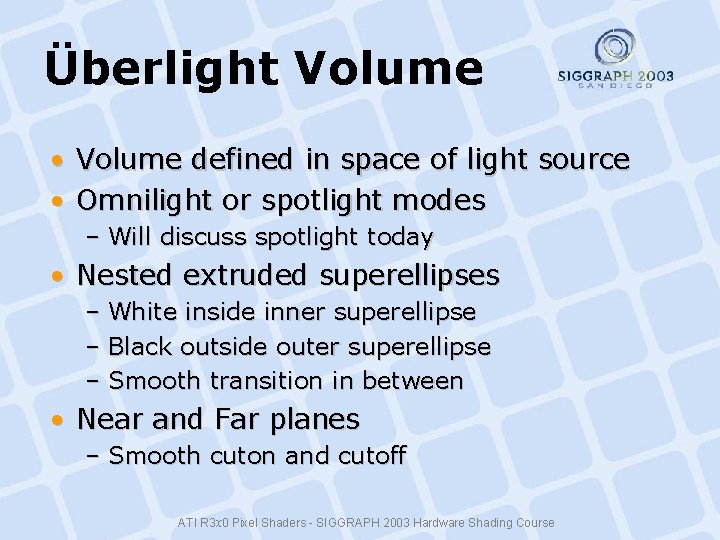
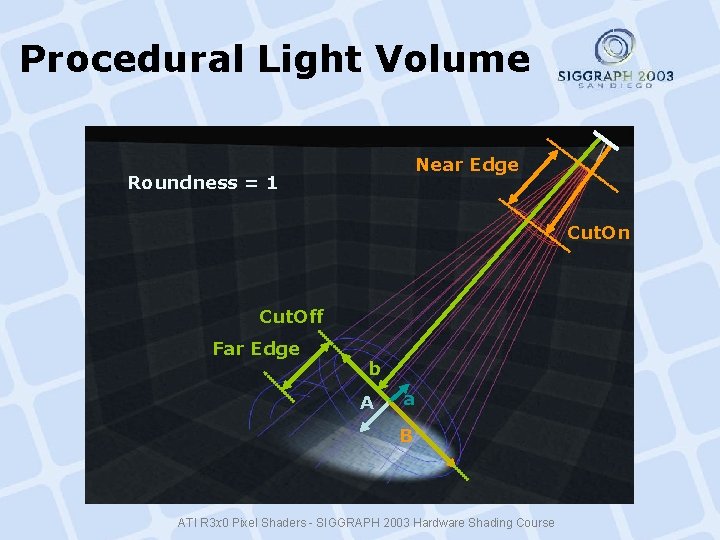
Überlight Volume • Volume defined in space of light source • Omnilight or spotlight modes – Will discuss spotlight today • Nested extruded superellipses – White inside inner superellipse – Black outside outer superellipse – Smooth transition in between • Near and Far planes – Smooth cuton and cutoff ATI R 3 x 0 Pixel Shaders - SIGGRAPH 2003 Hardware Shading Course
Procedural Light Volume Near Edge Roundness = 1 Cut. On Cut. Off Far Edge b A a B ATI R 3 x 0 Pixel Shaders - SIGGRAPH 2003 Hardware Shading Course
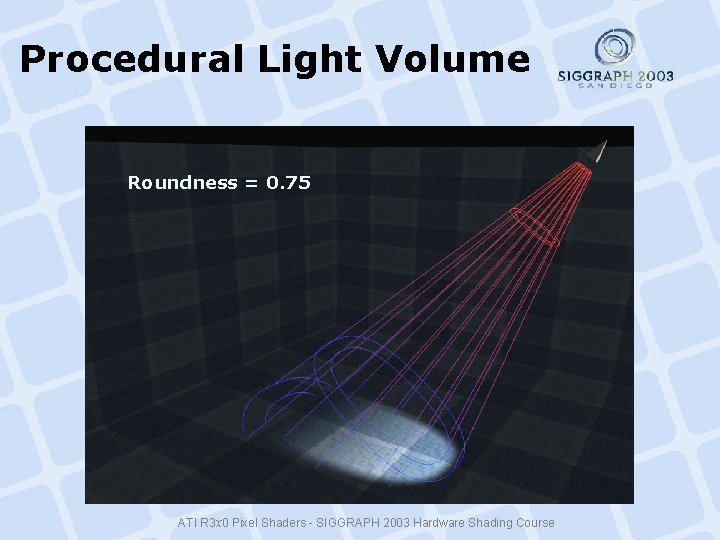
Procedural Light Volume Roundness = 0. 75 ATI R 3 x 0 Pixel Shaders - SIGGRAPH 2003 Hardware Shading Course
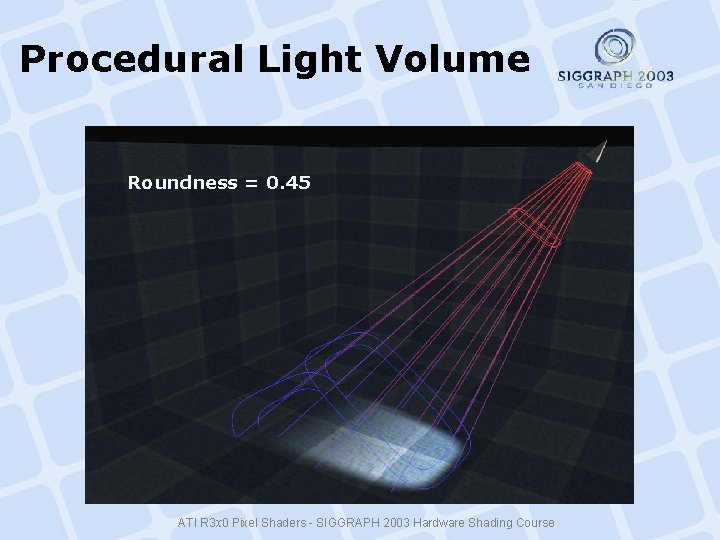
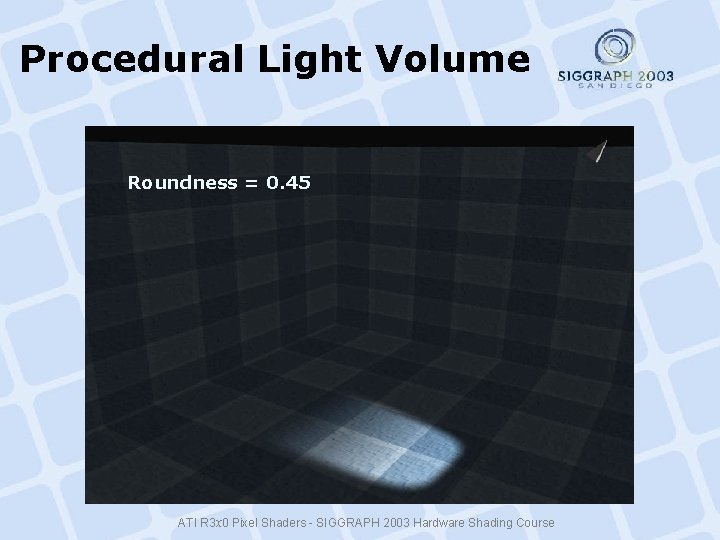
Procedural Light Volume Roundness = 0. 45 ATI R 3 x 0 Pixel Shaders - SIGGRAPH 2003 Hardware Shading Course
Procedural Light Volume Roundness = 0. 45 ATI R 3 x 0 Pixel Shaders - SIGGRAPH 2003 Hardware Shading Course
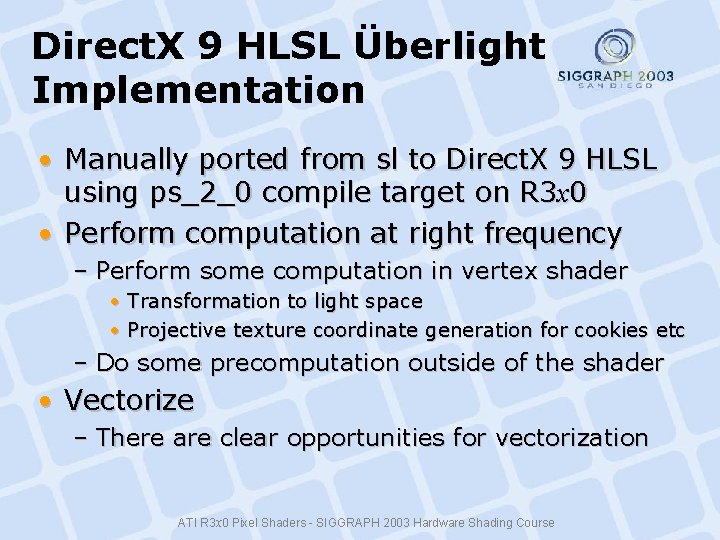
Direct. X 9 HLSL Überlight Implementation • Manually ported from sl to Direct. X 9 HLSL using ps_2_0 compile target on R 3 x 0 • Perform computation at right frequency – Perform some computation in vertex shader • Transformation to light space • Projective texture coordinate generation for cookies etc – Do some precomputation outside of the shader • Vectorize – There are clear opportunities for vectorization ATI R 3 x 0 Pixel Shaders - SIGGRAPH 2003 Hardware Shading Course
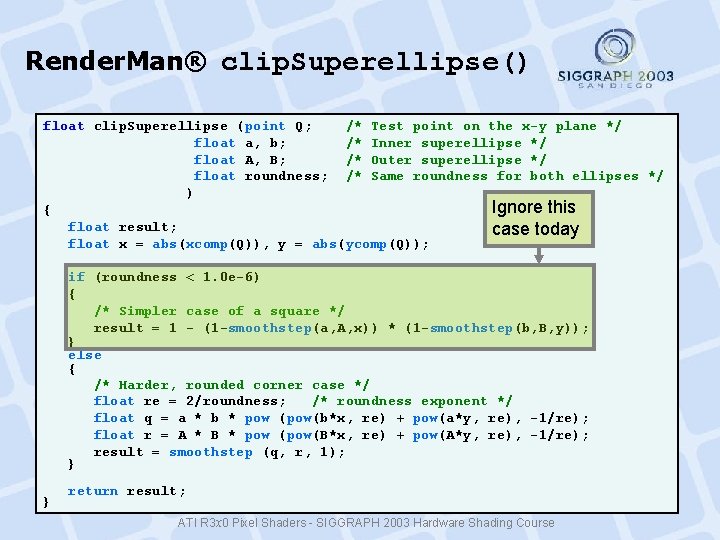
Render. Man® clip. Superellipse() float clip. Superellipse (point Q; /* Test point on the x-y plane */ float a, b; /* Inner superellipse */ float A, B; /* Outer superellipse */ float roundness; /* Same roundness for both ellipses */ ) Ignore this { float result; case today float x = abs(xcomp(Q)), y = abs(ycomp(Q)); if (roundness < 1. 0 e-6) { /* Simpler case of a square */ result = 1 - (1 -smoothstep(a, A, x)) * (1 -smoothstep(b, B, y)); } else { /* Harder, rounded corner case */ float re = 2/roundness; /* roundness exponent */ float q = a * b * pow (pow(b*x, re) + pow(a*y, re), -1/re); float r = A * B * pow (pow(B*x, re) + pow(A*y, re), -1/re); result = smoothstep (q, r, 1); } } return result; ATI R 3 x 0 Pixel Shaders - SIGGRAPH 2003 Hardware Shading Course
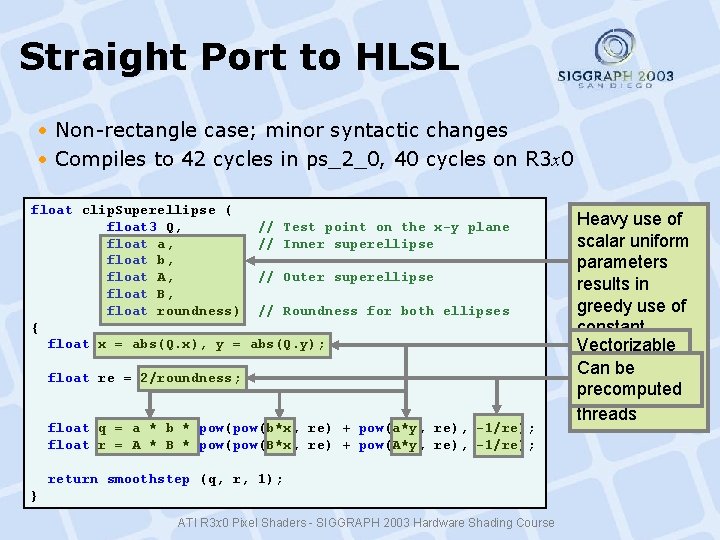
Straight Port to HLSL • Non-rectangle case; minor syntactic changes • Compiles to 42 cycles in ps_2_0, 40 cycles on R 3 x 0 float clip. Superellipse ( float 3 Q, // Test point on the x-y plane float a, // Inner superellipse float b, float A, // Outer superellipse float B, float roundness) // Roundness for both ellipses { float x = abs(Q. x), y = abs(Q. y); float re = 2/roundness; float q = a * b * pow(b*x, re) + pow(a*y, re), -1/re); float r = A * B * pow(B*x, re) + pow(A*y, re), -1/re); return smoothstep (q, r, 1); } ATI R 3 x 0 Pixel Shaders - SIGGRAPH 2003 Hardware Shading Course Heavy use of scalar uniform parameters results in greedy use of constant Vectorizable registers, Can be number limiting precomputed of active threads
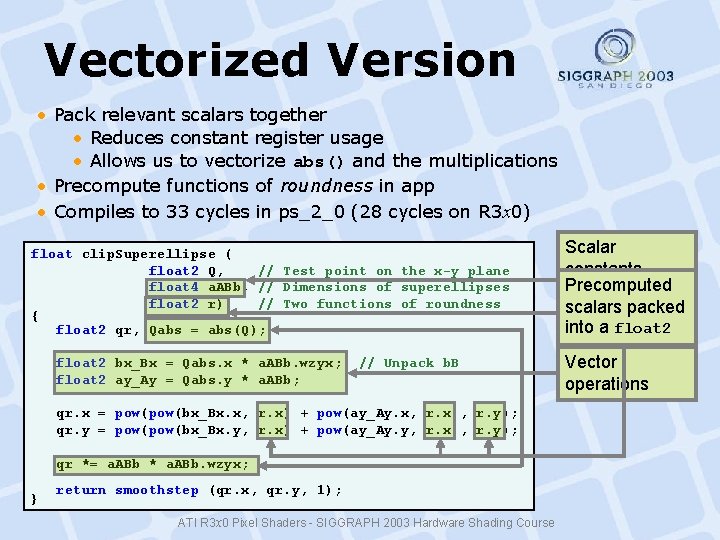
Vectorized Version • Pack relevant scalars together • Reduces constant register usage • Allows us to vectorize abs() and the multiplications • Precompute functions of roundness in app • Compiles to 33 cycles in ps_2_0 (28 cycles on R 3 x 0) float clip. Superellipse ( float 2 Q, // Test point on the x-y plane float 4 a. ABb, // Dimensions of superellipses float 2 r) // Two functions of roundness { float 2 qr, Qabs = abs(Q); float 2 bx_Bx = Qabs. x * a. ABb. wzyx; float 2 ay_Ay = Qabs. y * a. ABb; // Unpack b. B qr. x = pow(bx_Bx. x, r. x) + pow(ay_Ay. x, r. x), r. y); qr. y = pow(bx_Bx. y, r. x) + pow(ay_Ay. y, r. x), r. y); qr *= a. ABb * a. ABb. wzyx; } return smoothstep (qr. x, qr. y, 1); ATI R 3 x 0 Pixel Shaders - SIGGRAPH 2003 Hardware Shading Course Scalar constants Precomputed packed scalars togetherpacked into a float 2 Note the Vector ordering operations
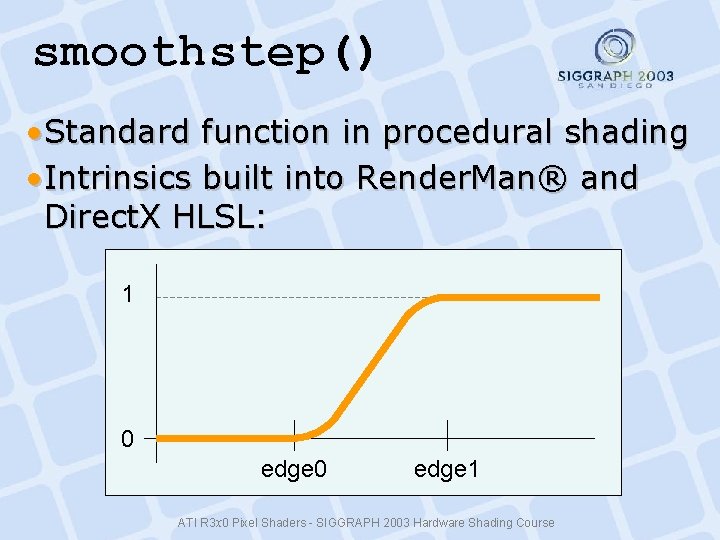
smoothstep() • Standard function in procedural shading • Intrinsics built into Render. Man® and Direct. X HLSL: 1 0 edge 1 ATI R 3 x 0 Pixel Shaders - SIGGRAPH 2003 Hardware Shading Course
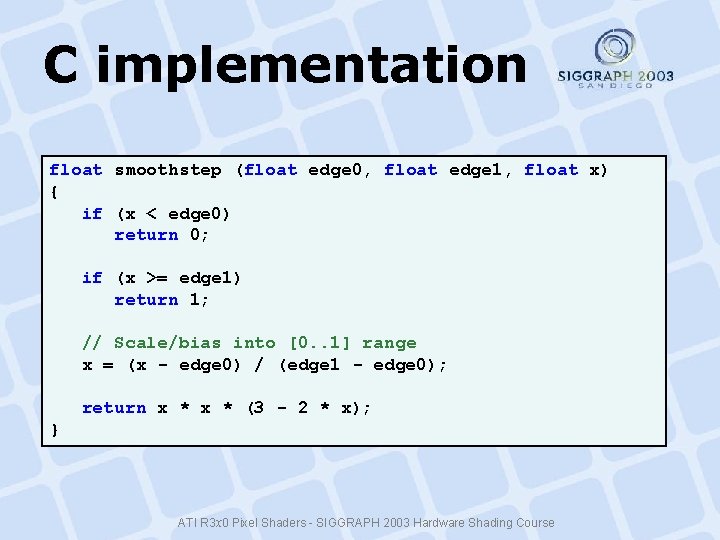
C implementation float smoothstep (float edge 0, float edge 1, float x) { if (x < edge 0) return 0; if (x >= edge 1) return 1; // Scale/bias into [0. . 1] range x = (x - edge 0) / (edge 1 - edge 0); return x * (3 - 2 * x); } ATI R 3 x 0 Pixel Shaders - SIGGRAPH 2003 Hardware Shading Course
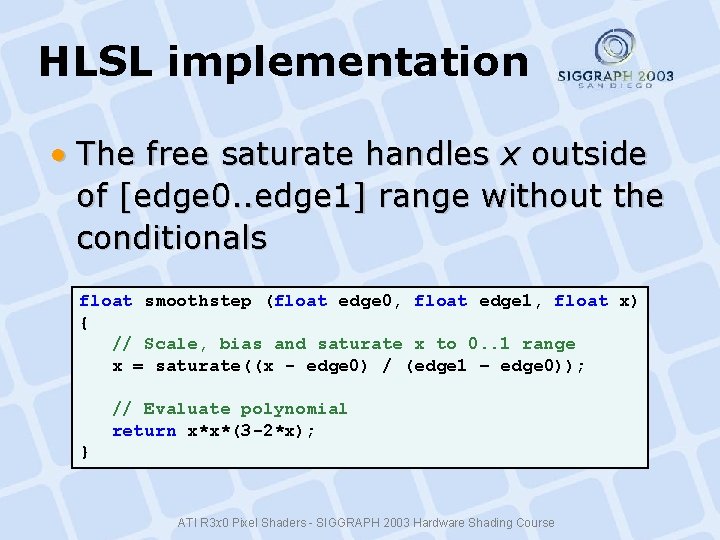
HLSL implementation • The free saturate handles x outside of [edge 0. . edge 1] range without the conditionals float smoothstep (float edge 0, float edge 1, float x) { // Scale, bias and saturate x to 0. . 1 range x = saturate((x - edge 0) / (edge 1 – edge 0)); // Evaluate polynomial return x*x*(3 -2*x); } ATI R 3 x 0 Pixel Shaders - SIGGRAPH 2003 Hardware Shading Course
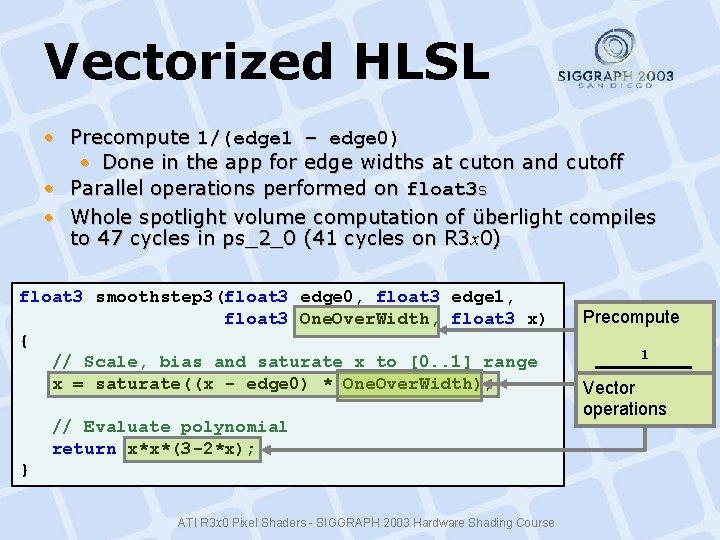
Vectorized HLSL • Precompute 1/(edge 1 – edge 0) • Done in the app for edge widths at cuton and cutoff • Parallel operations performed on float 3 s • Whole spotlight volume computation of überlight compiles to 47 cycles in ps_2_0 (41 cycles on R 3 x 0) float 3 smoothstep 3(float 3 edge 0, float 3 edge 1, float 3 One. Over. Width, float 3 x) { // Scale, bias and saturate x to [0. . 1] range x = saturate((x - edge 0) * One. Over. Width); // Evaluate polynomial return x*x*(3 -2*x); } ATI R 3 x 0 Pixel Shaders - SIGGRAPH 2003 Hardware Shading Course Precompute 1 (edge 1–edge 0) Vector operations
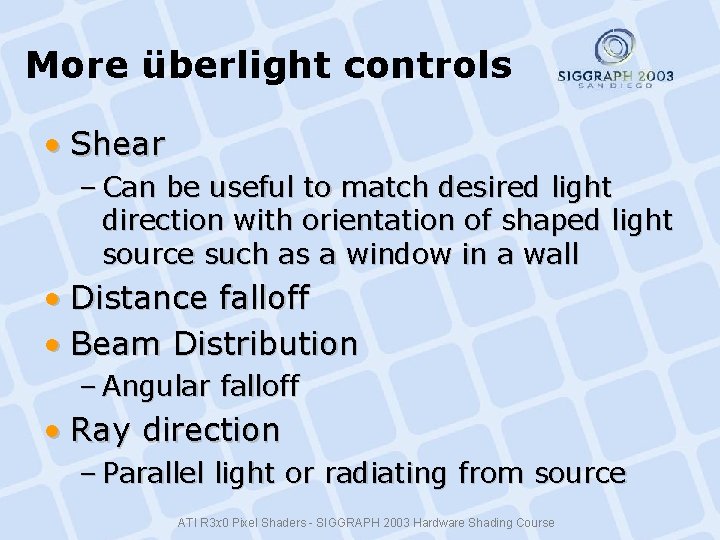
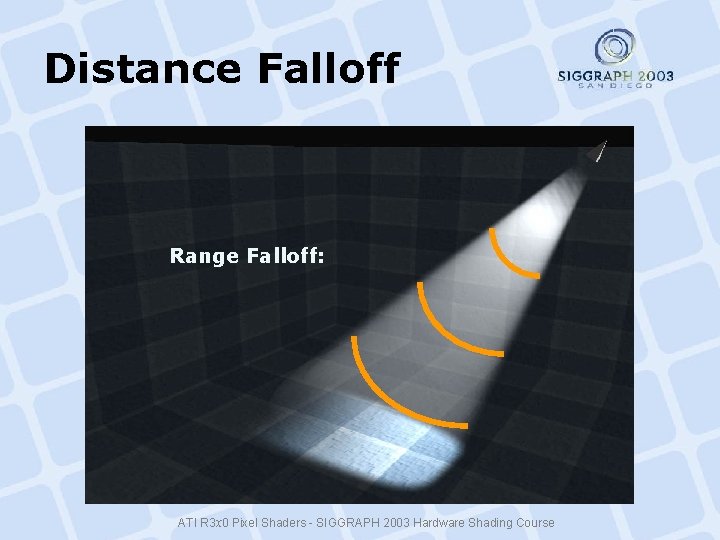
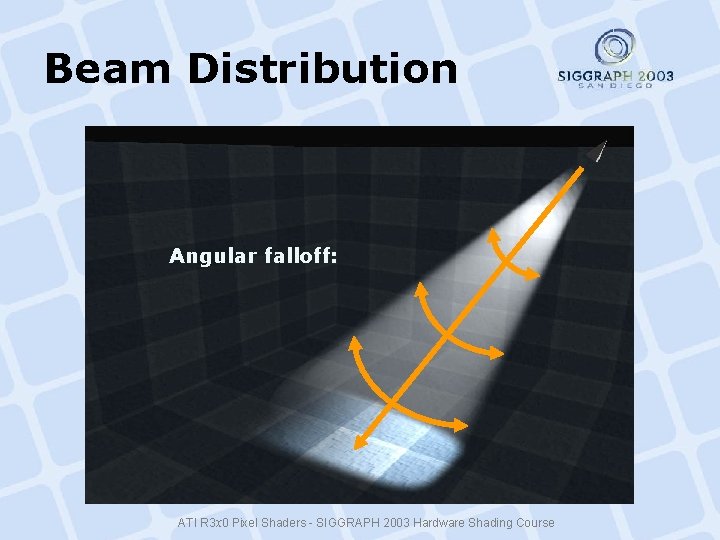
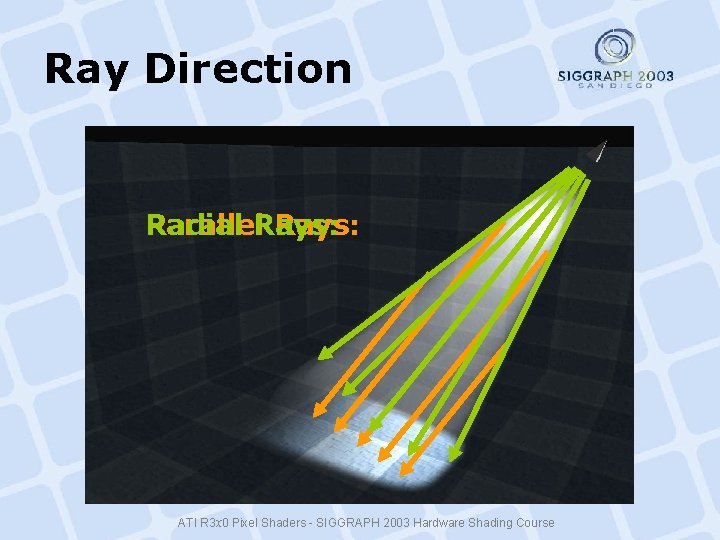
More überlight controls • Shear – Can be useful to match desired light direction with orientation of shaped light source such as a window in a wall • Distance falloff • Beam Distribution – Angular falloff • Ray direction – Parallel light or radiating from source ATI R 3 x 0 Pixel Shaders - SIGGRAPH 2003 Hardware Shading Course
Distance Falloff Range Falloff: ATI R 3 x 0 Pixel Shaders - SIGGRAPH 2003 Hardware Shading Course
Beam Distribution Angular falloff: ATI R 3 x 0 Pixel Shaders - SIGGRAPH 2003 Hardware Shading Course
Ray Direction Parallel. Rays: Radial Rays: ATI R 3 x 0 Pixel Shaders - SIGGRAPH 2003 Hardware Shading Course
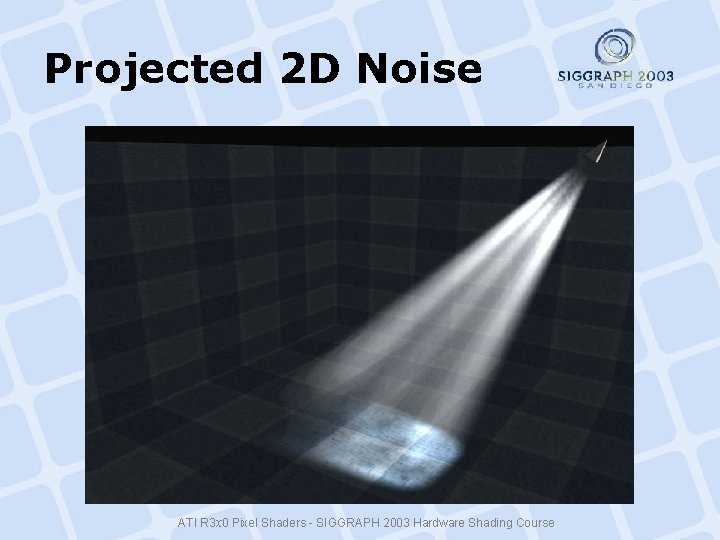
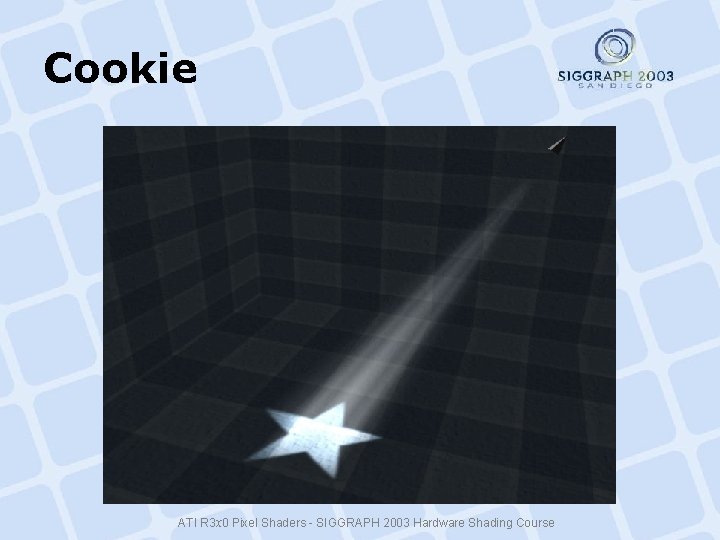
Projective Textures • Cookie, noise and shadow map • Generate projective texture coordinates in vertex shader • Do projective texture loads in pixel shader • Modulate with überlight intensity ATI R 3 x 0 Pixel Shaders - SIGGRAPH 2003 Hardware Shading Course
Projected 2 D Noise ATI R 3 x 0 Pixel Shaders - SIGGRAPH 2003 Hardware Shading Course
Cookie ATI R 3 x 0 Pixel Shaders - SIGGRAPH 2003 Hardware Shading Course
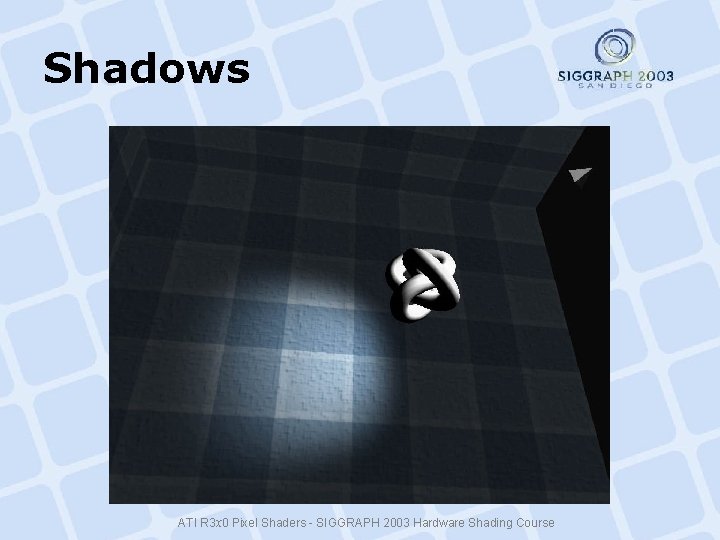
Shadows ATI R 3 x 0 Pixel Shaders - SIGGRAPH 2003 Hardware Shading Course
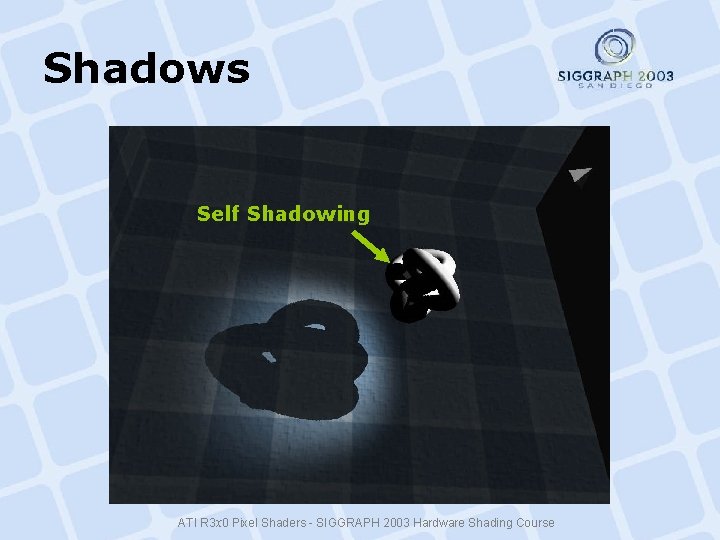
Shadows Self Shadowing ATI R 3 x 0 Pixel Shaders - SIGGRAPH 2003 Hardware Shading Course
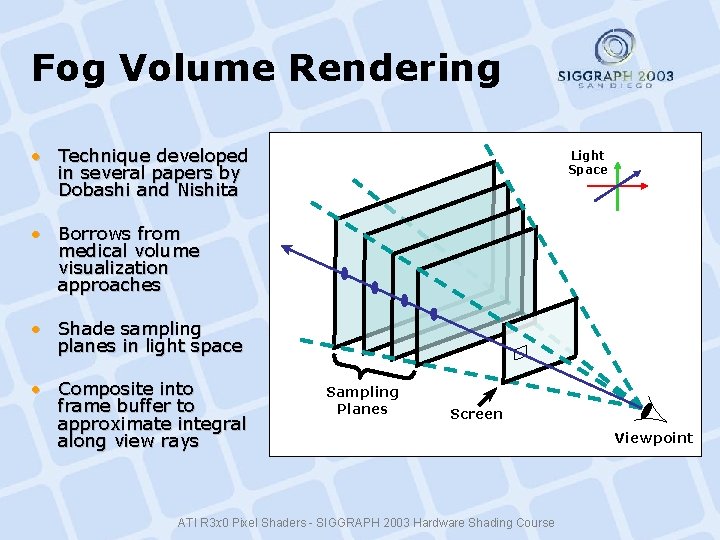
Fog Volume Rendering • Technique developed in several papers by Dobashi and Nishita Light Space • Borrows from medical volume visualization approaches • Shade sampling planes in light space • Composite into frame buffer to approximate integral along view rays Sampling Planes Screen ATI R 3 x 0 Pixel Shaders - SIGGRAPH 2003 Hardware Shading Course Viewpoint
Sampling Planes • Shaded in light space – Project cookies as in Dobashi papers – Run shader like überlight • Parallel to view plane • Vertex shader stretches them to fill viewspace bounding box of light frustum • Clipped to light frustum with user clip planes – Absolutely required due to extreme fill demands ATI R 3 x 0 Pixel Shaders - SIGGRAPH 2003 Hardware Shading Course
Summary • Focused on R 3 x 0 pixel shader – Illustrated architectural properties with real-time überlight implementation – As a side effect, gave some tips on how to write HLSL that generates efficient code – Rendered shafts of light through participating medium in order to illustrate some of the überlight controls • Will put demo app online at some point ATI R 3 x 0 Pixel Shaders - SIGGRAPH 2003 Hardware Shading Course
References • [Barzel 97] Ronen Barzel, “Lighting Controls for Computer Cinematography” in the Journal of Graphics Tools, vol. 2, no. 1: 1 -20 • [Dobashi 02] Yoshinori Dobashi, Tsuyoshi Yamamoto and Tomoyuki Nishita, “Interactive Rendering of Atmospheric Scattering Effects Using Graphics Hardware, ” Graphics Hardware 2002. ATI R 3 x 0 Pixel Shaders - SIGGRAPH 2003 Hardware Shading Course