
Creating Clarity about Clinical Judgment Nursing Actions and
Creating Clarity about Clinical Judgment: Nursing Actions and Measurable Indicators Sheryl Sommer Ph. D, RN, CNE Christine Mills, Ph. D
Objectives § Discuss the role of clinical judgment in the provision of safe, quality client care. § Examine the clinical judgment process. § Discuss results and implications of a Clinical Judgment Survey including nursing actions and measurable indicators. § Explore ways to integrate clinical judgment into nursing classes and clinical experiences. 2 Copyright © 2019 Assessment Technologies Institute, LLC. All rights reserved. Copying is not permitted without express written permission of ATI.
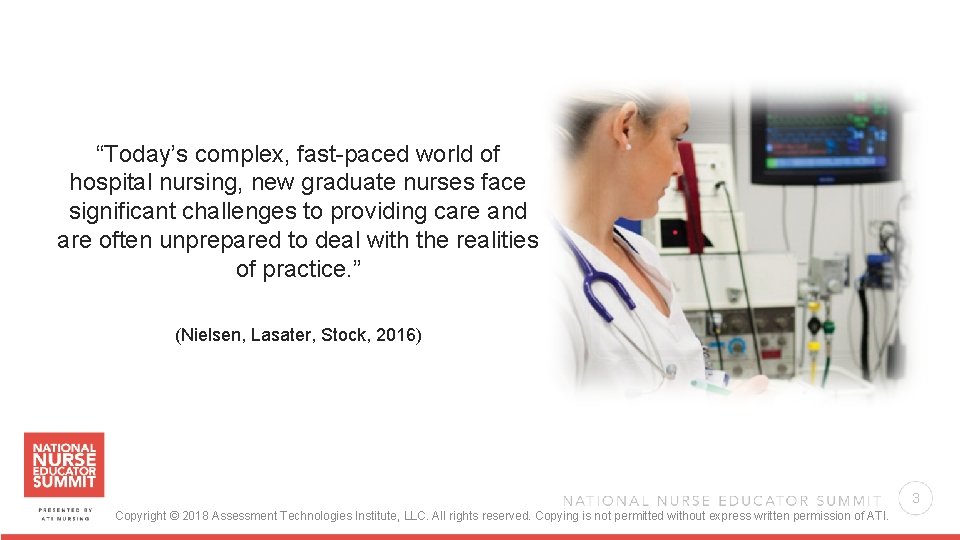
“Today’s complex, fast-paced world of hospital nursing, new graduate nurses face significant challenges to providing care and are often unprepared to deal with the realities of practice. ” (Nielsen, Lasater, Stock, 2016) 3 Copyright © 2018 Assessment Technologies Institute, LLC. All rights reserved. Copying is not permitted without express written permission of ATI.
Clinical Judgment Definition § Clinical Judgment is defined as “The nurses ability to apply knowledge, both tacit and explicit, to the unique patient situation to make sense of it and respond appropriately in a specific context of care. “ (Nielsen & Lasater, 2017) 4 Copyright © 2019 Assessment Technologies Institute, LLC. All rights reserved. Copying is not permitted without express written permission of ATI.
Clinical Judgment Role in Providing Client Care § Knowledge and clinical judgment are essential to nursing practice (Muntean et al. , 2016). § Clinical judgment is an essential skill for nurses (National Council of State Board of Nursing, 2018). § Client care and nurse errors can be improved by enhancing clinical judgment skills in nurse. § Attainment of content knowledge does not imply the possession of clinical judgment skills (Muntean et al. , 2016). 5 Copyright © 2018 Assessment Technologies Institute, LLC. All rights reserved. Copying is not permitted without express written permission of ATI.
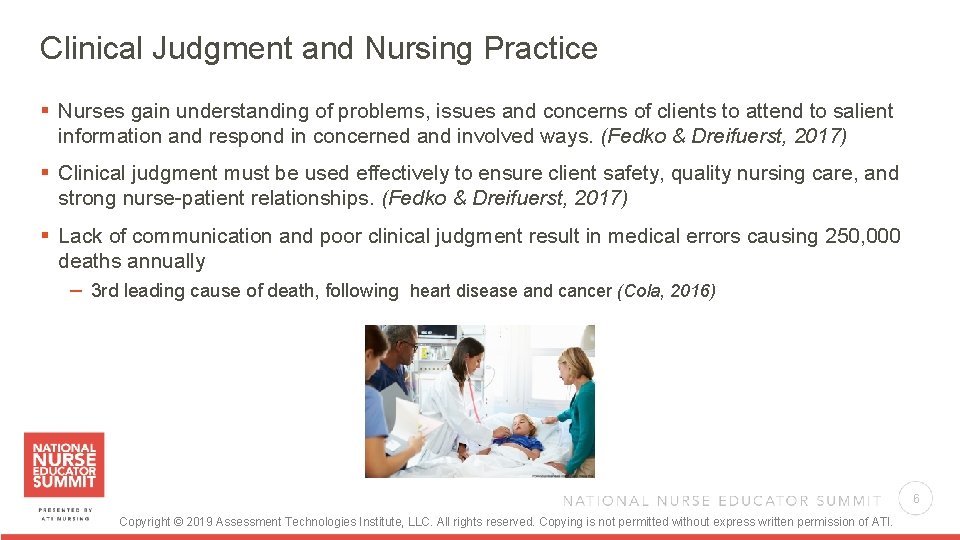
Clinical Judgment and Nursing Practice § Nurses gain understanding of problems, issues and concerns of clients to attend to salient information and respond in concerned and involved ways. (Fedko & Dreifuerst, 2017) § Clinical judgment must be used effectively to ensure client safety, quality nursing care, and strong nurse-patient relationships. (Fedko & Dreifuerst, 2017) § Lack of communication and poor clinical judgment result in medical errors causing 250, 000 deaths annually ― 3 rd leading cause of death, following heart disease and cancer (Cola, 2016) 6 Copyright © 2019 Assessment Technologies Institute, LLC. All rights reserved. Copying is not permitted without express written permission of ATI.

National Council for State Boards of Nursing Clinical Judgment is progressive in nature and consists of 5 steps § Collect Cues ― Identify relevant data to gain the best understanding about the client’s health status. § Generate Hypothesis ― Use collected data to identify actual and/or potential health problems indicating a need for intervention. § Judge Hypotheses ― Prioritize client problems by determining the order of clinical significance at a point in time, and the need for nursing intervention. § Take action ― Select and implement appropriate interventions based on nursing knowledge and priorities of care to promote, maintain, or restore a client’s health. § Evaluate ― Assess a client’s response to nursing interventions and the extent to which goals and outcomes have been met. (National Council of State Boards of Nursing, 2018) Copyright © 2019 Assessment Technologies Institute, LLC. All rights reserved. Copying is not permitted without express written permission of ATI. 7
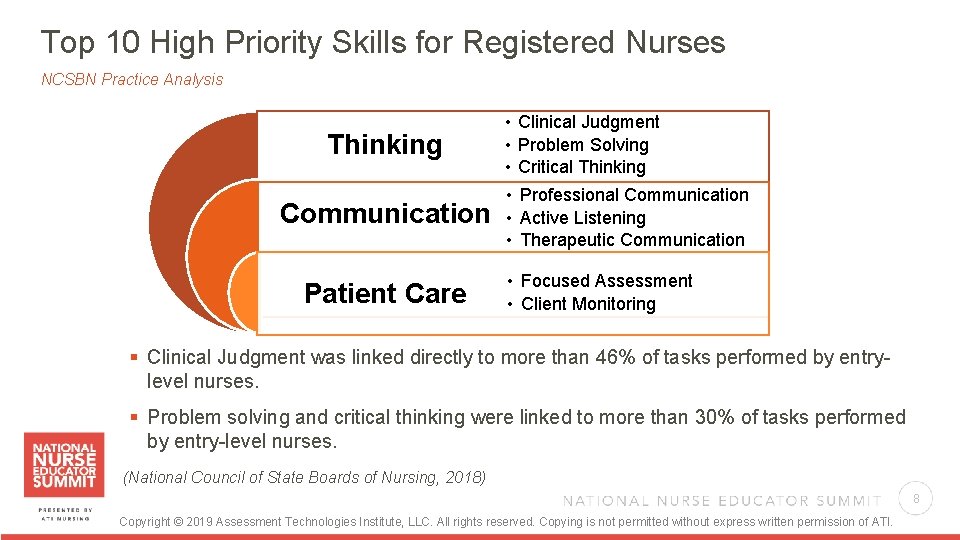
Top 10 High Priority Skills for Registered Nurses NCSBN Practice Analysis Thinking Communication Patient Care • Clinical Judgment • Problem Solving • Critical Thinking • Professional Communication • Active Listening • Therapeutic Communication • Focused Assessment • Client Monitoring § Clinical Judgment was linked directly to more than 46% of tasks performed by entrylevel nurses. § Problem solving and critical thinking were linked to more than 30% of tasks performed by entry-level nurses. (National Council of State Boards of Nursing, 2018) 8 Copyright © 2019 Assessment Technologies Institute, LLC. All rights reserved. Copying is not permitted without express written permission of ATI.
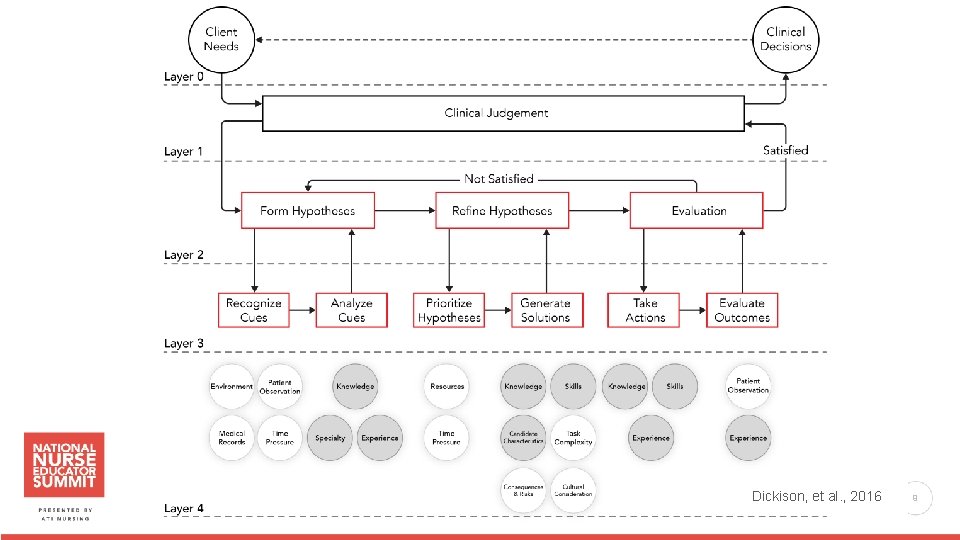
Dickison, et al. , 2016 9
Clinical Judgment Survey 10
Clinical Judgment Survey § The survey evaluated steps in the Clinical Judgment process described by the NCSBN (2018) which consists of “Recognizing cues about a clinical situation, generating and weighing hypotheses, taking action and evaluating outcomes for the purpose of arriving at a satisfactory clinical ” (p. 4). § Aims: ― What actions must nurses (and nursing students) perform when implementing NCSBN’s clinical judgment model to provide safe quality client care? ― What nursing actions provide measurable criteria indicating that nurses (and nursing students) demonstrate the use of clinical judgment skills? 11 Copyright © 2019 Assessment Technologies Institute, LLC. All rights reserved. Copying is not permitted without express written permission of ATI.
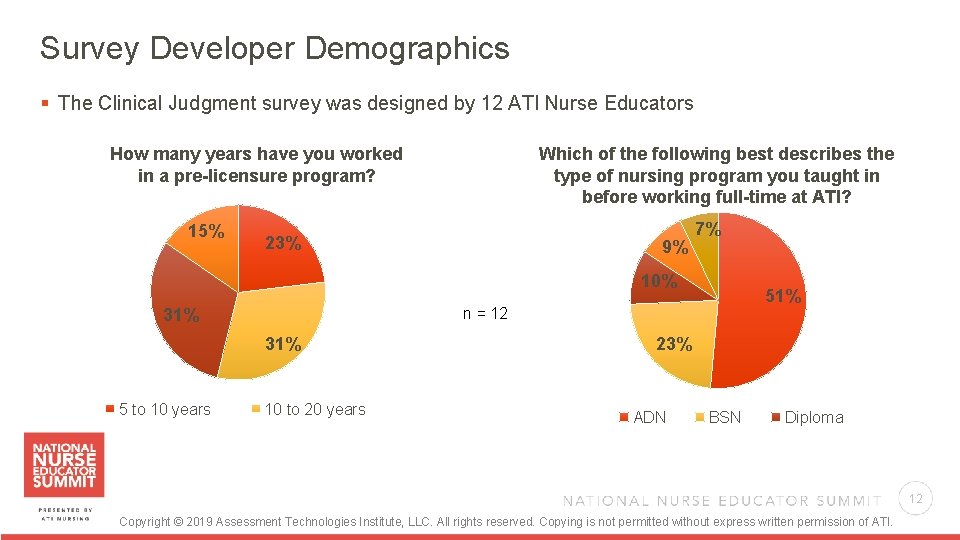
Survey Developer Demographics § The Clinical Judgment survey was designed by 12 ATI Nurse Educators Which of the following best describes the type of nursing program you taught in before working full-time at ATI? How many years have you worked in a pre-licensure program? 15% 23% 9% 7% 10% n = 12 31% 5 to 10 years 51% 10 to 20 years 23% ADN BSN Diploma 12 Copyright © 2019 Assessment Technologies Institute, LLC. All rights reserved. Copying is not permitted without express written permission of ATI.
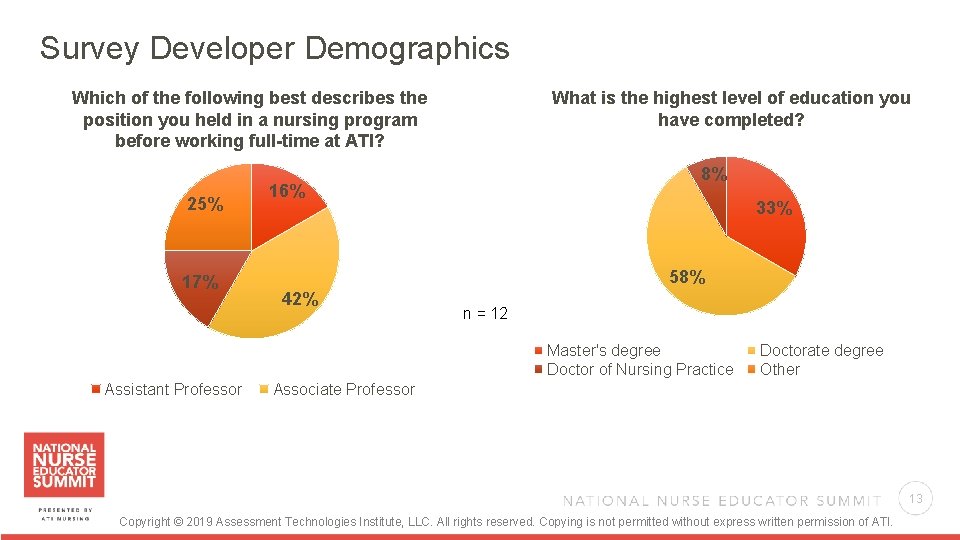
Survey Developer Demographics Which of the following best describes the position you held in a nursing program before working full-time at ATI? 25% 17% What is the highest level of education you have completed? 8% 16% 33% 58% 42% n = 12 Master's degree Doctor of Nursing Practice Assistant Professor Doctorate degree Other Associate Professor 13 Copyright © 2019 Assessment Technologies Institute, LLC. All rights reserved. Copying is not permitted without express written permission of ATI.
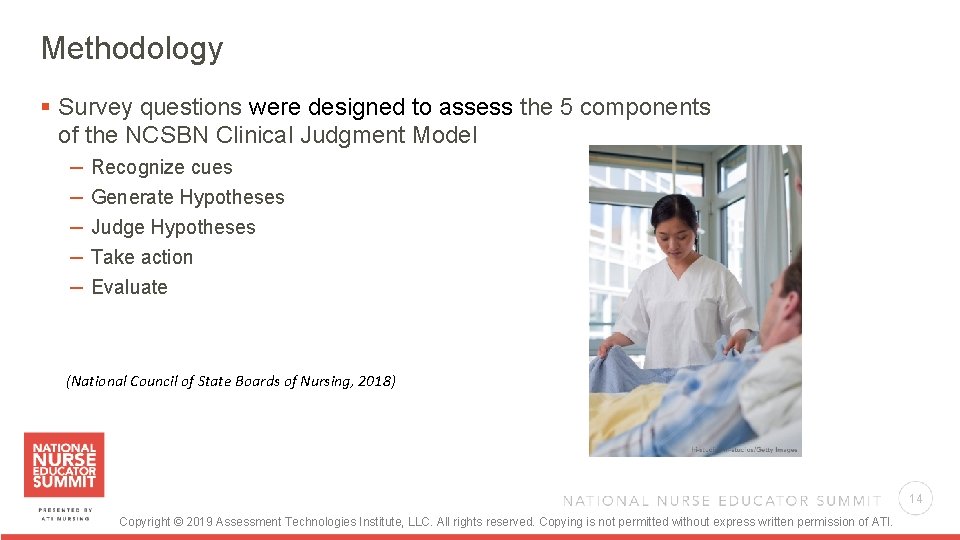
Methodology § Survey questions were designed to assess the 5 components of the NCSBN Clinical Judgment Model ― ― ― Recognize cues Generate Hypotheses Judge Hypotheses Take action Evaluate (National Council of State Boards of Nursing, 2018) 14 Copyright © 2019 Assessment Technologies Institute, LLC. All rights reserved. Copying is not permitted without express written permission of ATI.
Methodology (continued) § All five steps in the Clinical Judgment process were categorized into two criteria: 1) Nursing Actions and 2) Measurable Indicators § Both criteria were analyzed for frequency of selection made by respondents. § The survey was comprised of both quantitative and qualitative items. ― Quantitative items addressed each action or indicator which provided evidence that nurses/nursing students demonstrated clinical judgment skills necessary for each step. ― Items included an optional open-ended response option which allowed respondents to write in additional actions or indicators they thought were necessary for nurses/nursing students to demonstrate clinical judgment skills for each step. Though optional, answering the ‘other’ open-ended response option was emphasized as a critical factor to the success of the study. 15 Copyright © 2019 Assessment Technologies Institute, LLC. All rights reserved. Copying is not permitted without express written permission of ATI.
Methodology (continued) § An email invitation was sent to 664 potential respondents asking them to complete the Clinical Judgment Survey. § Respondents were educators trained on ATI products. They were identified on their campus as a faculty resource for product integration and use. § The survey was deployed via Qualtrics, a secure online survey platform, on November 12, 2018 and closed on November 27, 2018. § 94 out of 664 (14. 6%) respondents completed the survey § Quantitative data were analyzed by adding frequency of selections made by respondents for each action/indicator within each step and obtaining percentages calculated from the sample size. § Qualitative data were analyzed by reviewing open response comments, classifying them into categories and adding up how many times each classified category was mentioned by respondents. 16 Copyright © 2019 Assessment Technologies Institute, LLC. All rights reserved. Copying is not permitted without express written permission of ATI.
Respondents § The majority of respondents were from Two-Year or Four-Year colleges and have worked as an educator in a pre-licensure ADN or BSN nursing program for at least 5 years. § Respondents were either instructors or assistant professors with advanced degrees in nursing. 17 Copyright © 2019 Assessment Technologies Institute, LLC. All rights reserved. Copying is not permitted without express written permission of ATI.
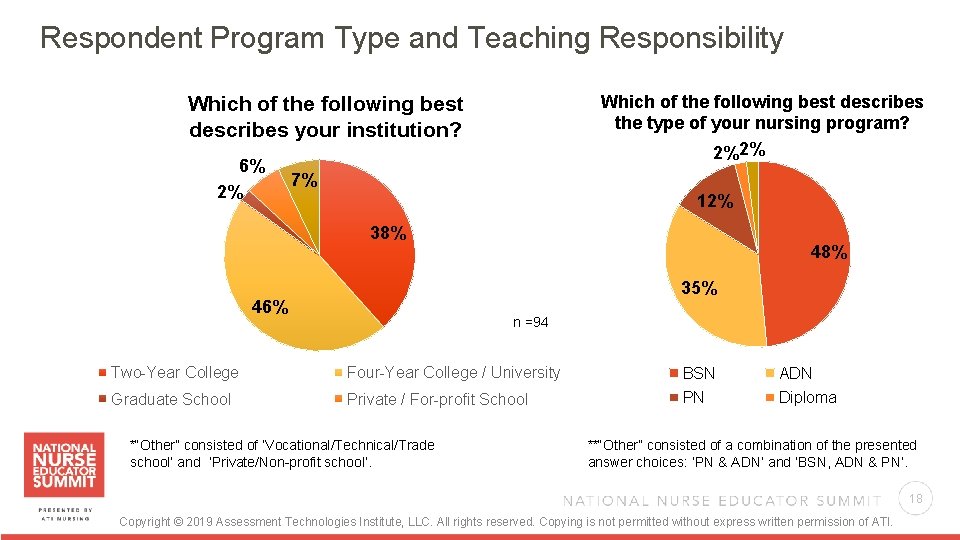
Respondent Program Type and Teaching Responsibility Which of the following best describes the type of your nursing program? 2%2% Which of the following best describes your institution? 6% 2% 7% 12% 38% 48% 35% 46% n =94 Two-Year College Four-Year College / University BSN ADN Graduate School Private / For-profit School PN Diploma *“Other” consisted of ‘Vocational/Technical/Trade school’ and ‘Private/Non-profit school’. **“Other” consisted of a combination of the presented answer choices: ‘PN & ADN’ and ‘BSN, ADN & PN’. 18 Copyright © 2019 Assessment Technologies Institute, LLC. All rights reserved. Copying is not permitted without express written permission of ATI.
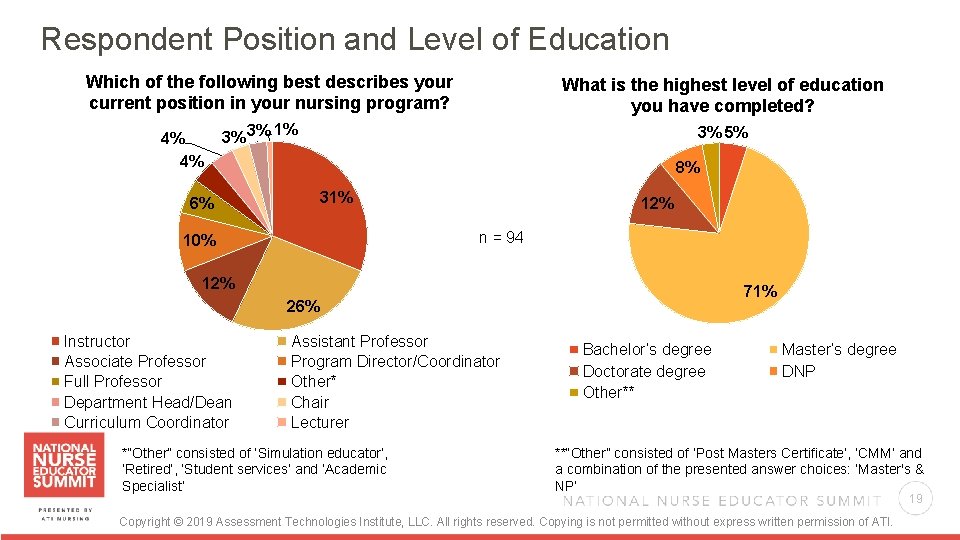
Respondent Position and Level of Education Which of the following best describes your current position in your nursing program? 4% 4% 3% 3% What is the highest level of education you have completed? 1% 3% 5% 8% 31% 6% 12% n = 94 10% 12% 71% 26% Instructor Associate Professor Full Professor Department Head/Dean Curriculum Coordinator Assistant Professor Program Director/Coordinator Other* Chair Lecturer *“Other” consisted of ‘Simulation educator’, ‘Retired’, ‘Student services’ and ‘Academic Specialist’ Bachelor’s degree Doctorate degree Other** Master’s degree DNP **“Other” consisted of ‘Post Masters Certificate’, ‘CMM’ and a combination of the presented answer choices: ‘Master's & NP’ Copyright © 2019 Assessment Technologies Institute, LLC. All rights reserved. Copying is not permitted without express written permission of ATI. 19
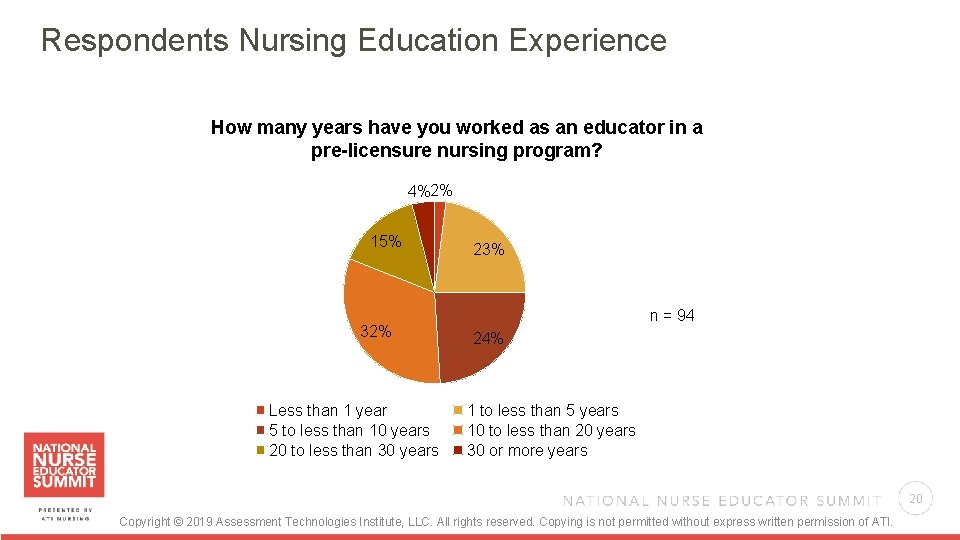
Respondents Nursing Education Experience How many years have you worked as an educator in a pre-licensure nursing program? 4%2% 15% 32% Less than 1 year 5 to less than 10 years 20 to less than 30 years 23% n = 94 24% 1 to less than 5 years 10 to less than 20 years 30 or more years 20 Copyright © 2019 Assessment Technologies Institute, LLC. All rights reserved. Copying is not permitted without express written permission of ATI.
Results and Findings 21 Copyright © 2019 Assessment Technologies Institute, LLC. All rights reserved. Copying is not permitted without express written permission of ATI.
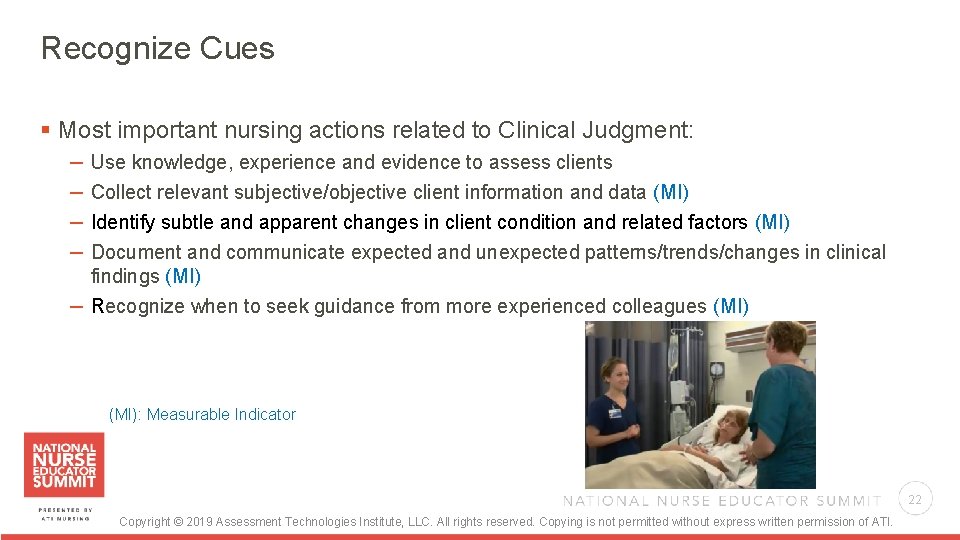
Recognize Cues § Most important nursing actions related to Clinical Judgment: ― ― Use knowledge, experience and evidence to assess clients Collect relevant subjective/objective client information and data (MI) Identify subtle and apparent changes in client condition and related factors (MI) Document and communicate expected and unexpected patterns/trends/changes in clinical findings (MI) ― Recognize when to seek guidance from more experienced colleagues (MI): Measurable Indicator 22 Copyright © 2019 Assessment Technologies Institute, LLC. All rights reserved. Copying is not permitted without express written permission of ATI.
Generate Hypotheses § Most important nursing actions related to Clinical Judgment : ― ― ― ― Analyze expected and unexpected findings in health data Relate client findings to evidence-based resources (MI) Organize client assessment information and data according to changes, patterns and trends (MI) Identify actual client problems (MI) Anticipate illness/injury and wellness progression Identify potential client problems (MI) Relate current client situation to scientific principles and standards of care to formulate a relevant hypothesis (MI): Measurable Indicator 23 Copyright © 2019 Assessment Technologies Institute, LLC. All rights reserved. Copying is not permitted without express written permission of ATI.
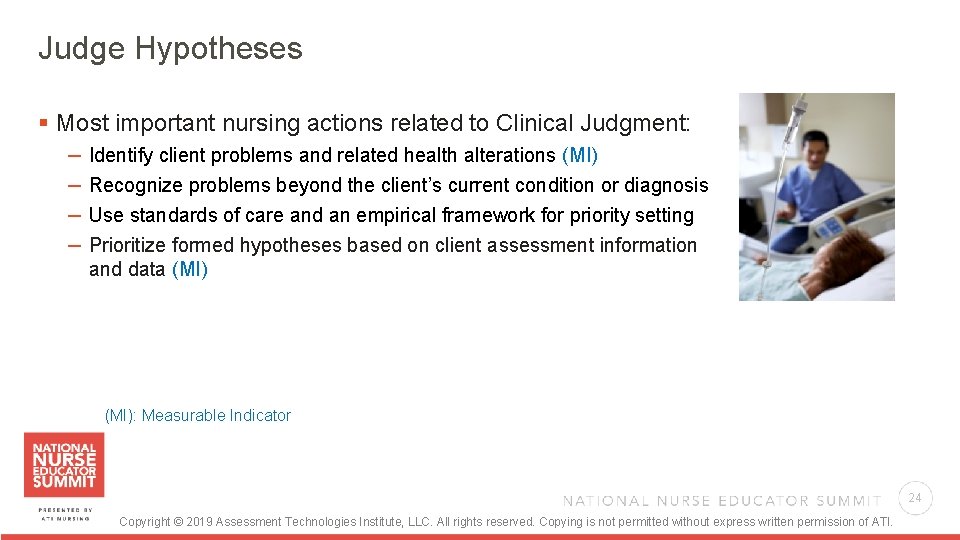
Judge Hypotheses § Most important nursing actions related to Clinical Judgment: ― ― Identify client problems and related health alterations (MI) Recognize problems beyond the client’s current condition or diagnosis Use standards of care and an empirical framework for priority setting Prioritize formed hypotheses based on client assessment information and data (MI): Measurable Indicator 24 Copyright © 2019 Assessment Technologies Institute, LLC. All rights reserved. Copying is not permitted without express written permission of ATI.
Take Action § Most important nursing actions related to Clinical Judgment: ― ― ― Establish optimal client outcomes (MI) Identify evidence-based actions to achieve outcomes (MI) Promptly and accurately perform nursing actions based on prioritized client problems (MI) Re-prioritize nursing actions as the client’s condition changes Modify the plan of care to assure achievement of optimal client outcomes when indicated (MI) Prioritize client care for multiple clients (MI): Measurable Indicator 25 Copyright © 2019 Assessment Technologies Institute, LLC. All rights reserved. Copying is not permitted without express written permission of ATI.
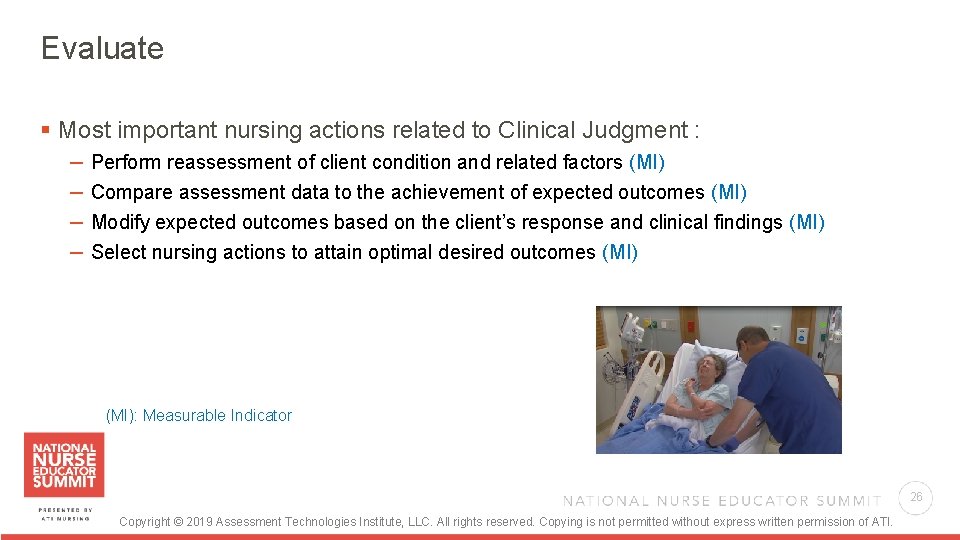
Evaluate § Most important nursing actions related to Clinical Judgment : ― ― Perform reassessment of client condition and related factors (MI) Compare assessment data to the achievement of expected outcomes (MI) Modify expected outcomes based on the client’s response and clinical findings (MI) Select nursing actions to attain optimal desired outcomes (MI): Measurable Indicator 26 Copyright © 2019 Assessment Technologies Institute, LLC. All rights reserved. Copying is not permitted without express written permission of ATI.
Conclusion § For each of the five steps of the Clinical Judgment process, the majority of respondents selected the predefined answer options for both measurable actions and indicators, identifying all options as important skills related to Clinical Judgment. § Additional nursing actions and measurable indicators were adopted from open response results for each step of the Clinical Judgment process following a review by 5 nurse educators that participated in creating the survey. 27 Copyright © 2019 Assessment Technologies Institute, LLC. All rights reserved. Copying is not permitted without express written permission of ATI.
Results of Similar Studies § Dickison, Haerling and Lasater performed a qualitative comparative analysis of the relationships between the National Council of State Boards of Nursing Clinical Judgment Model and the three leading frameworks for providing clinical judgment education to entry-level nurses. § Kantar and Alexander identified common Clinical Judgment deficiencies in nursing students related to Tanner’s Clinical Judgment Model (2012). § The Lasater Clinical Judgment Rubric is an outline of expectations for performance with criteria, designed to evaluate a single episode requiring clinical judgment. (Miraglia & Asselin, 2015; Lasater, 2007). 28 Copyright © 2019 Assessment Technologies Institute, LLC. All rights reserved. Copying is not permitted without express written permission of ATI.
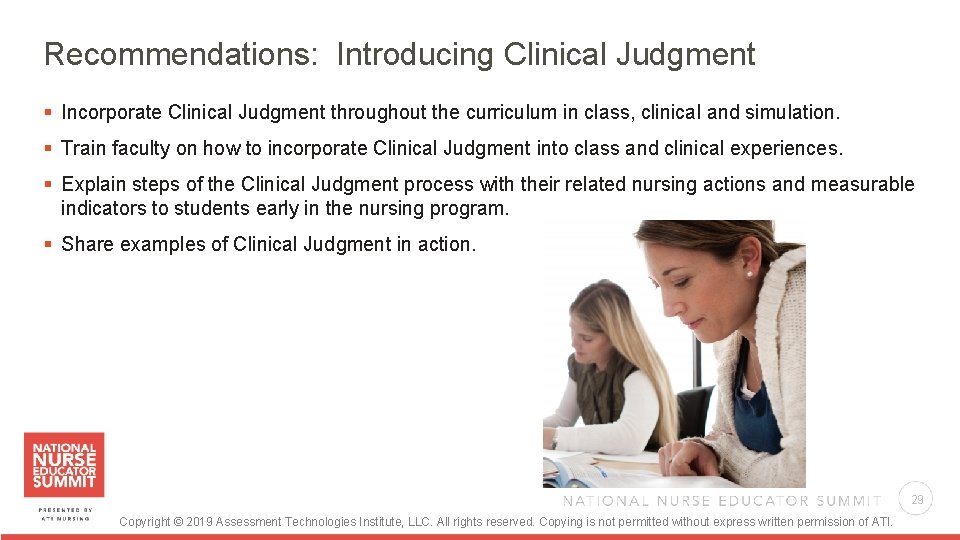
Recommendations: Introducing Clinical Judgment § Incorporate Clinical Judgment throughout the curriculum in class, clinical and simulation. § Train faculty on how to incorporate Clinical Judgment into class and clinical experiences. § Explain steps of the Clinical Judgment process with their related nursing actions and measurable indicators to students early in the nursing program. § Share examples of Clinical Judgment in action. 29 Copyright © 2019 Assessment Technologies Institute, LLC. All rights reserved. Copying is not permitted without express written permission of ATI.
Recommendations: Introducing Clinical Judgment EXAMPLE: COLLECTING CUES ― 72 year-old client is hospitalized for treatment of pneumonia. Relate the following clinical findings to their associated nursing action and measurable indicator. • • 4 L O 2 per nasal canula (Collect objective data) Client displays labored breathing and reports shortness of breath (Collect objective/subjective data) Current O 2 Sat 80%, reading was 90% 2 hours earlier (Identify changes in client condition) Notify provider of 10% drop in O 2 Sat (Communicate changes in clinical findings) 30 Copyright © 2019 Assessment Technologies Institute, LLC. All rights reserved. Copying is not permitted without express written permission of ATI.
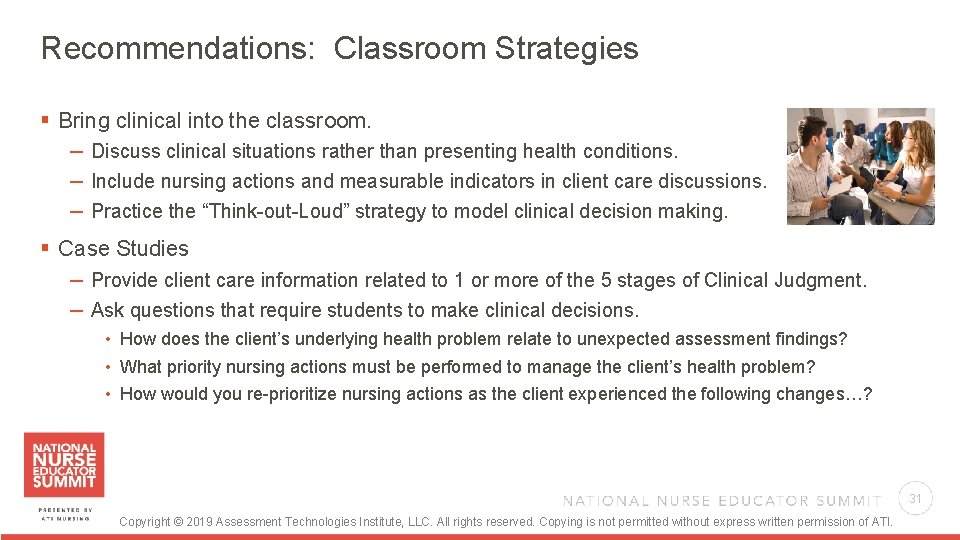
Recommendations: Classroom Strategies § Bring clinical into the classroom. ― Discuss clinical situations rather than presenting health conditions. ― Include nursing actions and measurable indicators in client care discussions. ― Practice the “Think-out-Loud” strategy to model clinical decision making. § Case Studies ― Provide client care information related to 1 or more of the 5 stages of Clinical Judgment. ― Ask questions that require students to make clinical decisions. • How does the client’s underlying health problem relate to unexpected assessment findings? • What priority nursing actions must be performed to manage the client’s health problem? • How would you re-prioritize nursing actions as the client experienced the following changes…? 31 Copyright © 2019 Assessment Technologies Institute, LLC. All rights reserved. Copying is not permitted without express written permission of ATI.
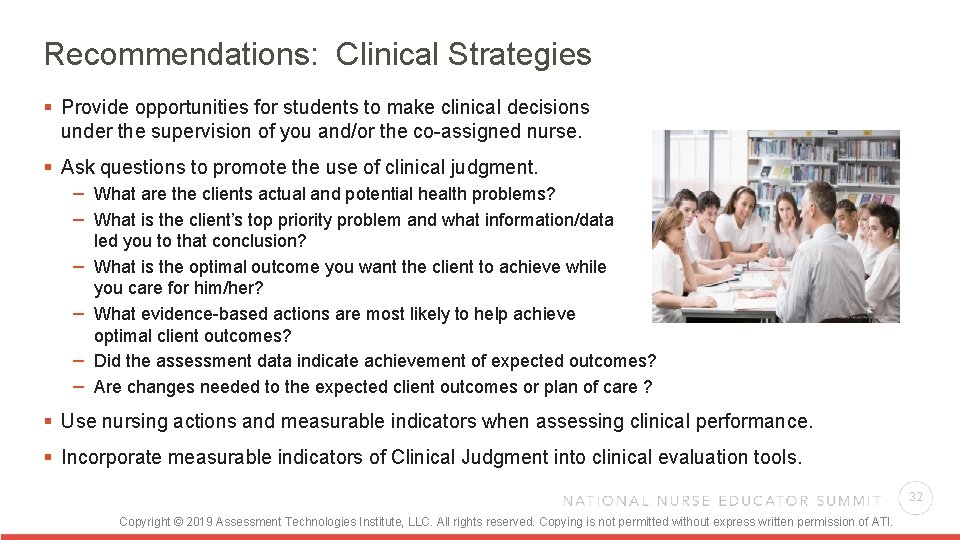
Recommendations: Clinical Strategies § Provide opportunities for students to make clinical decisions under the supervision of you and/or the co-assigned nurse. § Ask questions to promote the use of clinical judgment. ― What are the clients actual and potential health problems? ― What is the client’s top priority problem and what information/data led you to that conclusion? ― What is the optimal outcome you want the client to achieve while you care for him/her? ― What evidence-based actions are most likely to help achieve optimal client outcomes? ― Did the assessment data indicate achievement of expected outcomes? ― Are changes needed to the expected client outcomes or plan of care ? § Use nursing actions and measurable indicators when assessing clinical performance. § Incorporate measurable indicators of Clinical Judgment into clinical evaluation tools. 32 Copyright © 2019 Assessment Technologies Institute, LLC. All rights reserved. Copying is not permitted without express written permission of ATI.
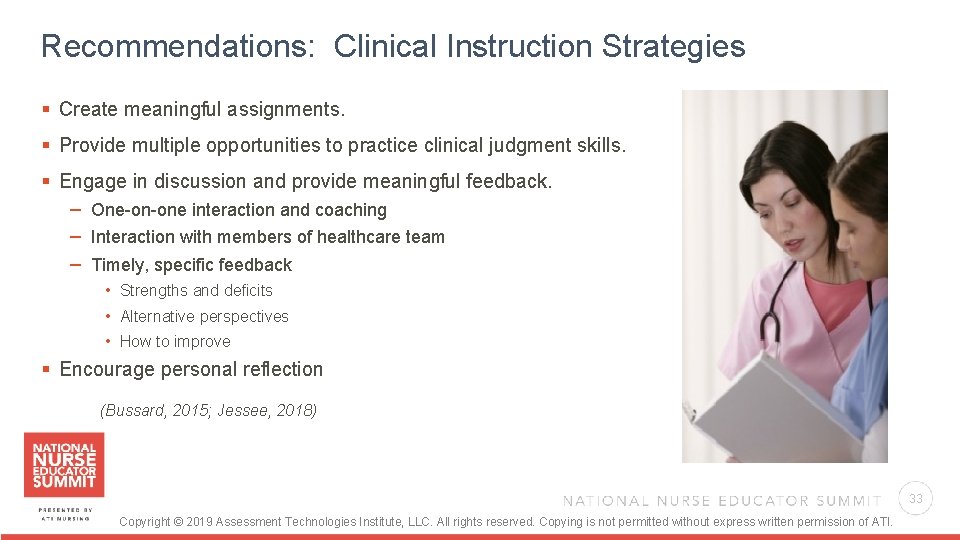
Recommendations: Clinical Instruction Strategies § Create meaningful assignments. § Provide multiple opportunities to practice clinical judgment skills. § Engage in discussion and provide meaningful feedback. ― One-on-one interaction and coaching ― Interaction with members of healthcare team ― Timely, specific feedback • Strengths and deficits • Alternative perspectives • How to improve § Encourage personal reflection (Bussard, 2015; Jessee, 2018) 33 Copyright © 2019 Assessment Technologies Institute, LLC. All rights reserved. Copying is not permitted without express written permission of ATI.
Implications § Future direction for research : ― Confirm the validity and reliability of the Clinical Judgment Survey using a diverse group of faculty from various levels of nursing education ― Confirm the validity of using nursing actions and measurable indicators of Clinical Judgment to help students develop the skill. ― Establish validity of using measurable criteria of Clinical Judgment in the evaluation of student performance. ― Assess the cognitive lab element to assess the student’s use of the dual reasoning process theory 34 Copyright © 2019 Assessment Technologies Institute, LLC. All rights reserved. Copying is not permitted without express written permission of ATI.
Limitations § § Small sample size Survey participants limited to ATI clients Focus on a limited subset of the clinical judgment model Initial steps to identify measurable indicators and not confirmed 35
Acknowledgements § § Christine Mills Ph. D - co-investigator Kevin Loughlin MS - assistance with the survey and data analysis Panel of ATI Nurse Educators - development of Clinical Judgment survey items Cynthia Clark Ph. D, RN, ANEF, FAAN – editorial review 36 Copyright © 2019 Assessment Technologies Institute, LLC. All rights reserved. Copying is not permitted without express written permission of ATI.
References Bussard, M. E. (2015). Clinical judgment in reflective journals of prelicensure nursing students. Journal of Nursing Education. 54(1), 36 -40. COLA acknowledges significance of medical errors reported in johns hopkins study (2016). Los Angeles: Anthem Media Group. Retrieved from https: //search-proquestcom. contentproxy. phoenix. edu/docview/1796047286? accountid=134061 Dickison, P. , Haerling, K. A. , & Lasater, K. (2019). Integrating the national council of state boards of nursing clinical judgment model into nursing educational frameworks. Journal of Nursing Education, 28(2), 72 -78. Dickison, P. , Luo, X. , Kim, D. , Woo, A. , Muntean, W. , Bergstrom, B. (2016). Assessing Higher. Order Cognitive Constructs by Using an Information-Processing Framework. Journal of Applied Testing Technology, 17(1), 1 -19. Fedko , A. S. & Dreifuerst, K. T. (2017). Examining the relationship between clinical judgment and nursing actions in prelicensure students. Nurse Educator. 42(1), 47 -50. 37 Copyright © 2019 Assessment Technologies Institute, LLC. All rights reserved. Copying is not permitted without express written permission of ATI.
References Jessee, M. A. , (2018). Pursuing improvement in clinical reasoning: The integrated clinical education theory. Journal of Nursing Education, 57(1), 7 -13. Lasater, K. (2007). Clinical judgment development: Using simulation to create an assessment rubric. Journal of Nursing Education. 46(11), 496 -503. Miraglia, R. & Asselin, M. E. (2015). The lasater clinical judgment rubric as a framework to enhance clinical judgment in novice and experienced nurses. Journal for Nurses in Professional Development. September/October, 2015, 284 -291. Muntean, W. , Lindsay, M. , Betts, J. , Kim, D. , Woo, A. & Dickison, P. (April 10, 2016). Separating assessment of subject matter knowledge from assessment of higher order cognitive constructs. Paper presented at the 2016 American Educational Research Association Annual Meeting in Washington, DC. National Council of State Boards of Nursing. (2018). NCLEX Examinations: Analysis and Research. Next generation NCLEX news. Winter, 2018. 38 Copyright © 2019 Assessment Technologies Institute, LLC. All rights reserved. Copying is not permitted without express written permission of ATI.
References Nielsen, A. , & Lasater, K. (2017). Clinical Judgment. In J. F. Giddens (Ed. ), Concepts of nursing practice, (pp. 387 -395). (2 nd ed. ). St. Louis, MO: Elsevier. Nielsen, A. , Lasater, K. , & Stock, M. , (2016). A framework to support preceptors’ evaluation and development of new nurses’ clinical judgment. Nursing Education in Practice, 19(2016), 84 -90. Saintsing, D. , Gibson, L. M. , & Pennington, A. W. (2011). The novice nurse and clinical decisionmaking: How to avoid errors. Journal of Nursing Management, 19, 354– 359. 39 Copyright © 2019 Assessment Technologies Institute, LLC. All rights reserved. Copying is not permitted without express written permission of ATI.
- Slides: 39