Aquatic Ecology Envirothon Study Session March 14 2017


- Slides: 66
Aquatic Ecology Envirothon Study Session March 14, 2017
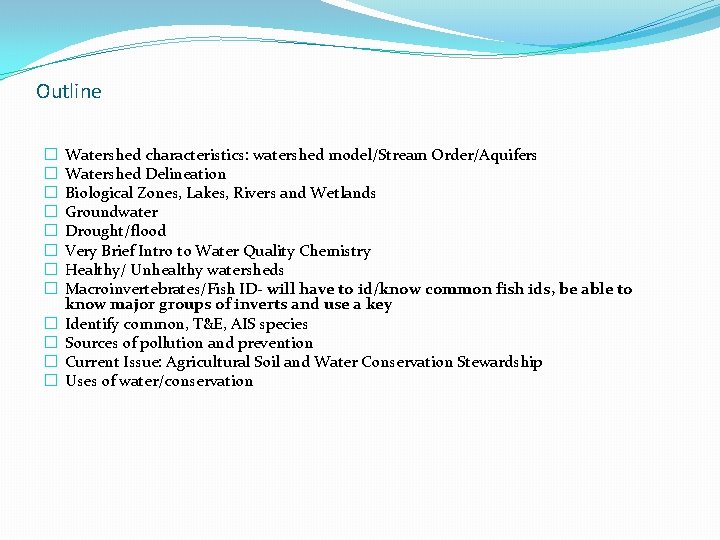
Outline � � � Watershed characteristics: watershed model/Stream Order/Aquifers Watershed Delineation Biological Zones, Lakes, Rivers and Wetlands Groundwater Drought/flood Very Brief Intro to Water Quality Chemistry Healthy/ Unhealthy watersheds Macroinvertebrates/Fish ID- will have to id/know common fish ids, be able to know major groups of inverts and use a key Identify common, T&E, AIS species Sources of pollution and prevention Current Issue: Agricultural Soil and Water Conservation Stewardship Uses of water/conservation
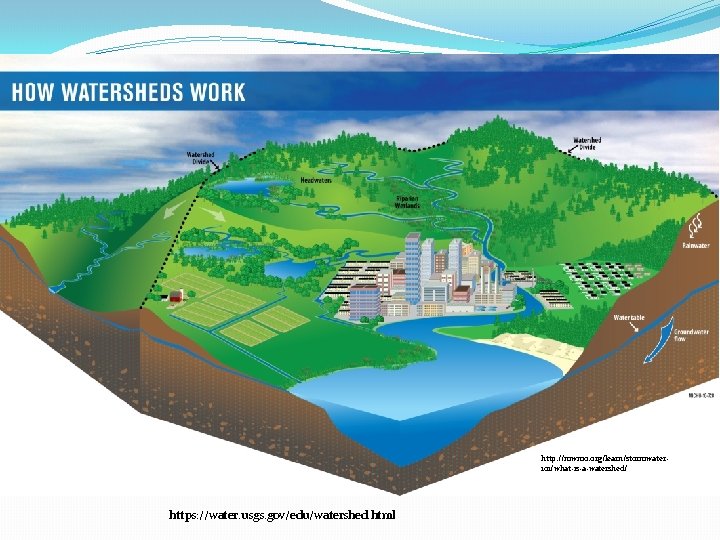
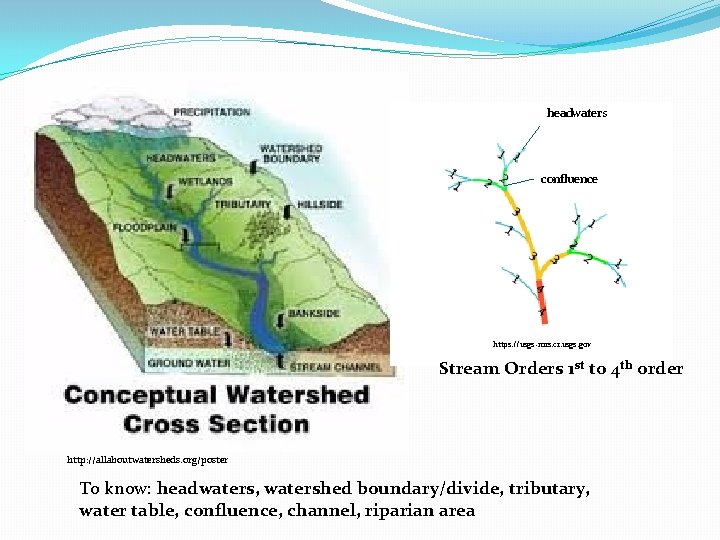
What is a Watershed? �All the land water features (surface water, but groundwater will be an input to surface water)that drain to a specific location on a landscape. �Scale-dependent. To know: Tributaries, riparian zone, watershed boundary/divide
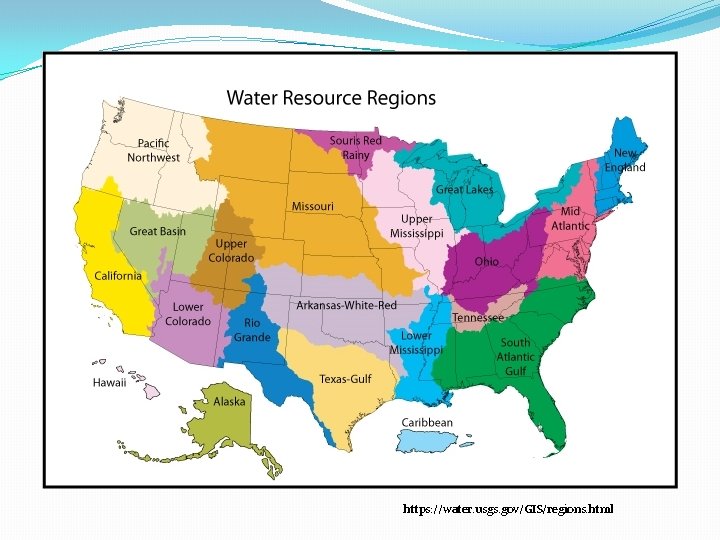
https: //water. usgs. gov/GIS/regions. html
Hydrologic units (HUs) are defined watersheds at different spatial levels ranging from HU-2’s( big- Missouri River basin) to HU- 16 (small: roughly creek level). Here HUC 8’s are pictured. Their HUC (hydrologic unit code) is 8 - digits.
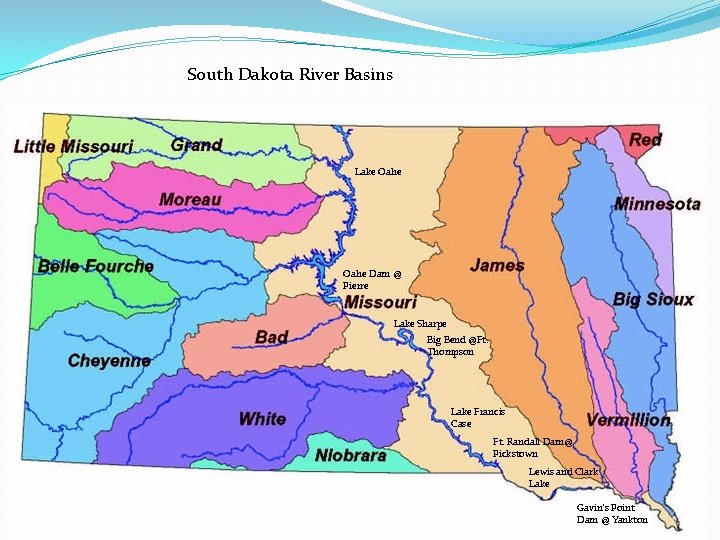
South Dakota River Basins Lake Oahe Dam @ Pierre Lake Sharpe Big Bend @Ft. Thompson Lake Francis Case Ft. Randall Dam@ Pickstown Lewis and Clark Lake Gavin’s Point Dam @ Yankton
http: //mwmo. org/learn/stormwater 101/what-is-a-watershed/ https: //water. usgs. gov/edu/watershed. html
headwaters confluence https: //usgs-mrs. cr. usgs. gov Stream Orders 1 st to 4 th order http: //allaboutwatersheds. org/poster To know: headwaters, watershed boundary/divide, tributary, water table, confluence, channel, riparian area
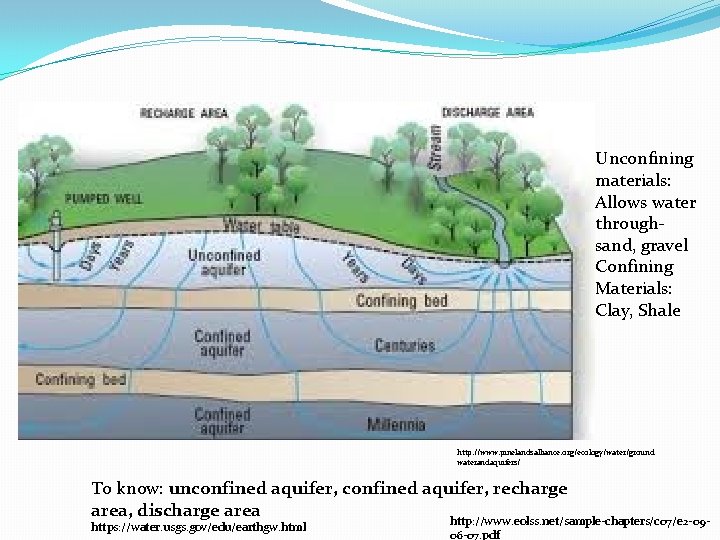
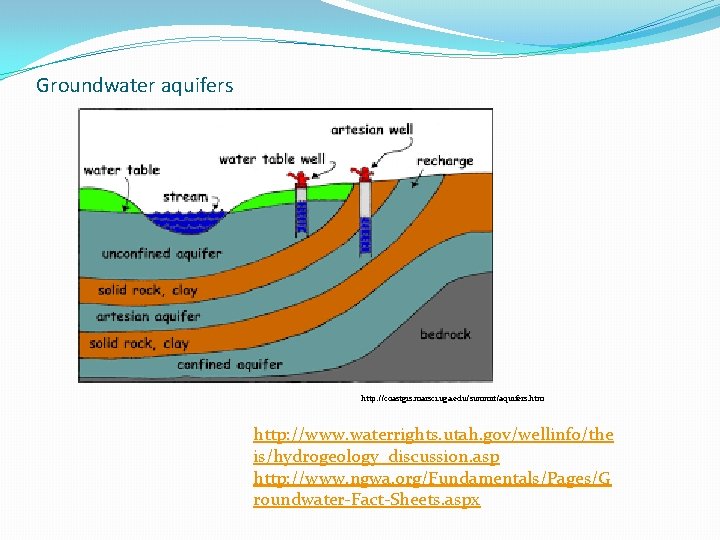
Unconfining materials: Allows water through- sand, gravel Confining Materials: Clay, Shale http: //www. pinelandsalliance. org/ecology/water/ground waterandaquifers/ To know: unconfined aquifer, recharge area, discharge area http: //www. eolss. net/sample-chapters/c 07/e 2 -09 https: //water. usgs. gov/edu/earthgw. html 06 -07. pdf
Groundwater aquifers http: //coastgis. marsci. uga. edu/summit/aquifers. htm http: //www. waterrights. utah. gov/wellinfo/the is/hydrogeology_discussion. asp http: //www. ngwa. org/Fundamentals/Pages/G roundwater-Fact-Sheets. aspx
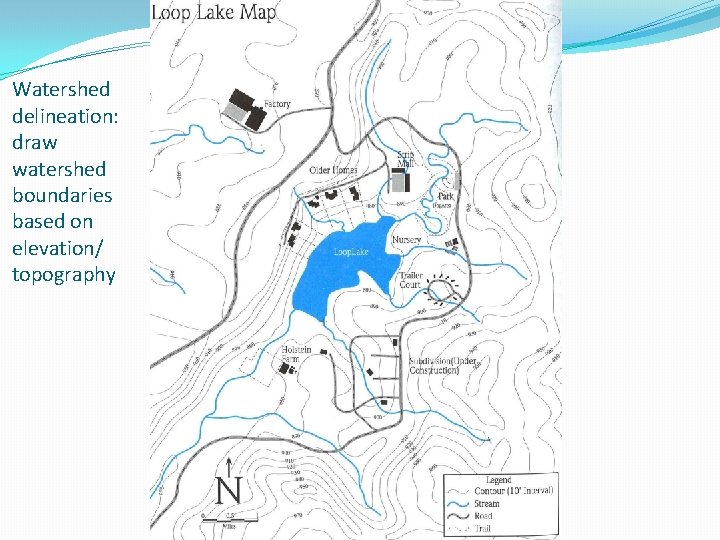
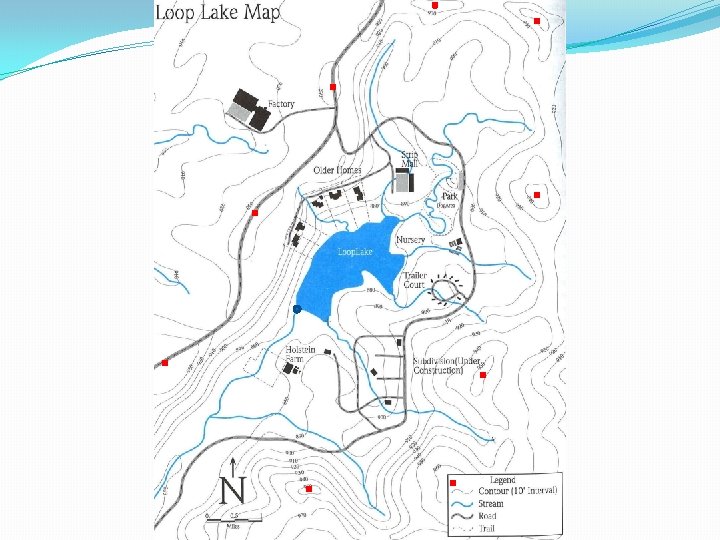
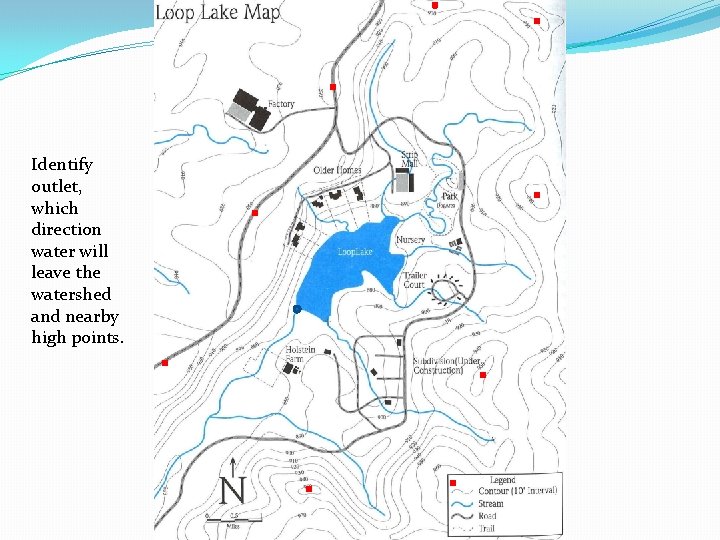
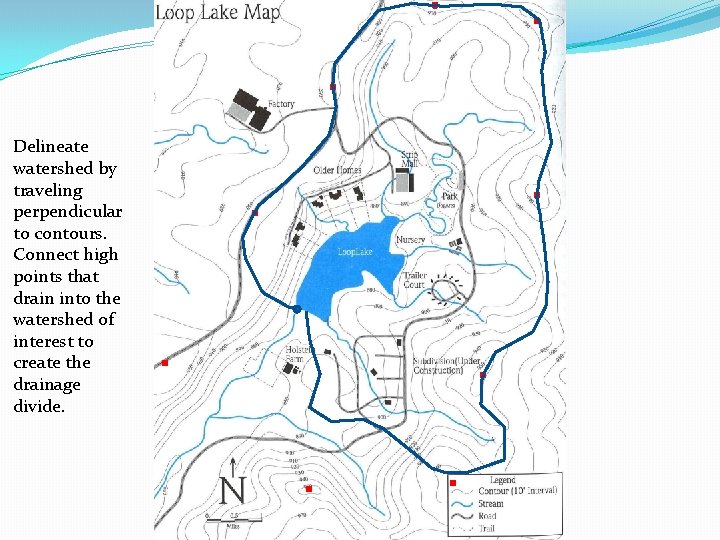
Watershed delineation: draw watershed boundaries based on elevation/ topography
Identify outlet, which direction water will leave the watershed and nearby high points.
Delineate watershed by traveling perpendicular to contours. Connect high points that drain into the watershed of interest to create the drainage divide.
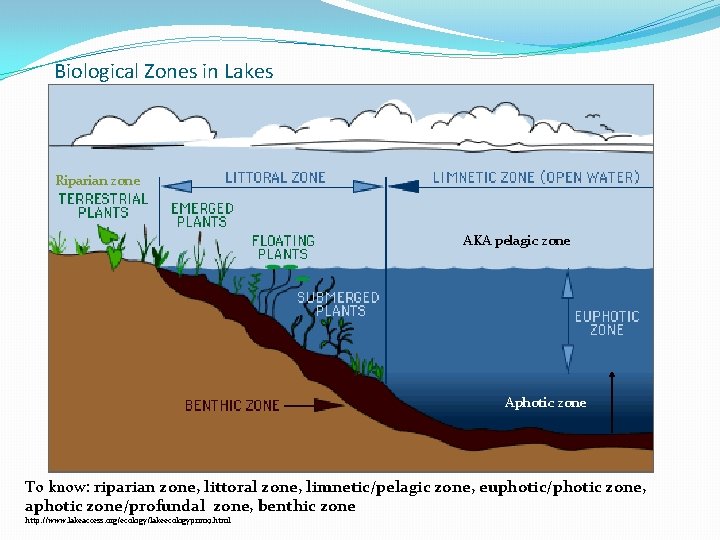
Biological Zones in Lakes Riparian zone AKA pelagic zone Aphotic zone To know: riparian zone, littoral zone, limnetic/pelagic zone, euphotic/photic zone, aphotic zone/profundal zone, benthic zone http: //www. lakeaccess. org/ecology/lakeecologyprim 9. html
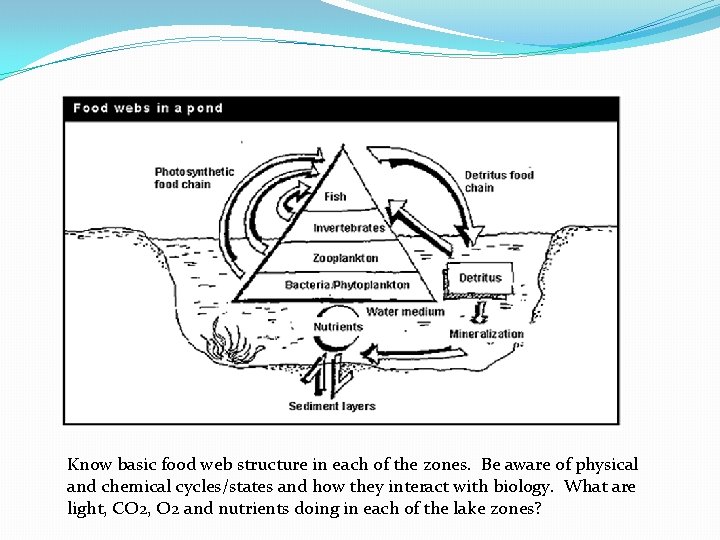
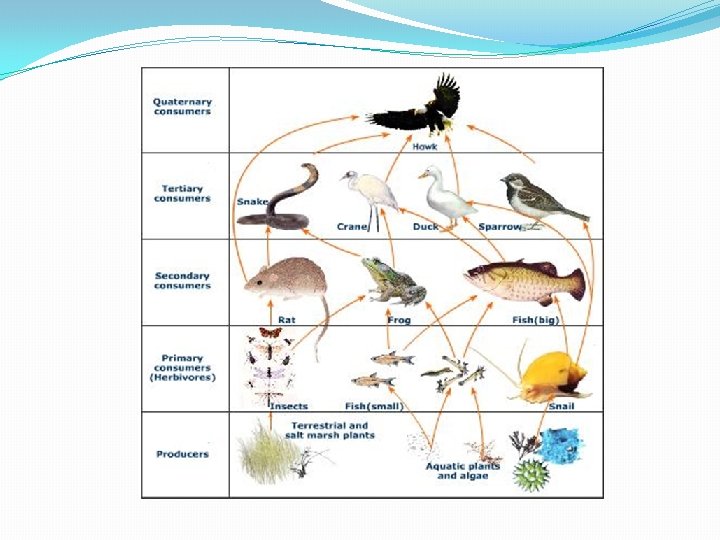
Know basic food web structure in each of the zones. Be aware of physical and chemical cycles/states and how they interact with biology. What are light, CO 2, O 2 and nutrients doing in each of the lake zones?
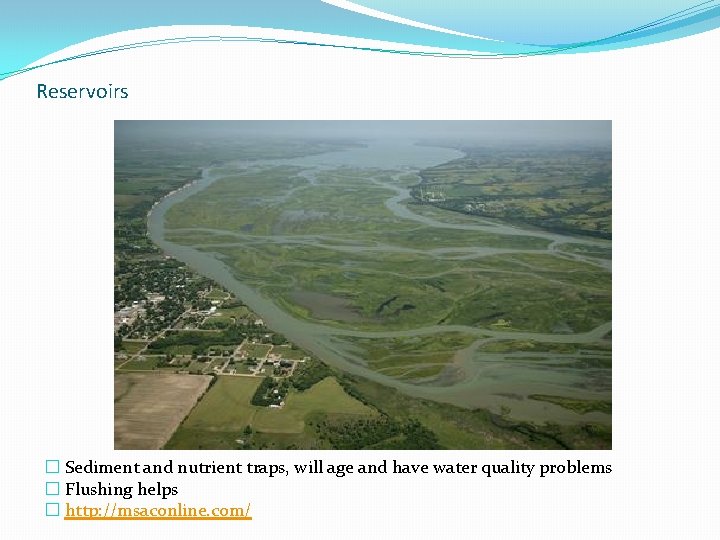
Reservoirs � Sediment and nutrient traps, will age and have water quality problems � Flushing helps � http: //msaconline. com/
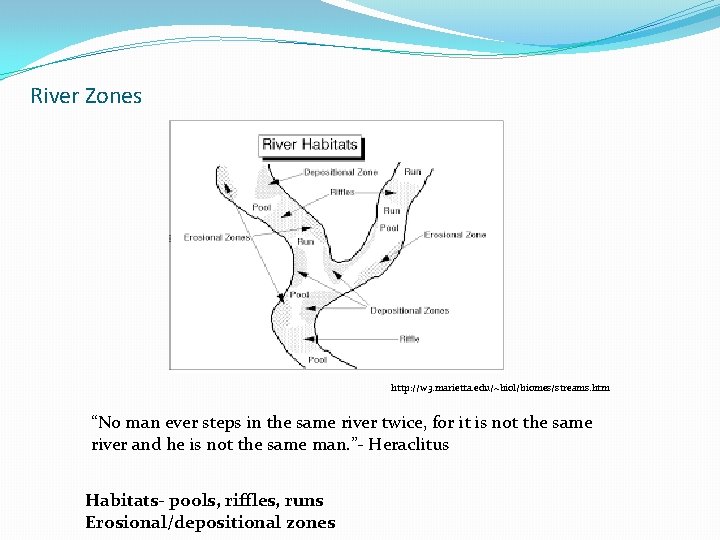
River Zones http: //w 3. marietta. edu/~biol/biomes/streams. htm “No man ever steps in the same river twice, for it is not the same river and he is not the same man. ”- Heraclitus Habitats- pools, riffles, runs Erosional/depositional zones
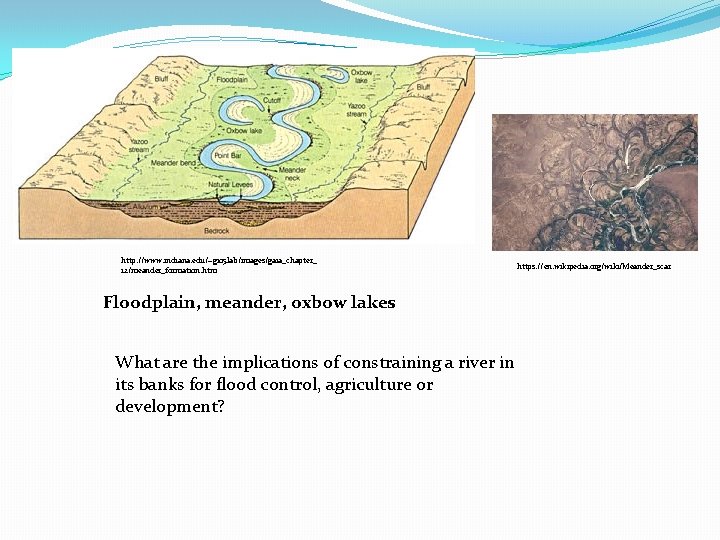
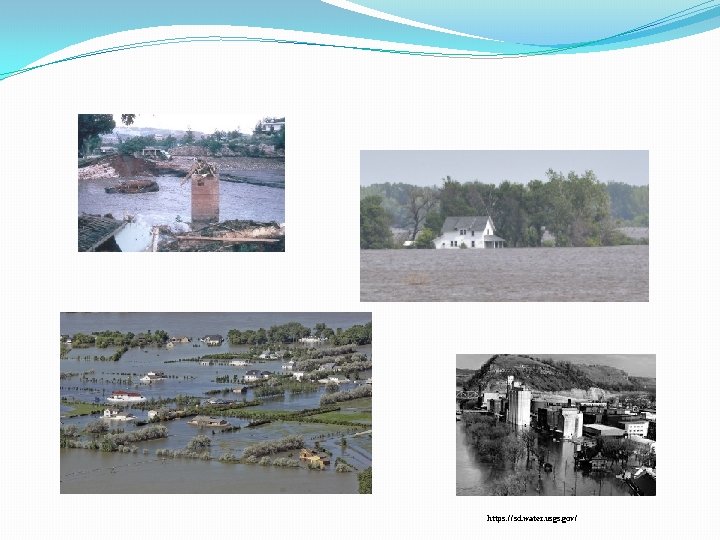
http: //www. indiana. edu/~g 105 lab/images/gaia_chapter_ 12/meander_formation. htm https: //en. wikipedia. org/wiki/Meander_scar Floodplain, meander, oxbow lakes What are the implications of constraining a river in its banks for flood control, agriculture or development?
https: //sd. water. usgs. gov/
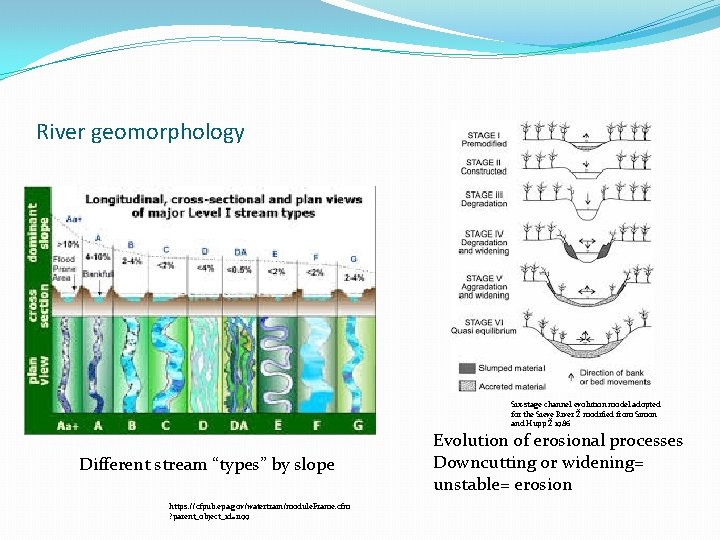
River geomorphology Six-stage channel evolution model adopted for the Sieve River Ž modified from Simon and Hupp Ž 1986 Different stream “types” by slope https: //cfpub. epa. gov/watertrain/module. Frame. cfm ? parent_object_id=1199 Evolution of erosional processes Downcutting or widening= unstable= erosion
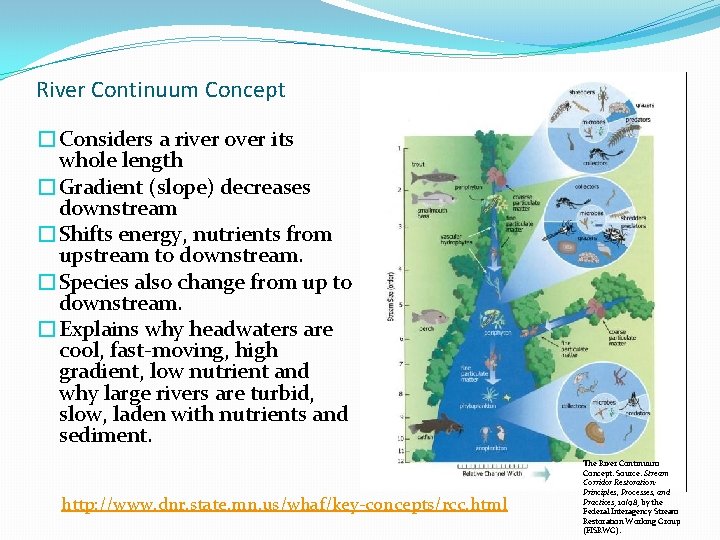
River Continuum Concept �Considers a river over its whole length �Gradient (slope) decreases downstream �Shifts energy, nutrients from upstream to downstream. �Species also change from up to downstream. �Explains why headwaters are cool, fast-moving, high gradient, low nutrient and why large rivers are turbid, slow, laden with nutrients and sediment. http: //www. dnr. state. mn. us/whaf/key-concepts/rcc. html The River Continuum Concept. Source: Stream Corridor Restoration: Principles, Processes, and Practices, 10/98, by the Federal Interagency Stream Restoration Working Group (FISRWG).
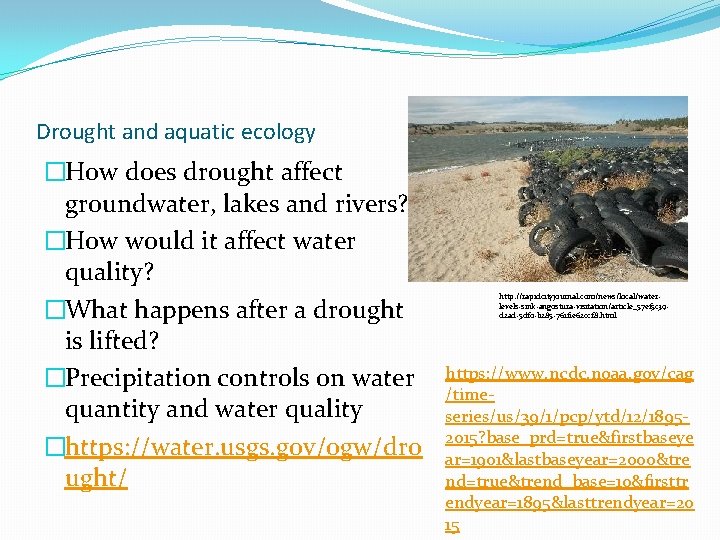
Drought and aquatic ecology �How does drought affect groundwater, lakes and rivers? �How would it affect water quality? �What happens after a drought is lifted? �Precipitation controls on water quantity and water quality �https: //water. usgs. gov/ogw/dro ught/ http: //rapidcityjournal. com/news/local/waterlevels-sink-angostura-visitation/article_57 ef 5 c 39 d 2 ad-5 df 0 -b 285 -761 f 1 e 62 ccf 8. html https: //www. ncdc. noaa. gov/cag /timeseries/us/39/1/pcp/ytd/12/18952015? base_prd=true&firstbaseye ar=1901&lastbaseyear=2000&tre nd=true&trend_base=10&firsttr endyear=1895&lasttrendyear=20 15
Water Chemistry 101 �p. H- can be too high or low for aquatic life, p. H of 5 -9 generally safe, in SD, too high of p. H is a problem connected with eutrophication. �Sediment �Bacteria: E. Coli �Fish flesh- mercury �Dissolved oxygen �Many possible chemicals to test for ( arsenic, cadmium fairly common but not routinely tested for) �Also test conductivity and temperature
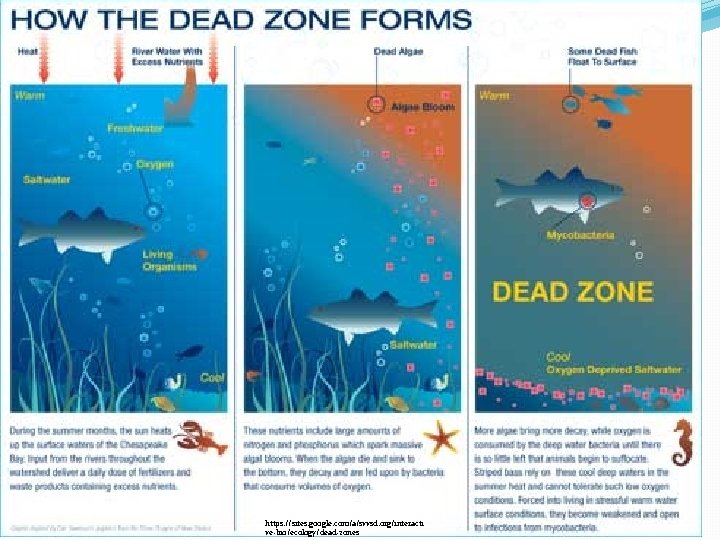
Water Chemistry 101: Dissolved oxygen and eutrophification � Lakes naturally progress toward more production. � Reservoirs especially fill with sediment, age and become eutrophic. � Inputs of nutrients ( N, P) accelerate algae growth and increase eutrophication. � Overly productive lakes contain algae that grow, bloom and die can result in crashes in dissolved oxygen that impact fish and aquatic life � Anoxia- when the bottom lake layer becomes oxygen-depleted can release inorganic phosphorus bound to the sediment= a vicious cycle where more phosphorus enters the water column, called internal loading � Biological health indices can indicate health or dysfunction over time given the presence or absence of certain groups and can be a proxy for water quality data. https: //water. usgs. gov/edu/dissolvedoxygen. html
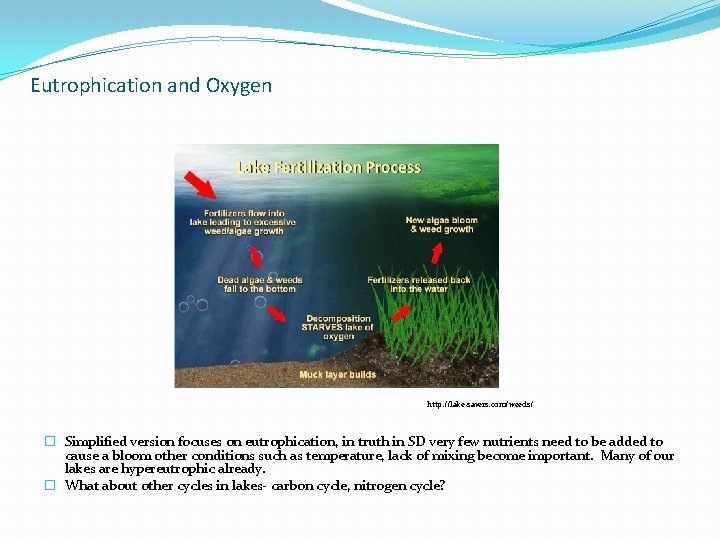
Eutrophication and Oxygen http: //lake-savers. com/weeds/ � Simplified version focuses on eutrophication, in truth in SD very few nutrients need to be added to cause a bloom other conditions such as temperature, lack of mixing become important. Many of our lakes are hypereutrophic already. � What about other cycles in lakes- carbon cycle, nitrogen cycle?
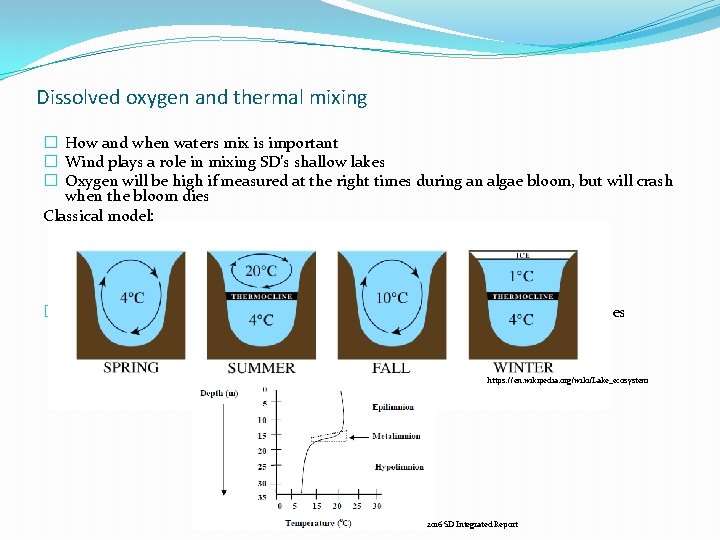
Dissolved oxygen and thermal mixing � How and when waters mix is important � Wind plays a role in mixing SD’s shallow lakes � Oxygen will be high if measured at the right times during an algae bloom, but will crash when the bloom dies Classical model: � Anoxic ( low to zero oxygen) layer can form on bottom forms when lake stratifies https: //en. wikipedia. org/wiki/Lake_ecosystem 2016 SD Integrated Report
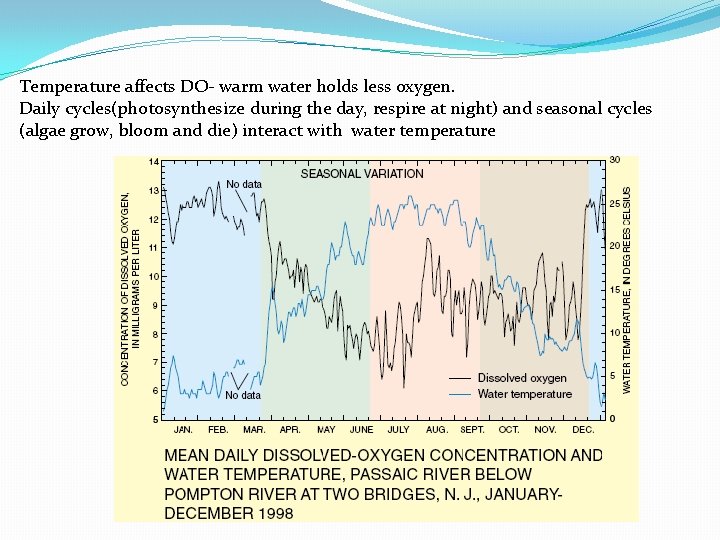
Temperature affects DO- warm water holds less oxygen. Daily cycles(photosynthesize during the day, respire at night) and seasonal cycles (algae grow, bloom and die) interact with water temperature
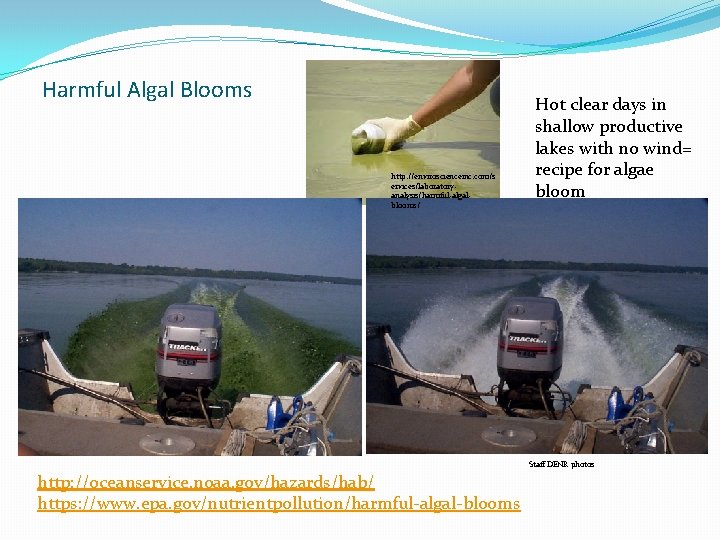
Harmful Algal Blooms http: //enviroscienceinc. com/s ervices/laboratoryanalysis/harmful-algalblooms/ Hot clear days in shallow productive lakes with no wind= recipe for algae bloom Staff DENR photos http: //oceanservice. noaa. gov/hazards/hab/ https: //www. epa. gov/nutrientpollution/harmful-algal-blooms
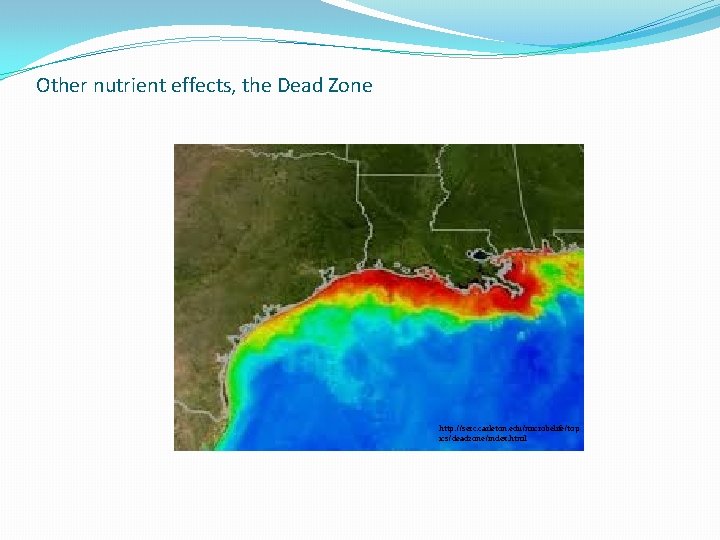
Other nutrient effects, the Dead Zone http: //serc. carleton. edu/microbelife/top ics/deadzone/index. html
https: //sites. google. com/a/svvsd. org/interacti ve-bio/ecology/dead-zones
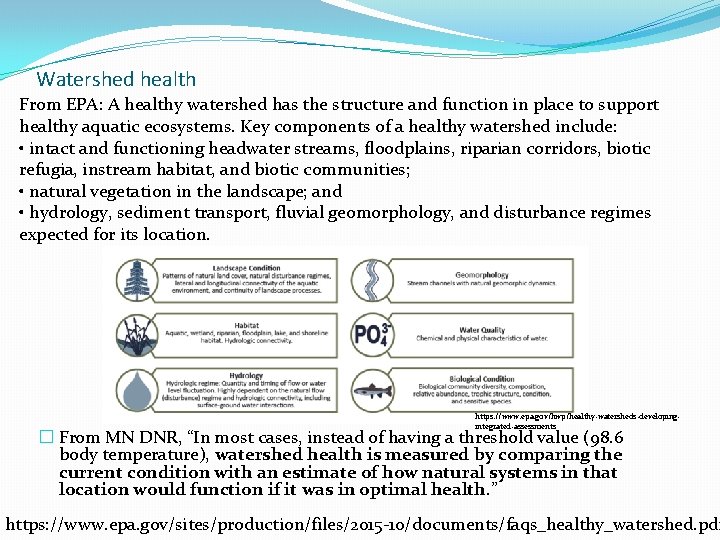
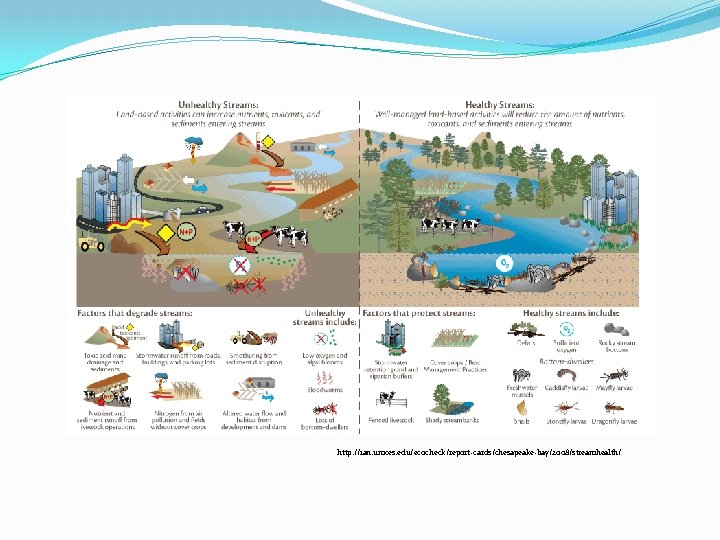
Watershed health From EPA: A healthy watershed has the structure and function in place to support healthy aquatic ecosystems. Key components of a healthy watershed include: • intact and functioning headwater streams, floodplains, riparian corridors, biotic refugia, instream habitat, and biotic communities; • natural vegetation in the landscape; and • hydrology, sediment transport, fluvial geomorphology, and disturbance regimes expected for its location. https: //www. epa. gov/hwp/healthy-watersheds-developingintegrated-assessments � From MN DNR, “In most cases, instead of having a threshold value (98. 6 body temperature), watershed health is measured by comparing the current condition with an estimate of how natural systems in that location would function if it was in optimal health. ” https: //www. epa. gov/sites/production/files/2015 -10/documents/faqs_healthy_watershed. pdf
http: //ian. umces. edu/ecocheck/report-cards/chesapeake-bay/2008/streamhealth/
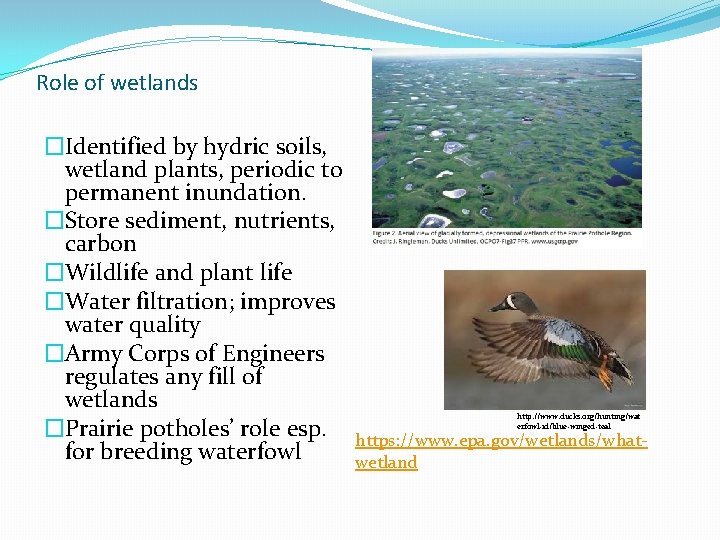
Role of wetlands �Identified by hydric soils, wetland plants, periodic to permanent inundation. �Store sediment, nutrients, carbon �Wildlife and plant life �Water filtration; improves water quality �Army Corps of Engineers regulates any fill of wetlands �Prairie potholes’ role esp. https: //www. epa. gov/wetlands/whatfor breeding waterfowl wetland http: //www. ducks. org/hunting/wat erfowl-id/blue-winged-teal
Keys to Aquatic Animals �Know basic fish biology and adaptations to the environment �Be aware of the importance of macroinvertebrates, how the presence of groups can tell something about water quality, functional roles and be able to identify from a key. �Be able to identify fish using a key. Know common, sport, bait, AIS (Aquatic Invasive Species) and T&E species. �http: //www. dep. wv. gov/WWE/getinvolved/sos/macros/Pa ges/Aq. Inverts. aspx �http: //mrbdc. mnsu. edu/macroinvertebrates �http: //www. waterontheweb. org/
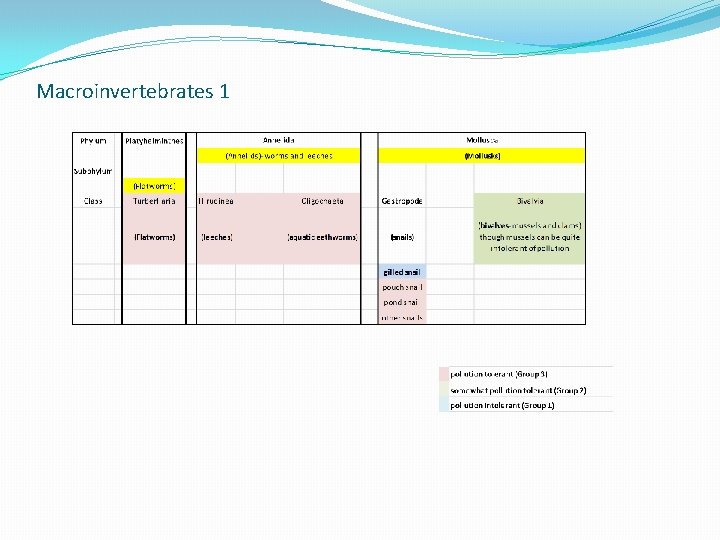
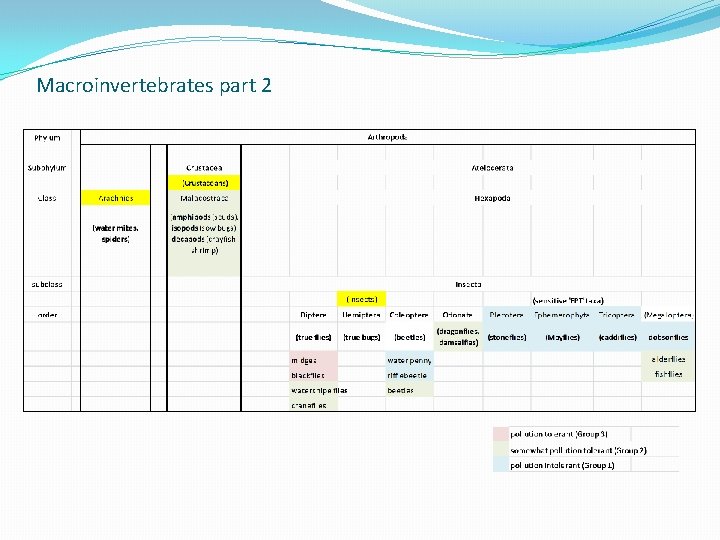
Macroinvertebrates �Pollution tolerance with some examples �Major groups (highlighted in yellow) with some examples �Basic body plan, features of groups �Be able to use a key to identify
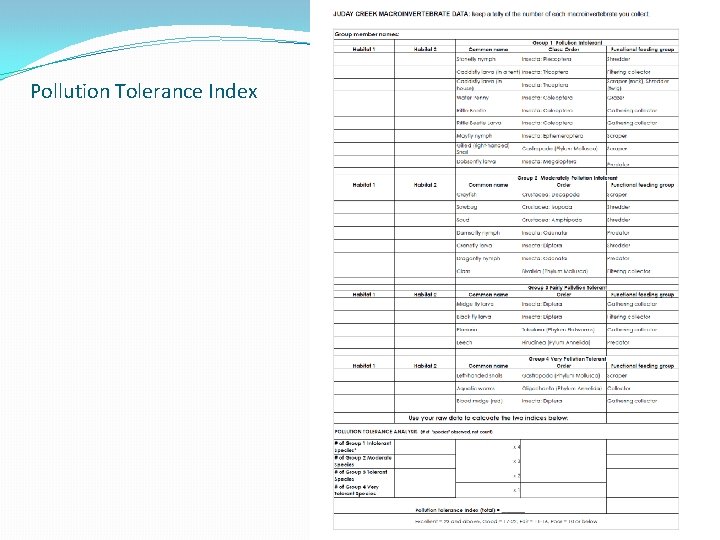
Pollution Tolerance Index
Macroinvertebrate functional roles�Shredders- feed on decaying organic matter (OM), leaves, twigs. Ex- scuds, stoneflies, caddisflies. Favor headwater streams. �Collectors/ filter feeders: feed on OM particles. Ex- black flies, riffle beetles, midges, mayflies, some caddisflies. All habitats. �Scrapers/Grazers : feed on algae. Ex- water pennies, mayflies, some caddisflies. Favors larger streams. �Predators- capture prey. All habitat types- dragonflies, damselflies, dobsonflies, alderflies, fishflies, aquatic beetles, stoneflies, spiders and water mites. Live in all habitats. �https: //www. water. wa. gov. au/__data/assets/pdf_file/0018/4527/ 12591. pdf �http: //www. lakegeorgeassociation. org/what-wedo/Education/Macroinvertebrates. htm
Macroinvertebrates 1
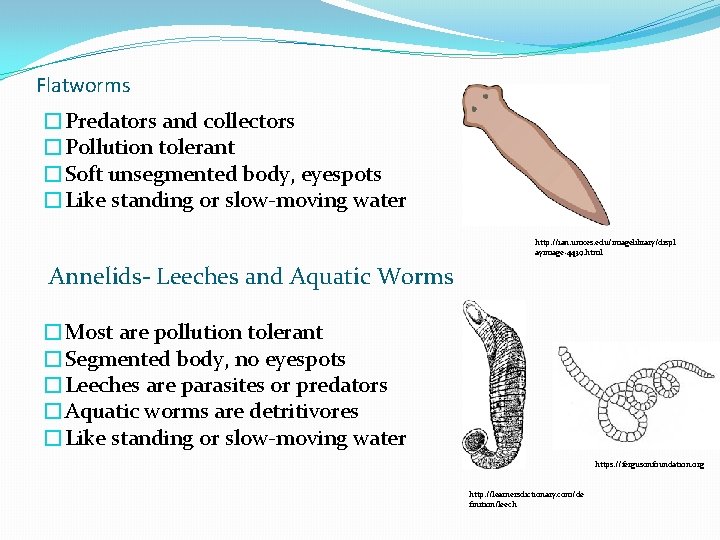
Flatworms �Predators and collectors �Pollution tolerant �Soft unsegmented body, eyespots �Like standing or slow-moving water http: //ian. umces. edu/imagelibrary/displ ayimage-4439. html Annelids- Leeches and Aquatic Worms �Most are pollution tolerant �Segmented body, no eyespots �Leeches are parasites or predators �Aquatic worms are detritivores �Like standing or slow-moving water https: //fergusonfoundation. org http: //learnersdictionary. com/de finition/leech
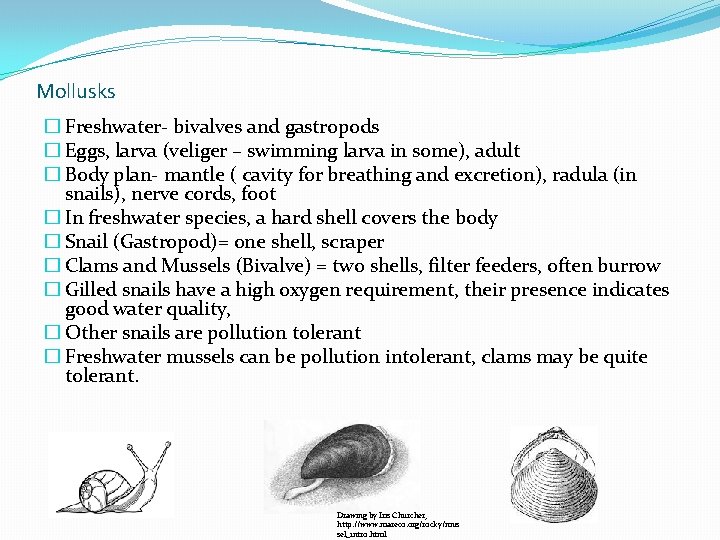
Mollusks � Freshwater- bivalves and gastropods � Eggs, larva (veliger – swimming larva in some), adult � Body plan- mantle ( cavity for breathing and excretion), radula (in snails), nerve cords, foot � In freshwater species, a hard shell covers the body � Snail (Gastropod)= one shell, scraper � Clams and Mussels (Bivalve) = two shells, filter feeders, often burrow � Gilled snails have a high oxygen requirement, their presence indicates good water quality, � Other snails are pollution tolerant � Freshwater mussels can be pollution intolerant, clams may be quite tolerant. Drawing by Iris Churcher, http: //www. mareco. org/rocky/mus sel_intro. html
Macroinvertebrates part 2
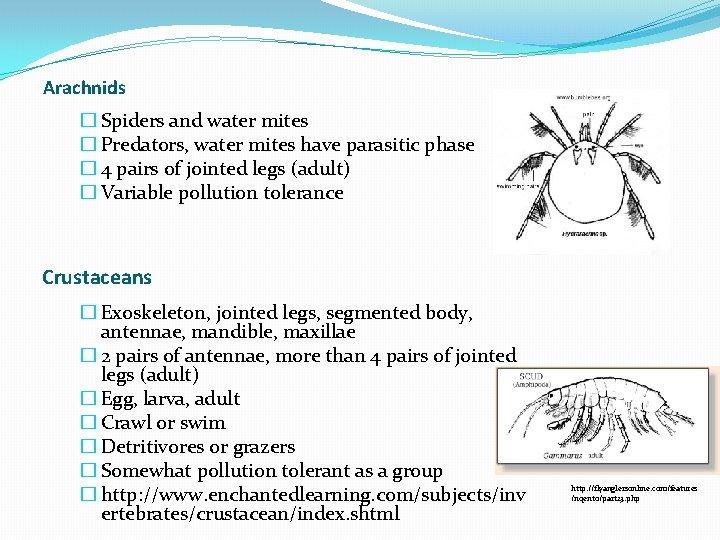
Arachnids � Spiders and water mites � Predators, water mites have parasitic phase � 4 pairs of jointed legs (adult) � Variable pollution tolerance Crustaceans � Exoskeleton, jointed legs, segmented body, antennae, mandible, maxillae � 2 pairs of antennae, more than 4 pairs of jointed legs (adult) � Egg, larva, adult � Crawl or swim � Detritivores or grazers � Somewhat pollution tolerant as a group � http: //www. enchantedlearning. com/subjects/inv ertebrates/crustacean/index. shtml http: //flyanglersonline. com/features /nqento/part 23. php
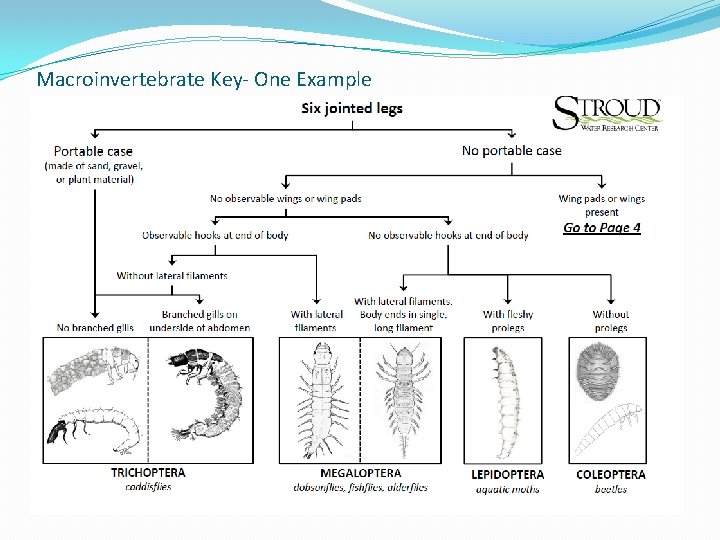
Insects �Arthropod �In adults: exoskeleton, three-part body: head, thorax, abdomen, three pairs of joined legs, compound eyes, two antennae �Life cycle: egg, larva, (pupa), adult �Larvae- to distinguish count tails and tail filaments, look for wing pads and abdominal gills; see Stroud Macro. Key for practice http: //www. enchantedlearning. com/subjects/insects/pr intouts. shtml
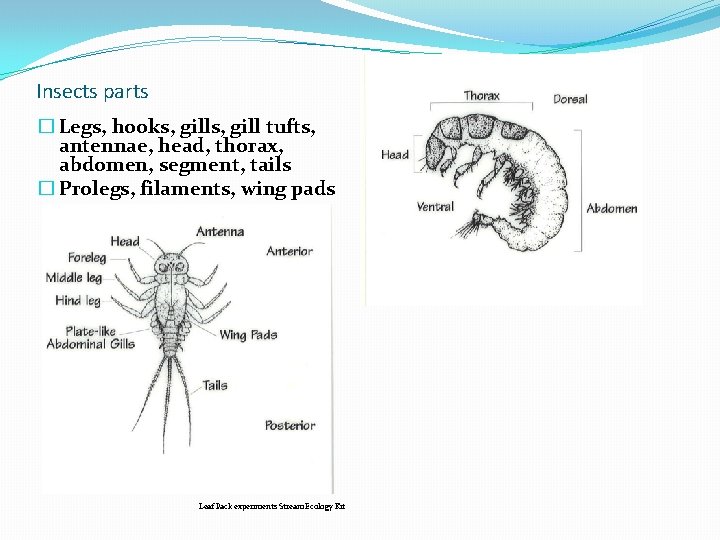
Insects parts � Legs, hooks, gill tufts, antennae, head, thorax, abdomen, segment, tails � Prolegs, filaments, wing pads Leaf Pack experiments Stream Ecology Kit
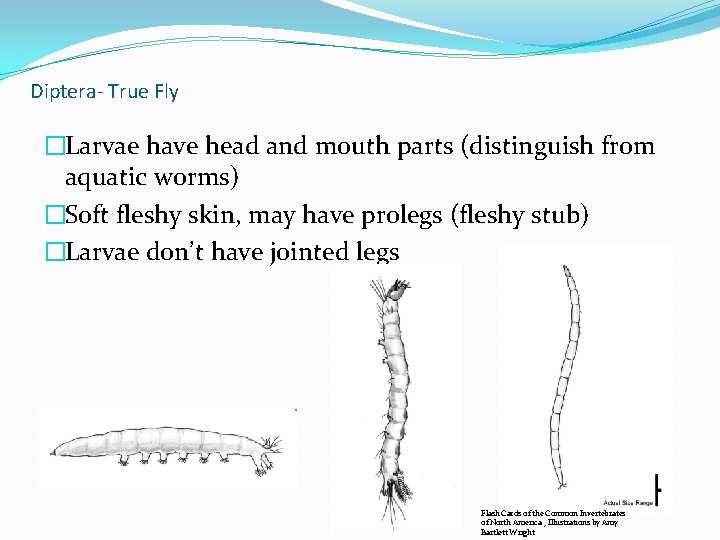
Diptera- True Fly �Larvae have head and mouth parts (distinguish from aquatic worms) �Soft fleshy skin, may have prolegs (fleshy stub) �Larvae don’t have jointed legs Flash Cards of the Common Invertebrates of North America , Illustrations by Amy Bartlett Wright
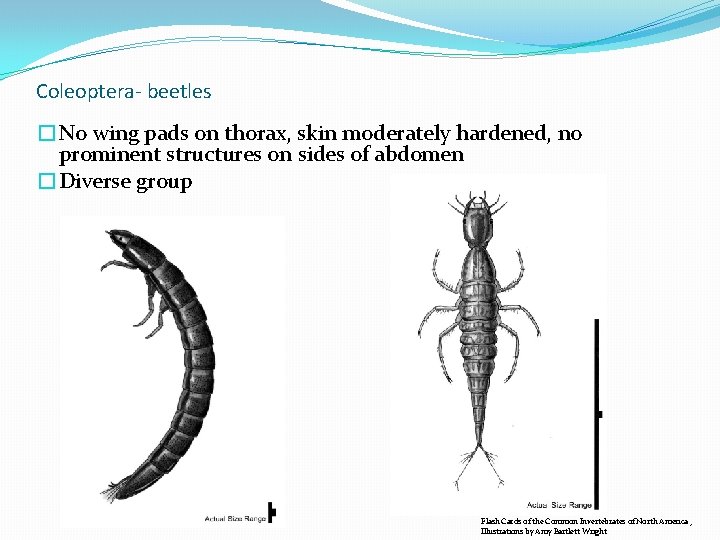
Coleoptera- beetles �No wing pads on thorax, skin moderately hardened, no prominent structures on sides of abdomen �Diverse group Flash Cards of the Common Invertebrates of North America , Illustrations by Amy Bartlett Wright
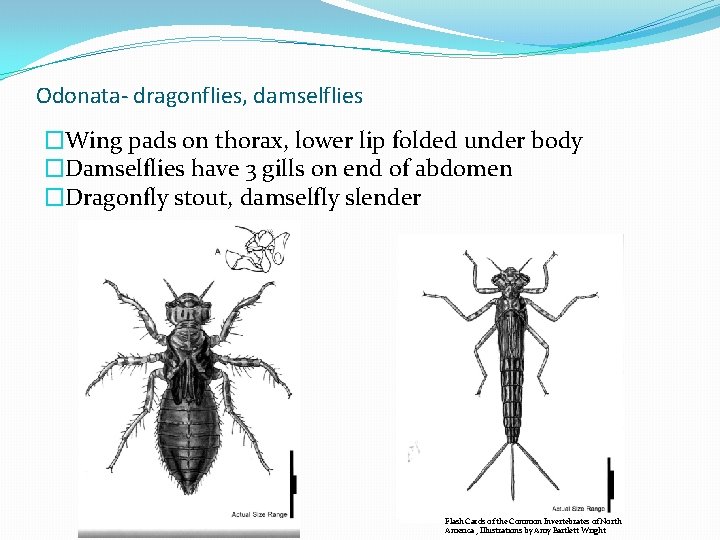
Odonata- dragonflies, damselflies �Wing pads on thorax, lower lip folded under body �Damselflies have 3 gills on end of abdomen �Dragonfly stout, damselfly slender Flash Cards of the Common Invertebrates of North America , Illustrations by Amy Bartlett Wright
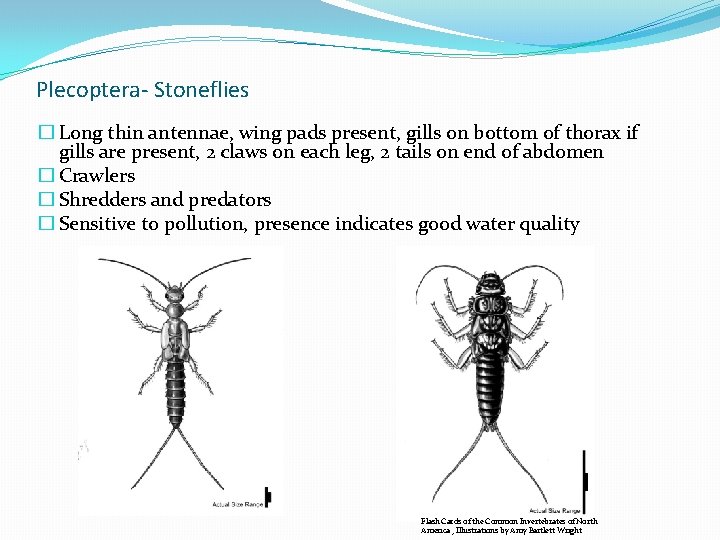
Plecoptera- Stoneflies � Long thin antennae, wing pads present, gills on bottom of thorax if gills are present, 2 claws on each leg, 2 tails on end of abdomen � Crawlers � Shredders and predators � Sensitive to pollution, presence indicates good water quality Flash Cards of the Common Invertebrates of North America , Illustrations by Amy Bartlett Wright
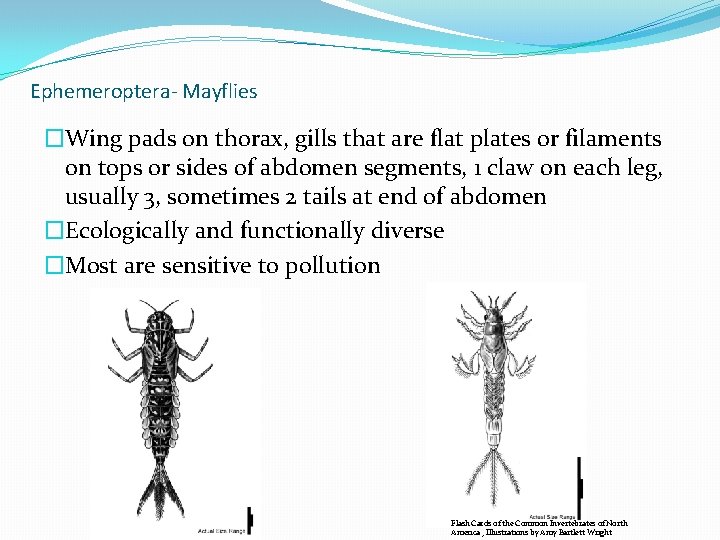
Ephemeroptera- Mayflies �Wing pads on thorax, gills that are flat plates or filaments on tops or sides of abdomen segments, 1 claw on each leg, usually 3, sometimes 2 tails at end of abdomen �Ecologically and functionally diverse �Most are sensitive to pollution Flash Cards of the Common Invertebrates of North America , Illustrations by Amy Bartlett Wright
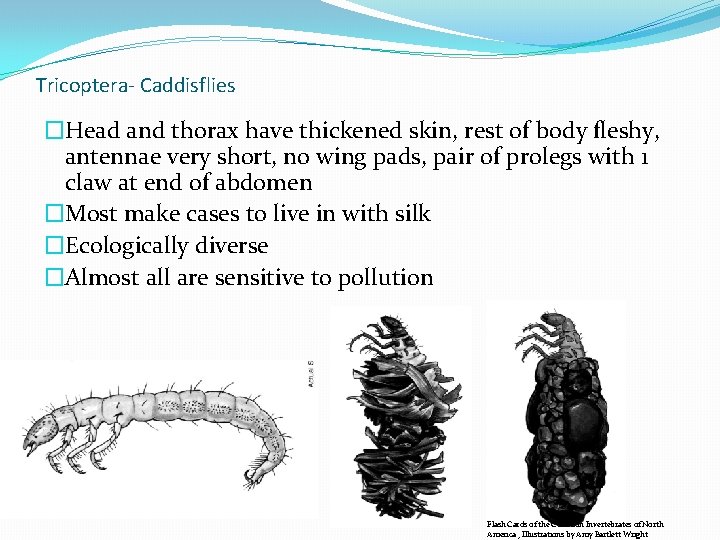
Tricoptera- Caddisflies �Head and thorax have thickened skin, rest of body fleshy, antennae very short, no wing pads, pair of prolegs with 1 claw at end of abdomen �Most make cases to live in with silk �Ecologically diverse �Almost all are sensitive to pollution Flash Cards of the Common Invertebrates of North America , Illustrations by Amy Bartlett Wright
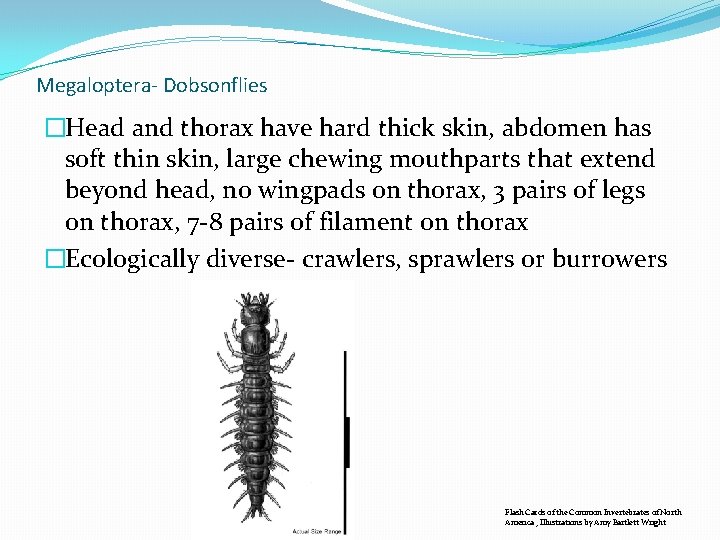
Megaloptera- Dobsonflies �Head and thorax have hard thick skin, abdomen has soft thin skin, large chewing mouthparts that extend beyond head, no wingpads on thorax, 3 pairs of legs on thorax, 7 -8 pairs of filament on thorax �Ecologically diverse- crawlers, sprawlers or burrowers Flash Cards of the Common Invertebrates of North America , Illustrations by Amy Bartlett Wright
Macroinvertebrate Key- One Example
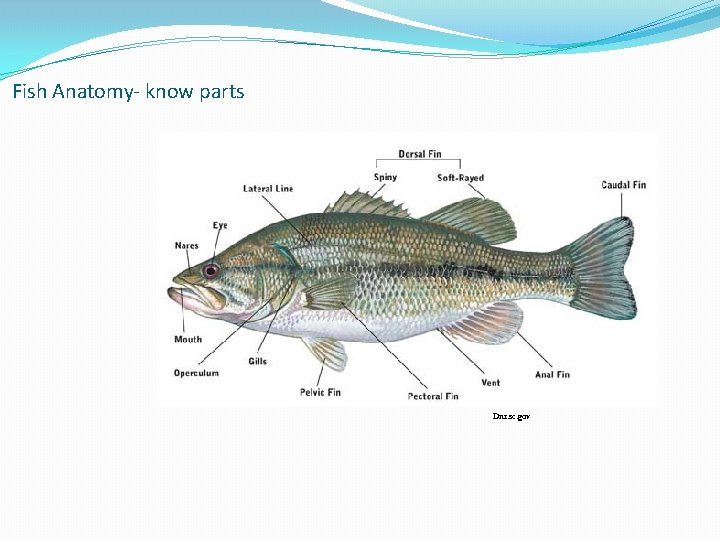
Fish Anatomy- know parts Dnr. sc. gov
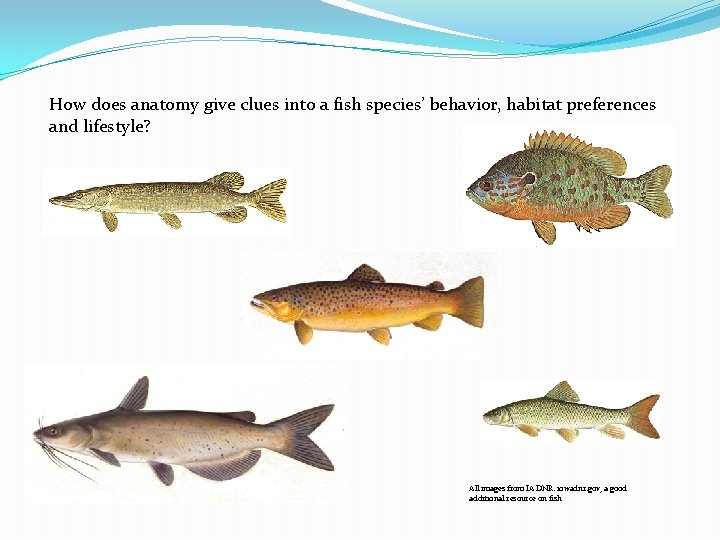
How does anatomy give clues into a fish species’ behavior, habitat preferences and lifestyle? All images from IA DNR: iowadnr. gov, a good additional resource on fish
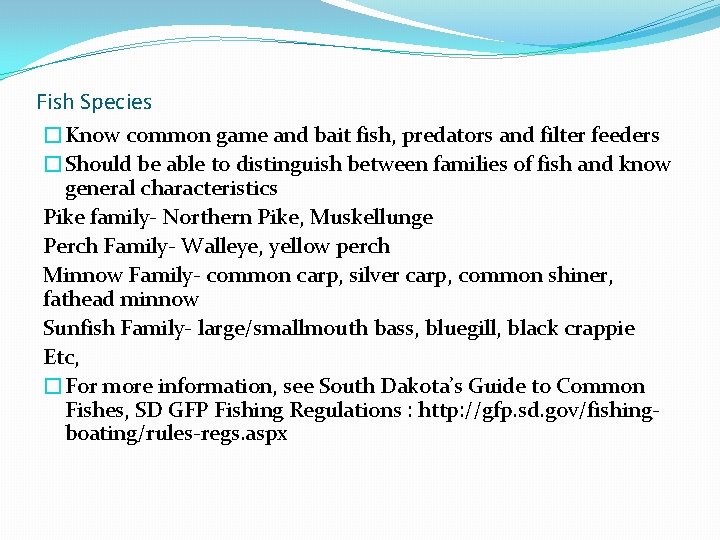
Fish Species �Know common game and bait fish, predators and filter feeders �Should be able to distinguish between families of fish and know general characteristics Pike family- Northern Pike, Muskellunge Perch Family- Walleye, yellow perch Minnow Family- common carp, silver carp, common shiner, fathead minnow Sunfish Family- large/smallmouth bass, bluegill, black crappie Etc, �For more information, see South Dakota’s Guide to Common Fishes, SD GFP Fishing Regulations : http: //gfp. sd. gov/fishingboating/rules-regs. aspx
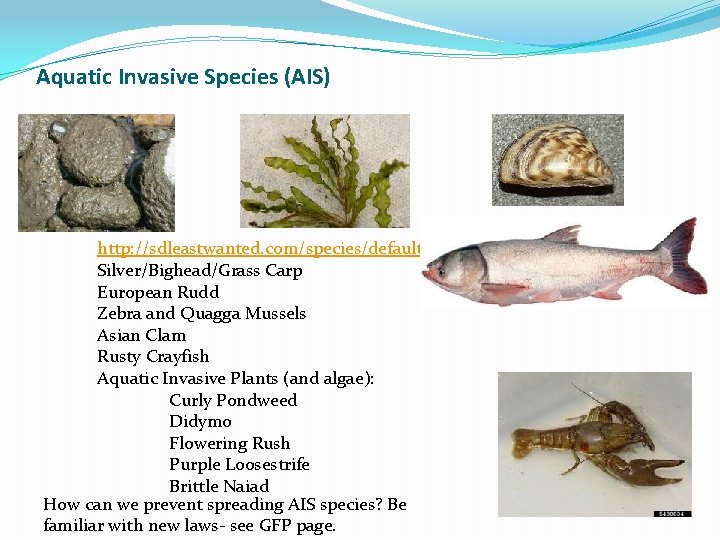
Aquatic Invasive Species (AIS) http: //sdleastwanted. com/species/default. aspx Silver/Bighead/Grass Carp European Rudd Zebra and Quagga Mussels Asian Clam Rusty Crayfish Aquatic Invasive Plants (and algae): Curly Pondweed Didymo Flowering Rush Purple Loosestrife Brittle Naiad How can we prevent spreading AIS species? Be familiar with new laws- see GFP page.
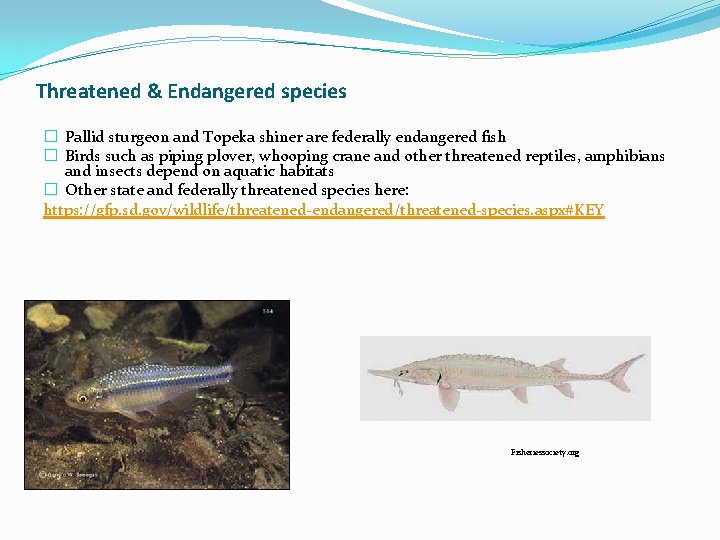
Threatened & Endangered species � Pallid sturgeon and Topeka shiner are federally endangered fish � Birds such as piping plover, whooping crane and other threatened reptiles, amphibians and insects depend on aquatic habitats � Other state and federally threatened species here: https: //gfp. sd. gov/wildlife/threatened-endangered/threatened-species. aspx#KEY Fisheriessociety. org
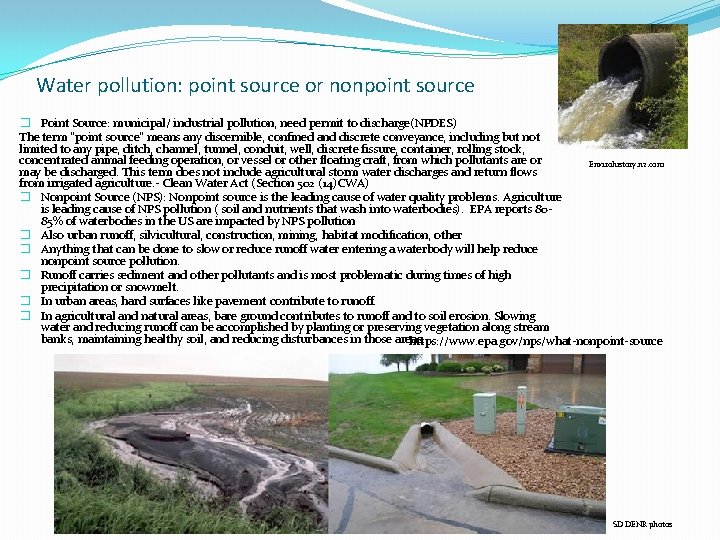
Water pollution: point source or nonpoint source � Point Source: municipal/ industrial pollution, need permit to discharge(NPDES) The term "point source" means any discernible, confined and discrete conveyance, including but not limited to any pipe, ditch, channel, tunnel, conduit, well, discrete fissure, container, rolling stock, concentrated animal feeding operation, or vessel or other floating craft, from which pollutants are or Envirohistory. nz. com may be discharged. This term does not include agricultural storm water discharges and return flows from irrigated agriculture. - Clean Water Act (Section 502 (14)CWA) � Nonpoint Source (NPS): Nonpoint source is the leading cause of water quality problems. Agriculture is leading cause of NPS pollution ( soil and nutrients that wash into waterbodies). EPA reports 8085% of waterbodies in the US are impacted by NPS pollution � Also urban runoff, silvicultural, construction, mining, habitat modification, other � Anything that can be done to slow or reduce runoff water entering a waterbody will help reduce nonpoint source pollution. � Runoff carries sediment and other pollutants and is most problematic during times of high precipitation or snowmelt. � In urban areas, hard surfaces like pavement contribute to runoff. � In agricultural and natural areas, bare ground contributes to runoff and to soil erosion. Slowing water and reducing runoff can be accomplished by planting or preserving vegetation along stream banks, maintaining healthy soil, and reducing disturbances in those areas. https: //www. epa. gov/nps/what-nonpoint-source SD DENR photos
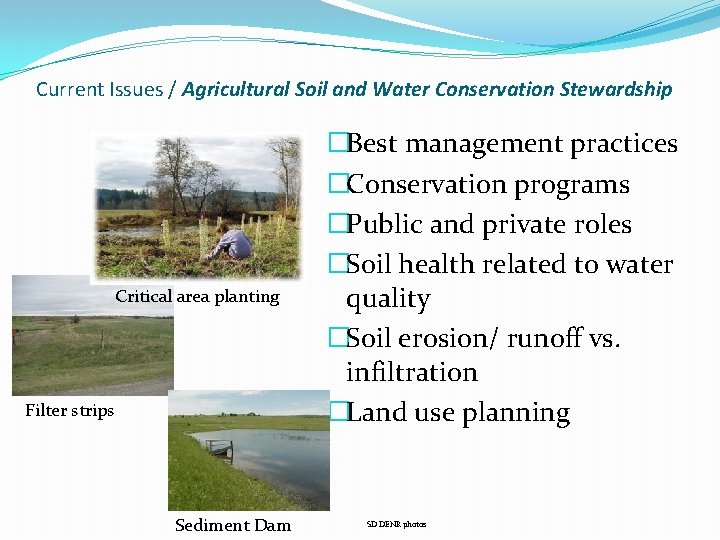
Current Issues / Agricultural Soil and Water Conservation Stewardship Critical area planting Filter strips Sediment Dam �Best management practices �Conservation programs �Public and private roles �Soil health related to water quality �Soil erosion/ runoff vs. infiltration �Land use planning SD DENR photos
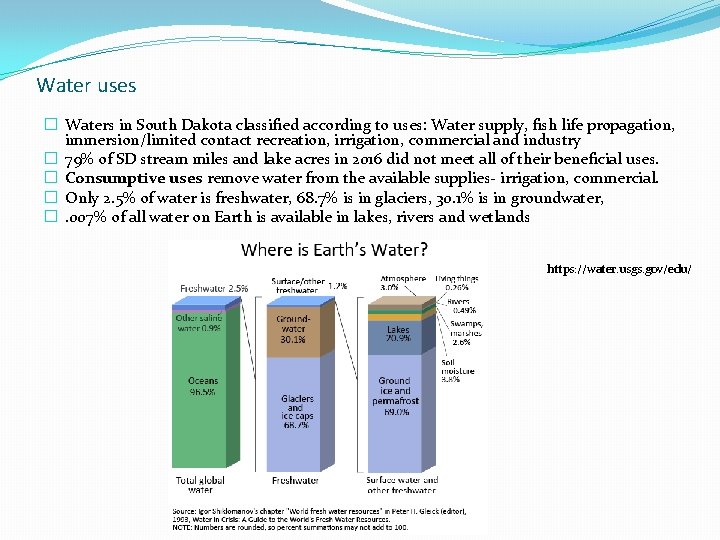
Water uses � Waters in South Dakota classified according to uses: Water supply, fish life propagation, immersion/limited contact recreation, irrigation, commercial and industry � 79% of SD stream miles and lake acres in 2016 did not meet all of their beneficial uses. � Consumptive uses remove water from the available supplies- irrigation, commercial. � Only 2. 5% of water is freshwater, 68. 7% is in glaciers, 30. 1% is in groundwater, �. 007% of all water on Earth is available in lakes, rivers and wetlands https: //water. usgs. gov/edu/
Water Conservation �Reducing water usage �Also “ all the policies, strategies and activities to sustainable manage fresh water resources, protect the water environment, meet current and future human demand. ” � Also “balancing current and future needs” �Related to our current issue, promoting healthy soil and infiltration to reduce runoff �Be an informed and educated citizen http: //www. nationalgeographic. com/environment/freshwater/water-conservation-tips/
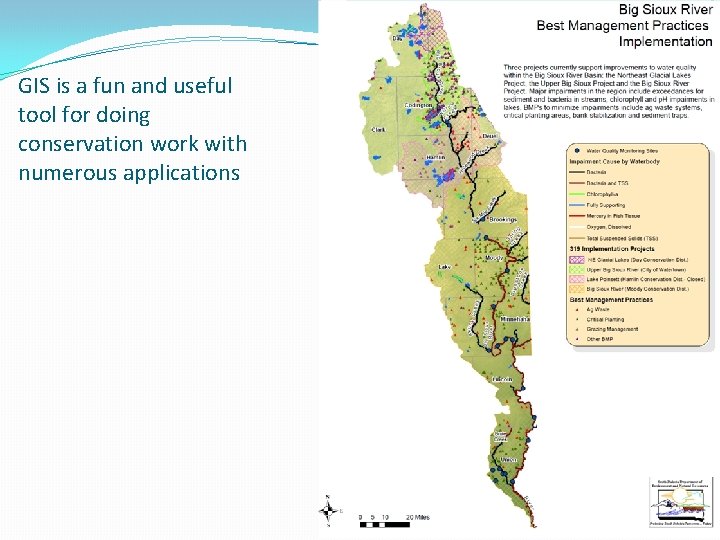
GIS is a fun and useful tool for doing conservation work with numerous applications
(Some) Important Rules, Regulations, and Agencies SD GFP: public lands, fishing and boating regs https: //gfp. sd. gov/fishing-boating/rules-regs. aspx Also some private land assistance South Dakota DENR: State standards for air and water quality, beneficial uses for waters of the state and total maximum daily loads for waters that do not meet uses https: //denr. sd. gov/lawsrulesindex. aspx Natural Resources Conservation Service (USDA): Conservation Programs to reduce erosion and nonpoint source pollution in the agriculture sector, drought information Environmental Protection Agency: Implements Clean Water Act, Safe Drinking Water Act https: //www. epa. gov/laws-regulations/summary-clean-water-act USGS: Collect, analyze and interpret water quality data
Questions? Anine Rosse, Environmental Scientist, SD DENR Anine. Rosse@state. sd. us Dennis Skadsen, Watershed Coordinator, Day County Conservation District dennis. skadsen@sd. nacdnet. net