
SUSTAINING AQUATIC BIODIVERSITY Core case study 1 Protecting
SUSTAINING AQUATIC BIODIVERSITY
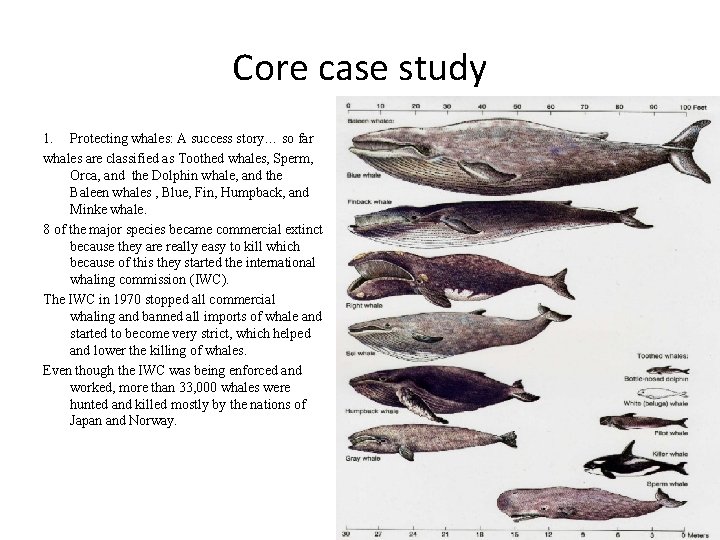
Core case study 1. Protecting whales: A success story… so far whales are classified as Toothed whales, Sperm, Orca, and the Dolphin whale, and the Baleen whales , Blue, Fin, Humpback, and Minke whale. 8 of the major species became commercial extinct because they are really easy to kill which because of this they started the international whaling commission (IWC). The IWC in 1970 stopped all commercial whaling and banned all imports of whale and started to become very strict, which helped and lower the killing of whales. Even though the IWC was being enforced and worked, more than 33, 000 whales were hunted and killed mostly by the nations of Japan and Norway.
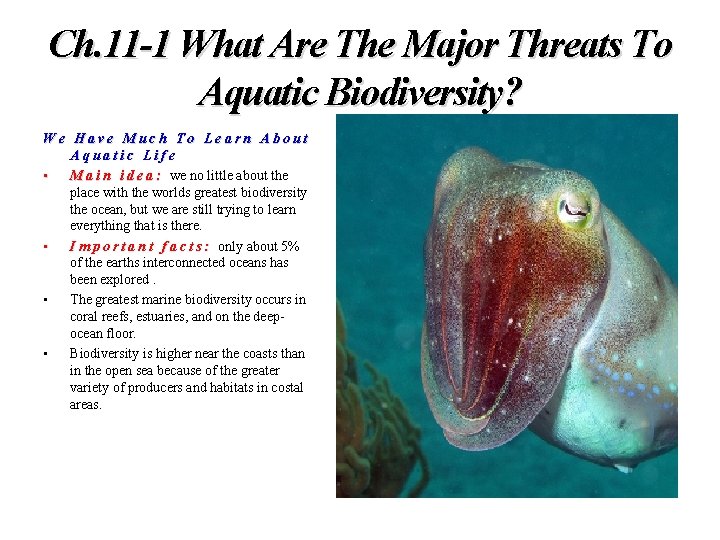
Ch. 11 -1 What Are The Major Threats To Aquatic Biodiversity? We Have Much To Learn About Aquatic Life • M a i n i d e a : we no little about the place with the worlds greatest biodiversity the ocean, but we are still trying to learn everything that is there. • I m p o r t a n t f a c t s : only about 5% of the earths interconnected oceans has been explored. • The greatest marine biodiversity occurs in coral reefs, estuaries, and on the deepocean floor. • Biodiversity is higher near the coasts than in the open sea because of the greater variety of producers and habitats in costal areas.
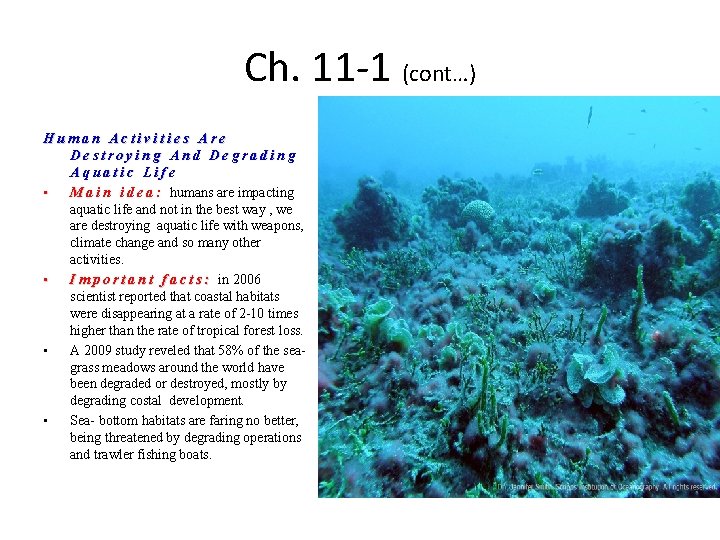
Ch. 11 -1 (cont…) Human Activities Are Destroying And Degrading Aquatic Life • M a i n i d e a : humans are impacting aquatic life and not in the best way , we are destroying aquatic life with weapons, climate change and so many other activities. • I m p o r t a n t f a c t s : in 2006 scientist reported that coastal habitats were disappearing at a rate of 2 -10 times higher than the rate of tropical forest loss. • A 2009 study reveled that 58% of the seagrass meadows around the world have been degraded or destroyed, mostly by degrading costal development. • Sea- bottom habitats are faring no better, being threatened by degrading operations and trawler fishing boats.
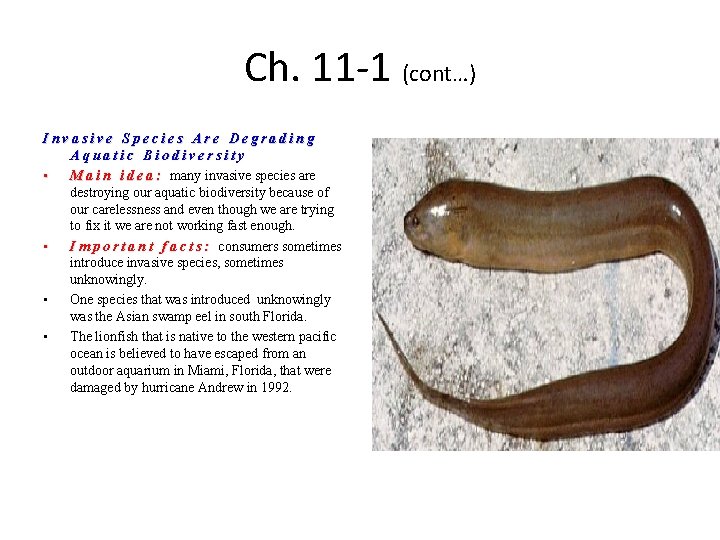
Ch. 11 -1 (cont…) Invasive Species Are Degrading Aquatic Biodiversity • M a i n i d e a : many invasive species are destroying our aquatic biodiversity because of our carelessness and even though we are trying to fix it we are not working fast enough. • I m p o r t a n t f a c t s : consumers sometimes introduce invasive species, sometimes unknowingly. • One species that was introduced unknowingly was the Asian swamp eel in south Florida. • The lionfish that is native to the western pacific ocean is believed to have escaped from an outdoor aquarium in Miami, Florida, that were damaged by hurricane Andrew in 1992.
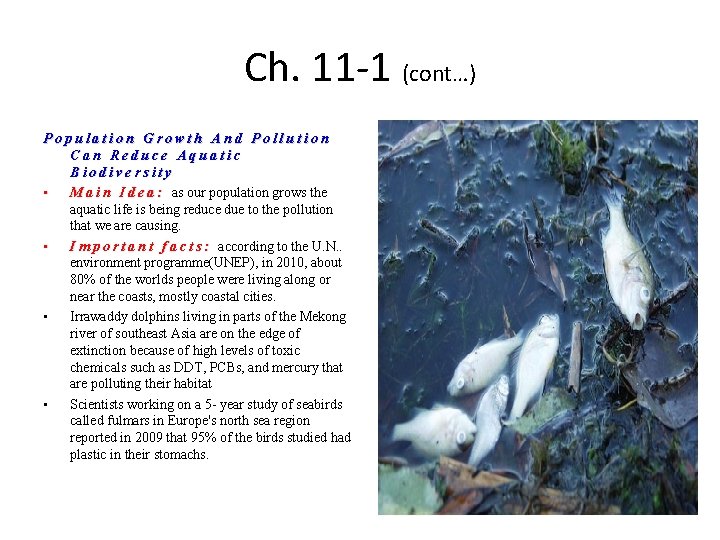
Ch. 11 -1 (cont…) Population Growth And Pollution Can Reduce Aquatic Biodiversity • M a i n I d e a : as our population grows the aquatic life is being reduce due to the pollution that we are causing. • I m p o r t a n t f a c t s : according to the U. N. . environment programme(UNEP), in 2010, about 80% of the worlds people were living along or near the coasts, mostly coastal cities. • Irrawaddy dolphins living in parts of the Mekong river of southeast Asia are on the edge of extinction because of high levels of toxic chemicals such as DDT, PCBs, and mercury that are polluting their habitat • Scientists working on a 5 - year study of seabirds called fulmars in Europe's north sea region reported in 2009 that 95% of the birds studied had plastic in their stomachs.
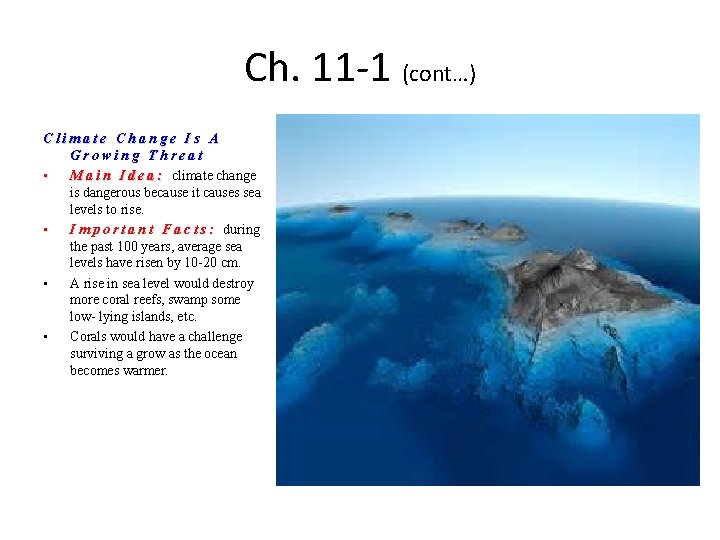
Ch. 11 -1 (cont…) Climate Change Is A Growing Threat • M a i n I d e a : climate change is dangerous because it causes sea levels to rise. • I m p o r t a n t F a c t s : during the past 100 years, average sea levels have risen by 10 -20 cm. • A rise in sea level would destroy more coral reefs, swamp some low- lying islands, etc. • Corals would have a challenge surviving a grow as the ocean becomes warmer.
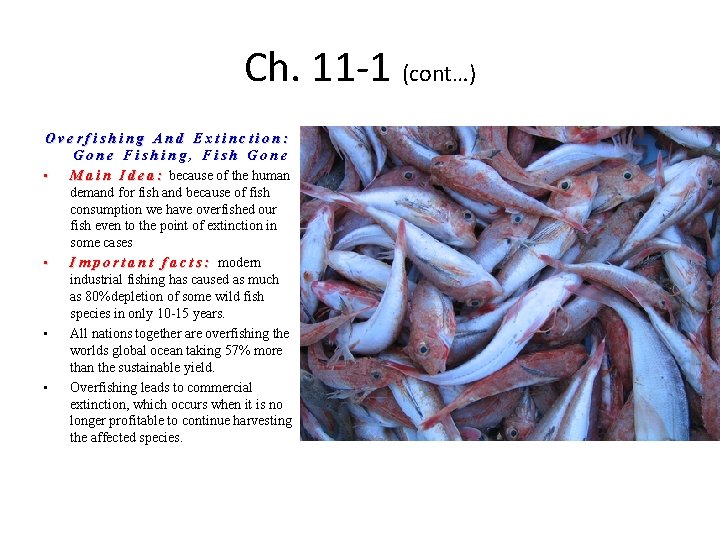
Ch. 11 -1 (cont…) Overfishing And Extinction: Gone Fishing, Fish Gone • M a i n I d e a : because of the human demand for fish and because of fish consumption we have overfished our fish even to the point of extinction in some cases • I m p o r t a n t f a c t s : modern industrial fishing has caused as much as 80%depletion of some wild fish species in only 10 -15 years. • All nations together are overfishing the worlds global ocean taking 57% more than the sustainable yield. • Overfishing leads to commercial extinction, which occurs when it is no longer profitable to continue harvesting the affected species.
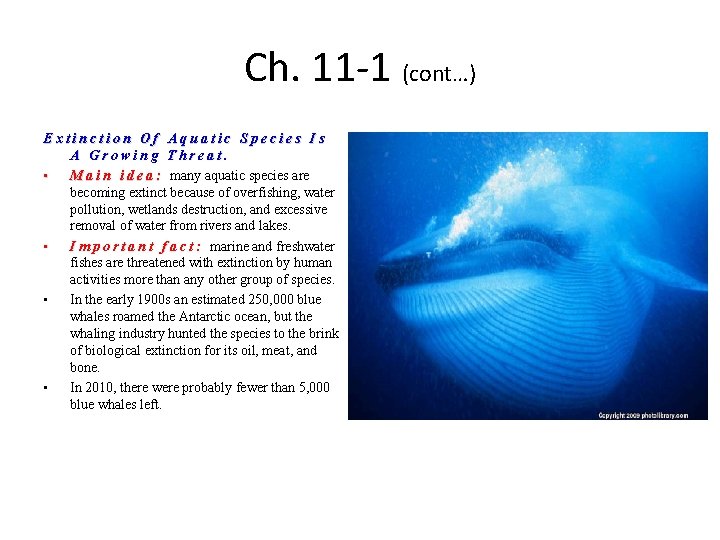
Ch. 11 -1 (cont…) Extinction Of Aquatic Species Is A Growing Threat. • M a i n i d e a : many aquatic species are becoming extinct because of overfishing, water pollution, wetlands destruction, and excessive removal of water from rivers and lakes. • I m p o r t a n t f a c t : marine and freshwater fishes are threatened with extinction by human activities more than any other group of species. • In the early 1900 s an estimated 250, 000 blue whales roamed the Antarctic ocean, but the whaling industry hunted the species to the brink of biological extinction for its oil, meat, and bone. • In 2010, there were probably fewer than 5, 000 blue whales left.
Ch. 11 -2 how can we protect and sustain marine biodiversity Laws And Treaties Have Protected Some Endangered And Threatened Marine Species • M a i n i d e a : monitoring and enforcing these laws are difficult but we can still help sustain our marine biodiversity by having these laws. • I m p o r t a n t f a c t s : national and international laws and treaties to help protect marine species include the 1975 convention on international trade in endangered species(CITES) • These laws also include the 1979 global treaty on migratory species. • The U. S. endangered species act and several international agreements have been used to identify and protect endangered and threatened marine species such as whales, seals, sea lions, and sea turtles.
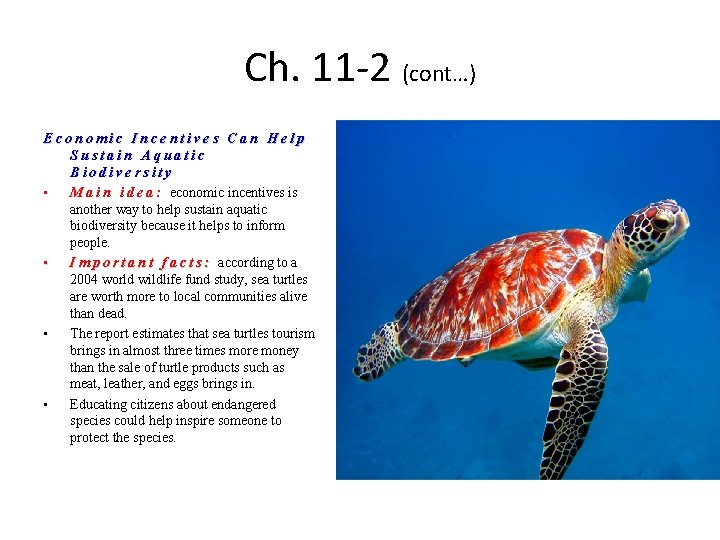
Ch. 11 -2 (cont…) Economic Incentives Can Help Sustain Aquatic Biodiversity • M a i n i d e a : economic incentives is another way to help sustain aquatic biodiversity because it helps to inform people. • I m p o r t a n t f a c t s : according to a 2004 world wildlife fund study, sea turtles are worth more to local communities alive than dead. • The report estimates that sea turtles tourism brings in almost three times more money than the sale of turtle products such as meat, leather, and eggs brings in. • Educating citizens about endangered species could help inspire someone to protect the species.
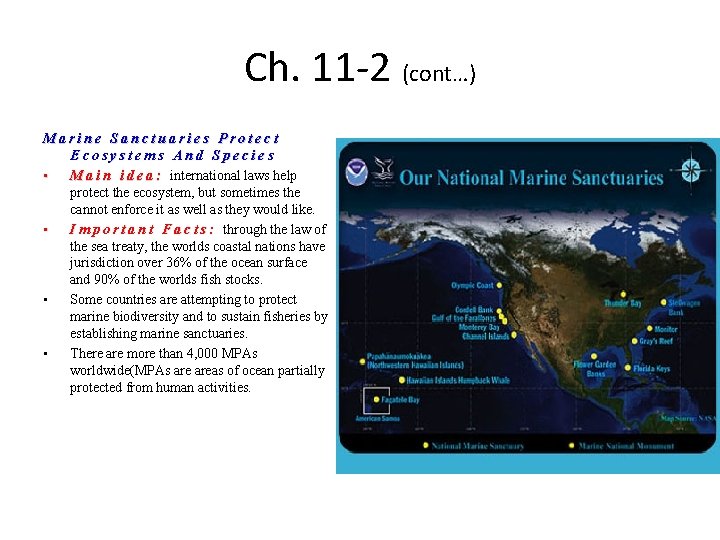
Ch. 11 -2 (cont…) Marine Sanctuaries Protect Ecosystems And Species • M a i n i d e a : international laws help protect the ecosystem, but sometimes the cannot enforce it as well as they would like. • I m p o r t a n t F a c t s : through the law of the sea treaty, the worlds coastal nations have jurisdiction over 36% of the ocean surface and 90% of the worlds fish stocks. • Some countries are attempting to protect marine biodiversity and to sustain fisheries by establishing marine sanctuaries. • There are more than 4, 000 MPAs worldwide(MPAs areas of ocean partially protected from human activities.
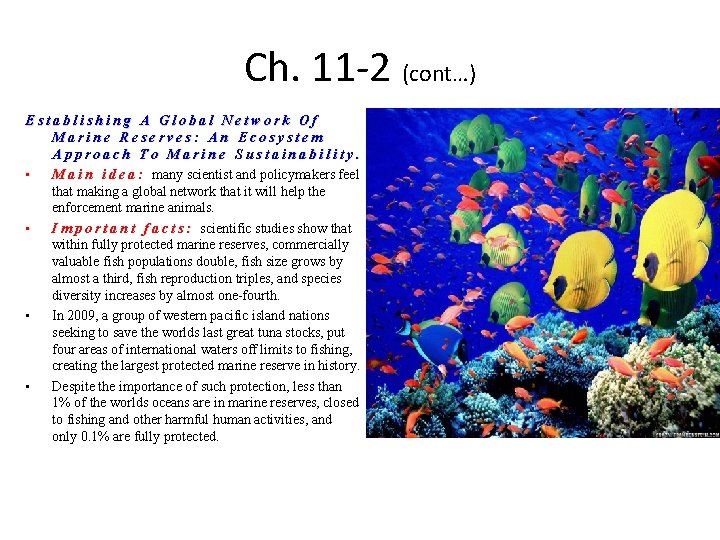
Ch. 11 -2 (cont…) Establishing A Global Network Of Marine Reserves: An Ecosystem Approach To Marine Sustainability. • M a i n i d e a : many scientist and policymakers feel that making a global network that it will help the enforcement marine animals. • I m p o r t a n t f a c t s : scientific studies show that within fully protected marine reserves, commercially valuable fish populations double, fish size grows by almost a third, fish reproduction triples, and species diversity increases by almost one-fourth. • In 2009, a group of western pacific island nations seeking to save the worlds last great tuna stocks, put four areas of international waters off limits to fishing, creating the largest protected marine reserve in history. • Despite the importance of such protection, less than 1% of the worlds oceans are in marine reserves, closed to fishing and other harmful human activities, and only 0. 1% are fully protected.
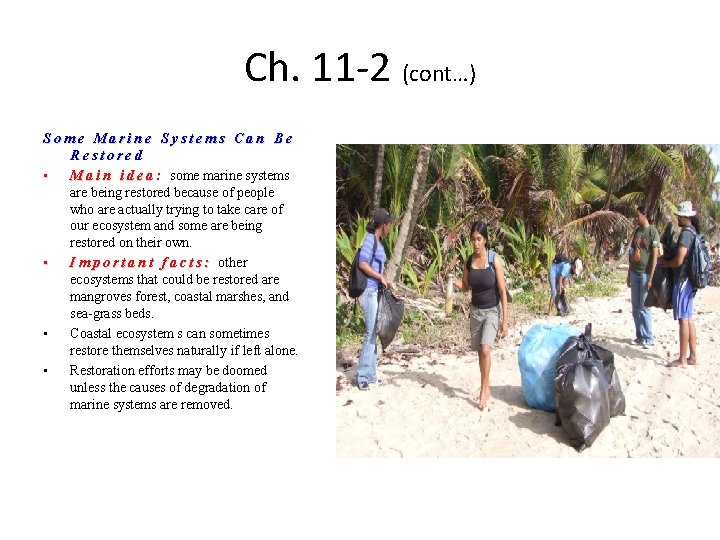
Ch. 11 -2 (cont…) Some Marine Systems Can Be Restored • M a i n i d e a : some marine systems are being restored because of people who are actually trying to take care of our ecosystem and some are being restored on their own. • I m p o r t a n t f a c t s : other ecosystems that could be restored are mangroves forest, coastal marshes, and sea-grass beds. • Coastal ecosystem s can sometimes restore themselves naturally if left alone. • Restoration efforts may be doomed unless the causes of degradation of marine systems are removed.
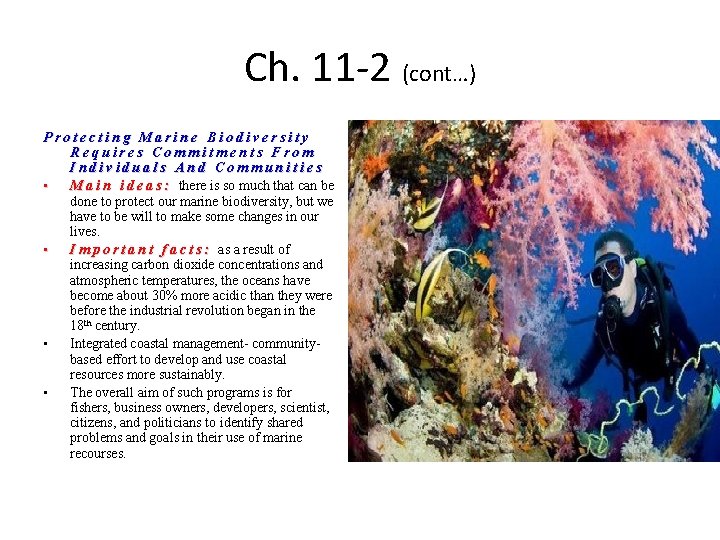
Ch. 11 -2 (cont…) Protecting Marine Biodiversity Requires Commitments From Individuals And Communities • M a i n i d e a s : there is so much that can be done to protect our marine biodiversity, but we have to be will to make some changes in our lives. • I m p o r t a n t f a c t s : as a result of increasing carbon dioxide concentrations and atmospheric temperatures, the oceans have become about 30% more acidic than they were before the industrial revolution began in the 18 th century. • Integrated coastal management- communitybased effort to develop and use coastal resources more sustainably. • The overall aim of such programs is for fishers, business owners, developers, scientist, citizens, and politicians to identify shared problems and goals in their use of marine recourses.
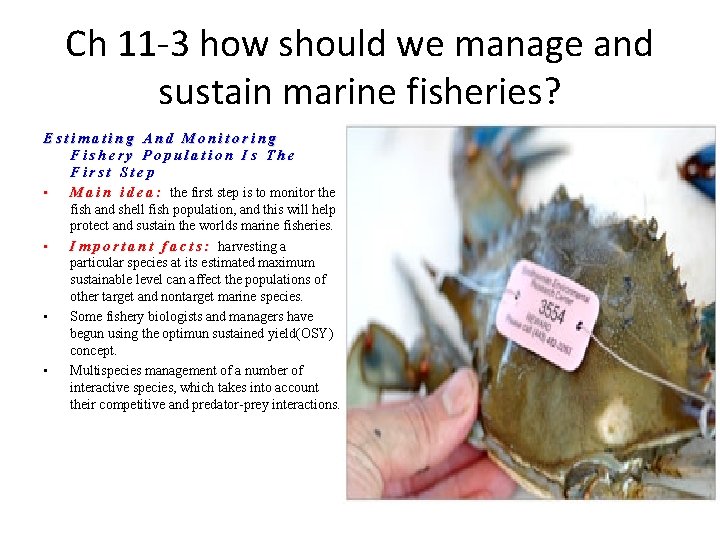
Ch 11 -3 how should we manage and sustain marine fisheries? Estimating And Monitoring Fishery Population Is The First Step • M a i n i d e a : the first step is to monitor the fish and shell fish population, and this will help protect and sustain the worlds marine fisheries. • I m p o r t a n t f a c t s : harvesting a particular species at its estimated maximum sustainable level can affect the populations of other target and nontarget marine species. • Some fishery biologists and managers have begun using the optimun sustained yield(OSY) concept. • Multispecies management of a number of interactive species, which takes into account their competitive and predator-prey interactions.
Ch. 11 -3 (cont. . . ) Some Communities Cooperate To Regulate Fish Harvests • M a i n I d e a : a way to protect marine biodiversity and fisheries is by regulating fishing, and many communities have already set up systems to regulate fishing. • I m p o r t a n t F a c t s : Norway's Lofoten fishery has been self- regulated, with no participation by the Norwegian government for 100 years. • Community management systems have often been replaced by co- management. • A central government typically sets quotas for various species and divides the quotas among communities.
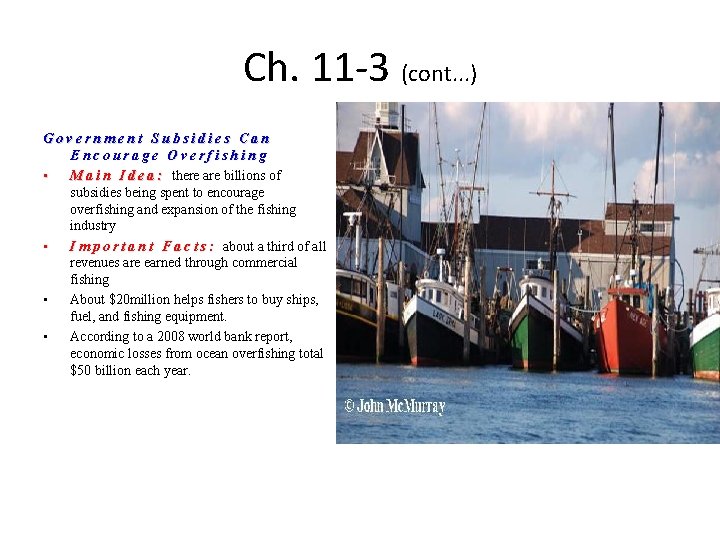
Ch. 11 -3 (cont. . . ) Government Subsidies Can Encourage Overfishing • M a i n I d e a : there are billions of subsidies being spent to encourage overfishing and expansion of the fishing industry • I m p o r t a n t F a c t s : about a third of all revenues are earned through commercial fishing • About $20 million helps fishers to buy ships, fuel, and fishing equipment. • According to a 2008 world bank report, economic losses from ocean overfishing total $50 billion each year.
Ch. 11 -3 (cont. . . ) Consumer Choices Can Help Sustain Fisheries And Aquatic Biodiversity • M a i n I d e a : over all the important component to sustaining the aquatic life is all dependent on the consumer. • I m p o r t a n t F a c t s : a way to help consumers make the right choice is by labeling fresh and frozen seafood to inform consumers about how and where the fish and shellfish were caught • Another way is through certification of sustainably caught seafood • “fish forever” eco-label certifies that the fish were caught by fishers who used environmentally sound and socially responsible practices.
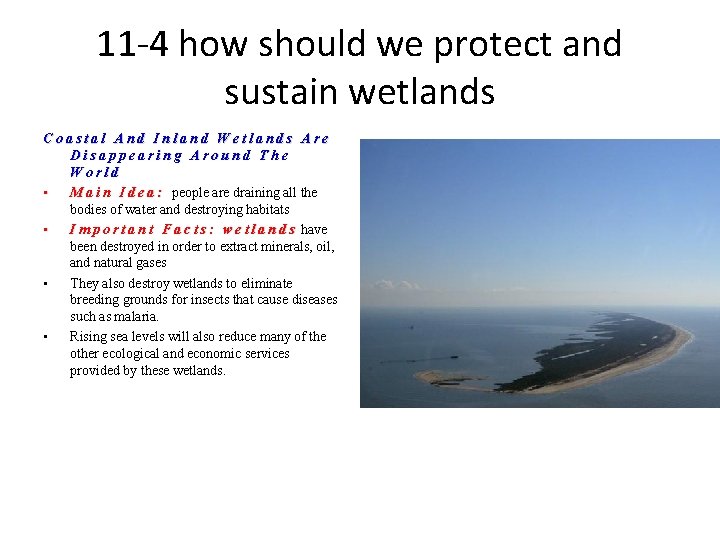
11 -4 how should we protect and sustain wetlands Coastal And Inland Wetlands Are Disappearing Around The World • M a i n I d e a : people are draining all the bodies of water and destroying habitats • I m p o r t a n t F a c t s : w e t l a n d s have been destroyed in order to extract minerals, oil, and natural gases • They also destroy wetlands to eliminate breeding grounds for insects that cause diseases such as malaria. • Rising sea levels will also reduce many of the other ecological and economic services provided by these wetlands.
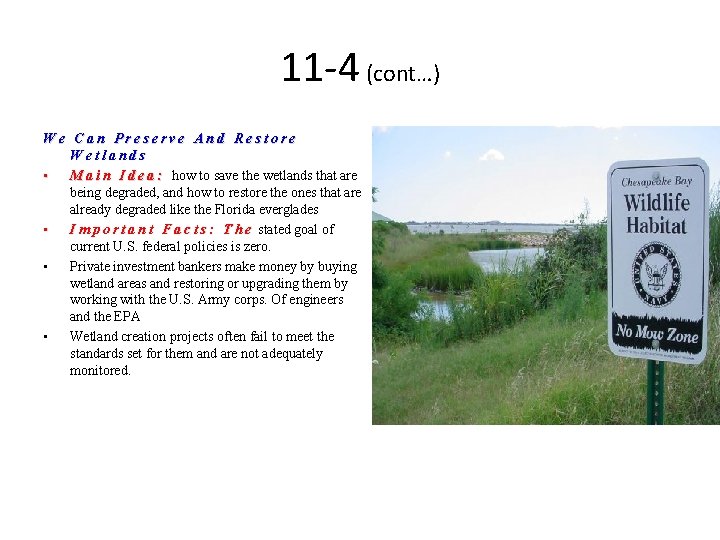
11 -4 (cont…) We Can Preserve And Restore Wetlands • M a i n I d e a : how to save the wetlands that are being degraded, and how to restore the ones that are already degraded like the Florida everglades • I m p o r t a n t F a c t s : T h e stated goal of current U. S. federal policies is zero. • Private investment bankers make money by buying wetland areas and restoring or upgrading them by working with the U. S. Army corps. Of engineers and the EPA • Wetland creation projects often fail to meet the standards set for them and are not adequately monitored.
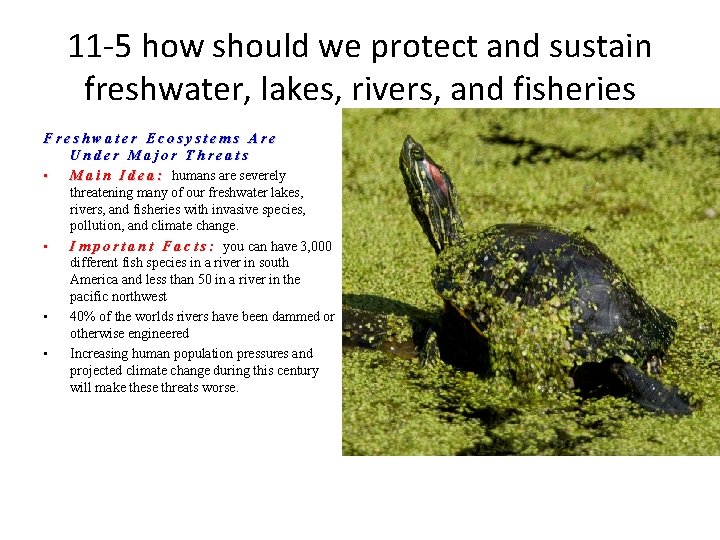
11 -5 how should we protect and sustain freshwater, lakes, rivers, and fisheries Freshwater Ecosystems Are Under Major Threats • M a i n I d e a : humans are severely threatening many of our freshwater lakes, rivers, and fisheries with invasive species, pollution, and climate change. • I m p o r t a n t F a c t s : you can have 3, 000 different fish species in a river in south America and less than 50 in a river in the pacific northwest • 40% of the worlds rivers have been dammed or otherwise engineered • Increasing human population pressures and projected climate change during this century will make these threats worse.
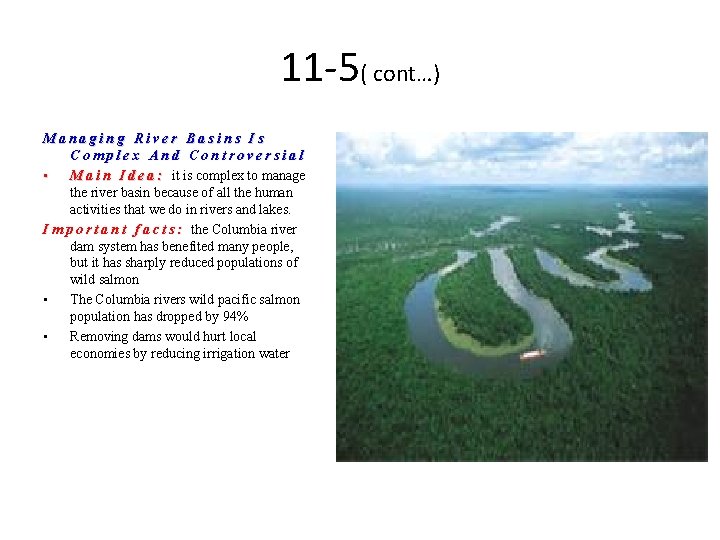
11 -5( cont…) Managing River Basins Is Complex And Controversial • M a i n I d e a : it is complex to manage the river basin because of all the human activities that we do in rivers and lakes. I m p o r t a n t f a c t s : the Columbia river dam system has benefited many people, but it has sharply reduced populations of wild salmon • The Columbia rivers wild pacific salmon population has dropped by 94% • Removing dams would hurt local economies by reducing irrigation water
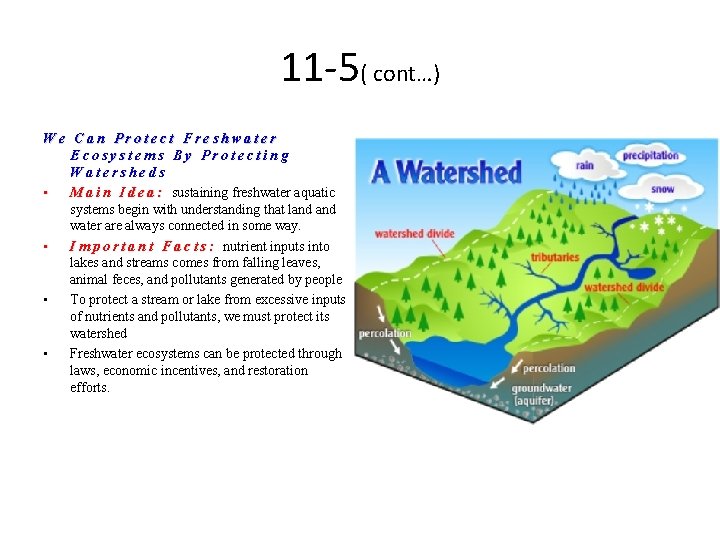
11 -5( cont…) We Can Protect Freshwater Ecosystems By Protecting Watersheds • M a i n I d e a : sustaining freshwater aquatic systems begin with understanding that land water are always connected in some way. • I m p o r t a n t F a c t s : nutrient inputs into lakes and streams comes from falling leaves, animal feces, and pollutants generated by people • To protect a stream or lake from excessive inputs of nutrients and pollutants, we must protect its watershed • Freshwater ecosystems can be protected through laws, economic incentives, and restoration efforts.
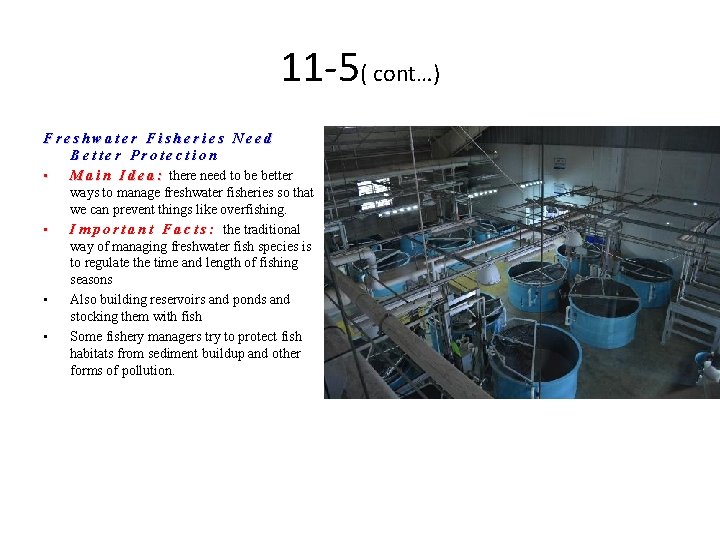
11 -5( cont…) Freshwater Fisheries Need Better Protection • M a i n I d e a : there need to be better ways to manage freshwater fisheries so that we can prevent things like overfishing. • I m p o r t a n t F a c t s : the traditional way of managing freshwater fish species is to regulate the time and length of fishing seasons • Also building reservoirs and ponds and stocking them with fish • Some fishery managers try to protect fish habitats from sediment buildup and other forms of pollution.
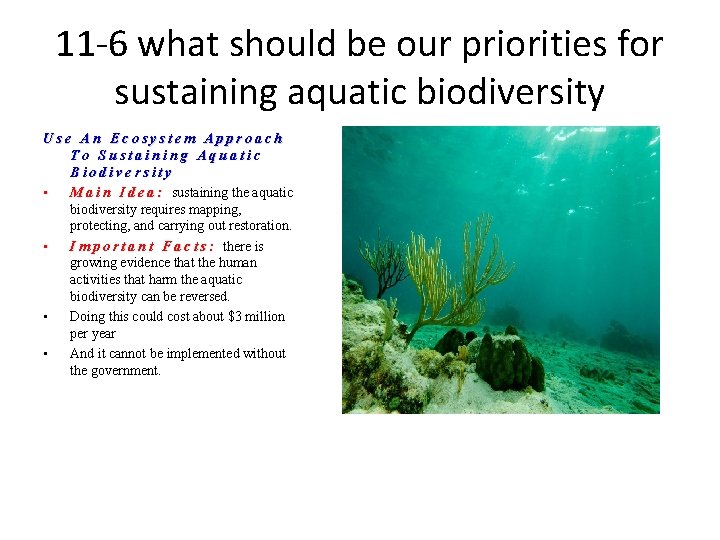
11 -6 what should be our priorities for sustaining aquatic biodiversity Use An Ecosystem Approach To Sustaining Aquatic Biodiversity • M a i n I d e a : sustaining the aquatic biodiversity requires mapping, protecting, and carrying out restoration. • I m p o r t a n t F a c t s : there is growing evidence that the human activities that harm the aquatic biodiversity can be reversed. • Doing this could cost about $3 million per year • And it cannot be implemented without the government.
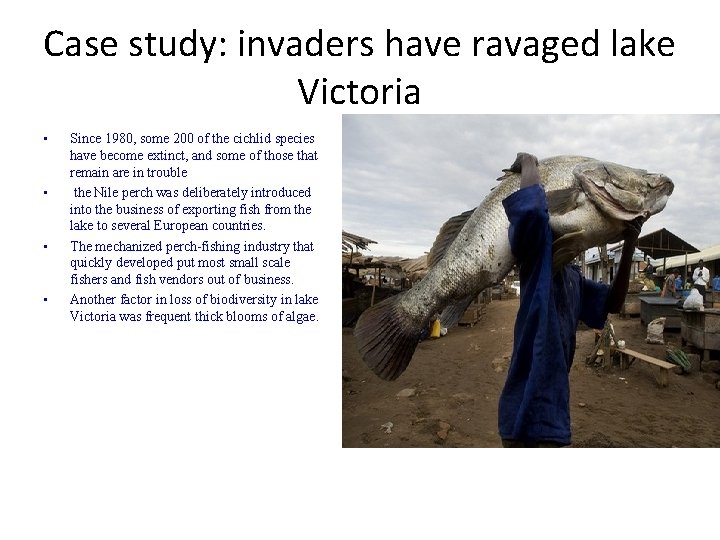
Case study: invaders have ravaged lake Victoria • • Since 1980, some 200 of the cichlid species have become extinct, and some of those that remain are in trouble the Nile perch was deliberately introduced into the business of exporting fish from the lake to several European countries. The mechanized perch-fishing industry that quickly developed put most small scale fishers and fish vendors out of business. Another factor in loss of biodiversity in lake Victoria was frequent thick blooms of algae.
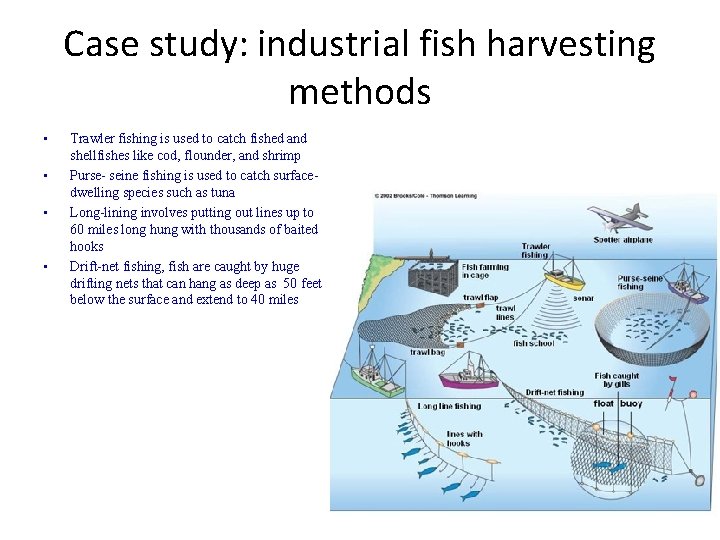
Case study: industrial fish harvesting methods • • Trawler fishing is used to catch fished and shellfishes like cod, flounder, and shrimp Purse- seine fishing is used to catch surfacedwelling species such as tuna Long-lining involves putting out lines up to 60 miles long hung with thousands of baited hooks Drift-net fishing, fish are caught by huge drifting nets that can hang as deep as 50 feet below the surface and extend to 40 miles
Case study: the international whaling commission moratorium on commercial whaling • • Some scientists argue that the IWC moratorium on whaling has helped some whale species to recover. Japan, Norway, and Iceland allow killing of the whales and ignore the IWC All three are hoping to over throw the IWC Whaling proponents contend that the moratorium should be lifted because populations of minke, humpback, and several other whale species have rebounded
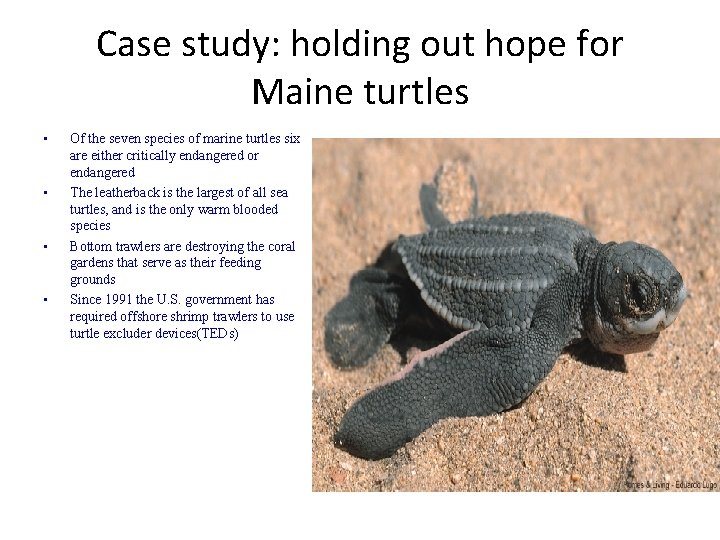
Case study: holding out hope for Maine turtles • • Of the seven species of marine turtles six are either critically endangered or endangered The leatherback is the largest of all sea turtles, and is the only warm blooded species Bottom trawlers are destroying the coral gardens that serve as their feeding grounds Since 1991 the U. S. government has required offshore shrimp trawlers to use turtle excluder devices(TEDs)
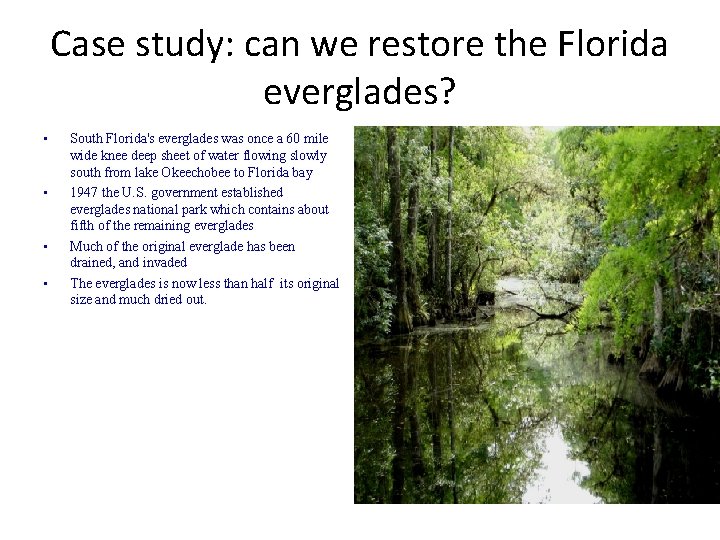
Case study: can we restore the Florida everglades? • • South Florida's everglades was once a 60 mile wide knee deep sheet of water flowing slowly south from lake Okeechobee to Florida bay 1947 the U. S. government established everglades national park which contains about fifth of the remaining everglades Much of the original everglade has been drained, and invaded The everglades is now less than half its original size and much dried out.
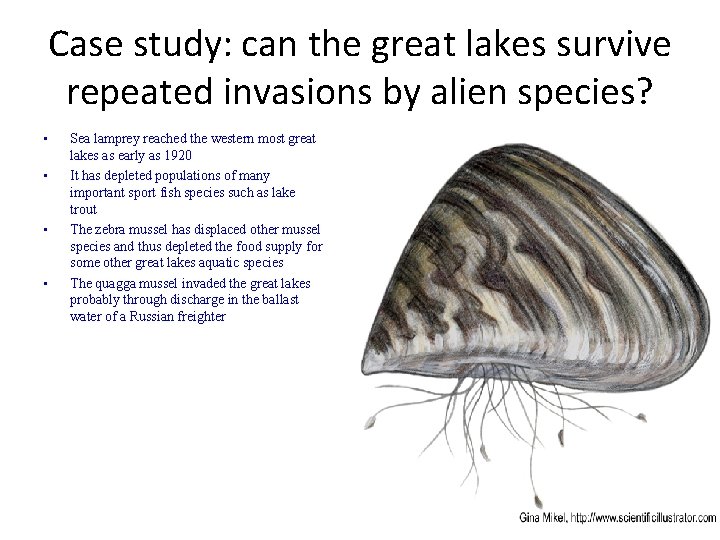
Case study: can the great lakes survive repeated invasions by alien species? • • Sea lamprey reached the western most great lakes as early as 1920 It has depleted populations of many important sport fish species such as lake trout The zebra mussel has displaced other mussel species and thus depleted the food supply for some other great lakes aquatic species The quagga mussel invaded the great lakes probably through discharge in the ballast water of a Russian freighter
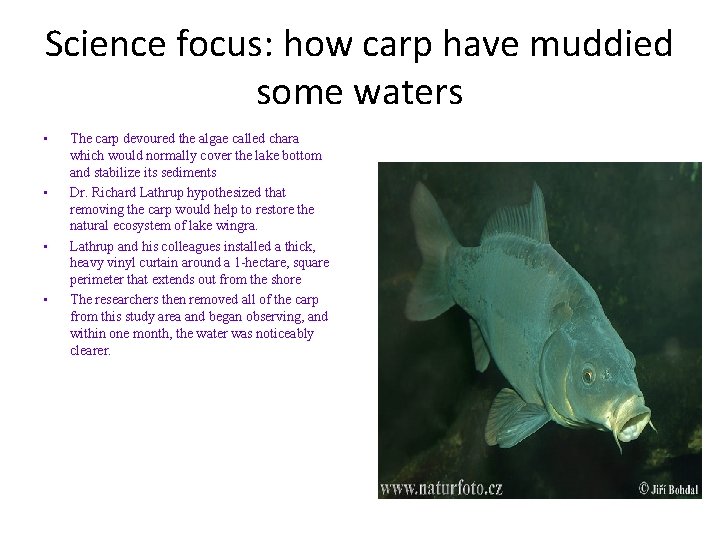
Science focus: how carp have muddied some waters • • The carp devoured the algae called chara which would normally cover the lake bottom and stabilize its sediments Dr. Richard Lathrup hypothesized that removing the carp would help to restore the natural ecosystem of lake wingra. Lathrup and his colleagues installed a thick, heavy vinyl curtain around a 1 -hectare, square perimeter that extends out from the shore The researchers then removed all of the carp from this study area and began observing, and within one month, the water was noticeably clearer.
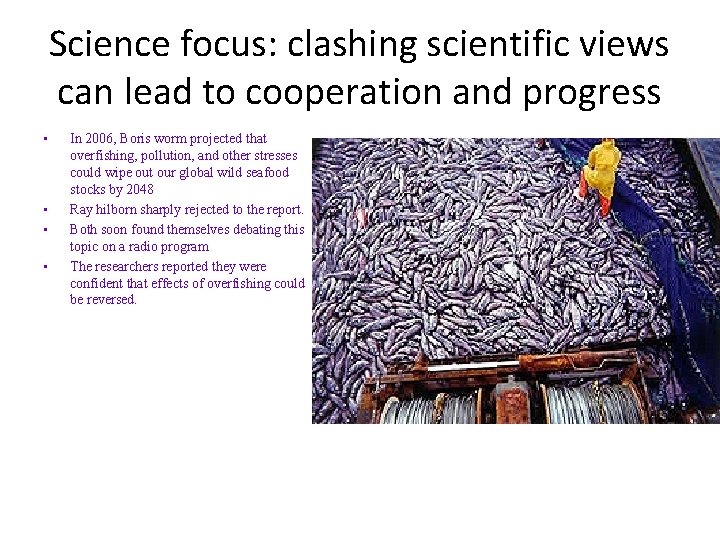
Science focus: clashing scientific views can lead to cooperation and progress • • In 2006, Boris worm projected that overfishing, pollution, and other stresses could wipe out our global wild seafood stocks by 2048 Ray hilborn sharply rejected to the report. Both soon found themselves debating this topic on a radio program The researchers reported they were confident that effects of overfishing could be reversed.
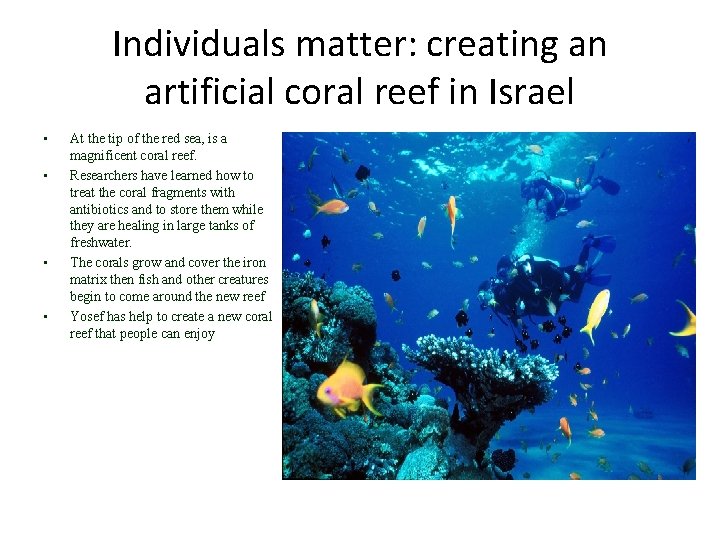
Individuals matter: creating an artificial coral reef in Israel • • At the tip of the red sea, is a magnificent coral reef. Researchers have learned how to treat the coral fragments with antibiotics and to store them while they are healing in large tanks of freshwater. The corals grow and cover the iron matrix then fish and other creatures begin to come around the new reef Yosef has help to create a new coral reef that people can enjoy
- Slides: 35