Anglistics Study Programme Language choice and language learning










- Slides: 36
Anglistics Study Programme Language choice and language learning Class 11 Anglistics Study Programme www. singidunum. ac. rs/admission
Anglistics Study Programme Language choice • Today we will discuss issues about using foreign and first language in the classroom • It is generally believed that teacher constantly use foreign language in their language lessons • In practice evidence suggest that most teachers who share mother tongue with their students , use the mixture of foreign language and the mother tongue
Anglistics Study Programme Target language only? • Why is there a policy that insists on target language only? • The reason is to maximise learner’s exposure to the language • To maximise their learning abilities • The more language the pupils hear, the more they will learn
Anglistics Study Programme BUT! • In situations where the foreign language is not heard outside of the classroom – it actually doesn’t matter if children hear as much as possible when they are in the class • These theories forget about the complexity of teaching and learning by ignoring the possibility of mother tongue contribution to foreign language learning
Anglistics Study Programme • Why is there a gap between policy and practice around using the target language? • Teachers do not feel confident to use the foreign language to a full range of functions • Teachers do not feel competent enough • Teacher must have a repertoire of language for: • • Classroom management and organisation Discipline Giving feedback Chatting with children informally
Anglistics Study Programme • Another reason for using a mother tongue: • If using only English, teachers are in constant struggle against the natural forces of communication between people • If a teacher and students share the same mother tongue, then not using a mother tongue is very unnatural
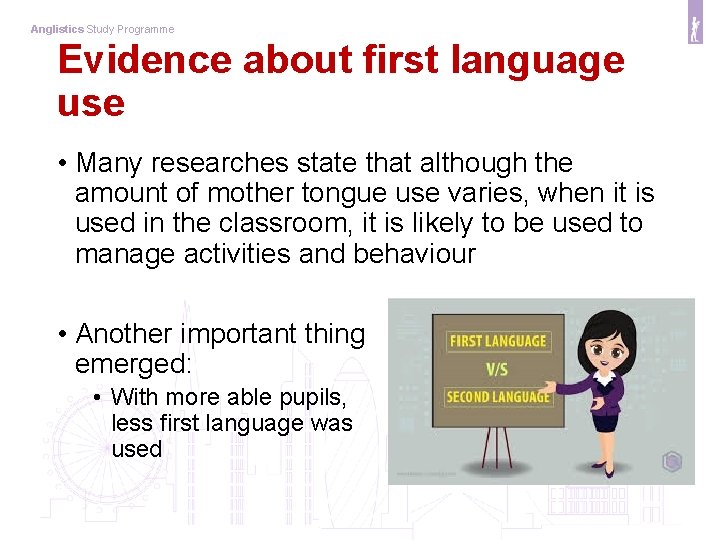
Anglistics Study Programme Evidence about first language use • Many researches state that although the amount of mother tongue use varies, when it is used in the classroom, it is likely to be used to manage activities and behaviour • Another important thing emerged: • With more able pupils, less first language was used
Anglistics Study Programme • Even when most of the lesson is carried out in the first language, the core of language content -vocabulary and sentence patterns – remained in the foreign language • So, to sum up…
Anglistics Study Programme Teacher’s use of first language: • • • Explaining aspect of the foreign language Translating words or sentences Giving instructions Checking understanding Focusing pupil’s attention Testing Giving feedback Disciplining and control Informal, friendly talk with pupils
Anglistics Study Programme Pupil’s use of mother tongue: • Asking for help from teacher • Asking for help from peers • Responding to teacher’s questions
Anglistics Study Programme Choice of language • Choice of language as compensatory or strategic • by using the mother tongue, teacher may compensate for problems that they perceive with their pupils’ language level of ability, or with discipline and motivation • First language use may also compensate for teacher-related factors: • Lack of confidence • Preparation • Language proficiency
Anglistics Study Programme • The strategic choice of language use is connected to creating and maintaining levels of formality and informality of classroom discourse
Anglistics Study Programme Interpersonal factors in language choice • Interpersonal motivation may lie behind any instance of language choice • how a particular choice of language affects the particular group of teachers and pupils • The choice of a language is influenced by previous choices and by wider context
Anglistics Study Programme • Interpersonal factors are a combination of three sub-factors: • Alignment • Emphasis • Evaluation
Anglistics Study Programme Alignment • The choice of a native language / foreign language in a class can convey a sense that teacher is / isn’t on pupil’s side • When using the first language, there may be a feeling of teacher being aligned with pupils • When the shared language is used in the classroom, pupils are reassured that the teacher understands their language learning problems
Anglistics Study Programme Emphasis • The choice of first or foreign language use may serve to emphasise the importance of what is being said • The use of first language to control or discipline may underline the seriousness of the offence • Use of foreign language may de-emphasise the importance , and work for less serious problems
Anglistics Study Programme Evaluation • The choice of language also carries attitudes and values to foreign language learning • A teacher who uses the foreign language only for content of a lesson, and not for other purposes, reinforces the idea that the foreign language is a subject of study, rather than a means of communication
Anglistics Study Programme A dynamic view of language choice • It considers movement between languages in classroom interaction by using 3 types of dynamic use • Example – DYNAMIC 1 • take a look at the switching pattern used by the teacher during the lesson… • Teachers normally tend to move from the foreign language to the first language when giving instructions
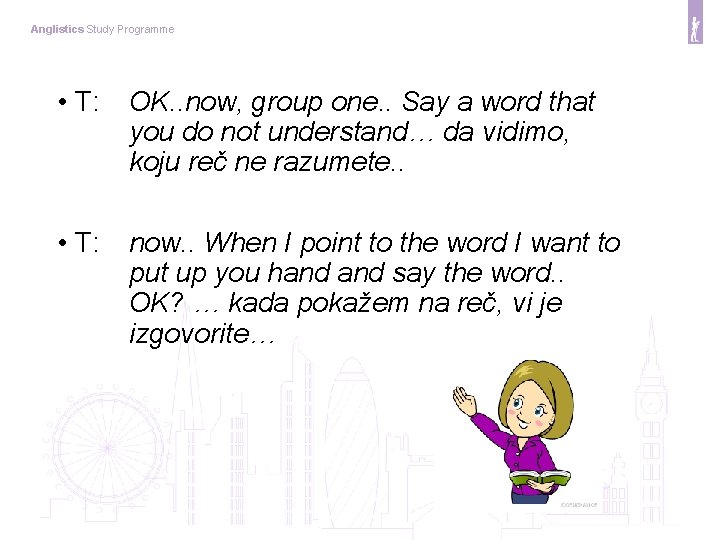
Anglistics Study Programme • T: OK. . now, group one. . Say a word that you do not understand… da vidimo, koju reč ne razumete. . • T: now. . When I point to the word I want to put up you hand say the word. . OK? … kada pokažem na reč, vi je izgovorite…
Anglistics Study Programme • In this case teacher is using native language for the following reason: • He is competent and confident enough to give instructions in English • He feels that pupils need more help to understand the instructions • Translates the information • Switching between languages makes the situation more dynamic
Anglistics Study Programme • This FL-L 1 dynamic, or switching strategy aligns the teacher with the pupils and emphasises key aspects of the instruction • A very helpful aspect of DYNAMIC 1 would be: • To ask the students to give the L 1 version after the teacher’s FL instruction
Anglistics Study Programme Dynamic 2 – keeping the same language • The following example gives a more complicated movement between the first and foreign language as the T and Ss talk about strategies of finding the meaning of the new words
Anglistics Study Programme • T: Šta radimo ako ne znamo neku reč? • S: Pogledamo u rečnik • T: Good! So, we must use a …. DICTIONARY now, take out your dictionaries and find the word den Hajde, idemo, tražite
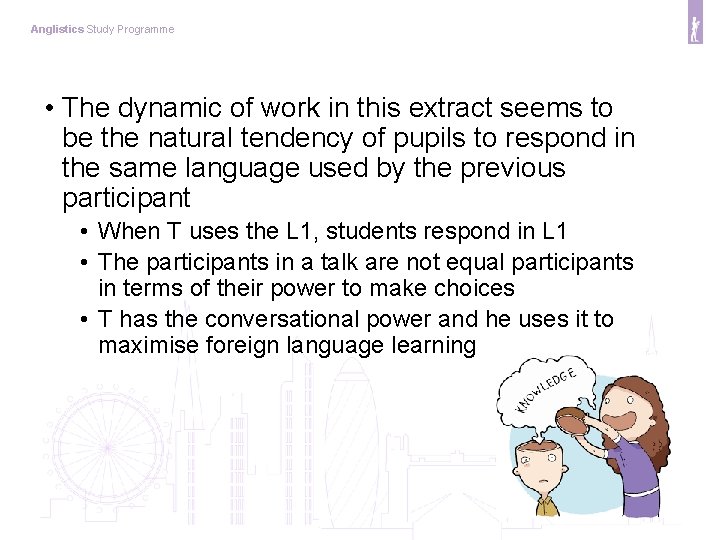
Anglistics Study Programme • The dynamic of work in this extract seems to be the natural tendency of pupils to respond in the same language used by the previous participant • When T uses the L 1, students respond in L 1 • The participants in a talk are not equal participants in terms of their power to make choices • T has the conversational power and he uses it to maximise foreign language learning
Anglistics Study Programme Dynamic 3 • Giving meaning through a first language equivalent • Ss are first asked to underline new words in the text • Then they say the words to the T who writes them on the board • The whole class practices pronouncing them • Ss then turn to their dictionary to find the meaningthe idea is to use bilingual dictionaries
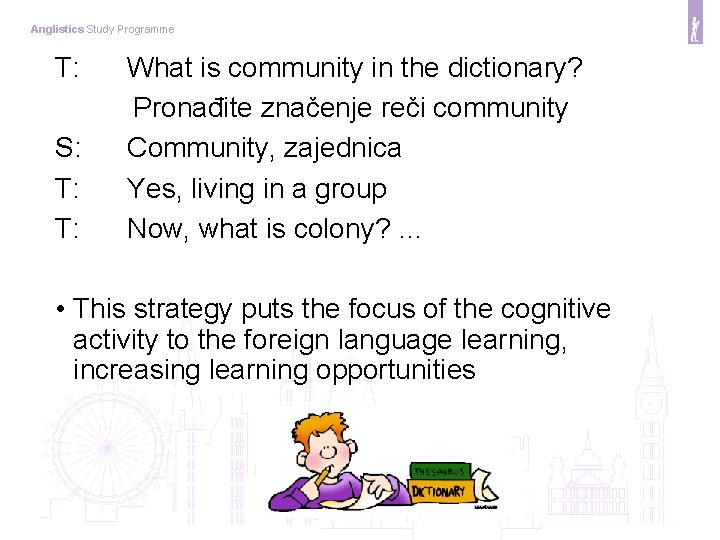
Anglistics Study Programme T: S: T: T: What is community in the dictionary? Pronađite značenje reči community Community, zajednica Yes, living in a group Now, what is colony? … • This strategy puts the focus of the cognitive activity to the foreign language learning, increasing learning opportunities
Anglistics Study Programme Taking responsibility, making choices • Use as much target language as possible • Ensure that the use of first language supports the children’s foreign language learning
Anglistics Study Programme Exam practice: • Give explanations for the following use of L 1: • • • Teacher led choice Explaining new language Giving instructions Checking understanding Talk about learning Feedback Discipline Informal talk Making language choice conscious
Anglistics Study Programme
Anglistics Study Programme Discipline • Maintaining order in the classroom is probably the single biggest problem for most novice teachers • There are some fairly simple strategies which can also help
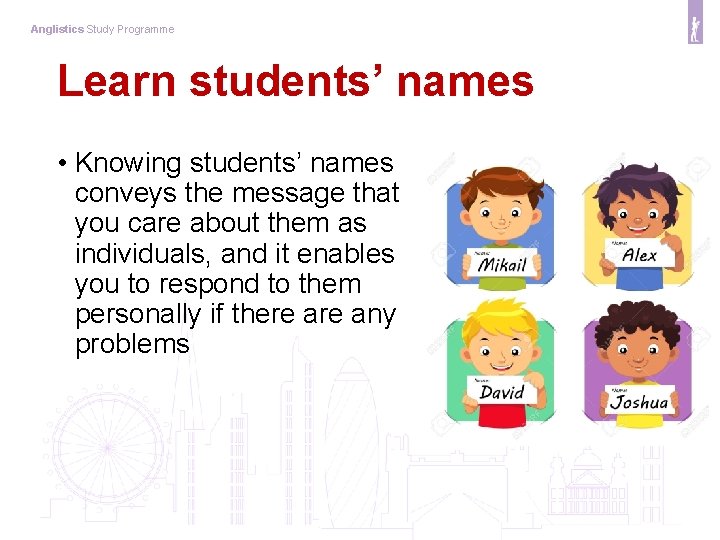
Anglistics Study Programme Learn students’ names • Knowing students’ names conveys the message that you care about them as individuals, and it enables you to respond to them personally if there any problems
Anglistics Study Programme Keep the lesson moving • A major principle in dealing with problems of classroom discipline is to prevent them arising in the first place • The more occupied the students are it is more likely they are to cooperate and work well • Always have: • A fully-planned lesson • Stop longer activities at the first sign of students’ boredom • Prepare a reserve activity
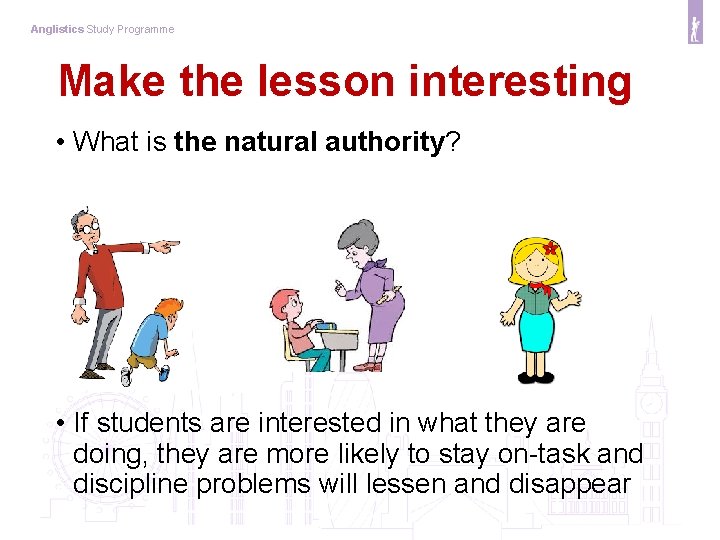
Anglistics Study Programme Make the lesson interesting • What is the natural authority? • If students are interested in what they are doing, they are more likely to stay on-task and discipline problems will lessen and disappear
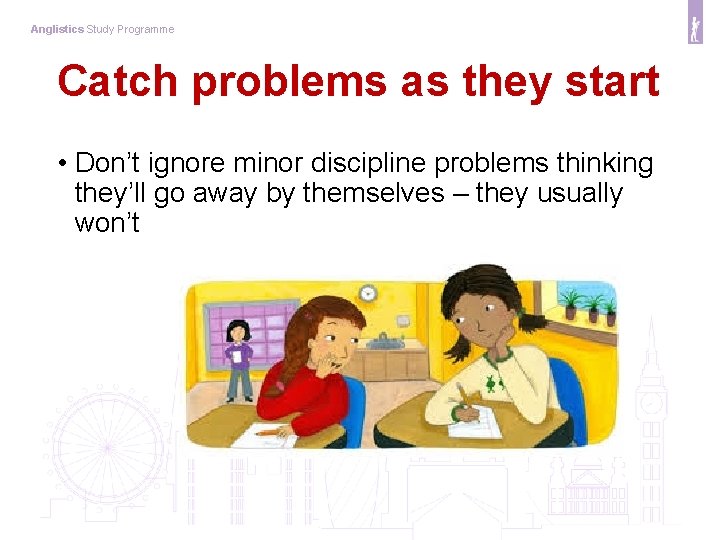
Anglistics Study Programme Catch problems as they start • Don’t ignore minor discipline problems thinking they’ll go away by themselves – they usually won’t
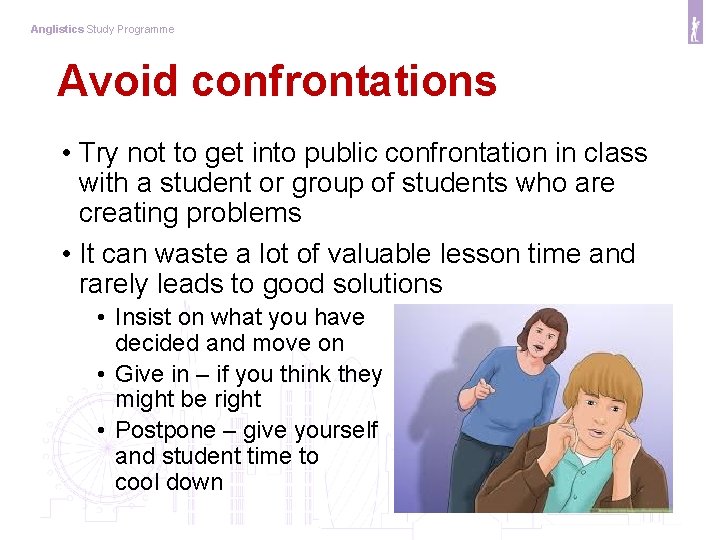
Anglistics Study Programme Avoid confrontations • Try not to get into public confrontation in class with a student or group of students who are creating problems • It can waste a lot of valuable lesson time and rarely leads to good solutions • Insist on what you have decided and move on • Give in – if you think they might be right • Postpone – give yourself and student time to cool down
Anglistics Study Programme Compliment good behaviour • We naturally notice students who chat, or send text messages, or use mobile phones… • We should also be aware of individual students who are working well, and draw attention to them • With younger classes use system of stars • With older classes – give verbal compliment