ACE Personal Trainer Manual 4 th edition Chapter




- Slides: 42
ACE Personal Trainer Manual, 4 th edition Chapter 11: Cardiorespiratory Training: Programming and Progressions 1
Learning Objectives § This session, which is based on Chapter 11 of the ACE Personal Trainer Manual, 4 th edition, features a discussion of the physiological adaptations to acute and chronic cardiorespiratory exercise. It also includes coverage of the cardiorespiratory-training phases of the ACE IFT™ Model. § After completing this session, you will have a better understanding of: – How cardiorespiratory exercise affects the following systems: muscular, cardiovascular, and respiratory – The components of a well-designed cardiorespiratory-training session – General guidelines for cardiorespiratory exercise – Various modes of cardiorespiratory exercise – The ACE IFT Model cardiorespiratory training phases and their appropriate application with clients – Special considerations for youth and older adults
Introduction § Physical movement is essential for human survival. § The obligatory need for physical activity is very low in modern society. § The need for people to structure their lives to include higher levels of physical activity has risen dramatically.
Physiological Adaptations to Cardiorespiratory Exercise § Muscular system – Type I muscle fibers (low- to moderate-intensity exercise) – Mitochondria – Capillaries – Type II muscle fibers (high-intensity exercise)
Physiological Adaptations to Cardiorespiratory Exercise (cont. ) § Cardiovascular system – With endurance training, the heart muscle will hypertrophy, enlarging its chambers and becoming a bigger and stronger muscle. – Increased cardiac output • Primarily due to a larger stroke volume • A redistribution of the cardiac output to the active muscles (via vasodilation) may also improve after training.
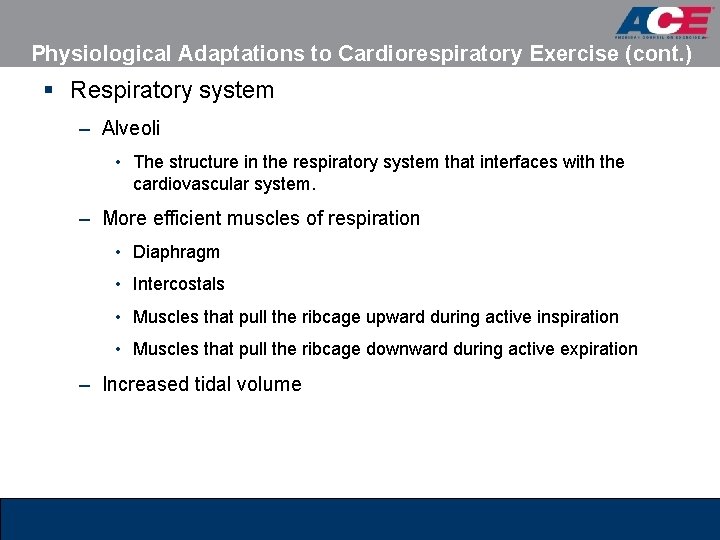
Physiological Adaptations to Cardiorespiratory Exercise (cont. ) § Respiratory system – Alveoli • The structure in the respiratory system that interfaces with the cardiovascular system. – More efficient muscles of respiration • Diaphragm • Intercostals • Muscles that pull the ribcage upward during active inspiration • Muscles that pull the ribcage downward during active expiration – Increased tidal volume
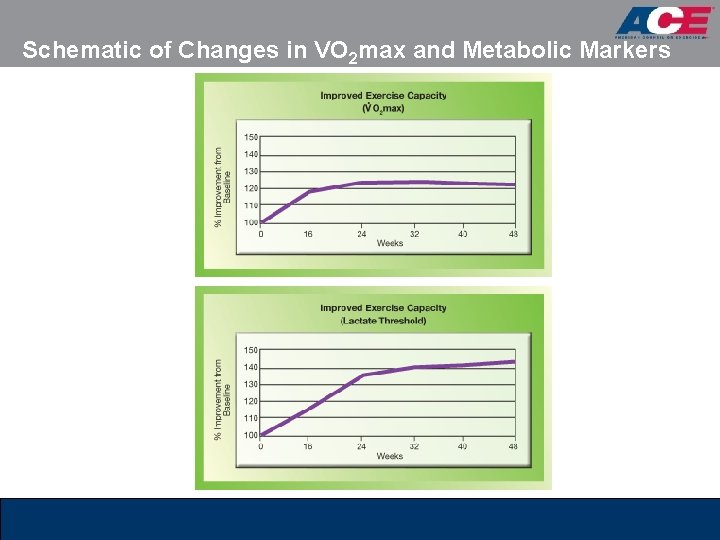
Time Required for Increases in Aerobic Capacity § Cardiovascular adaptations are usually measureable after a couple of weeks of training. § VO 2 max – Increases with training, but reaches a peak and plateaus within about six months § Ventilatory threshold (VT) – A significant marker of metabolism that permits prediction of lactate threshold (LT) during progressive exercise – May continue to increase for years with continued training, as illustrated on the following slide
Schematic of Changes in VO 2 max and Metabolic Markers
Steady-state and Interval-based Exercise § Steady state – Consistent intensity of exercise where the energy and physiological demands are met by the delivery from the physiological systems – Limited by the willingness to continue or the availability of oxygen, muscle glycogen, and/or blood glucose § Interval training – Higher-intensity exercise followed by recovery periods – Provides anaerobic adaptations that improve tolerance for the buildup of lactic acid (lactate threshold) – Provokes an increase in stroke volume that is not achievable with lower-intensity steady-state training
Components of a Cardiorespiratory Workout Session § Warm-up – A period of lighter exercise preceding the conditioning phase of the exercise bout – Should last for five to 10 minutes for most healthy adults – Should not be so demanding that it creates fatigue that would reduce performance. – Stretching • The practice of stretching before performing any warm-up is not justified and may potentially be harmful. – May be subdivided into a general cardiovascular warm-up followed by a more exercise- or event-specific dynamic warm-up.
Components of a Cardiorespiratory Workout Session (cont. ) § Conditioning phase – The higher-intensity elements of a session should take place fairly early in the conditioning phase of the workout. – Cardiovascular drift during steady-state training • A gradual increase in heart-rate response during a steady-state bout of exercise – Aerobic-interval training exercise-to-recovery ratios between 1: 2 and 1: 1 – “Lactate sinks” • Aerobically trained type II muscle fibers that are proficient at using lactate for energy during hard steady-state exercise
Components of a Cardiorespiratory Workout Session (cont. ) § Cool-down – Should be of approximately the same duration and intensity as the warm-up – Five to 10 minutes of low- to moderate-intensity activity – “Muscle pump” – An active cool-down can help remove metabolic waste from the muscles so that it can be metabolized by other tissues. – A stretching routine following the cool-down period is appropriate.
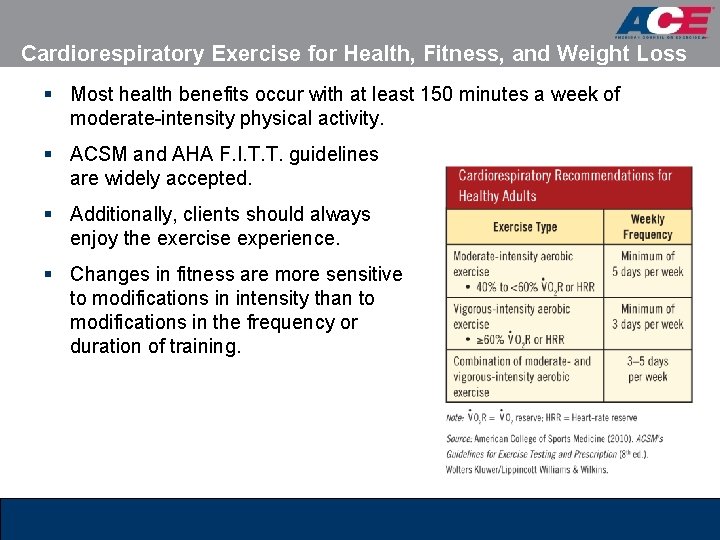
Cardiorespiratory Exercise for Health, Fitness, and Weight Loss § Most health benefits occur with at least 150 minutes a week of moderate-intensity physical activity. § ACSM and AHA F. I. T. T. guidelines are widely accepted. § Additionally, clients should always enjoy the exercise experience. § Changes in fitness are more sensitive to modifications in intensity than to modifications in the frequency or duration of training.
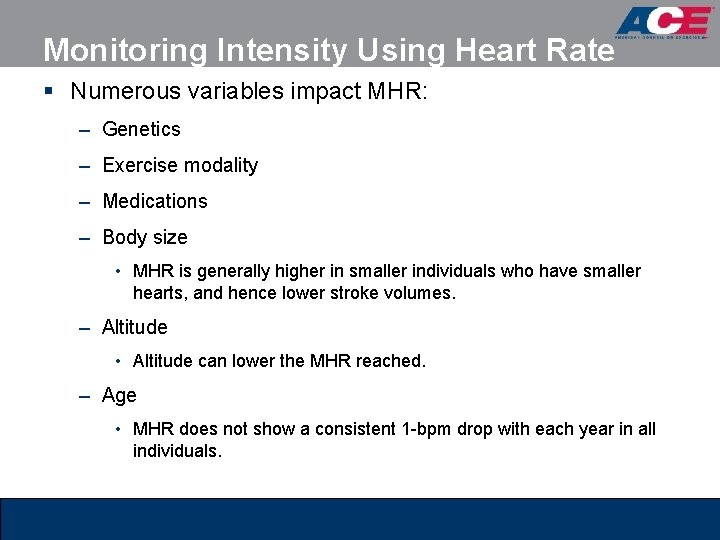
Monitoring Intensity Using Heart Rate § Numerous variables impact MHR: – Genetics – Exercise modality – Medications – Body size • MHR is generally higher in smaller individuals who have smaller hearts, and hence lower stroke volumes. – Altitude • Altitude can lower the MHR reached. – Age • MHR does not show a consistent 1 -bpm drop with each year in all individuals.
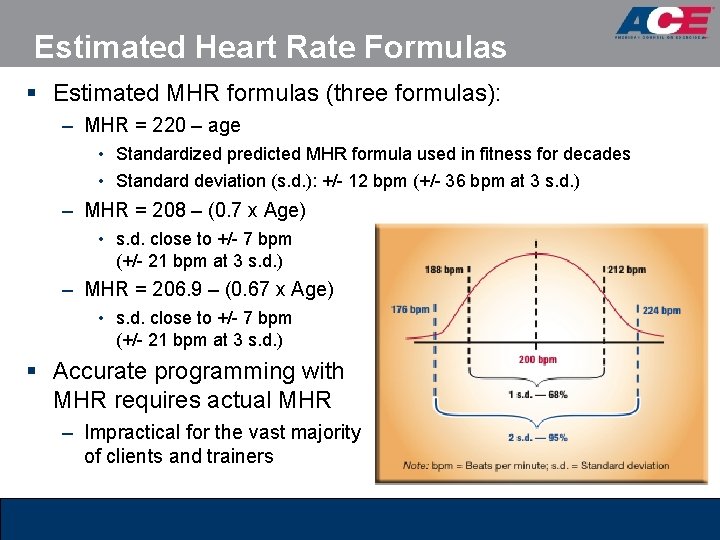
Estimated Heart Rate Formulas § Estimated MHR formulas (three formulas): – MHR = 220 – age • Standardized predicted MHR formula used in fitness for decades • Standard deviation (s. d. ): +/- 12 bpm (+/- 36 bpm at 3 s. d. ) – MHR = 208 – (0. 7 x Age) • s. d. close to +/- 7 bpm (+/- 21 bpm at 3 s. d. ) – MHR = 206. 9 – (0. 67 x Age) • s. d. close to +/- 7 bpm (+/- 21 bpm at 3 s. d. ) § Accurate programming with MHR requires actual MHR – Impractical for the vast majority of clients and trainers
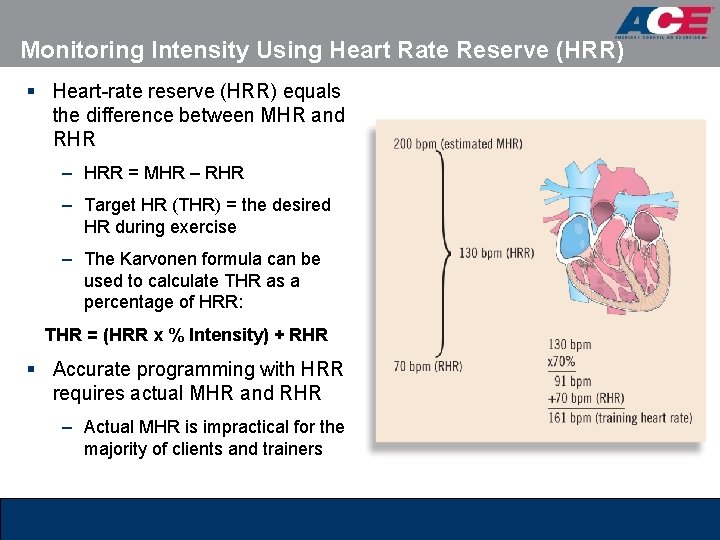
Monitoring Intensity Using Heart Rate Reserve (HRR) § Heart-rate reserve (HRR) equals the difference between MHR and RHR – HRR = MHR – RHR – Target HR (THR) = the desired HR during exercise – The Karvonen formula can be used to calculate THR as a percentage of HRR: THR = (HRR x % Intensity) + RHR § Accurate programming with HRR requires actual MHR and RHR – Actual MHR is impractical for the majority of clients and trainers
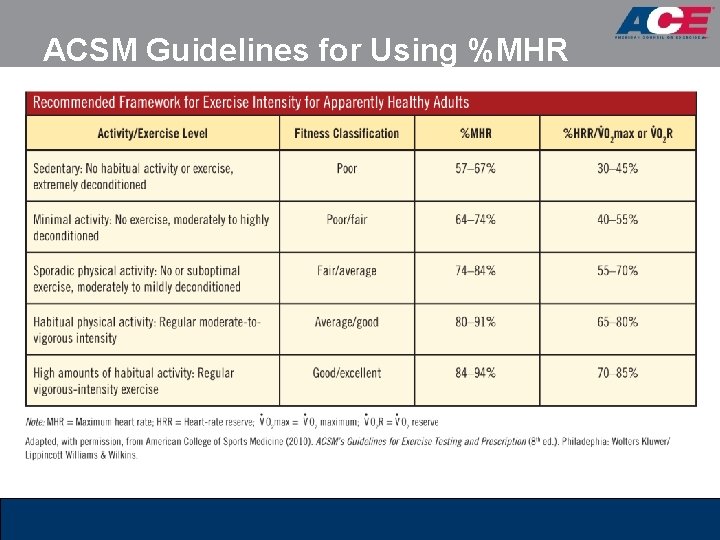
ACSM Guidelines for Using %MHR
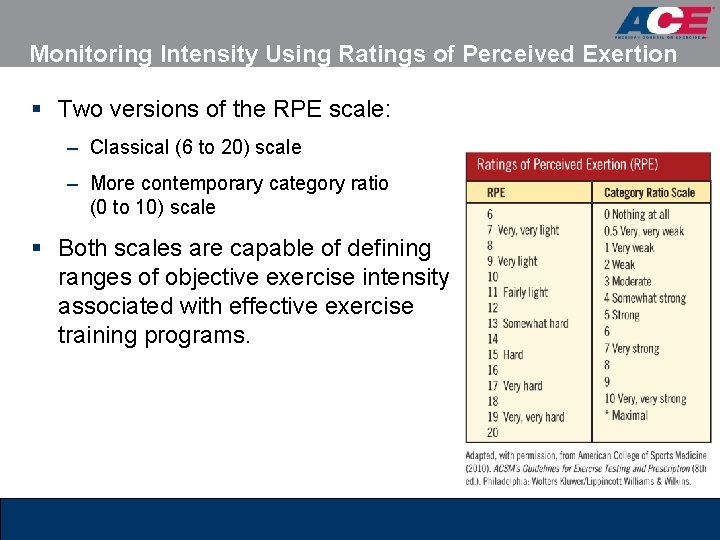
Monitoring Intensity Using Ratings of Perceived Exertion § Two versions of the RPE scale: – Classical (6 to 20) scale – More contemporary category ratio (0 to 10) scale § Both scales are capable of defining ranges of objective exercise intensity associated with effective exercise training programs.
Monitoring Intensity Using VO 2 § Intensity can be monitored as a %VO 2 max or %VO 2 R – Training based on metabolic or ventilatory responses is much more meaningful than using arbitrary ranges of %VO 2 max or %VO 2 R, especially when these values are predicted. – Training intensities that are too far below the first ventilatory threshold (VT 1) yield minimal cardiorespiratory fitness benefits. § Submaximal assessments that predict VO 2 max generally use predicted MHR – Errors in predicted MHR will affect predicted VO 2 max
Monitoring Intensity Using METS § METs – Multiples of an assumed average metabolic rate at rest of 3. 5 m. L/kg/min • Resting metabolic rate is not exactly 3. 5 m. L/kg/min in every individual. – The utility of using METs is so substantial that it more than makes up for any imprecision • Exercising at 5 METs equates to working 5 x greater than when at rest – 5 MET x 3. 5 m. L/kg/min = 17. 5 m. L/kg/min
Monitoring Intensity Using Caloric Expenditure § When the body burns fuel, O 2 is consumed, which yields calories to perform work. – 5 kcal per liter of O 2 § Absolute VO 2 (L/min) § Relative VO 2 (m. L/kg/min) § Commercial cardiovascular exercise equipment – Provide estimates of caloric expenditure using absolute VO 2 based on the amount of work being performed – Kcal per exercise session = L/min x 5 kcal/L x minutes § Online caloric-expenditure calculators are available for a variety of physical activities on the ACE website. – www. acefitness. org/calculators
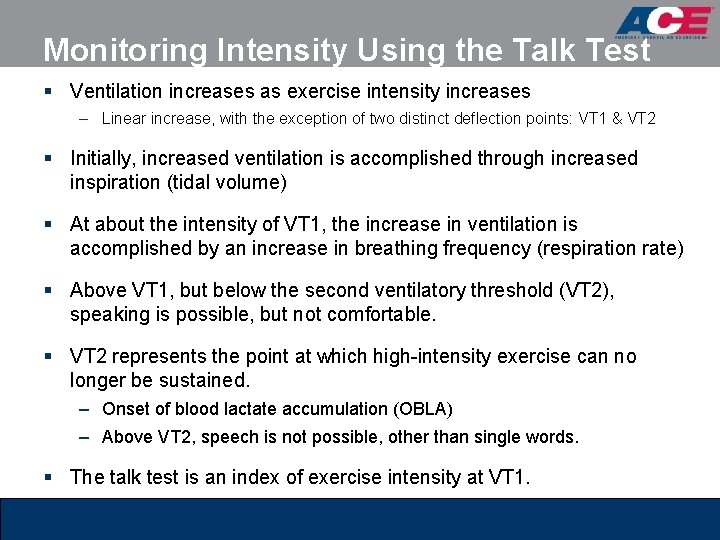
Monitoring Intensity Using the Talk Test § Ventilation increases as exercise intensity increases – Linear increase, with the exception of two distinct deflection points: VT 1 & VT 2 § Initially, increased ventilation is accomplished through increased inspiration (tidal volume) § At about the intensity of VT 1, the increase in ventilation is accomplished by an increase in breathing frequency (respiration rate) § Above VT 1, but below the second ventilatory threshold (VT 2), speaking is possible, but not comfortable. § VT 2 represents the point at which high-intensity exercise can no longer be sustained. – Onset of blood lactate accumulation (OBLA) – Above VT 2, speech is not possible, other than single words. § The talk test is an index of exercise intensity at VT 1.
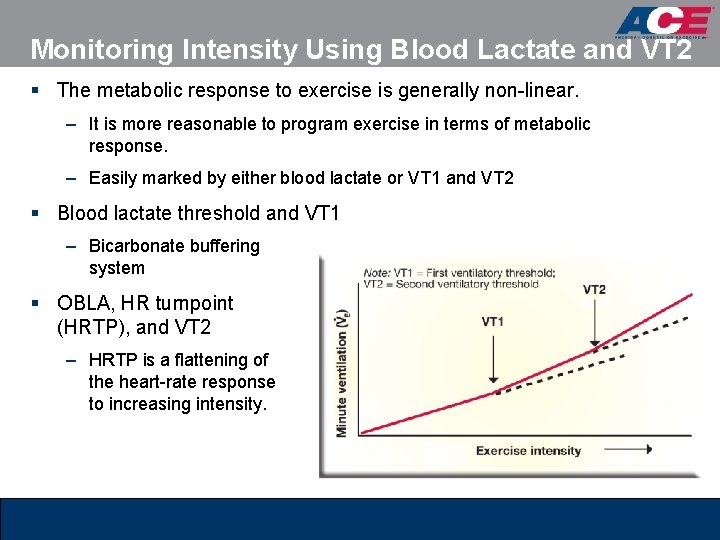
Monitoring Intensity Using Blood Lactate and VT 2 § The metabolic response to exercise is generally non-linear. – It is more reasonable to program exercise in terms of metabolic response. – Easily marked by either blood lactate or VT 1 and VT 2 § Blood lactate threshold and VT 1 – Bicarbonate buffering system § OBLA, HR turnpoint (HRTP), and VT 2 – HRTP is a flattening of the heart-rate response to increasing intensity.
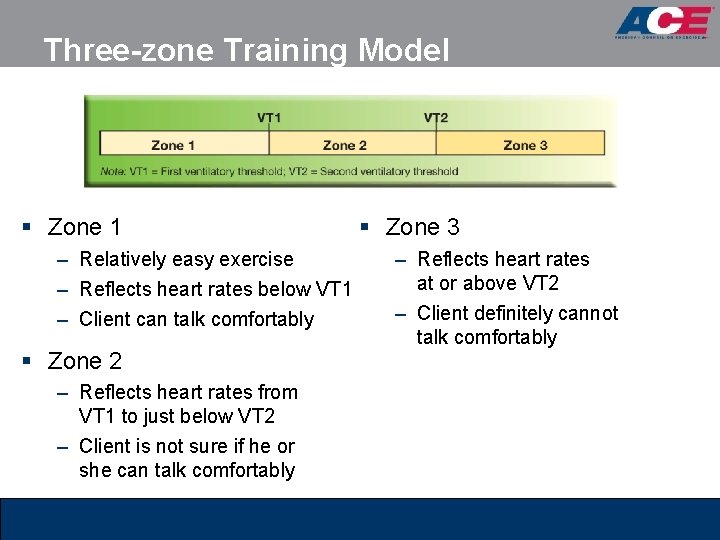
Three-zone Training Model § Zone 1 – Relatively easy exercise – Reflects heart rates below VT 1 – Client can talk comfortably § Zone 2 – Reflects heart rates from VT 1 to just below VT 2 – Client is not sure if he or she can talk comfortably § Zone 3 – Reflects heart rates at or above VT 2 – Client definitely cannot talk comfortably
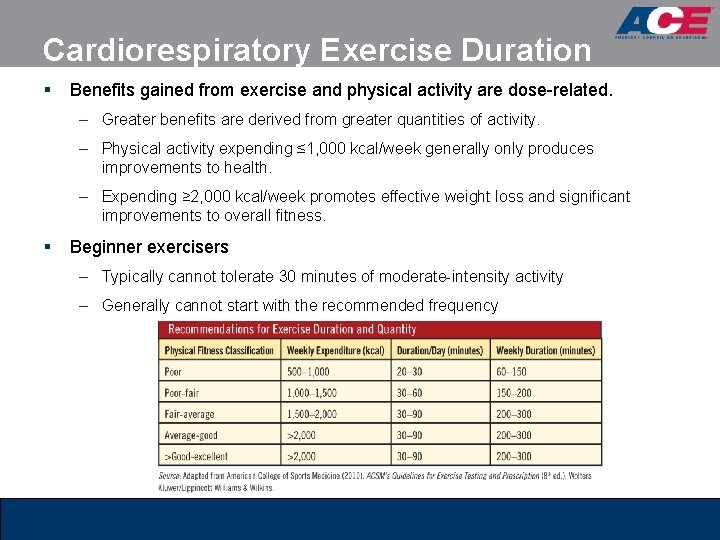
Cardiorespiratory Exercise Duration § Benefits gained from exercise and physical activity are dose-related. – Greater benefits are derived from greater quantities of activity. – Physical activity expending ≤ 1, 000 kcal/week generally only produces improvements to health. – Expending ≥ 2, 000 kcal/week promotes effective weight loss and significant improvements to overall fitness. § Beginner exercisers – Typically cannot tolerate 30 minutes of moderate-intensity activity – Generally cannot start with the recommended frequency
Cardiorespiratory Exercise Progression § Progression follows basic training principles, including: – Overload – Specificity § Exercise duration is the most appropriate variable to manipulate initially. § Thereafter, implement progressions by increasing exercise frequency and then exercise intensity. § Fartlek training
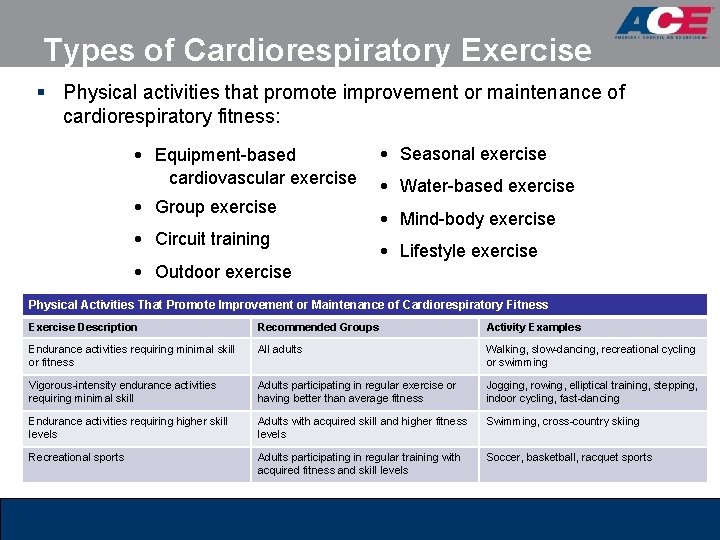
Types of Cardiorespiratory Exercise § Physical activities that promote improvement or maintenance of cardiorespiratory fitness: • Equipment-based cardiovascular exercise • Group exercise • Circuit training • Outdoor exercise • Seasonal exercise • Water-based exercise • Mind-body exercise • Lifestyle exercise Physical Activities That Promote Improvement or Maintenance of Cardiorespiratory Fitness Exercise Description Recommended Groups Activity Examples Endurance activities requiring minimal skill or fitness All adults Walking, slow-dancing, recreational cycling or swimming Vigorous-intensity endurance activities requiring minimal skill Adults participating in regular exercise or having better than average fitness Jogging, rowing, elliptical training, stepping, indoor cycling, fast-dancing Endurance activities requiring higher skill levels Adults with acquired skill and higher fitness levels Swimming, cross-country skiing Recreational sports Adults participating in regular training with acquired fitness and skill levels Soccer, basketball, racquet sports
Equipment-based Cardiovascular Exercise § The aerobic value of any equipment-based program is based on how the machine is used. – Sustained moderate-intensity exercise is the foundation of cardiorespiratory exercise training. § Many pieces can estimate the MET or caloric cost of exercise. – Common sense is required when using the MET or caloric values generated by exercise equipment. – In less-fit individuals, and if handrail support is used, the values may overestimate the actual value attained.
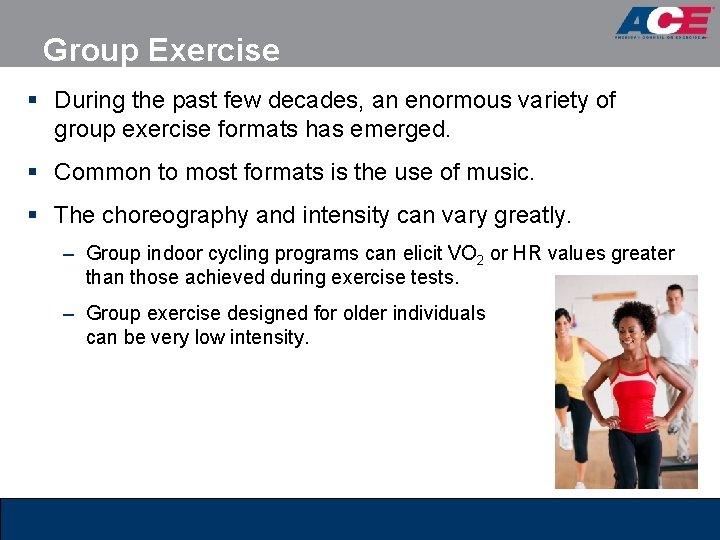
Group Exercise § During the past few decades, an enormous variety of group exercise formats has emerged. § Common to most formats is the use of music. § The choreography and intensity can vary greatly. – Group indoor cycling programs can elicit VO 2 or HR values greater than those achieved during exercise tests. – Group exercise designed for older individuals can be very low intensity.
Circuit Training § Cardiorespiratory training effects can be observed during circuit training by: – Alternating muscular strength and endurance activities with classical aerobic training – Performing the activities in a rapid sequence § Depending on equipment availability, circuit training can be performed by: – A single individual rotating through select exercises – Groups of participants rotating in an organized manner through several exercise stations
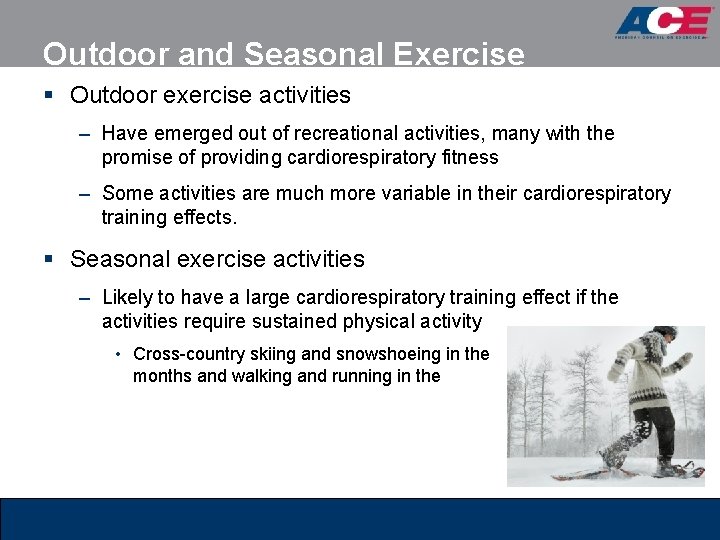
Outdoor and Seasonal Exercise § Outdoor exercise activities – Have emerged out of recreational activities, many with the promise of providing cardiorespiratory fitness – Some activities are much more variable in their cardiorespiratory training effects. § Seasonal exercise activities – Likely to have a large cardiorespiratory training effect if the activities require sustained physical activity • Cross-country skiing and snowshoeing in the months and walking and running in the winter warmer months
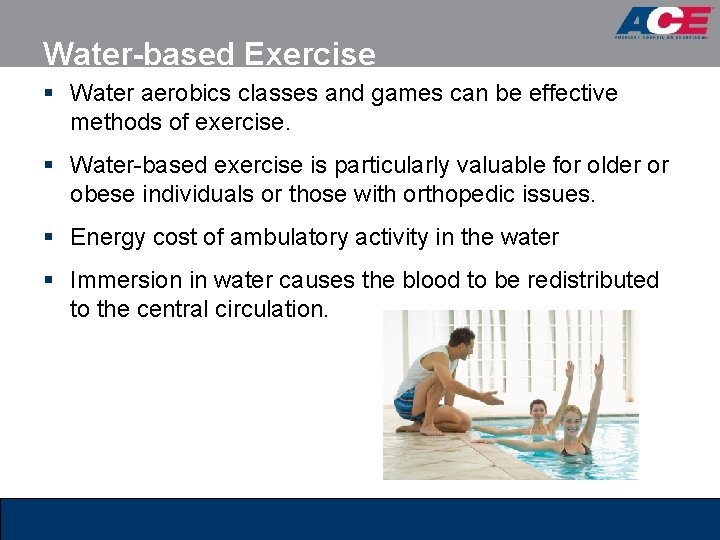
Water-based Exercise § Water aerobics classes and games can be effective methods of exercise. § Water-based exercise is particularly valuable for older or obese individuals or those with orthopedic issues. § Energy cost of ambulatory activity in the water § Immersion in water causes the blood to be redistributed to the central circulation.
Mind-body and Lifestyle Exercise § Mind-body exercise – Generally not associated with high-intensity aerobic activity – May provide an intensity comparable to that of walking – Examples include Pilates, hatha yoga, Nia, and tai chi § Lifestyle exercise – Consistently performed domestic activities can provide enough stimulus to make previously sedentary people fit and contribute to excellent health. – Activities like yard work should be viewed in the context of the total exercise load.
ACE IFT Model Cardiorespiratory Training Phases § The ACE IFT Model has four cardiorespiratory training phases: Phase 1 AEROBIC-BASE Phase 2 AEROBIC-EFFICIENCY Phase 3 ANAEROBICENDURANCE Phase 4 ANAEROBICPOWER § Clients are categorized into a given phase based on their current health, fitness level, and goals. – Clients may be in different phases for cardiorespiratory training and functional movement and resistance training.
Phase 1: Aerobic-base training § The focus is on creating positive exercise experiences that help sedentary clients become regular exercisers. § No fitness assessments are required prior to exercise. § Focus on steady-state exercise in zone 1 (below VT 1). § Gauge intensity by the client’s ability to talk comfortably and/or RPE of 3 to 4. § Increase exercise duration (<10% increase per week) § Progress to phase 2 once client can sustain steady-state cardiorespiratory exercise for 20 to 30 minutes in zone 1 (below talk test threshold; RPE of 3 to 4) and is comfortable with assessments. AEROBIC-BASE TRAINING DURANCE
Phase 2: Aerobic-efficiency Training § The focus is on increasing the duration of exercise and introducing intervals to improve aerobic efficiency, fitness, and health. § Administer the submaximal talk test to determine HR at VT 1. § Exercise programming in Zone 1 (< VT 1) and Zone 2 (VT 1 to < VT 2) § Progressions for Aerobic-efficiency Training: – Increase duration of exercise in zone 1 – Then introduce low zone 2 intervals just above VT 1 (RPE of 5) – Progress low zone 2 intervals by increasing the time of the work interval and later decreasing the recovery interval time. – As the client progresses, introduce intervals in the upper end of zone 2 (RPE of 6). § Most clients will train in this phase for many years. § If a client has event-specific goals or is a fitness enthusiast looking for increased challenges and fitness gains, progress to phase 3. AEROBIC-EFFICIENCY TRAINING
Phase 3: Anaerobic-endurance Training § The focus is on designing programs to help clients who have endurance performance goals and/or are performing seven or more hours of cardiorespiratory exercise per week. § Administer the VT 2 threshold test to determine HR at VT 2. § The majority of cardiorespiratory training time is spent in zone 1, with intervals and higher-intensity sessions focused in zones 2 and 3. § Cardiorespiratory training time is distributed as follows: – Zone 1 (< VT 1): 70– 80% of training time – Zone 2 (VT 1 to < VT 2): <10% of training time – Zone 3 (> VT 2): 10– 20% of training time § Many clients will never train in phase 3. § Only clients who have very specific goals for increasing speed for short bursts at near-maximal efforts will move on to phase 4. AEROBIC ANAEROBICENDURANCE TRAINING BASE EFFICIENCY POWER
Phase 4: Anaerobic-power Training § The focus is on improving anaerobic power to improve phosphagen energy pathways and buffer blood lactate. § Programs will have a similar distribution to phase 3 training times in terms of distribution among zones 1, 2, and 3. § Zone 3 training will include very intense anaerobic-power intervals that are at or near maximal levels. – Zone 3 intervals in phase 4 will be of shorter duration than in phase 3, due to greater intensity (RPE = 9 or 10) – Increase length of recovery interval during zone 3 interval sessions § Clients will generally only work in phase 4 during specific training cycles prior to competition. AEROBIC BASE AEROBIC EFFICIENCY ANAEROBIC ENDURANCE ANAEROBIC-POWER TRAINING
Recovery and Regeneration § As a general principle, training should be periodized. § The biggest programming mistakes include: – Taking too few recovery days – Trying to do something other than recover on recovery days – Trying to progress the training load on recovery days (when it should only be progressed on hard days). § The bottom line is that recovery days are for recovery. § Two or three hard training days per week are probably adequate to allow progress toward most goals.
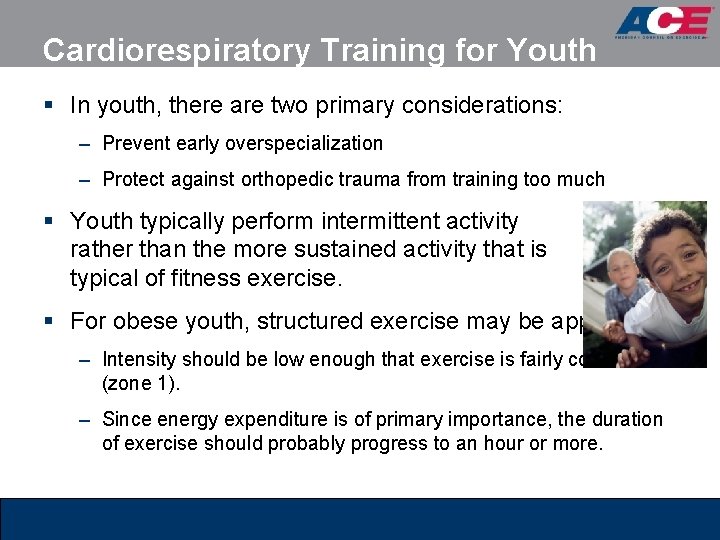
Cardiorespiratory Training for Youth § In youth, there are two primary considerations: – Prevent early overspecialization – Protect against orthopedic trauma from training too much § Youth typically perform intermittent activity rather than the more sustained activity that is typical of fitness exercise. § For obese youth, structured exercise may be appropriate. – Intensity should be low enough that exercise is fairly comfortable (zone 1). – Since energy expenditure is of primary importance, the duration of exercise should probably progress to an hour or more.
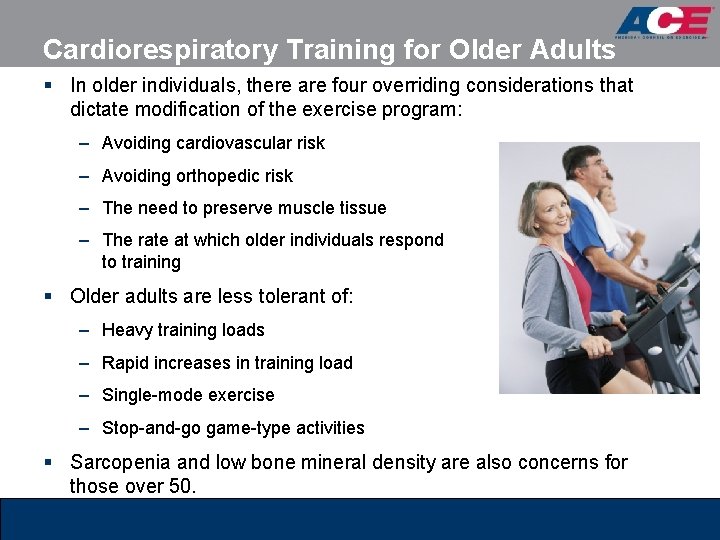
Cardiorespiratory Training for Older Adults § In older individuals, there are four overriding considerations that dictate modification of the exercise program: – Avoiding cardiovascular risk – Avoiding orthopedic risk – The need to preserve muscle tissue – The rate at which older individuals respond to training § Older adults are less tolerant of: – Heavy training loads – Rapid increases in training load – Single-mode exercise – Stop-and-go game-type activities § Sarcopenia and low bone mineral density are also concerns for those over 50.
Summary § Physical activity or structured exercise performed with regularity causes adaptation in the heart, lungs, blood, and muscle tissue and promotes the ability to perform even more exercise. § This session covered: – Physiological adaptations to cardiorespiratory exercise – Components of a cardiorespiratory workout session – Cardiorespiratory exercise for health, fitness, and weight loss – Types of cardiorespiratory exercise – ACE IFT Model cardiorespiratory-training phases – Recovery and regeneration – Considerations for youth and older adults