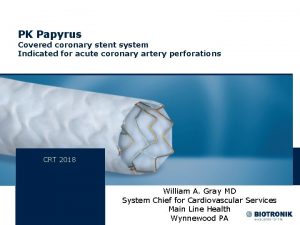
A Randomized Trial Comparing a Polymer Free Coronary

- Slides: 20
A Randomized Trial Comparing a Polymer. Free Coronary Drug-Eluting Stent With an Ultra-Thin Strut Bioresorbable Polymer. Based Drug-Eluting Stent in an All-Comers Patient Population Lisette Okkels Jensen, Michael Maeng, Bent Raungaard, Johnny Kahlert, Julia Ellert, Lars Jakobsen, Anton Villadsen, Karsten Tange Veien, Steen Dalby Kristensen, Ole Ahlehoff, Steen Carstensen, Martin Kirk Christensen, Christian Juhl Terkelsen, Thomas Engstroem, Knud Nørregaard Hansen, Hans Erik Botker, Jens Aaroee, Troels Thim, Leif Thuesen, Philip Freeman, Ahmed Aziz, Ashkan Eftekhari, Anders Junker, Jens Flensted Lassen, Svend Eggert Jensen, Henrik Steen Hansen, Evald Hoej Christiansen ODENSE UNIVERSITY HOSPITAL, AARHUS UNIVERSITY HOSPITAL, AALBORG UNIVERSITY HOSPITAL, COPENHAGEN UNIVERSITY HOSPITAL DENMARK SORT OUT IX
Disclosure Statement of Financial Interest Speaker's name: Lisette Okkels Jensen, professor MD DMSci Ph. D I have the following potential conflicts of interest to report: Honorarium: BIOTRONIK Institutional grant/research support: BIOSENSORS INTERNATIONAL, BIOTRONIK, TERUMO SORT OUT IX
Background § Persistence of polymer material on first and second generation drug-eluting stent after completion of drug release has been suggested to be a trigger of a chronic inflammatory response § Drug-eluting stents with biodegradable polymers have been designed to improve safety and efficacy § In patients with increased bleeding risk during dual antiplatelet therapy, the biolimus A 9 -coated Bio. Freedom stent devoid of polymer, has shown superiority compared to a bare metal stent SORT OUT IX
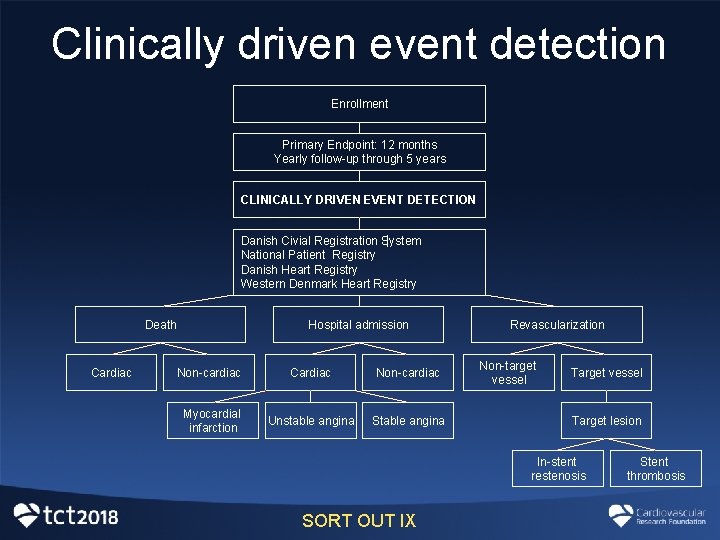
Design § SORT OUT IX is a randomized, multicenter, single-blind, all-comers, two-arm, non-inferiority trial comparing the polymer free biolimus A 9 -coated Bio. Freedom stent to the biodegradable polymer cobalt-chromium sirolimus-eluting Orsiro stent in patients treated with PCI at 4 hospitals in Denmark § Enrollment December 2015 to April 2017 § Clinically driven event detection based on Danish registries § Dual antiplatelet treatment: Stable angina pectoris 6 months (aspirin + clopidogrel) Acute coronary syndroms 12 months (aspirin + ticagrelor/prasugrel) SORT OUT IX
Clinically driven event detection Enrollment Primary Endpoint: 12 months Yearly follow-up through 5 years CLINICALLY DRIVEN EVENT DETECTION Danish Civial Registration System National Patient Registry Danish Heart Registry Western Denmark Heart Registry Death Cardiac Hospital admission Non-cardiac Cardiac Non-cardiac Myocardial infarction Unstable angina Stable angina Revascularization Non-target vessel Target lesion In-stent restenosis SORT OUT IX Stent thrombosis
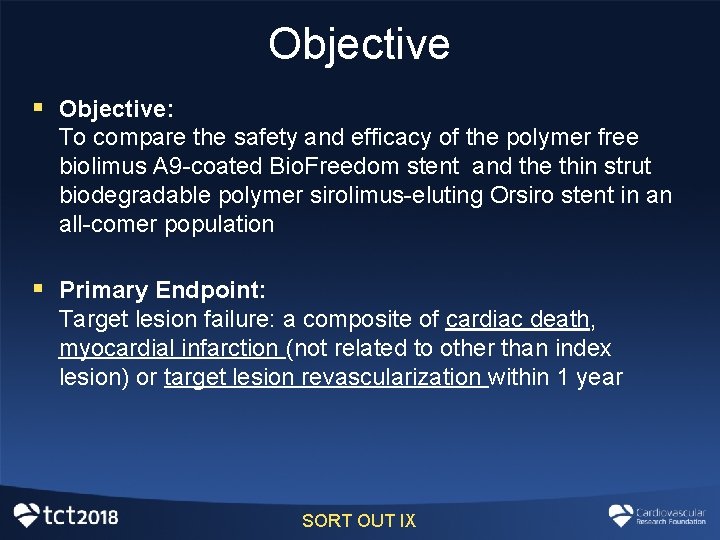
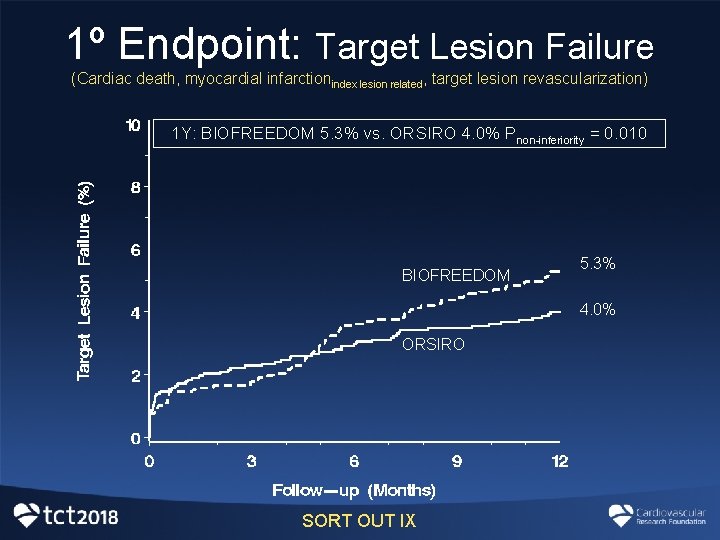
Objective § Objective: To compare the safety and efficacy of the polymer free biolimus A 9 -coated Bio. Freedom stent and the thin strut biodegradable polymer sirolimus-eluting Orsiro stent in an all-comer population § Primary Endpoint: Target lesion failure: a composite of cardiac death, myocardial infarction (not related to other than index lesion) or target lesion revascularization within 1 year SORT OUT IX
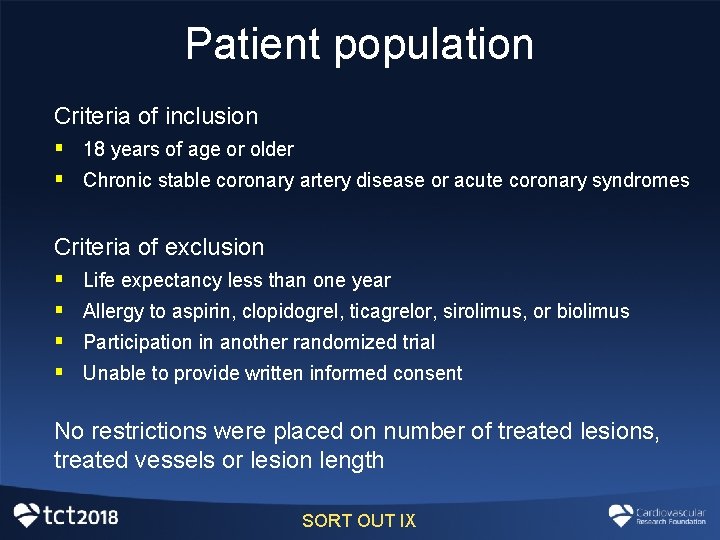
Patient population Criteria of inclusion § 18 years of age or older § Chronic stable coronary artery disease or acute coronary syndromes Criteria of exclusion § § Life expectancy less than one year Allergy to aspirin, clopidogrel, ticagrelor, sirolimus, or biolimus Participation in another randomized trial Unable to provide written informed consent No restrictions were placed on number of treated lesions, treated vessels or lesion length SORT OUT IX
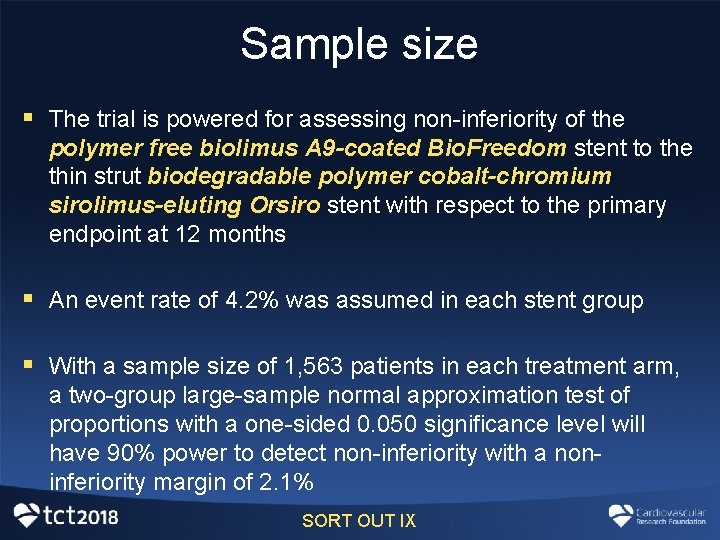
Sample size § The trial is powered for assessing non-inferiority of the polymer free biolimus A 9 -coated Bio. Freedom stent to the thin strut biodegradable polymer cobalt-chromium sirolimus-eluting Orsiro stent with respect to the primary endpoint at 12 months § An event rate of 4. 2% was assumed in each stent group § With a sample size of 1, 563 patients in each treatment arm, a two-group large-sample normal approximation test of proportions with a one-sided 0. 050 significance level will have 90% power to detect non-inferiority with a noninferiority margin of 2. 1% SORT OUT IX
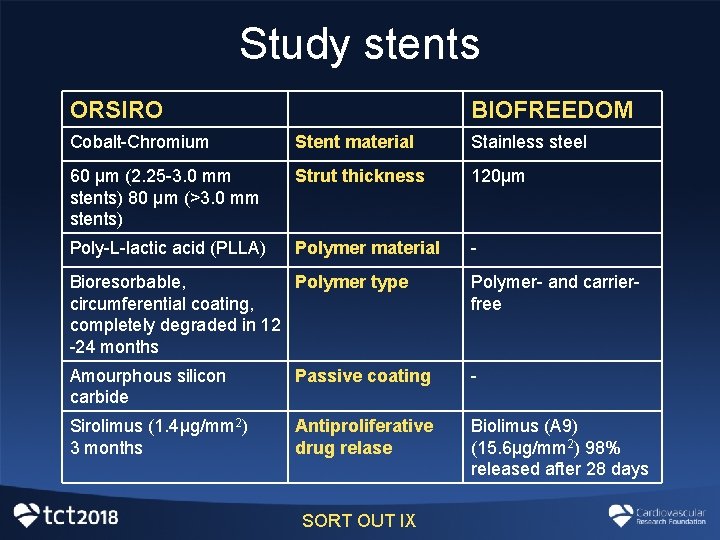
Study stents ORSIRO BIOFREEDOM Cobalt-Chromium Stent material Stainless steel 60 µm (2. 25 -3. 0 mm stents) 80 µm (>3. 0 mm stents) Strut thickness 120µm Poly-L-lactic acid (PLLA) Polymer material - Bioresorbable, Polymer type circumferential coating, completely degraded in 12 -24 months Polymer- and carrierfree Amourphous silicon carbide Passive coating - Sirolimus (1. 4µg/mm 2) 3 months Antiproliferative drug relase Biolimus (A 9) (15. 6µg/mm 2) 98% released after 28 days SORT OUT IX
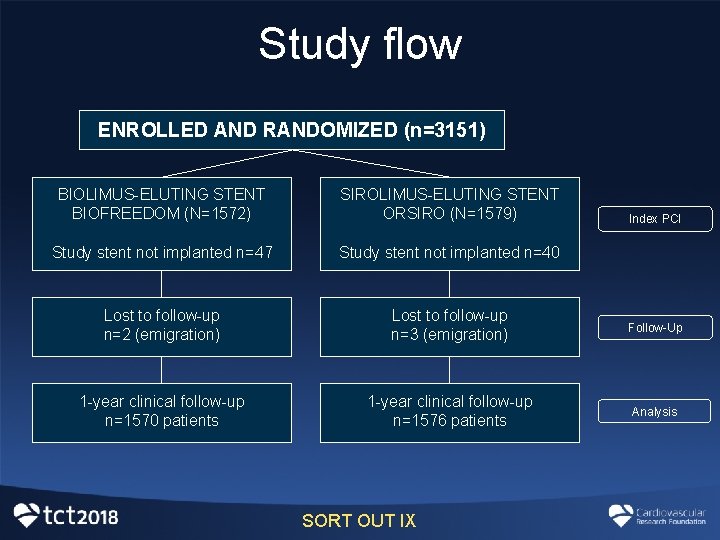
Study flow ENROLLED AND RANDOMIZED (n=3151) BIOLIMUS-ELUTING STENT BIOFREEDOM (N=1572) SIROLIMUS-ELUTING STENT ORSIRO (N=1579) Study stent not implanted n=47 Study stent not implanted n=40 Lost to follow-up n=2 (emigration) Lost to follow-up n=3 (emigration) Follow-Up 1 -year clinical follow-up n=1570 patients 1 -year clinical follow-up n=1576 patients Analysis SORT OUT IX Index PCI
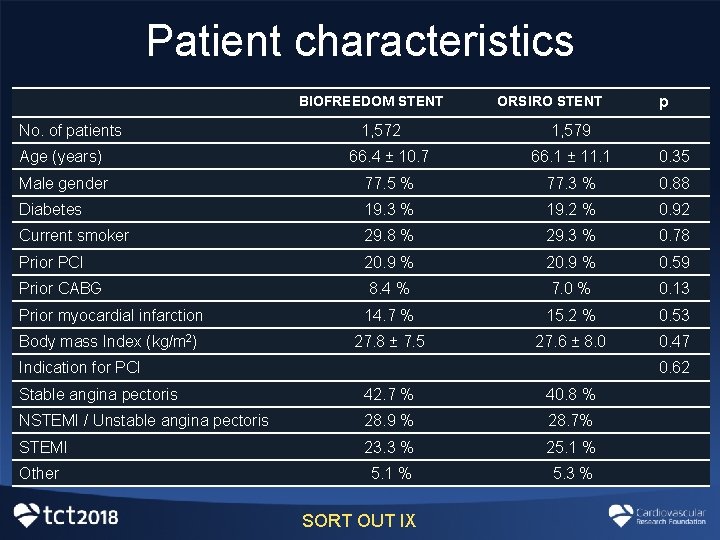
Patient characteristics BIOFREEDOM STENT No. of patients 1, 572 ORSIRO STENT p 1, 579 Age (years) 66. 4 ± 10. 7 66. 1 ± 11. 1 0. 35 Male gender 77. 5 % 77. 3 % 0. 88 Diabetes 19. 3 % 19. 2 % 0. 92 Current smoker 29. 8 % 29. 3 % 0. 78 Prior PCI 20. 9 % 0. 59 Prior CABG 8. 4 % 7. 0 % 0. 13 Prior myocardial infarction 14. 7 % 15. 2 % 0. 53 Body mass Index (kg/m 2) 27. 8 ± 7. 5 27. 6 ± 8. 0 0. 47 Indication for PCI 0. 62 Stable angina pectoris 42. 7 % 40. 8 % NSTEMI / Unstable angina pectoris 28. 9 % 28. 7% STEMI 23. 3 % 25. 1 % Other 5. 1 % 5. 3 % SORT OUT IX
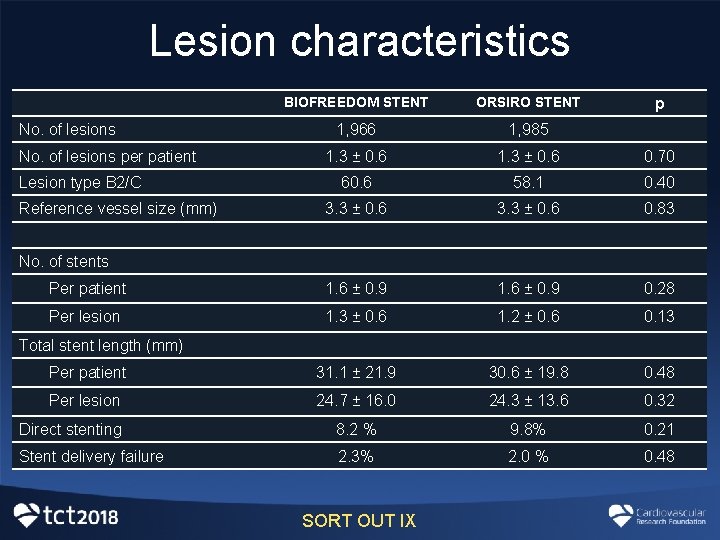
Lesion characteristics BIOFREEDOM STENT ORSIRO STENT 1, 966 1, 985 1. 3 ± 0. 6 0. 70 60. 6 58. 1 0. 40 3. 3 ± 0. 6 0. 83 Per patient 1. 6 ± 0. 9 0. 28 Per lesion 1. 3 ± 0. 6 1. 2 ± 0. 6 0. 13 Per patient 31. 1 ± 21. 9 30. 6 ± 19. 8 0. 48 Per lesion 24. 7 ± 16. 0 24. 3 ± 13. 6 0. 32 Direct stenting 8. 2 % 9. 8% 0. 21 Stent delivery failure 2. 3% 2. 0 % 0. 48 No. of lesions per patient Lesion type B 2/C Reference vessel size (mm) p No. of stents Total stent length (mm) SORT OUT IX
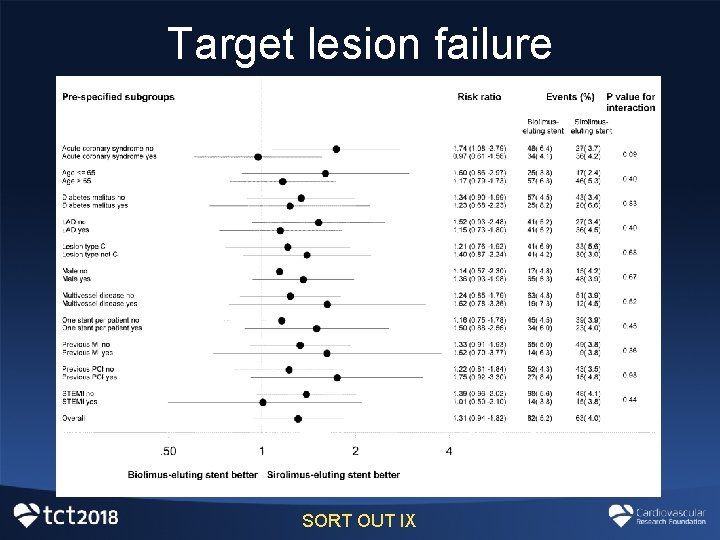
1º Endpoint: Target Lesion Failure (Cardiac death, myocardial infarctionindex lesion related, target lesion revascularization) 1 Y: BIOFREEDOM 5. 3% vs. ORSIRO 4. 0% Pnon-inferiority = 0. 010 BIOFREEDOM 5. 3% 4. 0% ORSIRO SORT OUT IX
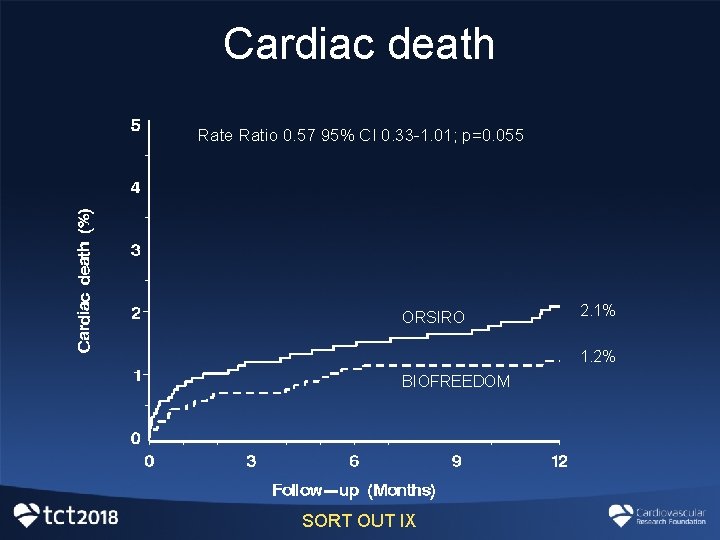
Cardiac death Rate Ratio 0. 57 95% CI 0. 33 -1. 01; p=0. 055 ORSIRO 2. 1% 1. 2% BIOFREEDOM SORT OUT IX
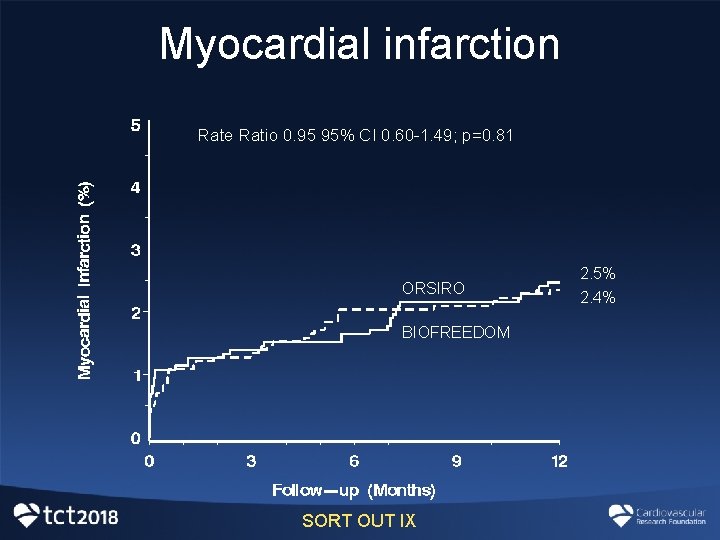
Myocardial infarction Rate Ratio 0. 95 95% CI 0. 60 -1. 49; p=0. 81 ORSIRO BIOFREEDOM SORT OUT IX 2. 5% 2. 4%
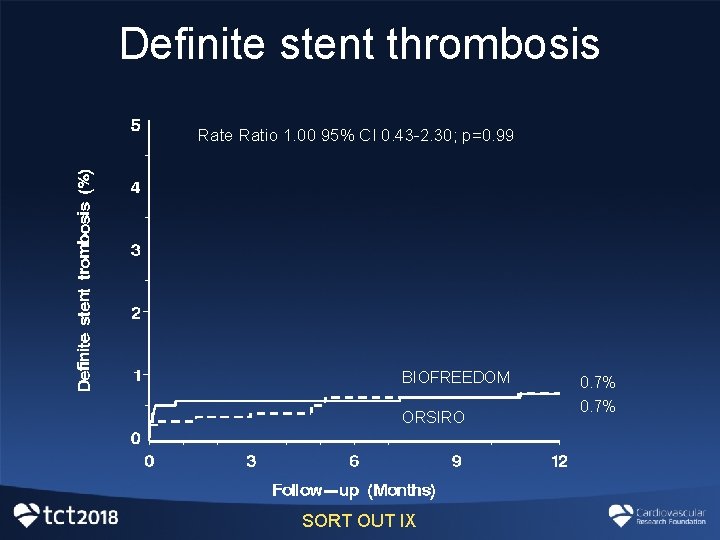
Definite stent thrombosis Rate Ratio 1. 00 95% CI 0. 43 -2. 30; p=0. 99 BIOFREEDOM ORSIRO SORT OUT IX 0. 7%
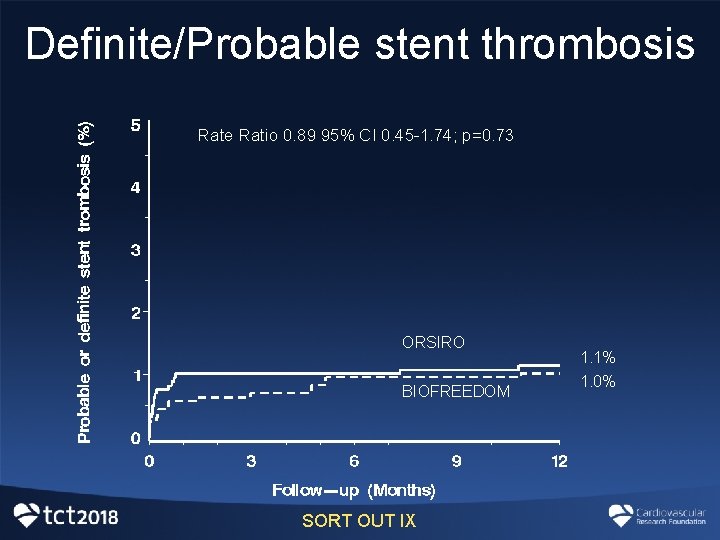
Definite/Probable stent thrombosis Rate Ratio 0. 89 95% CI 0. 45 -1. 74; p=0. 73 ORSIRO BIOFREEDOM SORT OUT IX 1. 1% 1. 0%
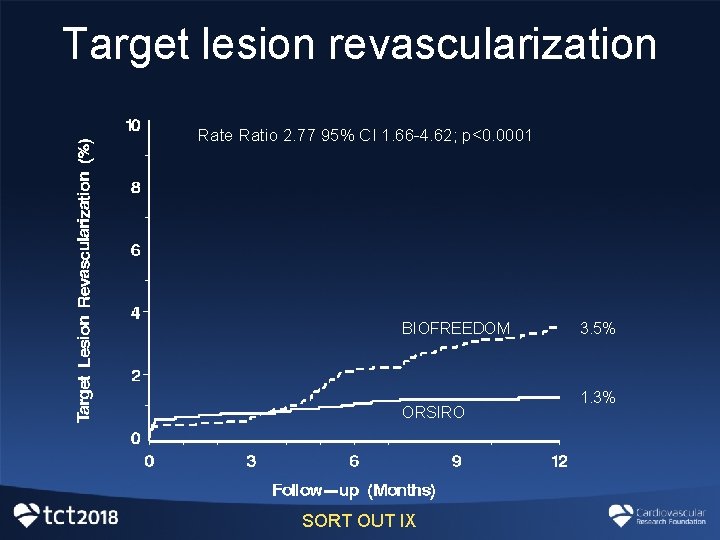
Target lesion revascularization Rate Ratio 2. 77 95% CI 1. 66 -4. 62; p<0. 0001 BIOFREEDOM ORSIRO SORT OUT IX 3. 5% 1. 3%
Target lesion failure SORT OUT IX
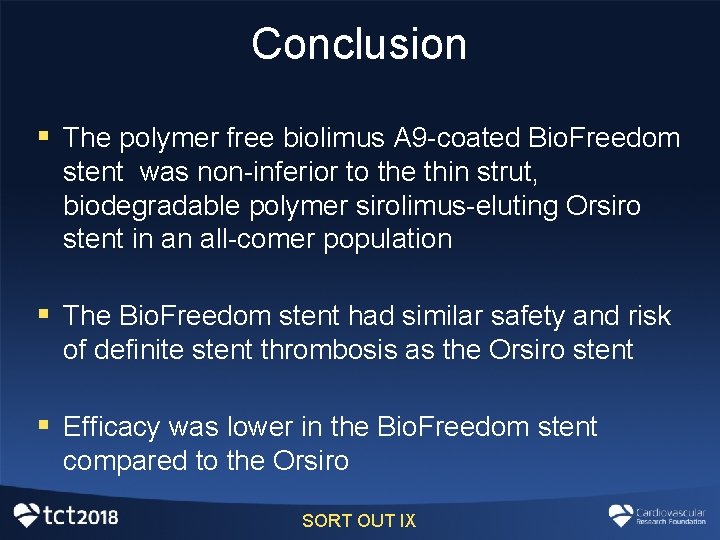
Conclusion § The polymer free biolimus A 9 -coated Bio. Freedom stent was non-inferior to the thin strut, biodegradable polymer sirolimus-eluting Orsiro stent in an all-comer population § The Bio. Freedom stent had similar safety and risk of definite stent thrombosis as the Orsiro stent § Efficacy was lower in the Bio. Freedom stent compared to the Orsiro SORT OUT IX