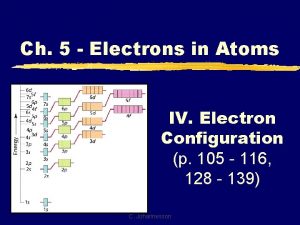
8 4 8 6 Electron Configuration The Explanatory

- Slides: 16
8. 4 -8. 6 Electron Configuration, The Explanatory Power of the Quantum Mechanical Model, and Periodic Trends
Electron Configurations, Valence Electrons, and the Periodic Table The periodic table is arranged by grouping elements with similar chemical properties- connection between electron configuration and chemical properties As we move right across a period, the orbitals fill in the correct order With each subsequent row, the highest principal quantum number increases by 1 As you move down group the number of electrons in outermost
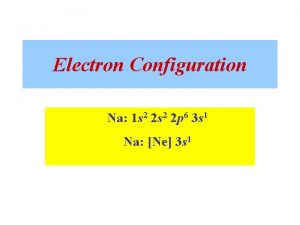
Why? Valence electrons - the electrons in the atom’s outermost energy level, important for chemical bonding This explains why elements in a group have the same chemical properties (they have the same number of valence electrons) Core Electrons - all other electrons in atom, those in complete principle energy levels, and those in complete d and f sublevels Example) Silicon’s electron configuration is 1 s^2 2 p^6 3 s^2 3 p^2 So it has 4 valence electrons (those in the n=3 level) and 10 core electrons
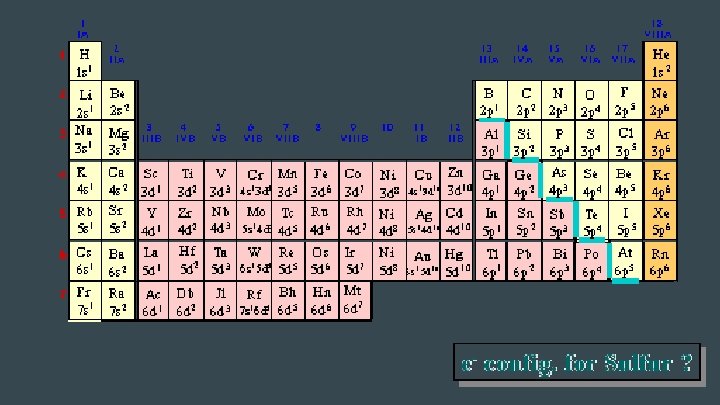
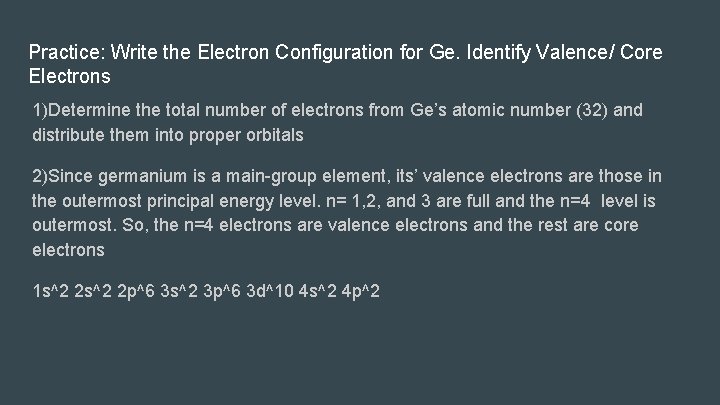
Practice: Write the Electron Configuration for Ge. Identify Valence/ Core Electrons 1)Determine the total number of electrons from Ge’s atomic number (32) and distribute them into proper orbitals 2)Since germanium is a main-group element, its’ valence electrons are those in the outermost principal energy level. n= 1, 2, and 3 are full and the n=4 level is outermost. So, the n=4 electrons are valence electrons and the rest are core electrons 1 s^2 2 p^6 3 s^2 3 p^6 3 d^10 4 s^2 4 p^2
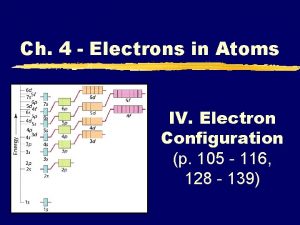
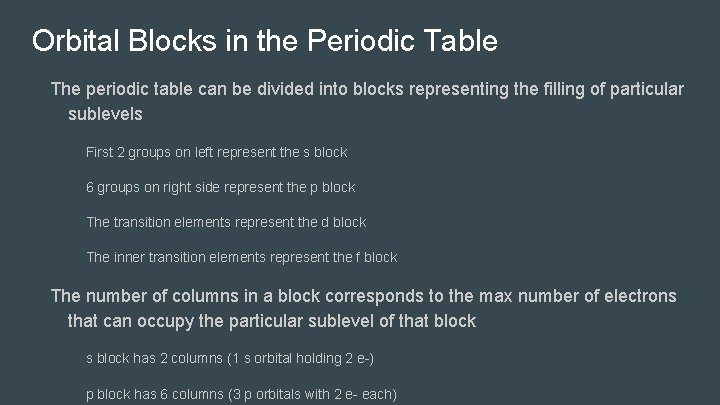
Orbital Blocks in the Periodic Table The periodic table can be divided into blocks representing the filling of particular sublevels First 2 groups on left represent the s block 6 groups on right side represent the p block The transition elements represent the d block The inner transition elements represent the f block The number of columns in a block corresponds to the max number of electrons that can occupy the particular sublevel of that block s block has 2 columns (1 s orbital holding 2 e-) p block has 6 columns (3 p orbitals with 2 e- each)
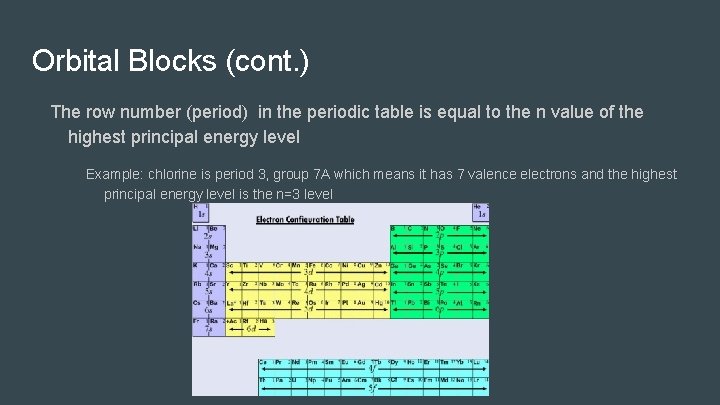
Orbital Blocks (cont. ) The row number (period) in the periodic table is equal to the n value of the highest principal energy level Example: chlorine is period 3, group 7 A which means it has 7 valence electrons and the highest principal energy level is the n=3 level
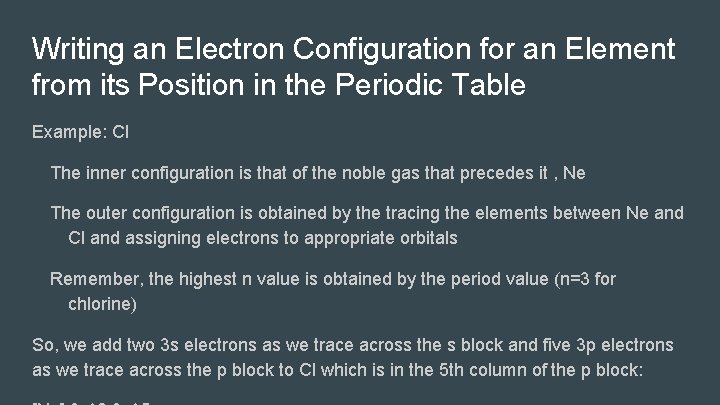
Writing an Electron Configuration for an Element from its Position in the Periodic Table Example: Cl The inner configuration is that of the noble gas that precedes it , Ne The outer configuration is obtained by the tracing the elements between Ne and Cl and assigning electrons to appropriate orbitals Remember, the highest n value is obtained by the period value (n=3 for chlorine) So, we add two 3 s electrons as we trace across the s block and five 3 p electrons as we trace across the p block to Cl which is in the 5 th column of the p block:
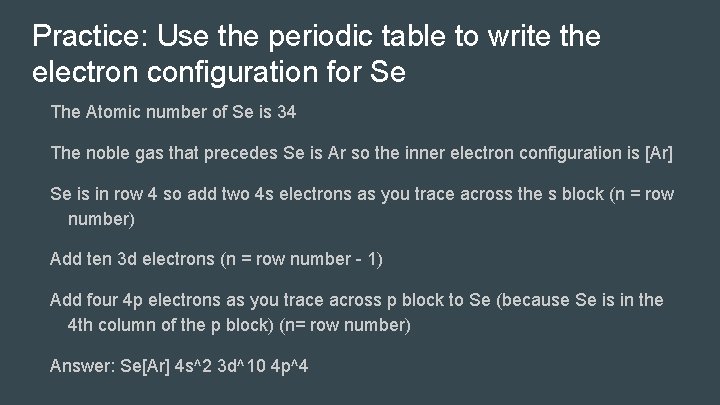
Practice: Use the periodic table to write the electron configuration for Se The Atomic number of Se is 34 The noble gas that precedes Se is Ar so the inner electron configuration is [Ar] Se is in row 4 so add two 4 s electrons as you trace across the s block (n = row number) Add ten 3 d electrons (n = row number - 1) Add four 4 p electrons as you trace across p block to Se (because Se is in the 4 th column of the p block) (n= row number) Answer: Se[Ar] 4 s^2 3 d^10 4 p^4
The Transition and Inner Transition Elements The electron configurations of the transition elements (d block) and inner transition elements (f block) show different trends than those of main-group elements The principal quantum number of the d orbitals that fill across each row in the transition series is equal to the row number minus 1 The principal quantum number of f orbitals that fill across each row in the inner transition series is equal to the row number minus 2
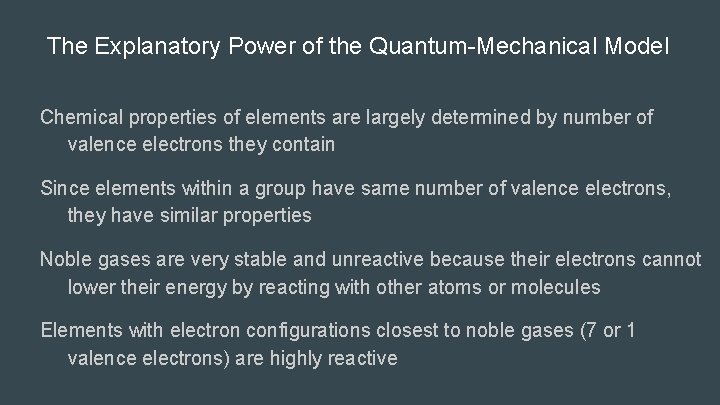
The Explanatory Power of the Quantum-Mechanical Model Chemical properties of elements are largely determined by number of valence electrons they contain Since elements within a group have same number of valence electrons, they have similar properties Noble gases are very stable and unreactive because their electrons cannot lower their energy by reacting with other atoms or molecules Elements with electron configurations closest to noble gases (7 or 1 valence electrons) are highly reactive
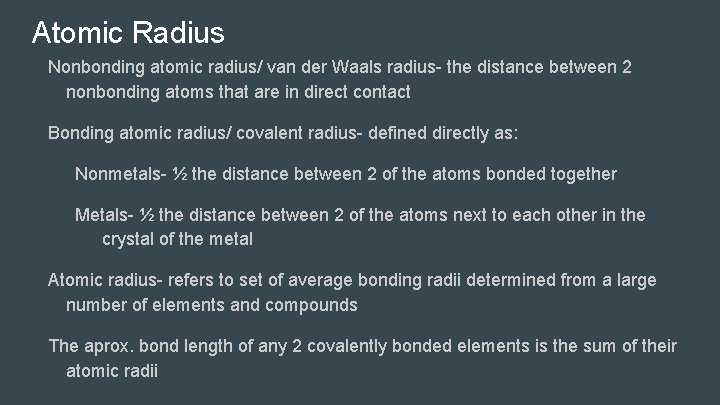
Atomic Radius Nonbonding atomic radius/ van der Waals radius- the distance between 2 nonbonding atoms that are in direct contact Bonding atomic radius/ covalent radius- defined directly as: Nonmetals- ½ the distance between 2 of the atoms bonded together Metals- ½ the distance between 2 of the atoms next to each other in the crystal of the metal Atomic radius- refers to set of average bonding radii determined from a large number of elements and compounds The aprox. bond length of any 2 covalently bonded elements is the sum of their atomic radii
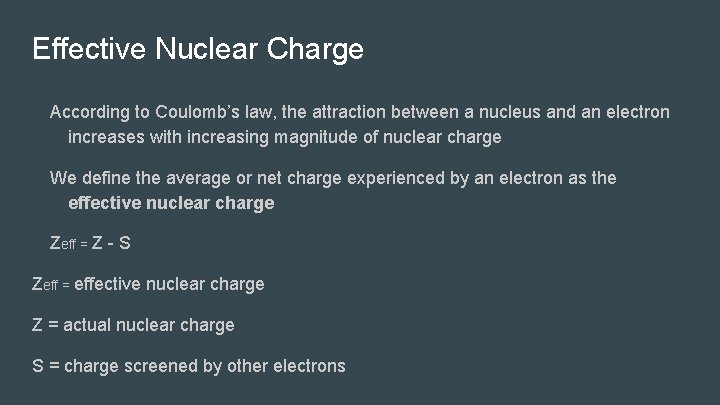
Effective Nuclear Charge According to Coulomb’s law, the attraction between a nucleus and an electron increases with increasing magnitude of nuclear charge We define the average or net charge experienced by an electron as the effective nuclear charge Zeff = Z - S Zeff = effective nuclear charge Z = actual nuclear charge S = charge screened by other electrons
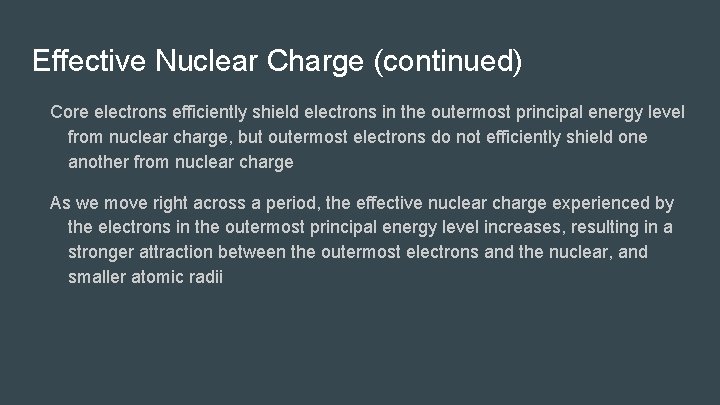
Effective Nuclear Charge (continued) Core electrons efficiently shield electrons in the outermost principal energy level from nuclear charge, but outermost electrons do not efficiently shield one another from nuclear charge As we move right across a period, the effective nuclear charge experienced by the electrons in the outermost principal energy level increases, resulting in a stronger attraction between the outermost electrons and the nuclear, and smaller atomic radii
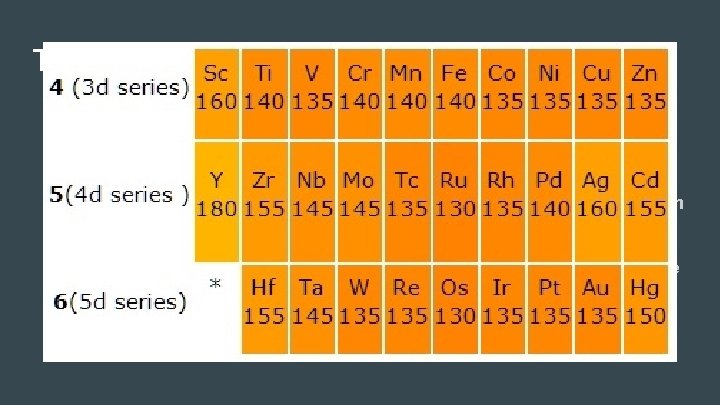
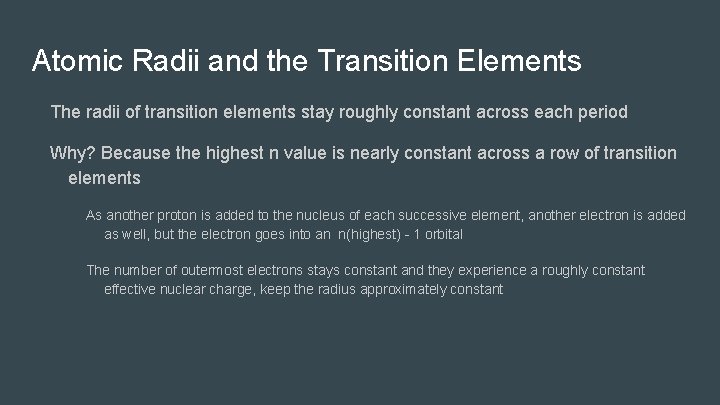
Atomic Radii and the Transition Elements The radii of transition elements stay roughly constant across each period Why? Because the highest n value is nearly constant across a row of transition elements As another proton is added to the nucleus of each successive element, another electron is added as well, but the electron goes into an n(highest) - 1 orbital The number of outermost electrons stays constant and they experience a roughly constant effective nuclear charge, keep the radius approximately constant
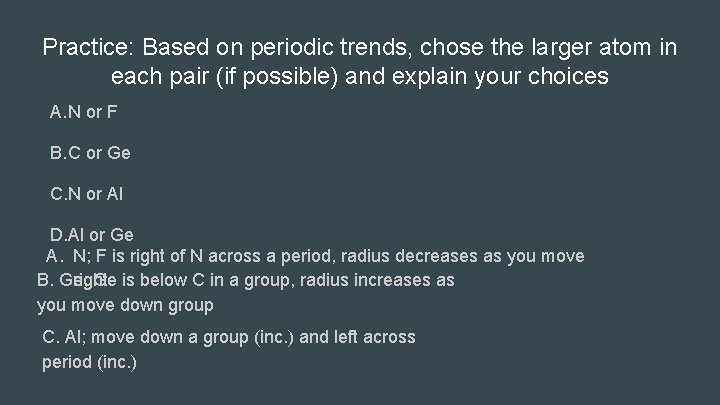
Practice: Based on periodic trends, chose the larger atom in each pair (if possible) and explain your choices A. N or F B. C or Ge C. N or Al D. Al or Ge A. N; F is right of N across a period, radius decreases as you move B. Ge; Ge is below C in a group, radius increases as right you move down group C. Al; move down a group (inc. ) and left across period (inc. )