4 3 Volumetric analysis Learning outcomes To understand

- Slides: 25
4. 3 Volumetric analysis Learning outcomes To understand the apparatus used in volumetric analysis and correct titrimetric procedure.
Students should know the following key words: Volumetric analysis, titration, standard and non standard solutions
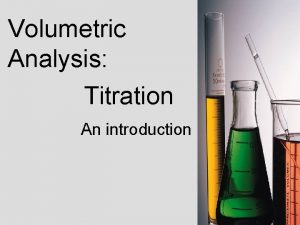
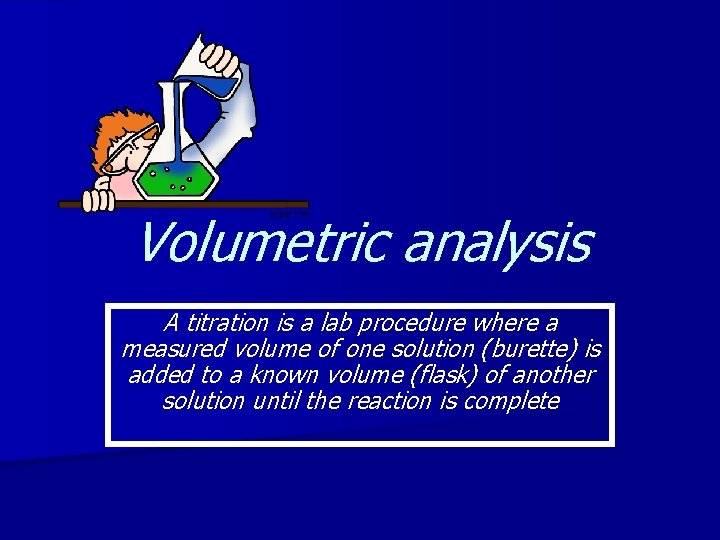
Volumetric analysis A titration is a lab procedure where a measured volume of one solution (burette) is added to a known volume (flask) of another solution until the reaction is complete
Standard solutions n n n A standard is a solution of precisely known concentration It must be available in a highly pure state It must be stable in air It must dissolve easily in water It should have a fairly high relative molecular wt It should under go a complete and rapid reaction
Non standard solutions n Sodium hydroxide absorbs carbon dioxide from atmosphere n HCl can produce chlorine gas in reactions and liberate hydrogen when exposed to air n Nitric acid can act as an oxidising agent interfering with reactions n Sulphuric acid absorbs water form the air
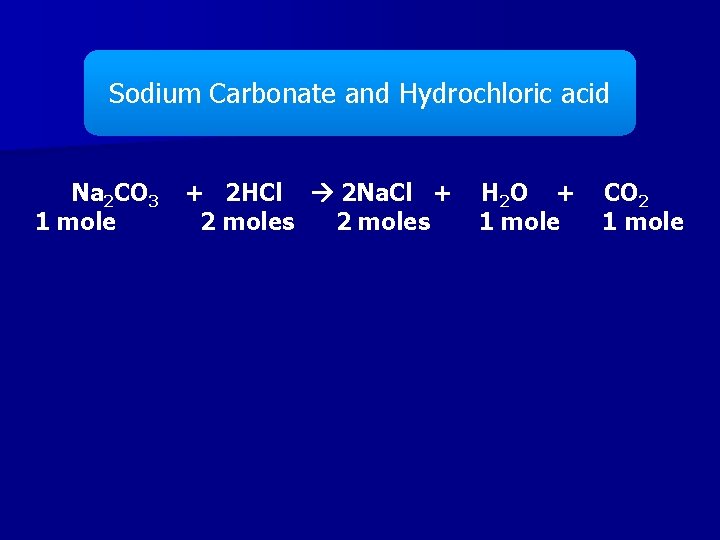
Sodium Carbonate and Hydrochloric acid Na 2 CO 3 1 mole + 2 HCl 2 Na. Cl + 2 moles H 2 O + 1 mole CO 2 1 mole
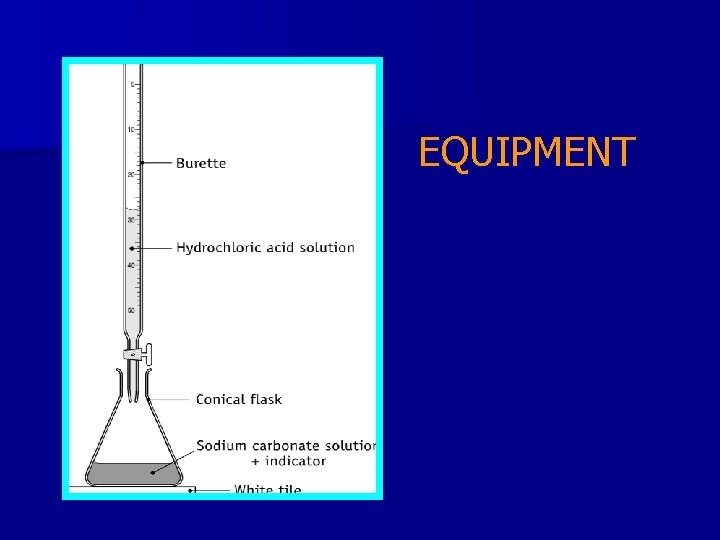
EQUIPMENT
Apparatus used n Burette n Volumetric n Beaker n Pipette n Funnel n Indicator n White tile flask
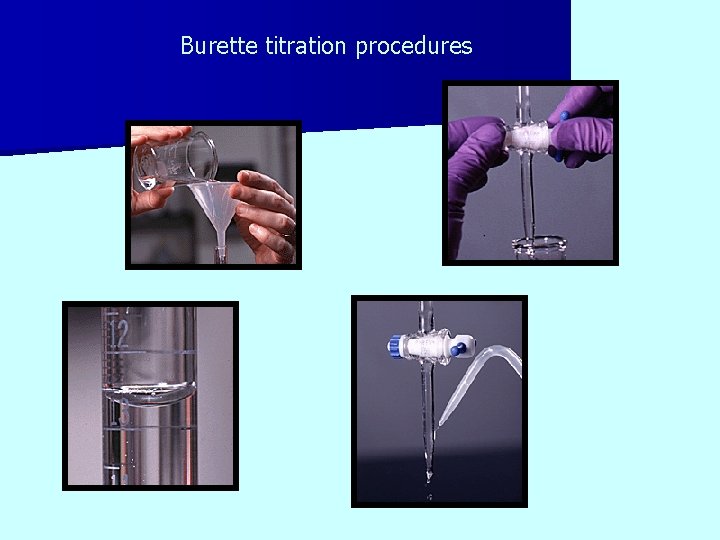
Burette titration procedures
Precautions when using equipment n Burette must be vertical, use and then remove funnel, check meniscus, rinse with de-ionised water and then given solution. n In using a Pipette rinse with de-ionised water first and then with given solution. Check meniscus. Do not blow out remainder of liquid into flask and keep tip of pipette in contact with flask
Precautions n Conical flask should not be rinsed with solution it is to contain and swirl n In using a Volumetric flask the last few cm³ must be added so that the meniscus rest on calibration mark n Invert stoppered flask to ensure solution is homogeneous/uniform
Why is a conical flask, rather than a beaker, used in the experiment? n To allow easy mixing of the contents, by swirling.
Why is the funnel removed from the burette after adding the acid solution? n So that drops of solution from the funnel will not fall into the burette.
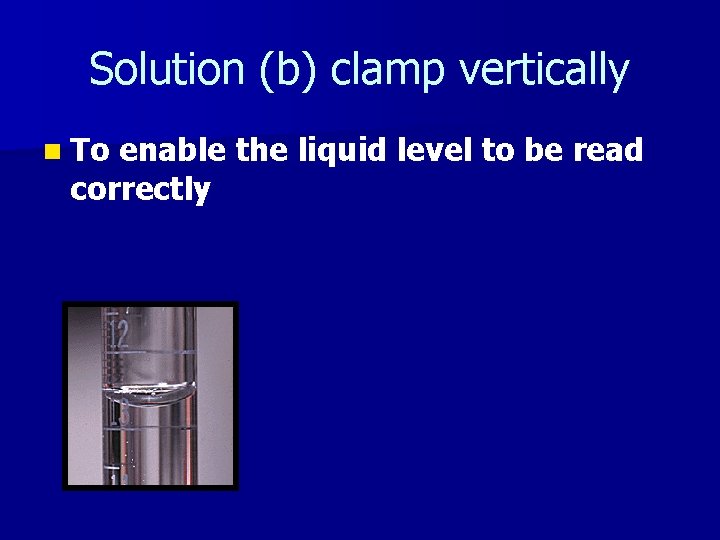
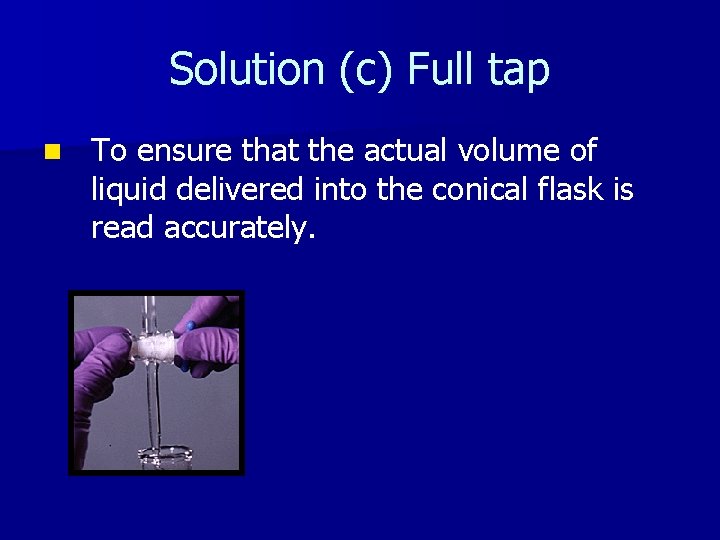
In using a burette, why is it important (a) to rinse it with a little of the solution it is going to contain. (b) to clamp it vertically. (c) to have the part below the tap full?
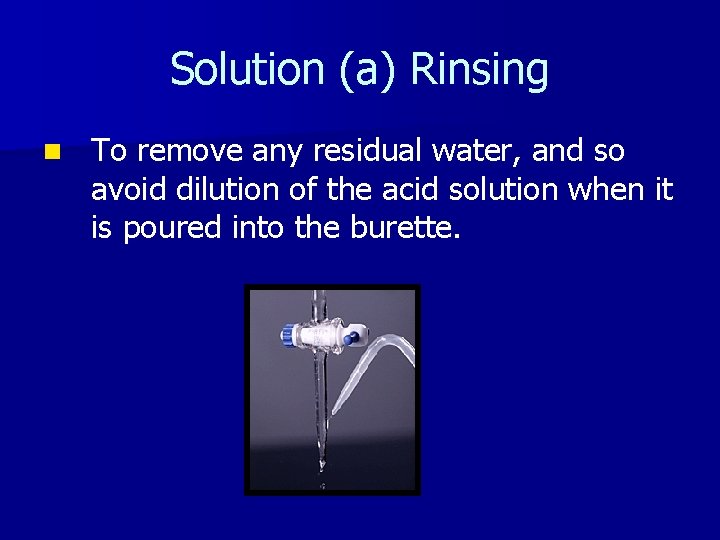
Solution (a) Rinsing n To remove any residual water, and so avoid dilution of the acid solution when it is poured into the burette.
Solution (b) clamp vertically n To enable the liquid level to be read correctly
Solution (c) Full tap n To ensure that the actual volume of liquid delivered into the conical flask is read accurately.
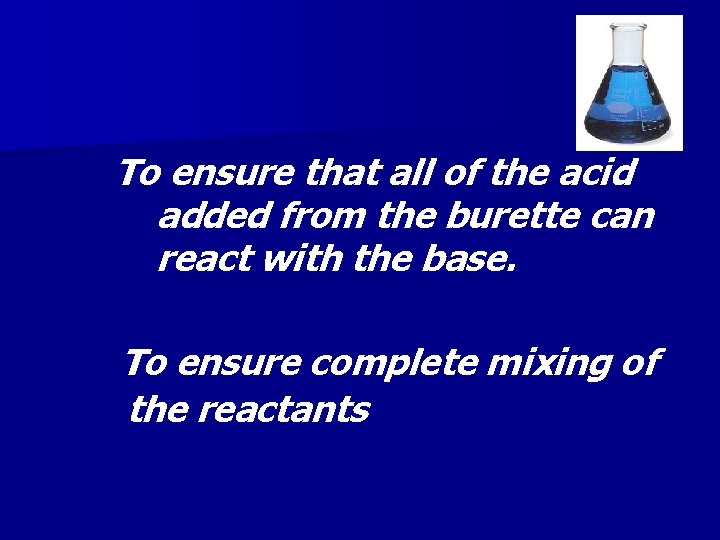
The following procedures were carried out during the titration: The sides of the conical flask were washed down with deionised water. The conical flask was frequently swirled or shaken. Give one reason for carrying out each of these procedures.
To ensure that all of the acid added from the burette can react with the base. To ensure complete mixing of the reactants
n Why is a rough titration carried out? n To find the approximate end-point. This information enables the subsequent titrations to be carried out more quickly.
n Why is more than one accurate titration carried out? n To minimise error by getting accurate readings within 0. 1 cm³ of each other.
Calculation example Volume of acid Va n Volume of base is Vb (cm 3) is the titration (cm³ ). Usually placed figure from burette in the conical flask. n The concentration of n Cb is the acid is Ca (mol) concentration of the base n na is the mol of full balanced equation per n na is the mol of full litre balanced per litre n
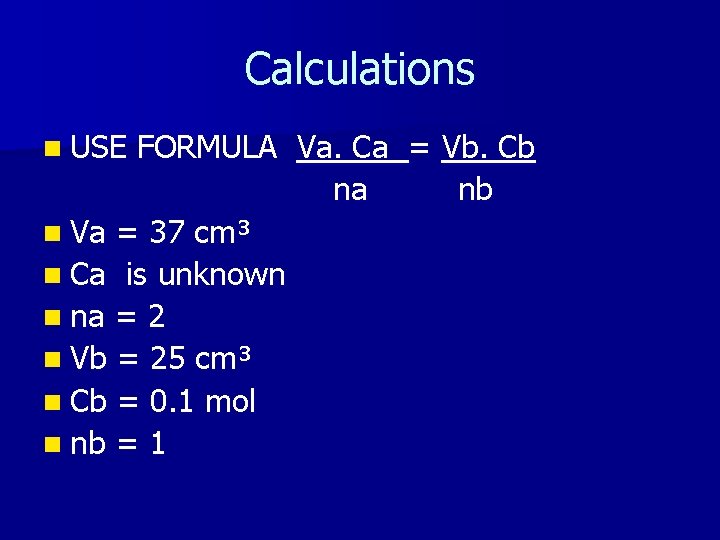
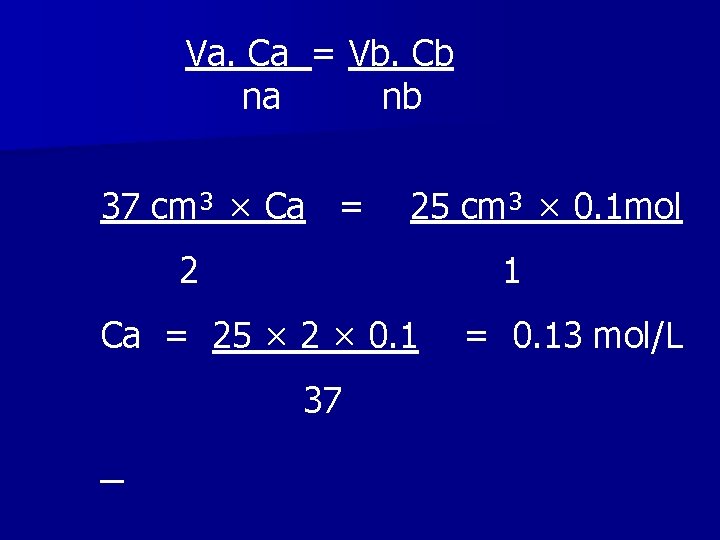
Calculations n USE FORMULA Va. Ca = Vb. Cb na nb n Va = 37 cm³ n Ca is unknown n na = 2 n Vb = 25 cm³ n Cb = 0. 1 mol n nb = 1
Va. Ca = Vb. Cb na nb 37 cm³ × Ca = 25 cm³ × 0. 1 mol 2 1 Ca = 25 × 2 × 0. 1 37 = 0. 13 mol/L
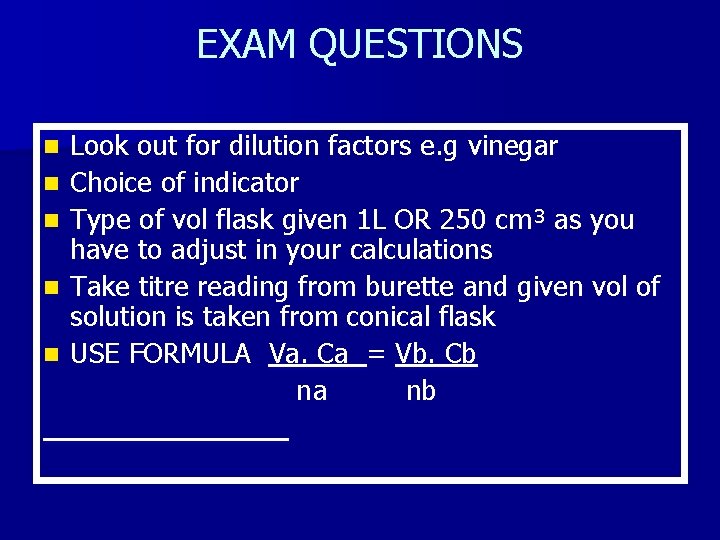
EXAM QUESTIONS n n n Look out for dilution factors e. g vinegar Choice of indicator Type of vol flask given 1 L OR 250 cm³ as you have to adjust in your calculations Take titre reading from burette and given vol of solution is taken from conical flask USE FORMULA Va. Ca = Vb. Cb na nb