30 Mentor Sentence Activities Rhetorical Devices Syntax Literary
- Slides: 91
30 Mentor Sentence Activities Rhetorical Devices, Syntax, & Literary Terms
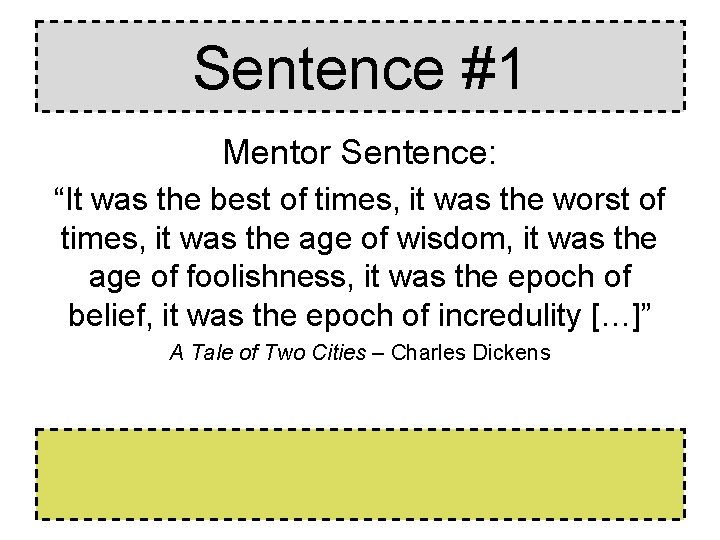
Sentence #1 Mentor Sentence: “It was the best of times, it was the worst of times, it was the age of wisdom, it was the age of foolishness, it was the epoch of belief, it was the epoch of incredulity […]” A Tale of Two Cities – Charles Dickens
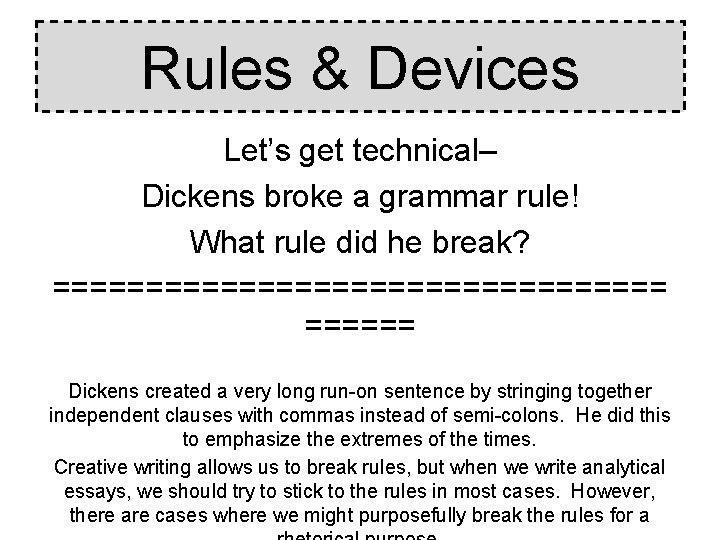
Rules & Devices Let’s get technical– Dickens broke a grammar rule! What rule did he break? ================= Dickens created a very long run-on sentence by stringing together independent clauses with commas instead of semi-colons. He did this to emphasize the extremes of the times. Creative writing allows us to break rules, but when we write analytical essays, we should try to stick to the rules in most cases. However, there are cases where we might purposefully break the rules for a
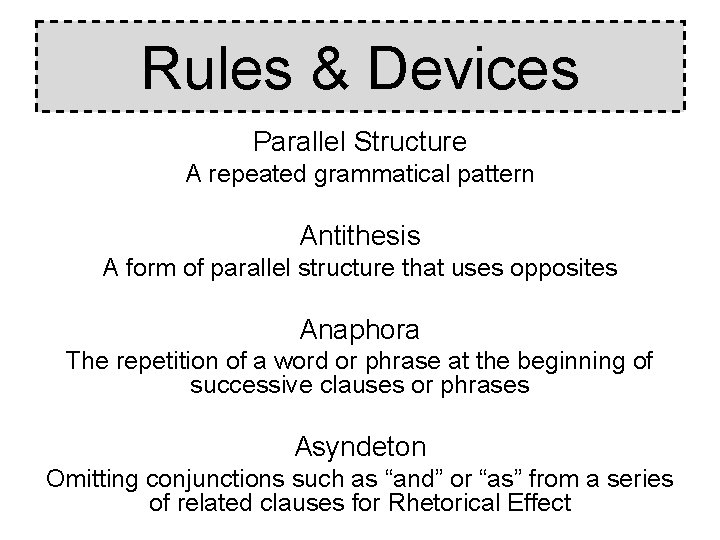
Rules & Devices Parallel Structure A repeated grammatical pattern Antithesis A form of parallel structure that uses opposites Anaphora The repetition of a word or phrase at the beginning of successive clauses or phrases Asyndeton Omitting conjunctions such as “and” or “as” from a series of related clauses for Rhetorical Effect
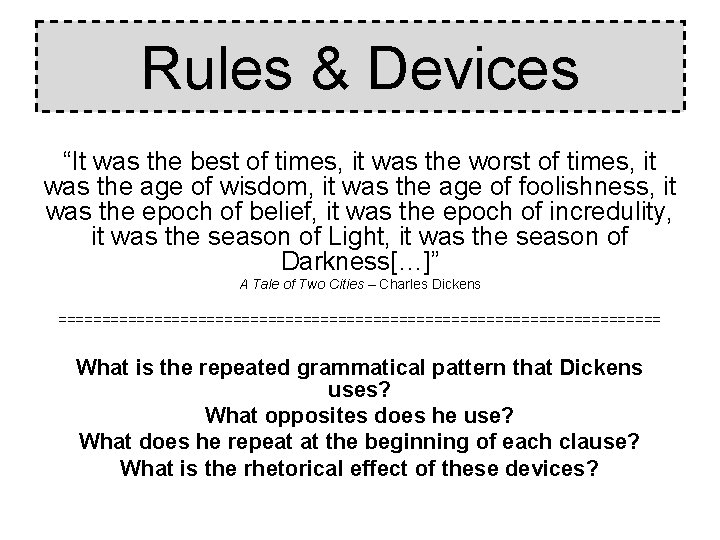
Rules & Devices “It was the best of times, it was the worst of times, it was the age of wisdom, it was the age of foolishness, it was the epoch of belief, it was the epoch of incredulity, it was the season of Light, it was the season of Darkness[…]” A Tale of Two Cities – Charles Dickens =================================== What is the repeated grammatical pattern that Dickens uses? What opposites does he use? What does he repeat at the beginning of each clause? What is the rhetorical effect of these devices?
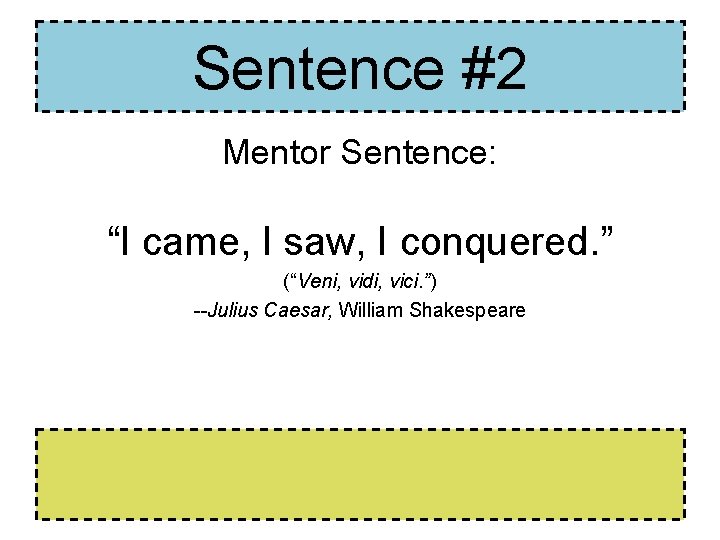
Sentence #2 Mentor Sentence: “I came, I saw, I conquered. ” (“Veni, vidi, vici. ”) --Julius Caesar, William Shakespeare
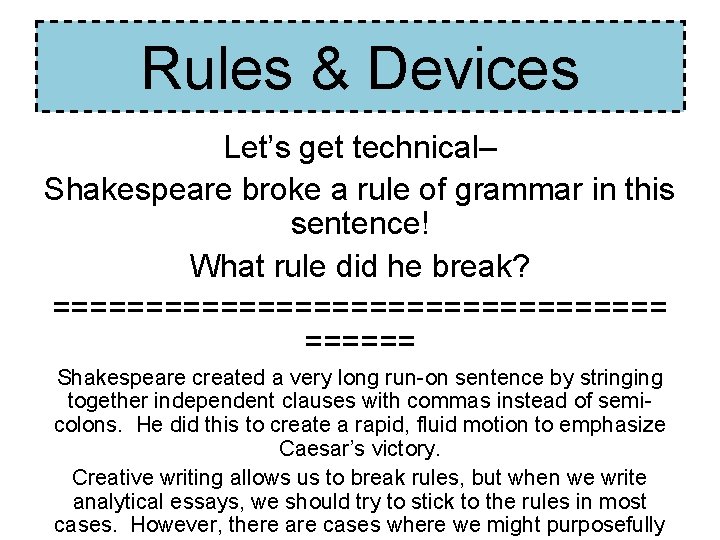
Rules & Devices Let’s get technical– Shakespeare broke a rule of grammar in this sentence! What rule did he break? ================= Shakespeare created a very long run-on sentence by stringing together independent clauses with commas instead of semicolons. He did this to create a rapid, fluid motion to emphasize Caesar’s victory. Creative writing allows us to break rules, but when we write analytical essays, we should try to stick to the rules in most cases. However, there are cases where we might purposefully
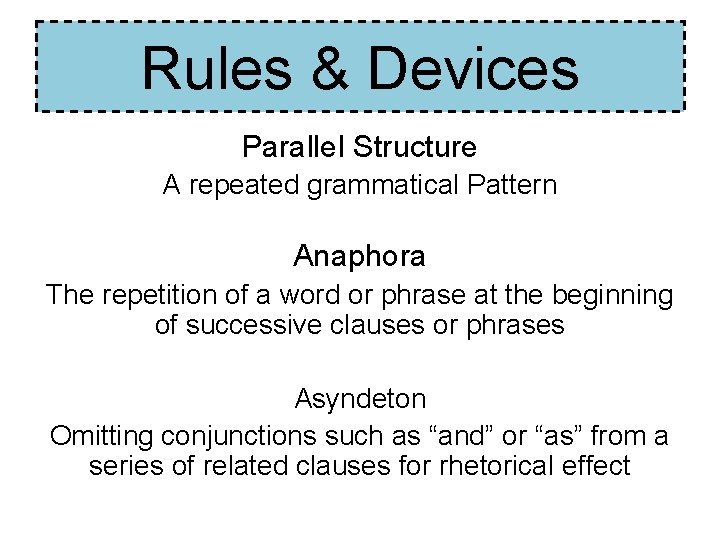
Rules & Devices Parallel Structure A repeated grammatical Pattern Anaphora The repetition of a word or phrase at the beginning of successive clauses or phrases Asyndeton Omitting conjunctions such as “and” or “as” from a series of related clauses for rhetorical effect
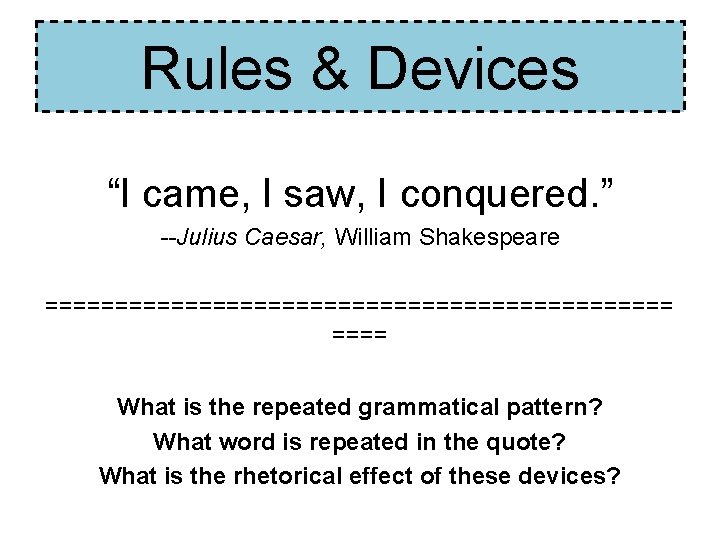
Rules & Devices “I came, I saw, I conquered. ” --Julius Caesar, William Shakespeare ======================= What is the repeated grammatical pattern? What word is repeated in the quote? What is the rhetorical effect of these devices?
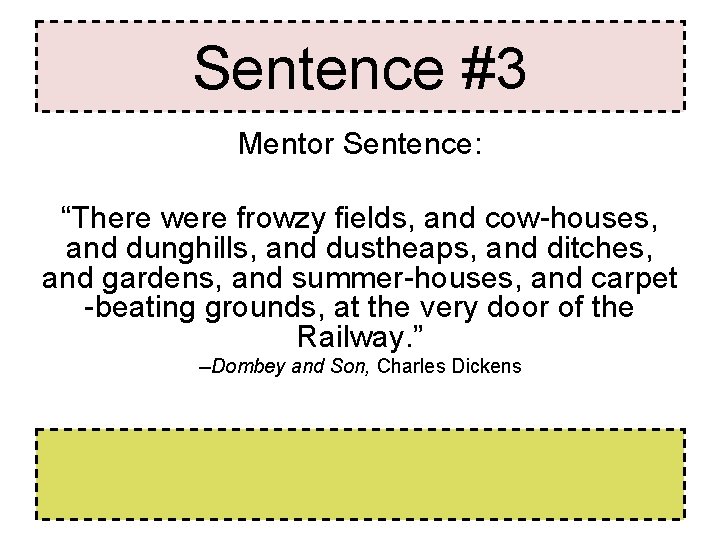
Sentence #3 Mentor Sentence: “There were frowzy fields, and cow-houses, and dunghills, and dustheaps, and ditches, and gardens, and summer-houses, and carpet -beating grounds, at the very door of the Railway. ” --Dombey and Son, Charles Dickens
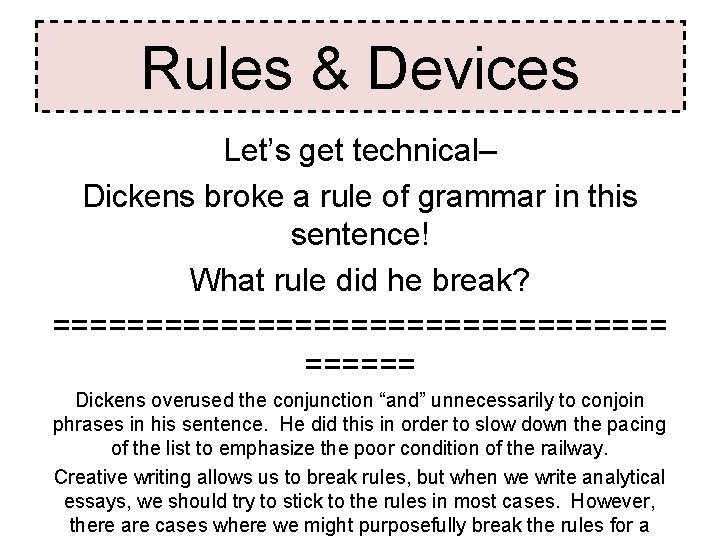
Rules & Devices Let’s get technical– Dickens broke a rule of grammar in this sentence! What rule did he break? ================= Dickens overused the conjunction “and” unnecessarily to conjoin phrases in his sentence. He did this in order to slow down the pacing of the list to emphasize the poor condition of the railway. Creative writing allows us to break rules, but when we write analytical essays, we should try to stick to the rules in most cases. However, there are cases where we might purposefully break the rules for a
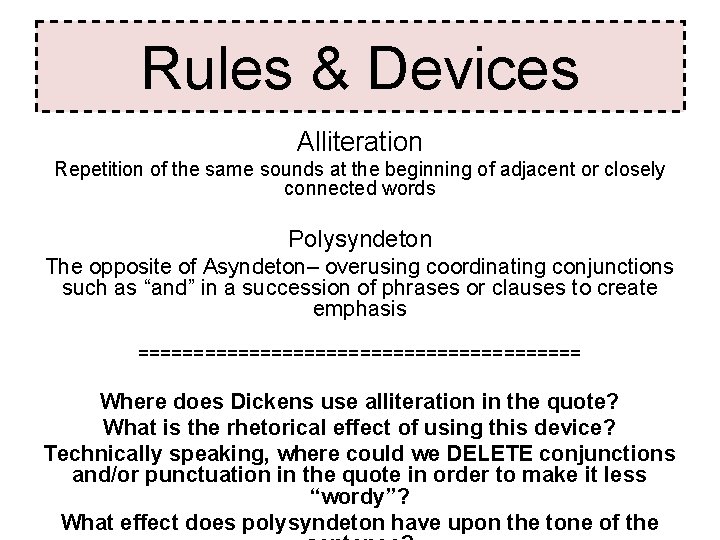
Rules & Devices Alliteration Repetition of the same sounds at the beginning of adjacent or closely connected words Polysyndeton The opposite of Asyndeton– overusing coordinating conjunctions such as “and” in a succession of phrases or clauses to create emphasis ==================== Where does Dickens use alliteration in the quote? What is the rhetorical effect of using this device? Technically speaking, where could we DELETE conjunctions and/or punctuation in the quote in order to make it less “wordy”? What effect does polysyndeton have upon the tone of the
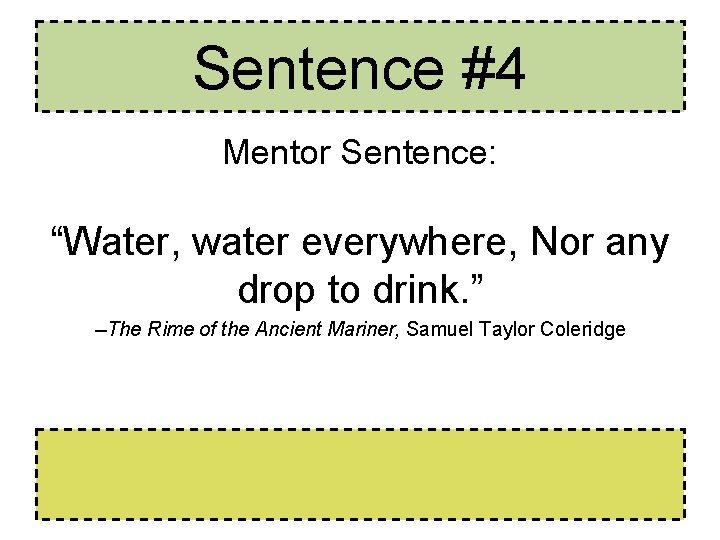
Sentence #4 Mentor Sentence: “Water, water everywhere, Nor any drop to drink. ” --The Rime of the Ancient Mariner, Samuel Taylor Coleridge
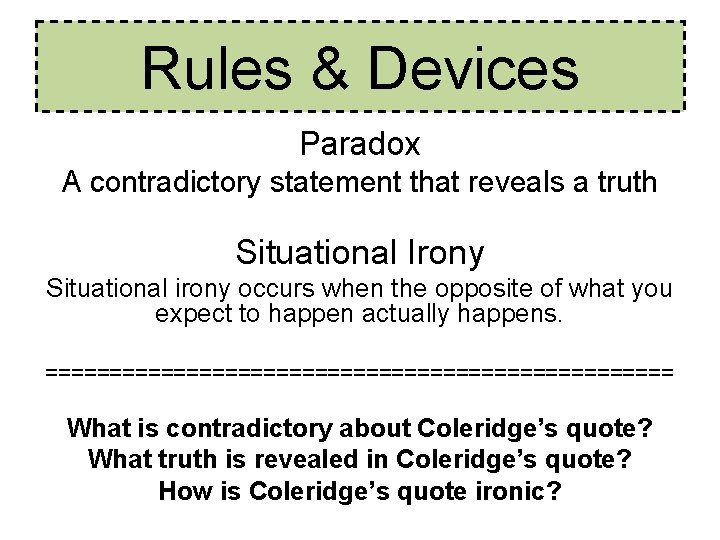
Rules & Devices Paradox A contradictory statement that reveals a truth Situational Irony Situational irony occurs when the opposite of what you expect to happen actually happens. ========================= What is contradictory about Coleridge’s quote? What truth is revealed in Coleridge’s quote? How is Coleridge’s quote ironic?
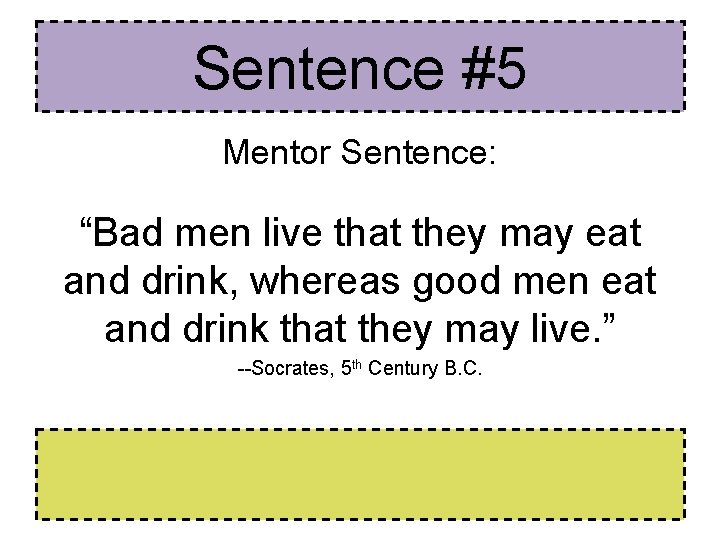
Sentence #5 Mentor Sentence: “Bad men live that they may eat and drink, whereas good men eat and drink that they may live. ” --Socrates, 5 th Century B. C.
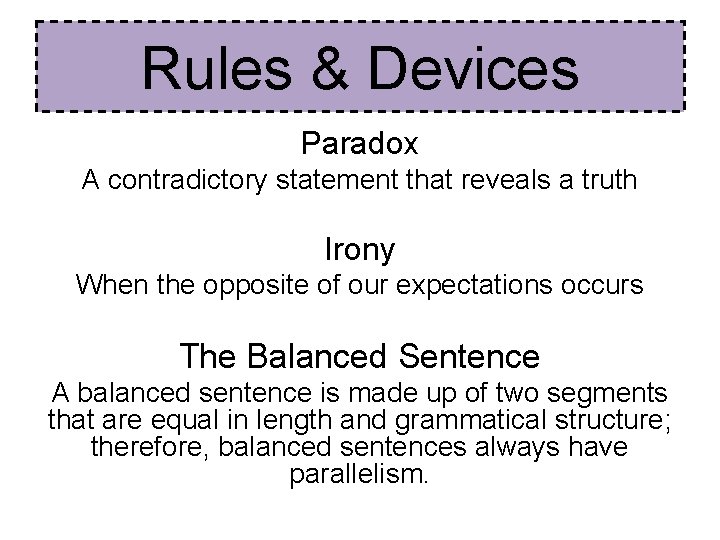
Rules & Devices Paradox A contradictory statement that reveals a truth Irony When the opposite of our expectations occurs The Balanced Sentence A balanced sentence is made up of two segments that are equal in length and grammatical structure; therefore, balanced sentences always have parallelism.
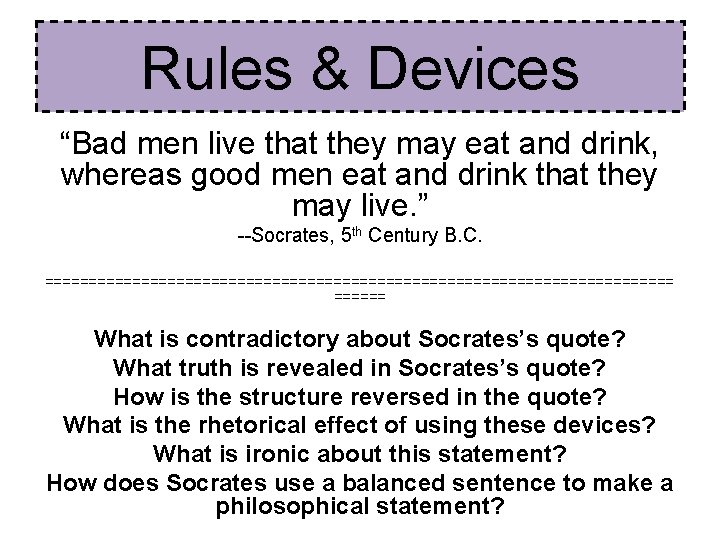
Rules & Devices “Bad men live that they may eat and drink, whereas good men eat and drink that they may live. ” --Socrates, 5 th Century B. C. ==================================== What is contradictory about Socrates’s quote? What truth is revealed in Socrates’s quote? How is the structure reversed in the quote? What is the rhetorical effect of using these devices? What is ironic about this statement? How does Socrates use a balanced sentence to make a philosophical statement?
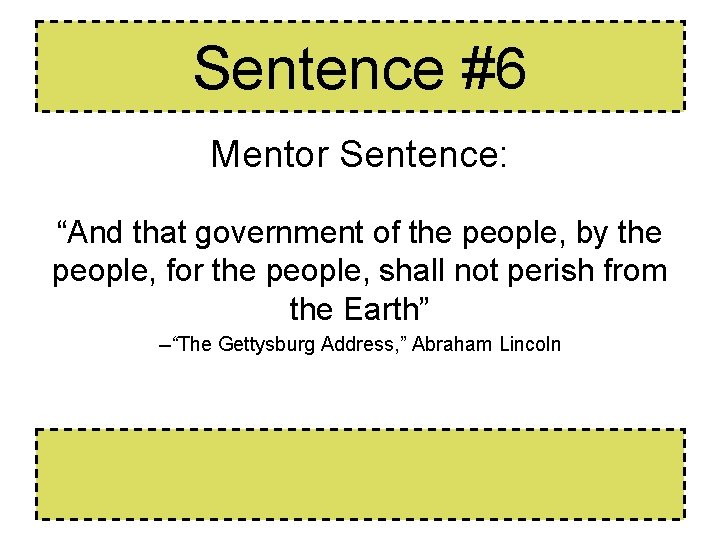
Sentence #6 Mentor Sentence: “And that government of the people, by the people, for the people, shall not perish from the Earth” --“The Gettysburg Address, ” Abraham Lincoln
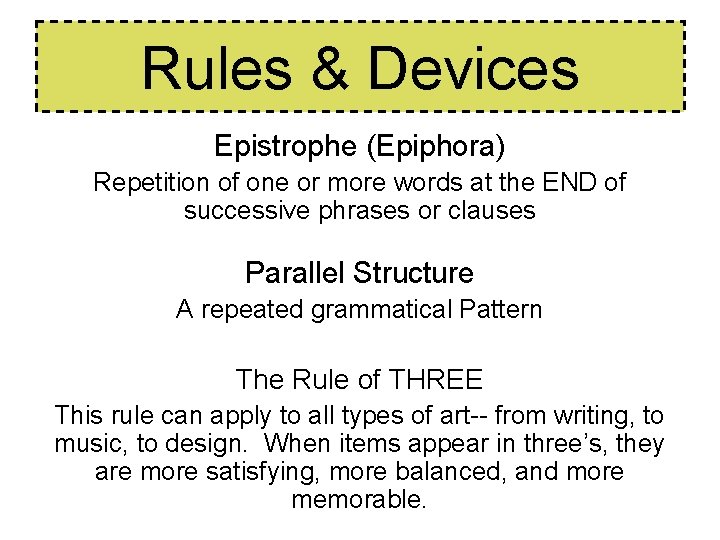
Rules & Devices Epistrophe (Epiphora) Repetition of one or more words at the END of successive phrases or clauses Parallel Structure A repeated grammatical Pattern The Rule of THREE This rule can apply to all types of art-- from writing, to music, to design. When items appear in three’s, they are more satisfying, more balanced, and more memorable.
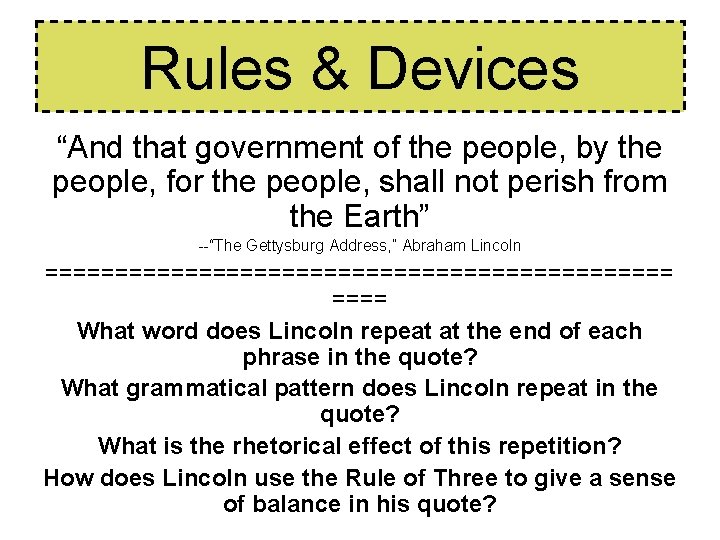
Rules & Devices “And that government of the people, by the people, for the people, shall not perish from the Earth” --“The Gettysburg Address, ” Abraham Lincoln ======================= What word does Lincoln repeat at the end of each phrase in the quote? What grammatical pattern does Lincoln repeat in the quote? What is the rhetorical effect of this repetition? How does Lincoln use the Rule of Three to give a sense of balance in his quote?
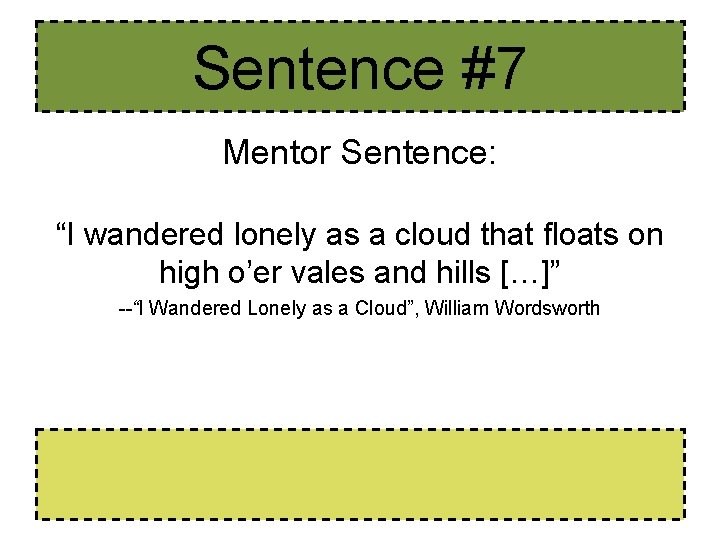
Sentence #7 Mentor Sentence: “I wandered lonely as a cloud that floats on high o’er vales and hills […]” --“I Wandered Lonely as a Cloud”, William Wordsworth
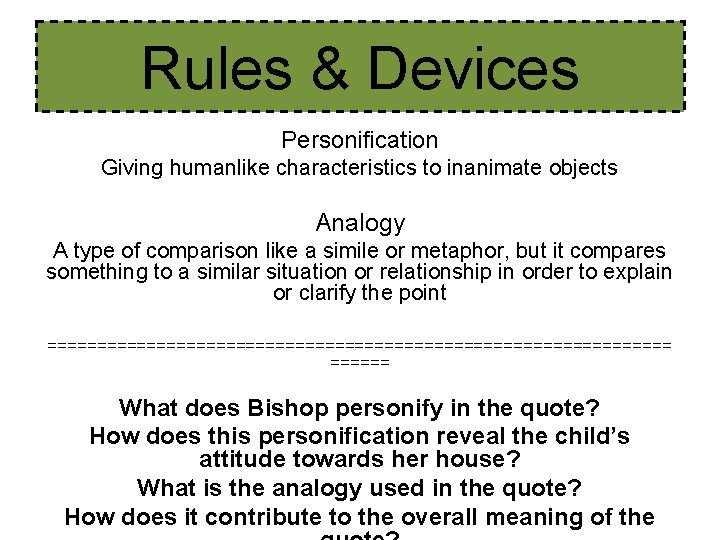
Rules & Devices Personification Giving humanlike characteristics to inanimate objects Analogy A type of comparison like a simile or metaphor, but it compares something to a similar situation or relationship in order to explain or clarify the point ================================ What does Bishop personify in the quote? How does this personification reveal the child’s attitude towards her house? What is the analogy used in the quote? How does it contribute to the overall meaning of the
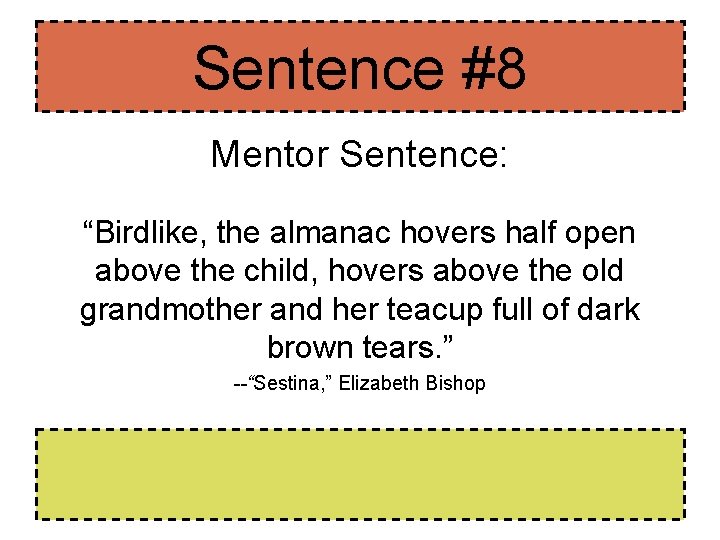
Sentence #8 Mentor Sentence: “Birdlike, the almanac hovers half open above the child, hovers above the old grandmother and her teacup full of dark brown tears. ” --“Sestina, ” Elizabeth Bishop
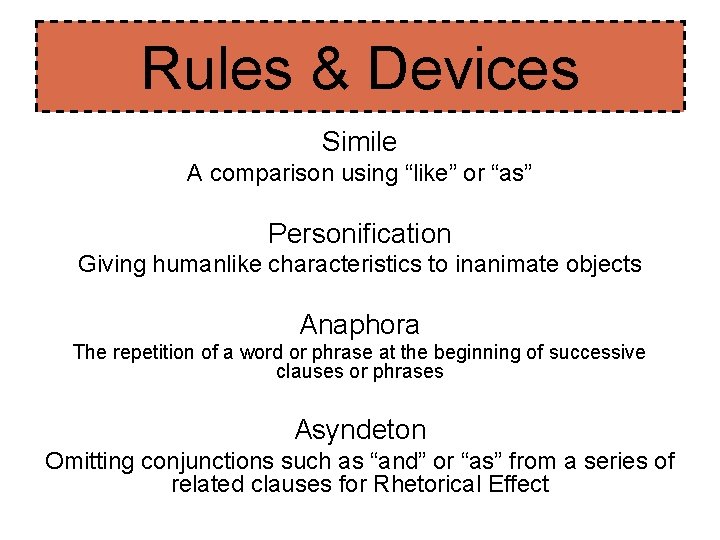
Rules & Devices Simile A comparison using “like” or “as” Personification Giving humanlike characteristics to inanimate objects Anaphora The repetition of a word or phrase at the beginning of successive clauses or phrases Asyndeton Omitting conjunctions such as “and” or “as” from a series of related clauses for Rhetorical Effect
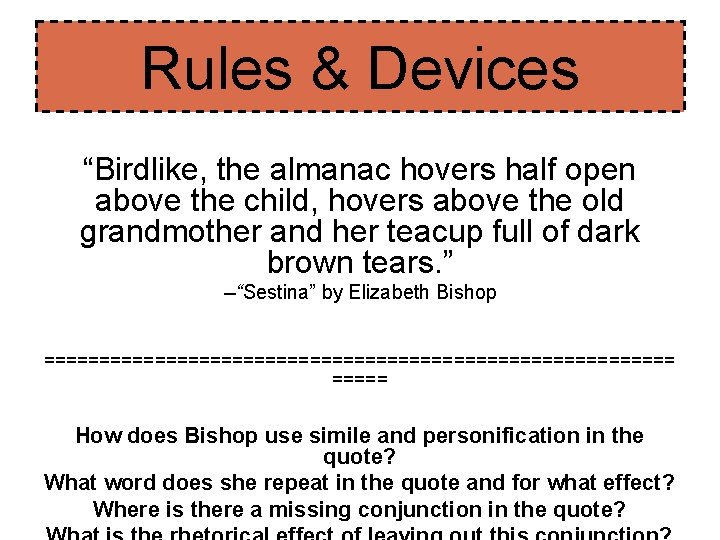
Rules & Devices “Birdlike, the almanac hovers half open above the child, hovers above the old grandmother and her teacup full of dark brown tears. ” --“Sestina” by Elizabeth Bishop ============================= How does Bishop use simile and personification in the quote? What word does she repeat in the quote and for what effect? Where is there a missing conjunction in the quote?
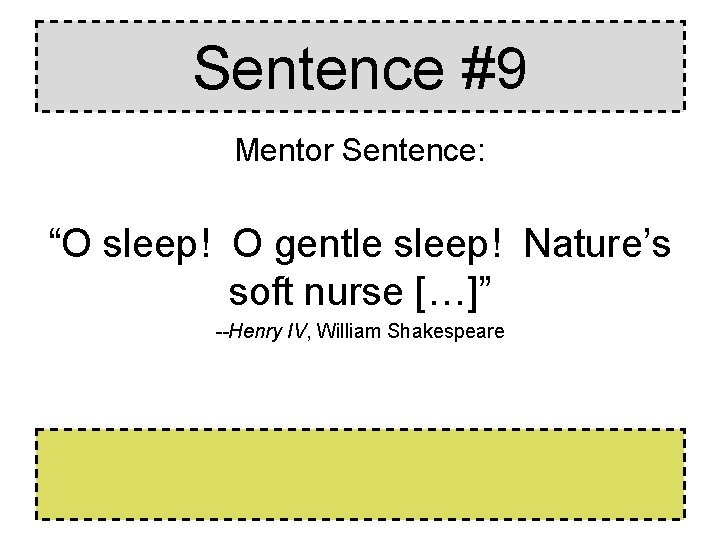
Sentence #9 Mentor Sentence: “O sleep! O gentle sleep! Nature’s soft nurse […]” --Henry IV, William Shakespeare
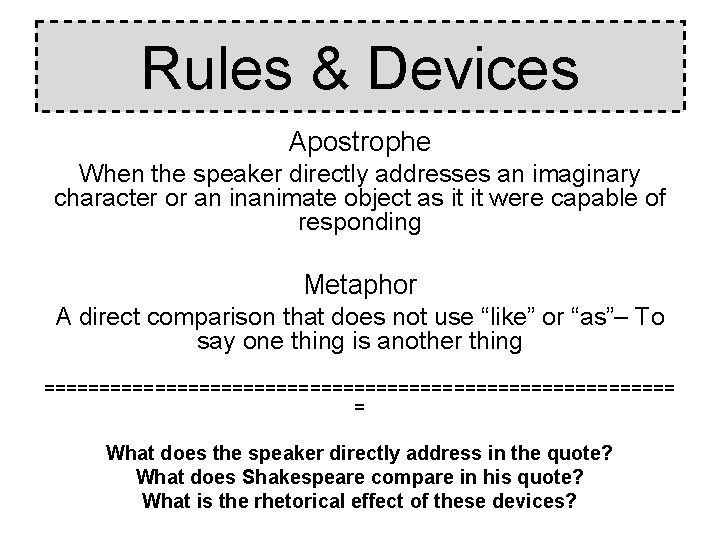
Rules & Devices Apostrophe When the speaker directly addresses an imaginary character or an inanimate object as it it were capable of responding Metaphor A direct comparison that does not use “like” or “as”– To say one thing is another thing ============================= = What does the speaker directly address in the quote? What does Shakespeare compare in his quote? What is the rhetorical effect of these devices?
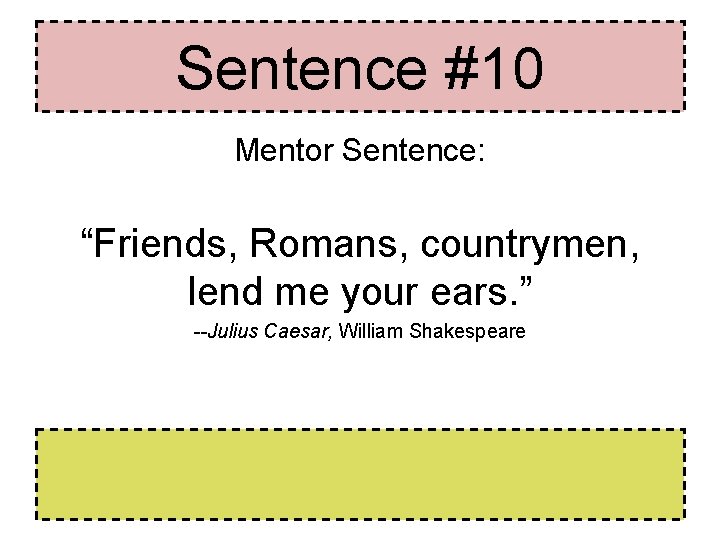
Sentence #10 Mentor Sentence: “Friends, Romans, countrymen, lend me your ears. ” --Julius Caesar, William Shakespeare
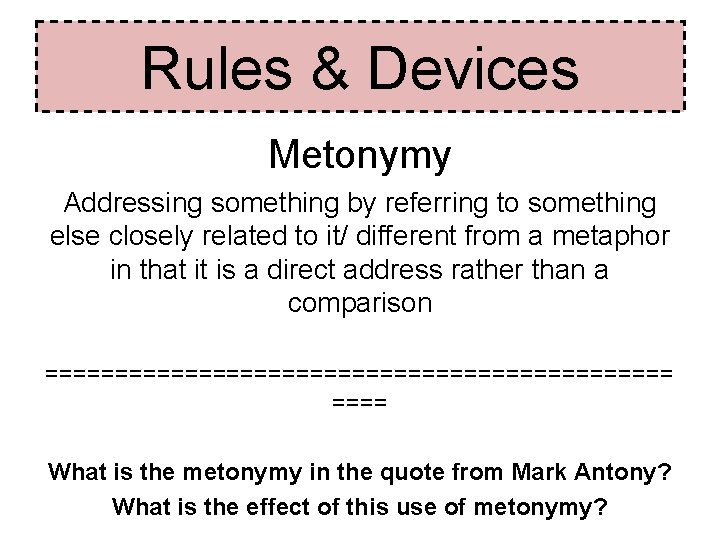
Rules & Devices Metonymy Addressing something by referring to something else closely related to it/ different from a metaphor in that it is a direct address rather than a comparison ======================= What is the metonymy in the quote from Mark Antony? What is the effect of this use of metonymy?
Rules & Devices The Rule of THREE This rule can apply to all types of art-- from writing, to music, to design. When items appear in three’s, they are more satisfying, more balanced, and more memorable. ======================= What is the rhetorical effect of the “rule of three” in the quote?
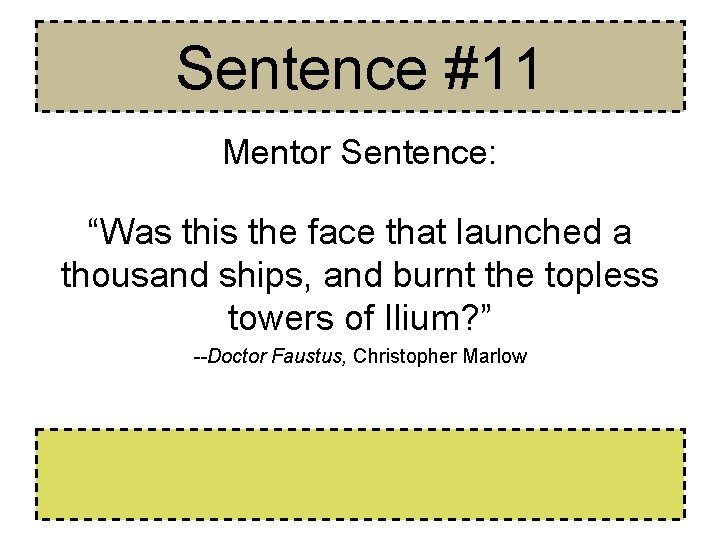
Sentence #11 Mentor Sentence: “Was this the face that launched a thousand ships, and burnt the topless towers of Ilium? ” --Doctor Faustus, Christopher Marlow
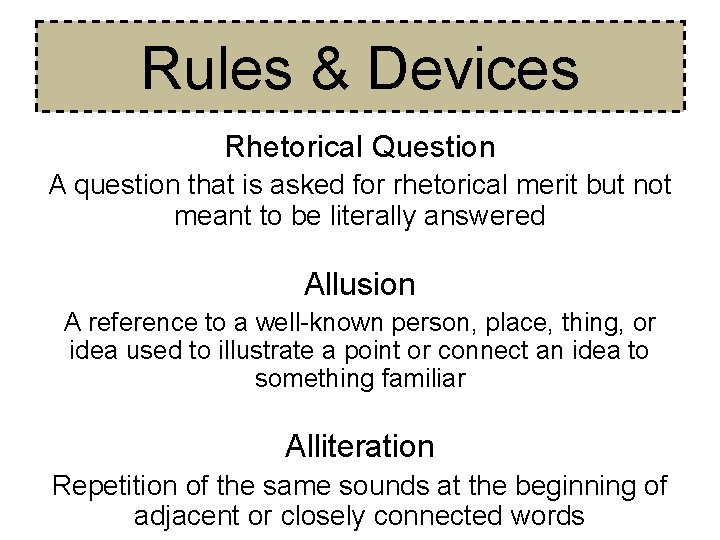
Rules & Devices Rhetorical Question A question that is asked for rhetorical merit but not meant to be literally answered Allusion A reference to a well-known person, place, thing, or idea used to illustrate a point or connect an idea to something familiar Alliteration Repetition of the same sounds at the beginning of adjacent or closely connected words
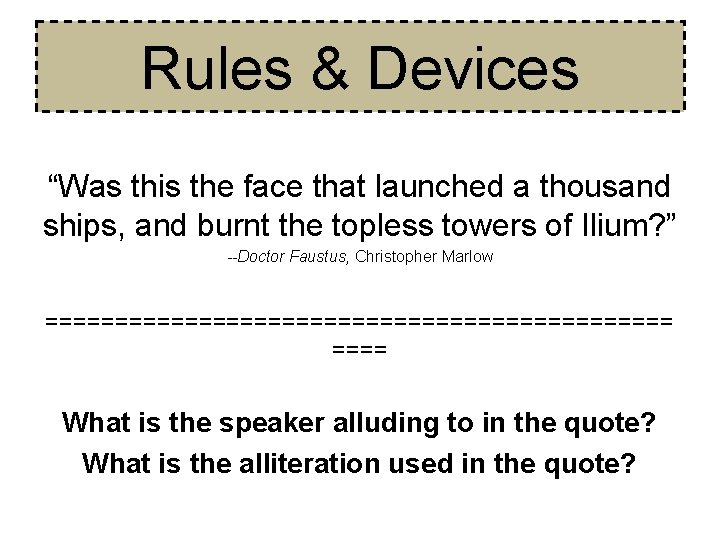
Rules & Devices “Was this the face that launched a thousand ships, and burnt the topless towers of Ilium? ” --Doctor Faustus, Christopher Marlow ======================= What is the speaker alluding to in the quote? What is the alliteration used in the quote?
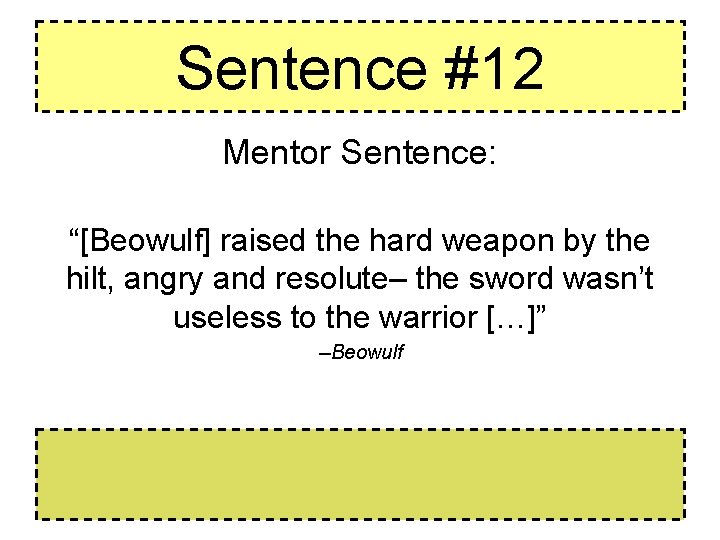
Sentence #12 Mentor Sentence: “[Beowulf] raised the hard weapon by the hilt, angry and resolute– the sword wasn’t useless to the warrior […]” --Beowulf
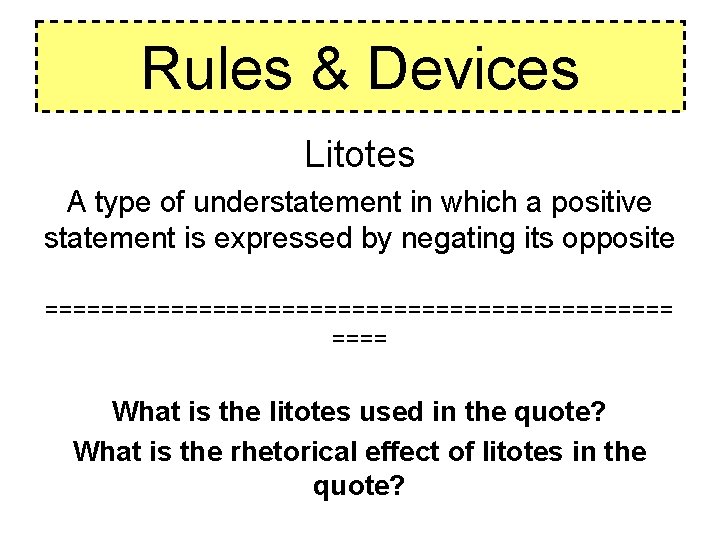
Rules & Devices Litotes A type of understatement in which a positive statement is expressed by negating its opposite ======================= What is the litotes used in the quote? What is the rhetorical effect of litotes in the quote?
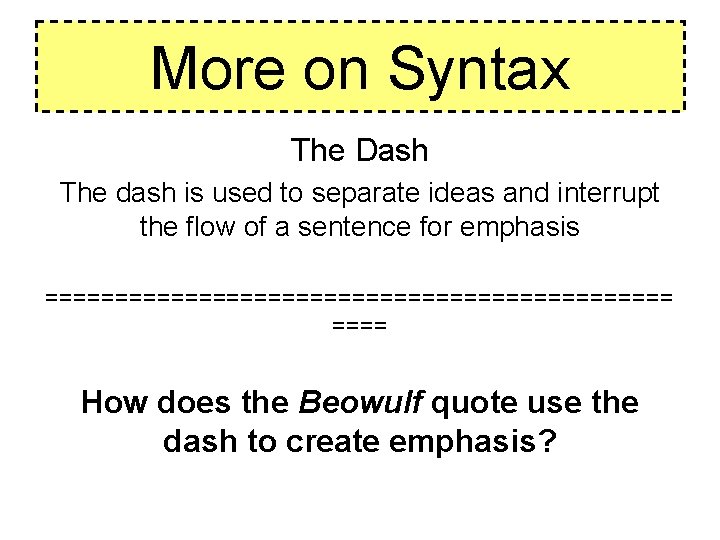
More on Syntax The Dash The dash is used to separate ideas and interrupt the flow of a sentence for emphasis ======================= How does the Beowulf quote use the dash to create emphasis?
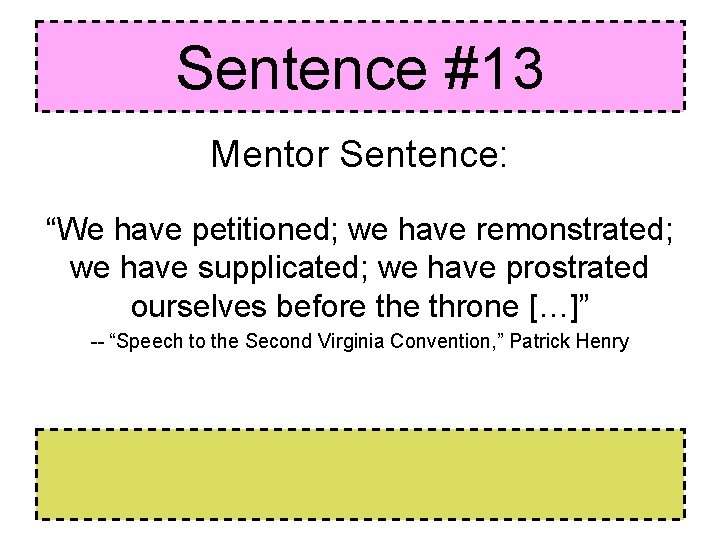
Sentence #13 Mentor Sentence: “We have petitioned; we have remonstrated; we have supplicated; we have prostrated ourselves before throne […]” -- “Speech to the Second Virginia Convention, ” Patrick Henry
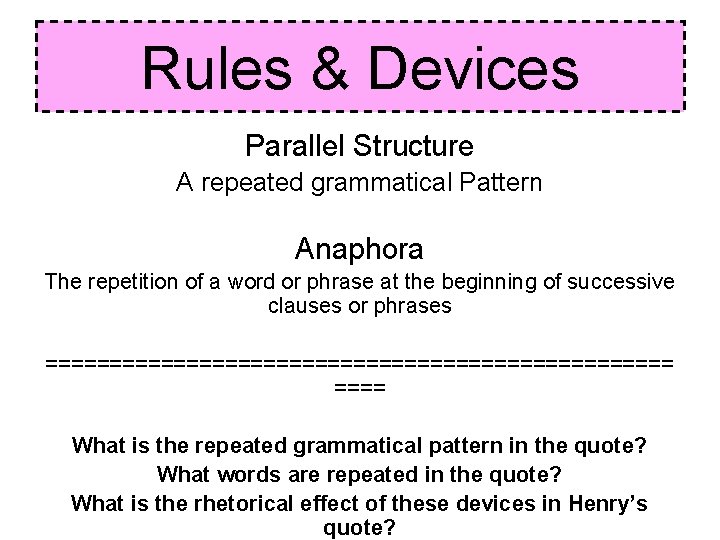
Rules & Devices Parallel Structure A repeated grammatical Pattern Anaphora The repetition of a word or phrase at the beginning of successive clauses or phrases ========================= What is the repeated grammatical pattern in the quote? What words are repeated in the quote? What is the rhetorical effect of these devices in Henry’s quote?
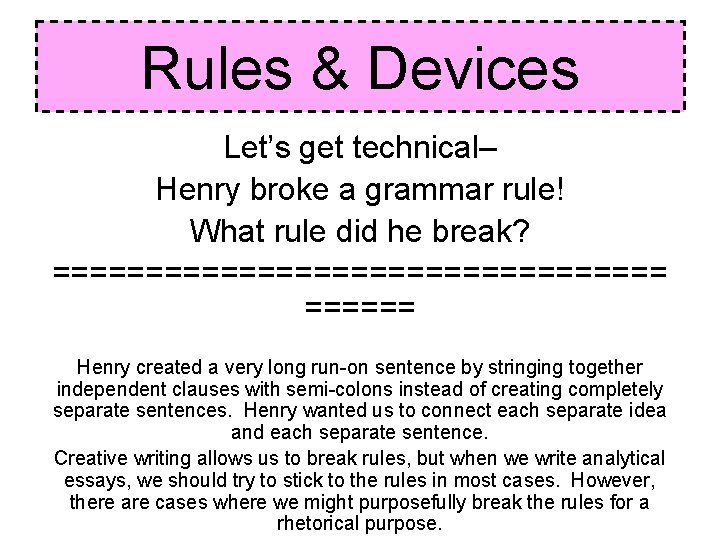
Rules & Devices Let’s get technical– Henry broke a grammar rule! What rule did he break? ================= Henry created a very long run-on sentence by stringing together independent clauses with semi-colons instead of creating completely separate sentences. Henry wanted us to connect each separate idea and each separate sentence. Creative writing allows us to break rules, but when we write analytical essays, we should try to stick to the rules in most cases. However, there are cases where we might purposefully break the rules for a rhetorical purpose.
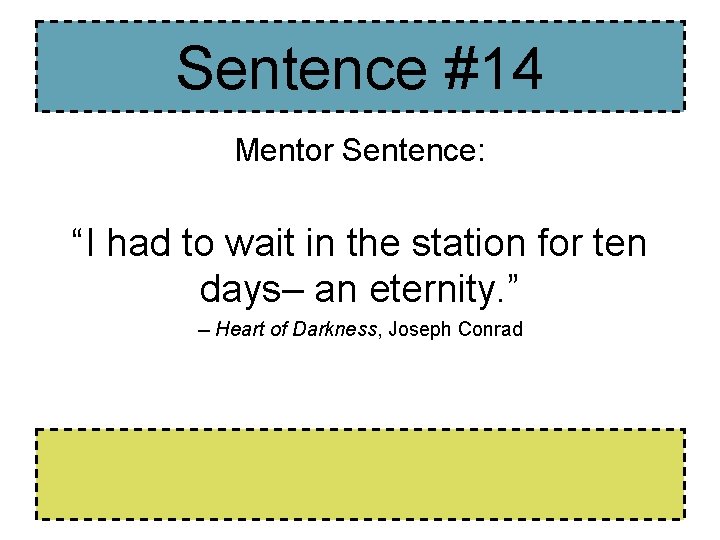
Sentence #14 Mentor Sentence: “I had to wait in the station for ten days– an eternity. ” -- Heart of Darkness, Joseph Conrad
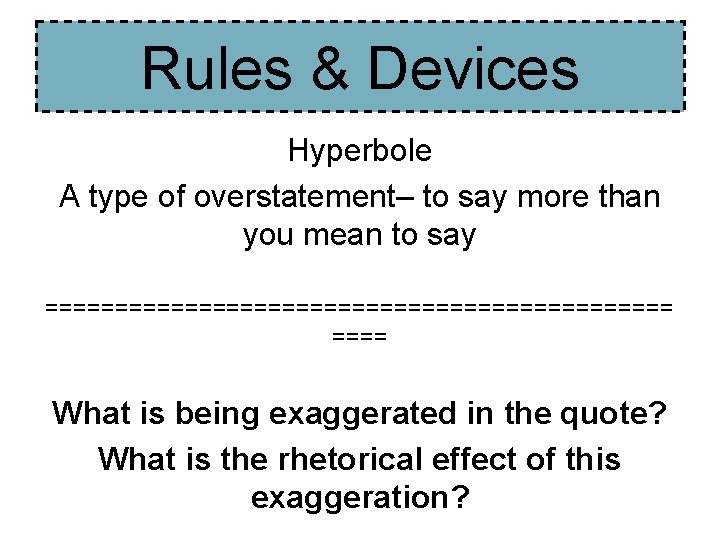
Rules & Devices Hyperbole A type of overstatement– to say more than you mean to say ======================= What is being exaggerated in the quote? What is the rhetorical effect of this exaggeration?
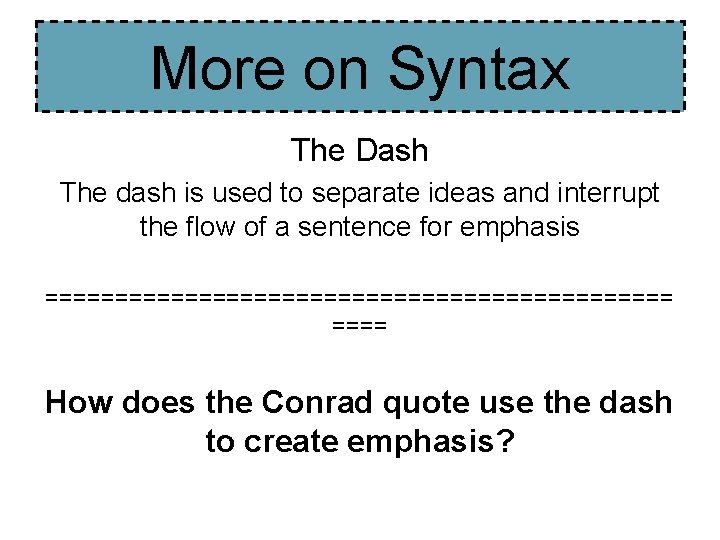
More on Syntax The Dash The dash is used to separate ideas and interrupt the flow of a sentence for emphasis ======================= How does the Conrad quote use the dash to create emphasis?
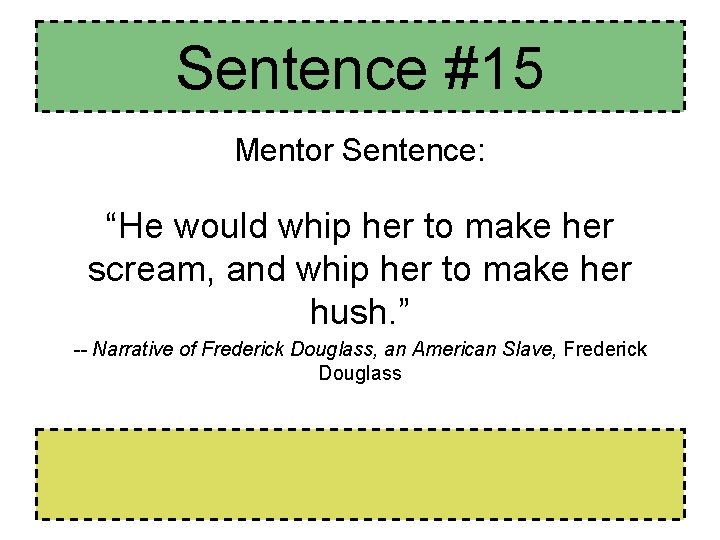
Sentence #15 Mentor Sentence: “He would whip her to make her scream, and whip her to make her hush. ” -- Narrative of Frederick Douglass, an American Slave, Frederick Douglass
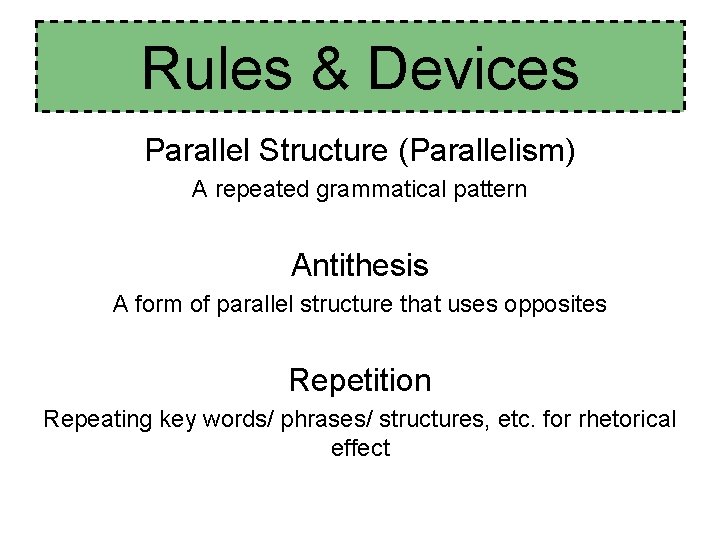
Rules & Devices Parallel Structure (Parallelism) A repeated grammatical pattern Antithesis A form of parallel structure that uses opposites Repetition Repeating key words/ phrases/ structures, etc. for rhetorical effect
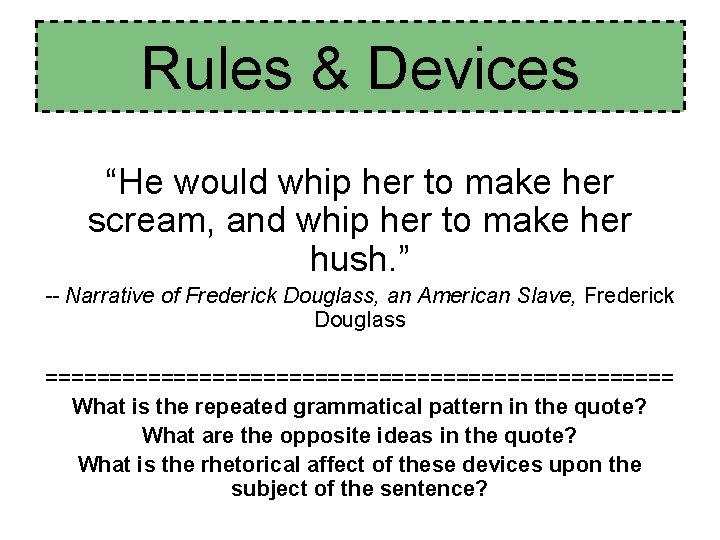
Rules & Devices “He would whip her to make her scream, and whip her to make her hush. ” -- Narrative of Frederick Douglass, an American Slave, Frederick Douglass ========================= What is the repeated grammatical pattern in the quote? What are the opposite ideas in the quote? What is the rhetorical affect of these devices upon the subject of the sentence?
Sentence #16 Mentor Sentence: “His food was too wet or too dry; he got it too soon or too late; he was too hot or too cold; he had too much hay and not enough grain. ” -- Narrative of Frederick Douglass, an American Slave, Frederick Douglass
Rules & Devices Parallel Structure (Parallelism) A repeated grammatical pattern Paradox A contradictory statement that reveals a truth Contrast Two or more juxtaposed items that are strikingly different Repetition Repeating key words/ phrases/ structures, etc. for rhetorical effect
Rules & Devices “His food was too wet or too dry; he got it too soon or too late; he was too hot or too cold; he had too much hay and not enough grain. ” -- Narrative of Frederick Douglass, an American Slave, Frederick Douglass ========================= What is the repeated grammatical pattern in the quote? What are the opposing ideas in the quote? What is the rhetorical affect of these devices upon the subject?
Rules & Devices Let’s get technical– Douglass broke a grammar rule! What rule did he break? ================= Douglass created a very long run-on sentence by stringing together independent clauses with semi-colons instead of creating completely separate sentences. Douglass wanted us to connect each separate idea and each separate sentence. Creative writing allows us to break rules, but when we write analytical essays, we should try to stick to the rules in most cases. However, there are cases where we might purposefully break the rules for a rhetorical purpose.
Sentence #17 Mentor Sentence: “Go ask his name: if he be married. My grave is like to be my wedding bed. ” -- Romeo and Juliet, William Shakespeare
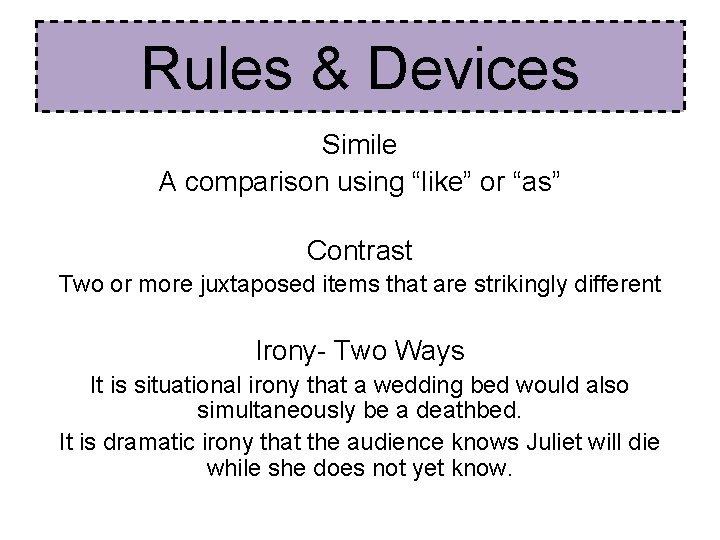
Rules & Devices Simile A comparison using “like” or “as” Contrast Two or more juxtaposed items that are strikingly different Irony- Two Ways It is situational irony that a wedding bed would also simultaneously be a deathbed. It is dramatic irony that the audience knows Juliet will die while she does not yet know.
Rules & Devices “Go ask his name: if he be married. My grave is like to be my wedding bed. ” -- Romeo and Juliet, William Shakespeare ======================= What is the simile used in the quote? How does the simile create irony and contrast?
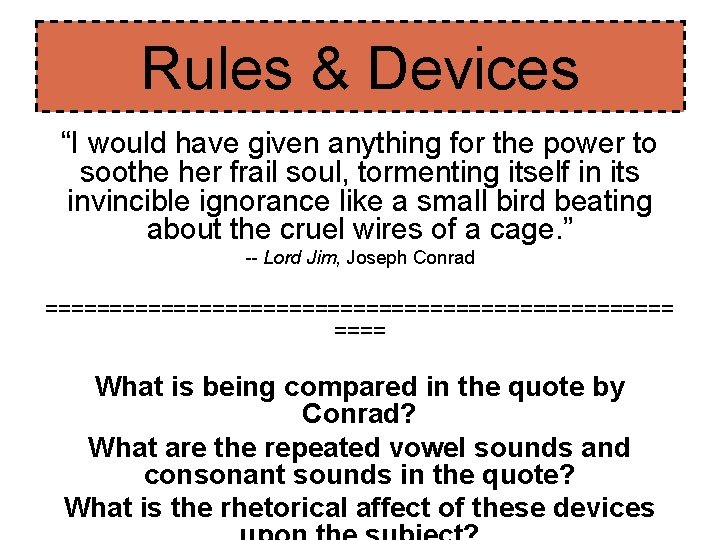
Sentence #18 Mentor Sentence: “I would have given anything for the power to soothe her frail soul, tormenting itself in its invincible ignorance like a small bird beating about the cruel wires of a cage. ” -- Lord Jim, Joseph Conrad
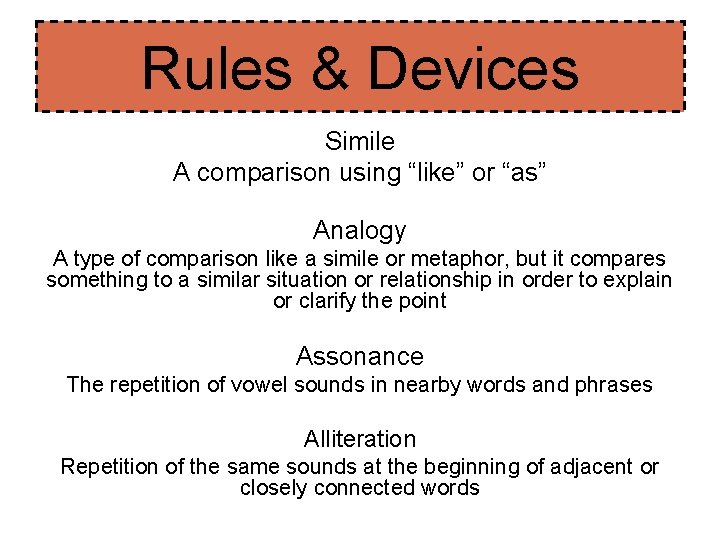
Rules & Devices Simile A comparison using “like” or “as” Analogy A type of comparison like a simile or metaphor, but it compares something to a similar situation or relationship in order to explain or clarify the point Assonance The repetition of vowel sounds in nearby words and phrases Alliteration Repetition of the same sounds at the beginning of adjacent or closely connected words
Rules & Devices “I would have given anything for the power to soothe her frail soul, tormenting itself in its invincible ignorance like a small bird beating about the cruel wires of a cage. ” -- Lord Jim, Joseph Conrad ========================= What is being compared in the quote by Conrad? What are the repeated vowel sounds and consonant sounds in the quote? What is the rhetorical affect of these devices
Sentence #20 Mentor Sentence: “Take thy face hence. ” -- Macbeth, William Shakespeare
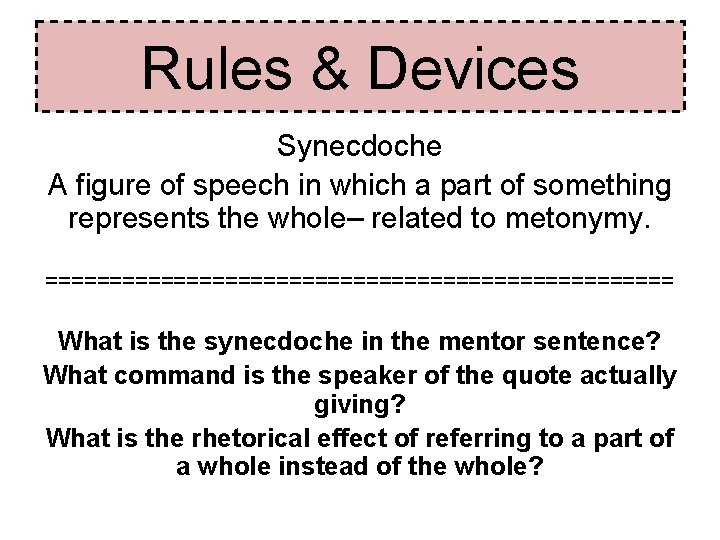
Rules & Devices Synecdoche A figure of speech in which a part of something represents the whole– related to metonymy. ========================= What is the synecdoche in the mentor sentence? What command is the speaker of the quote actually giving? What is the rhetorical effect of referring to a part of a whole instead of the whole?
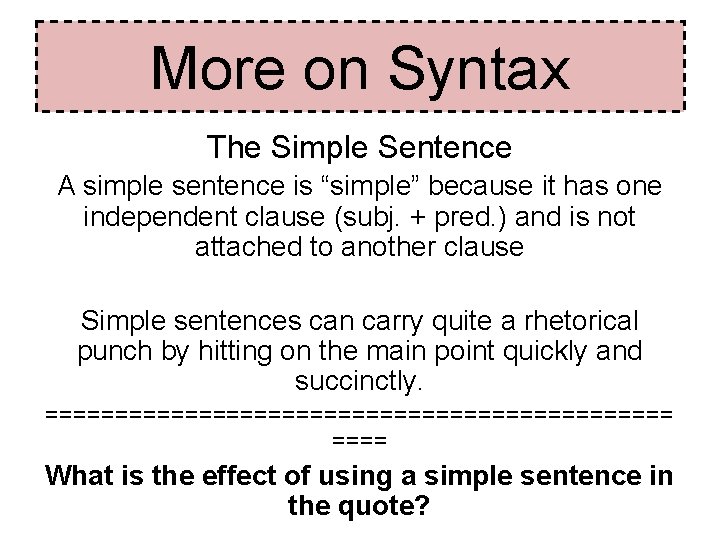
More on Syntax The Simple Sentence A simple sentence is “simple” because it has one independent clause (subj. + pred. ) and is not attached to another clause Simple sentences can carry quite a rhetorical punch by hitting on the main point quickly and succinctly. ======================= What is the effect of using a simple sentence in the quote?
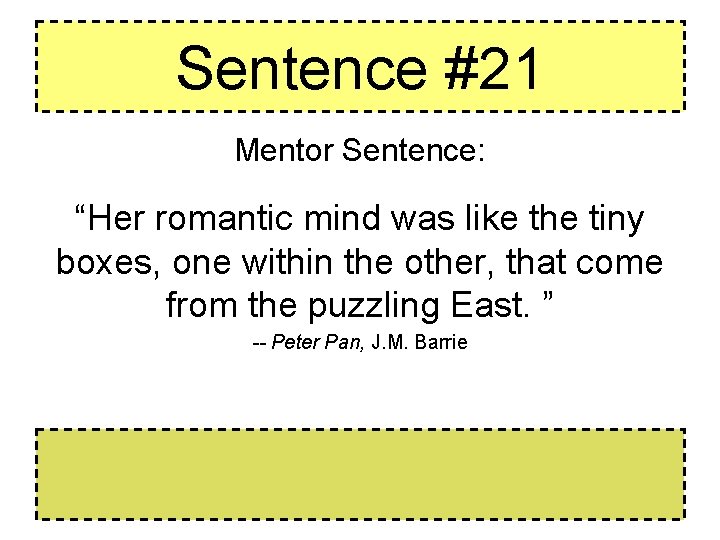
Sentence #21 Mentor Sentence: “Her romantic mind was like the tiny boxes, one within the other, that come from the puzzling East. ” -- Peter Pan, J. M. Barrie
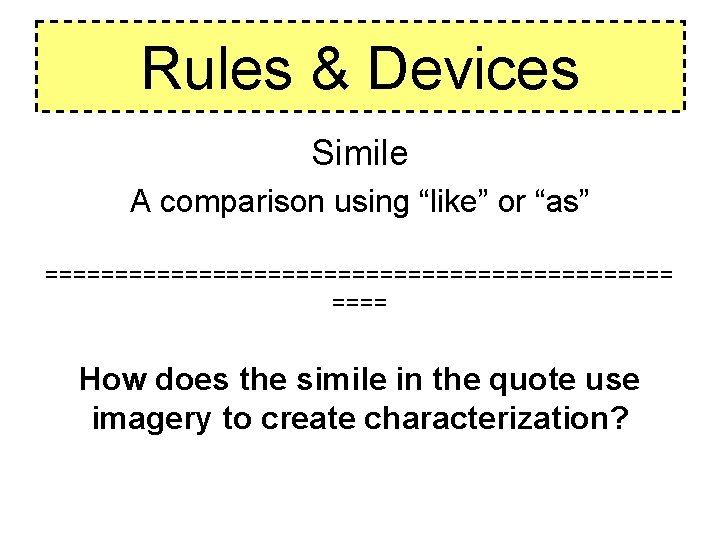
Rules & Devices Simile A comparison using “like” or “as” ======================= How does the simile in the quote use imagery to create characterization?
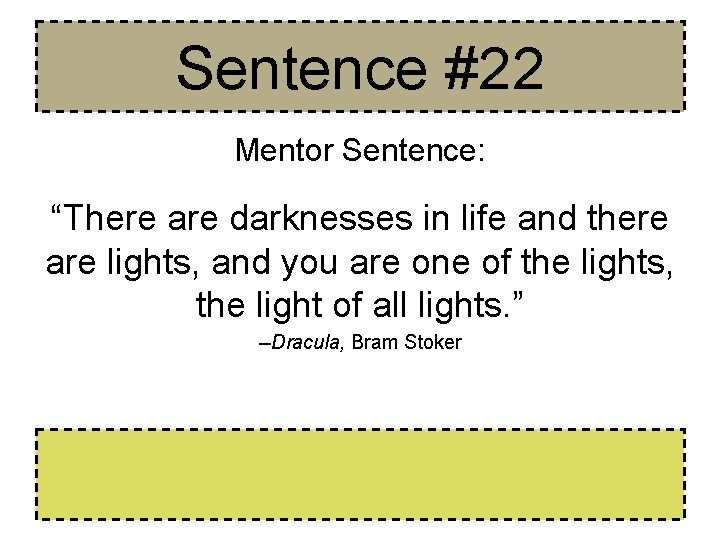
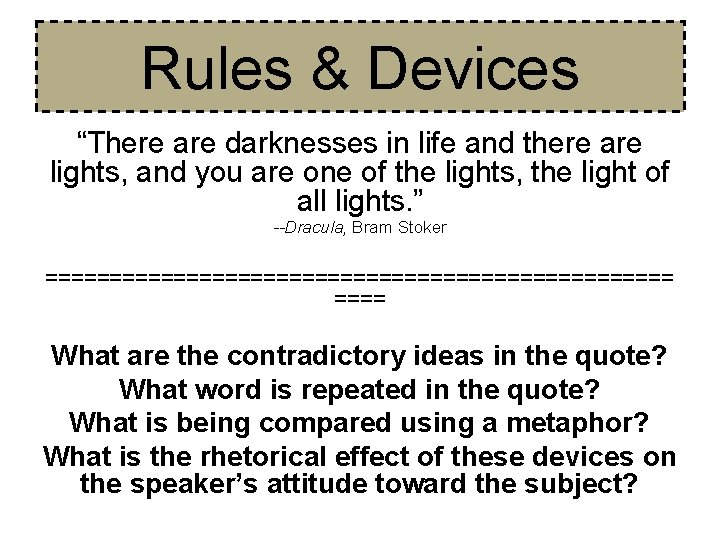
Sentence #22 Mentor Sentence: “There are darknesses in life and there are lights, and you are one of the lights, the light of all lights. ” --Dracula, Bram Stoker
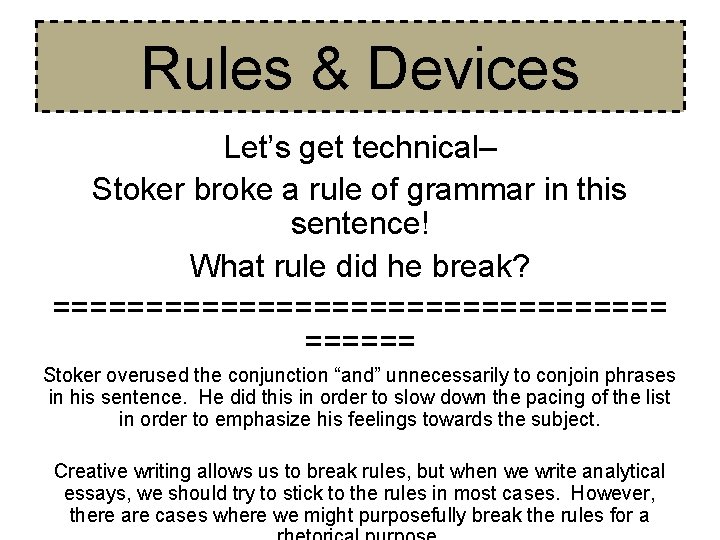
Rules & Devices Let’s get technical– Stoker broke a rule of grammar in this sentence! What rule did he break? ================= Stoker overused the conjunction “and” unnecessarily to conjoin phrases in his sentence. He did this in order to slow down the pacing of the list in order to emphasize his feelings towards the subject. Creative writing allows us to break rules, but when we write analytical essays, we should try to stick to the rules in most cases. However, there are cases where we might purposefully break the rules for a
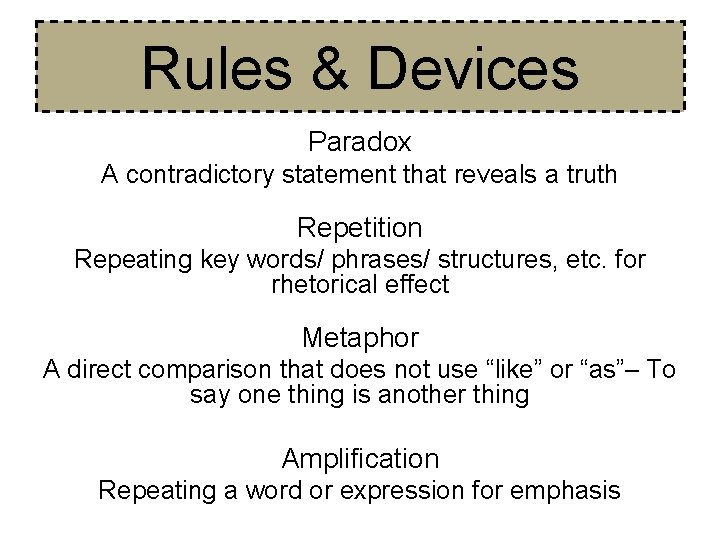
Rules & Devices Paradox A contradictory statement that reveals a truth Repetition Repeating key words/ phrases/ structures, etc. for rhetorical effect Metaphor A direct comparison that does not use “like” or “as”– To say one thing is another thing Amplification Repeating a word or expression for emphasis
Rules & Devices “There are darknesses in life and there are lights, and you are one of the lights, the light of all lights. ” --Dracula, Bram Stoker ========================= What are the contradictory ideas in the quote? What word is repeated in the quote? What is being compared using a metaphor? What is the rhetorical effect of these devices on the speaker’s attitude toward the subject?
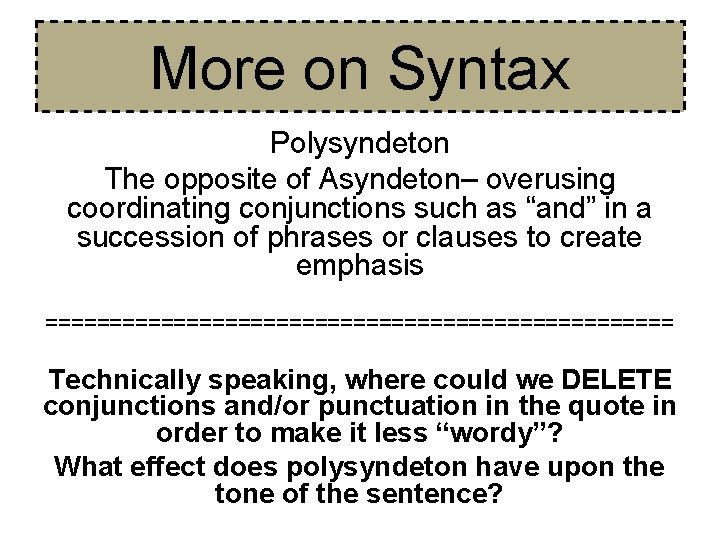
More on Syntax Polysyndeton The opposite of Asyndeton– overusing coordinating conjunctions such as “and” in a succession of phrases or clauses to create emphasis ========================= Technically speaking, where could we DELETE conjunctions and/or punctuation in the quote in order to make it less “wordy”? What effect does polysyndeton have upon the tone of the sentence?
Sentence #23 Mentor Sentence: “So we beat on, boats against the current, borne back ceaslessly into the past. ” --The Great Gatsby, F. Scott Fitzgerald
Rules & Devices Alliteration Repetition of the same sounds at the beginning of adjacent or closely connected words Consonance Repetition of consonant sounds anywhere within adjacent or closely connected words Analogy A type of comparison like a simile or metaphor, but it compares something to a similar situation or relationship in order to explain or clarify the point
Rules & Devices “So we beat on, boats against the current, borne back ceaslessly into the past. ” --The Great Gatsby, F. Scott Fitzgerald ========================= What sounds are repeated in the quote? What is the analogous relationship in the quote? How do these devices illustrate and emphasize the meaning of the sentence?
More on Syntax Beginning a Sentence with a Coordinating Conjunction Fitzgerald begins this famous quotation with the coordinating conjunction “so” instead of connecting the sentence to the one before it– as is common practice. Dividing the compound sentence into two separate sentences can work to emphasize key ideas. Beginning a sentence with “so” also reveals a cause/ effect relationship. ======================= How does beginning the sentence with “so” impact the meaning of the sentence?
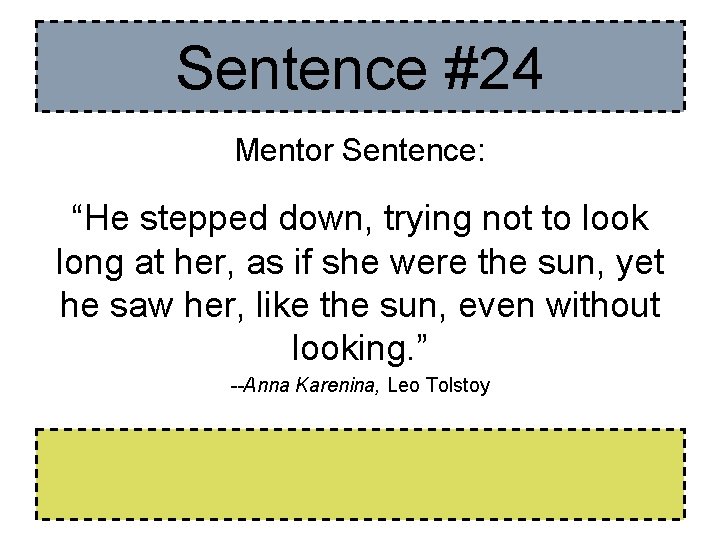
Sentence #24 Mentor Sentence: “He stepped down, trying not to look long at her, as if she were the sun, yet he saw her, like the sun, even without looking. ” --Anna Karenina, Leo Tolstoy
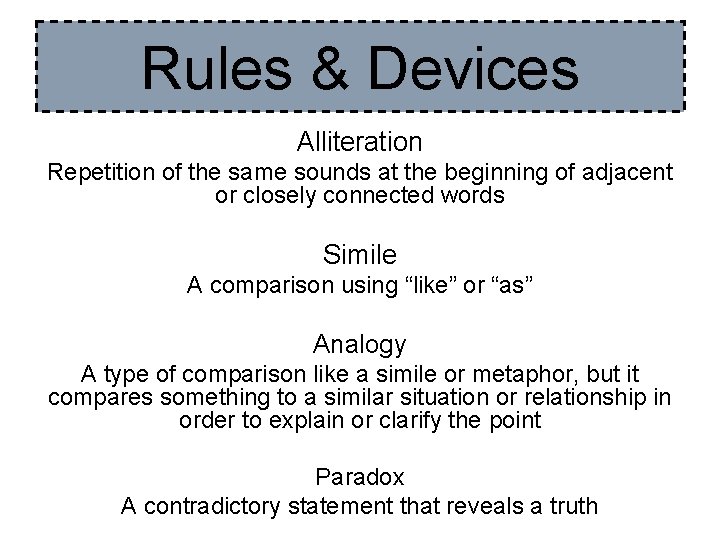
Rules & Devices Alliteration Repetition of the same sounds at the beginning of adjacent or closely connected words Simile A comparison using “like” or “as” Analogy A type of comparison like a simile or metaphor, but it compares something to a similar situation or relationship in order to explain or clarify the point Paradox A contradictory statement that reveals a truth
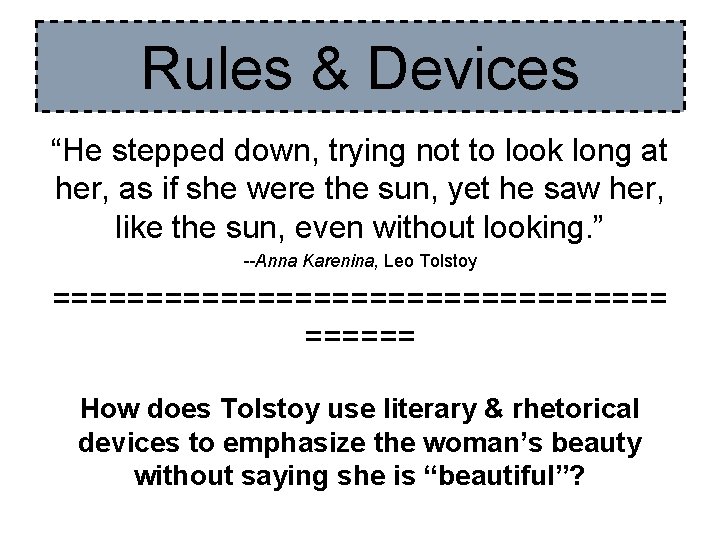
Rules & Devices “He stepped down, trying not to look long at her, as if she were the sun, yet he saw her, like the sun, even without looking. ” --Anna Karenina, Leo Tolstoy ================= How does Tolstoy use literary & rhetorical devices to emphasize the woman’s beauty without saying she is “beautiful”?
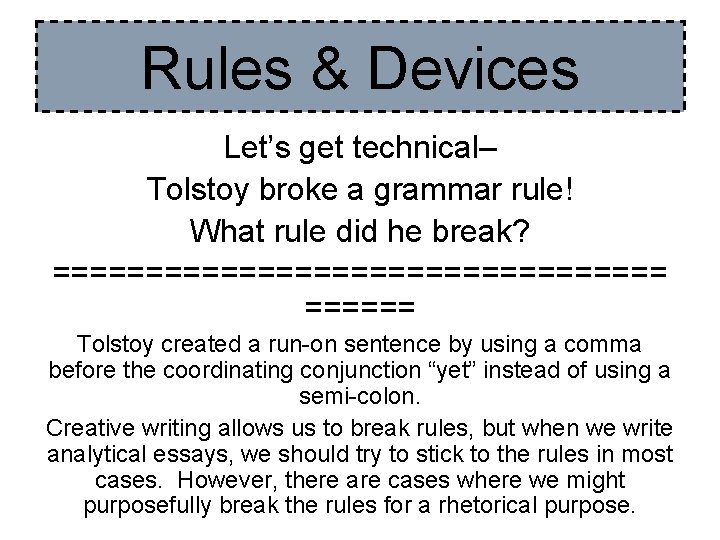
Rules & Devices Let’s get technical– Tolstoy broke a grammar rule! What rule did he break? ================= Tolstoy created a run-on sentence by using a comma before the coordinating conjunction “yet” instead of using a semi-colon. Creative writing allows us to break rules, but when we write analytical essays, we should try to stick to the rules in most cases. However, there are cases where we might purposefully break the rules for a rhetorical purpose.
Sentence #25 Mentor Sentence: “Fair is foul, and foul is fair. ” --Macbeth, William Shakespeare
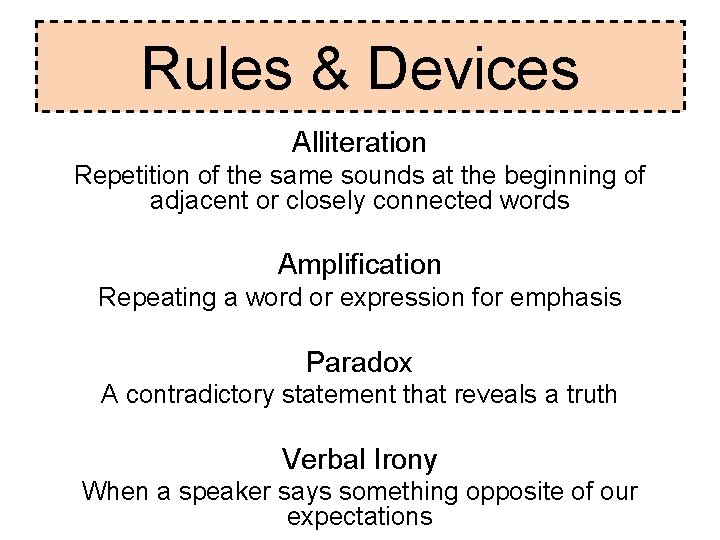
Rules & Devices Alliteration Repetition of the same sounds at the beginning of adjacent or closely connected words Amplification Repeating a word or expression for emphasis Paradox A contradictory statement that reveals a truth Verbal Irony When a speaker says something opposite of our expectations
Rules & Devices “Fair is foul, and foul is fair. ” --Macbeth, William Shakespeare ================= What is ironic or contradictory about Shakespeare’s quote? How does Shakespeare use literary & rhetorical devices to make a philosophical statement about appearances?
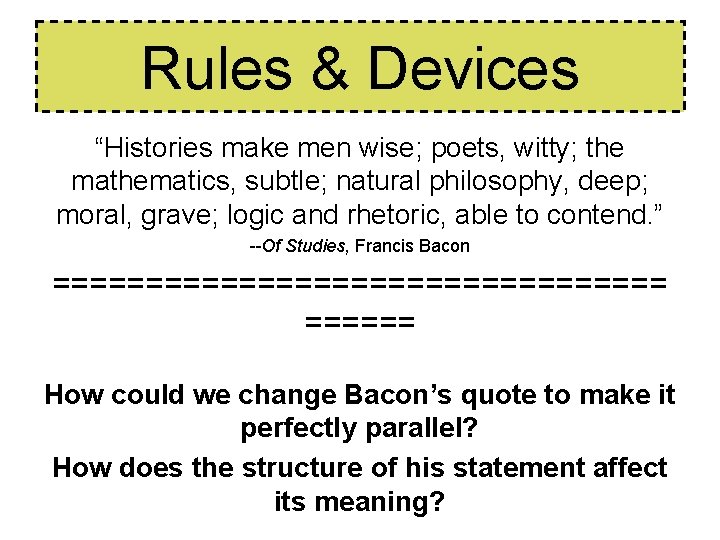
Sentence #26 Mentor Sentence: “Histories make men wise; poets, witty; the mathematics, subtle; natural philosophy, deep; moral, grave; logic and rhetoric, able to contend. ” --Of Studies, Francis Bacon
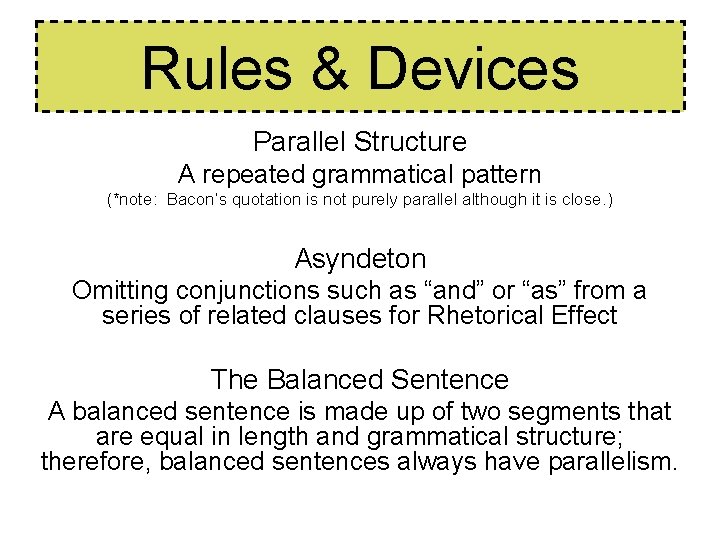
Rules & Devices Parallel Structure A repeated grammatical pattern (*note: Bacon’s quotation is not purely parallel although it is close. ) Asyndeton Omitting conjunctions such as “and” or “as” from a series of related clauses for Rhetorical Effect The Balanced Sentence A balanced sentence is made up of two segments that are equal in length and grammatical structure; therefore, balanced sentences always have parallelism.
Rules & Devices “Histories make men wise; poets, witty; the mathematics, subtle; natural philosophy, deep; moral, grave; logic and rhetoric, able to contend. ” --Of Studies, Francis Bacon ================= How could we change Bacon’s quote to make it perfectly parallel? How does the structure of his statement affect its meaning?
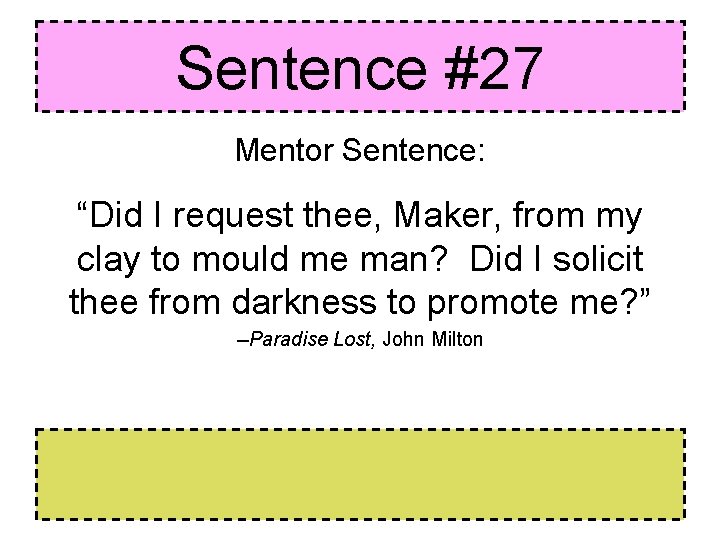
Sentence #27 Mentor Sentence: “Did I request thee, Maker, from my clay to mould me man? Did I solicit thee from darkness to promote me? ” --Paradise Lost, John Milton
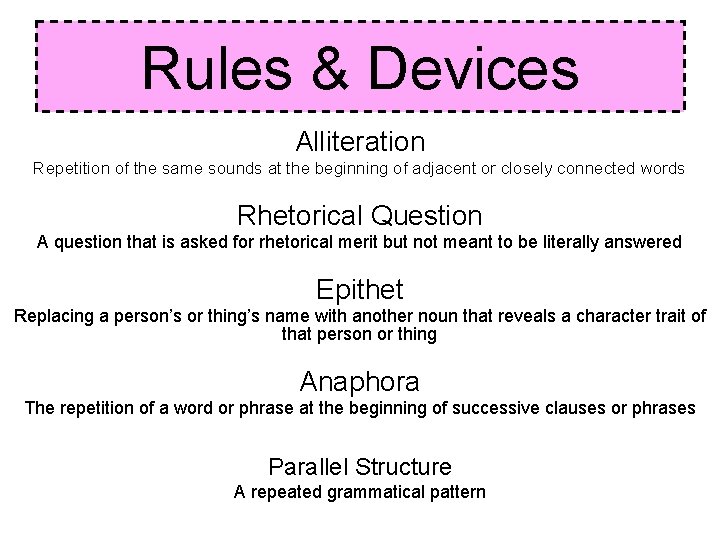
Rules & Devices Alliteration Repetition of the same sounds at the beginning of adjacent or closely connected words Rhetorical Question A question that is asked for rhetorical merit but not meant to be literally answered Epithet Replacing a person’s or thing’s name with another noun that reveals a character trait of that person or thing Anaphora The repetition of a word or phrase at the beginning of successive clauses or phrases Parallel Structure A repeated grammatical pattern
Rules & Devices “Did I request thee, Maker, from my clay to mould me man? Did I solicit thee from darkness to promote me? ” --Paradise Lost, John Milton ================= How does repetition create emphasis in Milton’s quote? How does repetition affect the tone of the
Sentence #28 Mentor Sentence: “The grave’s a fine and private place, but none, I think, do there embrace. ” -- “To His Coy Mistress, ” Andrew Marvell
Rules & Devices Assonance The repetition of vowel sounds in nearby words and phrases Understatement To say less than you mean-- When a writer presents a serious or important subject in a less severe or important way– the opposite of hyperbole or overstatement ===================== What is the effect of understatement on the
Sentence #29 Mentor Sentence: “Common sense is not so common. ” --Voltaire
Rules & Devices Paradox A contradictory statement that reveals a truth Repetition Repeating key words/ phrases/ structures, etc. for rhetorical effect ===================== What is the effect of repetition on the meaning of Candide’s statement?
Sentence #30 Mentor Sentence: “He strove to shelter her, as a fair exotic is sheltered by the gardener, from every rougher wind. ” --Frankenstein, Mary Shelley
Rules & Devices Analogy A type of comparison like a simile or metaphor, but it compares something to a similar situation or relationship in order to explain or clarify the point Simile A comparison using “like” or “as” Metaphor A direct comparison that does not use “like” or “as”– To say one thing is another thing
Rules & Devices “He strove to shelter her, as a fair exotic is sheltered by the gardener, from every rougher wind. ” --Frankenstein, Mary Shelley ================= How do the comparisons in the quote shape characterization? How does the structure of the sentence
Diction • The style of language used; generally tailored to be appropriate to the audience and situation. • Example: You might say "What's up, loser? " to your little brother, but you would probably say "How are you doing today? " to your principal.
Anecdote • Offering a brief narrative episode. This device can serve many functions in a text—for example, introducing an issue, serving as evidence, to illustrate a point, and so on. • Example: "When I went to buy my morning coffee, I ran into an old friend. He told me he had won the lottery and he was about to buy a yacht. Two months later I heard he had declared bankruptcy. "