
SUMMER RHETORICAL DEVICES ALLUSION A brief usually indirect

SUMMER RHETORICAL DEVICES
ALLUSION A brief, usually indirect reference to a person, place, or event--real or fictional. famous people history (Greek) mythology literature Just a few words are enough to create a certain picture (or scene) in the readers’ minds.
EXAMPLES: It has rained so long, it seems as though it has rained for 40 days and nights. Harriet Tubman was called the Moses of her time To act or not to act, that was Maria's dilemma Sue did not want to endure Eve's curse, so she opted for the epidural The killer wore a mark of Cain as he stalked his brother.
ANAPHORA successive clauses or sentences start with the same word(s) The same word or phrase is used to begin successive clauses or sentences. Thus, the reader's / listener's attention is drawn directly to the message of the sentence.
EXAMPLES Every child must be taught these principles. Every citizen must uphold them. And every immigrant, by embracing these ideals, makes our country more, not less, American. If we had no winter, the spring would not be so pleasant; if we did not sometimes taste of adversity, prosperity would not be so welcome. (Anne Bradstreet) A man without ambition is dead. A man with ambition but no love is dead. A man with ambition and love for his blessings here on earth is ever so alive. (Pearl Bailey) Anaphora is often used in conjunction with parallelism or climax.
ANADIPLOSIS The repetition of the last word (or phrase) from the previous line, clause, or sentence at the beginning of the next.
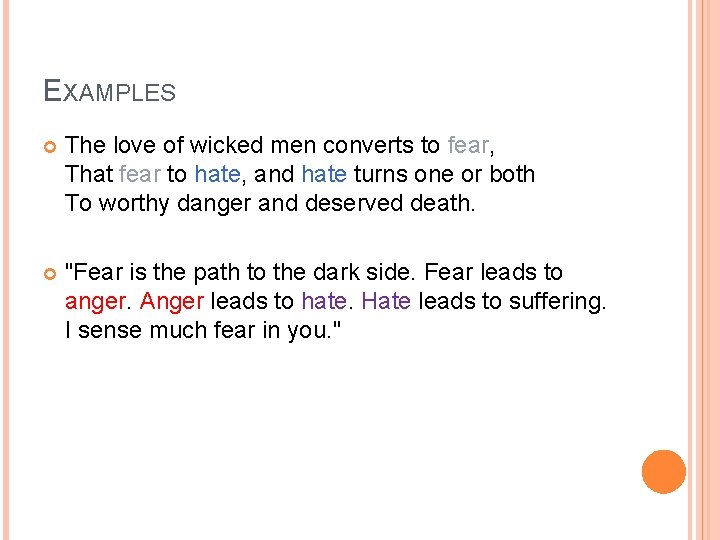
EXAMPLES The love of wicked men converts to fear, That fear to hate, and hate turns one or both To worthy danger and deserved death. "Fear is the path to the dark side. Fear leads to anger. Anger leads to hate. Hate leads to suffering. I sense much fear in you. "
ANTITHESIS a person or thing that is the direct opposite of someone or something else Opposition, or contrast of ideas or words in a balanced or parallel construction.
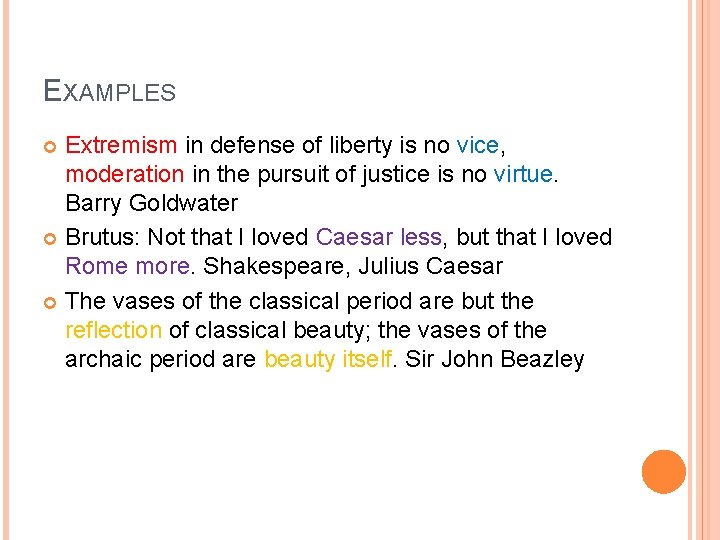
EXAMPLES Extremism in defense of liberty is no vice, moderation in the pursuit of justice is no virtue. Barry Goldwater Brutus: Not that I loved Caesar less, but that I loved Rome more. Shakespeare, Julius Caesar The vases of the classical period are but the reflection of classical beauty; the vases of the archaic period are beauty itself. Sir John Beazley
APOSTROPHE a sudden turn from the general audience to address a specific group or personified abstraction absent or present. Example: *For Brutus, as you know, was Caesar's angel. Judge, O you gods, how dearly Caesar loved him. Shakespeare, Julius Caesar
LITOTES A figure of speech consisting of an understatement in which an affirmative is expressed by negating its opposite – using a double negative � **note, this is a type of euphemism Example: “She’s not the brightest bulb in the box. ”
SYNECDOCHE Synechdoche is some kind of generalization or specification that uses a part, a member or a characteristic of what is meant. Synecdoche is a figure of speech in which a word or term is used to refer to a whole thing or effect, a part of it, or a specific class of things related to that word. Synecdoche in Greek originally means accepting a part as responsible for whole or vice versa
EXAMPLES Part used instead of the whole Example: Turning our long boat round […] on the last morning required all hands on deck … (hands = people)
METONYMY Substitution of one word for another which it suggests. Reference to something or someone by naming one of its attributes. A word or phrase that is used to stand in for another word. Sometimes a metonymy is chosen because it is a well-known characteristic of the word. Metonymy in Greek literally means 'a change of name'.
EXAMPLES The pen is mightier than the sword The pen is an attribute of thoughts that are written with a pen; the sword is an attribute of military action The "sword" stands in for "military aggression and force“ Crown - in place of a royal person The White House - in place of the President or others who work there The suits - in place of business people Dish - for an entire plate of food
DIFFERENCE BETWEEN THE 2 When the distinction is made, it is the following: when A is used to refer to B, it is a synecdoche if A is a part of B and a metonym if A is commonly associated with B but not a part of it. Thus, "The White House said" would be a metonymy for the president and his staff, because the White House (A) is not part of the president or his staff (B), it is merely closely associated with them because of physical proximity. On the other hand, asking for "All hands on deck" is a synecdoche because hands (A) are actually a part of the men (B) to whom they refer.
In the end, synecdoche - part equals whole. Metonymy - thing equals concept. Now, test yourself with the following tasty examples below: 1. Sweden today reports a dire shortage of lutefisk. 2. When I am done with this article, I plan to hit the bottle. 3. Bow to my flourishing, dubious crown. 4. There are over fifty head of cattle in that strange and wild herd.
1 -Metonymy, where 'Sweden' is representative of the Powers purporting; 2 -Synecdoche, where 'bottle' is a directly the container of the wine; 3 -Metonymy, where my 'crown' represent the inherent power within; 4 -Synecdoche, where 'head' is representative of the entire herd. )
ENTHYMEME An enthymeme is an argument in which one proposition is suppressed—i. e. , it's missing for one reason or another. The more subtle argument of a syllogism (major premise, minor premise, conclusion
JUXTAPOSITION “Juxtaposition” is the term which defines an act of placing a pair or even more things or ideas side by side usually in contrast or comparison. It is a literary means to portray and alleviate the differences and similarities between the combination of things. The combining items may be situations, ideas, emotions, characters, or personalities. The resulting effects of placing them in proximity is relatively enhanced by the impression and effect. � Compares and contrasts but doesn’t have to be an opposite
For instance, �Fearful/reassuring Darkness/frivolity Chaos/calm Indifference/feeling East/West Man/nature Love/hate Static/changing
PARADOX a statement or proposition that, despite sound (or apparently sound) reasoning from acceptable premises, leads to a conclusion that seems senseless, logically unacceptable, or selfcontradictory � War is Peace � Freedom is Slavery � Ignorance is Strength https: //www. youtube. com/watch? v=k. Jz. Sz. Gbfc 0 k&t=638 s
OXYMORON Contradicting words (adjectives and nouns) that are opposites but state a seemingly logical truth � Jumbo shrimp � Pretty ugly � Same difference
- Slides: 23