15 5 Disaccharides Lactose is a disaccharide found
- Slides: 24
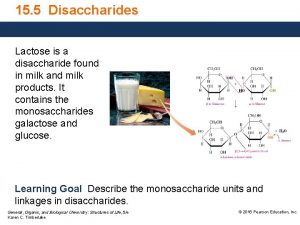
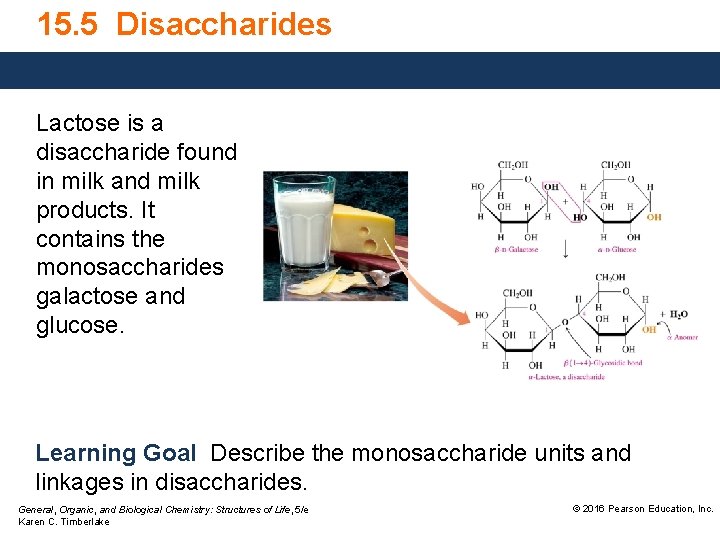
15. 5 Disaccharides Lactose is a disaccharide found in milk and milk products. It contains the monosaccharides galactose and glucose. Learning Goal Describe the monosaccharide units and linkages in disaccharides. General, Organic, and Biological Chemistry: Structures of Life, 5/e Karen C. Timberlake © 2016 Pearson Education, Inc.
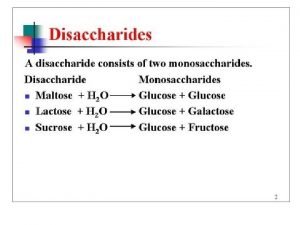
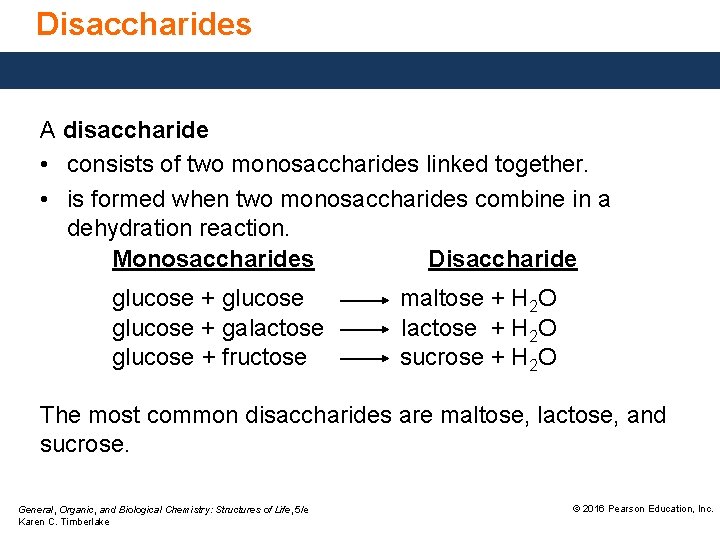
Disaccharides A disaccharide • consists of two monosaccharides linked together. • is formed when two monosaccharides combine in a dehydration reaction. Monosaccharides Disaccharide glucose + galactose glucose + fructose maltose + H 2 O lactose + H 2 O sucrose + H 2 O The most common disaccharides are maltose, lactose, and sucrose. General, Organic, and Biological Chemistry: Structures of Life, 5/e Karen C. Timberlake © 2016 Pearson Education, Inc.
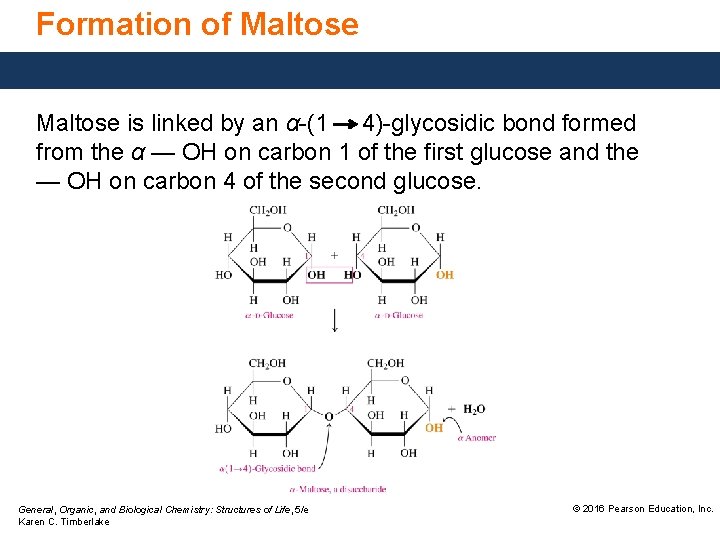
Maltose is • • • a disaccharide also known as malt sugar. composed of two D-glucose molecules. obtained from the hydrolysis of starch. used in cereals, candies, and brewing. found in both the α and β forms. General, Organic, and Biological Chemistry: Structures of Life, 5/e Karen C. Timberlake © 2016 Pearson Education, Inc.
Formation of Maltose is linked by an α-(1 4)-glycosidic bond formed from the α — OH on carbon 1 of the first glucose and the — OH on carbon 4 of the second glucose. General, Organic, and Biological Chemistry: Structures of Life, 5/e Karen C. Timberlake © 2016 Pearson Education, Inc.
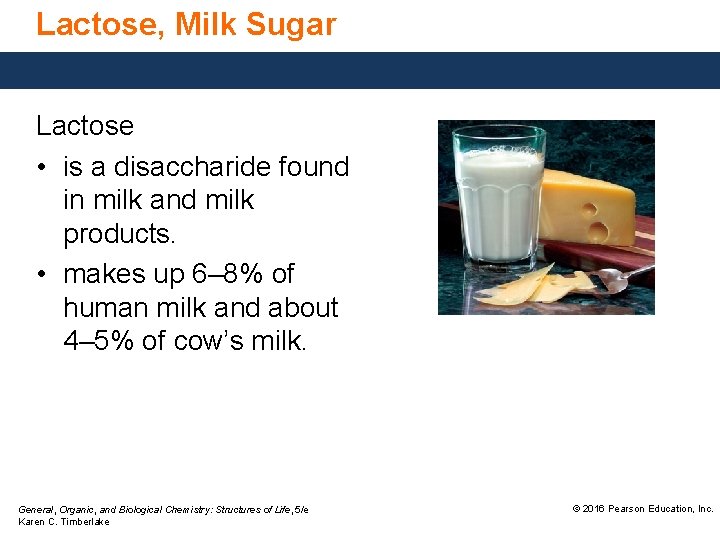
Lactose, Milk Sugar Lactose • is a disaccharide found in milk and milk products. • makes up 6– 8% of human milk and about 4– 5% of cow’s milk. General, Organic, and Biological Chemistry: Structures of Life, 5/e Karen C. Timberlake © 2016 Pearson Education, Inc.
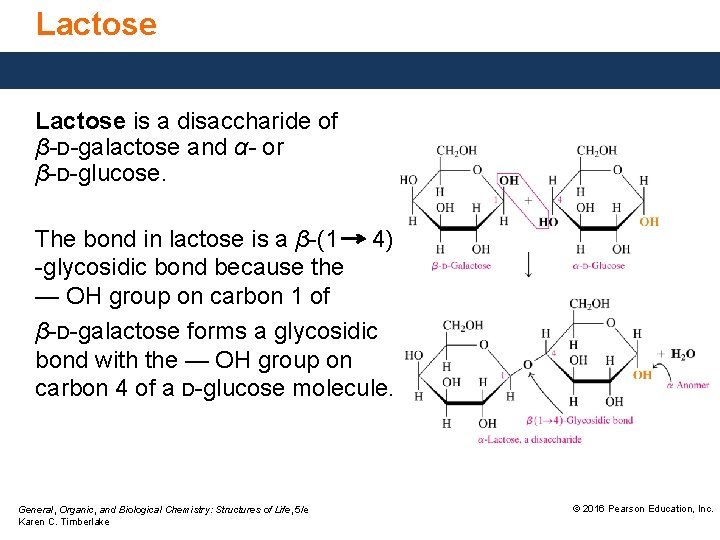
Lactose is a disaccharide of β-D-galactose and α- or β-D-glucose. The bond in lactose is a β-(1 4) -glycosidic bond because the — OH group on carbon 1 of β-D-galactose forms a glycosidic bond with the — OH group on carbon 4 of a D-glucose molecule. General, Organic, and Biological Chemistry: Structures of Life, 5/e Karen C. Timberlake © 2016 Pearson Education, Inc.
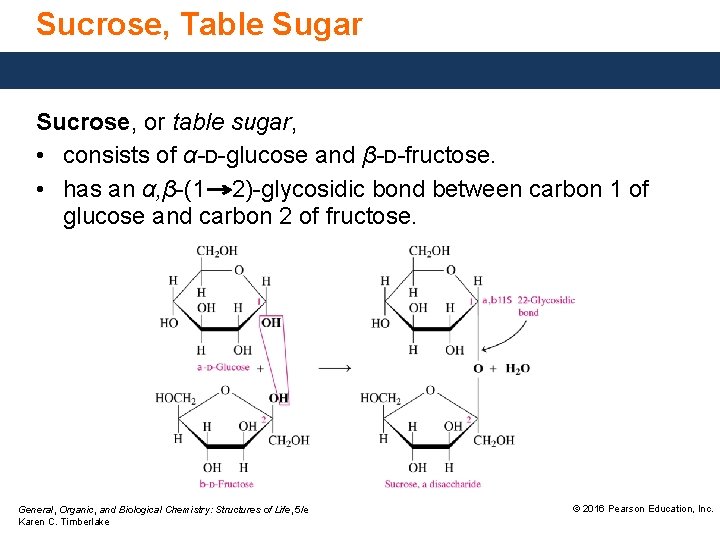
Sucrose, Table Sugar Sucrose, or table sugar, • consists of α-D-glucose and β-D-fructose. • has an α, β-(1 2)-glycosidic bond between carbon 1 of glucose and carbon 2 of fructose. General, Organic, and Biological Chemistry: Structures of Life, 5/e Karen C. Timberlake © 2016 Pearson Education, Inc.
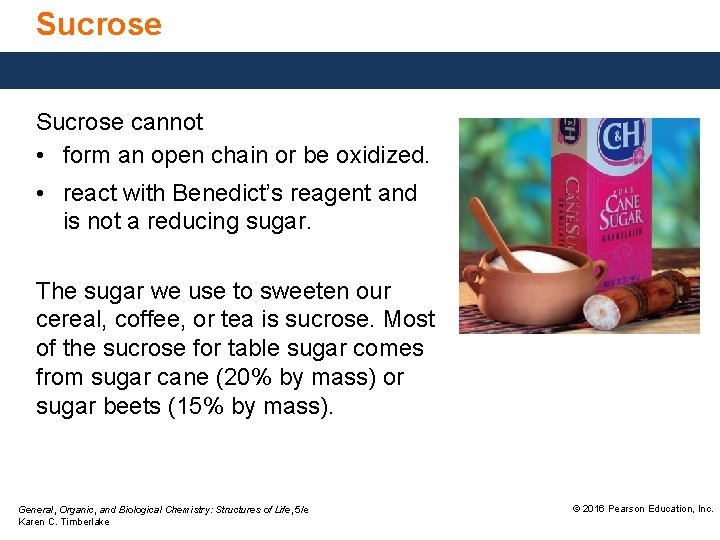
Sucrose cannot • form an open chain or be oxidized. • react with Benedict’s reagent and is not a reducing sugar. The sugar we use to sweeten our cereal, coffee, or tea is sucrose. Most of the sucrose for table sugar comes from sugar cane (20% by mass) or sugar beets (15% by mass). General, Organic, and Biological Chemistry: Structures of Life, 5/e Karen C. Timberlake © 2016 Pearson Education, Inc.
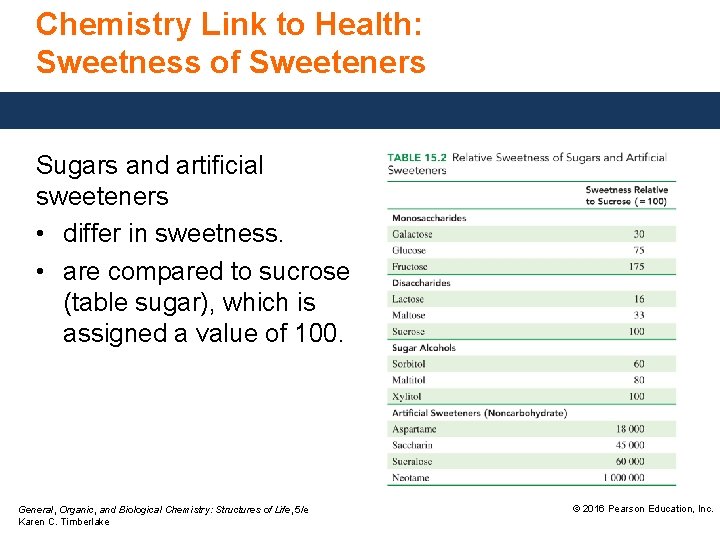
Chemistry Link to Health: Sweetness of Sweeteners Sugars and artificial sweeteners • differ in sweetness. • are compared to sucrose (table sugar), which is assigned a value of 100. General, Organic, and Biological Chemistry: Structures of Life, 5/e Karen C. Timberlake © 2016 Pearson Education, Inc.
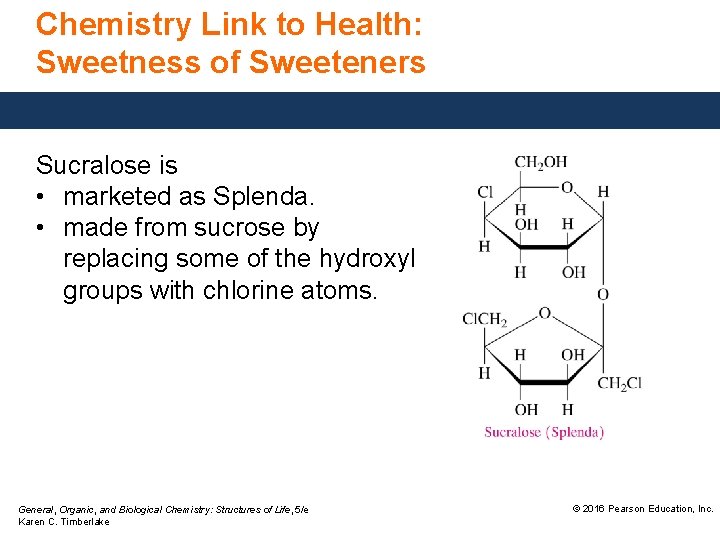
Chemistry Link to Health: Sweetness of Sweeteners Sucralose is • marketed as Splenda. • made from sucrose by replacing some of the hydroxyl groups with chlorine atoms. General, Organic, and Biological Chemistry: Structures of Life, 5/e Karen C. Timberlake © 2016 Pearson Education, Inc.
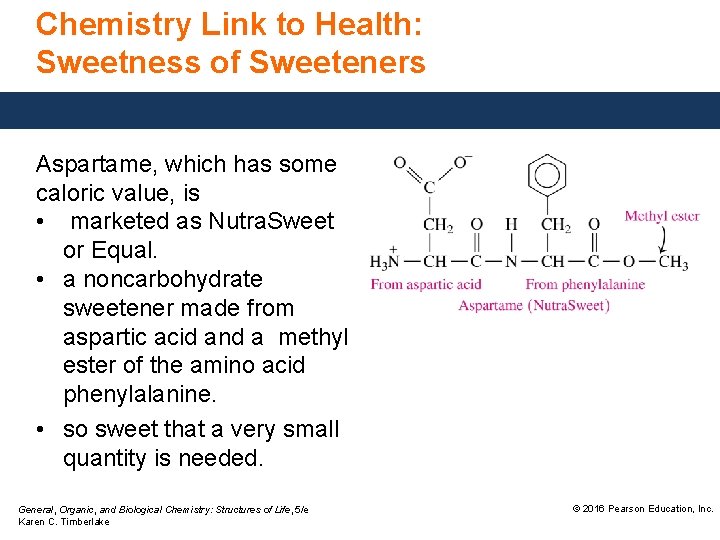
Chemistry Link to Health: Sweetness of Sweeteners Aspartame, which has some caloric value, is • marketed as Nutra. Sweet or Equal. • a noncarbohydrate sweetener made from aspartic acid and a methyl ester of the amino acid phenylalanine. • so sweet that a very small quantity is needed. General, Organic, and Biological Chemistry: Structures of Life, 5/e Karen C. Timberlake © 2016 Pearson Education, Inc.
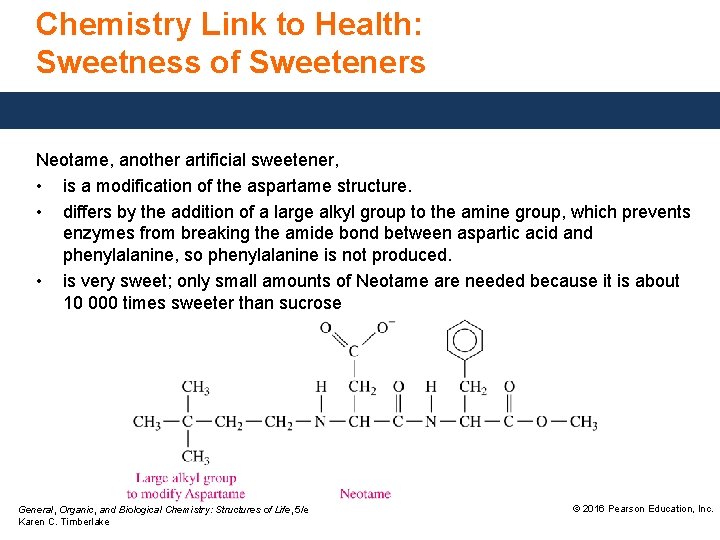
Chemistry Link to Health: Sweetness of Sweeteners Neotame, another artificial sweetener, • is a modification of the aspartame structure. • differs by the addition of a large alkyl group to the amine group, which prevents enzymes from breaking the amide bond between aspartic acid and phenylalanine, so phenylalanine is not produced. • is very sweet; only small amounts of Neotame are needed because it is about 10 000 times sweeter than sucrose General, Organic, and Biological Chemistry: Structures of Life, 5/e Karen C. Timberlake © 2016 Pearson Education, Inc.
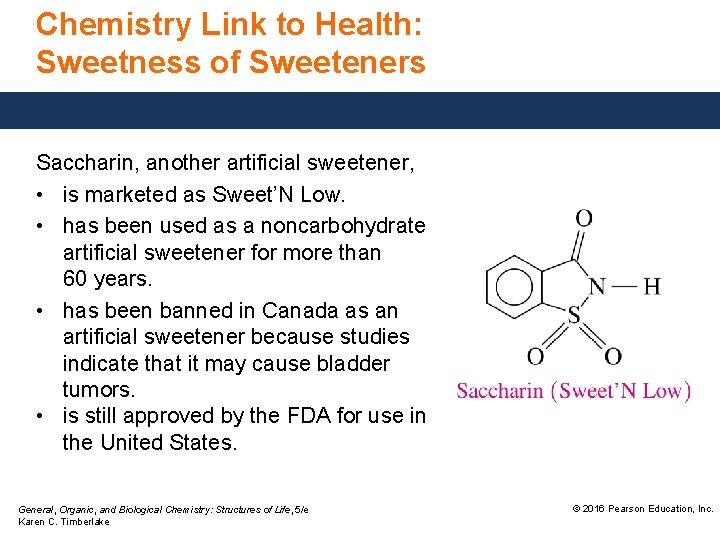
Chemistry Link to Health: Sweetness of Sweeteners Saccharin, another artificial sweetener, • is marketed as Sweet’N Low. • has been used as a noncarbohydrate artificial sweetener for more than 60 years. • has been banned in Canada as an artificial sweetener because studies indicate that it may cause bladder tumors. • is still approved by the FDA for use in the United States. General, Organic, and Biological Chemistry: Structures of Life, 5/e Karen C. Timberlake © 2016 Pearson Education, Inc.
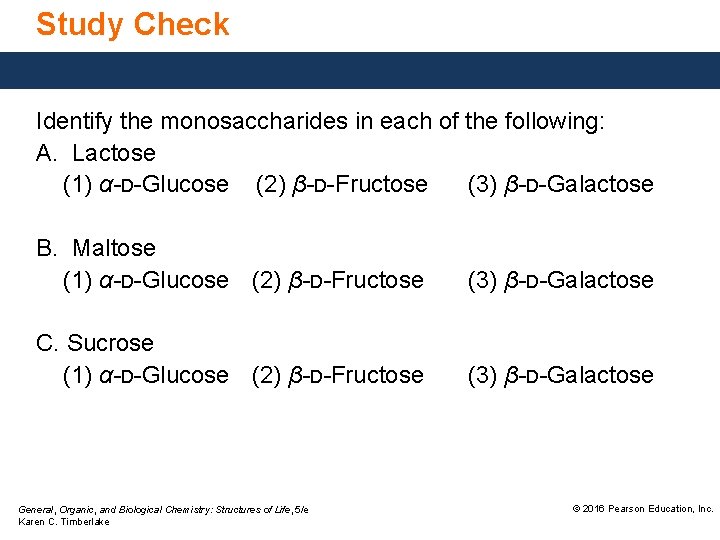
Study Check Identify the monosaccharides in each of the following: A. Lactose (1) α-D-Glucose (2) β-D-Fructose (3) β-D-Galactose B. Maltose (1) α-D-Glucose (2) β-D-Fructose (3) β-D-Galactose C. Sucrose (1) α-D-Glucose (2) β-D-Fructose (3) β-D-Galactose General, Organic, and Biological Chemistry: Structures of Life, 5/e Karen C. Timberlake © 2016 Pearson Education, Inc.
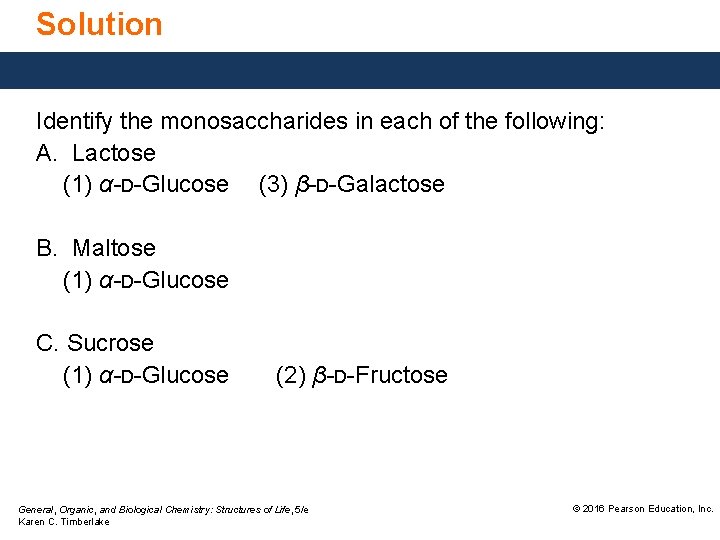
Solution Identify the monosaccharides in each of the following: A. Lactose (1) α-D-Glucose (3) β-D-Galactose B. Maltose (1) α-D-Glucose C. Sucrose (1) α-D-Glucose (2) β-D-Fructose General, Organic, and Biological Chemistry: Structures of Life, 5/e Karen C. Timberlake © 2016 Pearson Education, Inc.
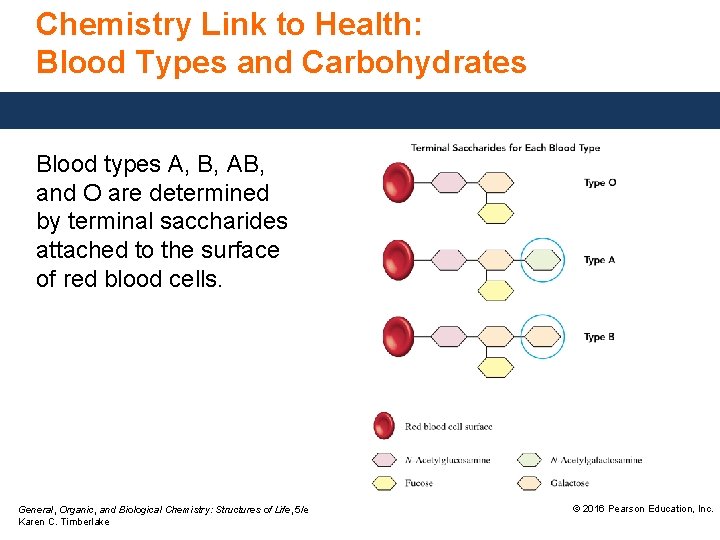
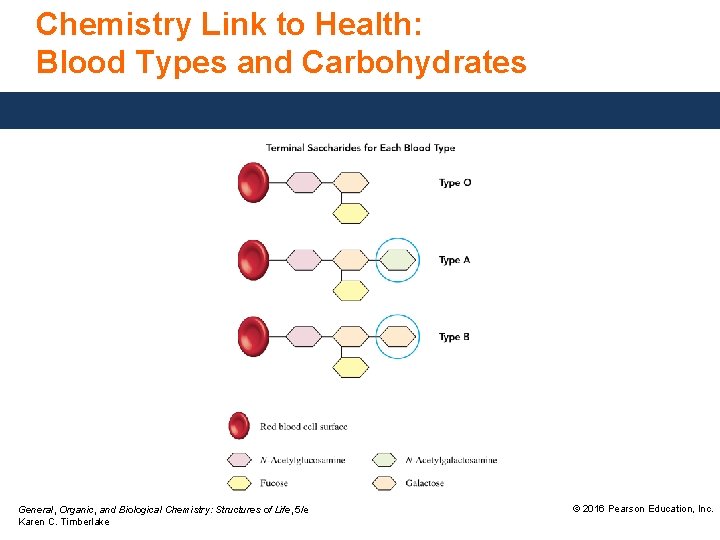
Chemistry Link to Health: Blood Types and Carbohydrates Blood types A, B, AB, and O are determined by terminal saccharides attached to the surface of red blood cells. General, Organic, and Biological Chemistry: Structures of Life, 5/e Karen C. Timberlake © 2016 Pearson Education, Inc.
Chemistry Link to Health: Blood Types and Carbohydrates Blood type • O has three common terminal monosaccharides: N-acetylglucosamine, galactose, and fucose. • A contains the same three monosaccharides, but in addition, a molecule of N-acetylgalactosamine is attached to galactose in the saccharide chain. • B also contains the same three monosaccharides, but in addition, a second molecule of galactose is attached to the saccharide chain. • AB consists of the same monosaccharides found in blood types A and B. General, Organic, and Biological Chemistry: Structures of Life, 5/e Karen C. Timberlake © 2016 Pearson Education, Inc.
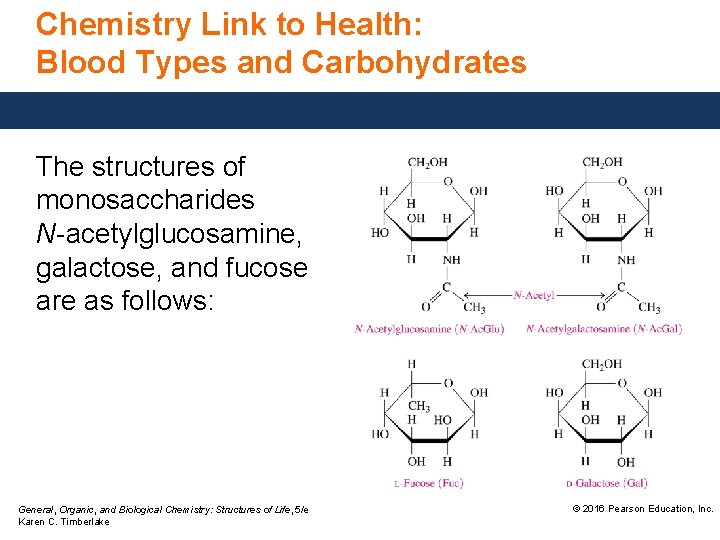
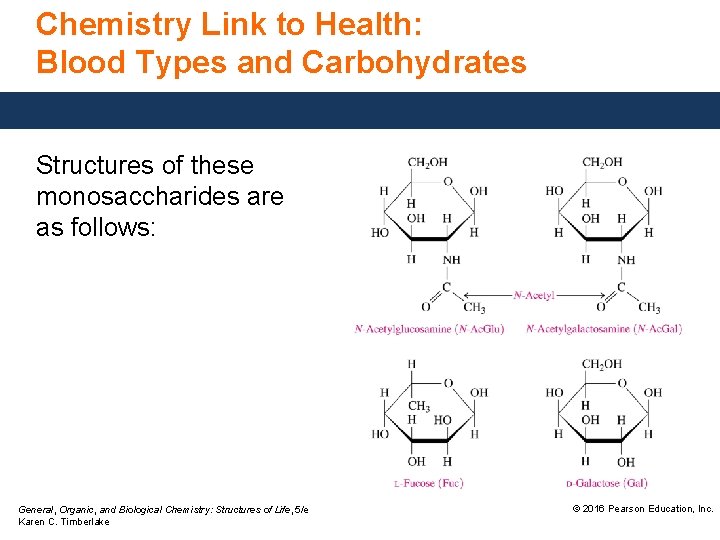
Chemistry Link to Health: Blood Types and Carbohydrates The structures of monosaccharides N-acetylglucosamine, galactose, and fucose are as follows: General, Organic, and Biological Chemistry: Structures of Life, 5/e Karen C. Timberlake © 2016 Pearson Education, Inc.
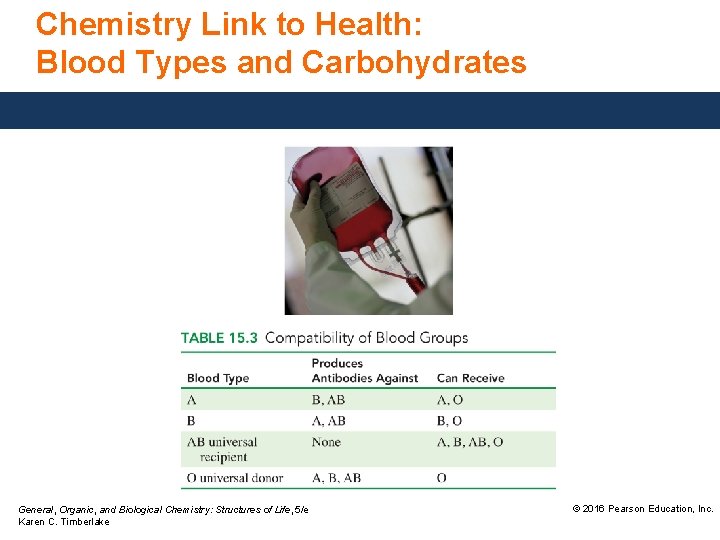
Chemistry Link to Health: Blood Types and Carbohydrates Persons with • type O blood, which produces antibodies against blood types A, B, and AB, are universal donors. • blood types A, B, and AB can receive type O blood. • type AB blood, which contains all the terminal monosaccharides, produce no antibodies to type A, B, or O blood. • type AB blood are universal recipients. General, Organic, and Biological Chemistry: Structures of Life, 5/e Karen C. Timberlake © 2016 Pearson Education, Inc.
Chemistry Link to Health: Blood Types and Carbohydrates Structures of these monosaccharides are as follows: General, Organic, and Biological Chemistry: Structures of Life, 5/e Karen C. Timberlake © 2016 Pearson Education, Inc.
Chemistry Link to Health: Blood Types and Carbohydrates General, Organic, and Biological Chemistry: Structures of Life, 5/e Karen C. Timberlake © 2016 Pearson Education, Inc.
Chemistry Link to Health: Blood Types and Carbohydrates General, Organic, and Biological Chemistry: Structures of Life, 5/e Karen C. Timberlake © 2016 Pearson Education, Inc.
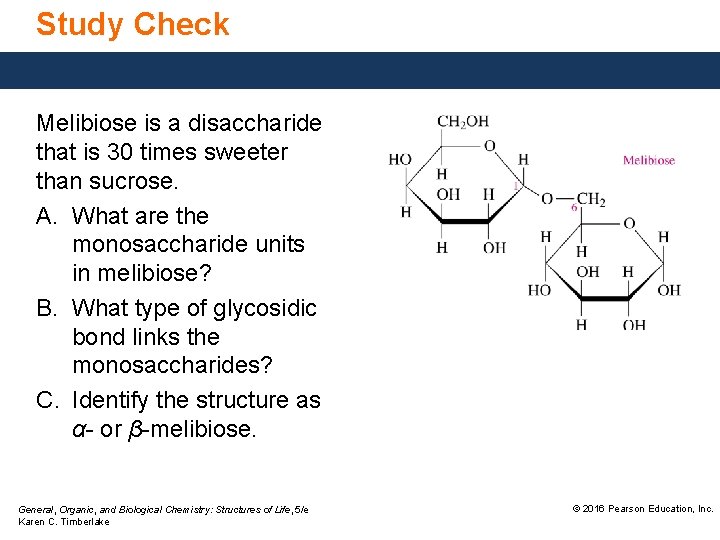
Study Check Melibiose is a disaccharide that is 30 times sweeter than sucrose. A. What are the monosaccharide units in melibiose? B. What type of glycosidic bond links the monosaccharides? C. Identify the structure as α- or β-melibiose. General, Organic, and Biological Chemistry: Structures of Life, 5/e Karen C. Timberlake © 2016 Pearson Education, Inc.
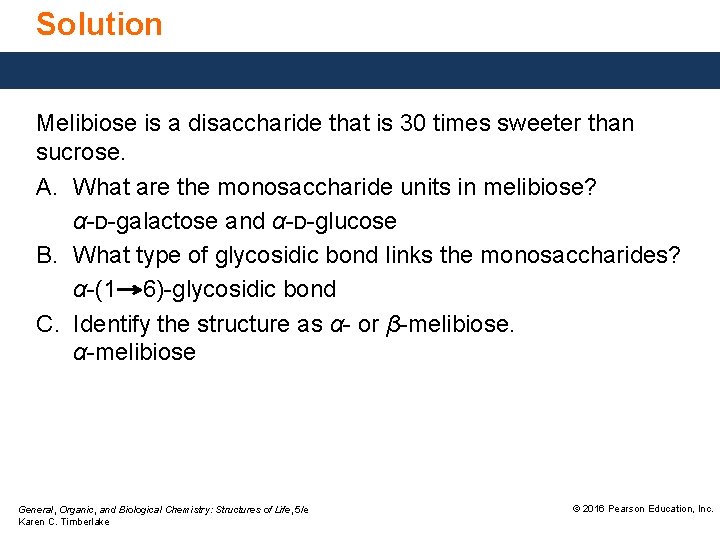
Solution Melibiose is a disaccharide that is 30 times sweeter than sucrose. A. What are the monosaccharide units in melibiose? α-D-galactose and α-D-glucose B. What type of glycosidic bond links the monosaccharides? α-(1 6)-glycosidic bond C. Identify the structure as α- or β-melibiose. α-melibiose General, Organic, and Biological Chemistry: Structures of Life, 5/e Karen C. Timberlake © 2016 Pearson Education, Inc.