
Suggestions for course your input please Please use


- Slides: 36
Suggestions for course- your input please Please use only your CBU emails when communicating with me. Please check your CBU emails frequently including for messages from me.
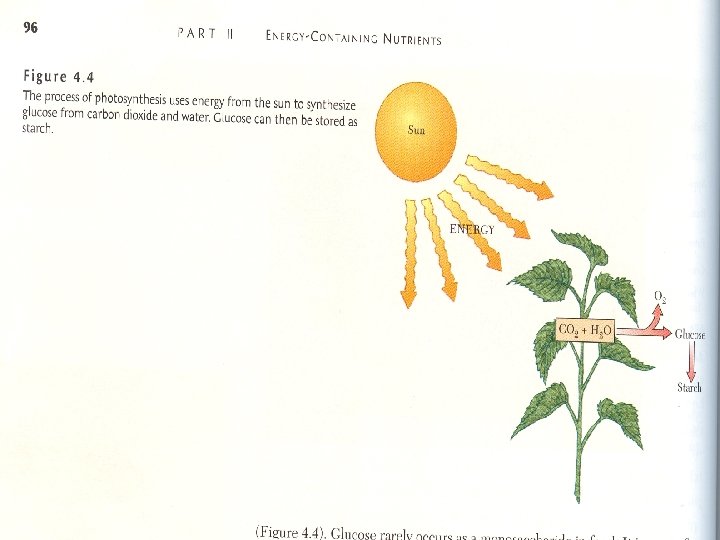
Lecture 3 a- 21 January 2020 Most of this lecture derived from Chapter 4 of Gropper, Chapter 4, 7 of Rolfes et al(Understanding Normal and Clinical Nutrition(Nutrition 2104/2108 text) Insel et al. (Nutrition) and page 96 of Smolin and Grosvenor (Nutrition. Science and Applications)
TODAY’S LECTURE Carbohydrate metabolism and regulation
Outline of lectures 3 a and 3 b Carbohydrates -forms -monosaccharides -disaccharides -oligosaccharides -polysaccharides -fibre-next week
Outline of lectures 3 a and 3 b Carbohydrates -foods where each is found -monosaccharides -disaccharides -oligosaccharides -polysaccharides
Outline of lectures 3 a and 3 b -definitions -monosaccharides -disaccharides -oligosaccharides -polysaccharides
Outline of lecture 3 a and 3 b -digestion -monosaccharides -disaccharides -oligosaccharides -polysaccharides
Outline of lectures 3 a and 3 b -absorption, transport and distribution -monosaccharides -disaccharides -oligosaccharides -polysaccharides -glucose transporters
Outline of lectures 3 a and 3 b -metabolism -glycogenesis -glycogenolysis -glycolysis -nicotinamide adenine dinucleotide -hexose monophosphate shunt -Krebs cycle -gluconeogenesis -regulation -allosteric -hormonal -changes in equilibrium -rate limiting enzymes
More detailed comments-lecture 3 a Carbohydrates -forms -simple carbohydrates -monosaccharides -glucose, fructose, galactose -disaccharides -maltose(glucose and glucose), -sucrose(glucose and fructose), -lactose(glucose and galactose)
Carbohydrates -forms -complex carbohydrates -oligosaccharides-three to ten saccharide units(some texts define as 2 -10 units)-eg breakdown of starch digestion -polysaccharides-more than 10 saccharides units-eg starch, glycogen
Examples of foods where each is found -monosaccharides -glucose-rare in foods as monosaccharide (except mother's milk and sports drinks) but is found in foods as disaccharides and starch -fructose-fruits and honey -galactose-seldom occurs free in nature
Examples of foods where each is found -disaccharides -maltose- part of starch - minor component of few foods -sucrose-fruits, vegetables and grain -sugar cane- gives rise to table sugar -sugar beets-give rise to table sugar -lactose-dairy products (eg milk)
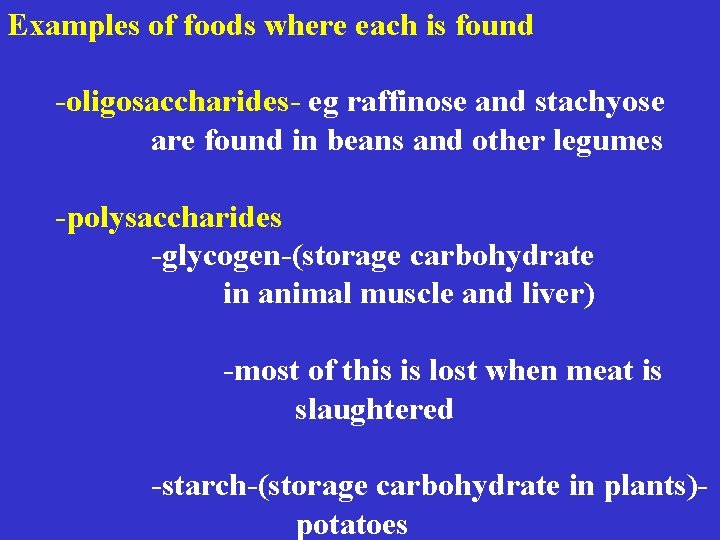
Examples of foods where each is found -oligosaccharides- eg raffinose and stachyose are found in beans and other legumes -polysaccharides -glycogen-(storage carbohydrate in animal muscle and liver) -most of this is lost when meat is slaughtered -starch-(storage carbohydrate in plants)potatoes
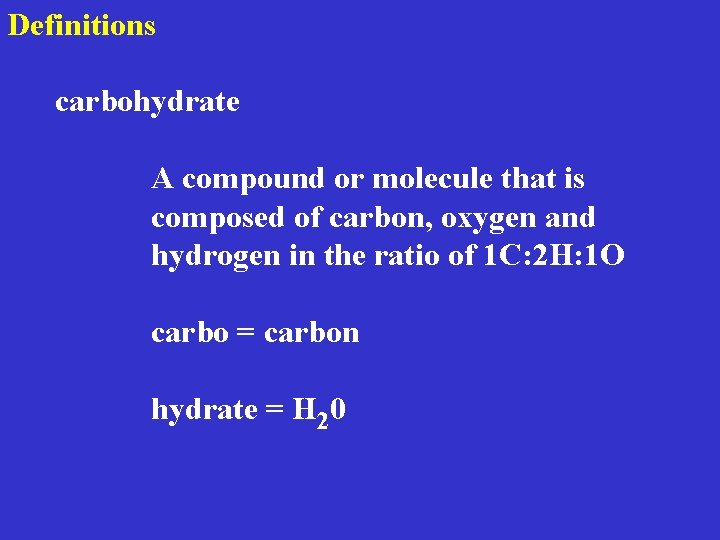
Definitions carbohydrate A compound or molecule that is composed of carbon, oxygen and hydrogen in the ratio of 1 C: 2 H: 1 O carbo = carbon hydrate = H 20
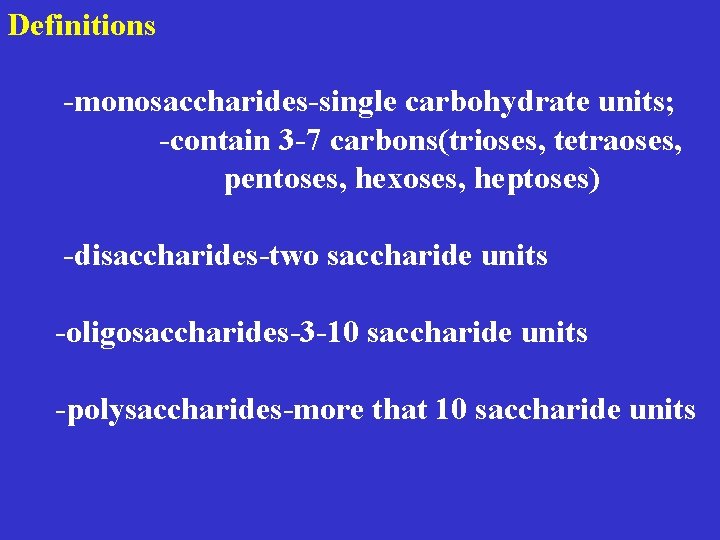
Definitions -monosaccharides-single carbohydrate units; -contain 3 -7 carbons(trioses, tetraoses, pentoses, hexoses, heptoses) -disaccharides-two saccharide units -oligosaccharides-3 -10 saccharide units -polysaccharides-more that 10 saccharide units
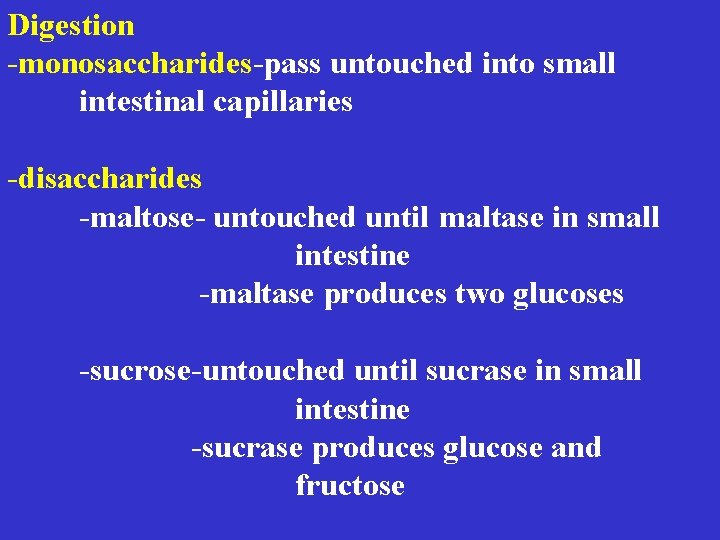
Digestion -monosaccharides-pass untouched into small intestinal capillaries -disaccharides -maltose- untouched until maltase in small intestine -maltase produces two glucoses -sucrose-untouched until sucrase in small intestine -sucrase produces glucose and fructose
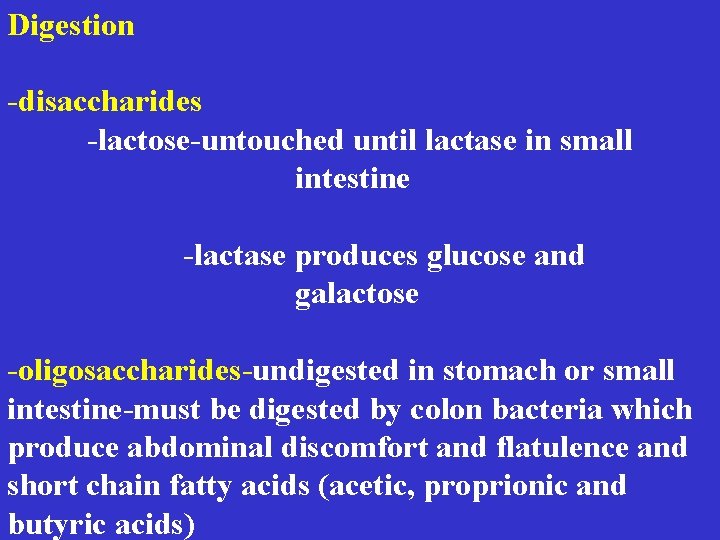
Digestion -disaccharides -lactose-untouched until lactase in small intestine -lactase produces glucose and galactose -oligosaccharides-undigested in stomach or small intestine-must be digested by colon bacteria which produce abdominal discomfort and flatulence and short chain fatty acids (acetic, proprionic and butyric acids)
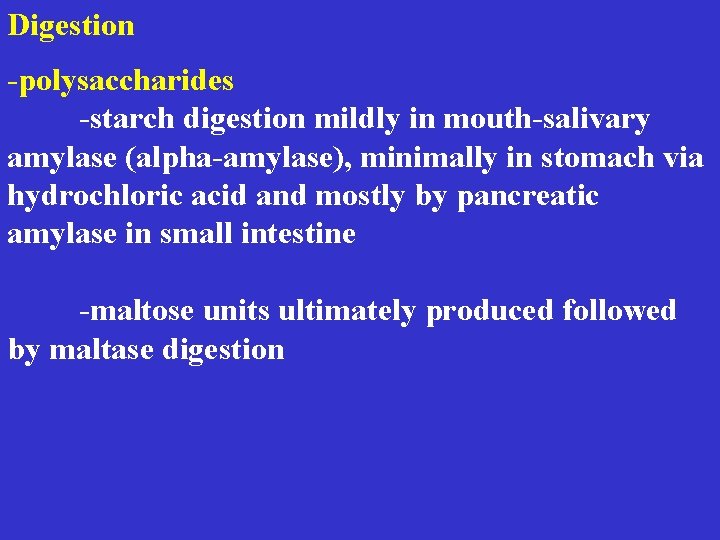
Digestion -polysaccharides -starch digestion mildly in mouth-salivary amylase (alpha-amylase), minimally in stomach via hydrochloric acid and mostly by pancreatic amylase in small intestine -maltose units ultimately produced followed by maltase digestion
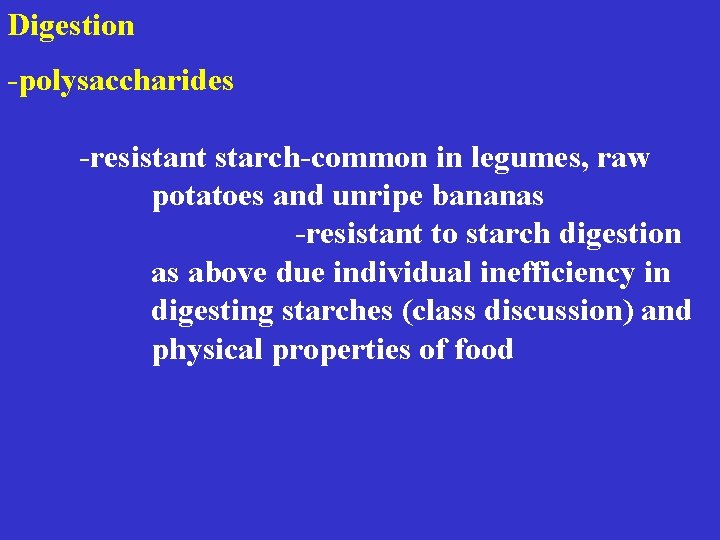
Digestion -polysaccharides -resistant starch-common in legumes, raw potatoes and unripe bananas -resistant to starch digestion as above due individual inefficiency in digesting starches (class discussion) and physical properties of food
Digestion -polysaccharides -resistant starch bacteria in colon ferment resistant starches and produce gas and short chain fatty acids (acetic, proprionic and butyric acids)
Absorption, transport and distribution -monosaccharides-pass untouched into small intestinal capillaries -glucose and galactose enter by active transport and both go to liver -fructose enters by facilitated diffusion and goes to liver -glucose goes to liver(some glycogen produced and other metabolic pathways)
Absorption, transport and distribution -monosaccharides -fructose and galactose converted to glucose in liver -glucose also goes to directly to other tissues eg voluntary muscle(some glycogen produced and other metabolic pathways are followed)
Absorption, transport and distribution oligosaccharides-undigested in stomach or small intestine-must be digested by colon bacteria which produce short chain fatty acids, abdominal discomfort and flatulence
Absorption, transport and distribution -polysaccharides-starch digestion mildy in mouth-salivary amylase (alpha-amylase), minimally in stomach via hydrochloric acid and mostly by pancreatic amylase in small intestine -maltose units ultimately producing glucose which is handled as above
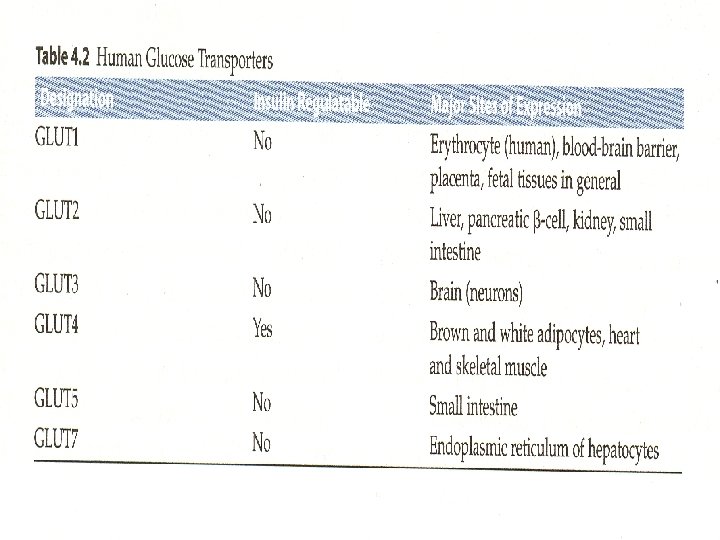
Absorption, transport and distribution -glucose transporters-proteins required to get glucose into cells -table 4. 2 Gropper
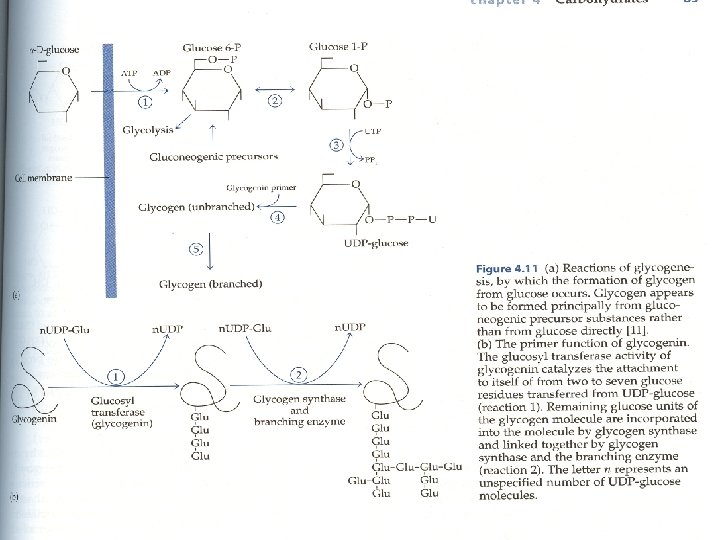
-metabolism -glycogenesis -conversion of glucose to glycogen(storage form of carbohydrate in humans) -occurs in liver and muscle (cytoplast) -glucose converted to glycogen precursors -most of glycogen arises from gluconeogenic precursors rather than glucose directly -figure 4. 11 Gropper
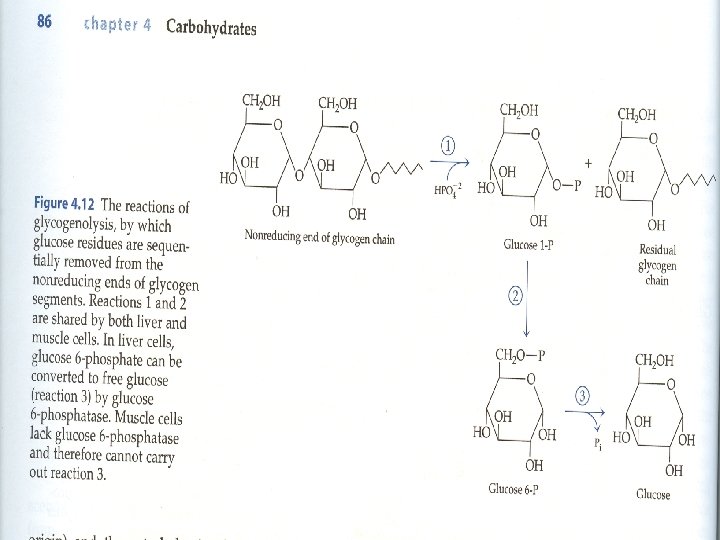
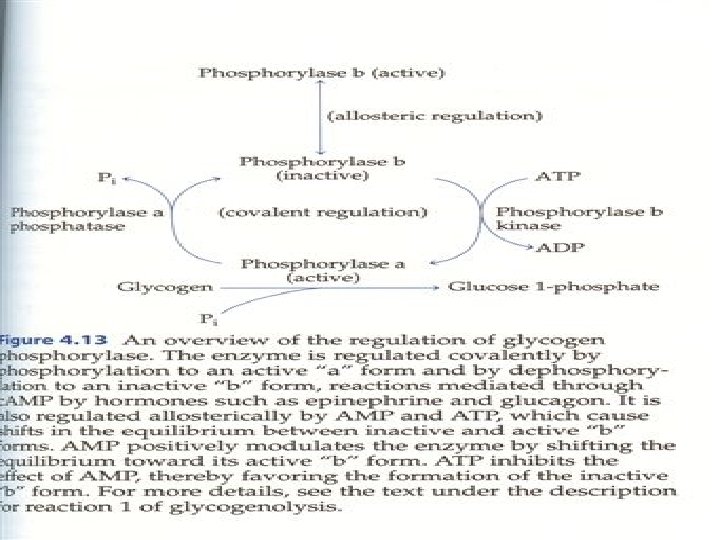
-metabolism -glycogenolysis -conversion of glycogen to glucose (usable form of carbohydrate in humans for energy and anabolism) Note: The end of the molecule containing a free carbon number one on glucose is called a reducing end. The other ends are all called non-reducing ends. -occurs in cytoplast -figure 4. 12 Gropper -regulation-figure 4. 13 Gropper
-metabolism
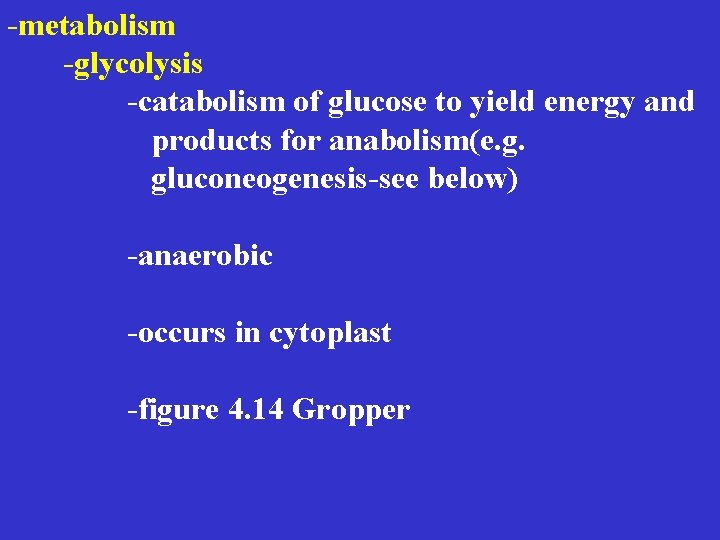
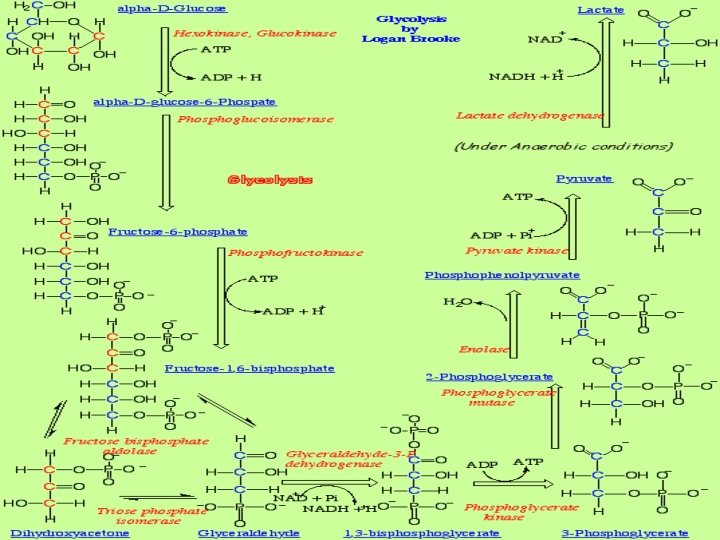
-metabolism -glycolysis -catabolism of glucose to yield energy and products for anabolism(e. g. gluconeogenesis-see below) -anaerobic -occurs in cytoplast -figure 4. 14 Gropper