11 P Vectors and the Geometry of Space
- Slides: 22
11 P Vectors and the Geometry of Space Copyright © Cengage Learning. All rights reserved.
11. 2 Space Coordinates and Vectors in Space Copyright © Cengage Learning. All rights reserved.
Objectives n Understand the three-dimensional rectangular coordinate system. n Analyze vectors in space. 3
Coordinates in Space 4
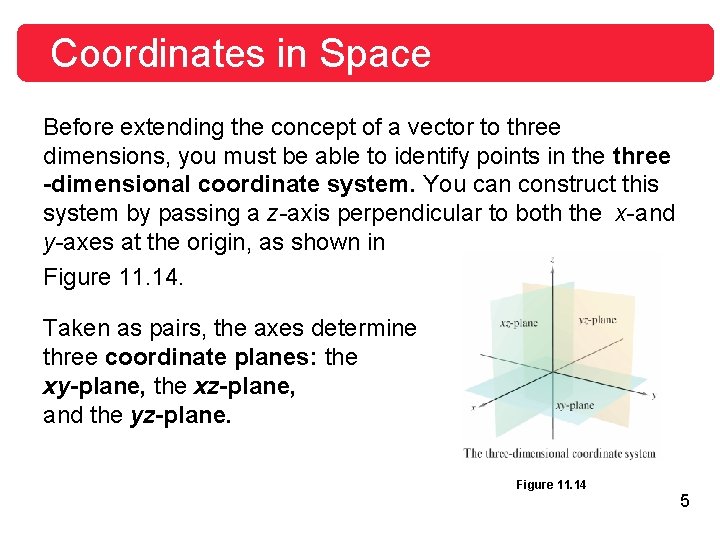
Coordinates in Space Before extending the concept of a vector to three dimensions, you must be able to identify points in the three -dimensional coordinate system. You can construct this system by passing a z-axis perpendicular to both the x-and y-axes at the origin, as shown in Figure 11. 14. Taken as pairs, the axes determine three coordinate planes: the xy-plane, the xz-plane, and the yz-plane. Figure 11. 14 5
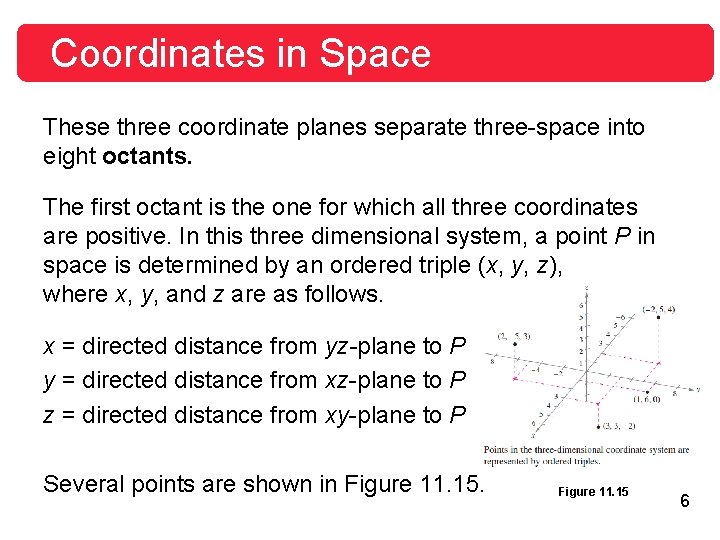
Coordinates in Space These three coordinate planes separate three-space into eight octants. The first octant is the one for which all three coordinates are positive. In this three dimensional system, a point P in space is determined by an ordered triple (x, y, z), where x, y, and z are as follows. x = directed distance from yz-plane to P y = directed distance from xz-plane to P z = directed distance from xy-plane to P Several points are shown in Figure 11. 15 6
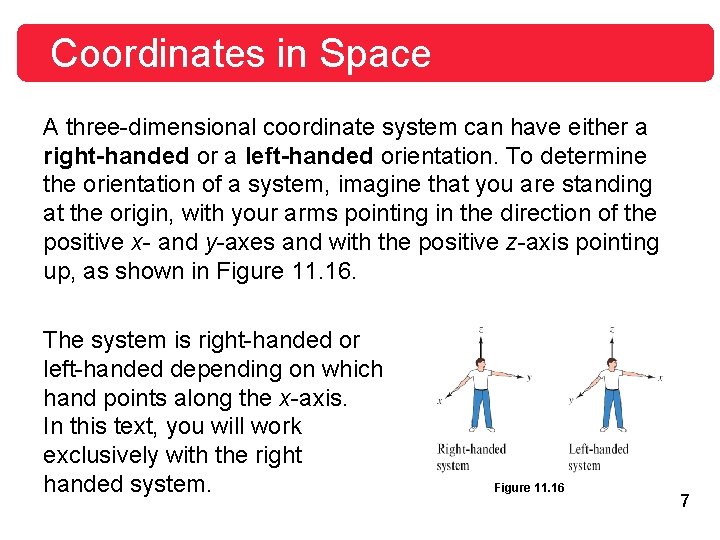
Coordinates in Space A three-dimensional coordinate system can have either a right-handed or a left-handed orientation. To determine the orientation of a system, imagine that you are standing at the origin, with your arms pointing in the direction of the positive x- and y-axes and with the positive z-axis pointing up, as shown in Figure 11. 16. The system is right-handed or left-handed depending on which hand points along the x-axis. In this text, you will work exclusively with the right handed system. Figure 11. 16 7
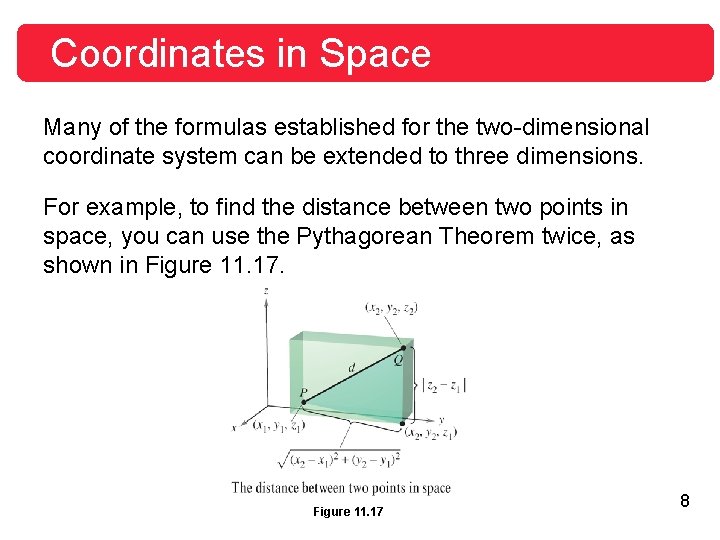
Coordinates in Space Many of the formulas established for the two-dimensional coordinate system can be extended to three dimensions. For example, to find the distance between two points in space, you can use the Pythagorean Theorem twice, as shown in Figure 11. 17 8
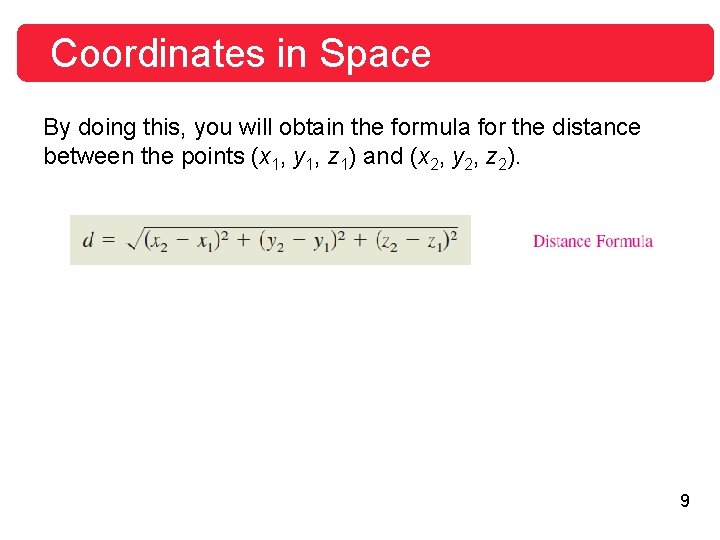
Coordinates in Space By doing this, you will obtain the formula for the distance between the points (x 1, y 1, z 1) and (x 2, y 2, z 2). 9
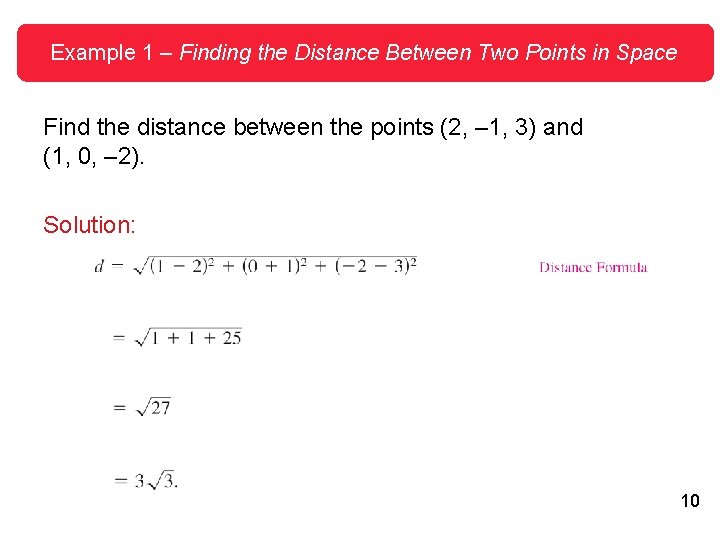
Example 1 – Finding the Distance Between Two Points in Space Find the distance between the points (2, – 1, 3) and (1, 0, – 2). Solution: 10
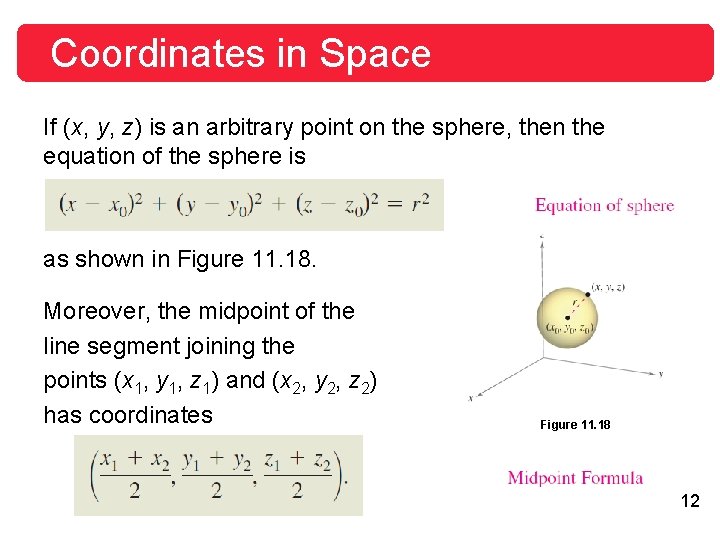
Coordinates in Space A sphere with center at (x 0, y 0, z 0) and radius r is defined to be the set of all points (x, y, z) such that the distance between (x, y, z) and (x 0, y 0, z 0) is r. You can use the Distance Formula to find the standard equation of a sphere of radius r, centered at (x 0, y 0, z 0). 11
Coordinates in Space If (x, y, z) is an arbitrary point on the sphere, then the equation of the sphere is as shown in Figure 11. 18. Moreover, the midpoint of the line segment joining the points (x 1, y 1, z 1) and (x 2, y 2, z 2) has coordinates Figure 11. 18 12
Vectors in Space 13
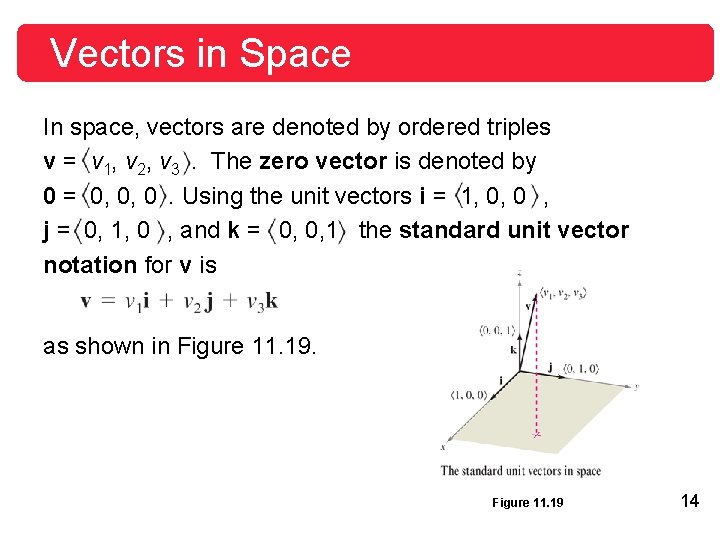
Vectors in Space In space, vectors are denoted by ordered triples v = v 1, v 2, v 3. The zero vector is denoted by 0 = 0, 0, 0. Using the unit vectors i = 1, 0, 0 , j = 0, 1, 0 , and k = 0, 0, 1 the standard unit vector notation for v is as shown in Figure 11. 19 14
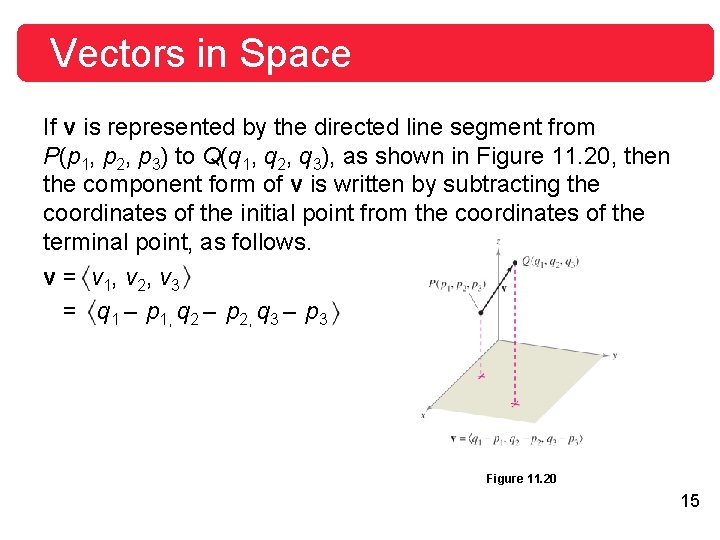
Vectors in Space If v is represented by the directed line segment from P(p 1, p 2, p 3) to Q(q 1, q 2, q 3), as shown in Figure 11. 20, then the component form of v is written by subtracting the coordinates of the initial point from the coordinates of the terminal point, as follows. v = v 1, v 2, v 3 = q 1 – p 1, q 2 – p 2, q 3 – p 3 Figure 11. 20 15
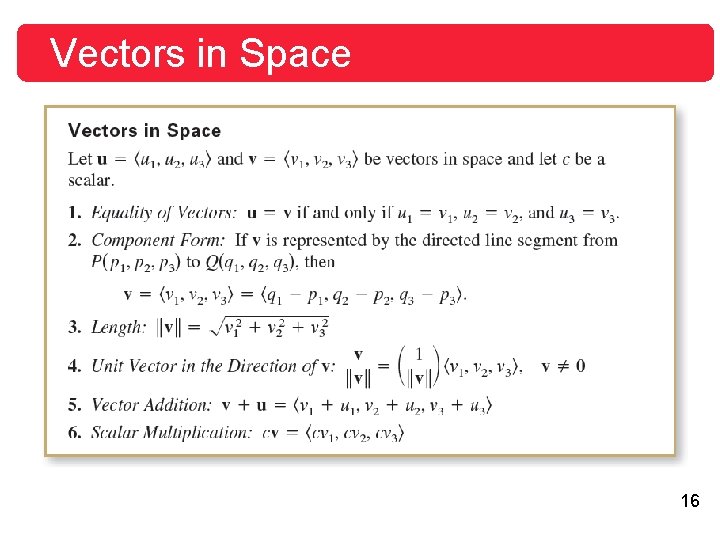
Vectors in Space 16
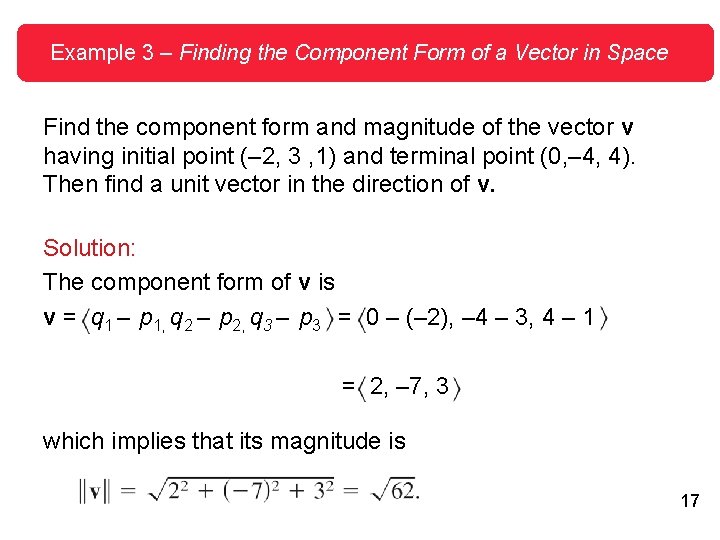
Example 3 – Finding the Component Form of a Vector in Space Find the component form and magnitude of the vector v having initial point (– 2, 3 , 1) and terminal point (0, – 4, 4). Then find a unit vector in the direction of v. Solution: The component form of v is v = q 1 – p 1, q 2 – p 2, q 3 – p 3 = 0 – (– 2), – 4 – 3, 4 – 1 = 2, – 7, 3 which implies that its magnitude is 17
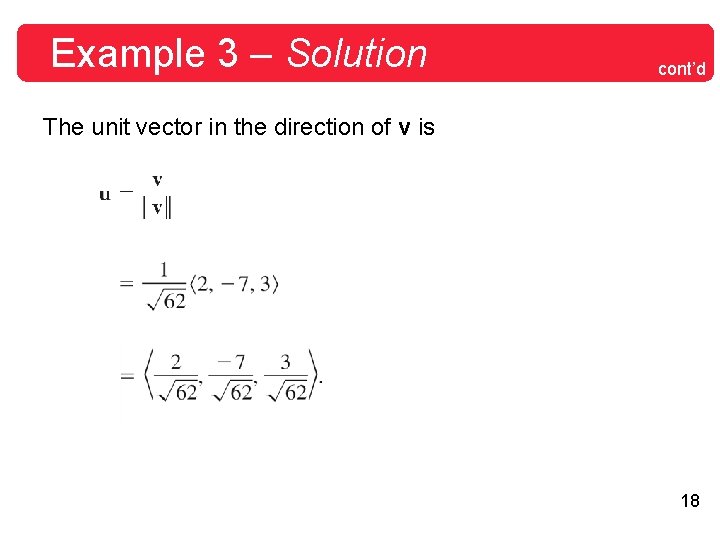
Example 3 – Solution cont’d The unit vector in the direction of v is 18
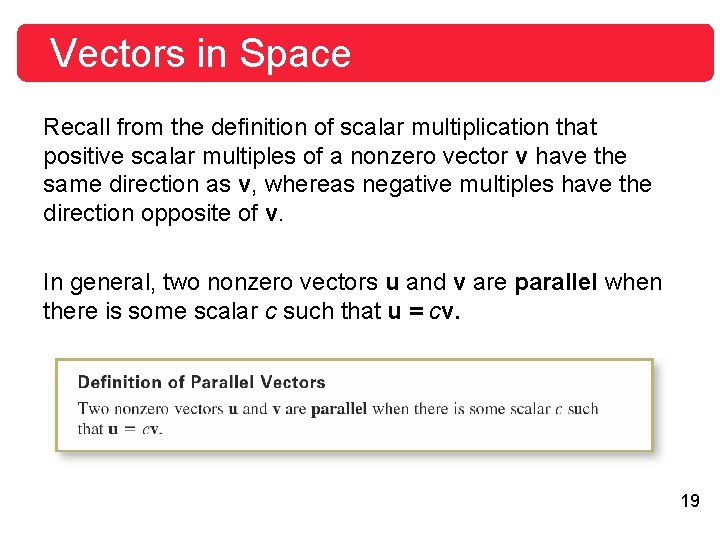
Vectors in Space Recall from the definition of scalar multiplication that positive scalar multiples of a nonzero vector v have the same direction as v, whereas negative multiples have the direction opposite of v. In general, two nonzero vectors u and v are parallel when there is some scalar c such that u = cv. 19
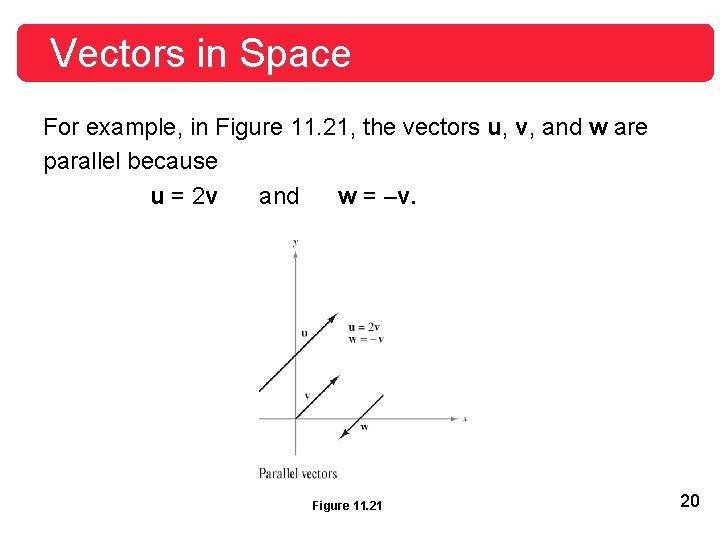
Vectors in Space For example, in Figure 11. 21, the vectors u, v, and w are parallel because u = 2 v and w = –v. Figure 11. 21 20
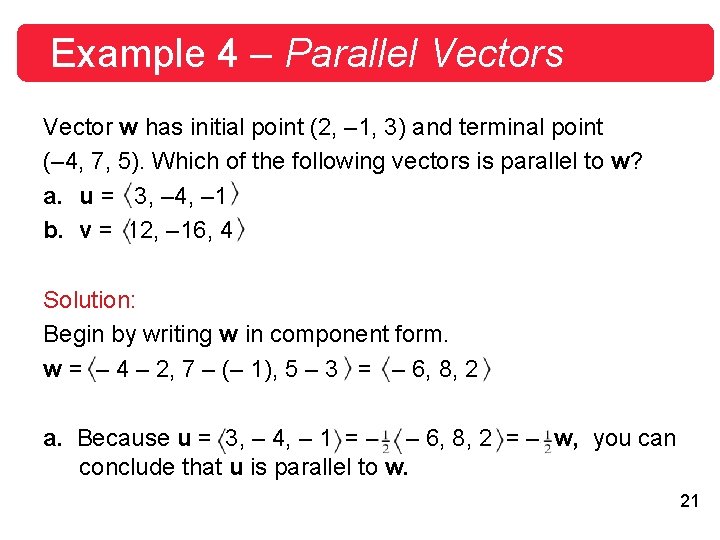
Example 4 – Parallel Vectors Vector w has initial point (2, – 1, 3) and terminal point (– 4, 7, 5). Which of the following vectors is parallel to w? a. u = 3, – 4, – 1 b. v = 12, – 16, 4 Solution: Begin by writing w in component form. w = – 4 – 2, 7 – (– 1), 5 – 3 = – 6, 8, 2 a. Because u = 3, – 4, – 1 = – – 6, 8, 2 = – w, you can conclude that u is parallel to w. 21
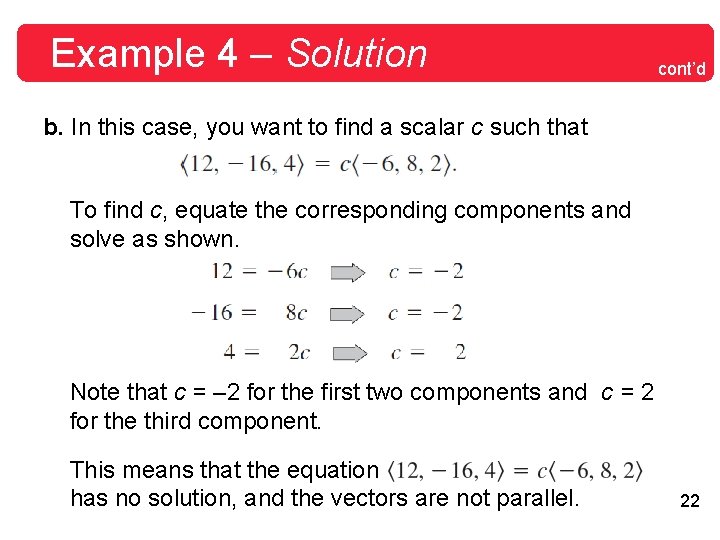
Example 4 – Solution cont’d b. In this case, you want to find a scalar c such that To find c, equate the corresponding components and solve as shown. Note that c = – 2 for the first two components and c = 2 for the third component. This means that the equation has no solution, and the vectors are not parallel. 22