1 Dividend Policy and Internal Financing Chapter 17

- Slides: 85
1 Dividend Policy and Internal Financing. Chapter 17
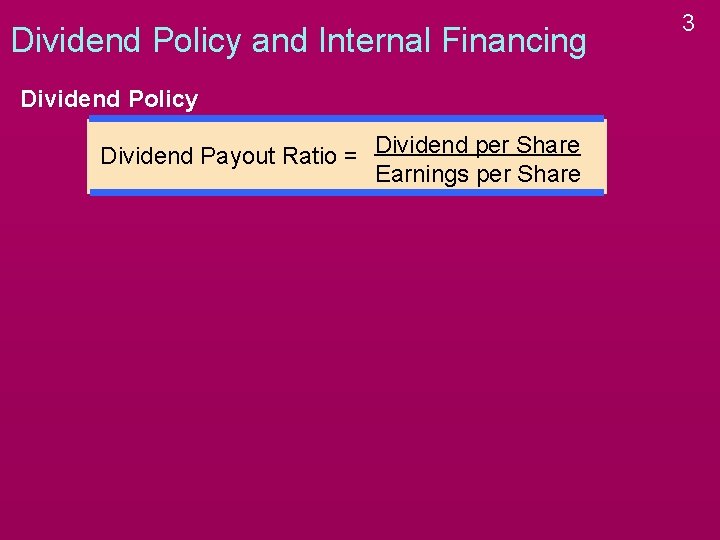
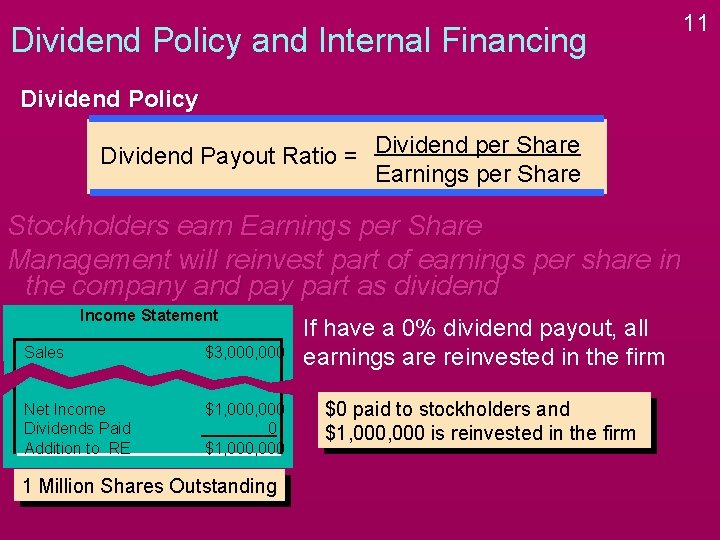
Dividend Policy and Internal Financing Dividend Policy Dividend Payout Ratio = Dividend per Share Earnings per Share 3
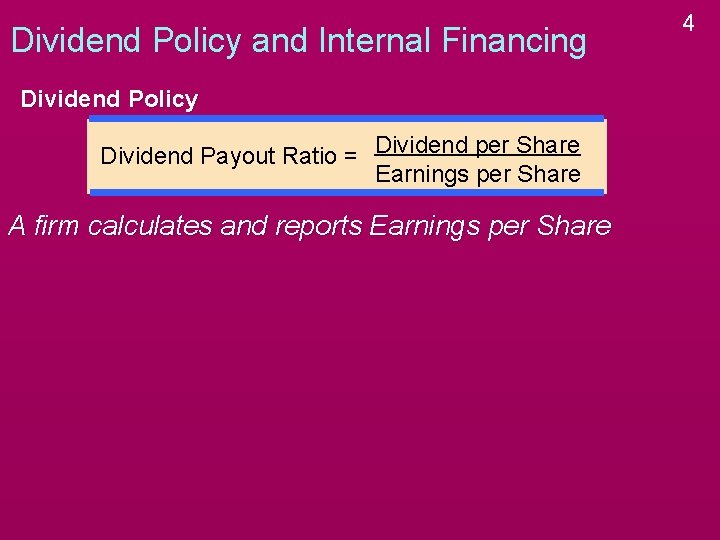
Dividend Policy and Internal Financing Dividend Policy Dividend Payout Ratio = Dividend per Share Earnings per Share A firm calculates and reports Earnings per Share 4
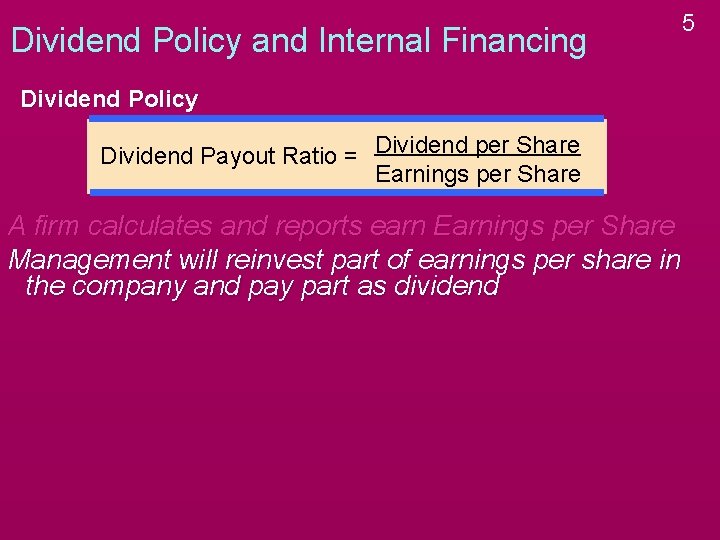
Dividend Policy and Internal Financing Dividend Policy Dividend Payout Ratio = Dividend per Share Earnings per Share A firm calculates and reports earn Earnings per Share Management will reinvest part of earnings per share in the company and pay part as dividend 5
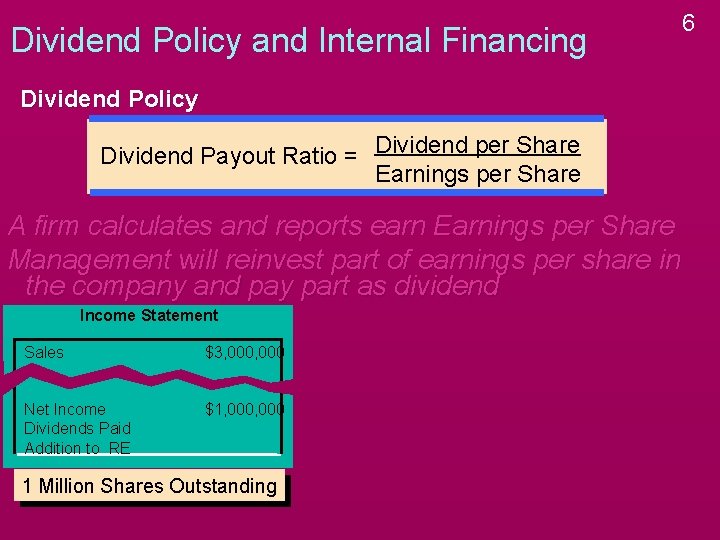
Dividend Policy and Internal Financing Dividend Policy Dividend Payout Ratio = Dividend per Share Earnings per Share A firm calculates and reports earn Earnings per Share Management will reinvest part of earnings per share in the company and pay part as dividend Income Statement Sales $3, 000 Net Income Dividends Paid Addition to RE $1, 000 1 Million Shares Outstanding 6
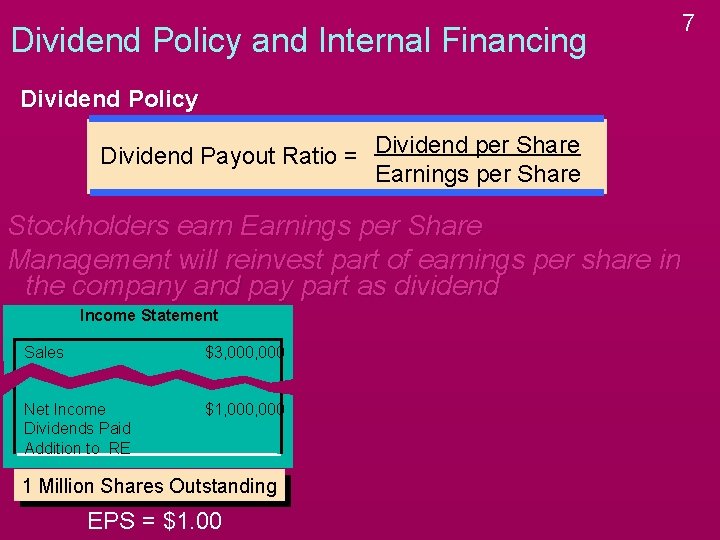
Dividend Policy and Internal Financing Dividend Policy Dividend Payout Ratio = Dividend per Share Earnings per Share Stockholders earn Earnings per Share Management will reinvest part of earnings per share in the company and pay part as dividend Income Statement Sales $3, 000 Net Income Dividends Paid Addition to RE $1, 000 1 Million Shares Outstanding EPS = $1. 00 7
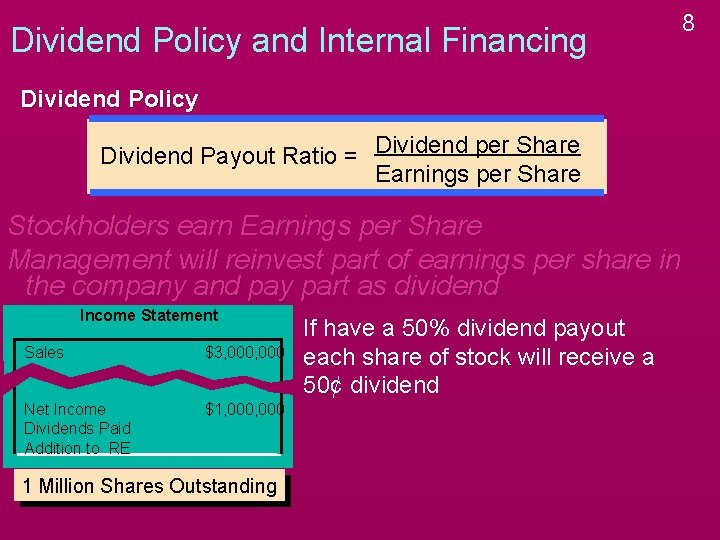
Dividend Policy and Internal Financing Dividend Policy Dividend Payout Ratio = Dividend per Share Earnings per Share Stockholders earn Earnings per Share Management will reinvest part of earnings per share in the company and pay part as dividend Income Statement Sales $3, 000 Net Income Dividends Paid Addition to RE $1, 000 1 Million Shares Outstanding If have a 50% dividend payout each share of stock will receive a 50¢ dividend 8
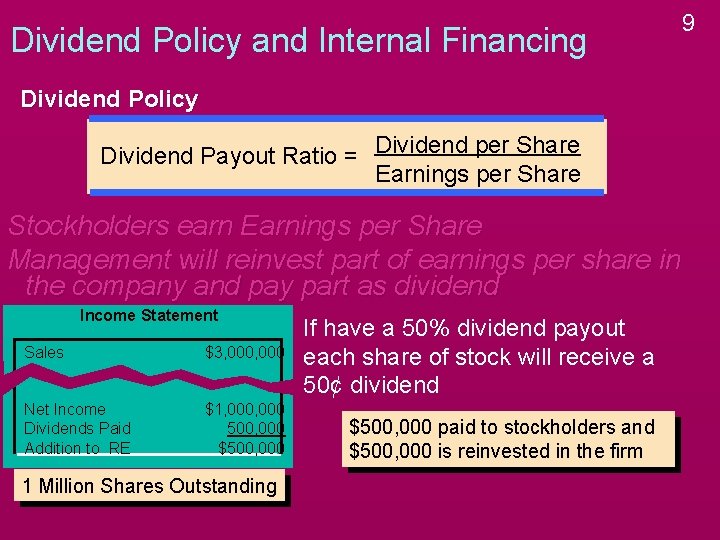
Dividend Policy and Internal Financing Dividend Policy Dividend Payout Ratio = Dividend per Share Earnings per Share Stockholders earn Earnings per Share Management will reinvest part of earnings per share in the company and pay part as dividend Income Statement Sales $3, 000 Net Income Dividends Paid Addition to RE $1, 000 500, 000 $500, 000 1 Million Shares Outstanding If have a 50% dividend payout each share of stock will receive a 50¢ dividend $500, 000 paid to stockholders and $500, 000 is reinvested in the firm 9
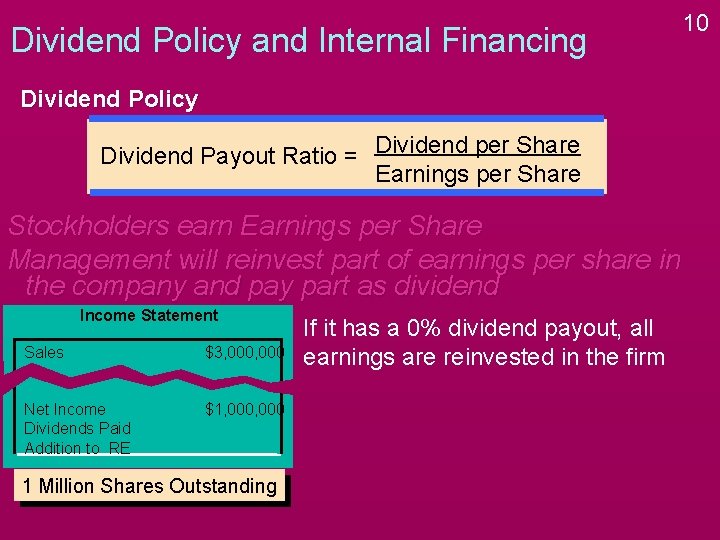
Dividend Policy and Internal Financing Dividend Policy Dividend Payout Ratio = Dividend per Share Earnings per Share Stockholders earn Earnings per Share Management will reinvest part of earnings per share in the company and pay part as dividend Income Statement Sales $3, 000 Net Income Dividends Paid Addition to RE $1, 000 1 Million Shares Outstanding If it has a 0% dividend payout, all earnings are reinvested in the firm 10
Dividend Policy and Internal Financing Dividend Policy Dividend Payout Ratio = Dividend per Share Earnings per Share Stockholders earn Earnings per Share Management will reinvest part of earnings per share in the company and pay part as dividend Income Statement Sales $3, 000 Net Income Dividends Paid Addition to RE $1, 000 0 $1, 000 1 Million Shares Outstanding If have a 0% dividend payout, all earnings are reinvested in the firm $0 paid to stockholders and $1, 000 is reinvested in the firm 11
Can Dividend Policy Affect Share Price Three Theories of Dividends v. Irrelevance v. Dividends Increase Stock Price v. Dividends Decrease Stock Price 12
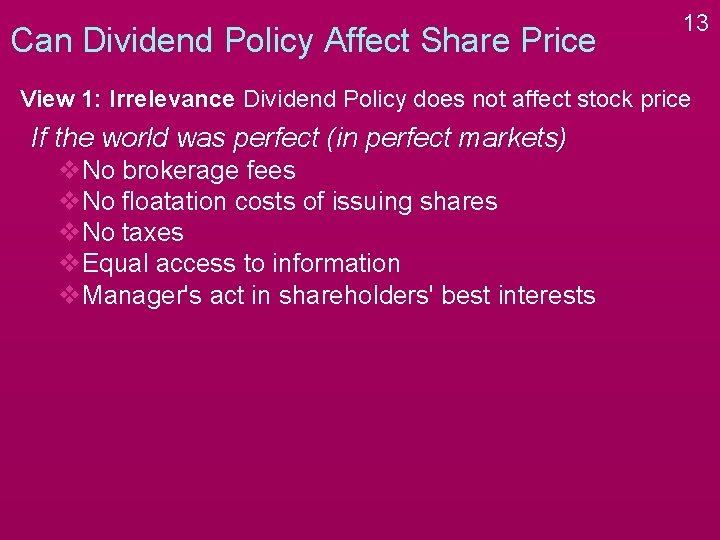
Can Dividend Policy Affect Share Price 13 View 1: Irrelevance Dividend Policy does not affect stock price If the world was perfect (in perfect markets) v. No brokerage fees v. No floatation costs of issuing shares v. No taxes v. Equal access to information v. Manager's act in shareholders' best interests
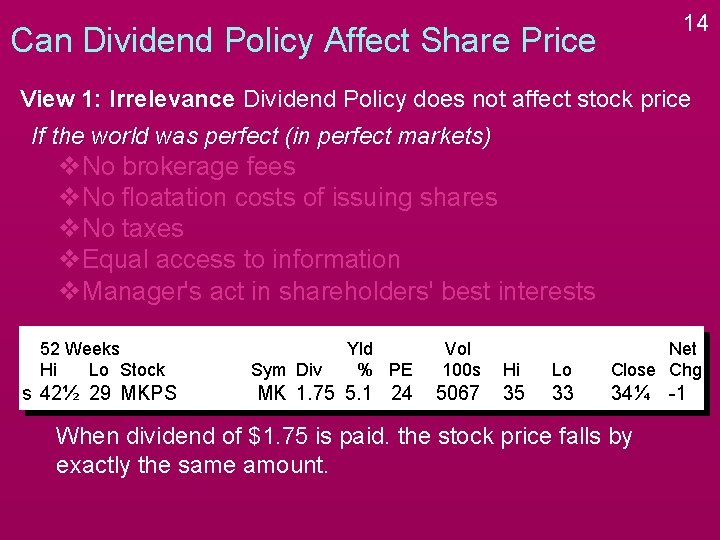
14 Can Dividend Policy Affect Share Price View 1: Irrelevance Dividend Policy does not affect stock price If the world was perfect (in perfect markets) v. No brokerage fees v. No floatation costs of issuing shares v. No taxes v. Equal access to information v. Manager's act in shareholders' best interests 52 Weeks Hi Lo Stock s 42½ 29 MKPS Yld % PE Vol 100 s Hi Lo Net Close Chg MK 1. 75 5. 1 24 5067 35 33 34¼ -1 Sym Div When dividend of $1. 75 is paid. the stock price falls by exactly the same amount.
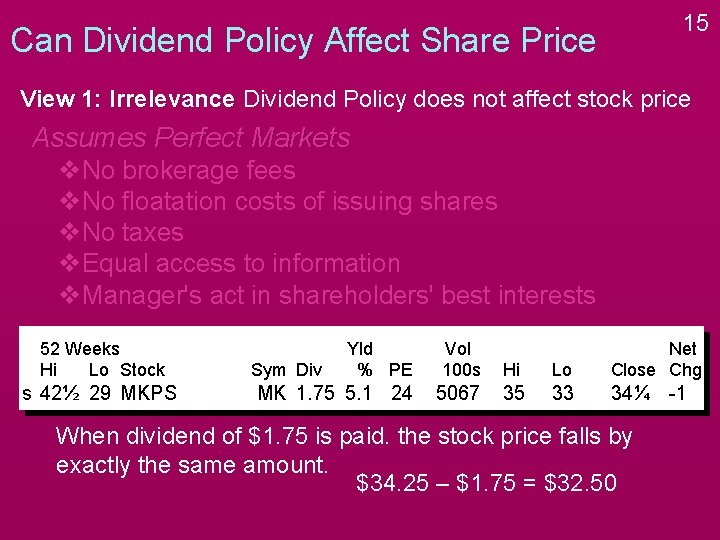
15 Can Dividend Policy Affect Share Price View 1: Irrelevance Dividend Policy does not affect stock price Assumes Perfect Markets v. No brokerage fees v. No floatation costs of issuing shares v. No taxes v. Equal access to information v. Manager's act in shareholders' best interests 52 Weeks Hi Lo Stock s 42½ 29 MKPS Yld % PE Vol 100 s Hi Lo Net Close Chg MK 1. 75 5. 1 24 5067 35 33 34¼ -1 Sym Div When dividend of $1. 75 is paid. the stock price falls by exactly the same amount. $34. 25 – $1. 75 = $32. 50
Can Dividend Policy Affect Share Price 16 View 1: Irrelevance Dividend Policy does not affect stock price If the world was perfect (in perfect markets) v. No brokerage fees v. No floatation costs of issuing shares v. No taxes v. Equal access to information v. Manager's act in shareholders' best interests Dividends are Irrelevant Since: v. No net gain to investor
Can Dividend Policy Affect Share Price 17 View 1: Irrelevance Dividend Policy does not affect stock price Assumes Perfect Markets v. No brokerage fees v. No floatation costs of issuing shares v. No taxes v. Equal access to information v. Manager's act in shareholders' best interests Dividends are Irrelevant Since: v. No net gain to investor v. Without receiving dividend, an investor can sell shares of stock costlessly and create their own "dividend"
Can Dividend Policy Affect Share Price 18 View 1: Irrelevance Dividend Policy does not affect stock price Assumes Perfect Markets v. No brokerage fees v. No floatation costs of issuing shares v. No taxes v. Equal access to information v. Manager's act in shareholders' best interests Dividends are Irrelevant Since: v. No net gain to investor v. Without receiving dividend, an investor can sell shares of stock costlessly and create their own "dividend" v. If the firm pays a large dividend, but needs cash to invest can sell additional shares of stock costlessly.
Can Dividend Policy Affect Share Price View 2: High Dividends Increase Stock Value Theory states: v. Dividends are more predicable that capital gains, so investors prefer dividends--"Bird in the Hand theory” 19
Can Dividend Policy Affect Share Price View 2: High Dividends Increase Stock Value Theory states: v. Dividends are more predicable that capital gains, so investors prefer dividends--"Bird in the Hand theory" v. To be indifferent, investors will require a higher rate on capital gains than dividends 20
Can Dividend Policy Affect Share Price View 2: High Dividends Increase Stock Value Theory states: v. Dividends are more predicable that capital gains, so investors prefer dividends-- "Bird in the Hand theory” v. To be indifferent, investors will require a higher rate on capital gains than dividends v. Critics of this theory v. Point out cash flows of overall firm are not affected by dividends v. If investors want cash, they should leave money in a bank account 21
Can Dividend Policy Affect Share Price View 3: Low Dividends Increase Stock Value Based on Tax Effects: v. Individual investors must pay taxes on dividends as the dividends are received 23
Can Dividend Policy Affect Share Price View 3: Low Dividends Increase Stock Value Based on Tax Effects: v. Individual investors must pay taxes on dividends as the dividends are received v. Individual investors can defer taxes on capital gains until they sell the stock Before 1987, Capital Gains were taxed at a lower rate than dividends. Once again, capital gain taxes are lower than current income taxes today. 24
Can Dividend Policy Affect Share Price View 3: Low Dividends Increase Stock Value Based on Tax Effects: v. Individual investors must pay taxes on dividends as the dividends are received v. Individual investors can defer taxes on capital gains until they sell the stock. v. However, corporations may exclude 70% of dividends from corporate income taxes, so they may actually prefer a higher level of dividends 25
Can Dividend Policy Affect Share Price View 3: Low Dividends Increase Stock Value Based on Tax Effects: v. Individual investors must pay taxes on dividends as the dividends are received v. Individual investors can defer taxes on capital gains until they sell the stock v. However, corporations may exclude 70% of dividends from corporate income taxes, so they may actually prefer a higher level of dividends v. Investors prefer the dividend policy that gives the highest after-tax return 26
Residual Dividend Theory Recognizes that floatation costs are involved in issuing new stock are very high 27
Residual Dividend Theory Recognizes that floatation costs are involved in issuing new stock are very high Companies with investment opportunities which require capital would prefer to use internal funds rather than issue new stock 28
Residual Dividend Theory 29 Recognizes that floatation costs are involved in issuing new stock are very high Companies with investment opportunities which require capital would prefer to use internal funds rather than issue new stock Residual Dividend Method v. Accept all investments with positive net present values
Residual Dividend Theory 30 Recognizes that floatation costs are involved in issuing new stock are very high Companies with investment opportunities which require capital would prefer to use internal funds rather than issue new stock Residual Dividend Method v. Accept all investments with positive net present values v. Use retained earnings to finance investments to the extent possible
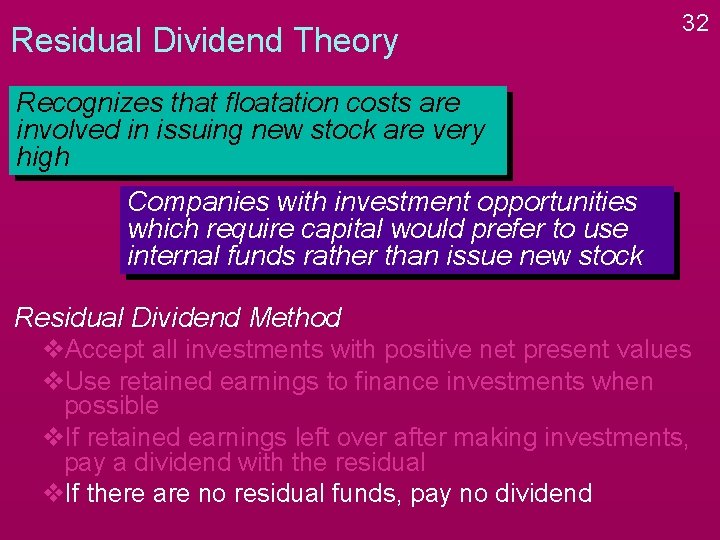
Residual Dividend Theory 31 Recognizes that floatation costs are involved in issuing new stock are very high Companies with investment opportunities which require capital would prefer to use internal funds rather than issue new stock Residual Dividend Method v. Accept all investments with positive net present values v. Use retained earnings to finance investments to the extent possible v. If earnings left over after making investments, pay a dividend with the residual
Residual Dividend Theory 32 Recognizes that floatation costs are involved in issuing new stock are very high Companies with investment opportunities which require capital would prefer to use internal funds rather than issue new stock Residual Dividend Method v. Accept all investments with positive net present values v. Use retained earnings to finance investments when possible v. If retained earnings left over after making investments, pay a dividend with the residual v. If there are no residual funds, pay no dividend
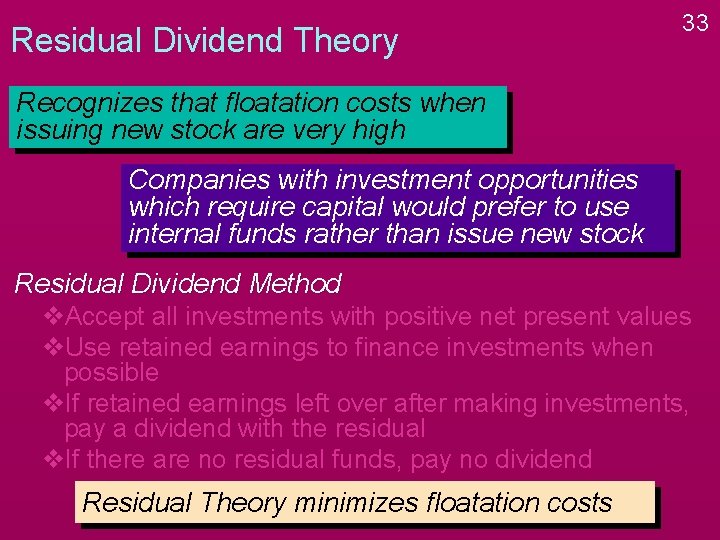
Residual Dividend Theory 33 Recognizes that floatation costs when issuing new stock are very high Companies with investment opportunities which require capital would prefer to use internal funds rather than issue new stock Residual Dividend Method v. Accept all investments with positive net present values v. Use retained earnings to finance investments when possible v. If retained earnings left over after making investments, pay a dividend with the residual v. If there are no residual funds, pay no dividend Residual Theory minimizes floatation costs
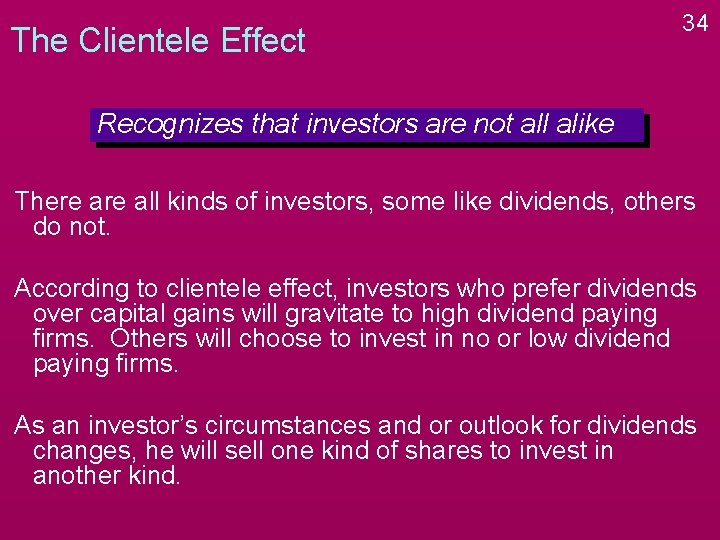
The Clientele Effect 34 Recognizes that investors are not all alike There all kinds of investors, some like dividends, others do not. According to clientele effect, investors who prefer dividends over capital gains will gravitate to high dividend paying firms. Others will choose to invest in no or low dividend paying firms. As an investor’s circumstances and or outlook for dividends changes, he will sell one kind of shares to invest in another kind.
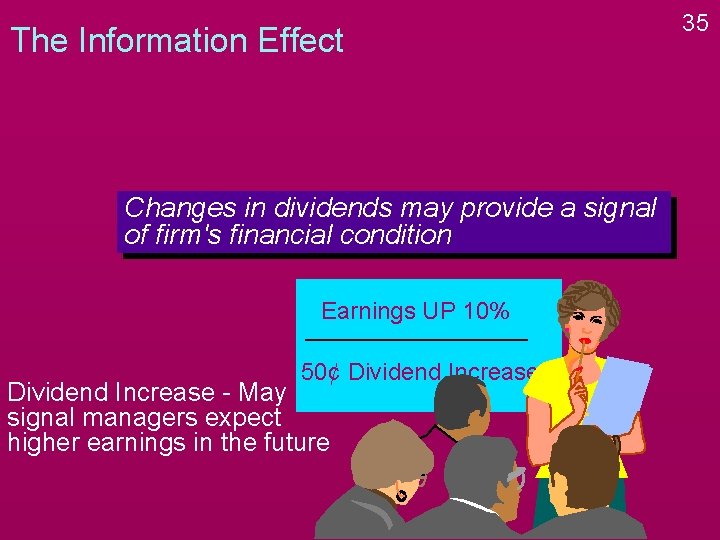
The Information Effect Changes in dividends may provide a signal of firm's financial condition Earnings UP 10% 50¢ Dividend Increase - May signal managers expect higher earnings in the future 35
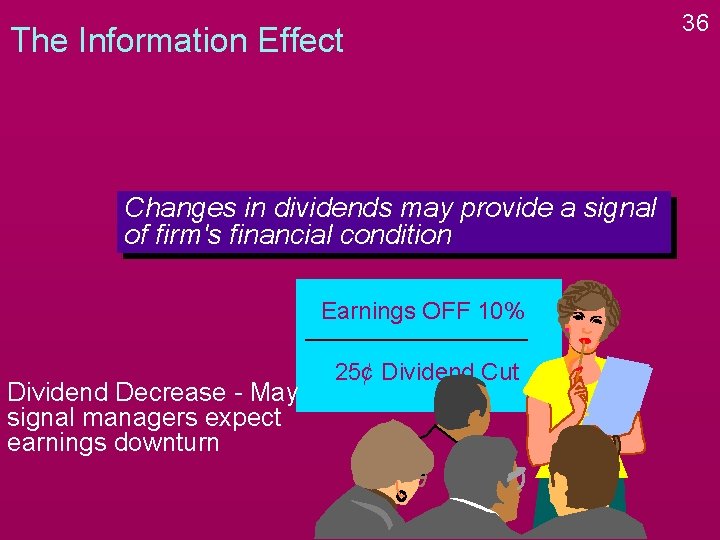
The Information Effect Changes in dividends may provide a signal of firm's financial condition Earnings OFF 10% Dividend Decrease - May signal managers expect earnings downturn 25¢ Dividend Cut 36
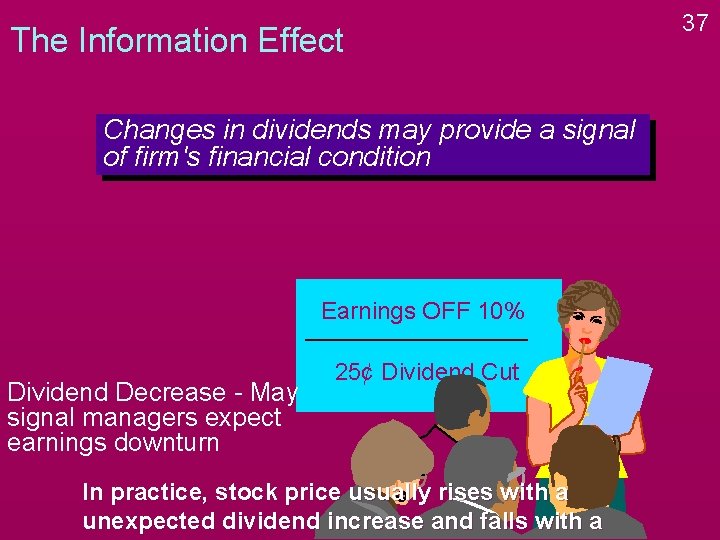
The Information Effect Changes in dividends may provide a signal of firm's financial condition Earnings OFF 10% Dividend Decrease - May signal managers expect earnings downturn 25¢ Dividend Cut In practice, stock price usually rises with a unexpected dividend increase and falls with a 37
Drop Agency Costs 38
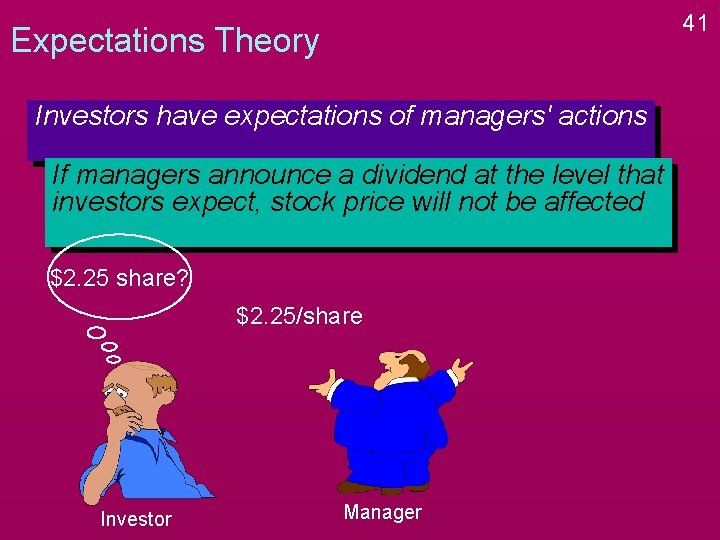
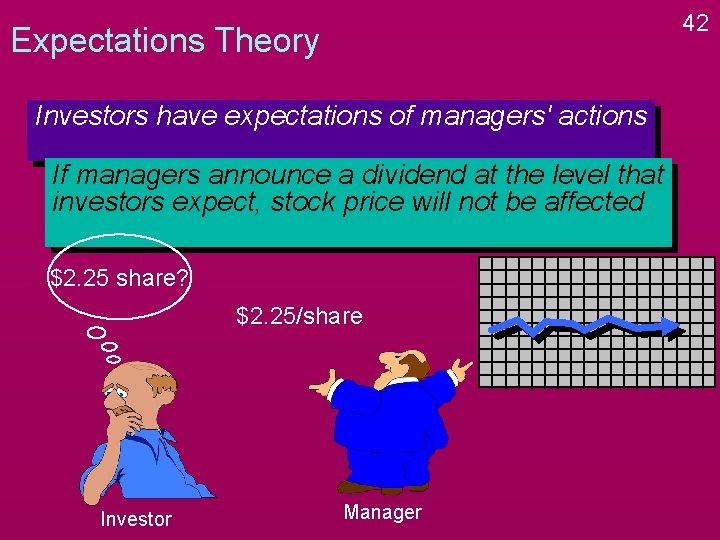
Expectations Theory Investors have expectations of managers' actions If managers announce a dividend at the level that investors expect, stock price will not be affected 40
41 Expectations Theory Investors have expectations of managers' actions If managers announce a dividend at the level that investors expect, stock price will not be affected $2. 25 share? $2. 25/share Investor Manager
42 Expectations Theory Investors have expectations of managers' actions If managers announce a dividend at the level that investors expect, stock price will not be affected $2. 25 share? $2. 25/share Investor Manager
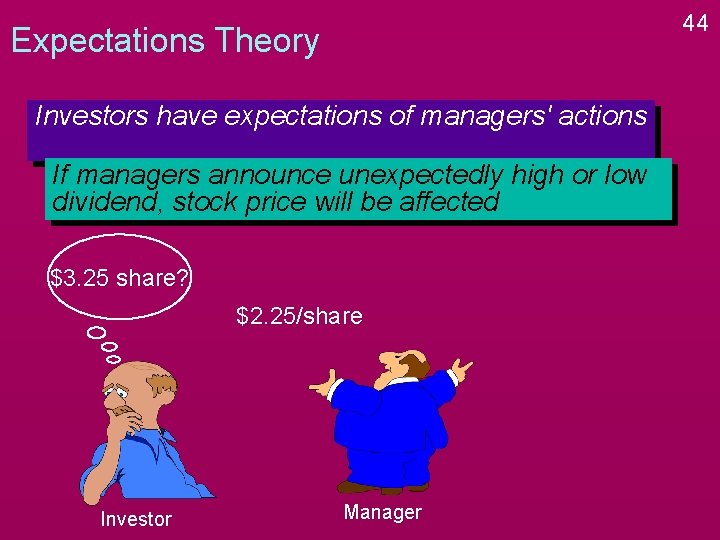
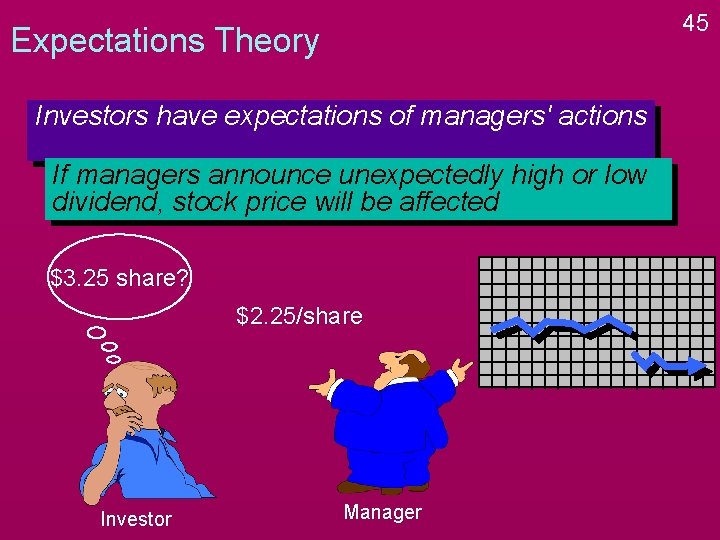
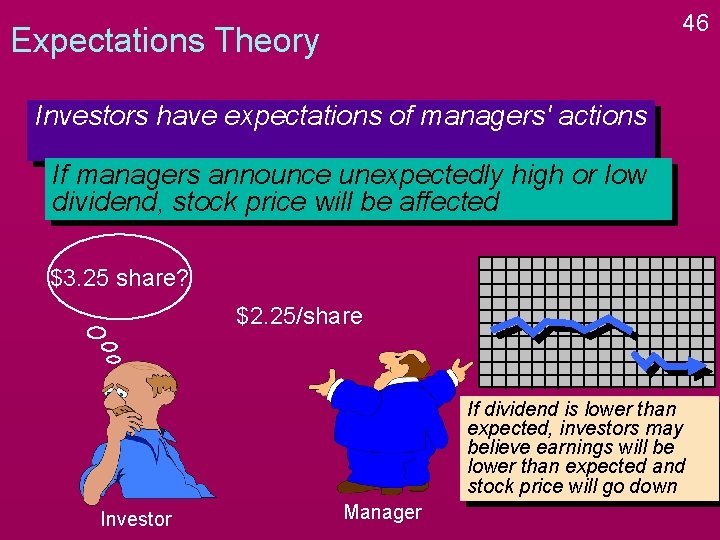
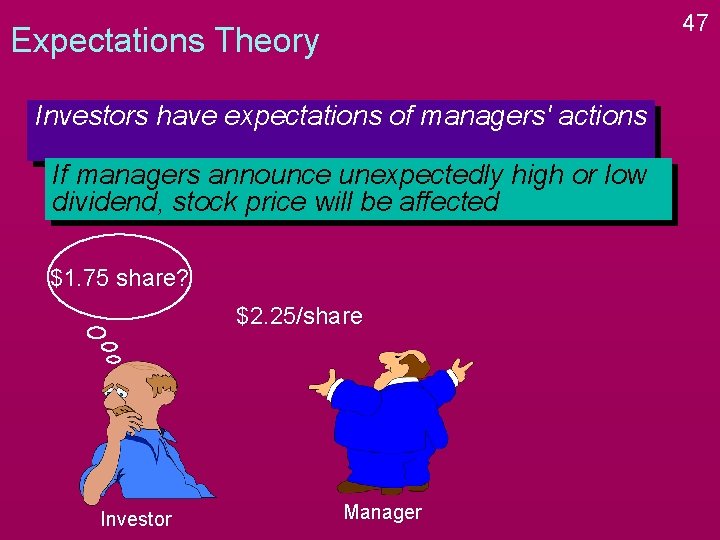
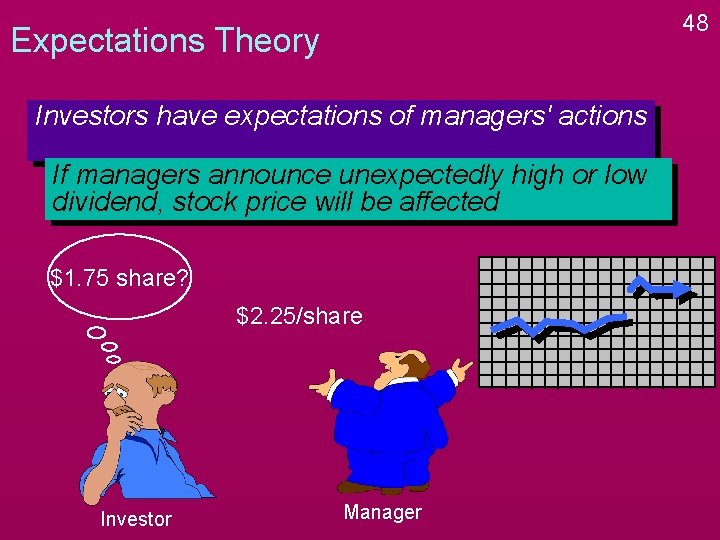
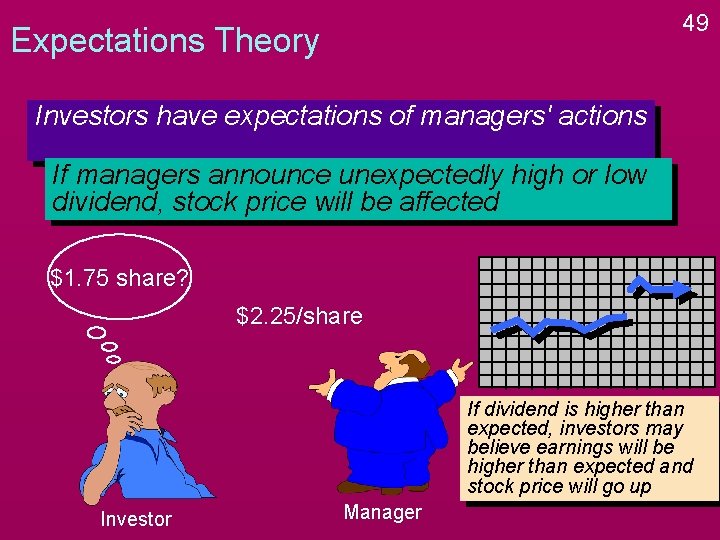
Expectations Theory Investors have expectations of managers' actions If managers announce unexpectedly high or low dividend, stock price will be affected 43
44 Expectations Theory Investors have expectations of managers' actions If managers announce unexpectedly high or low dividend, stock price will be affected $3. 25 share? $2. 25/share Investor Manager
45 Expectations Theory Investors have expectations of managers' actions If managers announce unexpectedly high or low dividend, stock price will be affected $3. 25 share? $2. 25/share Investor Manager
46 Expectations Theory Investors have expectations of managers' actions If managers announce unexpectedly high or low dividend, stock price will be affected $3. 25 share? $2. 25/share If dividend is lower than expected, investors may believe earnings will be lower than expected and stock price will go down Investor Manager
47 Expectations Theory Investors have expectations of managers' actions If managers announce unexpectedly high or low dividend, stock price will be affected $1. 75 share? $2. 25/share Investor Manager
48 Expectations Theory Investors have expectations of managers' actions If managers announce unexpectedly high or low dividend, stock price will be affected $1. 75 share? $2. 25/share Investor Manager
49 Expectations Theory Investors have expectations of managers' actions If managers announce unexpectedly high or low dividend, stock price will be affected $1. 75 share? $2. 25/share If dividend is higher than expected, investors may believe earnings will be higher than expected and stock price will go up Investor Manager
Summary of Dividend Theories u Tests of dividend policy have not found conclusively that dividends affect stock price u The majority of managers believe that dividend policy is important u There are tax disadvantages to paying dividends u Almost all companies pay regular dividends u Dividend Policy is a "puzzle" to academic researchers 50
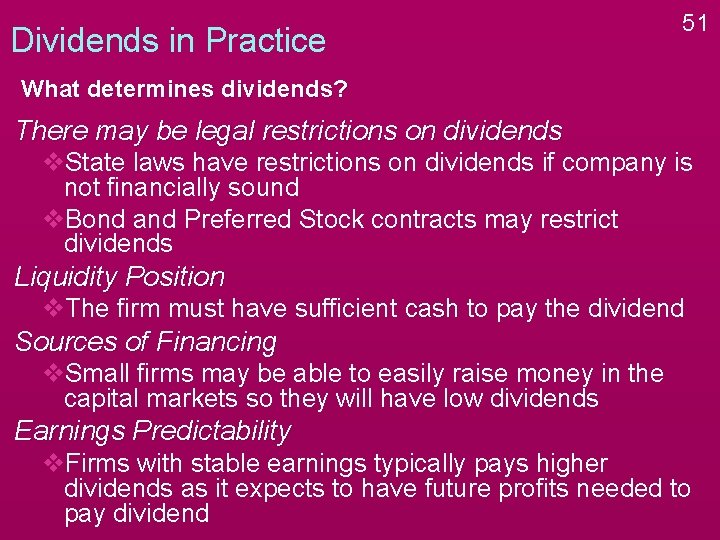
Dividends in Practice 51 What determines dividends? There may be legal restrictions on dividends v. State laws have restrictions on dividends if company is not financially sound v. Bond and Preferred Stock contracts may restrict dividends Liquidity Position v. The firm must have sufficient cash to pay the dividend Sources of Financing v. Small firms may be able to easily raise money in the capital markets so they will have low dividends Earnings Predictability v. Firms with stable earnings typically pays higher dividends as it expects to have future profits needed to pay dividend
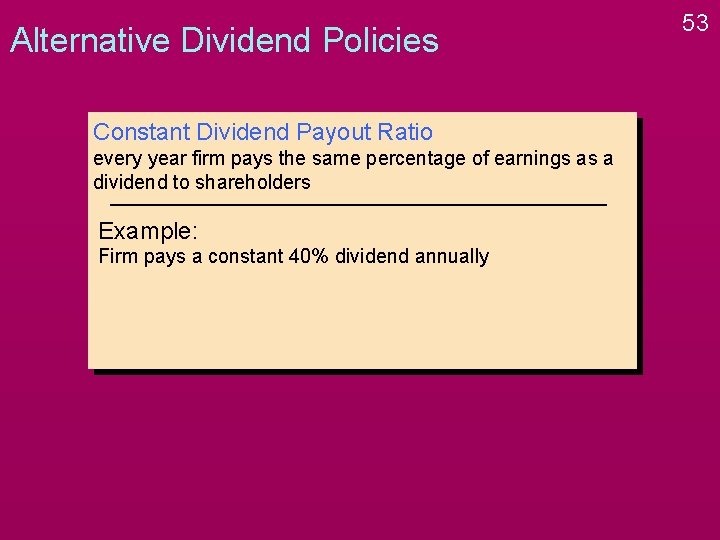
Alternative Dividend Policies Constant Dividend Payout Ratio every year firm pays the same percentage of earnings as a dividend to shareholders 52
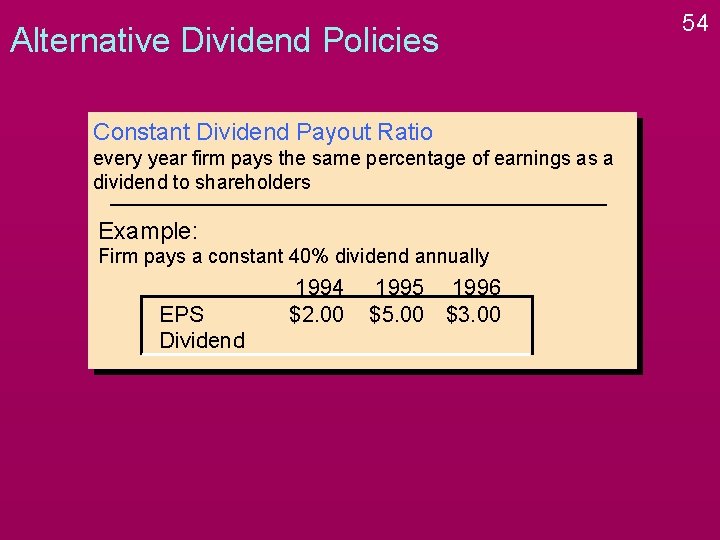
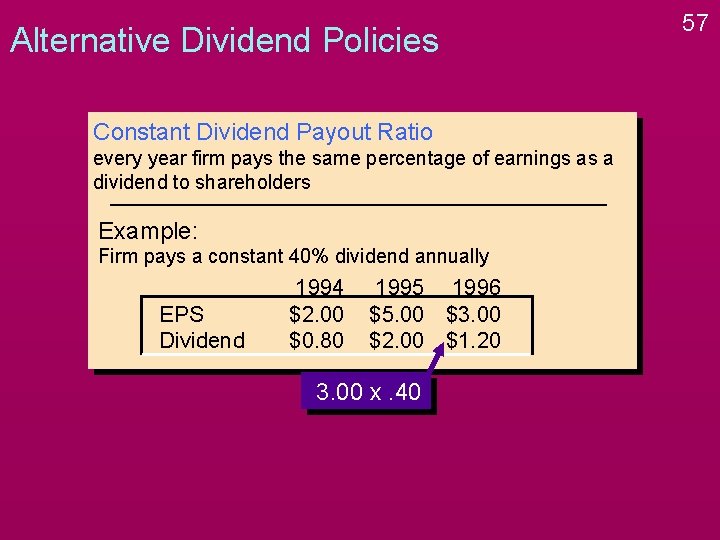
Alternative Dividend Policies Constant Dividend Payout Ratio every year firm pays the same percentage of earnings as a dividend to shareholders Example: Firm pays a constant 40% dividend annually 53
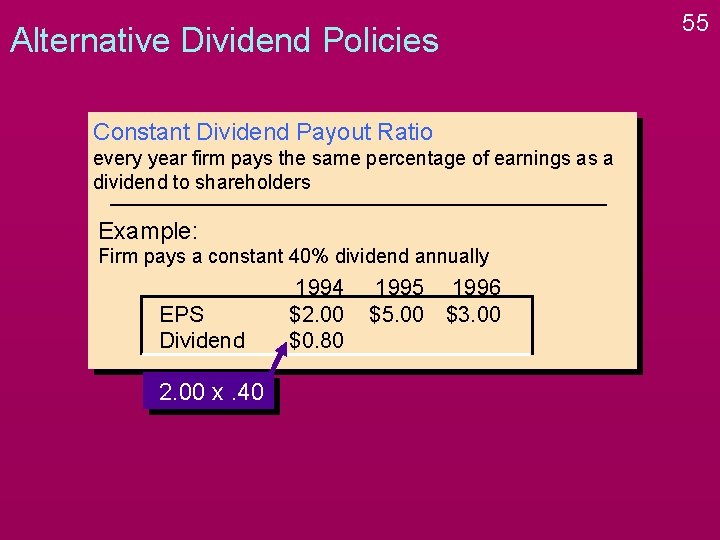
Alternative Dividend Policies Constant Dividend Payout Ratio every year firm pays the same percentage of earnings as a dividend to shareholders Example: Firm pays a constant 40% dividend annually EPS Dividend 1994 $2. 00 1995 1996 $5. 00 $3. 00 54
Alternative Dividend Policies Constant Dividend Payout Ratio every year firm pays the same percentage of earnings as a dividend to shareholders Example: Firm pays a constant 40% dividend annually EPS Dividend 2. 00 x. 40 1994 $2. 00 $0. 80 1995 1996 $5. 00 $3. 00 55
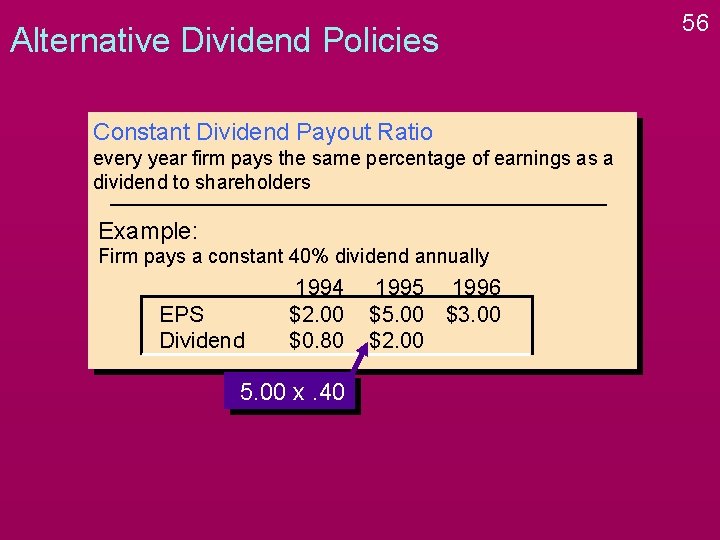
Alternative Dividend Policies Constant Dividend Payout Ratio every year firm pays the same percentage of earnings as a dividend to shareholders Example: Firm pays a constant 40% dividend annually EPS Dividend 1994 $2. 00 $0. 80 5. 00 x. 40 1995 1996 $5. 00 $3. 00 $2. 00 56
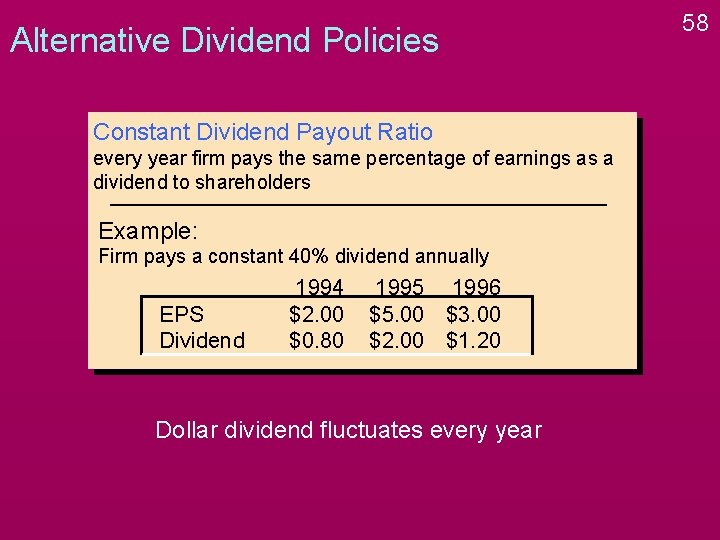
Alternative Dividend Policies Constant Dividend Payout Ratio every year firm pays the same percentage of earnings as a dividend to shareholders Example: Firm pays a constant 40% dividend annually EPS Dividend 1994 $2. 00 $0. 80 1995 1996 $5. 00 $3. 00 $2. 00 $1. 20 3. 00 x. 40 57
Alternative Dividend Policies Constant Dividend Payout Ratio every year firm pays the same percentage of earnings as a dividend to shareholders Example: Firm pays a constant 40% dividend annually EPS Dividend 1994 $2. 00 $0. 80 1995 1996 $5. 00 $3. 00 $2. 00 $1. 20 Dollar dividend fluctuates every year 58
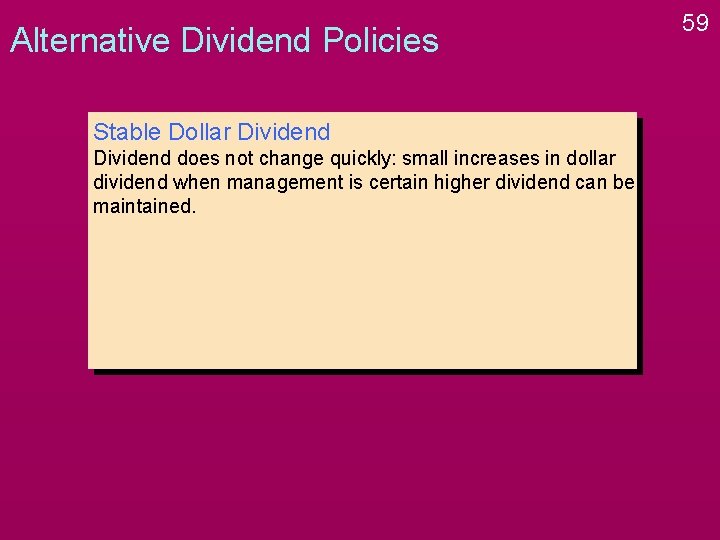
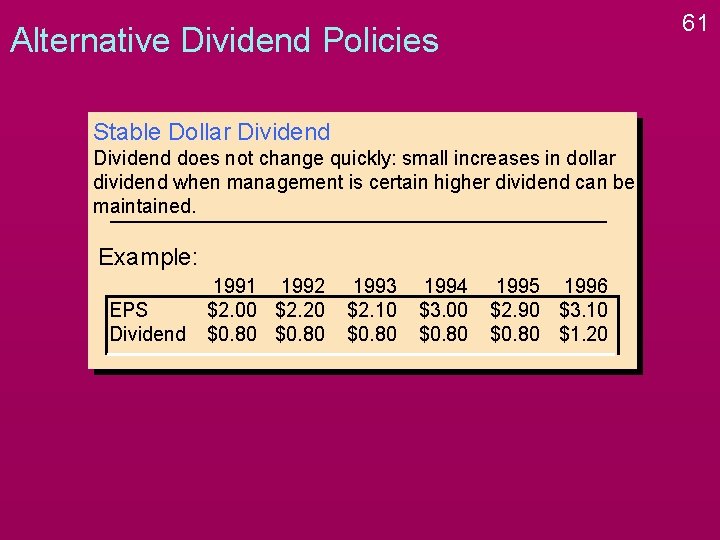
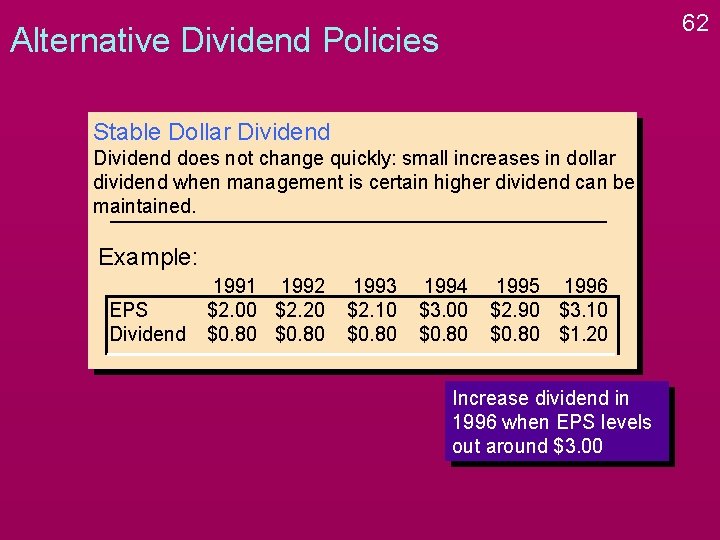
Alternative Dividend Policies Stable Dollar Dividend does not change quickly: small increases in dollar dividend when management is certain higher dividend can be maintained. 59
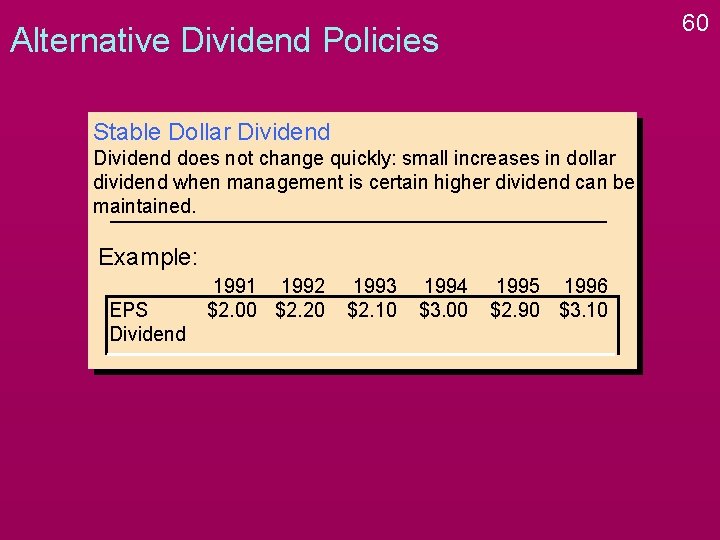
60 Alternative Dividend Policies Stable Dollar Dividend does not change quickly: small increases in dollar dividend when management is certain higher dividend can be maintained. Example: EPS Dividend 1991 1992 $2. 00 $2. 20 1993 $2. 10 1994 $3. 00 1995 1996 $2. 90 $3. 10
61 Alternative Dividend Policies Stable Dollar Dividend does not change quickly: small increases in dollar dividend when management is certain higher dividend can be maintained. Example: EPS Dividend 1991 1992 $2. 00 $2. 20 $0. 80 1993 $2. 10 $0. 80 1994 $3. 00 $0. 80 1995 1996 $2. 90 $3. 10 $0. 80 $1. 20
62 Alternative Dividend Policies Stable Dollar Dividend does not change quickly: small increases in dollar dividend when management is certain higher dividend can be maintained. Example: EPS Dividend 1991 1992 $2. 00 $2. 20 $0. 80 1993 $2. 10 $0. 80 1994 $3. 00 $0. 80 1995 1996 $2. 90 $3. 10 $0. 80 $1. 20 Increase dividend in 1996 when EPS levels out around $3. 00
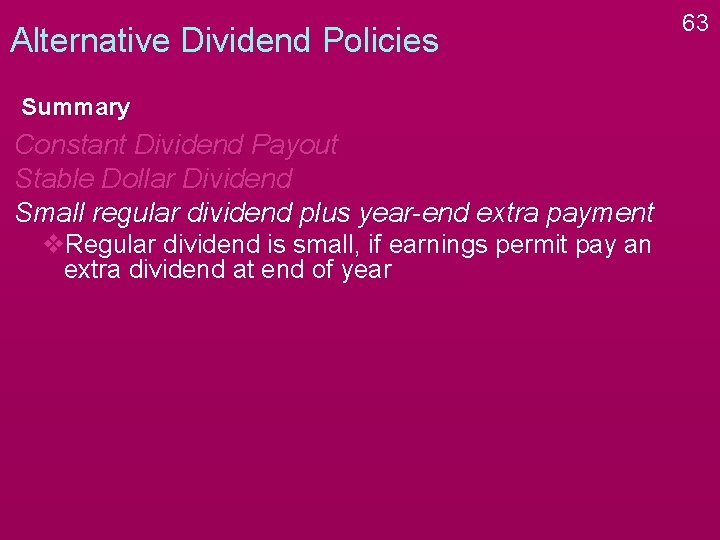
Alternative Dividend Policies Summary Constant Dividend Payout Stable Dollar Dividend Small regular dividend plus year-end extra payment v. Regular dividend is small, if earnings permit pay an extra dividend at end of year 63
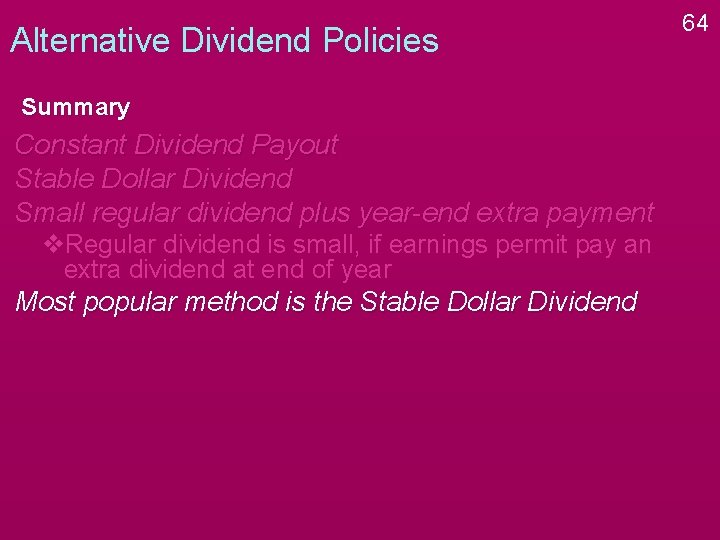
Alternative Dividend Policies Summary Constant Dividend Payout Stable Dollar Dividend Small regular dividend plus year-end extra payment v. Regular dividend is small, if earnings permit pay an extra dividend at end of year Most popular method is the Stable Dollar Dividend 64
Dividend Payment Procedures Dividends are usually paid quarterly 65
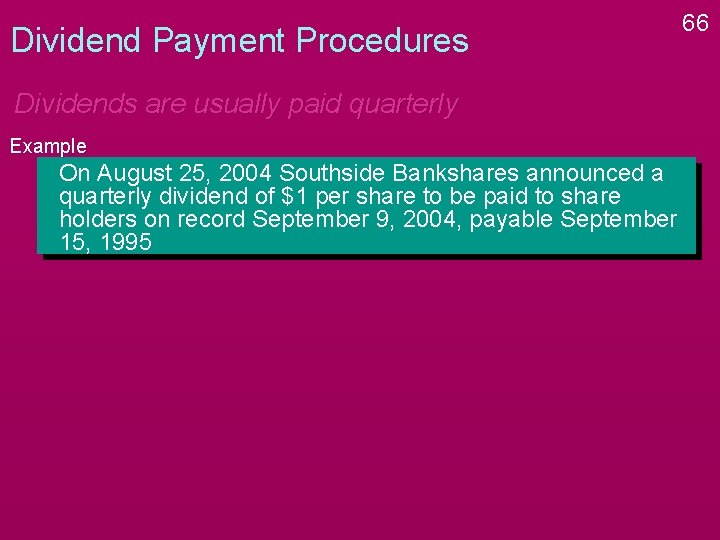
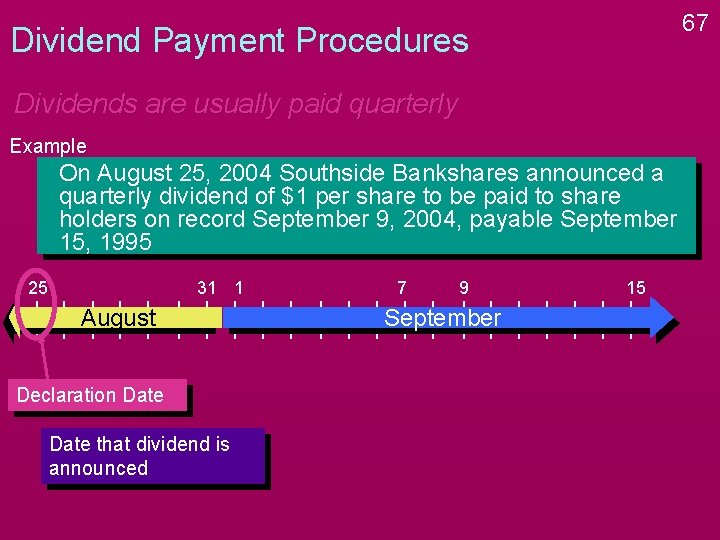
Dividend Payment Procedures Dividends are usually paid quarterly Example On August 25, 2004 Southside Bankshares announced a quarterly dividend of $1 per share to be paid to share holders on record September 9, 2004, payable September 15, 1995 66
67 Dividend Payment Procedures Dividends are usually paid quarterly Example On August 25, 2004 Southside Bankshares announced a quarterly dividend of $1 per share to be paid to share holders on record September 9, 2004, payable September 15, 1995 25 31 1 August Declaration Date that dividend is announced 7 9 September 15
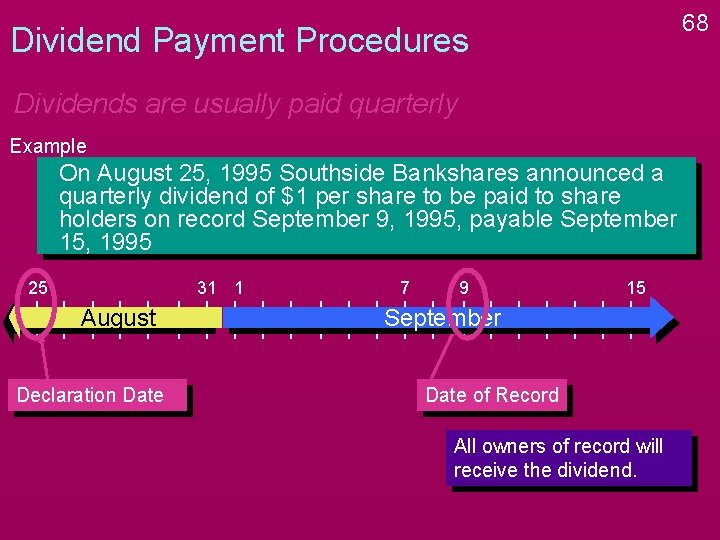
68 Dividend Payment Procedures Dividends are usually paid quarterly Example On August 25, 1995 Southside Bankshares announced a quarterly dividend of $1 per share to be paid to share holders on record September 9, 1995, payable September 15, 1995 25 31 1 August Declaration Date 7 9 15 September Date of Record All owners of record will receive the dividend.
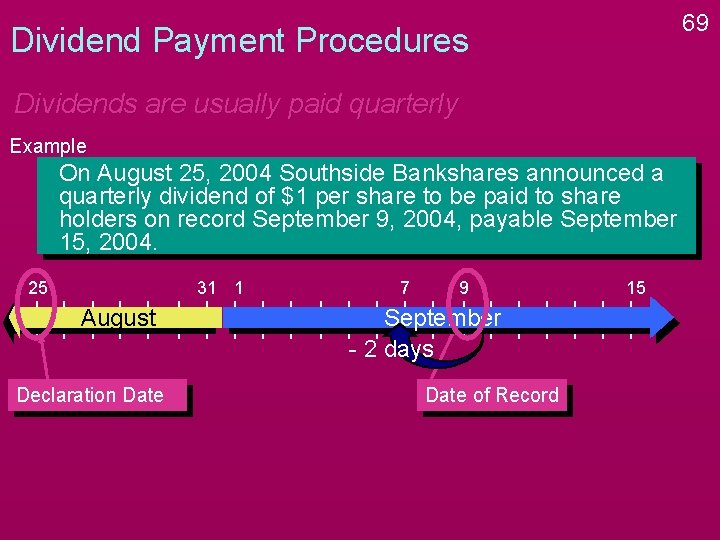
69 Dividend Payment Procedures Dividends are usually paid quarterly Example On August 25, 2004 Southside Bankshares announced a quarterly dividend of $1 per share to be paid to share holders on record September 9, 2004, payable September 15, 2004. 25 31 1 August Declaration Date 7 9 September - 2 days Date of Record 15
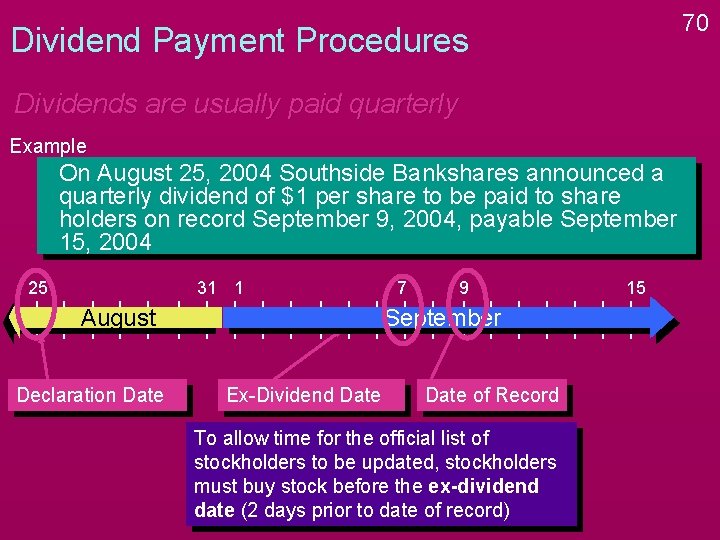
70 Dividend Payment Procedures Dividends are usually paid quarterly Example On August 25, 2004 Southside Bankshares announced a quarterly dividend of $1 per share to be paid to share holders on record September 9, 2004, payable September 15, 2004 25 31 1 August Declaration Date 7 9 September Ex-Dividend Date of Record To allow time for the official list of stockholders to be updated, stockholders must buy stock before the ex-dividend date (2 days prior to date of record) 15
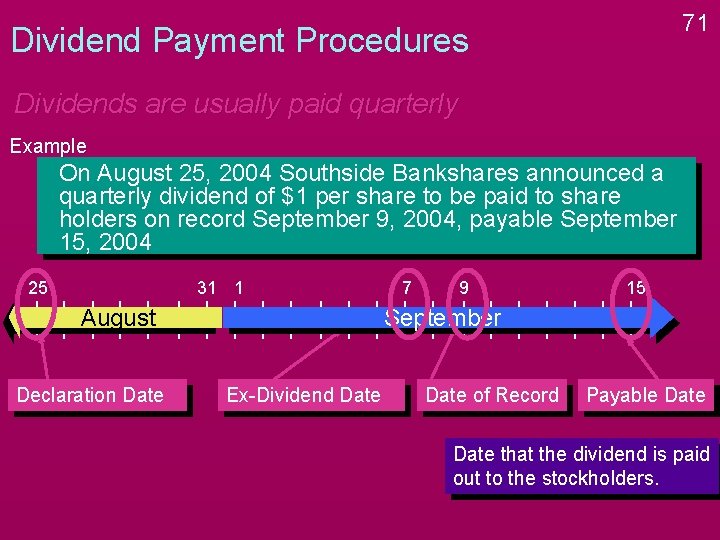
71 Dividend Payment Procedures Dividends are usually paid quarterly Example On August 25, 2004 Southside Bankshares announced a quarterly dividend of $1 per share to be paid to share holders on record September 9, 2004, payable September 15, 2004 25 31 1 August Declaration Date 7 9 15 September Ex-Dividend Date of Record Payable Date that the dividend is paid out to the stockholders.
Stock Dividends and Splits Stock Dividends u Company issues new shares and sends them on a pro rata basis to current shareholders instead of using cash to pay a dividend 72
Stock Dividends and Splits u Company issues new shares and sends them on a pro rata basis to current shareholders instead of using cash to pay a dividend u Number of shares increase, no money is collected or paid by the company 73
Stock Dividends and Splits u Company issues new shares and sends them on a pro rata basis to current shareholders instead of using cash to pay a dividend u Number of shares increase, no money is collected or paid by the company u With a 10% stock dividend, an investor will receive one tenth of a share for every share owned. 74
Stock Dividends and Splits u Company issues new shares and sends them on a pro rata basis to current shareholders instead of using cash to pay a dividend u Number of shares increase, no money is collected or paid by the company u With a 10% stock dividend, an investor will receive one tenth of a share for every share owned. u If company issues more than a 25% stock dividend it is considered a stock split v. Only difference between a stock dividend and stock split is accounting treatment on the balance sheet. v. Neither stock dividends nor stock splits are taxable. 77
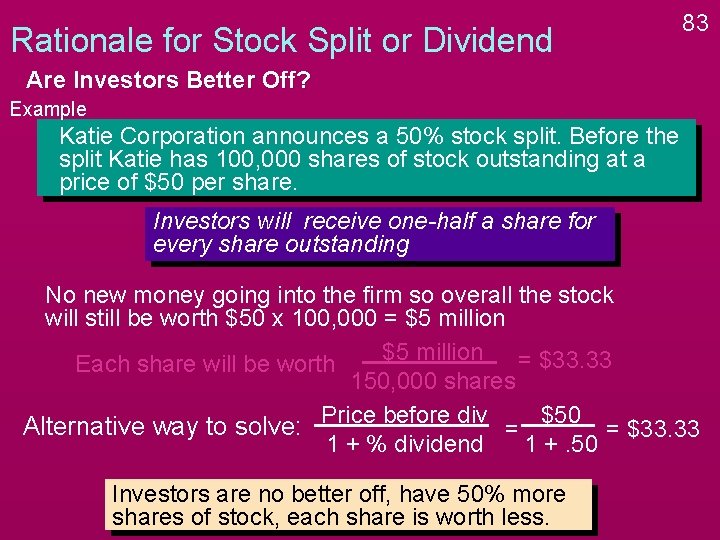
Rationale for Stock Split or Dividend Are Investors Better Off? Example Katie Corporation announces a 50% stock split. Before the split Katie has 100, 000 shares of stock outstanding at a price of $50 per share. 78
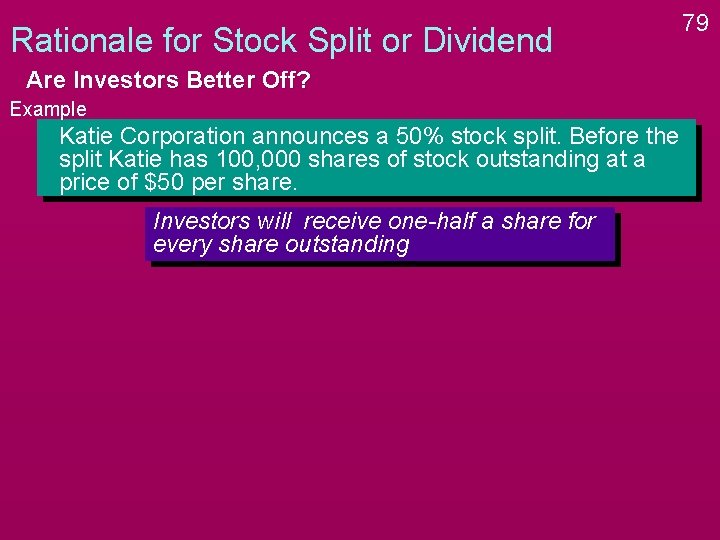
Rationale for Stock Split or Dividend Are Investors Better Off? Example Katie Corporation announces a 50% stock split. Before the split Katie has 100, 000 shares of stock outstanding at a price of $50 per share. Investors will receive one-half a share for every share outstanding 79
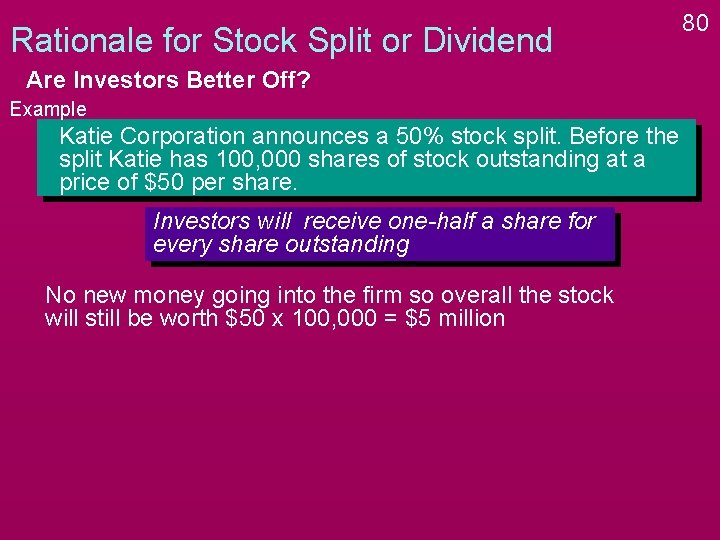
Rationale for Stock Split or Dividend Are Investors Better Off? Example Katie Corporation announces a 50% stock split. Before the split Katie has 100, 000 shares of stock outstanding at a price of $50 per share. Investors will receive one-half a share for every share outstanding No new money going into the firm so overall the stock will still be worth $50 x 100, 000 = $5 million 80
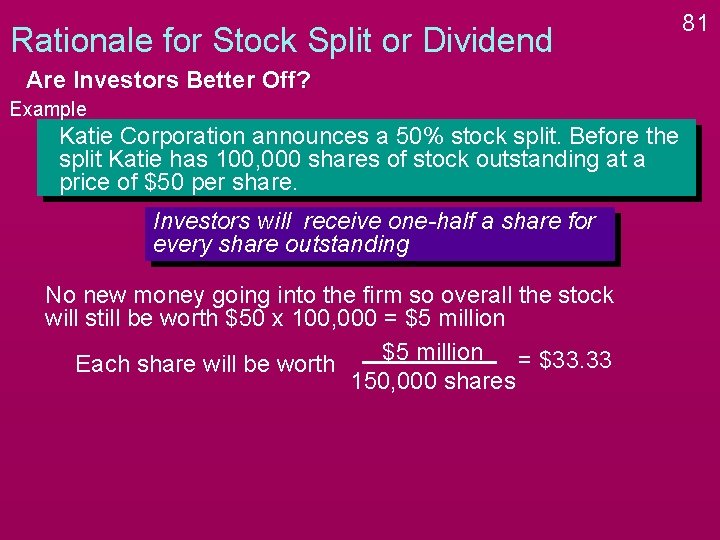
Rationale for Stock Split or Dividend Are Investors Better Off? Example Katie Corporation announces a 50% stock split. Before the split Katie has 100, 000 shares of stock outstanding at a price of $50 per share. Investors will receive one-half a share for every share outstanding No new money going into the firm so overall the stock will still be worth $50 x 100, 000 = $5 million = $33. 33 Each share will be worth 150, 000 shares 81
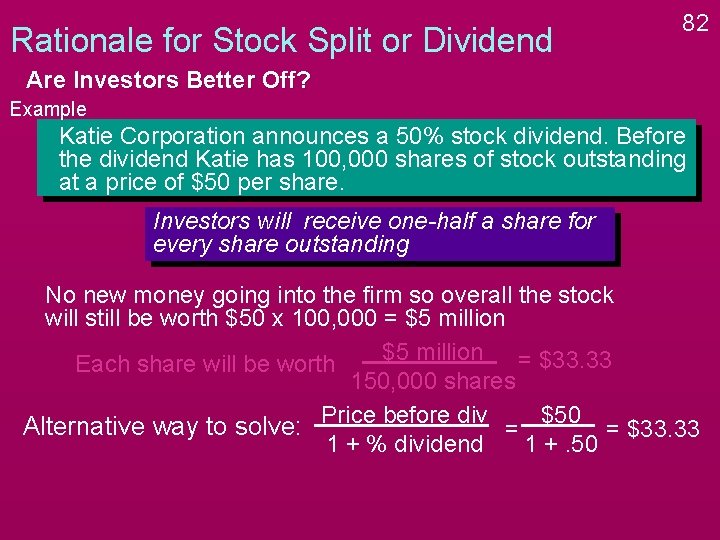
Rationale for Stock Split or Dividend 82 Are Investors Better Off? Example Katie Corporation announces a 50% stock dividend. Before the dividend Katie has 100, 000 shares of stock outstanding at a price of $50 per share. Investors will receive one-half a share for every share outstanding No new money going into the firm so overall the stock will still be worth $50 x 100, 000 = $5 million = $33. 33 Each share will be worth 150, 000 shares Alternative way to solve: Price before div = $50 = $33. 33 1 + % dividend 1 +. 50
Rationale for Stock Split or Dividend 83 Are Investors Better Off? Example Katie Corporation announces a 50% stock split. Before the split Katie has 100, 000 shares of stock outstanding at a price of $50 per share. Investors will receive one-half a share for every share outstanding No new money going into the firm so overall the stock will still be worth $50 x 100, 000 = $5 million = $33. 33 Each share will be worth 150, 000 shares Alternative way to solve: Price before div = $50 = $33. 33 1 + % dividend 1 +. 50 Investors are no better off, have 50% more shares of stock, each share is worth less.
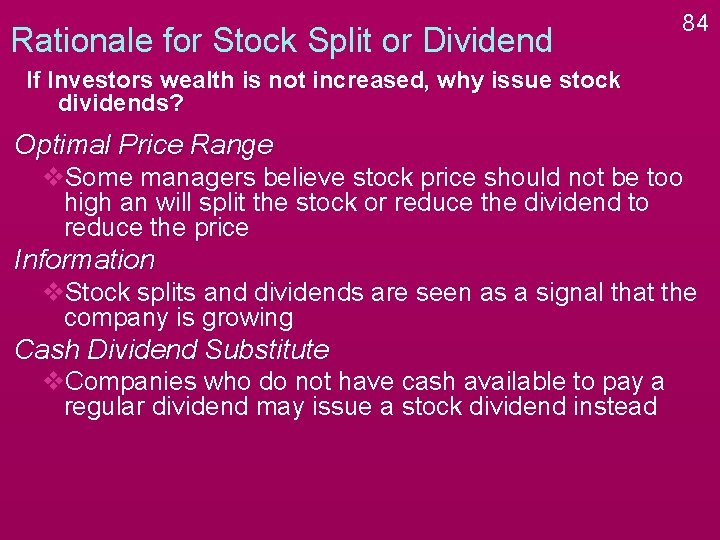
Rationale for Stock Split or Dividend 84 If Investors wealth is not increased, why issue stock dividends? Optimal Price Range v. Some managers believe stock price should not be too high an will split the stock or reduce the dividend to reduce the price Information v. Stock splits and dividends are seen as a signal that the company is growing Cash Dividend Substitute v. Companies who do not have cash available to pay a regular dividend may issue a stock dividend instead
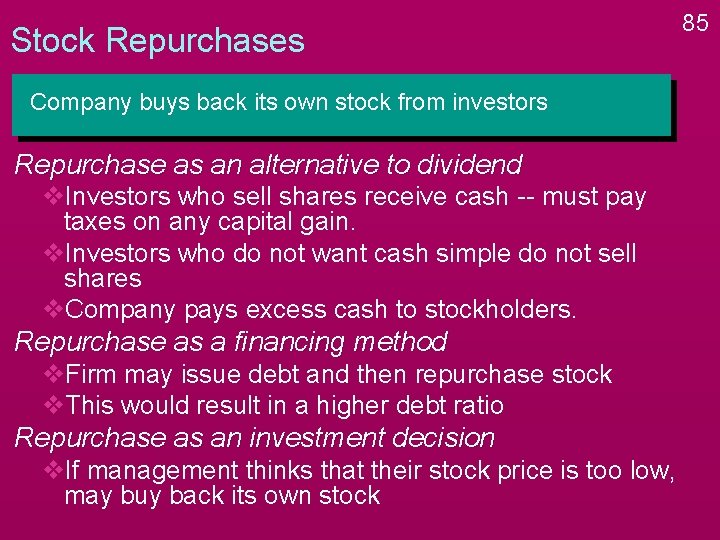
Stock Repurchases Company buys back its own stock from investors Repurchase as an alternative to dividend v. Investors who sell shares receive cash -- must pay taxes on any capital gain. v. Investors who do not want cash simple do not sell shares v. Company pays excess cash to stockholders. Repurchase as a financing method v. Firm may issue debt and then repurchase stock v. This would result in a higher debt ratio Repurchase as an investment decision v. If management thinks that their stock price is too low, may buy back its own stock 85
Stock Repurchase Procedure Market Purchase v. Firm buys its own shares through a broker at the market price. 86
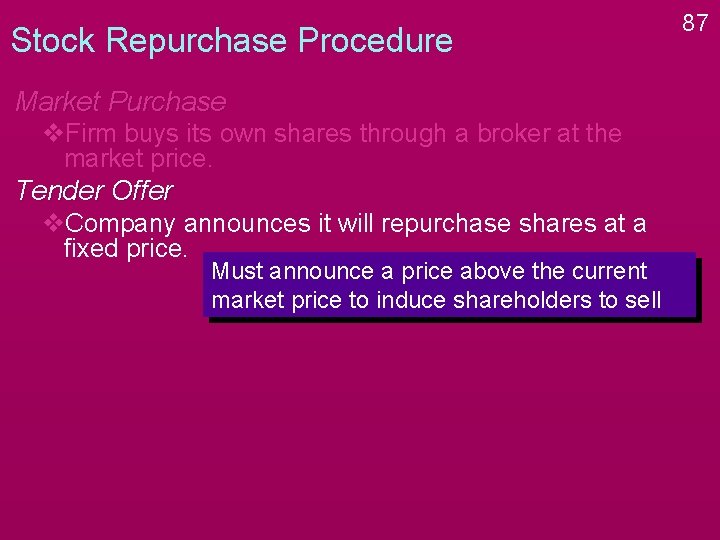
Stock Repurchase Procedure Market Purchase v. Firm buys its own shares through a broker at the market price. Tender Offer v. Company announces it will repurchase shares at a fixed price. Must announce a price above the current market price to induce shareholders to sell 87
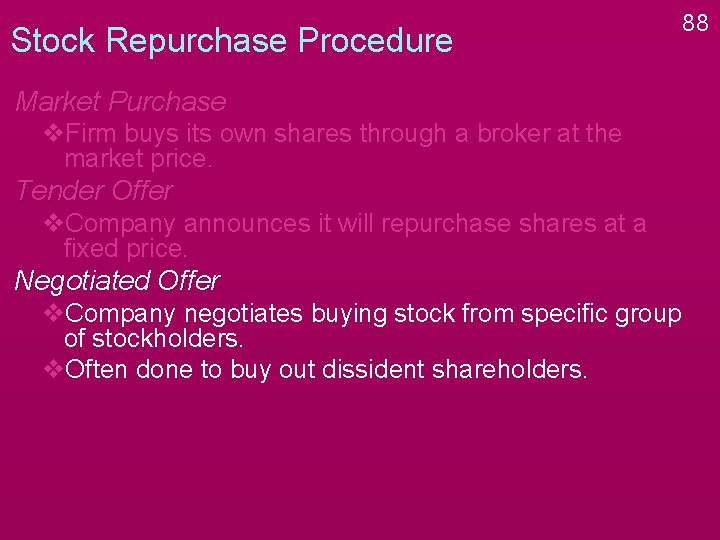
Stock Repurchase Procedure Market Purchase v. Firm buys its own shares through a broker at the market price. Tender Offer v. Company announces it will repurchase shares at a fixed price. Negotiated Offer v. Company negotiates buying stock from specific group of stockholders. v. Often done to buy out dissident shareholders. 88
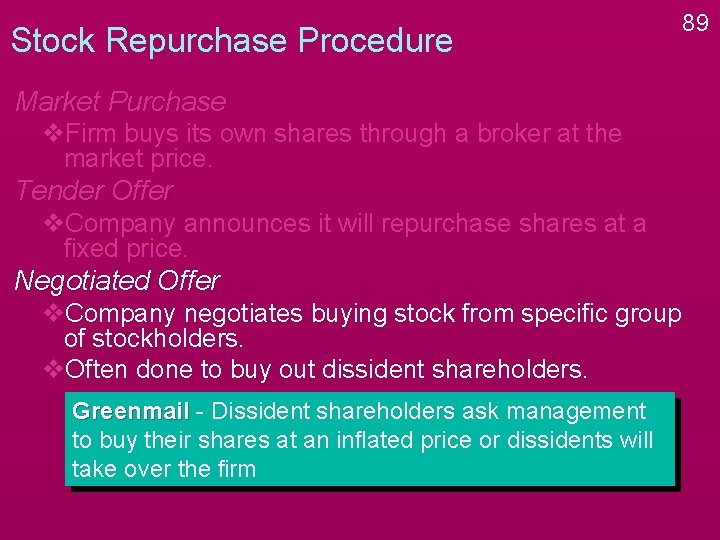
Stock Repurchase Procedure Market Purchase v. Firm buys its own shares through a broker at the market price. Tender Offer v. Company announces it will repurchase shares at a fixed price. Negotiated Offer v. Company negotiates buying stock from specific group of stockholders. v. Often done to buy out dissident shareholders. Greenmail - Dissident shareholders ask management to buy their shares at an inflated price or dissidents will take over the firm 89
90