1 Chapter Managers and Management Copyright 2011 Pearson



- Slides: 34
1 Chapter Managers and Management Copyright © 2011 Pearson Education
Learning Outcomes Tell who managers are and where they work Define management Describe what managers do Explain why it’s important to study management • Describe the factors that are reshaping and redefining management • • Copyright © 2011 Pearson Education 1 -2
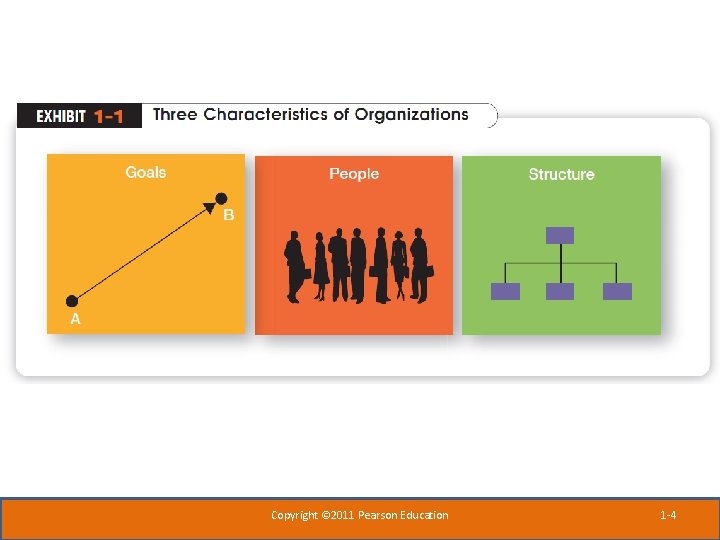
Who Are Managers? Where Do They Work? • Organization – A deliberate arrangement of people brought together to accomplish some are deliberate arrangements of people to accomplish a specific purpose. • Common Characteristics of Organizations – Distinct purpose – People working together – A deliberate systematic structure Copyright © 2011 Pearson Education 1 -3
Copyright © 2011 Pearson Education 1 -4
How Are Managers Different from Nonmanagerial Employees? • Nonmanagerial Employees – People who work directly on a job or task and have no responsibility for overseeing the work of others. – Examples, associates, team members • Managers – Individuals in organizations who direct the activities of others. Copyright © 2011 Pearson Education 1 -5
Copyright © 2011 Pearson Education 1 -6
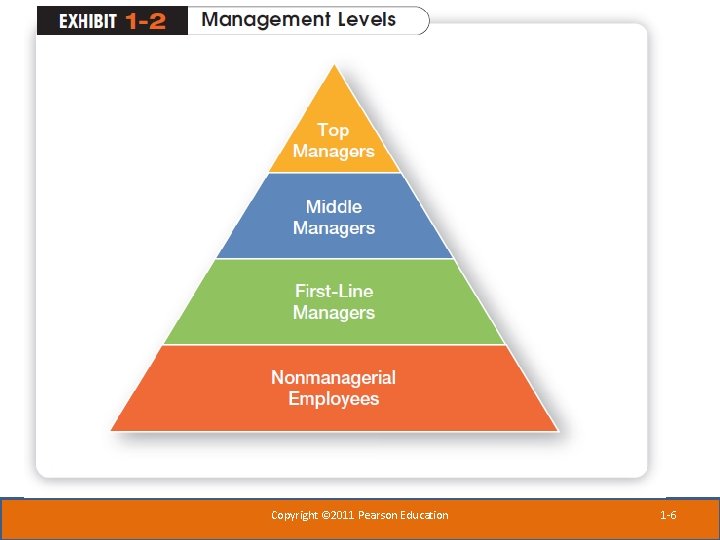
What Titles Do Managers Have? • Top Managers – Responsible for making decisions about the direction of the organization. – Examples; President, Chief Executive Officer, Vice. President • Middle Managers – Manage the activities of other managers. – Examples; District Manager, Division Manager • First-line Managers – Responsible for directing nonmanagerial employees – Examples; Supervisor, Team Leader Copyright © 2011 Pearson Education 1 -7
What Is Management? • Management – The process of getting things done effectively and efficiently, with and through people • Effectiveness – “Doing the right things”, doing those tasks that help an organization reach its goals • Efficiency – Concerned with the means, efficient use of resources like people, money, and equipment Copyright © 2011 Pearson Education 1 -8
Copyright © 2011 Pearson Education 1 -9
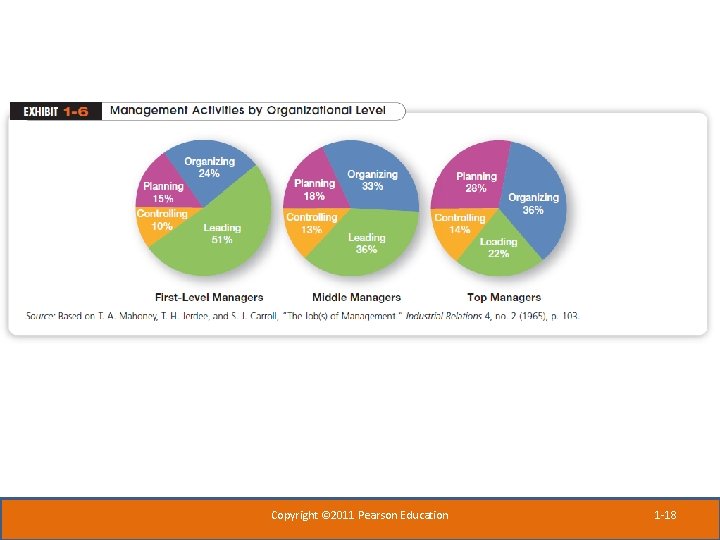
What Do Managers Do? In the functions approach proposed by French industrialist Henri Fayol, all managers perform certain activities or functions Copyright © 2011 Pearson Education 1 -10
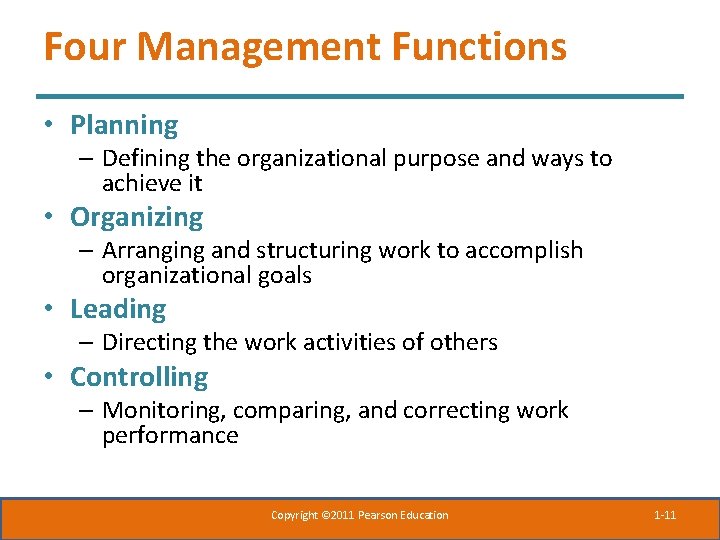
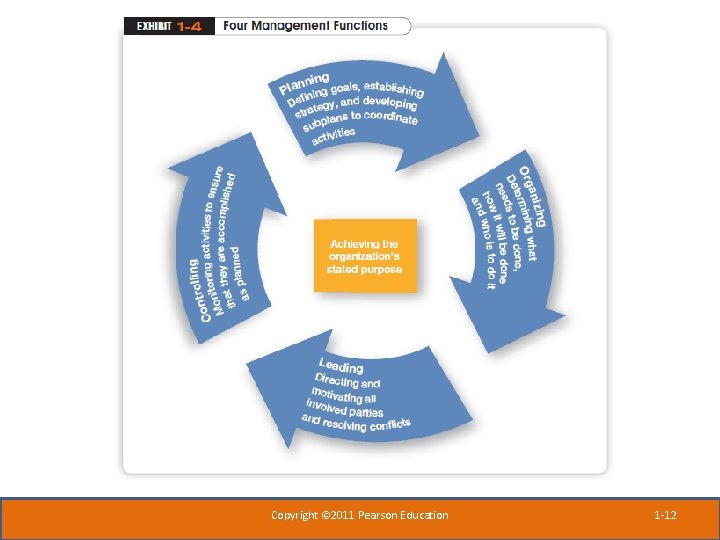
Four Management Functions • Planning – Defining the organizational purpose and ways to achieve it • Organizing – Arranging and structuring work to accomplish organizational goals • Leading – Directing the work activities of others • Controlling – Monitoring, comparing, and correcting work performance Copyright © 2011 Pearson Education 1 -11
Copyright © 2011 Pearson Education 1 -12
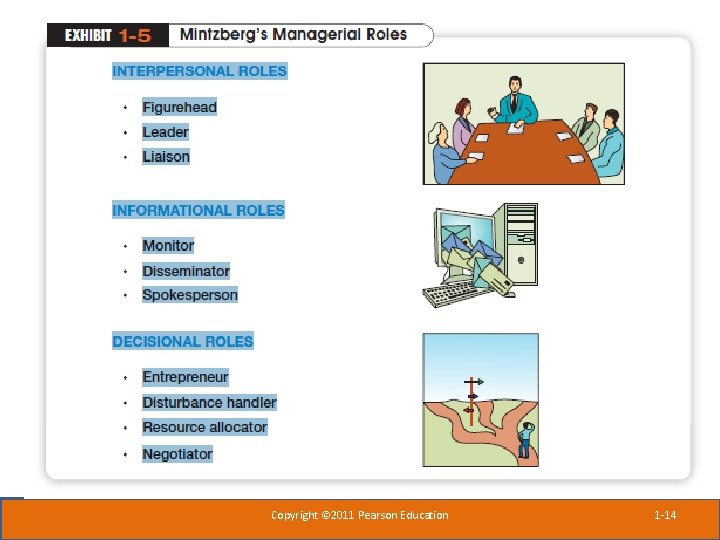
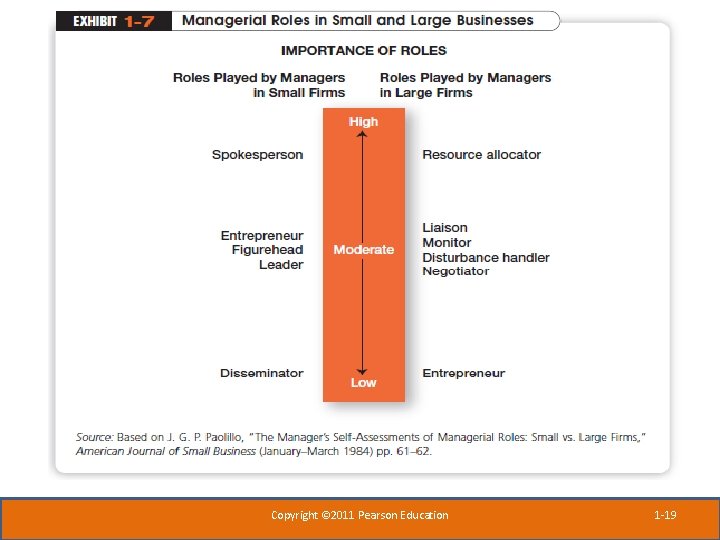
What Roles Do Managers Play? Henry Mintzberg observed that a manager’s job can be described by ten roles performed by managers in three general categories • Interpersonal Roles – Figurehead, Leader, and Liaison • Informational Roles – Monitor, Disseminator and Spokesperson • Decisional roles – Entrepreneur, Disturbance Handler, Resource Allocator and Negotiator Copyright © 2011 Pearson Education 1 -13
Copyright © 2011 Pearson Education 1 -14
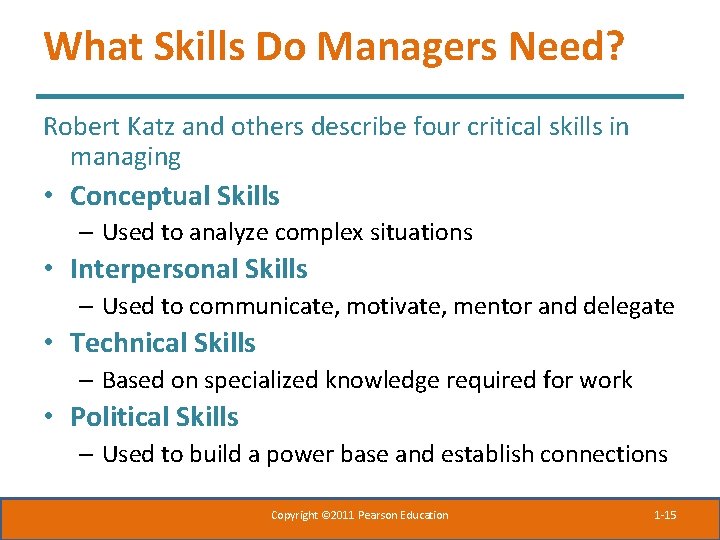
What Skills Do Managers Need? Robert Katz and others describe four critical skills in managing • Conceptual Skills – Used to analyze complex situations • Interpersonal Skills – Used to communicate, motivate, mentor and delegate • Technical Skills – Based on specialized knowledge required for work • Political Skills – Used to build a power base and establish connections Copyright © 2011 Pearson Education 1 -15
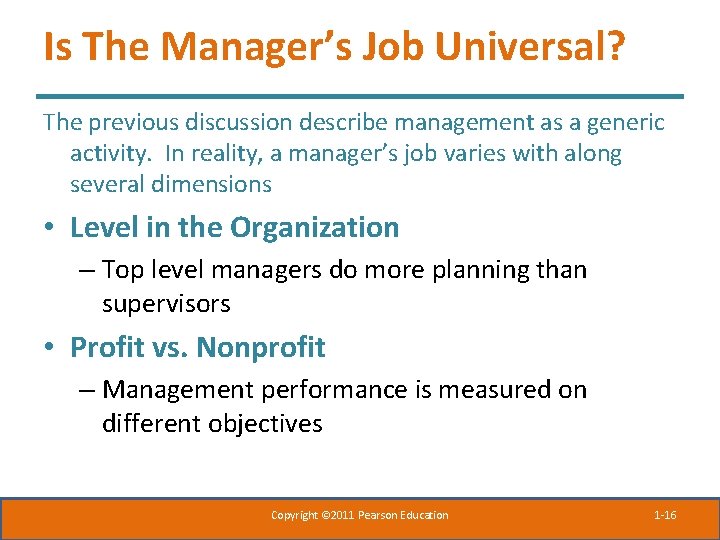
Is The Manager’s Job Universal? The previous discussion describe management as a generic activity. In reality, a manager’s job varies with along several dimensions • Level in the Organization – Top level managers do more planning than supervisors • Profit vs. Nonprofit – Management performance is measured on different objectives Copyright © 2011 Pearson Education 1 -16
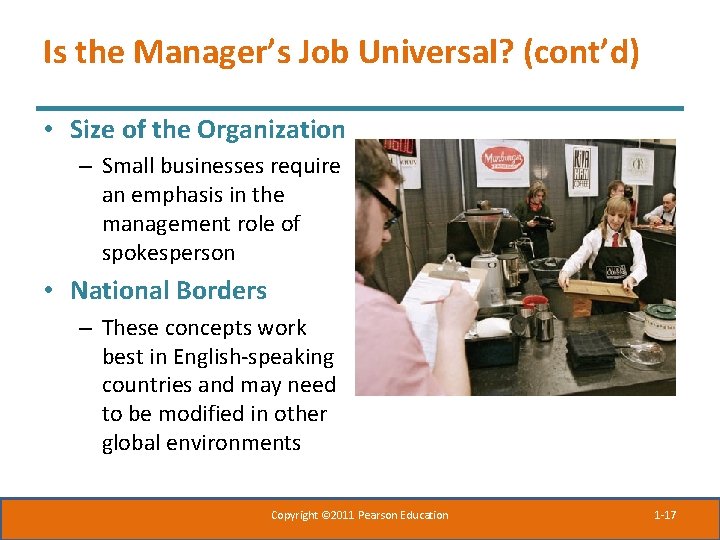
Is the Manager’s Job Universal? (cont’d) • Size of the Organization – Small businesses require an emphasis in the management role of spokesperson • National Borders – These concepts work best in English-speaking countries and may need to be modified in other global environments Copyright © 2011 Pearson Education 1 -17
Copyright © 2011 Pearson Education 1 -18
Copyright © 2011 Pearson Education 1 -19
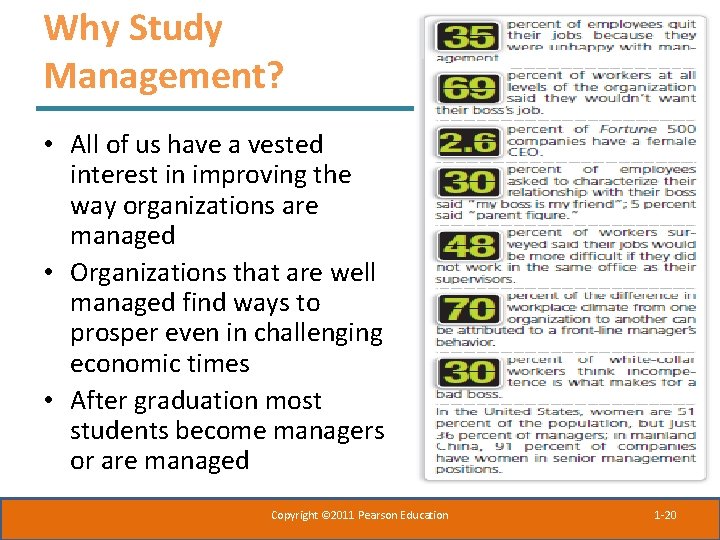
Why Study Management? • All of us have a vested interest in improving the way organizations are managed • Organizations that are well managed find ways to prosper even in challenging economic times • After graduation most students become managers or are managed Copyright © 2011 Pearson Education 1 -20
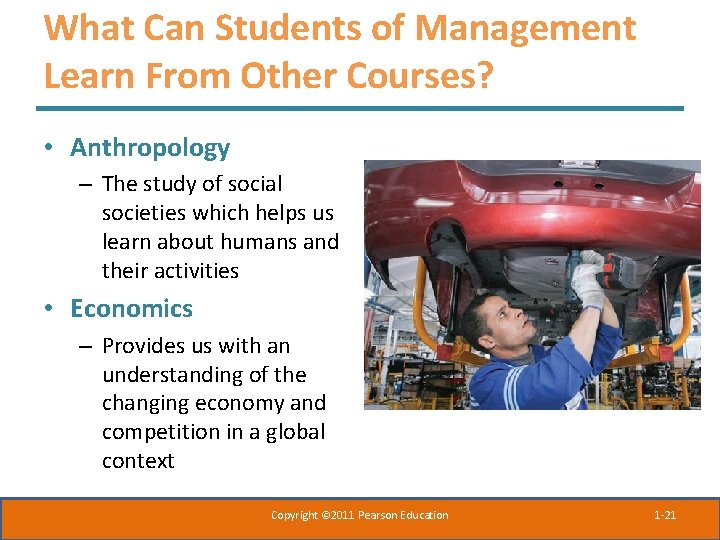
What Can Students of Management Learn From Other Courses? • Anthropology – The study of social societies which helps us learn about humans and their activities • Economics – Provides us with an understanding of the changing economy and competition in a global context Copyright © 2011 Pearson Education 1 -21
What Can Students of Management Learn From Other Courses? (cont’d) • Philosophy • Psychology – Inquires into the nature of things, particularly values and ethics – The science that seeks to measure, explain and sometimes change the behavior of humans • Sociology • Political Science – The study of behavior and groups within a political environment – The study of people in relationship to their fellow human beings Copyright © 2011 Pearson Education 1 -22
What Factors Are Reshaping and Redefining Management? Welcome to the new world of management! Today managers must deal with – Changing workplaces – Ethical and trust issues – Global economic uncertainties – Changing technologies Copyright © 2011 Pearson Education 1 -23
Why Are Customers Important to the Manager’s Job? • Without customers most organizations would cease to exist • Today we’re discovering that employee attitudes and behaviors play a big part in customer satisfaction • Managers must create a customer responsive where employees are friendly, knowledgeable, responsive g to customer needs Copyright © 2011 Pearson Education 1 -24
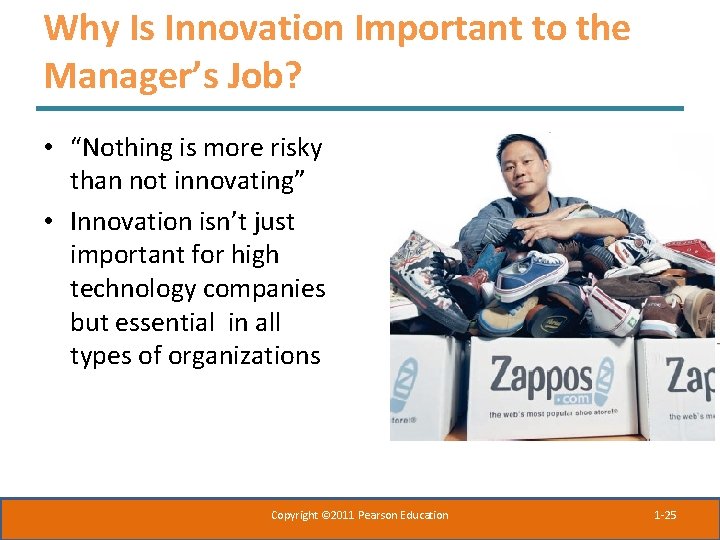
Why Is Innovation Important to the Manager’s Job? • “Nothing is more risky than not innovating” • Innovation isn’t just important for high technology companies but essential in all types of organizations Copyright © 2011 Pearson Education 1 -25
History Module A Brief History of Management’s Roots Copyright © 2011 Pearson Education 1 -26
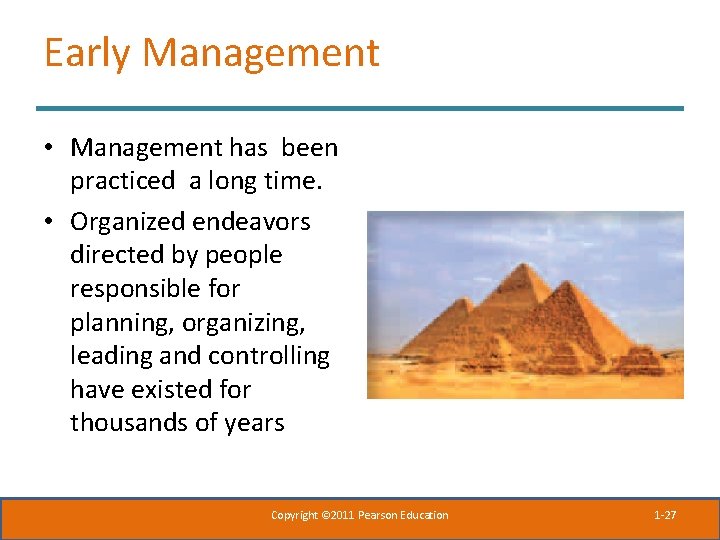
Early Management • Management has been practiced a long time. • Organized endeavors directed by people responsible for planning, organizing, leading and controlling have existed for thousands of years Copyright © 2011 Pearson Education 1 -27
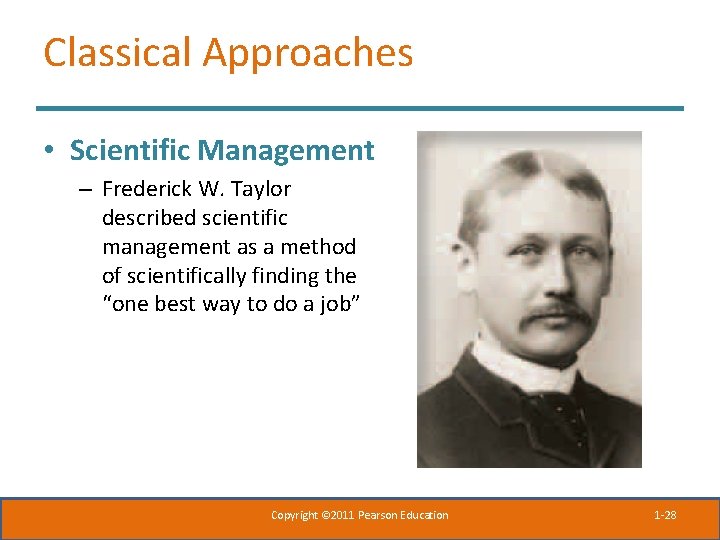
Classical Approaches • Scientific Management – Frederick W. Taylor described scientific management as a method of scientifically finding the “one best way to do a job” Copyright © 2011 Pearson Education 1 -28
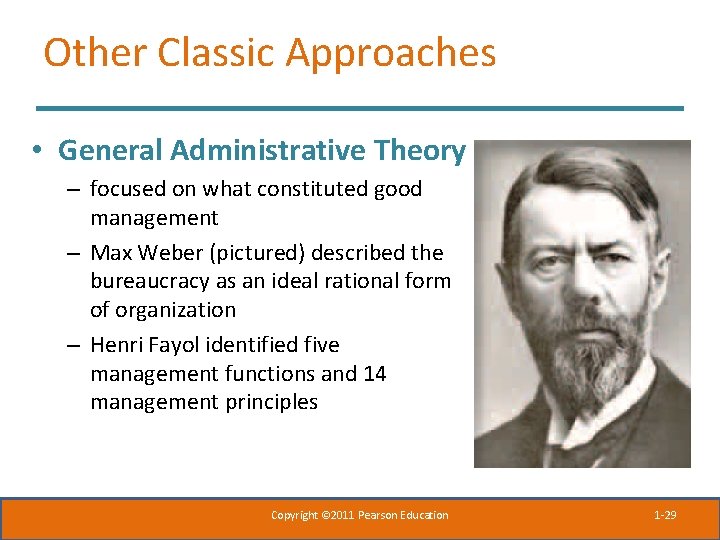
Other Classic Approaches • General Administrative Theory – focused on what constituted good management – Max Weber (pictured) described the bureaucracy as an ideal rational form of organization – Henri Fayol identified five management functions and 14 management principles Copyright © 2011 Pearson Education 1 -29
Behavioral Approaches • Early management writers included – Robert Owen, was concerned about deplorable working conditions – Hugo Munsterberg, a pioneer the field of industrial psychology – Mary Parker Follett recognized hat organizations could be viewed from both individual and group behavior. Copyright © 2011 Pearson Education 1 -30
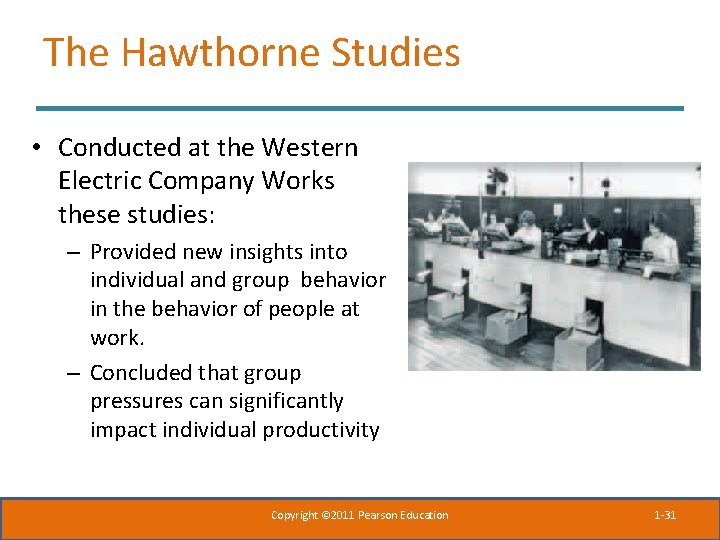
The Hawthorne Studies • Conducted at the Western Electric Company Works these studies: – Provided new insights into individual and group behavior in the behavior of people at work. – Concluded that group pressures can significantly impact individual productivity Copyright © 2011 Pearson Education 1 -31
Quantitative Approaches • Quantitative Approach – Used quantitative techniques to improve decision making – Evolved from mathematical and statistical solutions developed for military problems during World War II – W. Edwards Deming and Joseph M. Duran ‘s ideas became the basis for total quality management (TQM) Copyright © 2011 Pearson Education 1– 32
Contemporary Approaches • Focused on managers’ concerns inside the organization – Chester Barnard wrote in his 1938 book The Functions of the Executive that an organization functioned as a cooperative system – Fred Feildler first popularized the contingency approach (or situational approach) which says that organizations, employees, and situations are different and require different ways of managing Copyright © 2011 Pearson Education 1 -33
Copyright © 2011 Pearson Education 1 -34