www gdcuk org The General Dental Council Word
- Slides: 15
www. gdc-uk. org The General Dental Council ‘Word of Mouth’ Patient Panel Regulating for positive outcomes Cumberland Lodge, 11 March 2016 Guy Rubin General Dental Council
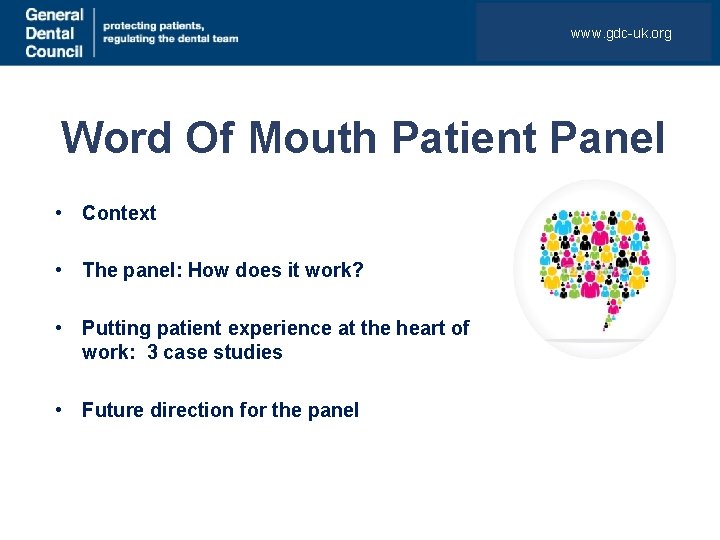
www. gdc-uk. org Word Of Mouth Patient Panel • Context • The panel: How does it work? • Putting patient experience at the heart of work: 3 case studies • Future direction for the panel our
www. gdc-uk. org Word Of Mouth Patient Panel Context • The Francis report (February 2013) recommended that health regulators should have more effective mechanisms for listening to patients and obtaining feedback • The Keogh report (2013) underlined the importance of engaging with patients • The GDC Council established the patient panel in 2014 as part of its response to the Francis Report – the first health regulator to do so.
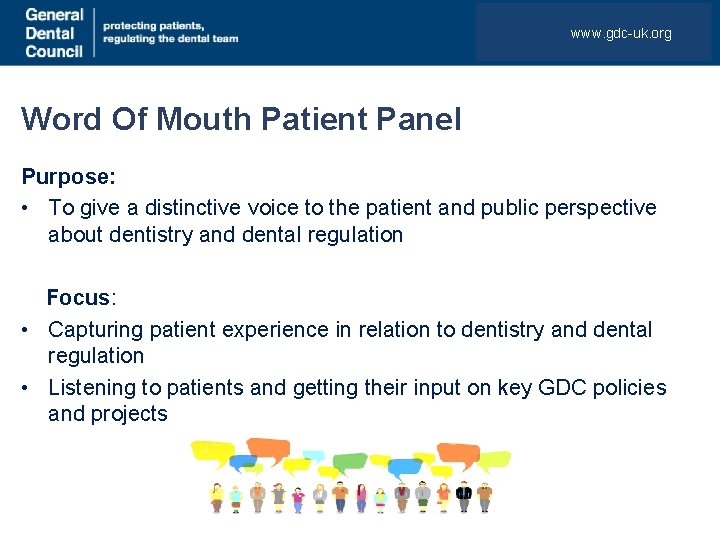
www. gdc-uk. org Word Of Mouth Patient Panel Purpose: • To give a distinctive voice to the patient and public perspective about dentistry and dental regulation Focus: • Capturing patient experience in relation to dentistry and dental regulation • Listening to patients and getting their input on key GDC policies and projects
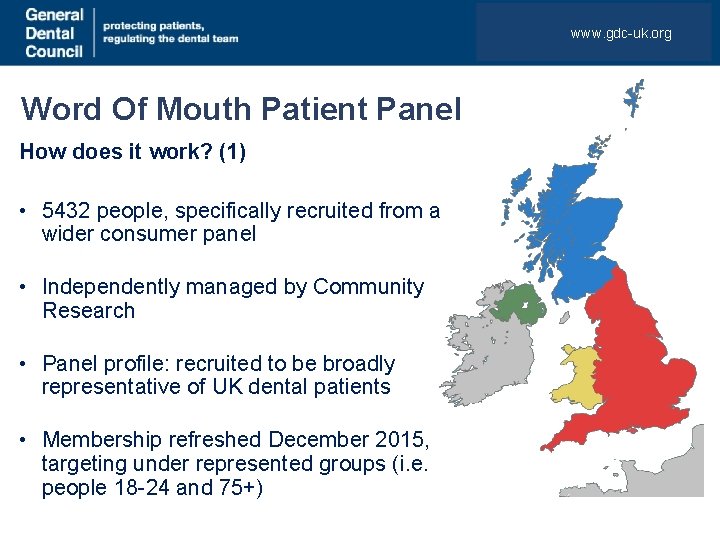
www. gdc-uk. org Word Of Mouth Patient Panel How does it work? (1) • 5432 people, specifically recruited from a wider consumer panel • Independently managed by Community Research • Panel profile: recruited to be broadly representative of UK dental patients • Membership refreshed December 2015, targeting under represented groups (i. e. people 18 -24 and 75+)
www. gdc-uk. org Word Of Mouth Patient Panel How does the panel work? (2) • Operates mainly online. • Members ‘opt in’ to take part in regular research and engagement activities (surveys, workshops, discussion groups, telephone interviews) • Regular newsletters keep members informed of outcomes of research ‘you said we did’
www. gdc-uk. org Word Of Mouth Patient Panel Case Studies: • Duty of Candour (Focus Groups) • Recent Dental Appointments (Survey) • GDC Roadmap (Workshop)
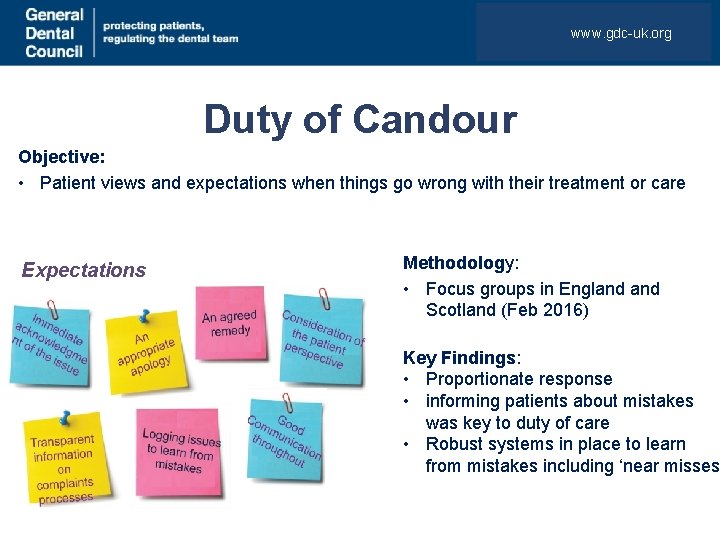
www. gdc-uk. org Duty of Candour Objective: • Patient views and expectations when things go wrong with their treatment or care Expectations Methodology: • Focus groups in England Scotland (Feb 2016) Key Findings: • Proportionate response • informing patients about mistakes was key to duty of care • Robust systems in place to learn from mistakes including ‘near misses’
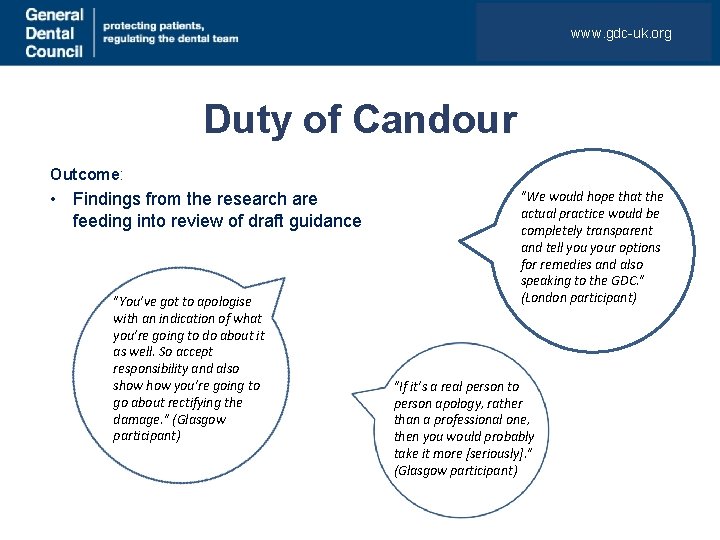
www. gdc-uk. org Duty of Candour Outcome: • Findings from the research are feeding into review of draft guidance "You’ve got to apologise with an indication of what you’re going to do about it as well. So accept responsibility and also show you’re going to go about rectifying the damage. " (Glasgow participant) "We would hope that the actual practice would be completely transparent and tell your options for remedies and also speaking to the GDC. " (London participant) "If it’s a real person to person apology, rather than a professional one, then you would probably take it more [seriously]. " (Glasgow participant)
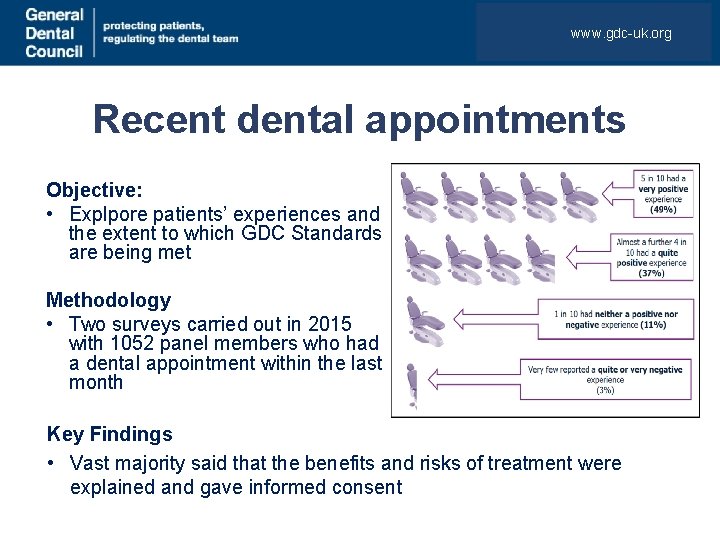
www. gdc-uk. org Recent dental appointments Objective: • Explpore patients’ experiences and the extent to which GDC Standards are being met Methodology • Two surveys carried out in 2015 with 1052 panel members who had a dental appointment within the last month Key Findings • Vast majority said that the benefits and risks of treatment were explained and gave informed consent
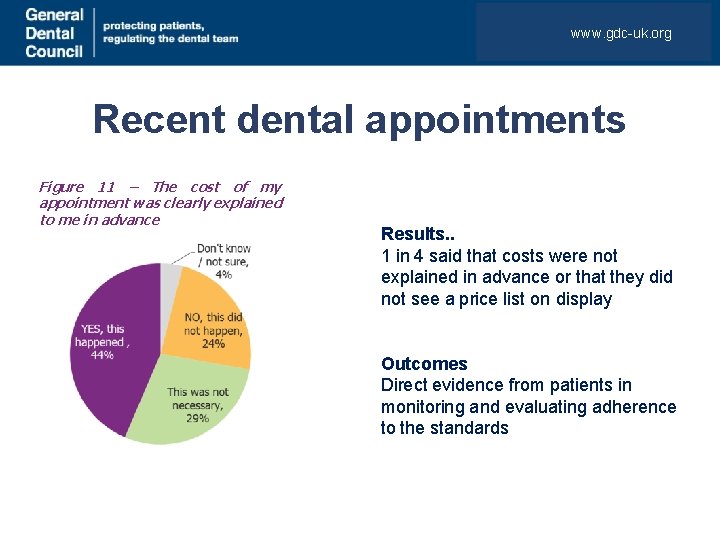
www. gdc-uk. org Recent dental appointments Figure 11 – The cost of my appointment was clearly explained to me in advance Results. . 1 in 4 said that costs were not explained in advance or that they did not see a price list on display Outcomes Direct evidence from patients in monitoring and evaluating adherence to the standards
www. gdc-uk. org GDC Roadmap 2016 -19 Objective: • Patient voice and input into the development of the GDC’s roadmap 2016 -2019 Methodology: • Deliberative workshop with cross section of patient panel members – a different way of working with the Panel
www. gdc-uk. org GDC Roadmap 2016 -19 Key Findings: • Attitudes towards dentistry are changing • Local Resolution • Patients focused on the importance of treating those with more complex needs (e. g. dementia) and the specialised knowledge and skills required. (e. g. communication skills tailored to patients/carers) Outcome: • Patient views are reflected in aims and objectives for patients set out in the roadmap
www. gdc-uk. org Word Of Mouth Patient Panel Next steps…. • Explore the potential for joint working with health care regulators and stakeholders in using the panel • An evaluation of the performance and effectiveness of the panel
www. gdc-uk. org Questions? Guy Rubin: Research Manager email: grubin@gdc-uk. org GDC website: www. gdc-uk. org Follow us on social media