
Writing a Report English 7 Why Write a


- Slides: 17
Writing a Report English 7
Why Write a Report? Some of the reasons to write a report are to: Inform Make proposals or recommendations for change Analyse and solve problems Present the findings of an investigation or project Record progress
Core Content English 7 Centralt innehåll Samhällsfrågor, kulturella, historiska, politiska och sociala förhållanden samt etiska och existentiella frågor i olika sammanhang och delar av världen där engelska används. Muntlig och skriftlig produktion och interaktion i olika situationer och med olika syften, där eleverna argumenterar ur olika perspektiv, ansöker, resonerar, värderar, utreder, förhandlar och motiverar sina åsikter. Strategier för användning av olika typer av källor, med källkritisk medvetenhet och vedertagna sätt ange källor, inom valt fördjupningsområde och inom andra områden.
Knowledge Requirements English 7 Eleven kan välja och med viss säkerhet använda strategier för att söka relevant information, strukturera den och värdera olika källors tillförlitlighet. I skriftliga framställningar i olika genrer kan eleven formulera sig varierat, tydligt och strukturerat. Eleven kan formulera sig skriftligt med flyt och viss anpassning till syfte, mottagare och situation. Eleven bearbetar, och gör välgrundade förbättringar av, egna framställningar. Eleven diskuterar översiktligt några företeelser i olika sammanhang och delar av världen där engelska används, och kan då också göra enkla jämförelser med egna erfarenheter och kunskaper.
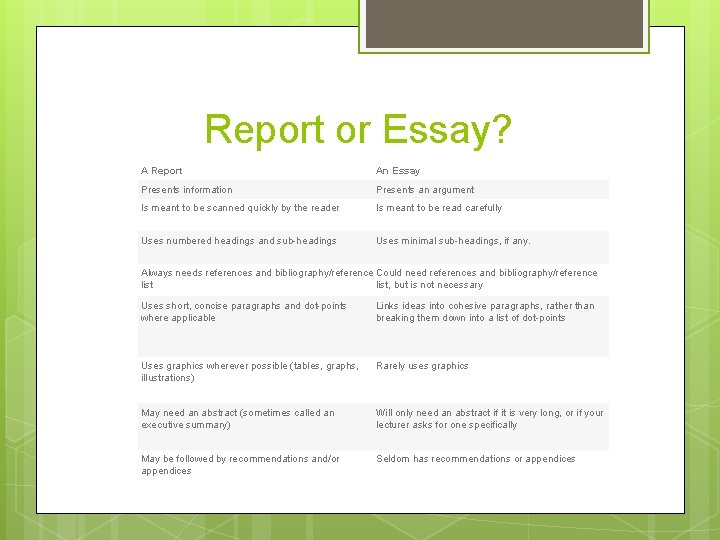
Report or Essay? A Report An Essay Presents information Presents an argument Is meant to be scanned quickly by the reader Is meant to be read carefully Uses numbered headings and sub-headings Uses minimal sub-headings, if any. Always needs references and bibliography/reference Could need references and bibliography/reference list, but is not necessary Uses short, concise paragraphs and dot-points where applicable Links ideas into cohesive paragraphs, rather than breaking them down into a list of dot-points Uses graphics wherever possible (tables, graphs, illustrations) Rarely uses graphics May need an abstract (sometimes called an executive summary) Will only need an abstract if it is very long, or if your lecturer asks for one specifically May be followed by recommendations and/or appendices Seldom has recommendations or appendices
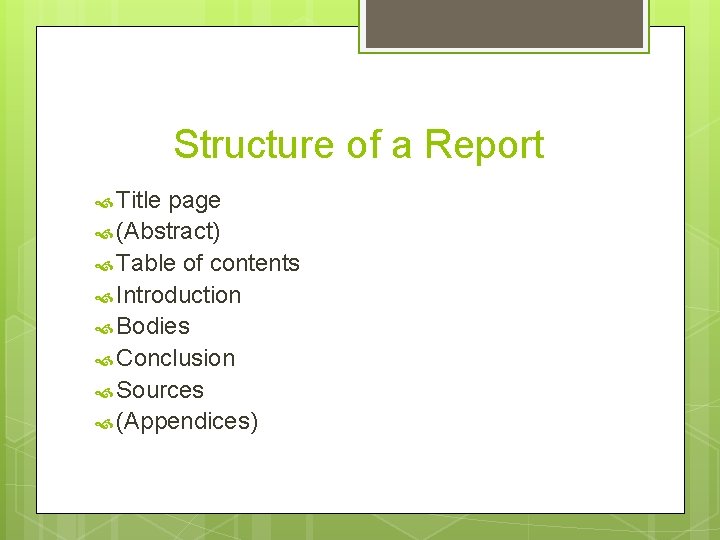
Structure of a Report Title page (Abstract) Table of contents Introduction Bodies Conclusion Sources (Appendices)
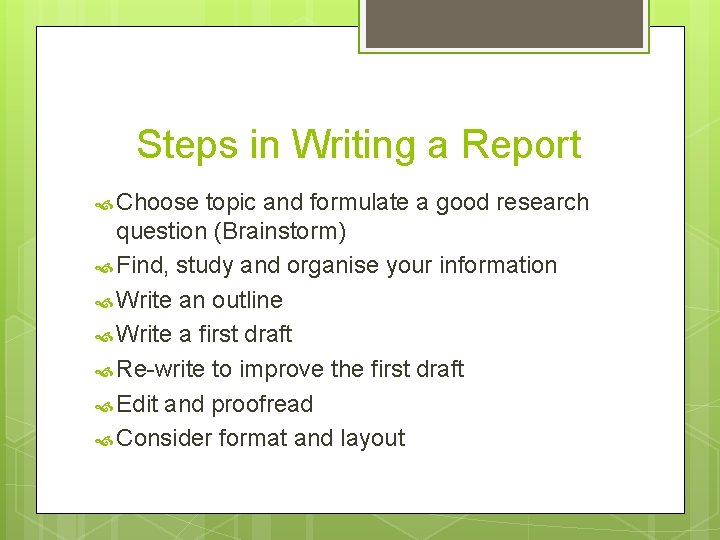
Steps in Writing a Report Choose topic and formulate a good research question (Brainstorm) Find, study and organise your information Write an outline Write a first draft Re-write to improve the first draft Edit and proofread Consider format and layout
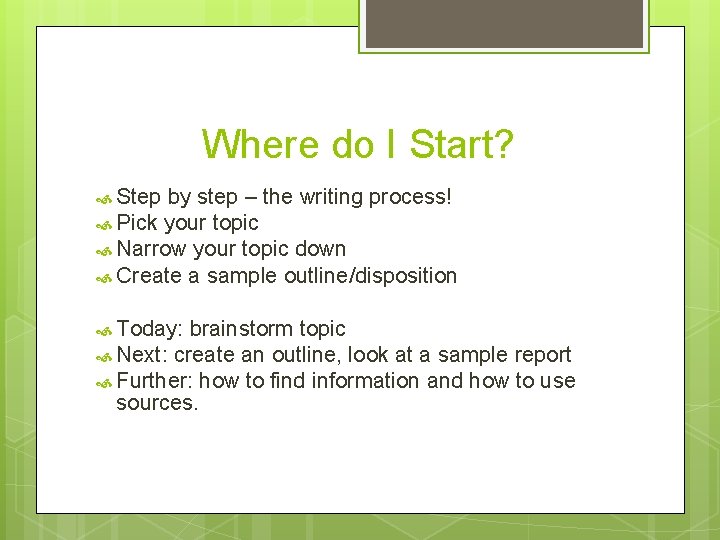
Where do I Start? Step by step – the writing process! Pick your topic Narrow your topic down Create a sample outline/disposition Today: brainstorm topic Next: create an outline, look at a sample report Further: how to find information and how to use sources.
Topic Examples The impact of urban sprawl in Sydney NHL lockout in the US and Canada Ecotourism in South Africa Social issues Mexico – United States border The impact of music in the Civil Rights Moment Measures against hooliganism in Britain Why the Falkland islands is still a British issue ALSO SEE THE LIST WITH TOPIC IDEAS!
Citations and References Background material and facts MUST have sources You are not allowed to ”borrow” sentences from other texts, unless you are quoting. PLAGIARISM You must rephrase to make the words your own. Never use words you do not understand! Sources need to be listed both as citations and references!
Oxford System Footnotes After the quote or opinion, you write a footnote by using the commando: Referenser In – Infoga fotnot the foot note: write the last name of the author and the number of the page/s where you found the quote or opinion.
Harvard System Parenthetic referencing After the quote or opinion, you put parentheses with the last name of the author and the page number
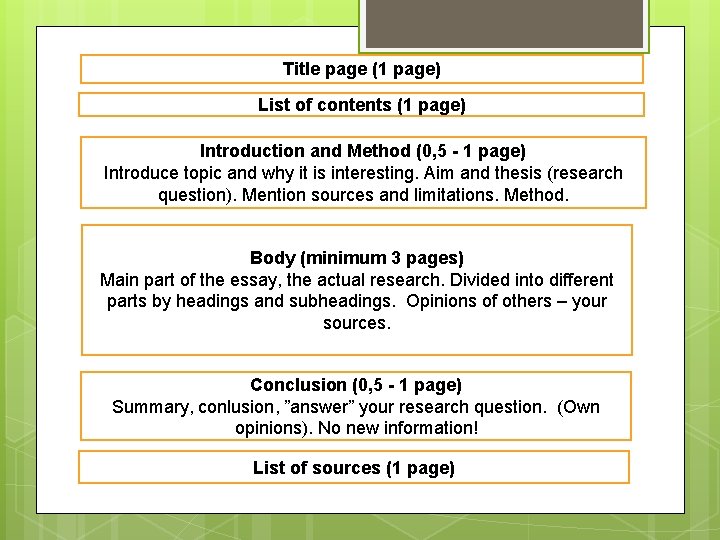
Title page (1 page) List of contents (1 page) Introduction and Method (0, 5 - 1 page) Introduce topic and why it is interesting. Aim and thesis (research question). Mention sources and limitations. Method. Body (minimum 3 pages) Main part of the essay, the actual research. Divided into different parts by headings and subheadings. Opinions of others – your sources. Conclusion (0, 5 - 1 page) Summary, conlusion, ”answer” your research question. (Own opinions). No new information! List of sources (1 page)
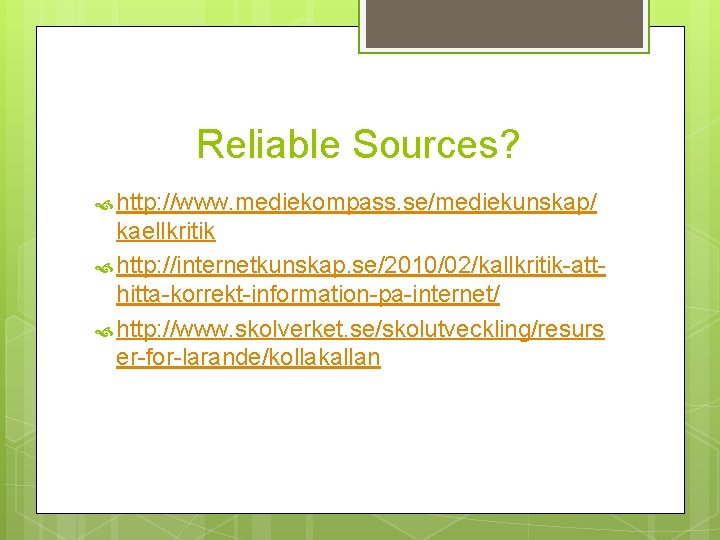
Reliable Sources? http: //www. mediekompass. se/mediekunskap/ kaellkritik http: //internetkunskap. se/2010/02/kallkritik-atthitta-korrekt-information-pa-internet/ http: //www. skolverket. se/skolutveckling/resurs er-for-larande/kollakallan
Suggestions https: //scholar. google. se/ Google Scholar provides a simple way to broadly search for scholarly literature. From one place, you can search across many disciplines and sources: articles, theses, books, abstracts and court opinions, from academic publishers, professional societies, online repositories, universities and other web sites. Google Scholar helps you find relevant work across the world of scholarly research.
Suggestions http: //www. ub. uu. se/soktips-och- sokteknik/tidskrifter-a-o/ Uppsala Universitetsbibliotek provides many magazines and scientific articles online. Search by topic or title.
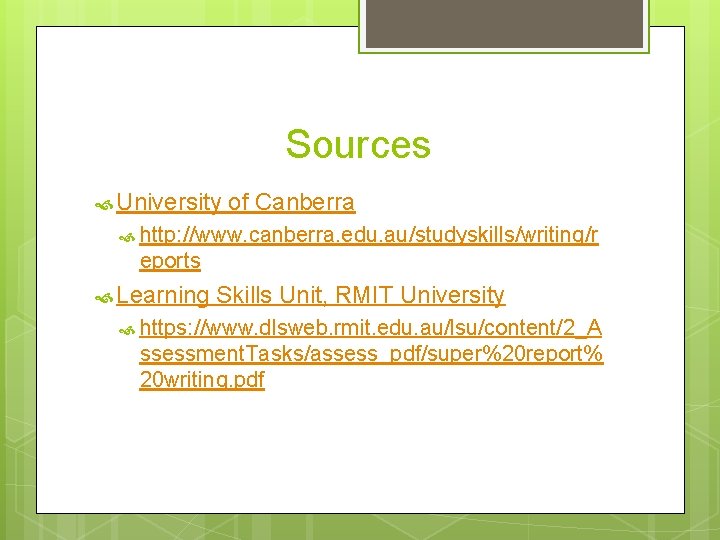
Sources University of Canberra http: //www. canberra. edu. au/studyskills/writing/r eports Learning Skills Unit, RMIT University https: //www. dlsweb. rmit. edu. au/lsu/content/2_A ssessment. Tasks/assess_pdf/super%20 report% 20 writing. pdf