Working Together to Safeguard Children Reigate School Staff

- Slides: 29
‘Working Together to Safeguard Children’ Reigate School Staff Training Friday 20 th November 2020 Matt Alexander (Lead DSL) Sheila Jethwa (Deputy DSL/CPLO)
Aim of the training: • To provide you with the opportunity to develop an awareness of what to do if you have concerns about the safety and welfare of any of our Reigate children/families and be familiar with the safeguarding requirements for Reigate School in line with Surrey County Council. REMEMBER: "It could happen here“ The reality is. . . it DOES happen here.
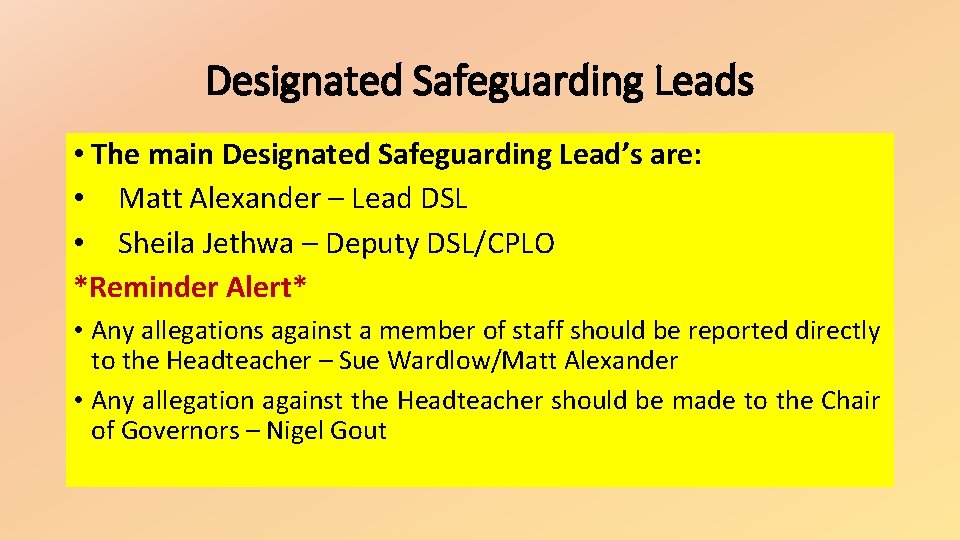
Designated Safeguarding Leads • The main Designated Safeguarding Lead’s are: • Matt Alexander – Lead DSL • Sheila Jethwa – Deputy DSL/CPLO *Reminder Alert* • Any allegations against a member of staff should be reported directly to the Headteacher – Sue Wardlow/Matt Alexander • Any allegation against the Headteacher should be made to the Chair of Governors – Nigel Gout
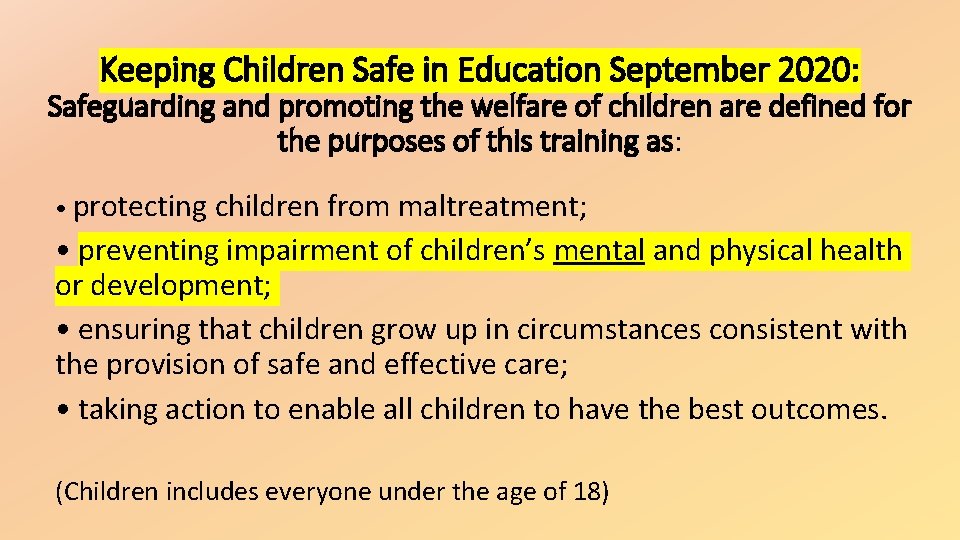
Keeping Children Safe in Education September 2020: Safeguarding and promoting the welfare of children are defined for the purposes of this training as: • protecting children from maltreatment; • preventing impairment of children’s mental and physical health or development; • ensuring that children grow up in circumstances consistent with the provision of safe and effective care; • taking action to enable all children to have the best outcomes. (Children includes everyone under the age of 18)
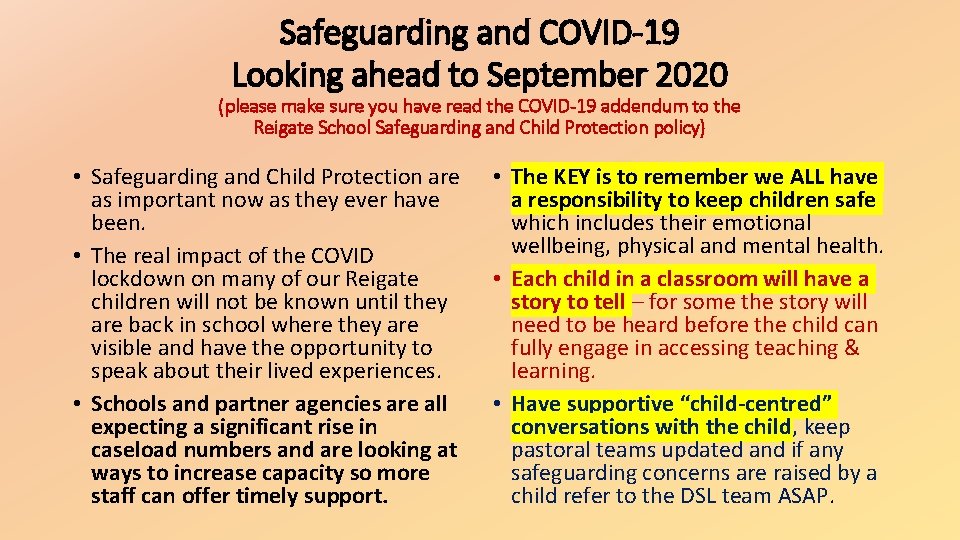
Safeguarding and COVID-19 Looking ahead to September 2020 (please make sure you have read the COVID-19 addendum to the Reigate School Safeguarding and Child Protection policy) • Safeguarding and Child Protection are as important now as they ever have been. • The real impact of the COVID lockdown on many of our Reigate children will not be known until they are back in school where they are visible and have the opportunity to speak about their lived experiences. • Schools and partner agencies are all expecting a significant rise in caseload numbers and are looking at ways to increase capacity so more staff can offer timely support. • The KEY is to remember we ALL have a responsibility to keep children safe which includes their emotional wellbeing, physical and mental health. • Each child in a classroom will have a story to tell – for some the story will need to be heard before the child can fully engage in accessing teaching & learning. • Have supportive “child-centred” conversations with the child, keep pastoral teams updated and if any safeguarding concerns are raised by a child refer to the DSL team ASAP.
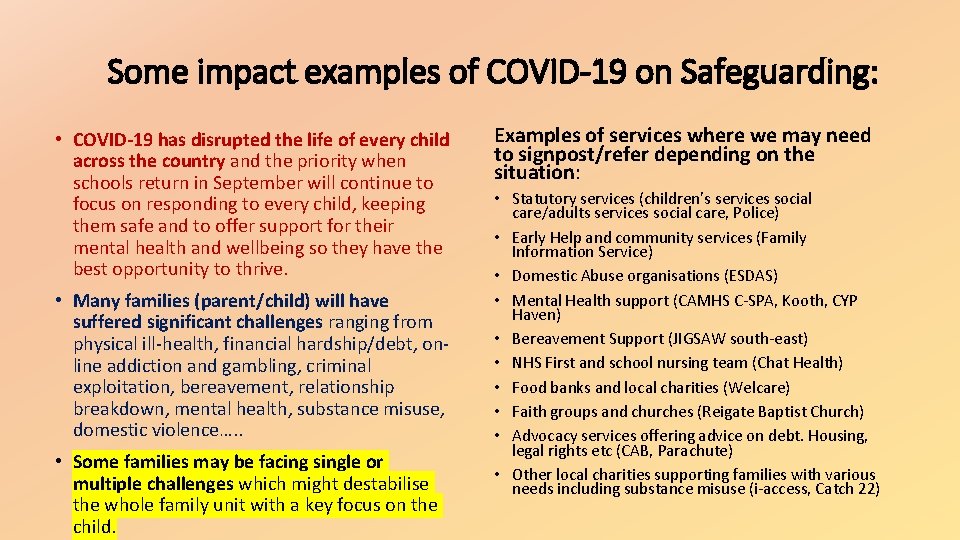
Some impact examples of COVID-19 on Safeguarding: • COVID-19 has disrupted the life of every child across the country and the priority when schools return in September will continue to focus on responding to every child, keeping them safe and to offer support for their mental health and wellbeing so they have the best opportunity to thrive. • Many families (parent/child) will have suffered significant challenges ranging from physical ill-health, financial hardship/debt, online addiction and gambling, criminal exploitation, bereavement, relationship breakdown, mental health, substance misuse, domestic violence…. . • Some families may be facing single or multiple challenges which might destabilise the whole family unit with a key focus on the child. Examples of services where we may need to signpost/refer depending on the situation: • Statutory services (children’s services social care/adults services social care, Police) • Early Help and community services (Family Information Service) • Domestic Abuse organisations (ESDAS) • Mental Health support (CAMHS C-SPA, Kooth, CYP Haven) • Bereavement Support (JIGSAW south-east) • NHS First and school nursing team (Chat Health) • Food banks and local charities (Welcare) • Faith groups and churches (Reigate Baptist Church) • Advocacy services offering advice on debt. Housing, legal rights etc (CAB, Parachute) • Other local charities supporting families with various needs including substance misuse (i-access, Catch 22)
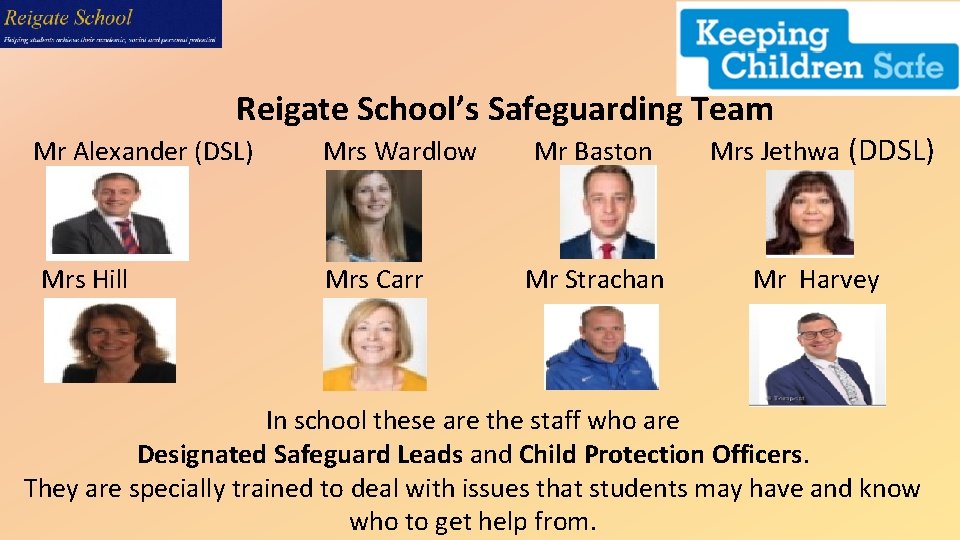
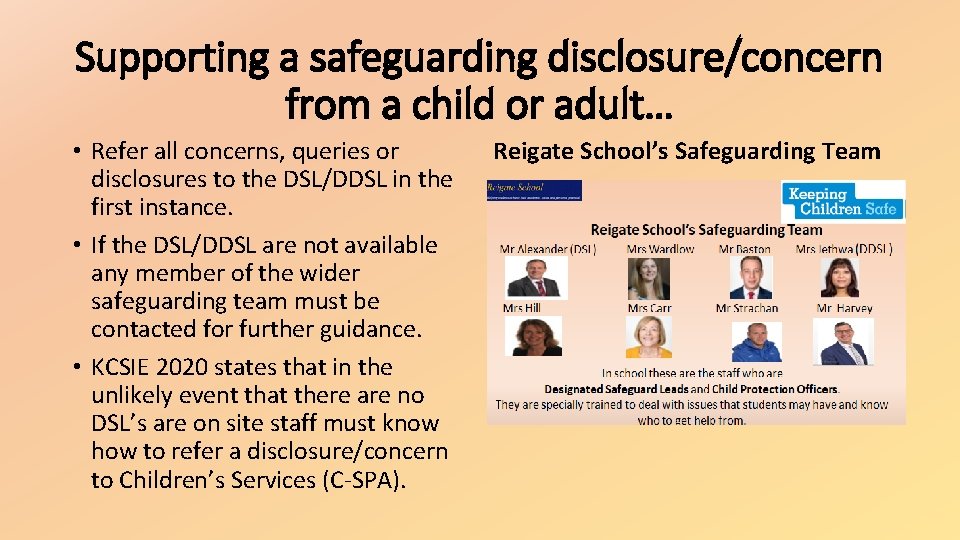
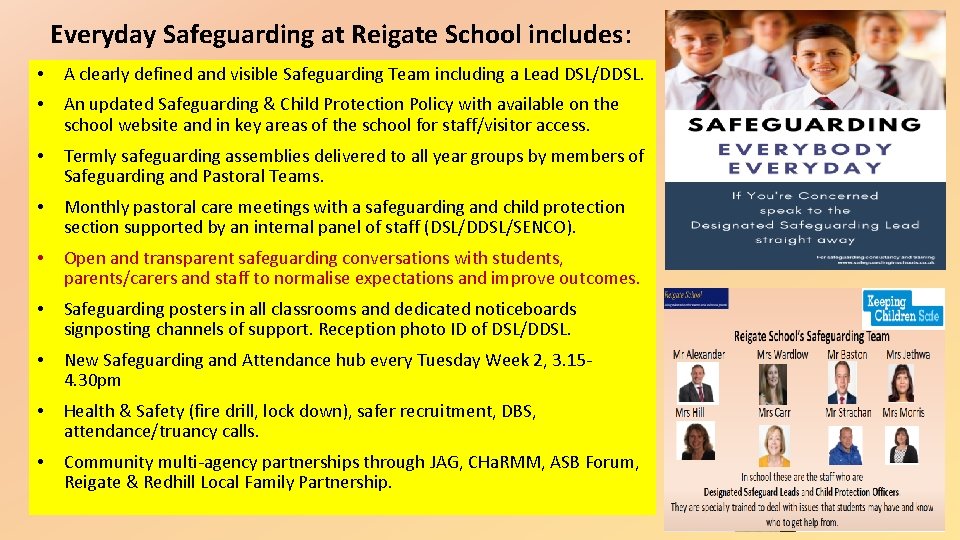
Reigate School’s Safeguarding Team Mr Alexander (DSL) Mrs Wardlow Mrs Hill Mrs Carr Mr Baston Mrs Jethwa (DDSL) Mr Strachan Mr Harvey In school these are the staff who are Designated Safeguard Leads and Child Protection Officers. They are specially trained to deal with issues that students may have and know who to get help from.
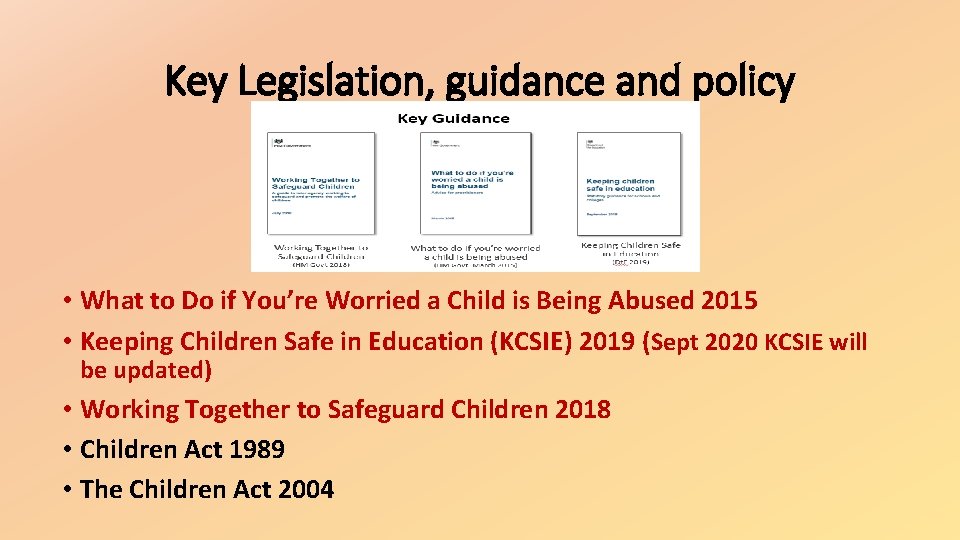
Key Legislation, guidance and policy • What to Do if You’re Worried a Child is Being Abused 2015 • Keeping Children Safe in Education (KCSIE) 2019 (Sept 2020 KCSIE will be updated) • Working Together to Safeguard Children 2018 • Children Act 1989 • The Children Act 2004
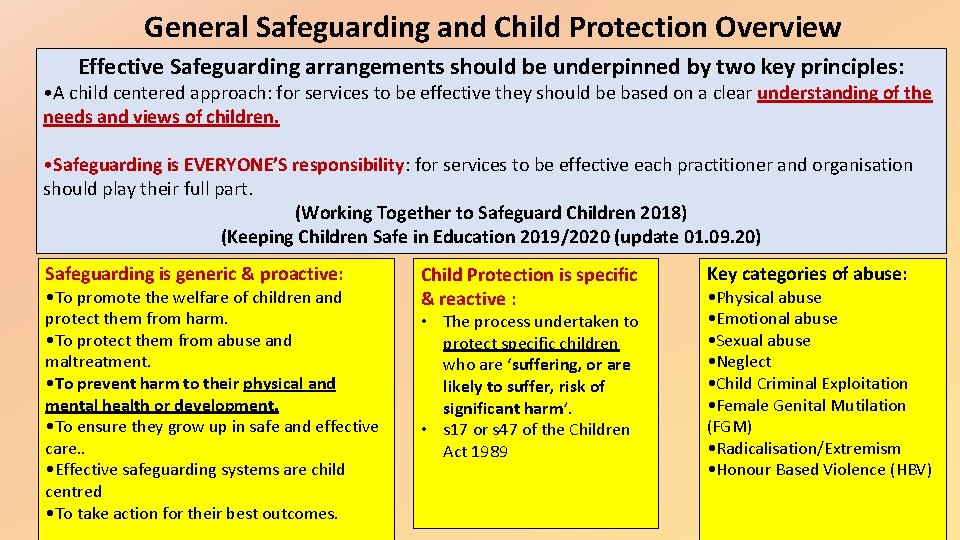
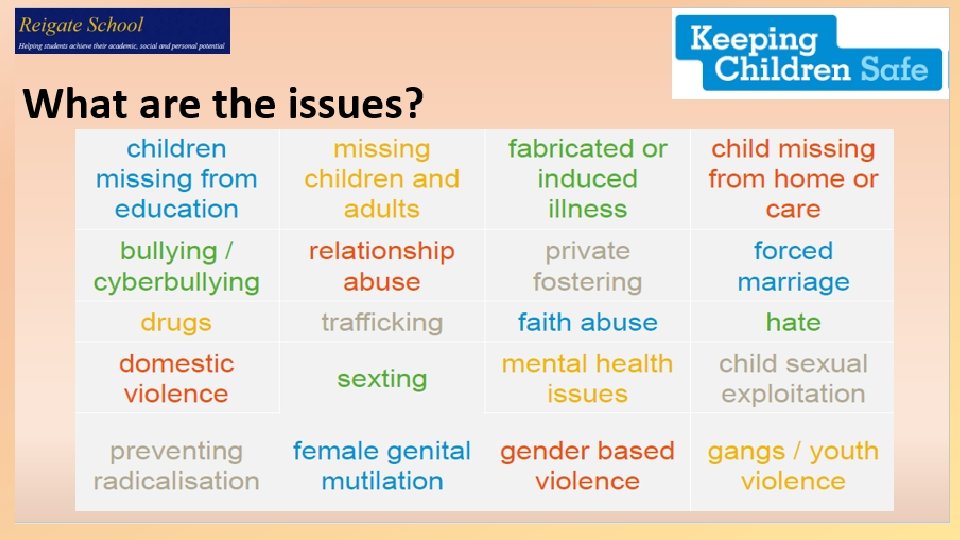
General Safeguarding and Child Protection Overview Effective Safeguarding arrangements should be underpinned by two key principles: • A child centered approach: for services to be effective they should be based on a clear understanding of the needs and views of children. • Safeguarding is EVERYONE’S responsibility: for services to be effective each practitioner and organisation should play their full part. (Working Together to Safeguard Children 2018) (Keeping Children Safe in Education 2019/2020 (update 01. 09. 20) Safeguarding is generic & proactive: • To promote the welfare of children and protect them from harm. • To protect them from abuse and maltreatment. • To prevent harm to their physical and mental health or development. • To ensure they grow up in safe and effective care. . • Effective safeguarding systems are child centred • To take action for their best outcomes. Child Protection is specific & reactive : • The process undertaken to protect specific children who are ‘suffering, or are likely to suffer, risk of significant harm’. • s 17 or s 47 of the Children Act 1989 Key categories of abuse: • Physical abuse • Emotional abuse • Sexual abuse • Neglect • Child Criminal Exploitation • Female Genital Mutilation (FGM) • Radicalisation/Extremism • Honour Based Violence (HBV)
Surrey threshold levels Universal: generic support available to every child at any time of their life. Early Help (Level 2): families and children who have additional needs that can be supported by Universal and Targeted support without the need for an Early Help Assessment. Targeted Help (Level 3) : Multi-agency support using an Early Help Assessment and Lead Professional for the family Specialist (Level 4): High level support using the statutory framework of CP and CIN.
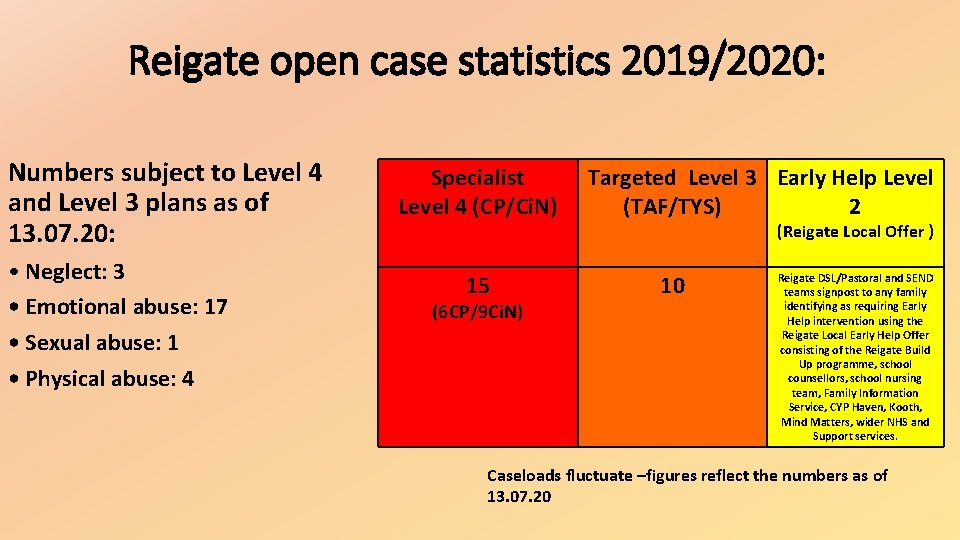
Reigate open case statistics 2019/2020: Numbers subject to Level 4 and Level 3 plans as of 13. 07. 20: • Neglect: 3 • Emotional abuse: 17 • Sexual abuse: 1 • Physical abuse: 4 Specialist Level 4 (CP/Ci. N) 15 (6 CP/9 Ci. N) Targeted Level 3 Early Help Level (TAF/TYS) 2 (Reigate Local Offer ) 10 Reigate DSL/Pastoral and SEND teams signpost to any family identifying as requiring Early Help intervention using the Reigate Local Early Help Offer consisting of the Reigate Build Up programme, school counsellors, school nursing team, Family Information Service, CYP Haven, Kooth, Mind Matters, wider NHS and Support services. Caseloads fluctuate –figures reflect the numbers as of 13. 07. 20
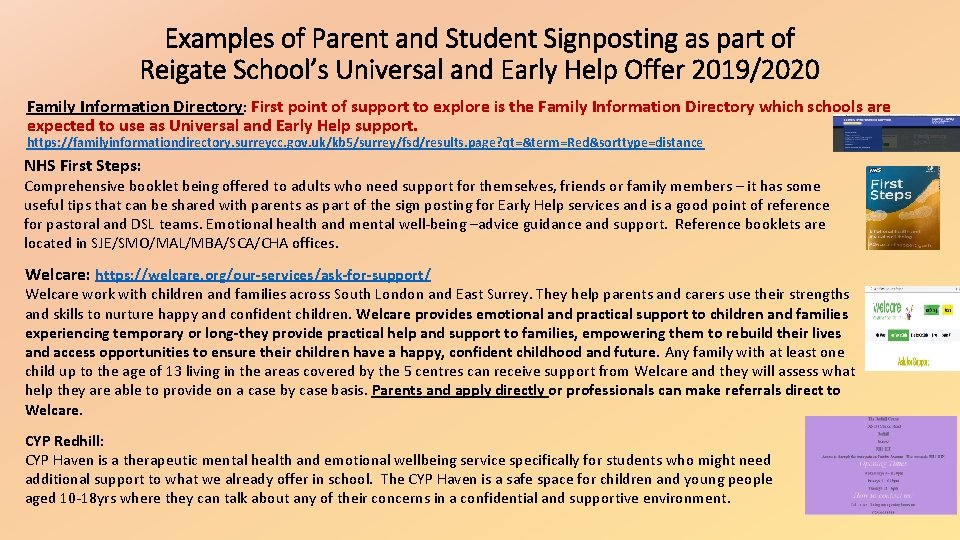
Examples of Parent and Student Signposting as part of Reigate School’s Universal and Early Help Offer 2019/2020 Family Information Directory: First point of support to explore is the Family Information Directory which schools are expected to use as Universal and Early Help support. https: //familyinformationdirectory. surreycc. gov. uk/kb 5/surrey/fsd/results. page? qt=&term=Red&sorttype=distance NHS First Steps: Comprehensive booklet being offered to adults who need support for themselves, friends or family members – it has some useful tips that can be shared with parents as part of the sign posting for Early Help services and is a good point of reference for pastoral and DSL teams. Emotional health and mental well-being –advice guidance and support. Reference booklets are located in SJE/SMO/MAL/MBA/SCA/CHA offices. Welcare: https: //welcare. org/our-services/ask-for-support/ Welcare work with children and families across South London and East Surrey. They help parents and carers use their strengths and skills to nurture happy and confident children. Welcare provides emotional and practical support to children and families experiencing temporary or long-they provide practical help and support to families, empowering them to rebuild their lives and access opportunities to ensure their children have a happy, confident childhood and future. Any family with at least one child up to the age of 13 living in the areas covered by the 5 centres can receive support from Welcare and they will assess what help they are able to provide on a case by case basis. Parents and apply directly or professionals can make referrals direct to Welcare. CYP Redhill: CYP Haven is a therapeutic mental health and emotional wellbeing service specifically for students who might need additional support to what we already offer in school. The CYP Haven is a safe space for children and young people aged 10 -18 yrs where they can talk about any of their concerns in a confidential and supportive environment.
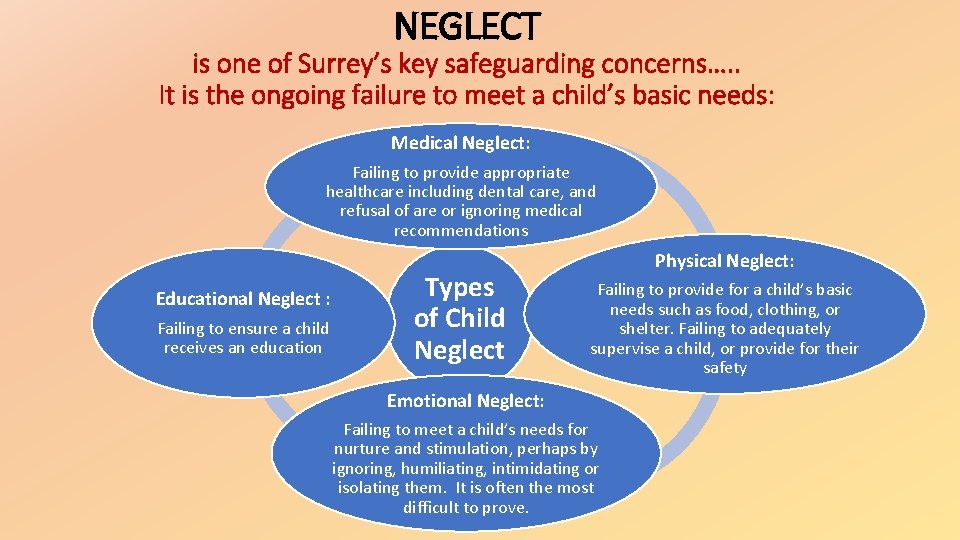
NEGLECT is one of Surrey’s key safeguarding concerns…. . It is the ongoing failure to meet a child’s basic needs: Medical Neglect: Failing to provide appropriate healthcare including dental care, and refusal of are or ignoring medical recommendations Educational Neglect : Failing to ensure a child receives an education Types of Child Neglect Physical Neglect: Failing to provide for a child’s basic needs such as food, clothing, or shelter. Failing to adequately supervise a child, or provide for their safety Emotional Neglect: Failing to meet a child’s needs for nurture and stimulation, perhaps by ignoring, humiliating, intimidating or isolating them. It is often the most difficult to prove.
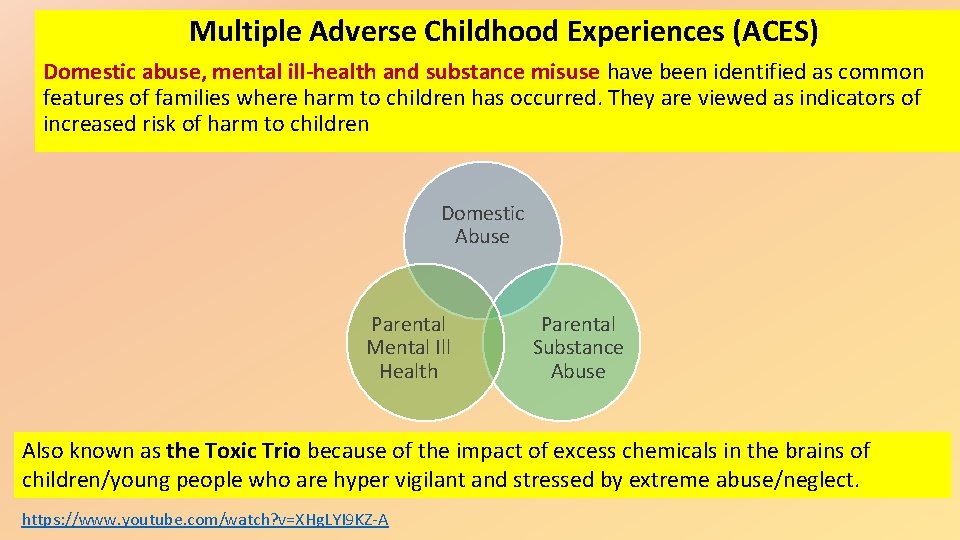
Multiple Adverse Childhood Experiences (ACES) Domestic abuse, mental ill-health and substance misuse have been identified as common features of families where harm to children has occurred. They are viewed as indicators of increased risk of harm to children Domestic Abuse Parental Mental Ill Health Parental Substance Abuse Also known as the Toxic Trio because of the impact of excess chemicals in the brains of children/young people who are hyper vigilant and stressed by extreme abuse/neglect. https: //www. youtube. com/watch? v=XHg. LYI 9 KZ-A
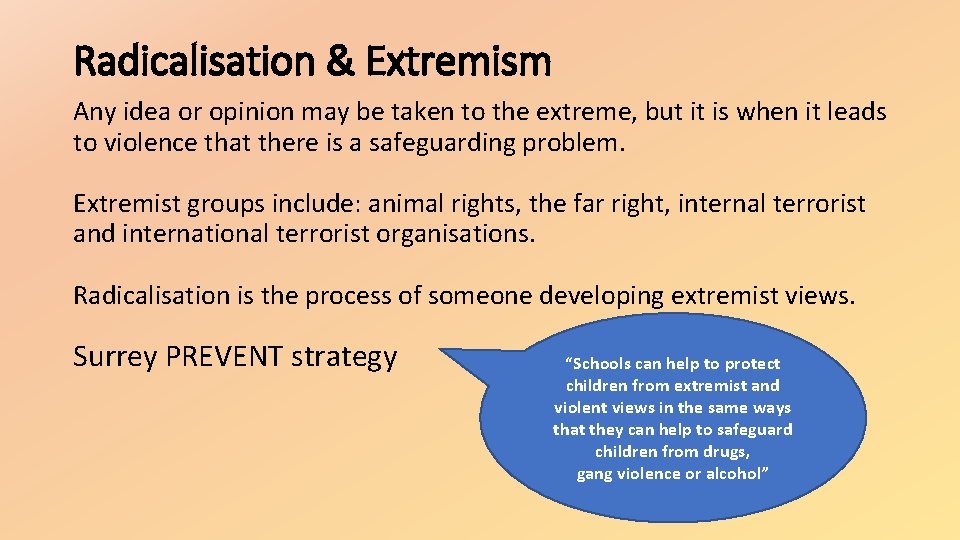
Radicalisation & Extremism Any idea or opinion may be taken to the extreme, but it is when it leads to violence that there is a safeguarding problem. Extremist groups include: animal rights, the far right, internal terrorist and international terrorist organisations. Radicalisation is the process of someone developing extremist views. Surrey PREVENT strategy “Schools can help to protect children from extremist and violent views in the same ways that they can help to safeguard children from drugs, gang violence or alcohol”
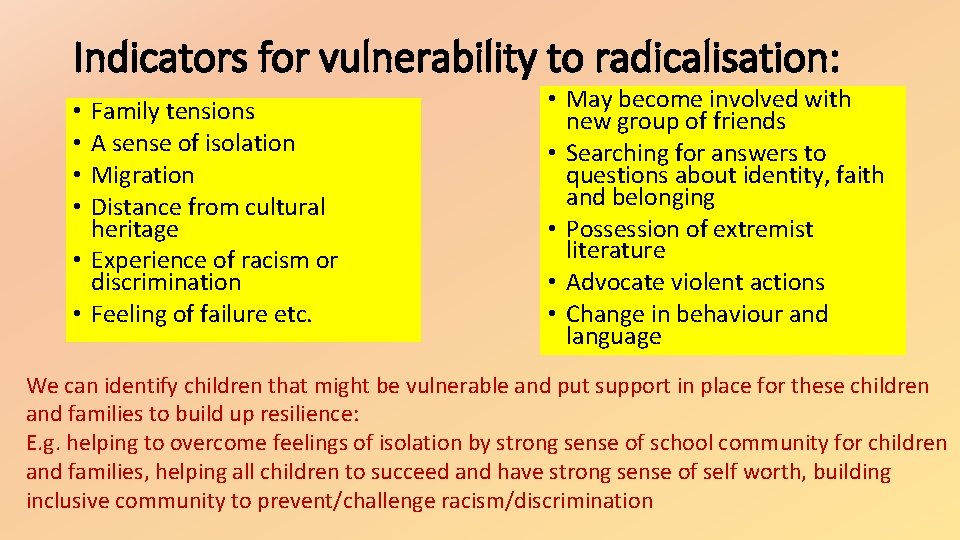
Indicators for vulnerability to radicalisation: Family tensions A sense of isolation Migration Distance from cultural heritage • Experience of racism or discrimination • Feeling of failure etc. • • • May become involved with new group of friends • Searching for answers to questions about identity, faith and belonging • Possession of extremist literature • Advocate violent actions • Change in behaviour and language We can identify children that might be vulnerable and put support in place for these children and families to build up resilience: E. g. helping to overcome feelings of isolation by strong sense of school community for children and families, helping all children to succeed and have strong sense of self worth, building inclusive community to prevent/challenge racism/discrimination
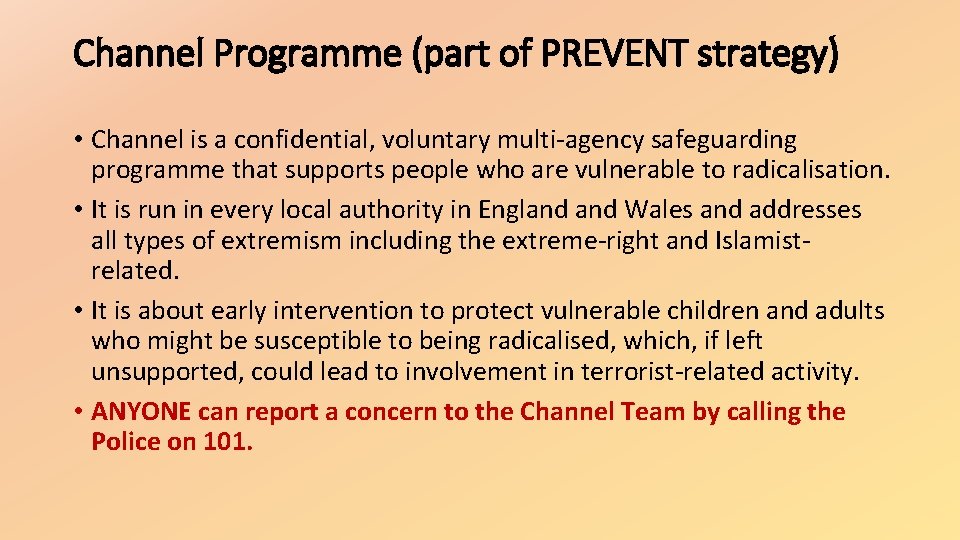
Channel Programme (part of PREVENT strategy) • Channel is a confidential, voluntary multi-agency safeguarding programme that supports people who are vulnerable to radicalisation. • It is run in every local authority in England Wales and addresses all types of extremism including the extreme-right and Islamistrelated. • It is about early intervention to protect vulnerable children and adults who might be susceptible to being radicalised, which, if left unsupported, could lead to involvement in terrorist-related activity. • ANYONE can report a concern to the Channel Team by calling the Police on 101.
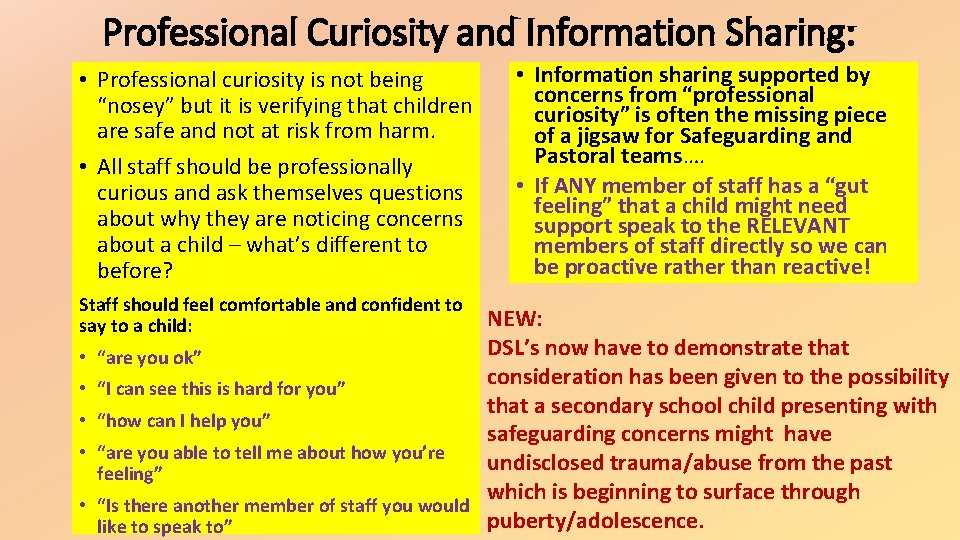
Professional Curiosity and Information Sharing: • Professional curiosity is not being “nosey” but it is verifying that children are safe and not at risk from harm. • All staff should be professionally curious and ask themselves questions about why they are noticing concerns about a child – what’s different to before? Staff should feel comfortable and confident to say to a child: • • • Information sharing supported by concerns from “professional curiosity” is often the missing piece of a jigsaw for Safeguarding and Pastoral teams…. • If ANY member of staff has a “gut feeling” that a child might need support speak to the RELEVANT members of staff directly so we can be proactive rather than reactive! NEW: DSL’s now have to demonstrate that “are you ok” consideration has been given to the possibility “I can see this is hard for you” that a secondary school child presenting with “how can I help you” safeguarding concerns might have “are you able to tell me about how you’re undisclosed trauma/abuse from the past feeling” which is beginning to surface through “Is there another member of staff you would puberty/adolescence. like to speak to”
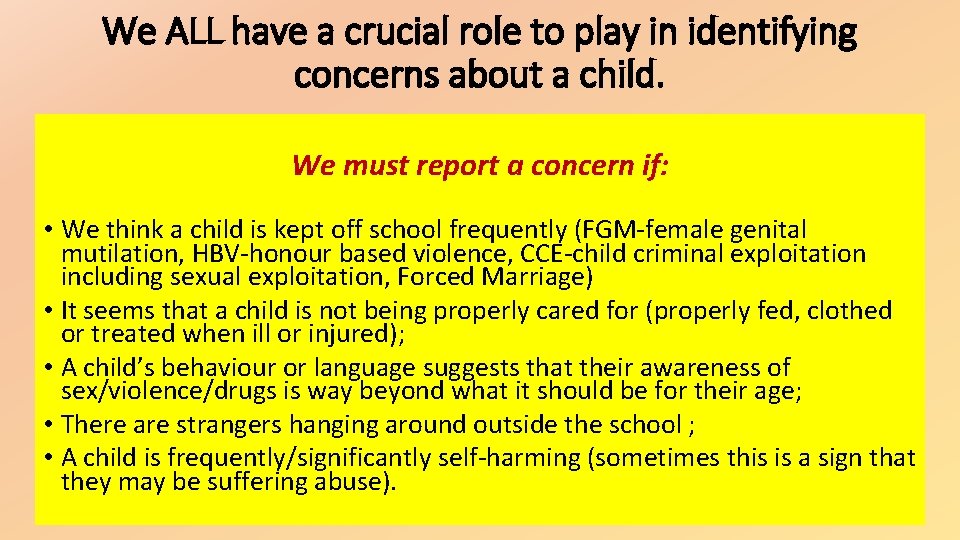
We ALL have a crucial role to play in identifying concerns about a child. We must report a concern if: • We think a child is kept off school frequently (FGM-female genital mutilation, HBV-honour based violence, CCE-child criminal exploitation including sexual exploitation, Forced Marriage) • It seems that a child is not being properly cared for (properly fed, clothed or treated when ill or injured); • A child’s behaviour or language suggests that their awareness of sex/violence/drugs is way beyond what it should be for their age; • There are strangers hanging around outside the school ; • A child is frequently/significantly self-harming (sometimes this is a sign that they may be suffering abuse).
Supporting a safeguarding disclosure/concern from a child or adult… • Refer all concerns, queries or disclosures to the DSL/DDSL in the first instance. • If the DSL/DDSL are not available any member of the wider safeguarding team must be contacted for further guidance. • KCSIE 2020 states that in the unlikely event that there are no DSL’s are on site staff must know how to refer a disclosure/concern to Children’s Services (C-SPA). Reigate School’s Safeguarding Team
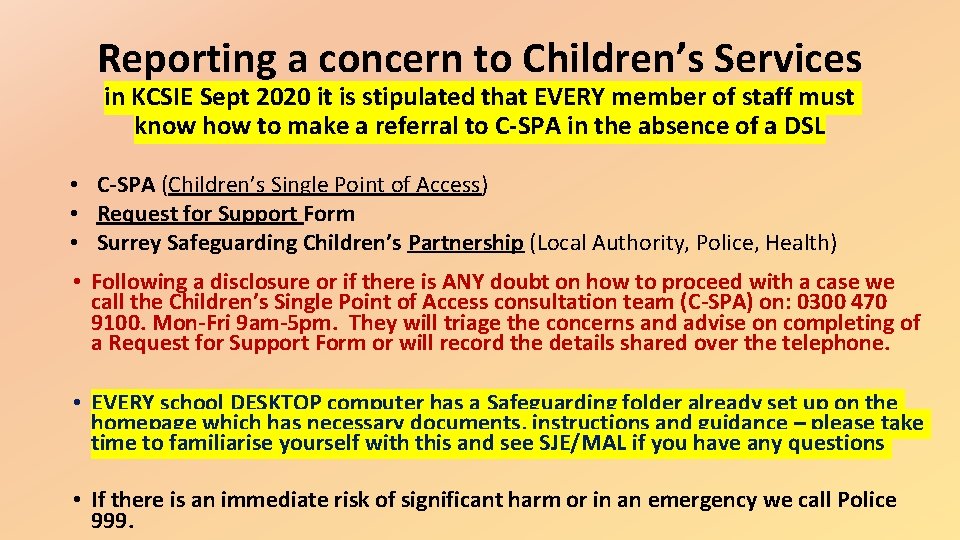
Reporting a concern to Children’s Services in KCSIE Sept 2020 it is stipulated that EVERY member of staff must know how to make a referral to C-SPA in the absence of a DSL • C-SPA (Children’s Single Point of Access) • Request for Support Form • Surrey Safeguarding Children’s Partnership (Local Authority, Police, Health) • Following a disclosure or if there is ANY doubt on how to proceed with a case we call the Children’s Single Point of Access consultation team (C-SPA) on: 0300 470 9100. Mon-Fri 9 am-5 pm. They will triage the concerns and advise on completing of a Request for Support Form or will record the details shared over the telephone. • EVERY school DESKTOP computer has a Safeguarding folder already set up on the homepage which has necessary documents, instructions and guidance – please take time to familiarise yourself with this and see SJE/MAL if you have any questions • If there is an immediate risk of significant harm or in an emergency we call Police 999.
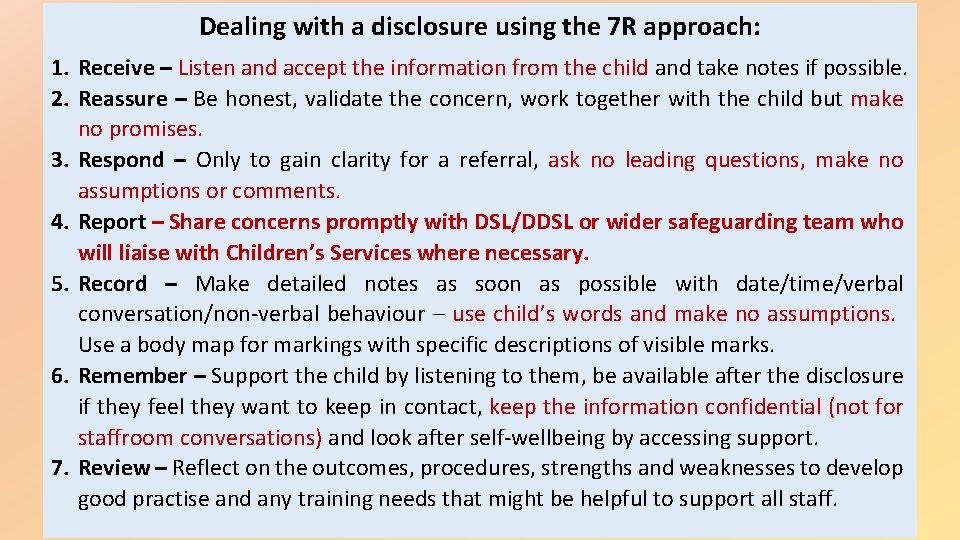
Dealing with a disclosure using the 7 R approach: 1. Receive – Listen and accept the information from the child and take notes if possible. 2. Reassure – Be honest, validate the concern, work together with the child but make no promises. 3. Respond – Only to gain clarity for a referral, ask no leading questions, make no assumptions or comments. 4. Report – Share concerns promptly with DSL/DDSL or wider safeguarding team who will liaise with Children’s Services where necessary. 5. Record – Make detailed notes as soon as possible with date/time/verbal conversation/non-verbal behaviour – use child’s words and make no assumptions. Use a body map for markings with specific descriptions of visible marks. 6. Remember – Support the child by listening to them, be available after the disclosure if they feel they want to keep in contact, keep the information confidential (not for staffroom conversations) and look after self-wellbeing by accessing support. 7. Review – Reflect on the outcomes, procedures, strengths and weaknesses to develop good practise and any training needs that might be helpful to support all staff.
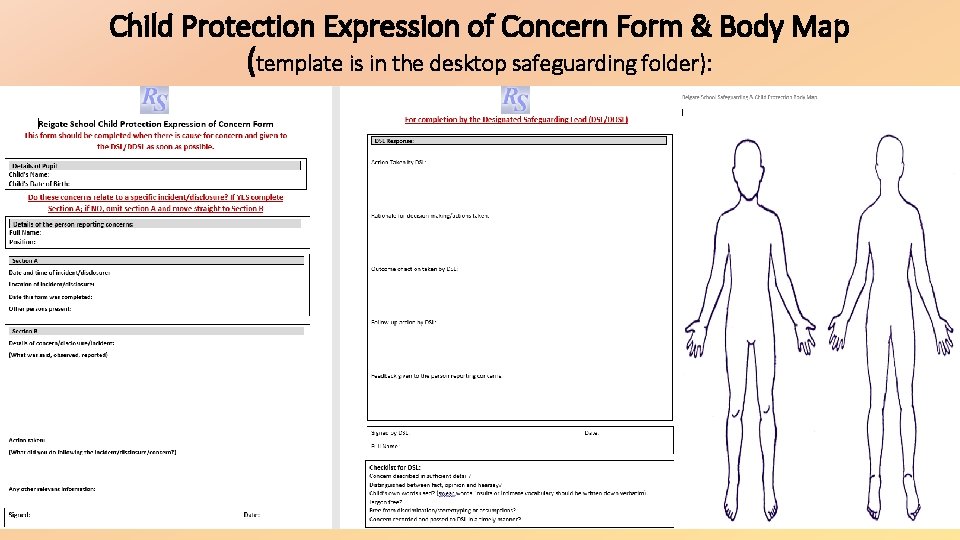
Child Protection Expression of Concern Form & Body Map (template is in the desktop safeguarding folder):
Key Disclosure Actions to Avoid: The person receiving the disclosure should not: • Panic… • Allow their shock or distaste to show…. • Probe for more information than is offered speculate or make assumptions…… • Make negative comments about the alleged abuser or approach/contact the alleged abuser…. . • Make promises or agree to keep secrets… • Enter into disguised compliance with adult/child….
Examples of what ineffective safeguarding might include: • Safeguarding allegations about staff members not being handled appropriately… • Children or particular groups of children, pupils do not feel safe in school…. . • Children have little confidence that the school will address concerns about their safety, including risk of abuse…… • Pupils are frequently missing from school or part of the school day, but this is not addressed appropriately by staff… • Incidents of bullying or prejudice and discriminatory behaviour are common…….
Everyday Safeguarding at Reigate School includes: • A clearly defined and visible Safeguarding Team including a Lead DSL/DDSL. • An updated Safeguarding & Child Protection Policy with available on the school website and in key areas of the school for staff/visitor access. • Termly safeguarding assemblies delivered to all year groups by members of Safeguarding and Pastoral Teams. • Monthly pastoral care meetings with a safeguarding and child protection supported by an internal panel of staff (DSL/DDSL/SENCO). • Open and transparent safeguarding conversations with students, parents/carers and staff to normalise expectations and improve outcomes. • Safeguarding posters in all classrooms and dedicated noticeboards signposting channels of support. Reception photo ID of DSL/DDSL. • New Safeguarding and Attendance hub every Tuesday Week 2, 3. 154. 30 pm • Health & Safety (fire drill, lock down), safer recruitment, DBS, attendance/truancy calls. • Community multi-agency partnerships through JAG, CHa. RMM, ASB Forum, Reigate & Redhill Local Family Partnership.
What children at Reigate School can expect when they make a disclosure: • They can expect that they will be taken seriously if they ever need to tell a member of staff that they are being harmed/neglected in some way. • They can expect that their safety will be our immediate concern. The DSL/DDSL will pass on any concerns to social workers and/or the police, and will work with them to help make sure that they and other children, where necessary, are safe. • They can expect to be asked for their views by other professionals on what they want to happen on important decisions in their life - like where they should live and who they are able to see. • They can expect to see different professionals working well together to do what is best for them. • They can expect to be kept informed of any developments or changes to the outcome of their disclosure and have a named member of the Safeguarding Team to liaise with. • They can also expect that their life will not be made any worse because they had the courage to come forward and speak out against their situation. • They can expect to continue to have clear boundaries and high expectations and be supported, encouraged and praised by staff at Reigate School.
Finally……If you have any questions or concerns that arise from this training please speak to MAL/SJE. REMINDERS: • In addition to this training please be familiar with the school safeguarding policy and addendum. Please also be familiar with the C-SPA referral process the details and procedures are saved in the desktop Safeguarding folder. • Last point…. if in doubt always ask – we will always listen and offer support/guidance.