Work and Energy Physics Chapter 5 5 1
- Slides: 33
Work and Energy Physics Chapter 5
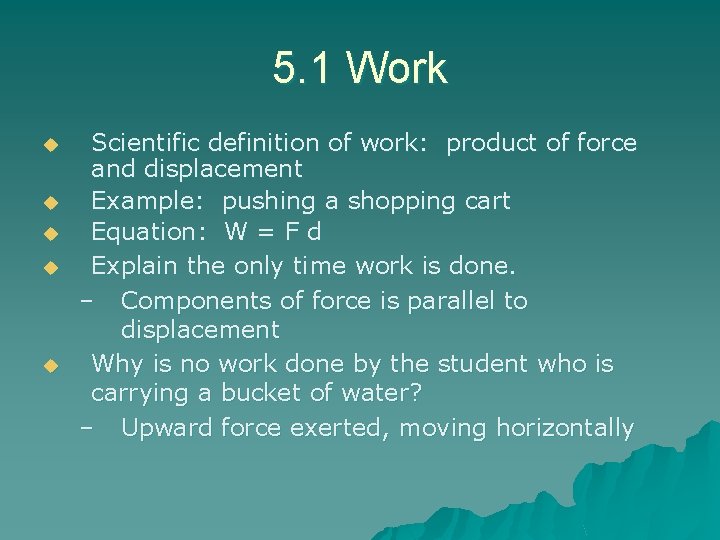
5. 1 Work u u u Scientific definition of work: product of force and displacement Example: pushing a shopping cart Equation: W = F d Explain the only time work is done. – Components of force is parallel to displacement Why is no work done by the student who is carrying a bucket of water? – Upward force exerted, moving horizontally
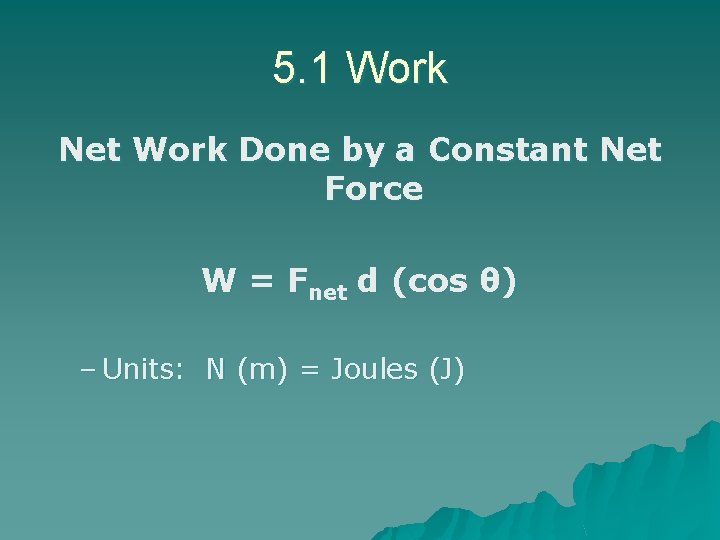
5. 1 Work Net Work Done by a Constant Net Force W = Fnet d (cos θ) – Units: N (m) = Joules (J)
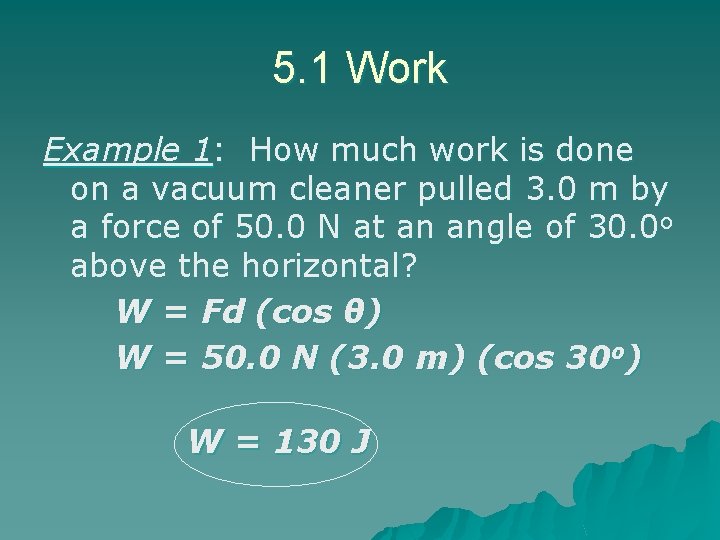
5. 1 Work Example 1: How much work is done on a vacuum cleaner pulled 3. 0 m by a force of 50. 0 N at an angle of 30. 0 o above the horizontal? W = Fd (cos θ) W = 50. 0 N (3. 0 m) (cos 30 o) W = 130 J
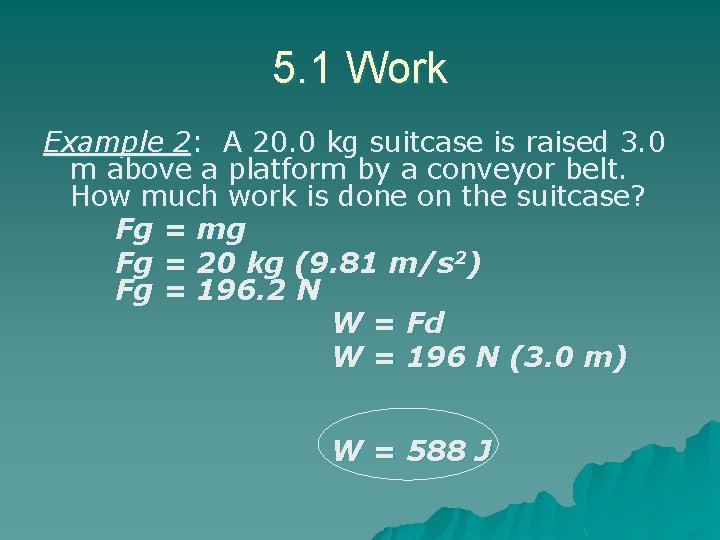
5. 1 Work Example 2: A 20. 0 kg suitcase is raised 3. 0 m above a platform by a conveyor belt. How much work is done on the suitcase? Fg = mg Fg = 20 kg (9. 81 m/s 2) Fg = 196. 2 N W = Fd W = 196 N (3. 0 m) W = 588 J
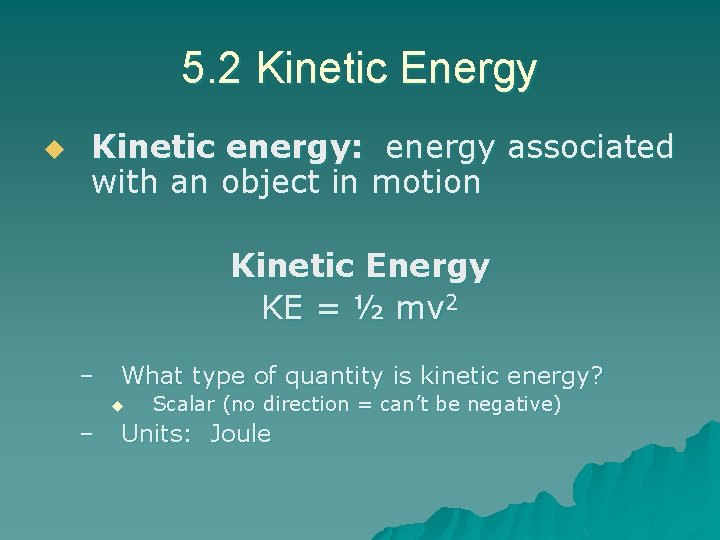
5. 2 Kinetic Energy u Kinetic energy: energy associated with an object in motion Kinetic Energy KE = ½ mv 2 – What type of quantity is kinetic energy? u – Scalar (no direction = can’t be negative) Units: Joule
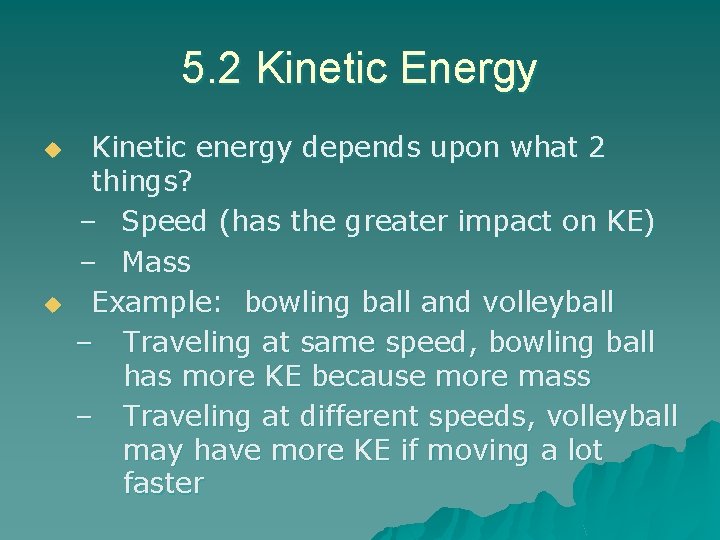
5. 2 Kinetic Energy u u Kinetic energy depends upon what 2 things? – Speed (has the greater impact on KE) – Mass Example: bowling ball and volleyball – Traveling at same speed, bowling ball has more KE because more mass – Traveling at different speeds, volleyball may have more KE if moving a lot faster
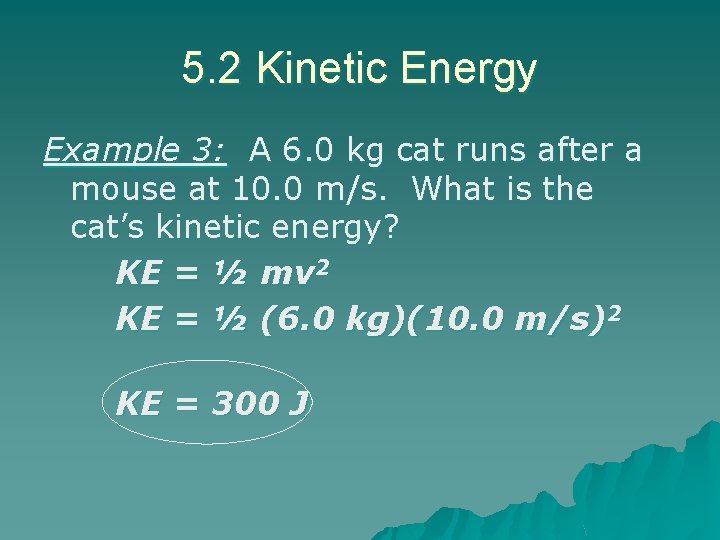
5. 2 Kinetic Energy Example 3: A 6. 0 kg cat runs after a mouse at 10. 0 m/s. What is the cat’s kinetic energy? KE = ½ mv 2 KE = ½ (6. 0 kg)(10. 0 m/s)2 KE = 300 J
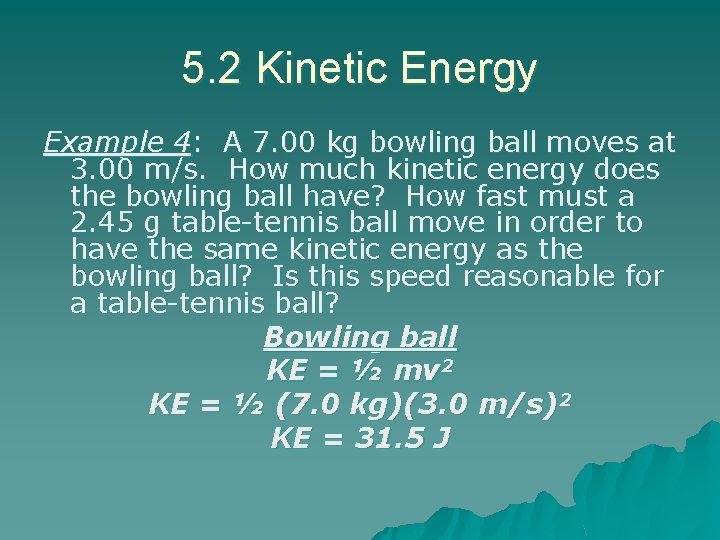
5. 2 Kinetic Energy Example 4: A 7. 00 kg bowling ball moves at 3. 00 m/s. How much kinetic energy does the bowling ball have? How fast must a 2. 45 g table-tennis ball move in order to have the same kinetic energy as the bowling ball? Is this speed reasonable for a table-tennis ball? Bowling ball KE = ½ mv 2 KE = ½ (7. 0 kg)(3. 0 m/s)2 KE = 31. 5 J
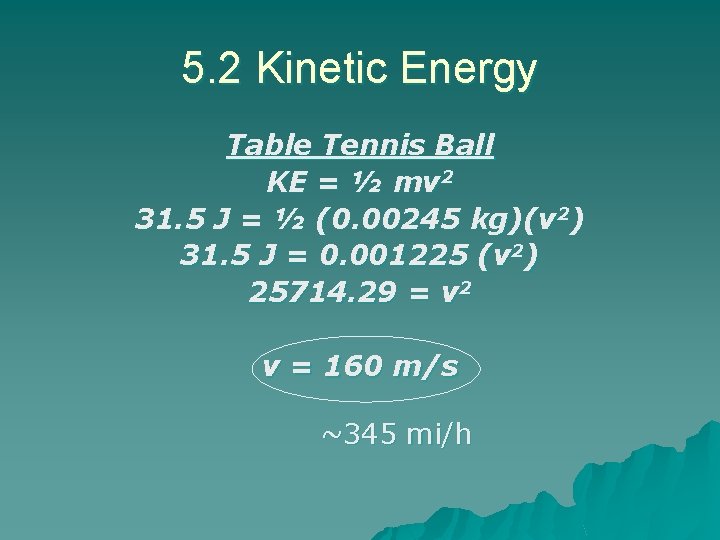
5. 2 Kinetic Energy Table Tennis Ball KE = ½ mv 2 31. 5 J = ½ (0. 00245 kg)(v 2) 31. 5 J = 0. 001225 (v 2) 25714. 29 = v 2 v = 160 m/s ~345 mi/h
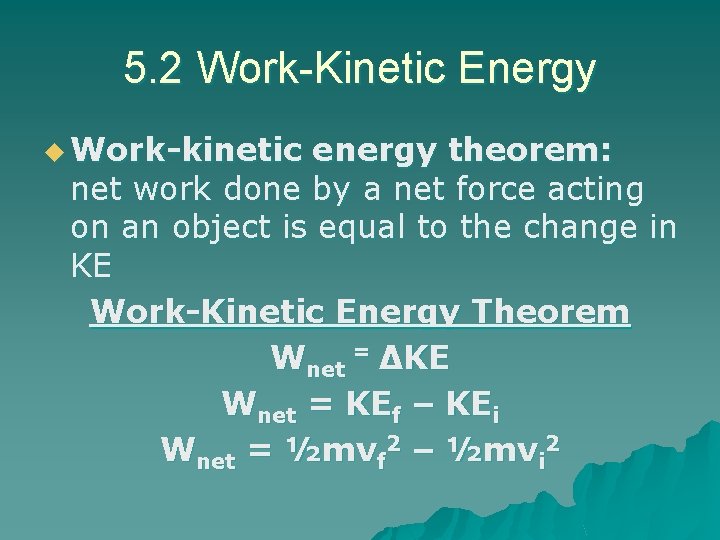
5. 2 Work-Kinetic Energy u Work-kinetic energy theorem: net work done by a net force acting on an object is equal to the change in KE Work-Kinetic Energy Theorem Wnet = ΔKE Wnet = KEf – KEi Wnet = ½mvf 2 – ½mvi 2
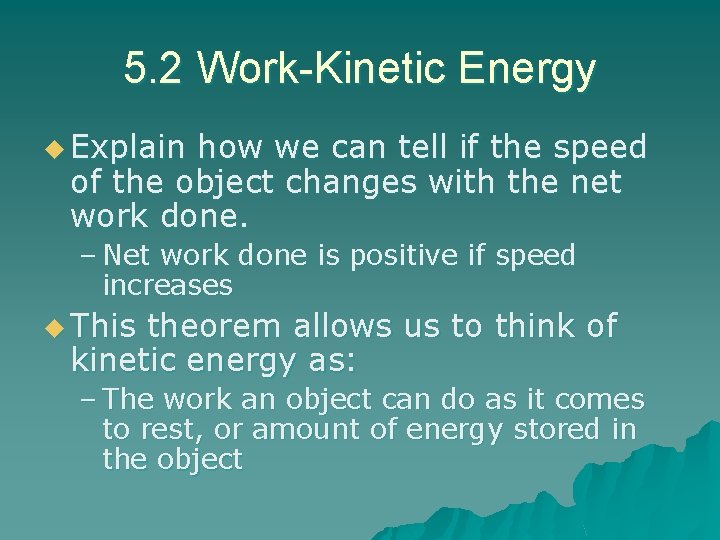
5. 2 Work-Kinetic Energy u Explain how we can tell if the speed of the object changes with the net work done. – Net work done is positive if speed increases u This theorem allows us to think of kinetic energy as: – The work an object can do as it comes to rest, or amount of energy stored in the object
5. 2 Work-Kinetic Energy u Example: – Moving hammer has KE and can do work on the nail. – The KE is transferred to work on the nail – The hammer can only do as much work as it has KE u 500 J of KE is converted to 500 J of work
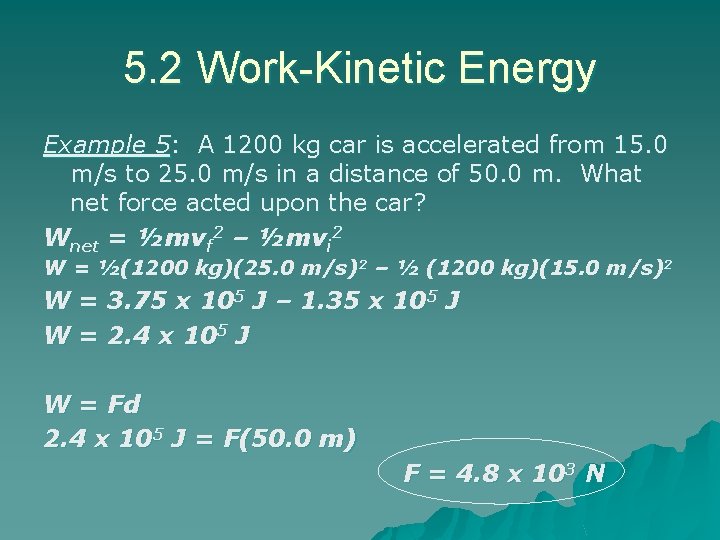
5. 2 Work-Kinetic Energy Example 5: A 1200 kg car is accelerated from 15. 0 m/s to 25. 0 m/s in a distance of 50. 0 m. What net force acted upon the car? Wnet = ½mvf 2 – ½mvi 2 W = ½(1200 kg)(25. 0 m/s)2 – ½ (1200 kg)(15. 0 m/s)2 W = 3. 75 x 105 J – 1. 35 x 105 J W = 2. 4 x 10⁵ J W = Fd 2. 4 x 10⁵ J = F(50. 0 m) F = 4. 8 x 10³ N
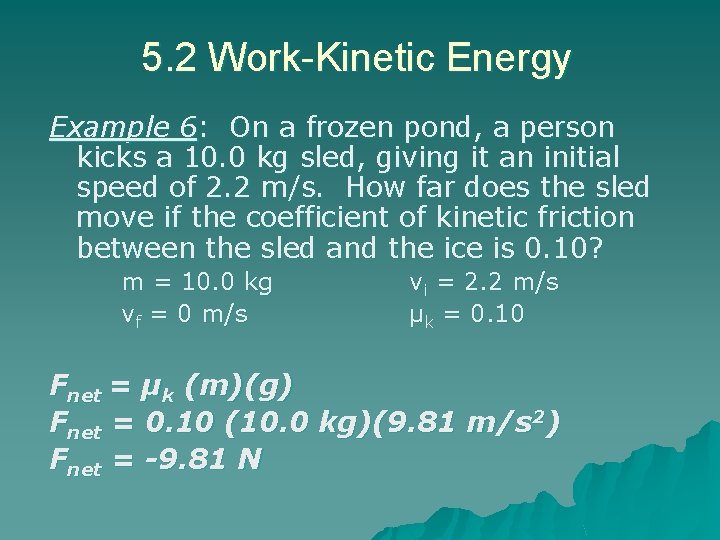
5. 2 Work-Kinetic Energy Example 6: On a frozen pond, a person kicks a 10. 0 kg sled, giving it an initial speed of 2. 2 m/s. How far does the sled move if the coefficient of kinetic friction between the sled and the ice is 0. 10? m = 10. 0 kg vf = 0 m/s vi = 2. 2 m/s µk = 0. 10 Fnet = µk (m)(g) Fnet = 0. 10 (10. 0 kg)(9. 81 m/s 2) Fnet = -9. 81 N
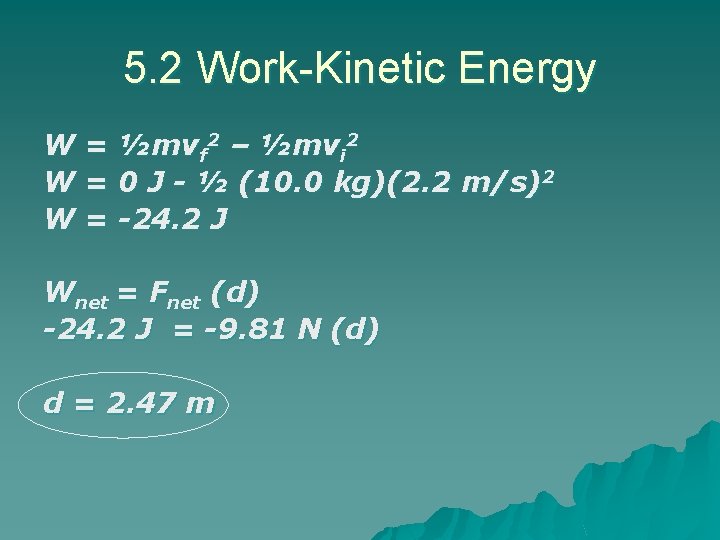
5. 2 Work-Kinetic Energy W = ½mvf 2 – ½mvi 2 W = 0 J - ½ (10. 0 kg)(2. 2 m/s)2 W = -24. 2 J Wnet = Fnet (d) -24. 2 J = -9. 81 N (d) d = 2. 47 m
5. 2 Potential Energy u Potential energy: the amount of energy stored in an object u What two things does the potential energy depend upon? – Properties of the object (ex: mass) – Interaction with environment (ex: gravity)
5. 2 Potential Energy u Gravitational PE: PE associated with an object due to the position of object relative to Earth or some gravitational source Gravitational Potential Energy PEg = mgh
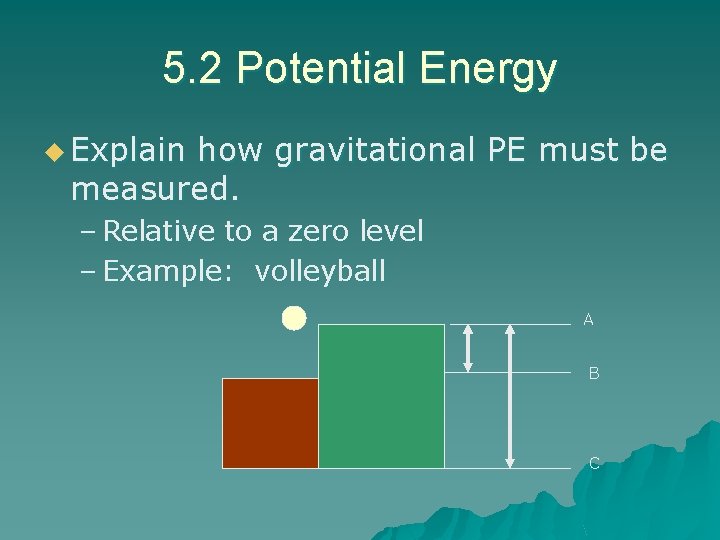
5. 2 Potential Energy u Explain how gravitational PE must be measured. – Relative to a zero level – Example: volleyball A B C
5. 2 Potential Energy Elastic PE: PE in a stretched/compressed elastic object u Relaxed length: length when no external forces are acting on the spring u Elastic Potential Energy PEelastic= ½ k x 2 k = spring constant x = how far stretched/compressed
5. 2 Potential Energy u Spring constant: how resistant a spring is to being compressed or stretched – Small constant: flexible spring – Large constant: stiff spring
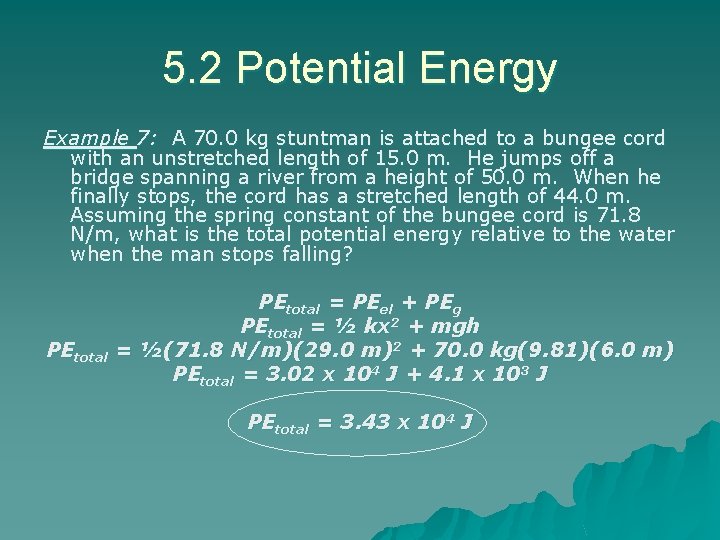
5. 2 Potential Energy Example 7: A 70. 0 kg stuntman is attached to a bungee cord with an unstretched length of 15. 0 m. He jumps off a bridge spanning a river from a height of 50. 0 m. When he finally stops, the cord has a stretched length of 44. 0 m. Assuming the spring constant of the bungee cord is 71. 8 N/m, what is the total potential energy relative to the water when the man stops falling? PEtotal = PEel + PEg PEtotal = ½ kx 2 + mgh PEtotal = ½(71. 8 N/m)(29. 0 m)2 + 70. 0 kg(9. 81)(6. 0 m) PEtotal = 3. 02 x 104 J + 4. 1 x 10³ J PEtotal = 3. 43 x 104 J
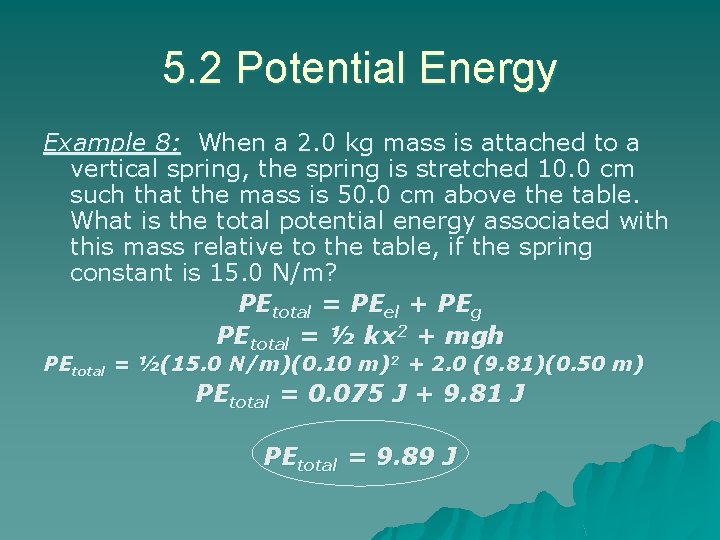
5. 2 Potential Energy Example 8: When a 2. 0 kg mass is attached to a vertical spring, the spring is stretched 10. 0 cm such that the mass is 50. 0 cm above the table. What is the total potential energy associated with this mass relative to the table, if the spring constant is 15. 0 N/m? PEtotal = PEel + PEg PEtotal = ½ kx 2 + mgh PEtotal = ½(15. 0 N/m)(0. 10 m)2 + 2. 0 (9. 81)(0. 50 m) PEtotal = 0. 075 J + 9. 81 J PEtotal = 9. 89 J
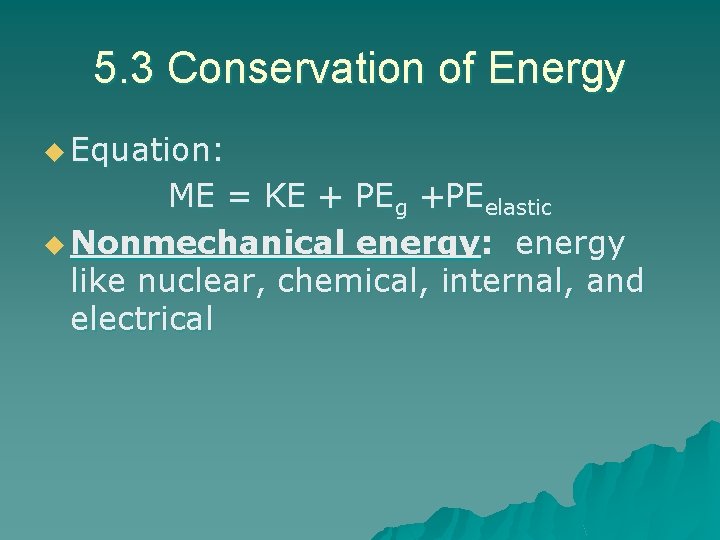
5. 3 Conservation of Energy u Mechanical energy: sum of kinetic energy and all forms of potential energy u Describe all forms of energy in a pendulum clock. – KE when pendulum is swinging – PEg when at different heights – PEelastic with springs, gears, etc.
5. 3 Conservation of Energy u Equation: ME = KE + PEg +PEelastic u Nonmechanical energy: energy like nuclear, chemical, internal, and electrical
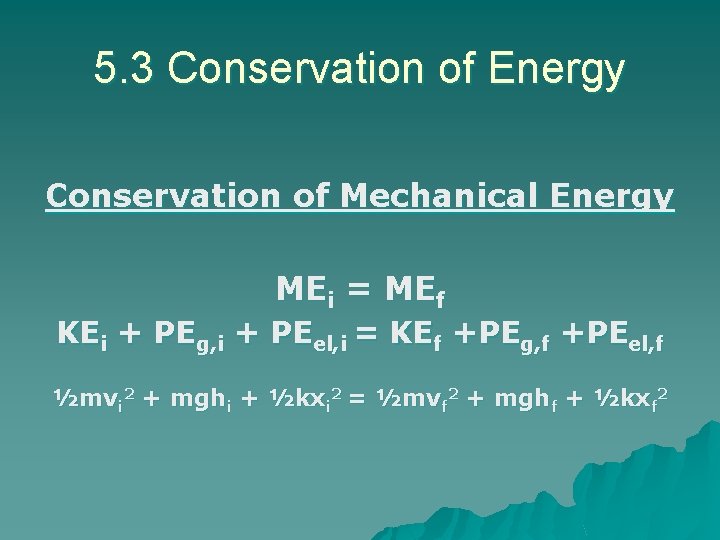
5. 3 Conservation of Energy Conservation of Mechanical Energy MEi = MEf KEi + PEg, i + PEel, i = KEf +PEg, f +PEel, f ½mvi 2 + mghi + ½kxi 2 = ½mvf 2 + mghf + ½kxf 2
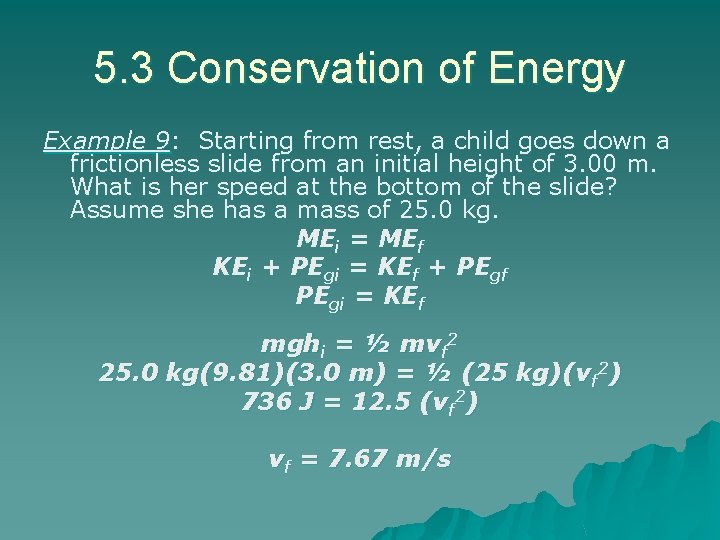
5. 3 Conservation of Energy Example 9: Starting from rest, a child goes down a frictionless slide from an initial height of 3. 00 m. What is her speed at the bottom of the slide? Assume she has a mass of 25. 0 kg. MEi = MEf KEi + PEgi = KEf + PEgf PEgi = KEf mghi = ½ mvf 2 25. 0 kg(9. 81)(3. 0 m) = ½ (25 kg)(vf 2) 736 J = 12. 5 (vf 2) vf = 7. 67 m/s
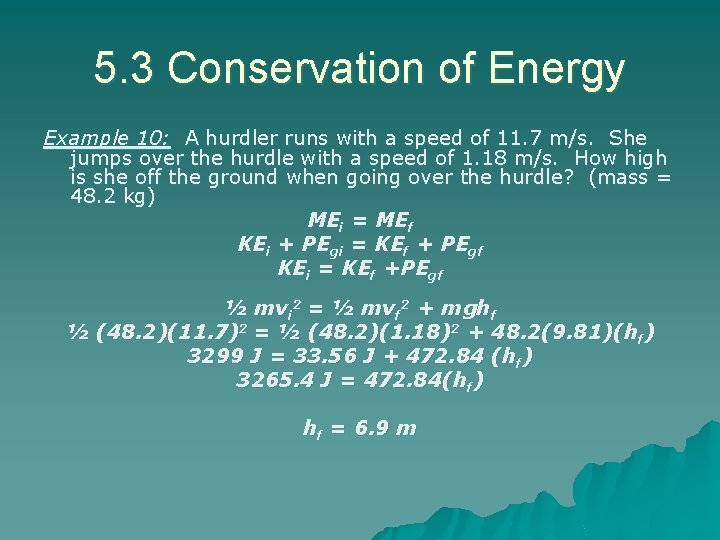
5. 3 Conservation of Energy Example 10: A hurdler runs with a speed of 11. 7 m/s. She jumps over the hurdle with a speed of 1. 18 m/s. How high is she off the ground when going over the hurdle? (mass = 48. 2 kg) MEi = MEf KEi + PEgi = KEf + PEgf KEi = KEf +PEgf ½ mvi 2 = ½ mvf 2 + mghf ½ (48. 2)(11. 7)2 = ½ (48. 2)(1. 18)2 + 48. 2(9. 81)(hf) 3299 J = 33. 56 J + 472. 84 (hf) 3265. 4 J = 472. 84(hf) hf = 6. 9 m
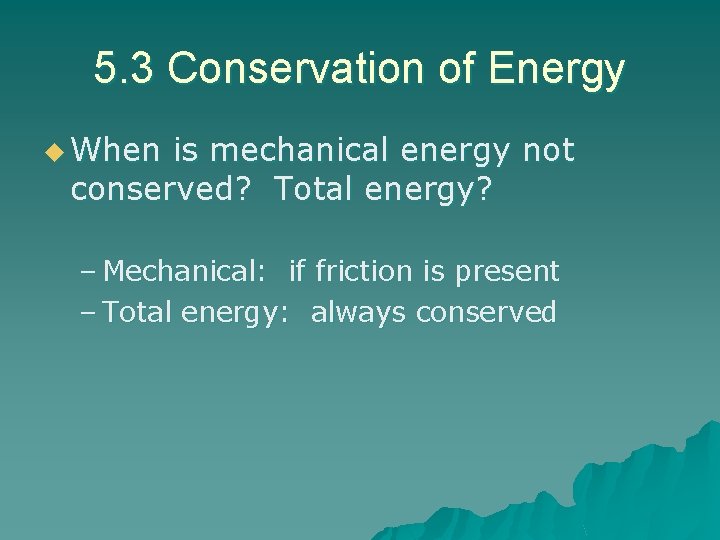
5. 3 Conservation of Energy u When is mechanical energy not conserved? Total energy? – Mechanical: if friction is present – Total energy: always conserved
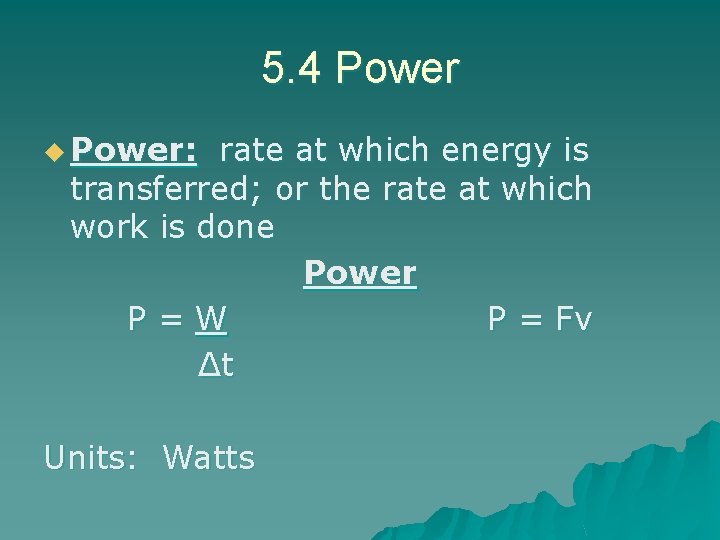
5. 4 Power u Power: rate at which energy is transferred; or the rate at which work is done Power P=W P = Fv Δt Units: Watts
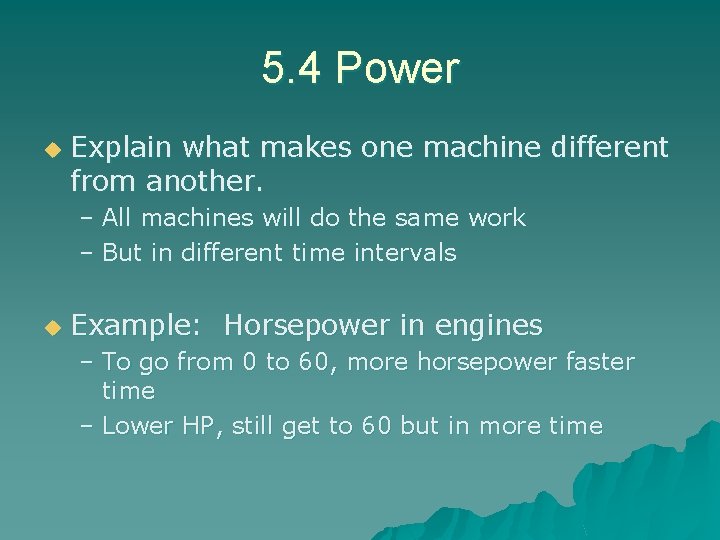
5. 4 Power u Explain what makes one machine different from another. – All machines will do the same work – But in different time intervals u Example: Horsepower in engines – To go from 0 to 60, more horsepower faster time – Lower HP, still get to 60 but in more time
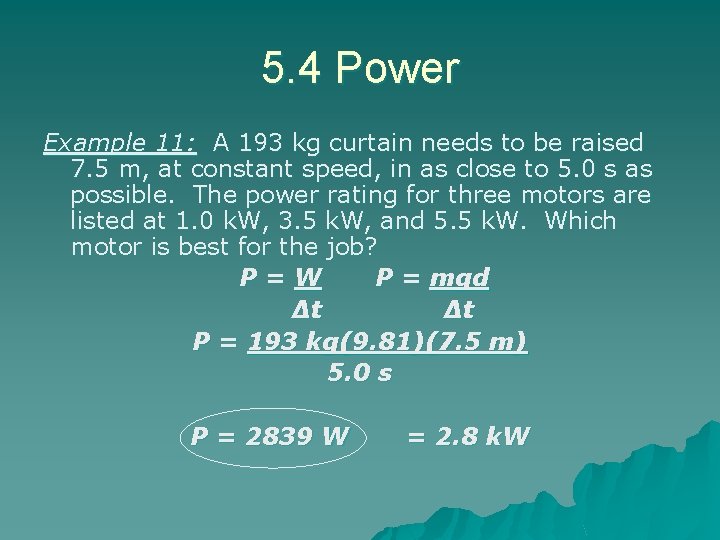
5. 4 Power Example 11: A 193 kg curtain needs to be raised 7. 5 m, at constant speed, in as close to 5. 0 s as possible. The power rating for three motors are listed at 1. 0 k. W, 3. 5 k. W, and 5. 5 k. W. Which motor is best for the job? P = W P = mgd Δt P = 193 kg(9. 81)(7. 5 m) 5. 0 s P = 2839 W = 2. 8 k. W
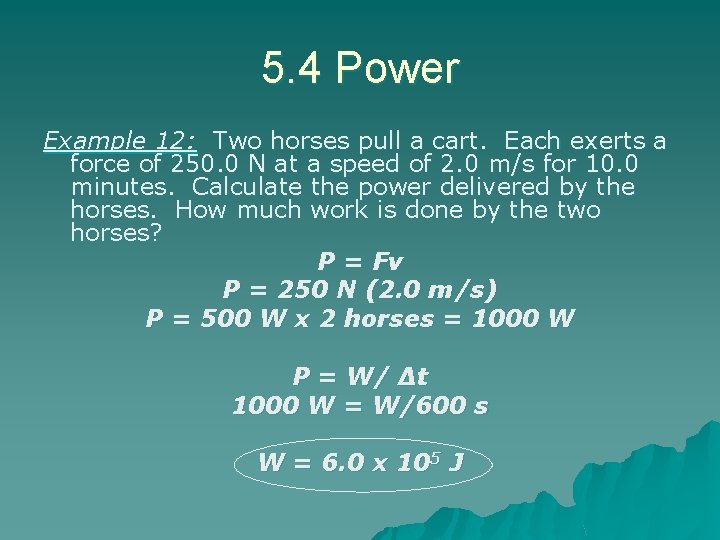
5. 4 Power Example 12: Two horses pull a cart. Each exerts a force of 250. 0 N at a speed of 2. 0 m/s for 10. 0 minutes. Calculate the power delivered by the horses. How much work is done by the two horses? P = Fv P = 250 N (2. 0 m/s) P = 500 W x 2 horses = 1000 W P = W/ Δt 1000 W = W/600 s W = 6. 0 x 105 J