White Dwarf Spectra and Atmospheres Tala Monroe A
- Slides: 27
White Dwarf Spectra and Atmospheres Tala Monroe A 540 Stellar Atmospheres Apr. 6, 2005
Outline • History • Current Classification Scheme • Spectra • Atmospheres • Spectral Evolution • Future Work
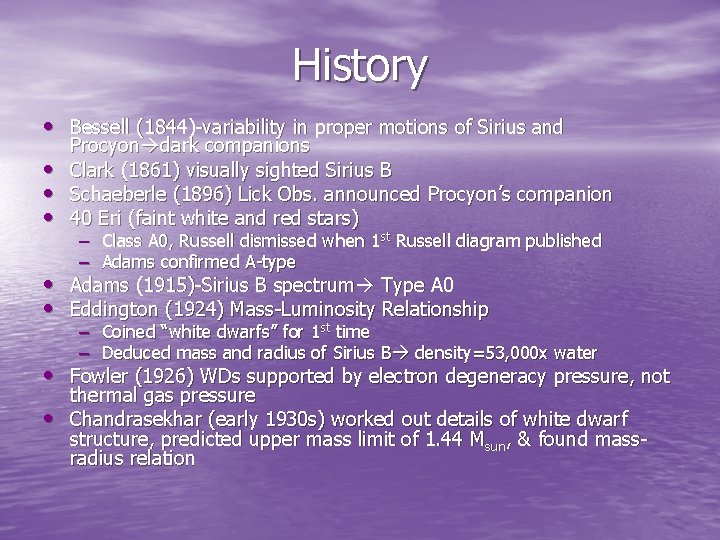
History • Bessell (1844)-variability in proper motions of Sirius and • • • Procyon dark companions Clark (1861) visually sighted Sirius B Schaeberle (1896) Lick Obs. announced Procyon’s companion 40 Eri (faint white and red stars) • • Adams (1915)-Sirius B spectrum Type A 0 Eddington (1924) Mass-Luminosity Relationship – Class A 0, Russell dismissed when 1 st Russell diagram published – Adams confirmed A-type – Coined “white dwarfs” for 1 st time – Deduced mass and radius of Sirius B density=53, 000 x water • Fowler (1926) WDs supported by electron degeneracy pressure, not • thermal gas pressure Chandrasekhar (early 1930 s) worked out details of white dwarf structure, predicted upper mass limit of 1. 44 Msun, & found massradius relation
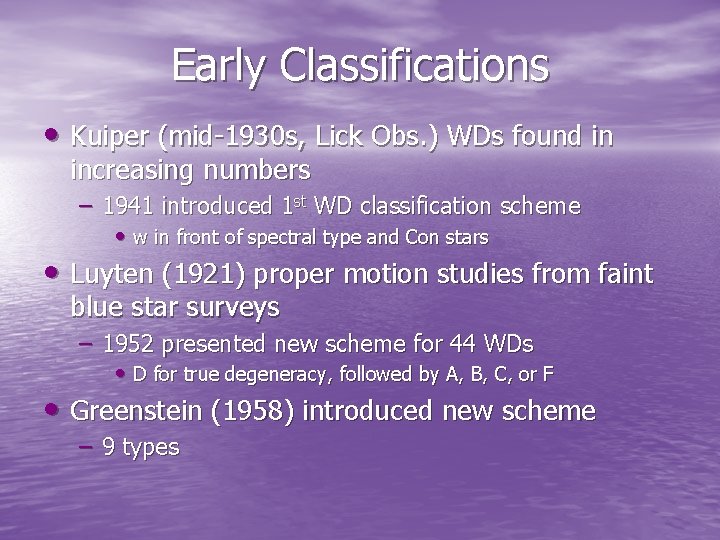
Early Classifications • Kuiper (mid-1930 s, Lick Obs. ) WDs found in increasing numbers – 1941 introduced 1 st WD classification scheme • w in front of spectral type and Con stars • Luyten (1921) proper motion studies from faint blue star surveys – 1952 presented new scheme for 44 WDs • D for true degeneracy, followed by A, B, C, or F • Greenstein (1958) introduced new scheme – 9 types
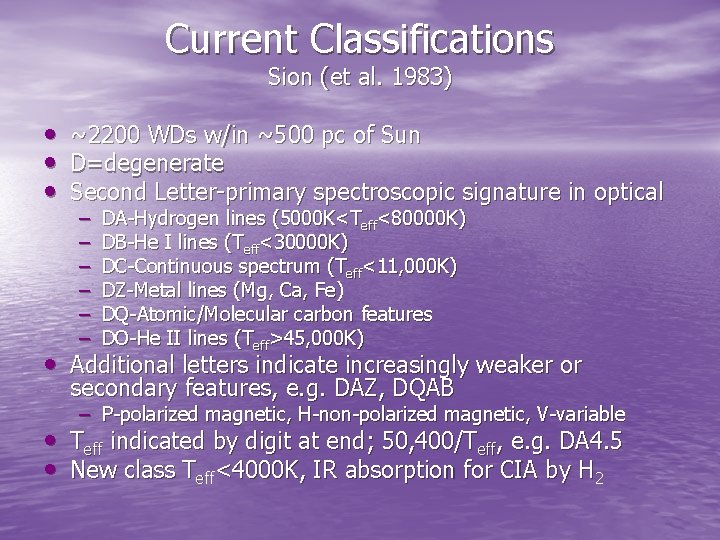
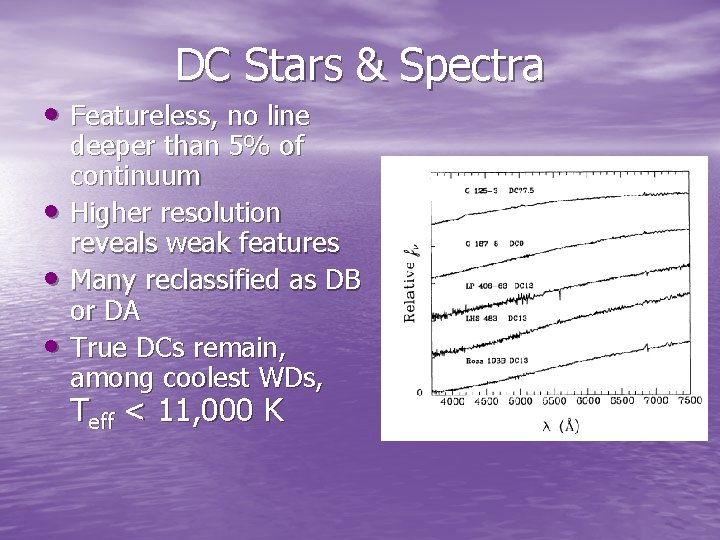
Current Classifications Sion (et al. 1983) • • • ~2200 WDs w/in ~500 pc of Sun D=degenerate Second Letter-primary spectroscopic signature in optical – – – DA-Hydrogen lines (5000 K<Teff<80000 K) DB-He I lines (Teff<30000 K) DC-Continuous spectrum (Teff<11, 000 K) DZ-Metal lines (Mg, Ca, Fe) DQ-Atomic/Molecular carbon features DO-He II lines (Teff>45, 000 K) • Additional letters indicate increasingly weaker or secondary features, e. g. DAZ, DQAB – P-polarized magnetic, H-non-polarized magnetic, V-variable • Teff indicated by digit at end; 50, 400/Teff, e. g. DA 4. 5 • New class Teff<4000 K, IR absorption for CIA by H 2
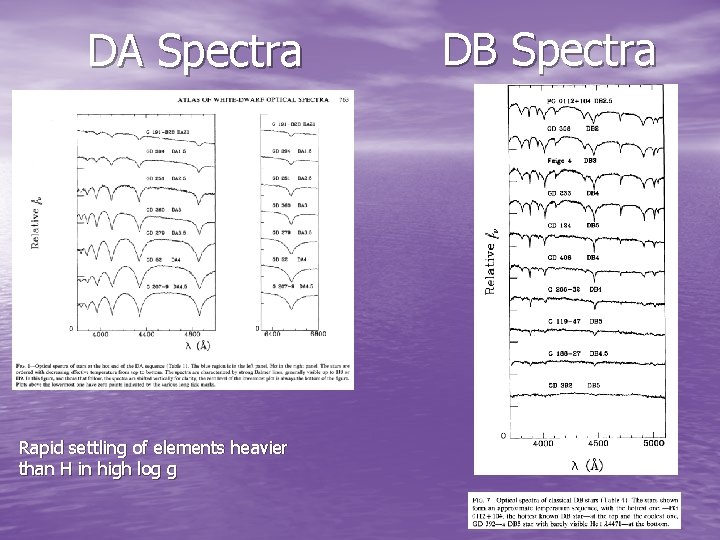
DA Spectra Rapid settling of elements heavier than H in high log g DB Spectra
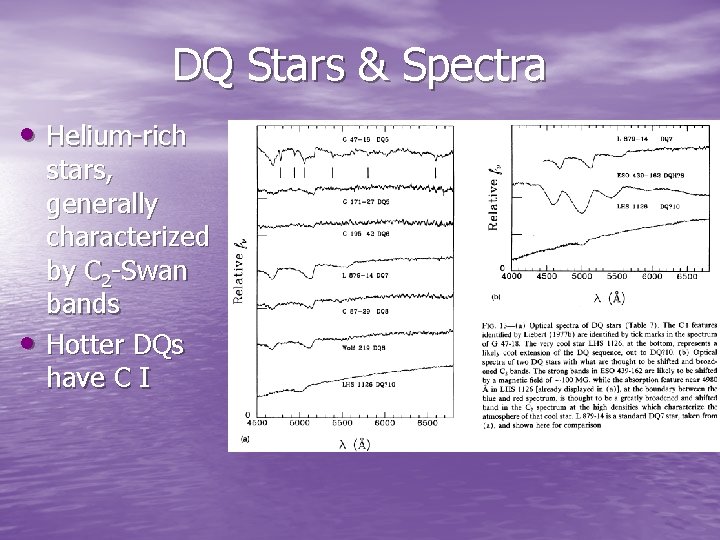
DQ Stars & Spectra • Helium-rich • stars, generally characterized by C 2 -Swan bands Hotter DQs have C I
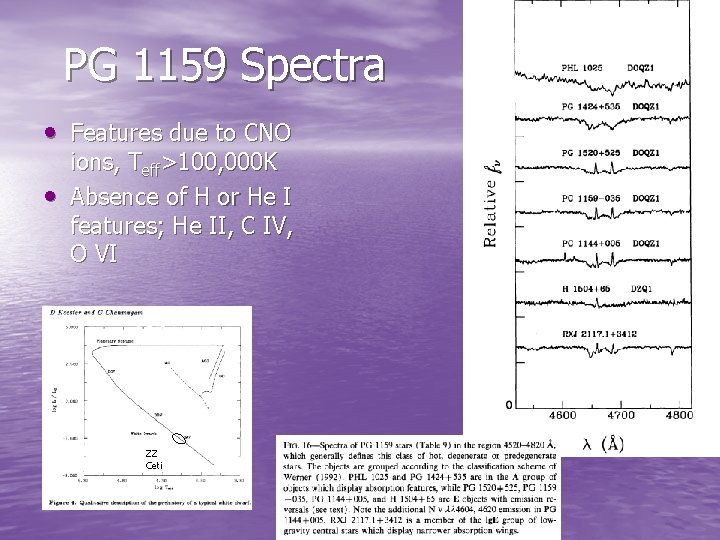
PG 1159 Spectra • Features due to CNO • ions, Teff>100, 000 K Absence of H or He I features; He II, C IV, O VI ZZ Ceti
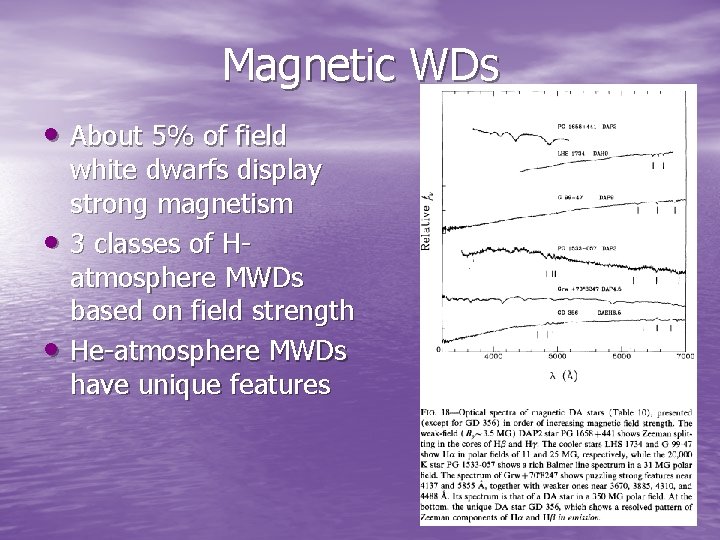
Magnetic WDs • About 5% of field • • white dwarfs display strong magnetism 3 classes of Hatmosphere MWDs based on field strength He-atmosphere MWDs have unique features
Basic Picture • 75% DA, 25% non-DA • Spectral classification provides info about • • principal constituent, with some T info Progenitors: Post-AGB stars, central stars of planetary nebulae (CSPN), hot subdwarfs Expected structure-stratified object with <M>~0. 6 Msun – C-O core, He-rich envelope, H-rich shell • O-Ne cores-most massive – Atmosphere contains <10 -14 M • Many WDs have pure H or He atmospheres • Thicknesses of H and He
Mechanisms in Atmosphere • Gravitational diffusion • Convection • Radiative levitation • Magnetism • Accretion • Wind-loss • T-sensitive T determines chemical abundances
Effects of Mechanisms • Diffusion & Settling – Gravitational separation leads to pure envelope of lightest element t<108 yr • But, observations show traces of heavier elements – radiative levitation – Cooler WDs result of recent accretion event • Radiative Levitation T>40 k. K – Radiative acceleration on heavy elements • Convection for T<12 k. K – – Convection zone forms and increases inward as star cools For He envelopes, convection begins at high T Mixing changes surface composition Need to couple models of atmospheres and interiors
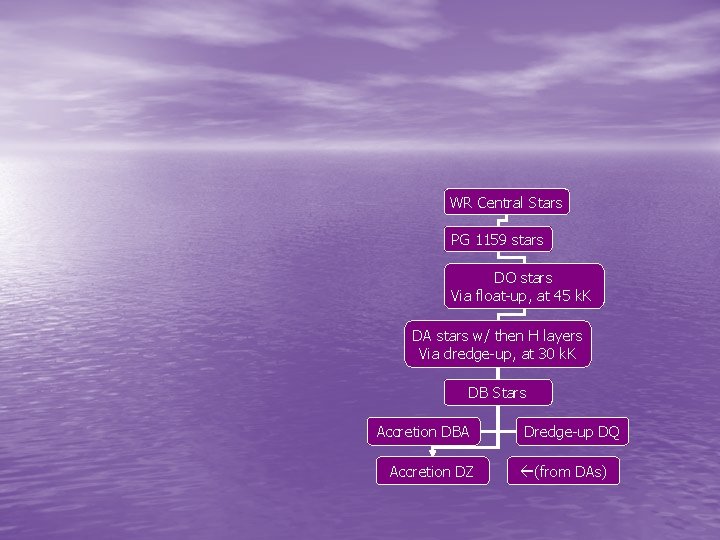
Statistics • T>45 k. K DA far outnumber DO – Ratio increases to about 30 k. K (diffusion) • DB gap in 45 k-30 k. K range – Float up of H • Always enough H to form atmosphere? – Dredge up of He • T<30 k. K He convection zone massive engulfs outer H layer if thin – 30 k. K-12 k. K 25% stars revert to DB spectral type (edge of ZZ Ceti Strip) – Convection zone increases as T decreases. At T~11 k. K, numbers of DAs and non-DAs are ~equal (ZZ Ceti Strip) • ‘Non-DA gap’ for 5000 -6000 K dearth of He atmospheres
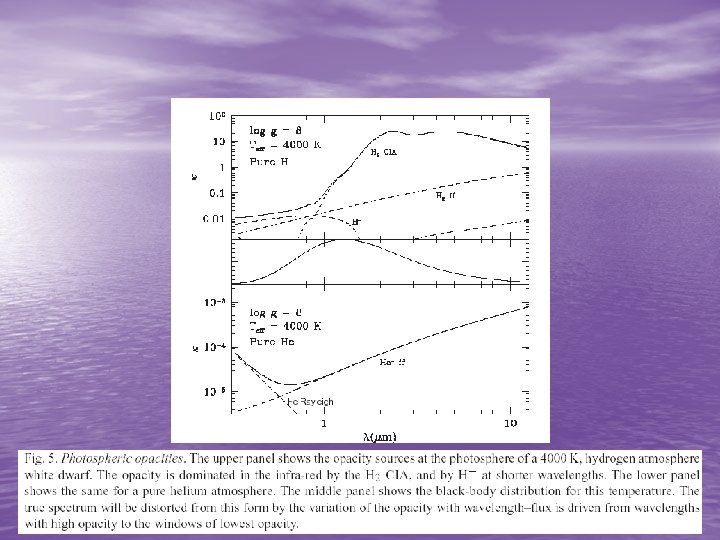
Spectral Evolution • Gaps individual WDs undergo spectral evolution – Compositions change, DA DB DA, as T changes • Evolution of convection zone? Accretion? • Explanation of ‘non-DA gap’-opacity? Bergeron et al. – Low opacity of He I means small amounts of H dominates opacity – H- atomic energy levels destroyed when H added to dense atmosphere-reduces H opacity contribution – Must accrete a lot of H to make difference in photospheric conditions DA (fixes 6000 K edge) – Re-appearance of DBs at 5000 K b/c convection zone grows, H is diluted with additional He – This fails! Destruction of H- bound level produces free e-, which provide opacity
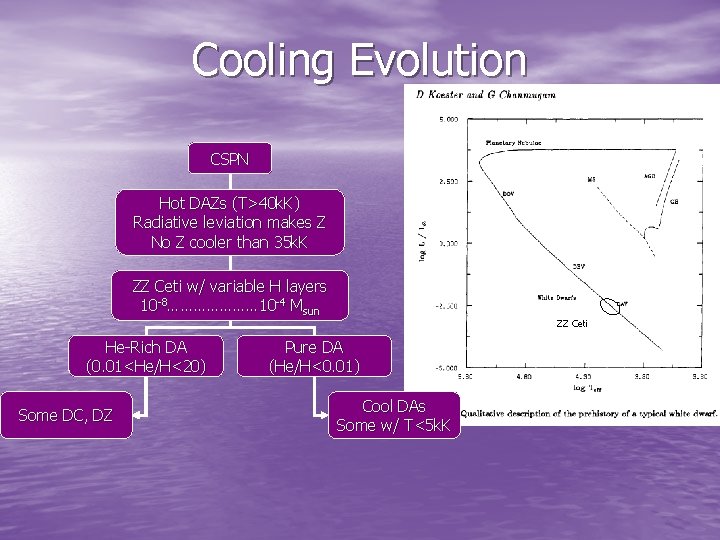
Cooling Evolution CSPN Hot DAZs (T>40 k. K) Radiative leviation makes Z No Z cooler than 35 k. K ZZ Ceti w/ variable H layers 10 -8………………… 10 -4 Msun He-Rich DA (0. 01<He/H<20) Some DC, DZ ZZ Ceti Pure DA (He/H<0. 01) Cool DAs Some w/ T<5 k. K
Model Atmospheres • Plane-parallel geometry • Hydrostatic equilibrium (mass loss rates) • NLTE • Stratisfied Atmospheres – Parameters: degree of ionization, intensity of radiation field • Make radiative cross sections of each element depth dependent • Convection – Parameters of Mixing Length theory
Future/Active Work • Exact masses of H and He layers – Thin or Thick Envelopes • Explanations for DB-gap • Explanations for ‘non-DA gap’ • DAs outnumber He-rich WDs, yet progenitor PNN have ~equal numbers of H - and He-rich stars. What rids degenerates of He? • Couple core & atmosphere models
References • Dreizler, S. 1999, Rv. MA, 12, 255 D • Fontaine et al. 2001, PASP, 113, 409 • Hansen, B. 2004, Physics Reports, 399, 1 • Hansen, B & Liebert, J. 2003 ARA&A, 41, 465 • Hearnshaw, J. B. 1986, The Analysis of Starlight. • Koester, D. & Chanmugam, G. 1990, RPPh, 53, 837 K • Shipman, H. 1997, White Dwarfs, p. 165. • Kluwer Wesemael et al. 1993, PASP, 105, 761
WR Central Stars PG 1159 stars DO stars Via float-up, at 45 k. K DA stars w/ then H layers Via dredge-up, at 30 k. K DB Stars Accretion DBA Accretion DZ Dredge-up DQ (from DAs)
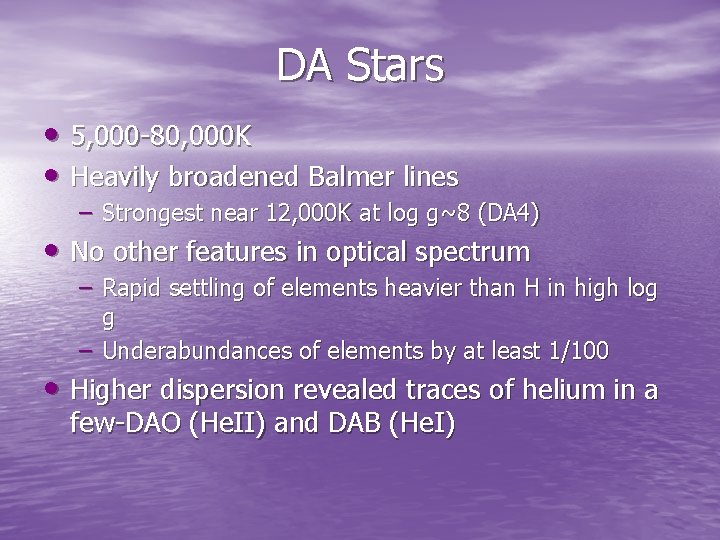
DA Stars • 5, 000 -80, 000 K • Heavily broadened Balmer lines – Strongest near 12, 000 K at log g~8 (DA 4) • No other features in optical spectrum – Rapid settling of elements heavier than H in high log g – Underabundances of elements by at least 1/100 • Higher dispersion revealed traces of helium in a few-DAO (He. II) and DAB (He. I)
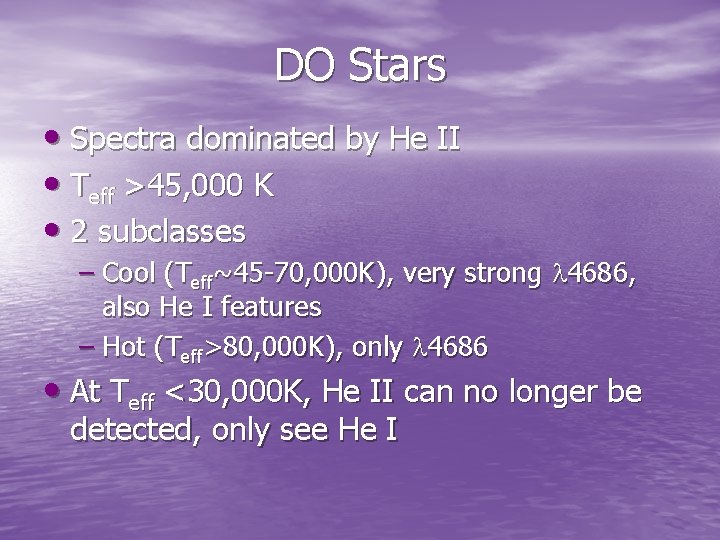
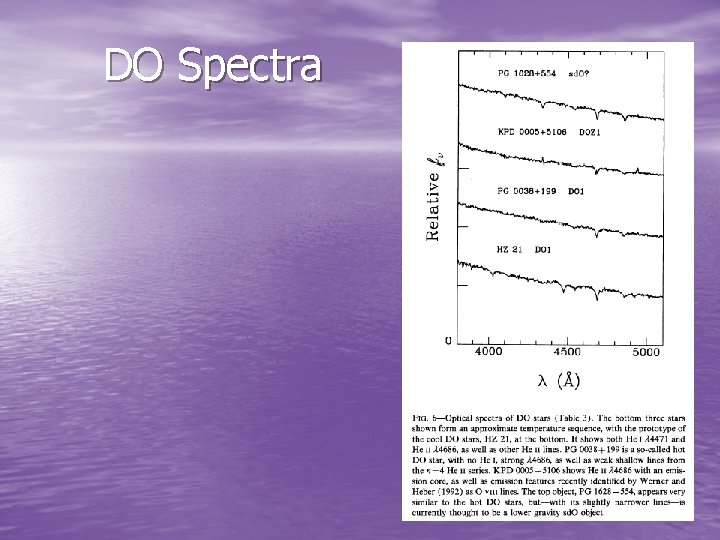
DO Stars • Spectra dominated by He II • Teff >45, 000 K • 2 subclasses – Cool (Teff~45 -70, 000 K), very strong l 4686, also He I features – Hot (Teff>80, 000 K), only l 4686 • At Teff <30, 000 K, He II can no longer be detected, only see He I
DO Spectra
DB Stars • Classical DB stars have rich spectra of He I in optical, with nothing else • Coolest DB stars merge with He-rich DQ stars • Many DBs have H, metals (Ca II), and carbon (C I and C 2)
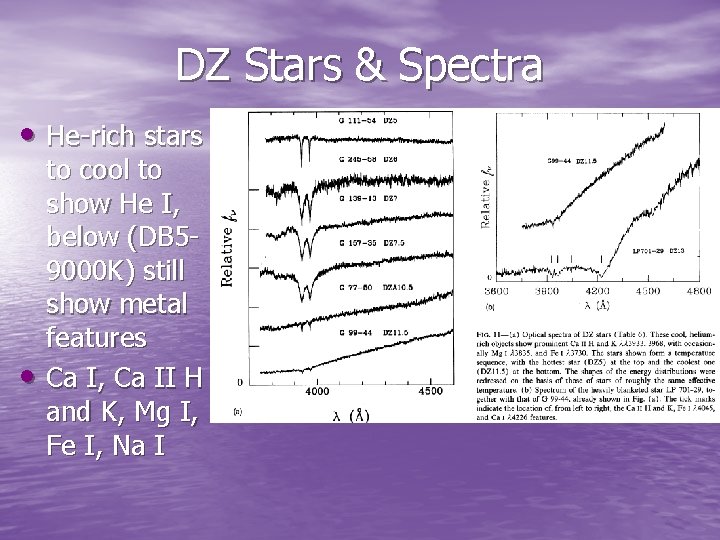
DZ Stars & Spectra • He-rich stars • to cool to show He I, below (DB 59000 K) still show metal features Ca I, Ca II H and K, Mg I, Fe I, Na I
PG 1159 Stars • Features due to CNO ions, Teff>100, 000 K • Absence of H or He I features; He II, C IV, O VI • 3 groups – A: Cooler Teff~100, 000 K, He II, C IV, O VI – E: Teff~140, 000 K, emission cores, He II, C IV, O VI, some have N V (DOQZ 1) – lg. E: Low g central stars of planetary nuclei • Characteristic emission cores, narrower absorption features
DC Stars & Spectra • Featureless, no line • • • deeper than 5% of continuum Higher resolution reveals weak features Many reclassified as DB or DA True DCs remain, among coolest WDs, Teff < 11, 000 K