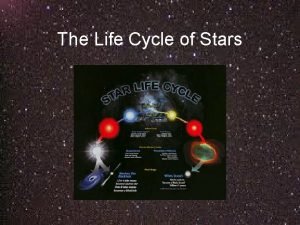
Life and death of stars Childhood Adulthood End
- Slides: 31
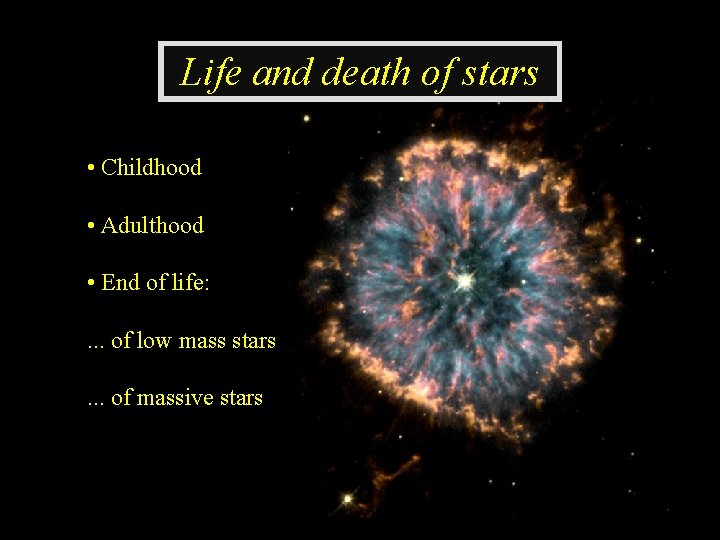
Life and death of stars • Childhood • Adulthood • End of life: . . . of low mass stars. . . of massive stars
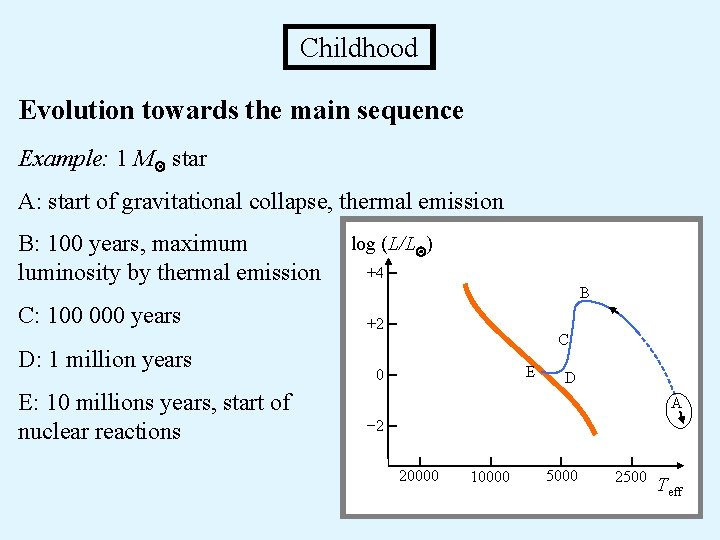
Childhood Evolution towards the main sequence Example: 1 M star A: start of gravitational collapse, thermal emission B: 100 years, maximum luminosity by thermal emission C: 100 000 years D: 1 million years E: 10 millions years, start of nuclear reactions log (L/L ) +4 B +2 C E 0 D A − 2 20000 10000 5000 2500 Teff
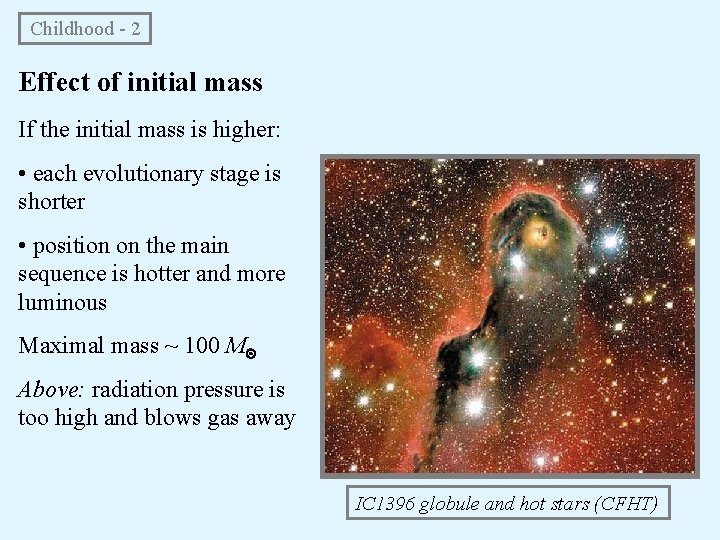
Childhood - 2 Effect of initial mass If the initial mass is higher: • each evolutionary stage is shorter • position on the main sequence is hotter and more luminous Maximal mass ~ 100 M Above: radiation pressure is too high and blows gas away IC 1396 globule and hot stars (CFHT)
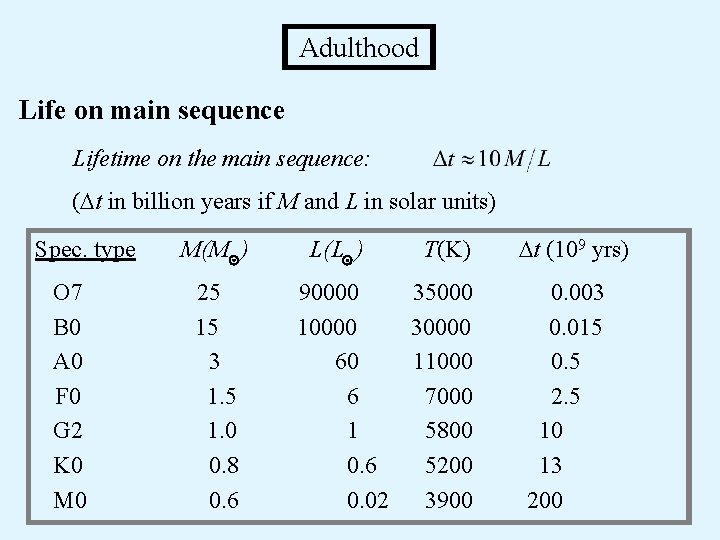
Adulthood Life on main sequence Lifetime on the main sequence: ( t in billion years if M and L in solar units) Spec. type O 7 B 0 A 0 F 0 G 2 K 0 M(M ) 25 15 3 1. 5 1. 0 0. 8 0. 6 L(L ) T(K) 90000 35000 10000 30000 60 11000 6 7000 1 5800 0. 6 5200 0. 02 3900 t (109 yrs) 0. 003 0. 015 0. 5 2. 5 10 13 200
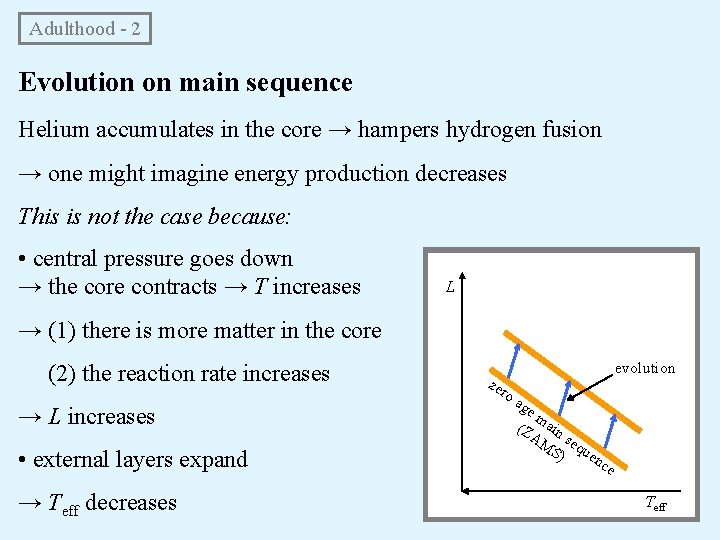
Adulthood - 2 Evolution on main sequence Helium accumulates in the core → hampers hydrogen fusion → one might imagine energy production decreases This is not the case because: • central pressure goes down → the core contracts → T increases L → (1) there is more matter in the core (2) the reaction rate increases → L increases • external layers expand → Teff decreases ze evolution ro ag em (Z ain AM se S) que nc e Teff
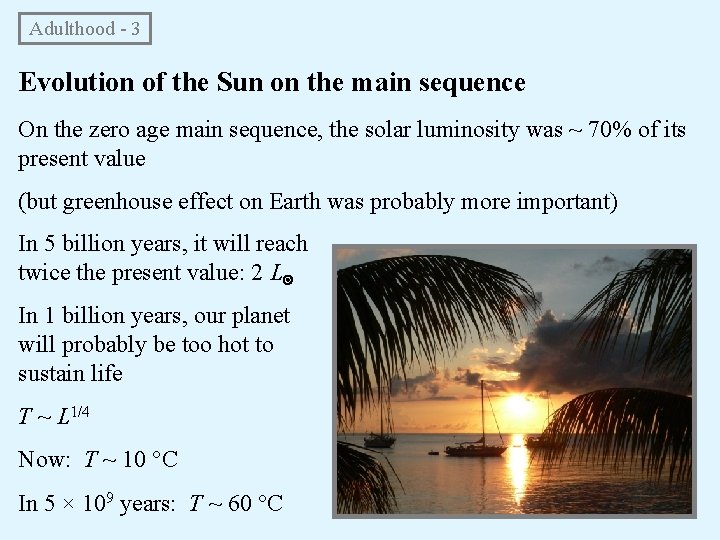
Adulthood - 3 Evolution of the Sun on the main sequence On the zero age main sequence, the solar luminosity was ~ 70% of its present value (but greenhouse effect on Earth was probably more important) In 5 billion years, it will reach twice the present value: 2 L In 1 billion years, our planet will probably be too hot to sustain life T ~ L 1/4 Now: T ~ 10 °C In 5 × 10⁹ years: T ~ 60 °C
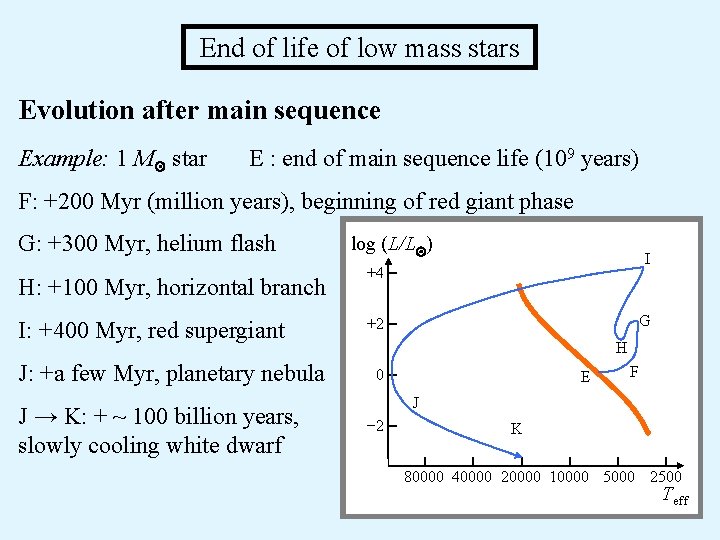
End of life of low mass stars Evolution after main sequence Example: 1 M star E : end of main sequence life (109 years) F: +200 Myr (million years), beginning of red giant phase G: +300 Myr, helium flash H: +100 Myr, horizontal branch I: +400 Myr, red supergiant J: +a few Myr, planetary nebula J → K: + ~ 100 billion years, slowly cooling white dwarf log (L/L ) I +4 G +2 H 0 E F J − 2 K 80000 40000 20000 10000 5000 2500 Teff
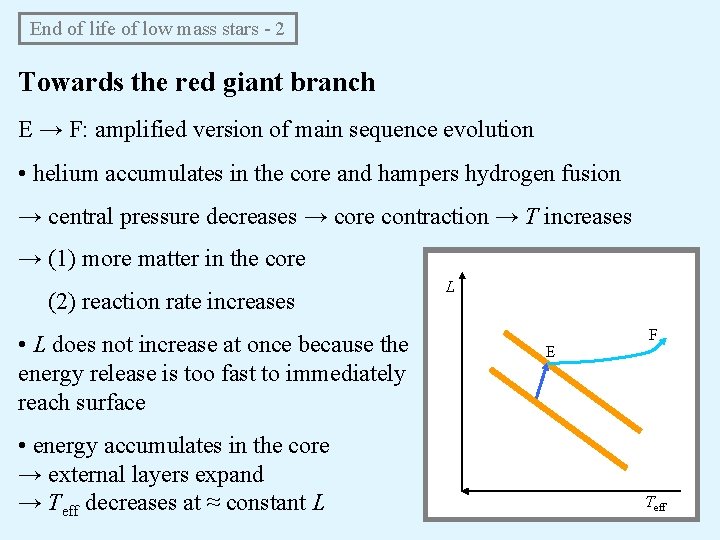
End of life of low mass stars - 2 Towards the red giant branch E → F: amplified version of main sequence evolution • helium accumulates in the core and hampers hydrogen fusion → central pressure decreases → core contraction → T increases → (1) more matter in the core (2) reaction rate increases • L does not increase at once because the energy release is too fast to immediately reach surface • energy accumulates in the core → external layers expand → Teff decreases at ≈ constant L L E F Teff
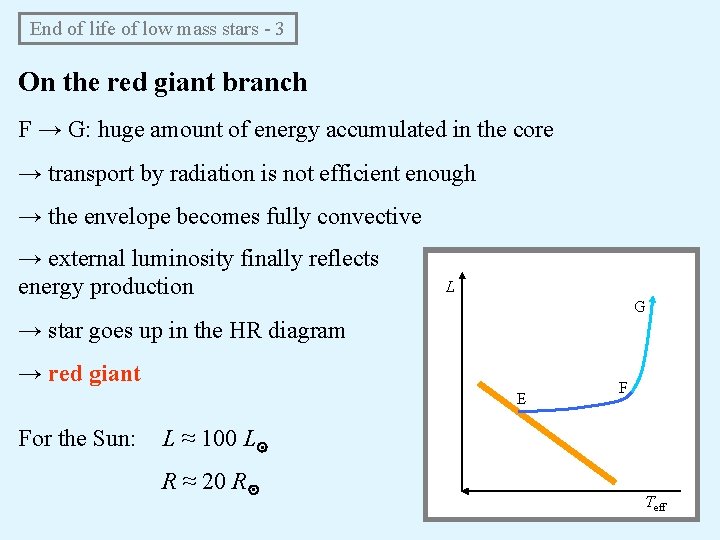
End of life of low mass stars - 3 On the red giant branch F → G: huge amount of energy accumulated in the core → transport by radiation is not efficient enough → the envelope becomes fully convective → external luminosity finally reflects energy production L G → star goes up in the HR diagram → red giant E For the Sun: F L ≈ 100 L R ≈ 20 R Teff
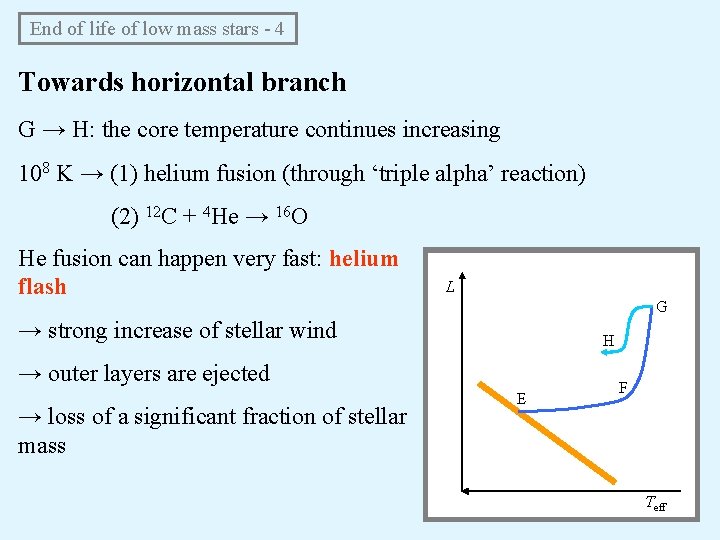
End of life of low mass stars - 4 Towards horizontal branch G → H: the core temperature continues increasing 108 K → (1) helium fusion (through ‘triple alpha’ reaction) (2) 12 C + 4 He → 16 O He fusion can happen very fast: helium flash L G → strong increase of stellar wind H → outer layers are ejected → loss of a significant fraction of stellar mass E F Teff
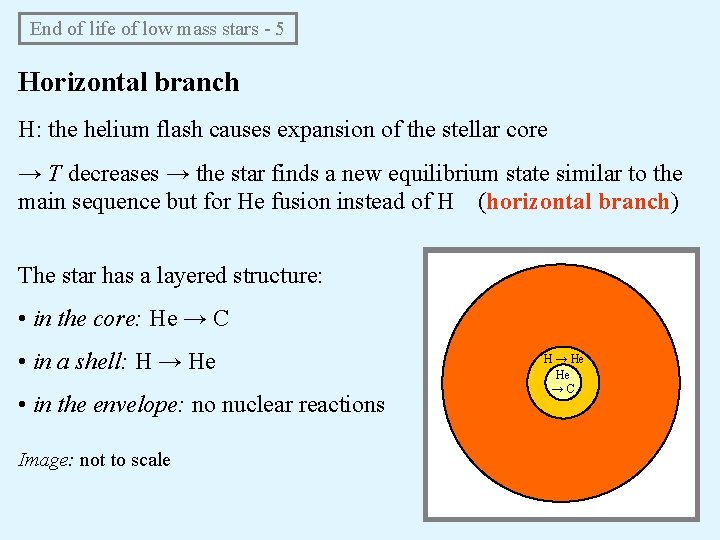
End of life of low mass stars - 5 Horizontal branch H: the helium flash causes expansion of the stellar core → T decreases → the star finds a new equilibrium state similar to the main sequence but for He fusion instead of H (horizontal branch) The star has a layered structure: • in the core: He → C • in a shell: H → He • in the envelope: no nuclear reactions Image: not to scale H → He He →C
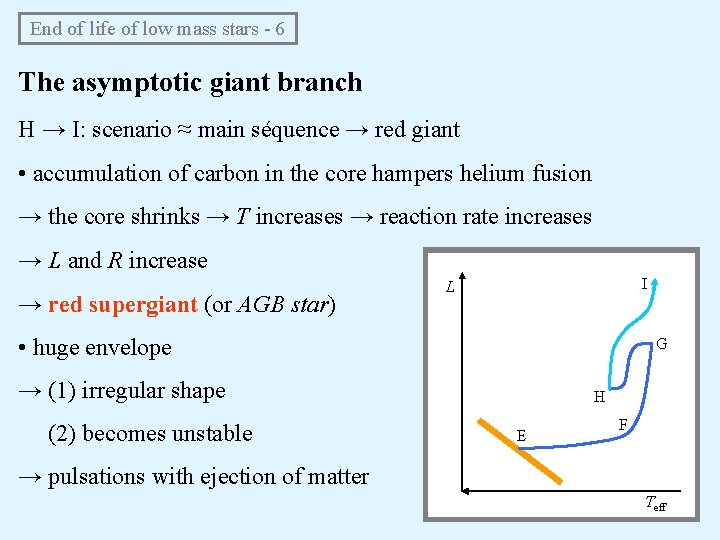
End of life of low mass stars - 6 The asymptotic giant branch H → I: scenario ≈ main séquence → red giant • accumulation of carbon in the core hampers helium fusion → the core shrinks → T increases → reaction rate increases → L and R increase → red supergiant (or AGB star) I L • huge envelope G → (1) irregular shape (2) becomes unstable H E F → pulsations with ejection of matter Teff
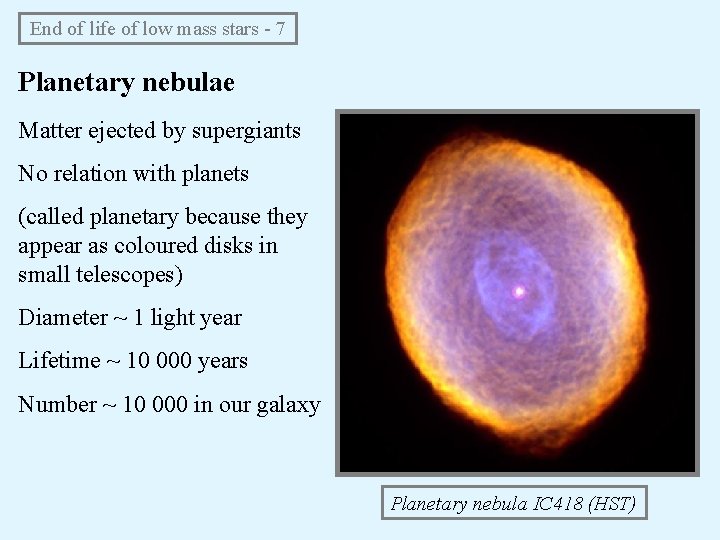
End of life of low mass stars - 7 Planetary nebulae Matter ejected by supergiants No relation with planets (called planetary because they appear as coloured disks in small telescopes) Diameter ~ 1 light year Lifetime ~ 10 000 years Number ~ 10 000 in our galaxy Planetary nebula IC 418 (HST)
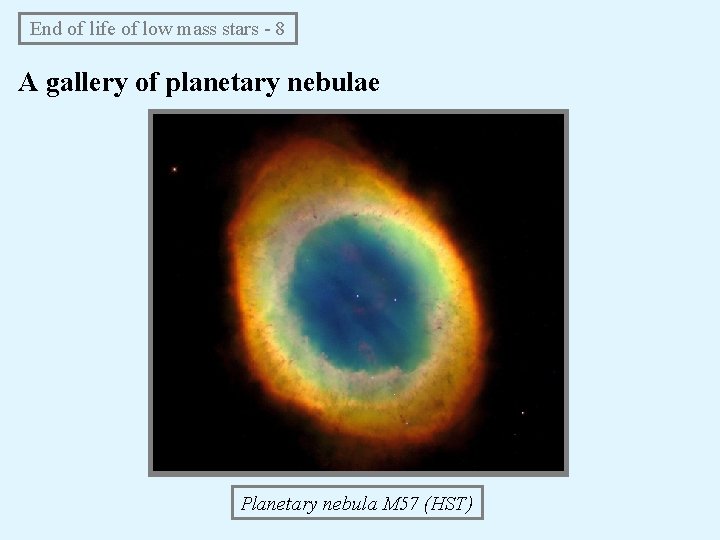
End of life of low mass stars - 8 A gallery of planetary nebulae Planetary nebula M 57 (HST)
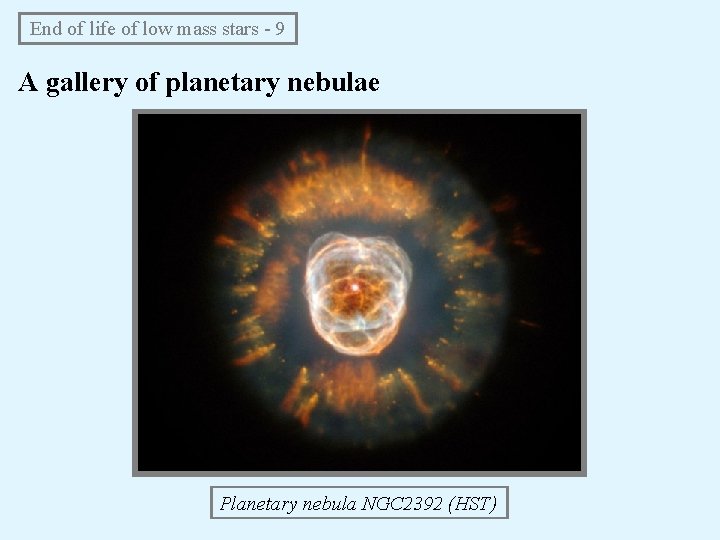
End of life of low mass stars - 9 A gallery of planetary nebulae Planetary nebula NGC 2392 (HST)
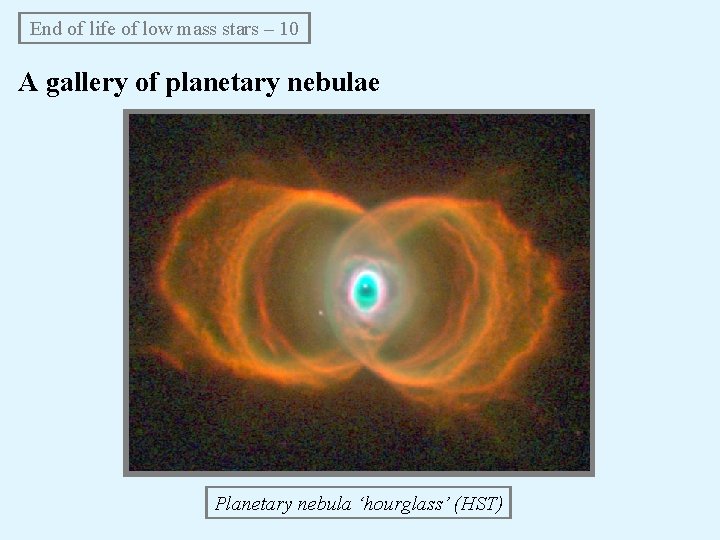
End of life of low mass stars – 10 A gallery of planetary nebulae Planetary nebula ‘hourglass’ (HST)
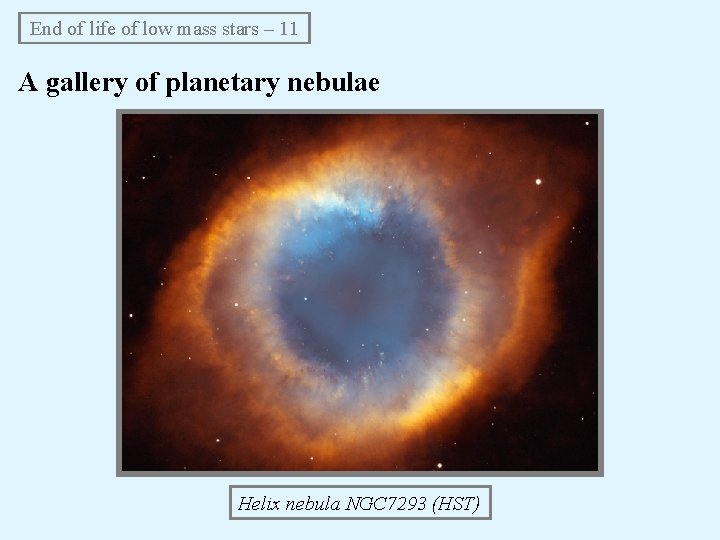
End of life of low mass stars – 11 A gallery of planetary nebulae Helix nebula NGC 7293 (HST)
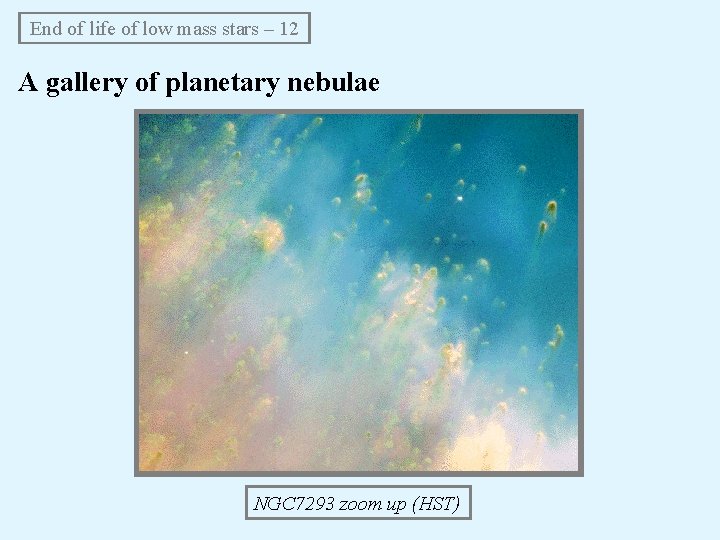
End of life of low mass stars – 12 A gallery of planetary nebulae NGC 7293 zoom up (HST)
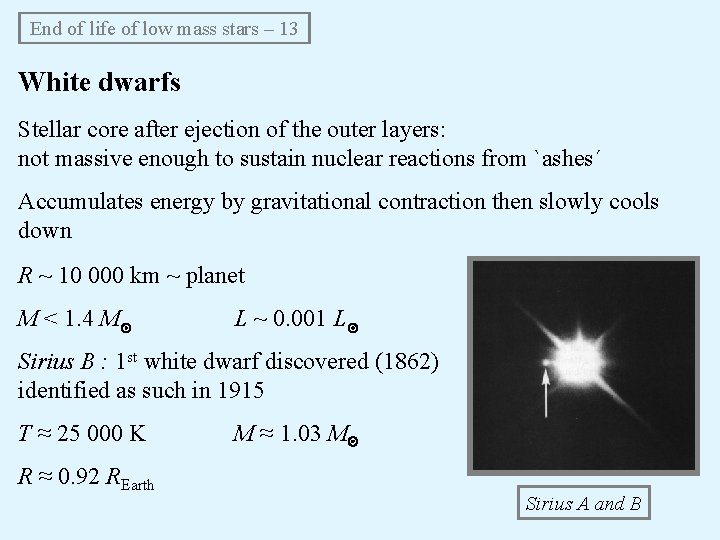
End of life of low mass stars – 13 White dwarfs Stellar core after ejection of the outer layers: not massive enough to sustain nuclear reactions from `ashes´ Accumulates energy by gravitational contraction then slowly cools down R ~ 10 000 km ~ planet M < 1. 4 M L ~ 0. 001 L Sirius B : 1 st white dwarf discovered (1862) identified as such in 1915 T ≈ 25 000 K R ≈ 0. 92 REarth M ≈ 1. 03 M Sirius A and B
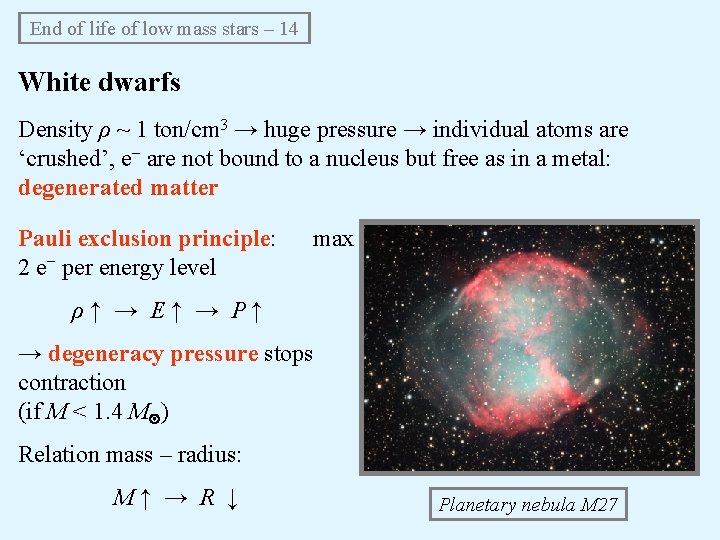
End of life of low mass stars – 14 White dwarfs Density ρ ~ 1 ton/cm 3 → huge pressure → individual atoms are ‘crushed’, e− are not bound to a nucleus but free as in a metal: degenerated matter Pauli exclusion principle: 2 e− per energy level max ρ↑ → E↑ → P↑ → degeneracy pressure stops contraction (if M < 1. 4 M ) Relation mass – radius: M↑ → R ↓ Planetary nebula M 27
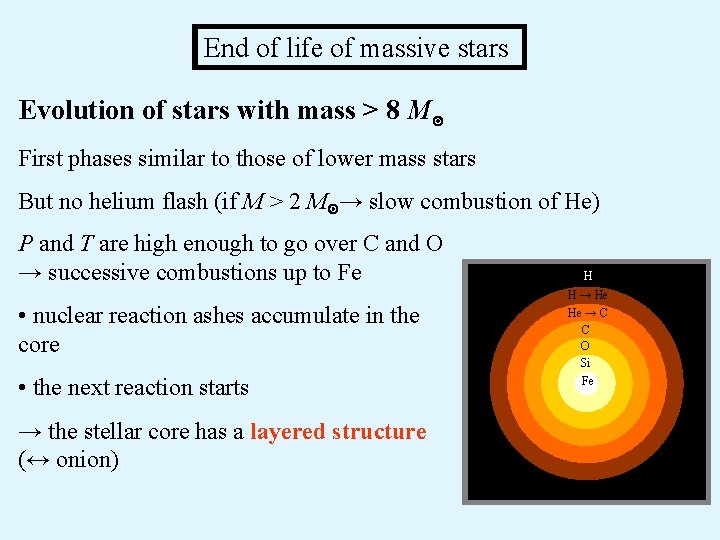
End of life of massive stars Evolution of stars with mass > 8 M First phases similar to those of lower mass stars But no helium flash (if M > 2 M → slow combustion of He) P and T are high enough to go over C and O → successive combustions up to Fe H H → He • nuclear reaction ashes accumulate in the core • the next reaction starts → the stellar core has a layered structure (↔ onion) He → C C O Si Fe
End of life of massive stars - 2 The iron catastrophe 56 Fe = most stable nucleus → no energy production by fusion → nothing can stop contraction of the Fe core (even degeneracy pressure is not strong enough) → P ↑ until e− combine with protons to form neutrons → the core is transformed in neutronic matter (ρ ~ 1017 kg/m 3) Very fast contraction → goes over equilibrium density → rebound of the core → shock wave Conservation of impulse → the wave accelerates when reaching lower density layers
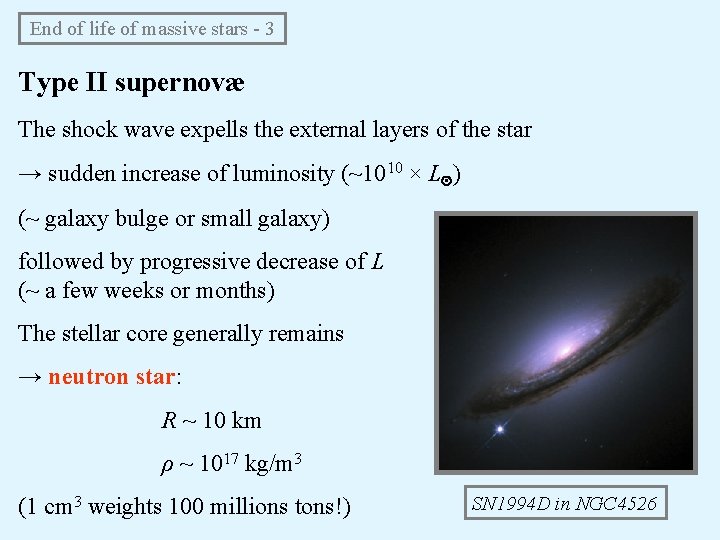
End of life of massive stars - 3 Type II supernovæ The shock wave expells the external layers of the star → sudden increase of luminosity (~1010 × L ) (~ galaxy bulge or small galaxy) followed by progressive decrease of L (~ a few weeks or months) The stellar core generally remains → neutron star: R ~ 10 km ρ ~ 1017 kg/m 3 (1 cm 3 weights 100 millions tons!) SN 1994 D in NGC 4526
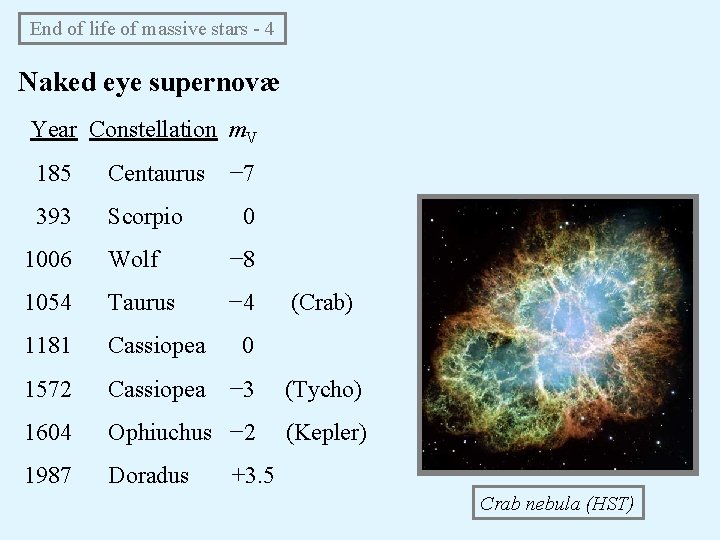
End of life of massive stars - 4 Naked eye supernovæ Year Constellation m. V 185 Centaurus 393 Scorpio − 7 0 1006 Wolf − 8 1054 Taurus − 4 1181 Cassiopea 0 1572 Cassiopea − 3 (Tycho) 1604 Ophiuchus − 2 (Kepler) 1987 Doradus (Crab) +3. 5 Crab nebula (HST)
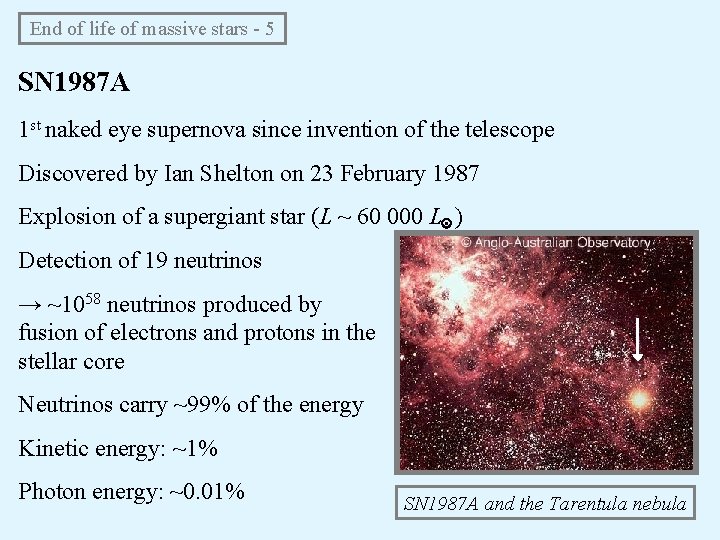
End of life of massive stars - 5 SN 1987 A 1 st naked eye supernova since invention of the telescope Discovered by Ian Shelton on 23 February 1987 Explosion of a supergiant star (L ~ 60 000 L ) Detection of 19 neutrinos → ~1058 neutrinos produced by fusion of electrons and protons in the stellar core Neutrinos carry ~99% of the energy Kinetic energy: ~1% Photon energy: ~0. 01% SN 1987 A and the Tarentula nebula
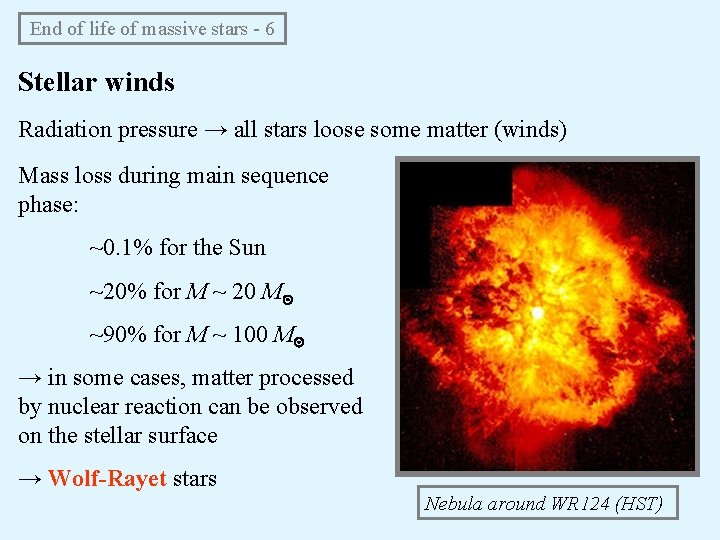
End of life of massive stars - 6 Stellar winds Radiation pressure → all stars loose some matter (winds) Mass loss during main sequence phase: ~0. 1% for the Sun ~20% for M ~ 20 M ~90% for M ~ 100 M → in some cases, matter processed by nuclear reaction can be observed on the stellar surface → Wolf-Rayet stars Nebula around WR 124 (HST)
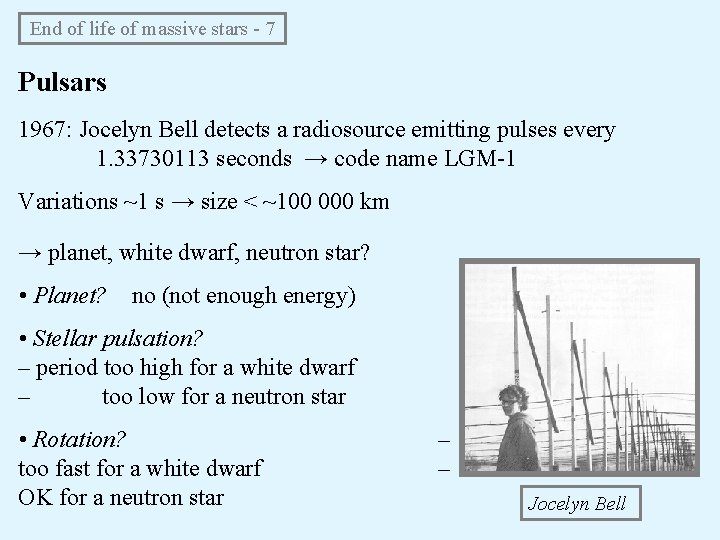
End of life of massive stars - 7 Pulsars 1967: Jocelyn Bell detects a radiosource emitting pulses every 1. 33730113 seconds → code name LGM-1 Variations ~1 s → size < ~100 000 km → planet, white dwarf, neutron star? • Planet? no (not enough energy) • Stellar pulsation? – period too high for a white dwarf – too low for a neutron star • Rotation? too fast for a white dwarf OK for a neutron star – – Jocelyn Bell
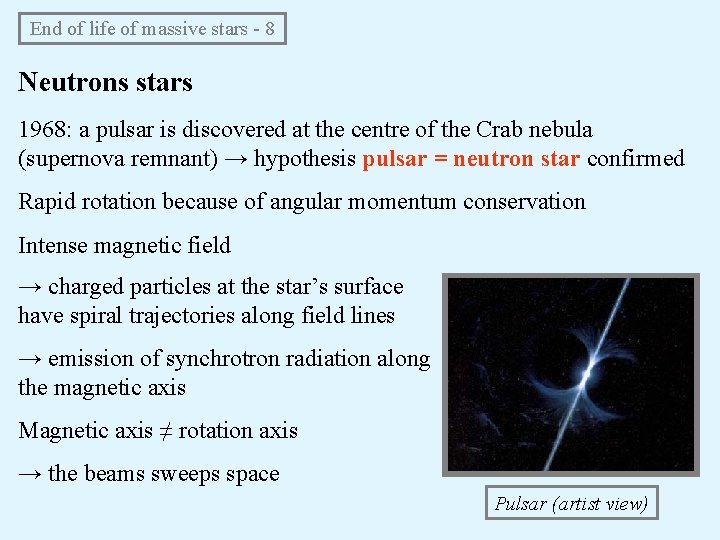
End of life of massive stars - 8 Neutrons stars 1968: a pulsar is discovered at the centre of the Crab nebula (supernova remnant) → hypothesis pulsar = neutron star confirmed Rapid rotation because of angular momentum conservation Intense magnetic field → charged particles at the star’s surface have spiral trajectories along field lines → emission of synchrotron radiation along the magnetic axis Magnetic axis ≠ rotation axis → the beams sweeps space Pulsar (artist view)
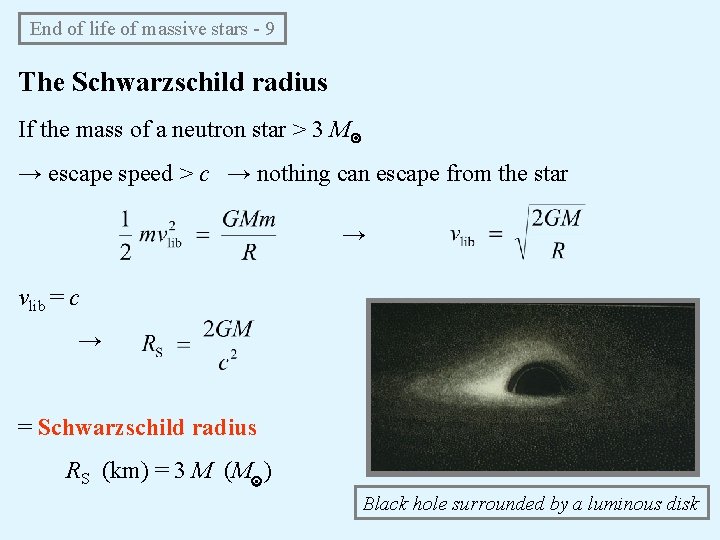
End of life of massive stars - 9 The Schwarzschild radius If the mass of a neutron star > 3 M → escape speed > c → nothing can escape from the star → vlib = c → = Schwarzschild radius RS (km) = 3 M (M ) Black hole surrounded by a luminous disk
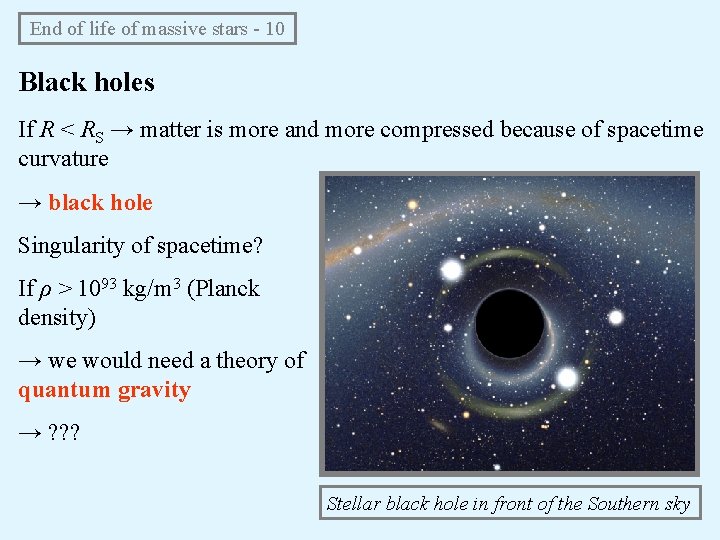
End of life of massive stars - 10 Black holes If R < RS → matter is more and more compressed because of spacetime curvature → black hole Singularity of spacetime? If ρ > 1093 kg/m 3 (Planck density) → we would need a theory of quantum gravity → ? ? ? Stellar black hole in front of the Southern sky
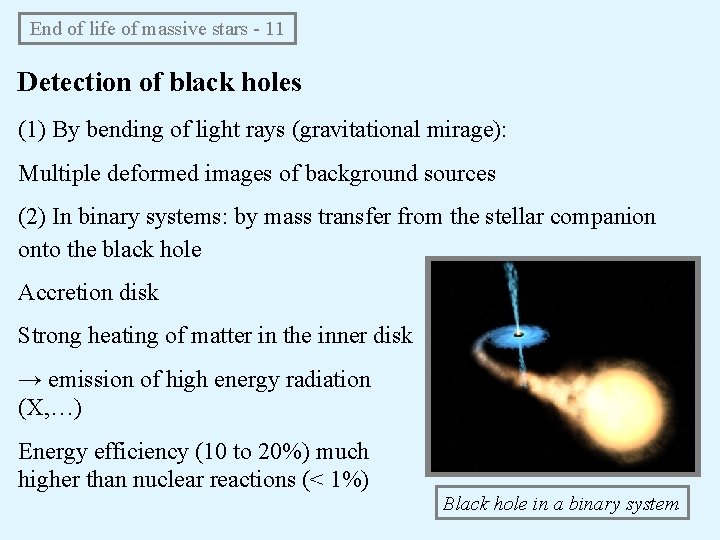
End of life of massive stars - 11 Detection of black holes (1) By bending of light rays (gravitational mirage): Multiple deformed images of background sources (2) In binary systems: by mass transfer from the stellar companion onto the black hole Accretion disk Strong heating of matter in the inner disk → emission of high energy radiation (X, …) Energy efficiency (10 to 20%) much higher than nuclear reactions (< 1%) Black hole in a binary system