
Sagittarius New Outer Halo Tidal Streams and the




- Slides: 55
Sagittarius, New Outer Halo Tidal Streams and the LMC as a Dwarf Galaxy “Cue-ball” Steven Majewski - University of Virginia Vienna UT 11 April 2005
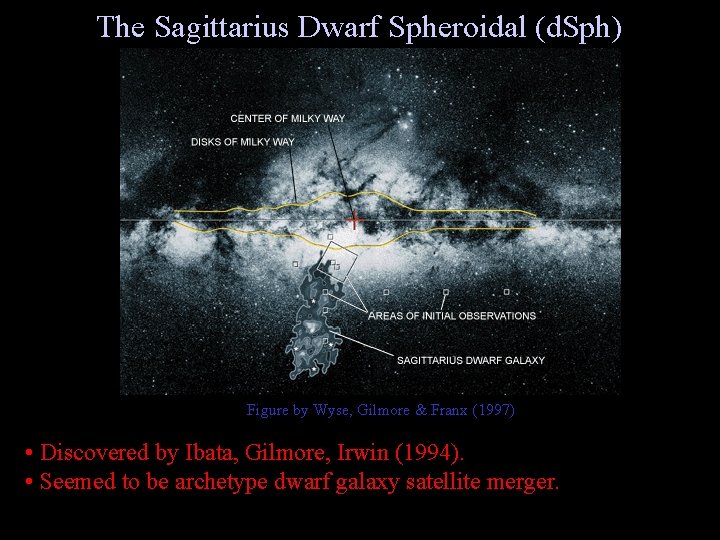
The Sagittarius Dwarf Spheroidal (d. Sph) Figure by Wyse, Gilmore & Franx (1997) • Discovered by Ibata, Gilmore, Irwin (1994). • Seemed to be archetype dwarf galaxy satellite merger.
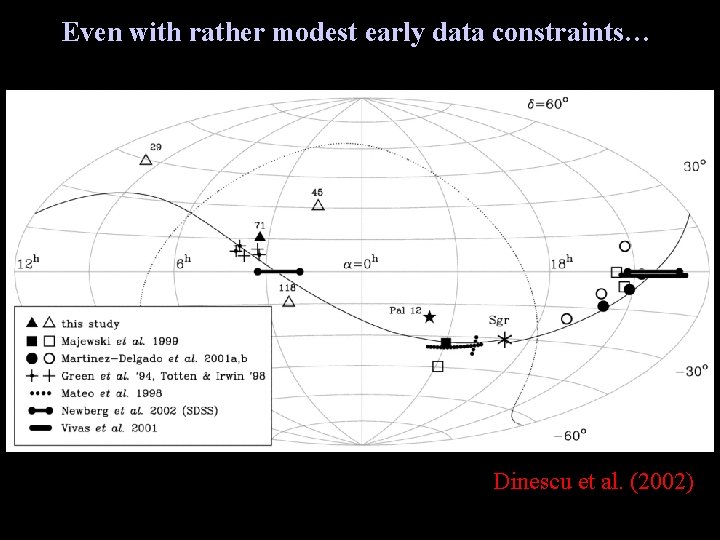
Even with rather modest early data constraints… Dinescu et al. (2002)
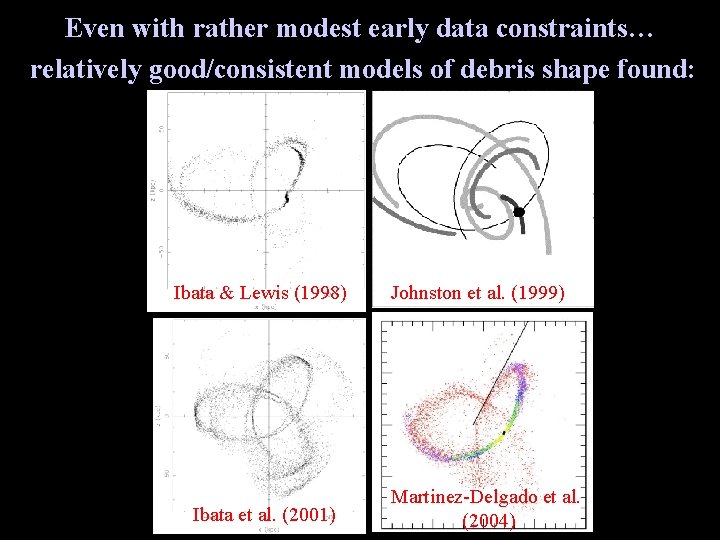
Even with rather modest early data constraints… relatively good/consistent models of debris shape found: Ibata & Lewis (1998) Ibata et al. (2001) Johnston et al. (1999) Martinez-Delgado et al. (2004)
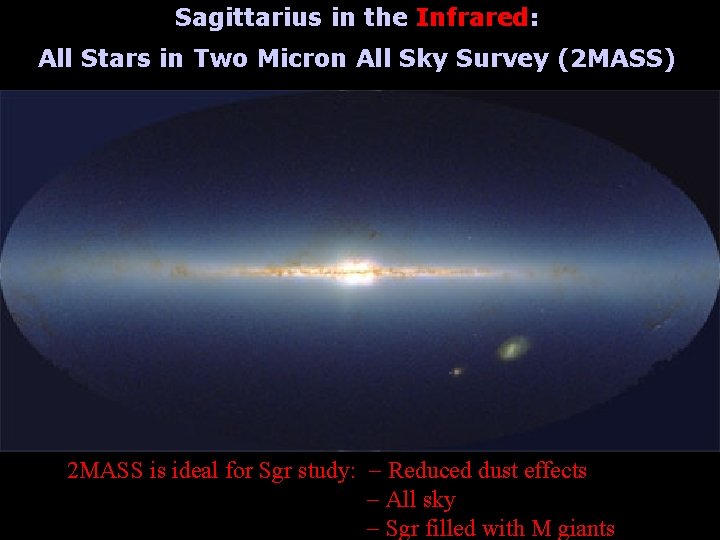
Sagittarius in the Infrared: All Stars in Two Micron All Sky Survey (2 MASS) 2 MASS is ideal for Sgr study: - Reduced dust effects - All sky - Sgr filled with M giants
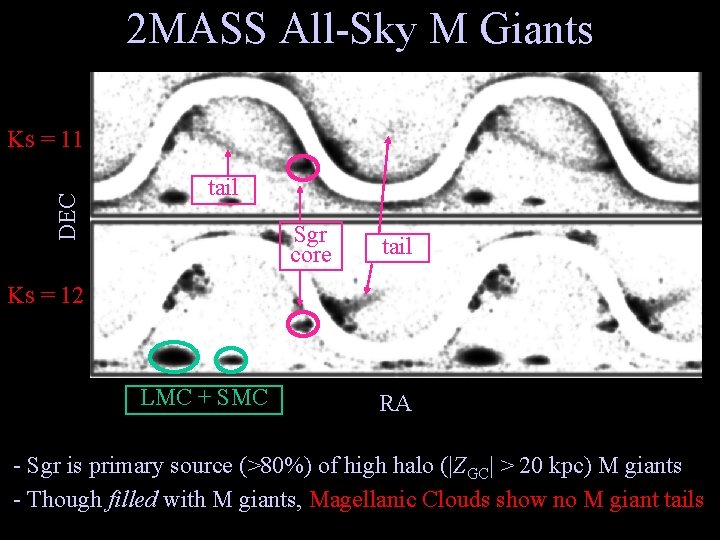
2 MASS All-Sky M Giants DEC KS = 11 tail Sgr core tail KS = 12 LMC + SMC RA - Sgr is primary source (>80%) of high halo (|ZGC| > 20 kpc) M giants - Though filled with M giants, Magellanic Clouds show no M giant tails
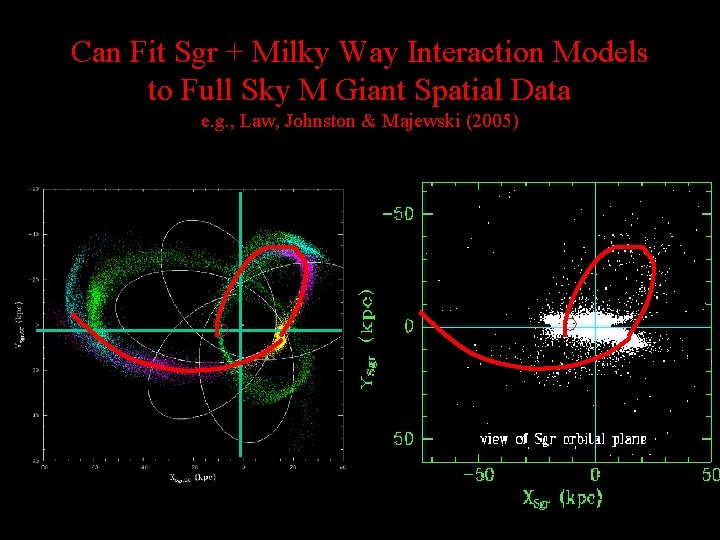
Can Fit Sgr + Milky Way Interaction Models to Full Sky M Giant Spatial Data e. g. , Law, Johnston & Majewski (2005)
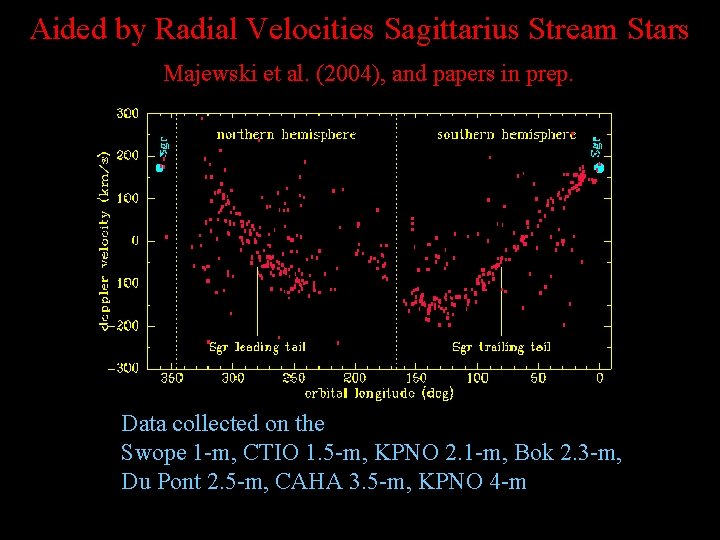
Aided by Radial Velocities Sagittarius Stream Stars Majewski et al. (2004), and papers in prep. Data collected on the Swope 1 -m, CTIO 1. 5 -m, KPNO 2. 1 -m, Bok 2. 3 -m, Du Pont 2. 5 -m, CAHA 3. 5 -m, KPNO 4 -m
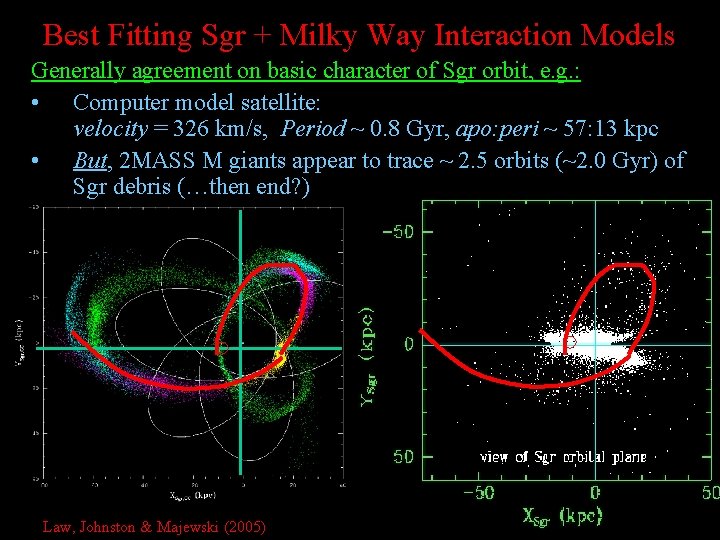
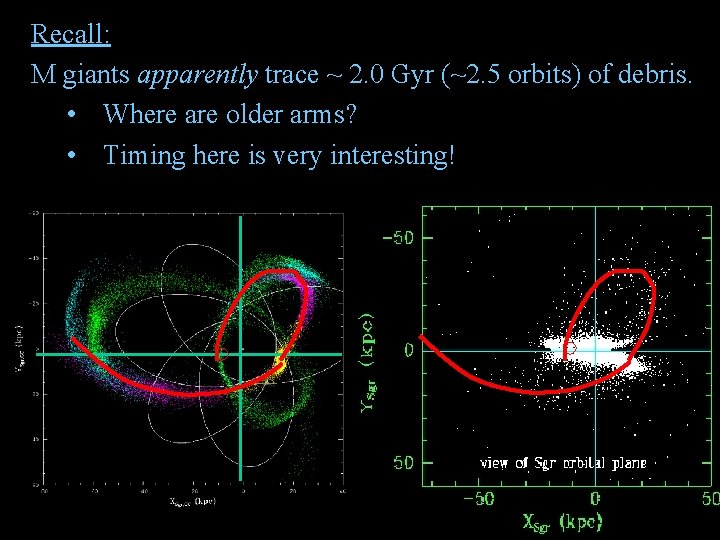
Best Fitting Sgr + Milky Way Interaction Models Generally agreement on basic character of Sgr orbit, e. g. : • Computer model satellite: velocity = 326 km/s, Period ~ 0. 8 Gyr, apo: peri ~ 57: 13 kpc • But, 2 MASS M giants appear to trace ~ 2. 5 orbits (~2. 0 Gyr) of Sgr debris (…then end? ) Law, Johnston & Majewski (2005)
Despite well matching models that generally agree between groups … … several (old and new) mysteries remain. (1) Model mismatches with data (2) Several timing problems
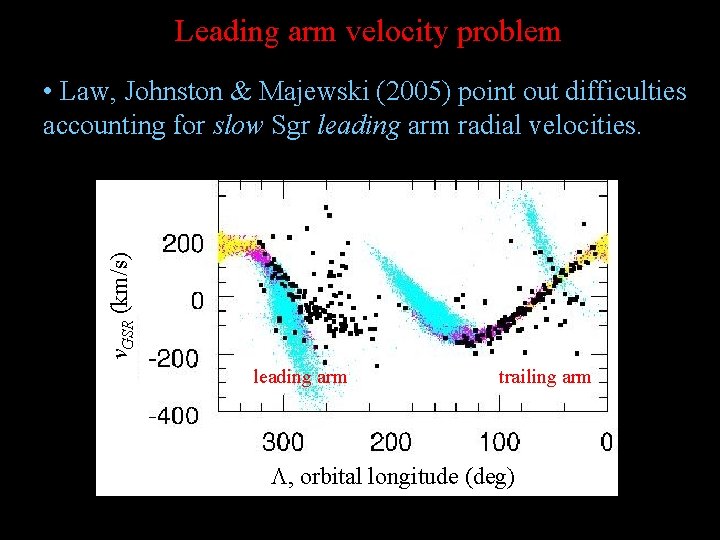
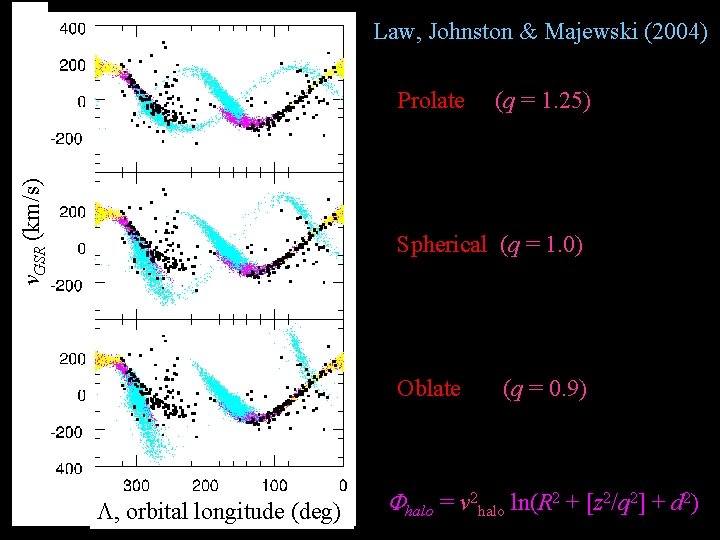
Leading arm velocity problem v. GSR (km/s) • Law, Johnston & Majewski (2005) point out difficulties accounting for slow Sgr leading arm radial velocities. leading arm trailing arm L, orbital longitude (deg)
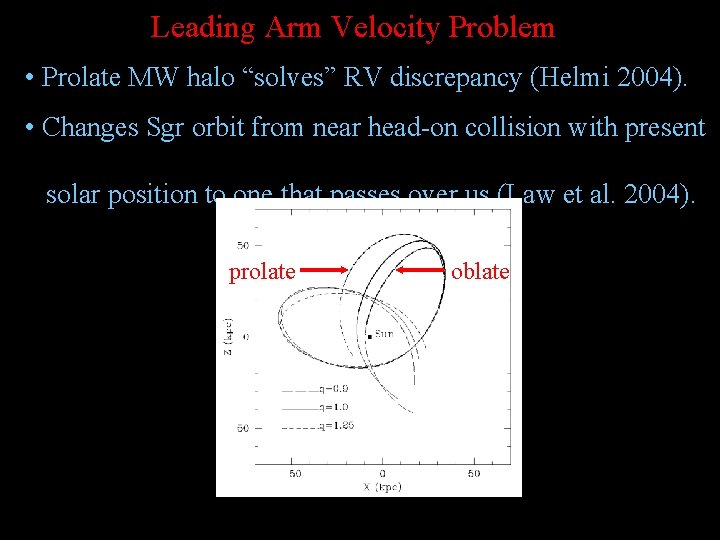
Leading Arm Velocity Problem • Prolate MW halo “solves” RV discrepancy (Helmi 2004). • Changes Sgr orbit from near head-on collision with present solar position to one that passes over us (Law et al. 2004). prolate oblate
Law, Johnston & Majewski (2004) v. GSR (km/s) Prolate (q = 1. 25) Spherical (q = 1. 0) Oblate L, orbital longitude (deg) (q = 0. 9) Fhalo = v 2 halo ln(R 2 + [z 2/q 2] + d 2)
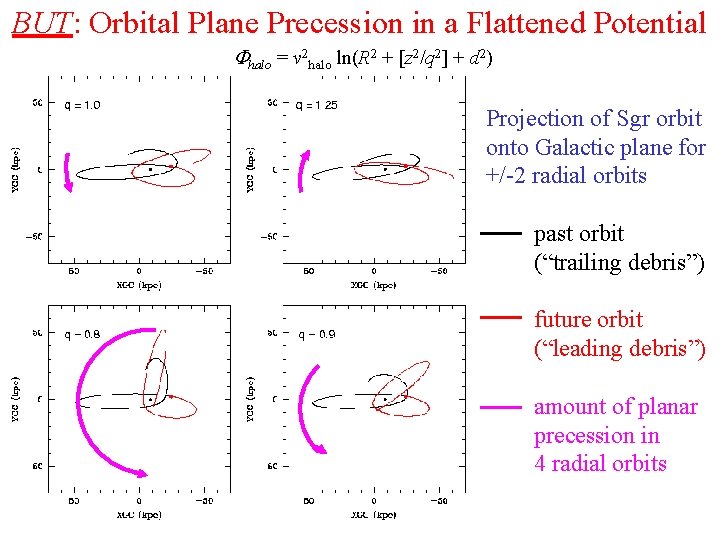
BUT: Orbital Plane Precession in a Flattened Potential Fhalo = v 2 halo ln(R 2 + [z 2/q 2] + d 2) Projection of Sgr orbit onto Galactic plane for +/-2 radial orbits past orbit (“trailing debris”) future orbit (“leading debris”) amount of planar precession in 4 radial orbits
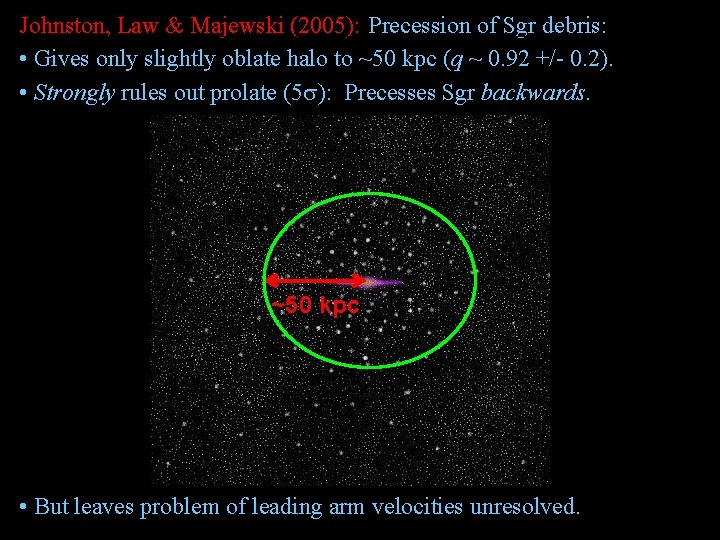
Johnston, Law & Majewski (2005): Precession of Sgr debris: • Gives only slightly oblate halo to ~50 kpc (q ~ 0. 92 +/- 0. 2). • Strongly rules out prolate (5 s): Precesses Sgr backwards. ~50 kpc • But leaves problem of leading arm velocities unresolved.
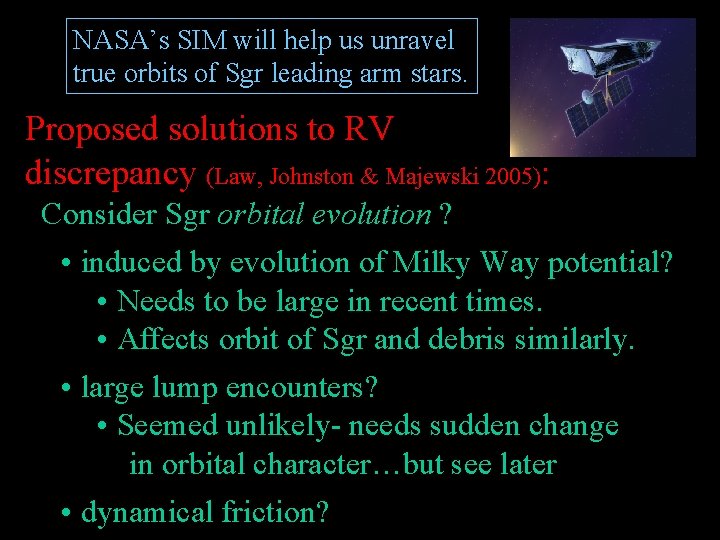
NASA’s SIM will help us unravel true orbits of Sgr leading arm stars. Proposed solutions to RV discrepancy (Law, Johnston & Majewski 2005): Consider Sgr orbital evolution ? • induced by evolution of Milky Way potential? • Needs to be large in recent times. • Affects orbit of Sgr and debris similarly. • large lump encounters? • Seemed unlikely- needs sudden change in orbital character…but see later • dynamical friction?
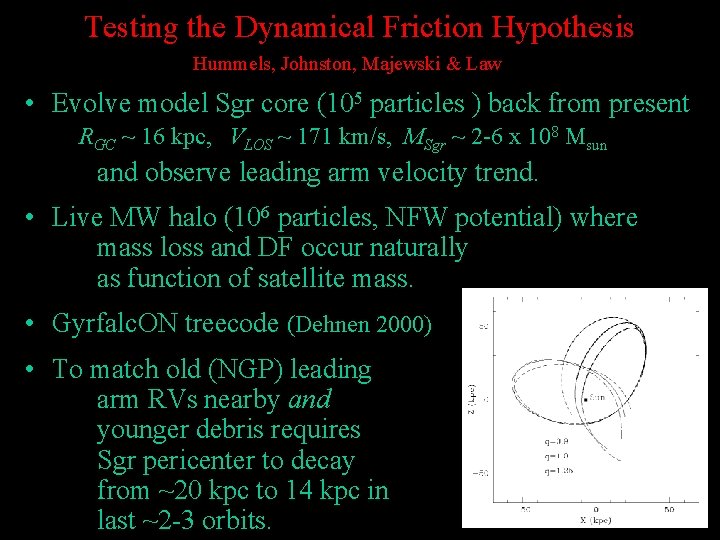
Testing the Dynamical Friction Hypothesis Hummels, Johnston, Majewski & Law • Evolve model Sgr core (105 particles ) back from present RGC ~ 16 kpc, VLOS ~ 171 km/s, MSgr ~ 2 -6 x 10⁸ Msun and observe leading arm velocity trend. • Live MW halo (106 particles, NFW potential) where mass loss and DF occur naturally as function of satellite mass. • Gyrfalc. ON treecode (Dehnen 2000) • To match old (NGP) leading arm RVs nearby and younger debris requires Sgr pericenter to decay from ~20 kpc to 14 kpc in last ~2 -3 orbits.
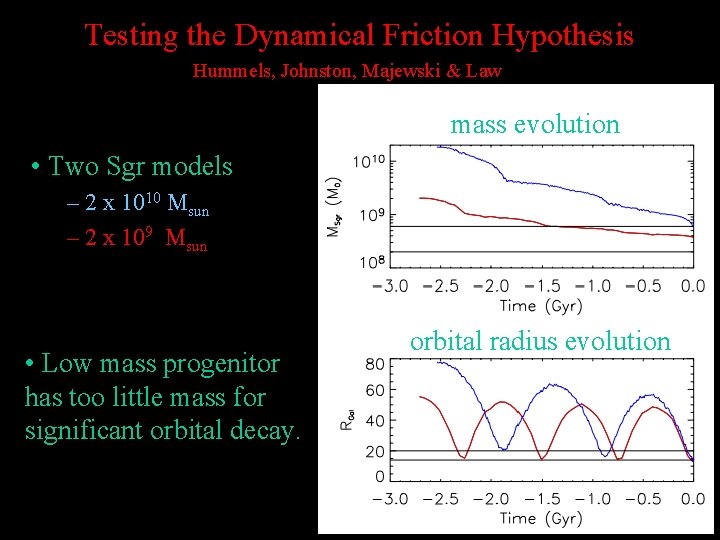
Testing the Dynamical Friction Hypothesis Hummels, Johnston, Majewski & Law mass evolution • Two Sgr models – 2 x 10¹⁰ Msun – 2 x 10⁹ Msun • Low mass progenitor has too little mass for significant orbital decay. orbital radius evolution
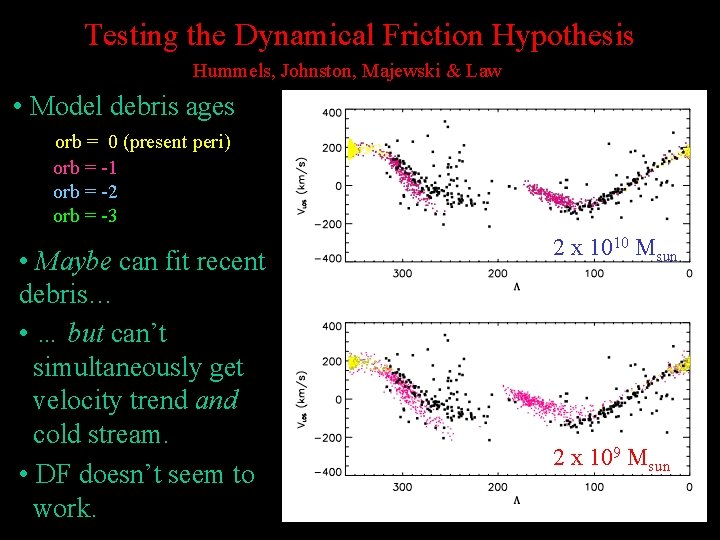
Testing the Dynamical Friction Hypothesis Hummels, Johnston, Majewski & Law • Model debris ages orb = 0 (present peri) orb = -1 orb = -2 orb = -3 • Maybe can fit recent debris… • … but can’t simultaneously get velocity trend and cold stream. • DF doesn’t seem to work. 2 x 10¹⁰ Msun 2 x 10⁹ Msun
Timing Problems (A) How is it (after numerous orbits) we just happen to be seeing what looks like critical Sgr disruption now? • Velazqueze & White (1995): “Not too surprising, since it must happen at some point to any satellite, and Sgr probably endured enough peri. Galacticons to reduce binding energy to critical stability”
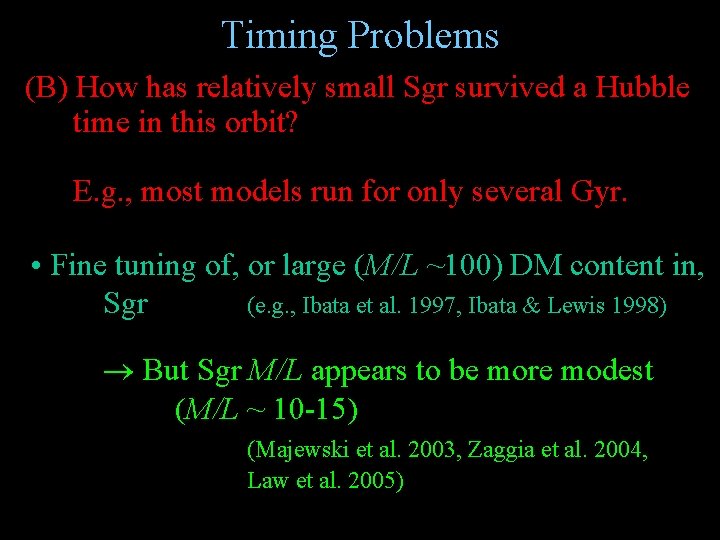
Timing Problems (B) How has relatively small Sgr survived a Hubble time in this orbit? E. g. , most models run for only several Gyr. • Fine tuning of, or large (M/L ~100) DM content in, Sgr (e. g. , Ibata et al. 1997, Ibata & Lewis 1998) ® But Sgr M/L appears to be more modest (M/L ~ 10 -15) (Majewski et al. 2003, Zaggia et al. 2004, Law et al. 2005)
Timing Problems (B) How has relatively small Sgr survived a Hubble time in this orbit? • Sgr is a tidal dwarf formed in major merger (e. g. , Gomez-Flechoso et al. 1999) ® No evidence for rest of merger.
Timing Problems (B) How has relatively small Sgr survived a Hubble time in this orbit? • Sgr not always in present orbit • Just fell in (Koribalski et al. 1994) ® ruled out by discovered streams • Dynamical friction (Jiang & Binney 2000, Zhao 2004) ® requires large mass loss quickly (Colpi et al. 1999, Law et al. 2004, Hummels et al. ) • Deflection off subhalo lump, e. g. , LMC (Ibata & Lewis 1998, Zhao 1998)
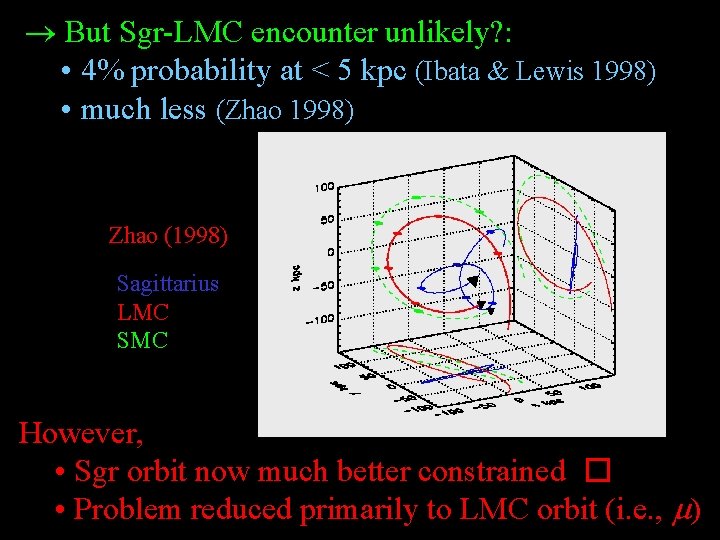
® But Sgr-LMC encounter unlikely? : • 4% probability at < 5 kpc (Ibata & Lewis 1998) • much less (Zhao 1998) Zhao (1998) Sagittarius LMC SMC However, • Sgr orbit now much better constrained � • Problem reduced primarily to LMC orbit (i. e. , m)
Galactic Billiards? Sagittarius LMC Separation Animation by David Nidever & SRM (Univ. Virginia) (LMC m optimized for HI position and velocity)
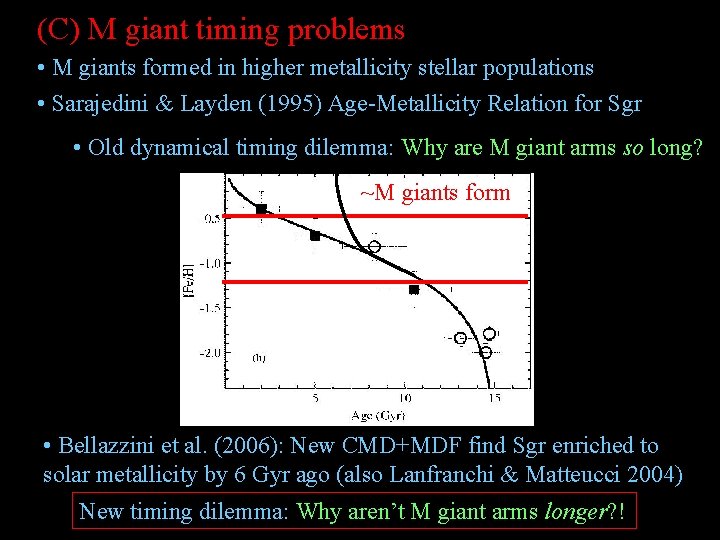
(C) M giant timing problems • M giants formed in higher metallicity stellar populations • Sarajedini & Layden (1995) Age-Metallicity Relation for Sgr • Old dynamical timing dilemma: Why are M giant arms so long? ~M giants form • Bellazzini et al. (2006): New CMD+MDF find Sgr enriched to solar metallicity by 6 Gyr ago (also Lanfranchi & Matteucci 2004) New timing dilemma: Why aren’t M giant arms longer? !
Recall: M giants apparently trace ~ 2. 0 Gyr (~2. 5 orbits) of debris. • Where are older arms? • Timing here is very interesting!
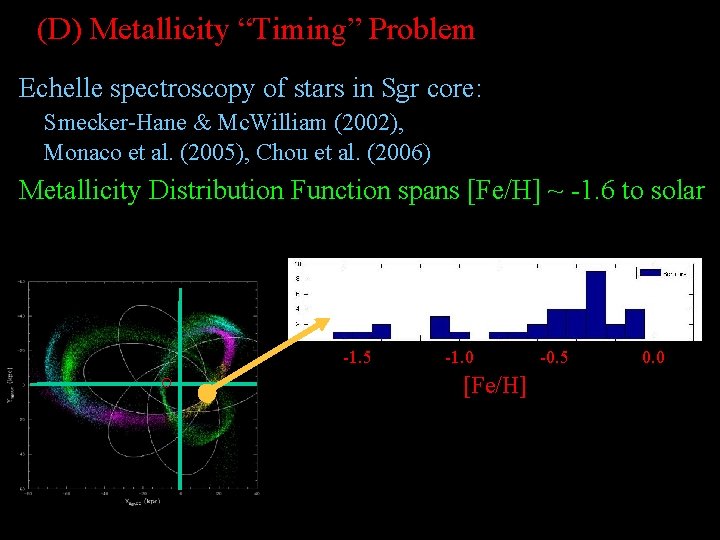
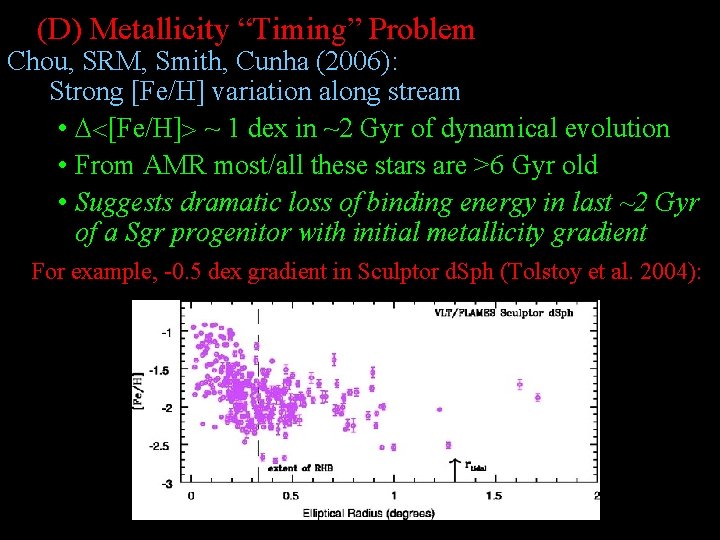
(D) Metallicity “Timing” Problem Echelle spectroscopy of stars in Sgr core: Smecker-Hane & Mc. William (2002), Monaco et al. (2005), Chou et al. (2006) Metallicity Distribution Function spans [Fe/H] ~ -1. 6 to solar -1. 5 -1. 0 [Fe/H] -0. 5 0. 0
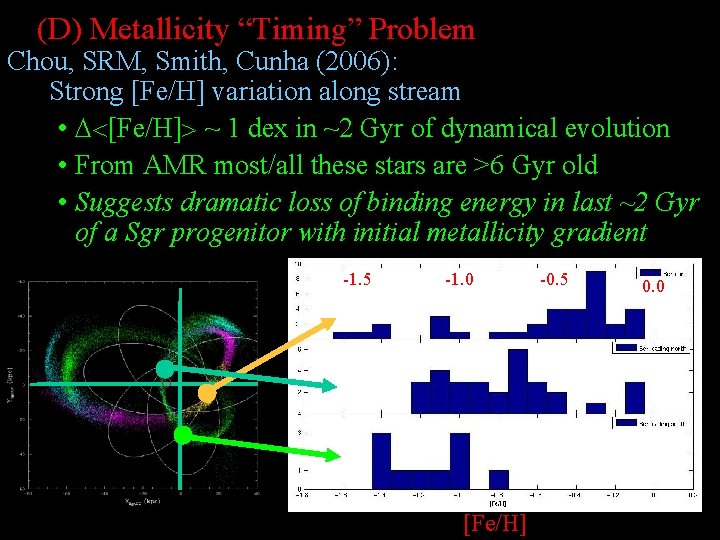
(D) Metallicity “Timing” Problem Chou, SRM, Smith, Cunha (2006): Strong [Fe/H] variation along stream • D<[Fe/H]> ~ 1 dex in ~2 Gyr of dynamical evolution • From AMR most/all these stars are >6 Gyr old • Suggests dramatic loss of binding energy in last ~2 Gyr of a Sgr progenitor with initial metallicity gradient -1. 5 -1. 0 [Fe/H] -0. 5 0. 0
(D) Metallicity “Timing” Problem Chou, SRM, Smith, Cunha (2006): Strong [Fe/H] variation along stream • D<[Fe/H]> ~ 1 dex in ~2 Gyr of dynamical evolution • From AMR most/all these stars are >6 Gyr old • Suggests dramatic loss of binding energy in last ~2 Gyr of a Sgr progenitor with initial metallicity gradient For example, -0. 5 dex gradient in Sculptor d. Sph (Tolstoy et al. 2004):
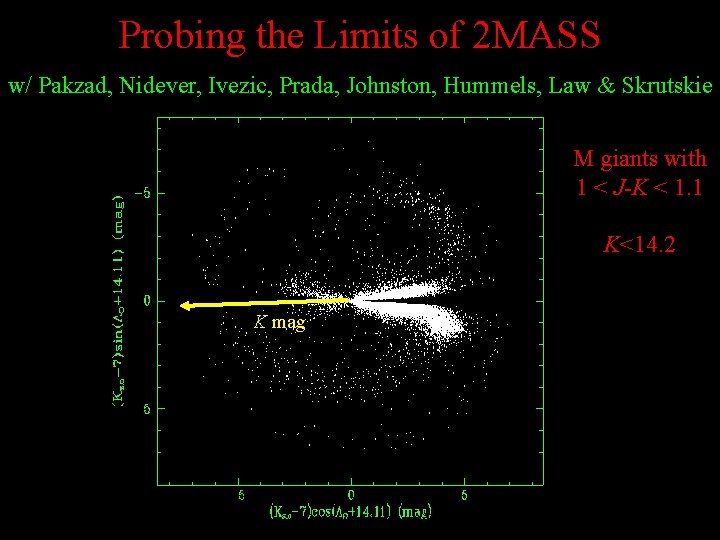
Probing the Limits of 2 MASS w/ Pakzad, Nidever, Ivezic, Prada, Johnston, Hummels, Law & Skrutskie M giants with 1 < J-K < 1. 1 K<14. 2 K mag
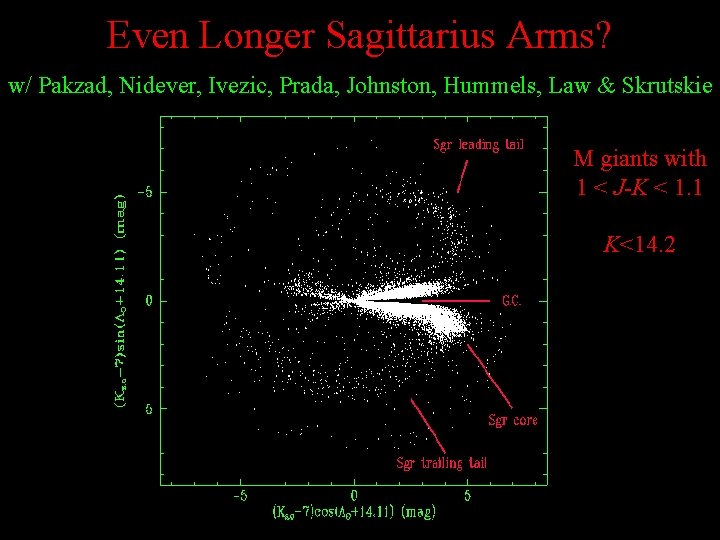
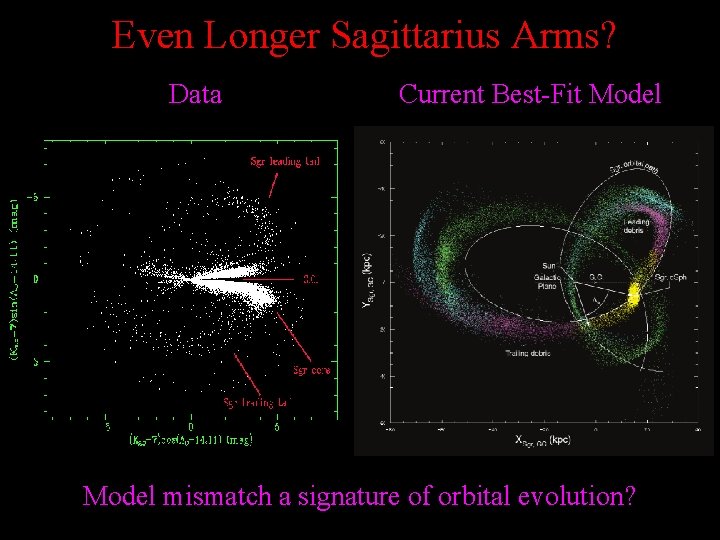
Even Longer Sagittarius Arms? w/ Pakzad, Nidever, Ivezic, Prada, Johnston, Hummels, Law & Skrutskie M giants with 1 < J-K < 1. 1 K<14. 2
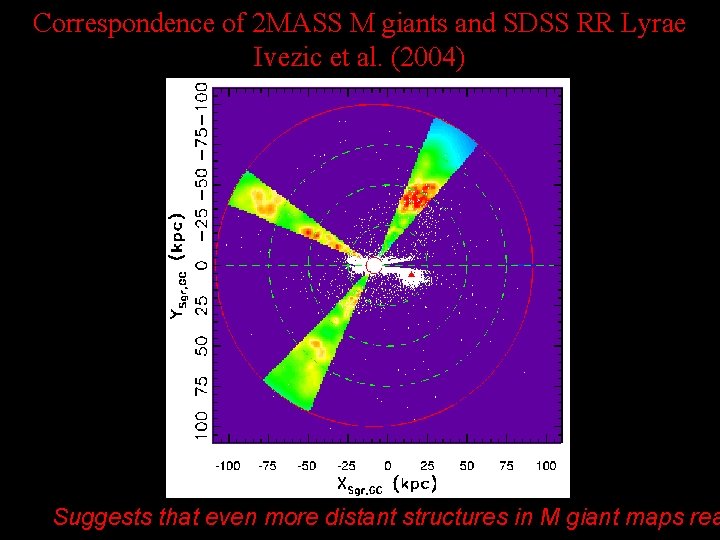
Correspondence of 2 MASS M giants and SDSS RR Lyrae Ivezic et al. (2004) Suggests that even more distant structures in M giant maps rea
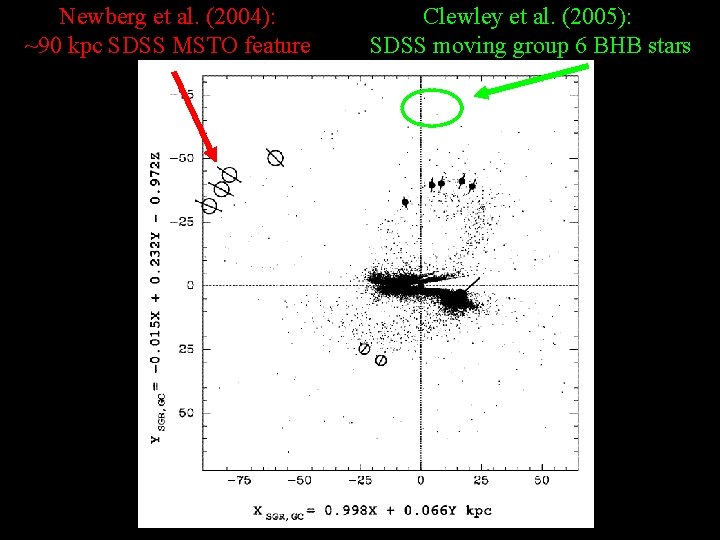
Newberg et al. (2004): ~90 kpc SDSS MSTO feature Clewley et al. (2005): SDSS moving group 6 BHB stars
Even Longer Sagittarius Arms? Data Current Best-Fit Model mismatch a signature of orbital evolution?
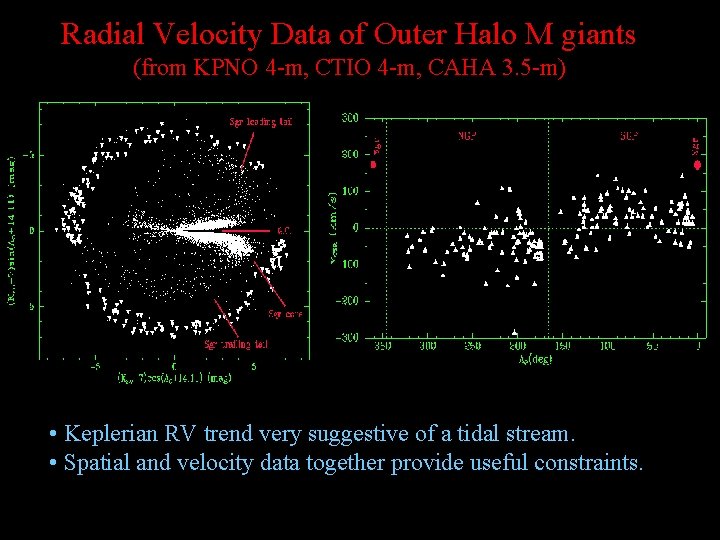
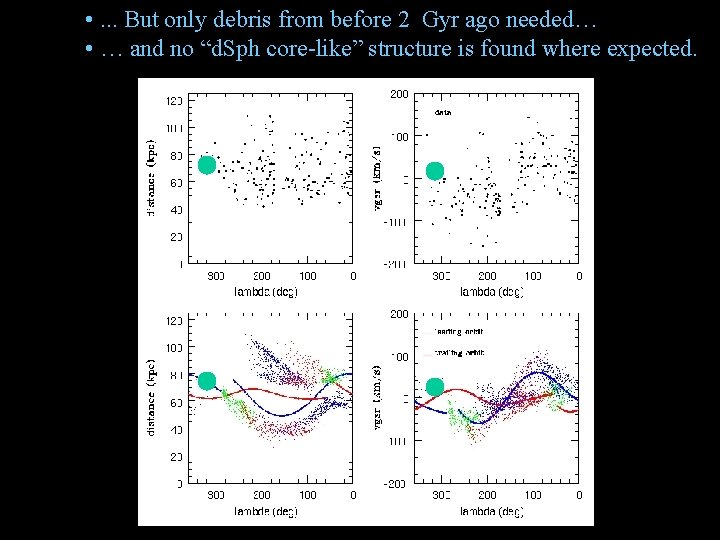
Radial Velocity Data of Outer Halo M giants (from KPNO 4 -m, CTIO 4 -m, CAHA 3. 5 -m) • Keplerian RV trend very suggestive of a tidal stream. • Spatial and velocity data together provide useful constraints.
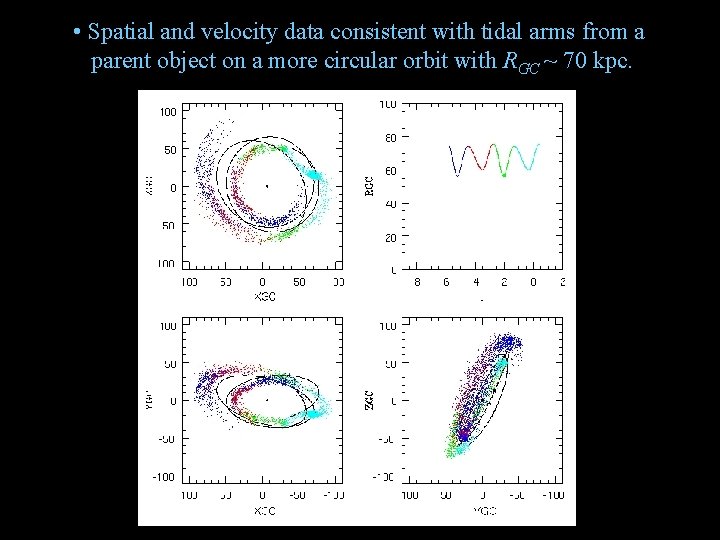
• Spatial and velocity data consistent with tidal arms from a parent object on a more circular orbit with RGC ~ 70 kpc.
• . . . But only debris from before 2 Gyr ago needed… • … and no “d. Sph core-like” structure is found where expected.
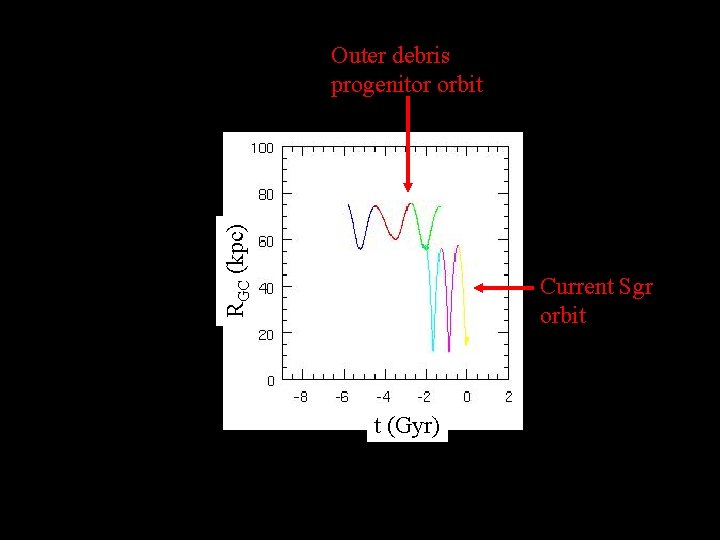
RGC (kpc) Outer debris progenitor orbit Current Sgr orbit t (Gyr)
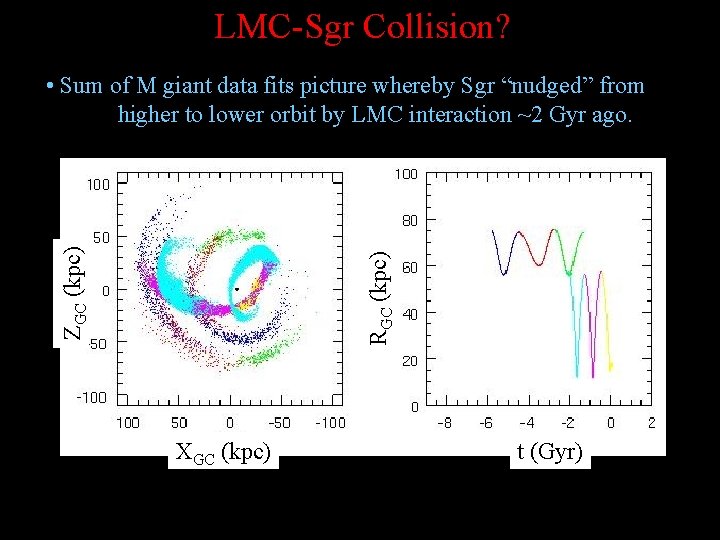
LMC-Sgr Collision? • Suggests a scenario where outer debris is Sgr, which was “nudged” from higher to lower orbit by LMC interaction ~2 Gyr ago. • Interestingly close to time of near passage of LMC and Sgr.
LMC-Sgr Collision? RGC (kpc) ZGC (kpc) • Sum of M giant data fits picture whereby Sgr “nudged” from higher to lower orbit by LMC interaction ~2 Gyr ago. XGC (kpc) t (Gyr)
Inner and Outer Sagittarius? Pakzad et al. poster 142. 05 Animation by David Law & SRM Caltech/University of Virginia
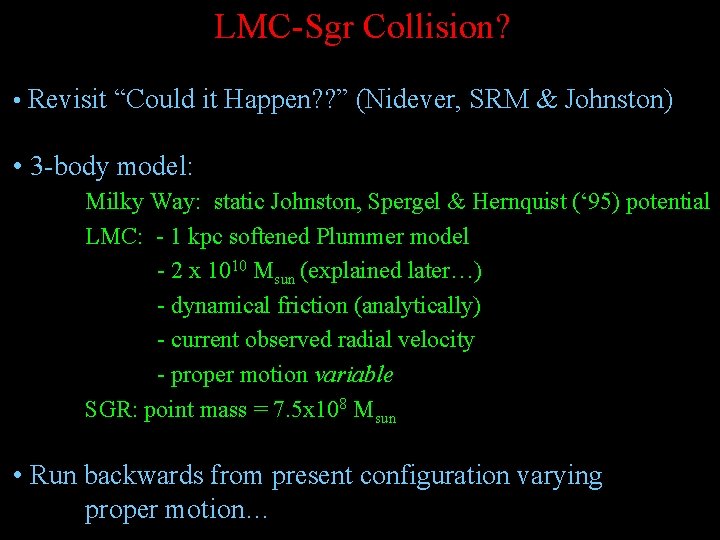
LMC-Sgr Collision? • Revisit “Could it Happen? ? ” (Nidever, SRM & Johnston) • 3 -body model: Milky Way: static Johnston, Spergel & Hernquist (‘ 95) potential LMC: - 1 kpc softened Plummer model - 2 x 10¹⁰ Msun (explained later…) - dynamical friction (analytically) - current observed radial velocity - proper motion variable SGR: point mass = 7. 5 x 10⁸ Msun • Run backwards from present configuration varying proper motion…
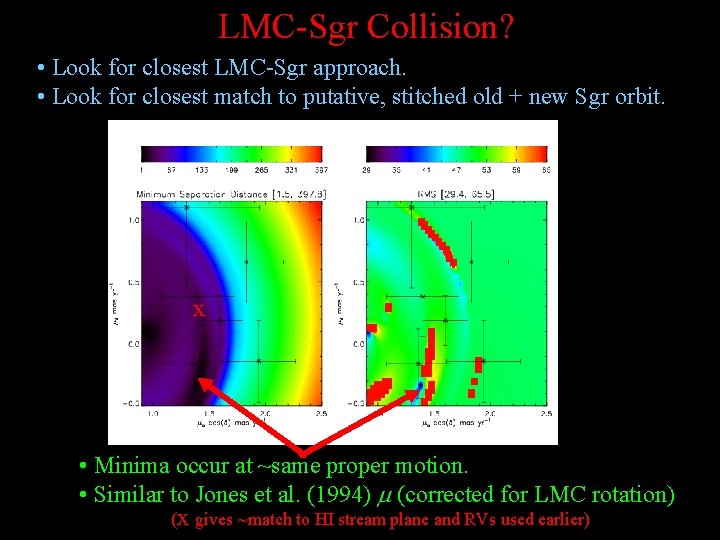
LMC-Sgr Collision? • Look for closest LMC-Sgr approach. • Look for closest match to putative, stitched old + new Sgr orbit. x • Minima occur at ~same proper motion. • Similar to Jones et al. (1994) m (corrected for LMC rotation) (x gives ~match to HI stream plane and RVs used earlier)
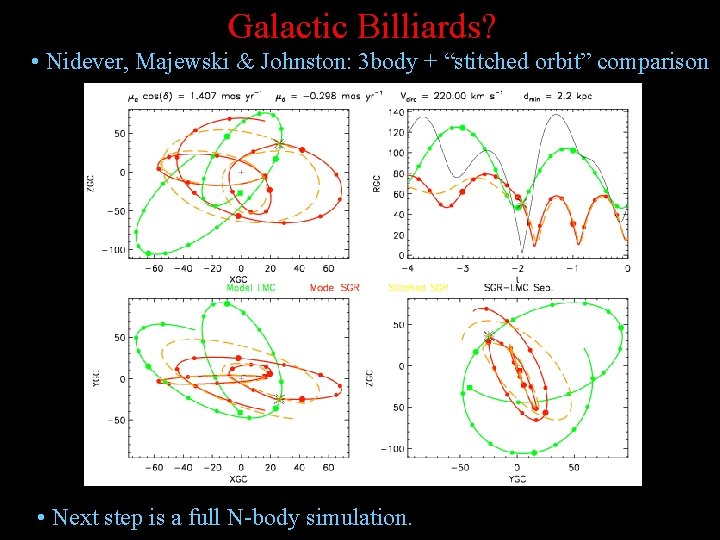
Galactic Billiards? • Nidever, Majewski & Johnston: 3 -body collision starting 3 Gyr ago
Galactic Billiards? • Nidever, Majewski & Johnston: 3 body + “stitched orbit” comparison • Next step is a full N-body simulation.
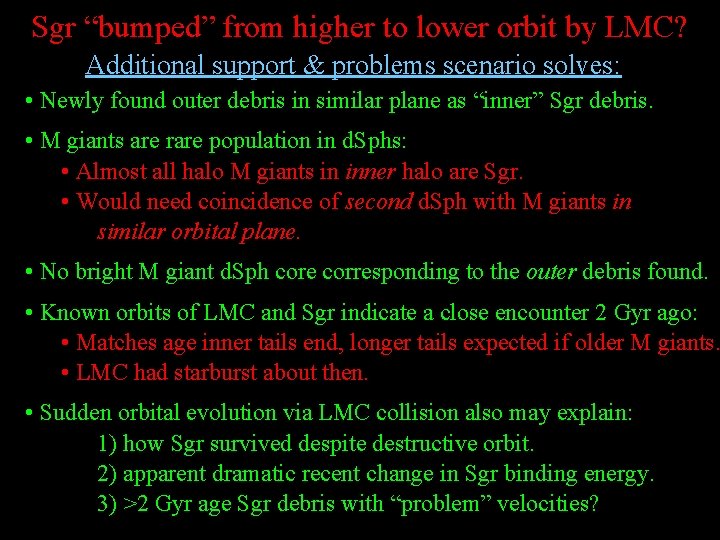
Sgr “bumped” from higher to lower orbit by LMC? Additional support & problems scenario solves: • Newly found outer debris in similar plane as “inner” Sgr debris. • M giants are rare population in d. Sphs: • Almost all halo M giants in inner halo are Sgr. • Would need coincidence of second d. Sph with M giants in similar orbital plane. • No bright M giant d. Sph core corresponding to the outer debris found. • Known orbits of LMC and Sgr indicate a close encounter 2 Gyr ago: • Matches age inner tails end, longer tails expected if older M giants. • LMC had starburst about then. • Sudden orbital evolution via LMC collision also may explain: 1) how Sgr survived despite destructive orbit. 2) apparent dramatic recent change in Sgr binding energy. 3) >2 Gyr age Sgr debris with “problem” velocities?
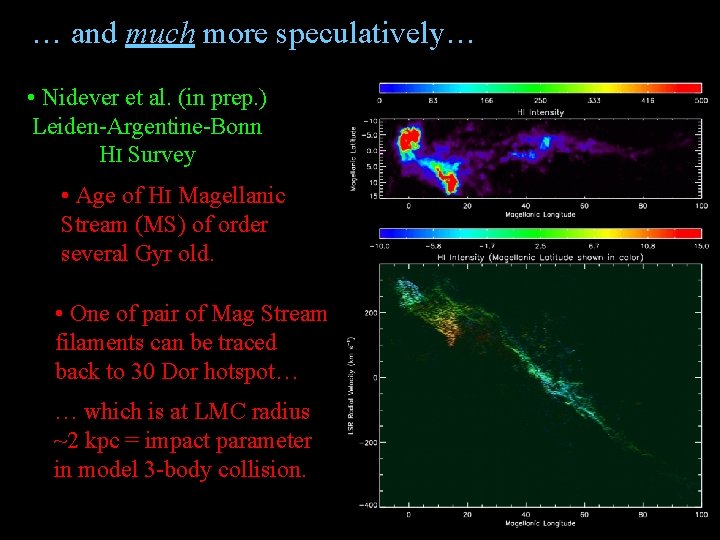
… and much more speculatively… • Nidever et al. (in prep. ) Leiden-Argentine-Bonn HI Survey • Age of HI Magellanic Stream (MS) of order several Gyr old. • One of pair of Mag Stream filaments can be traced back to 30 Dor hotspot… … which is at LMC radius ~2 kpc = impact parameter in model 3 -body collision.
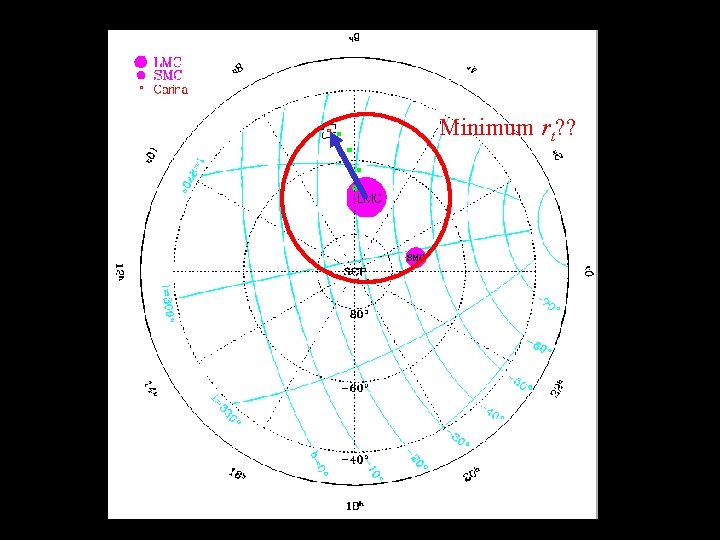
The LMC ``Cue Ball” • Is the putative Sgr-LMC collision unique? • Is LMC active perturber of dwarf galaxy “Oort Cloud”? • Most d. Sphs spend most of their lives RGC > 100 kpc, but with significant overlap of (evolving) LMC orbit (Rapo< 200). • Polar orbits preferred (although selection effect). • Other meetings near the Galactic poles might be expected (past and/or present) and promote late infall? • Evidence LMC is significantly bigger cue ball than previously measured…
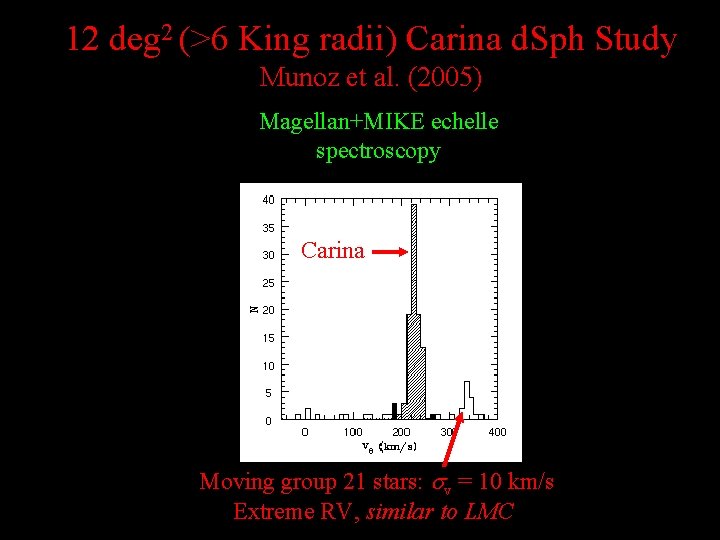
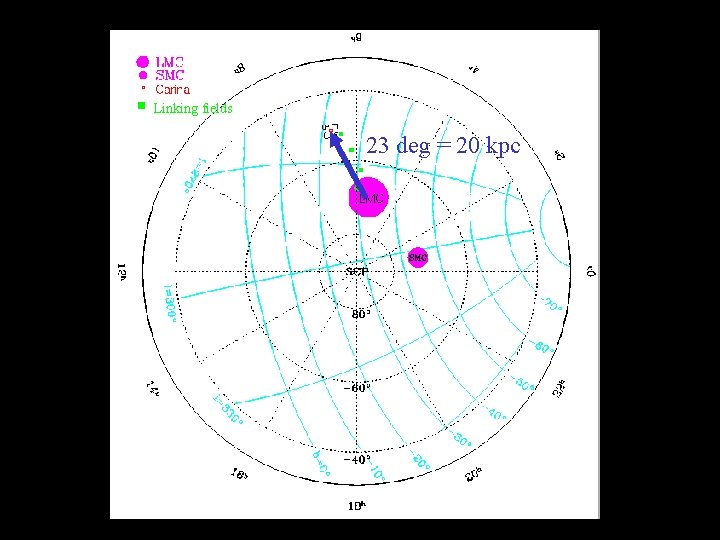
12 deg 2 (>6 King radii) Carina d. Sph Study Munoz et al. (2005) Magellan+MIKE echelle spectroscopy Carina Moving group 21 stars: sv = 10 km/s Extreme RV, similar to LMC
Linking fields 23 deg = 20 kpc
Minimum rt? ?
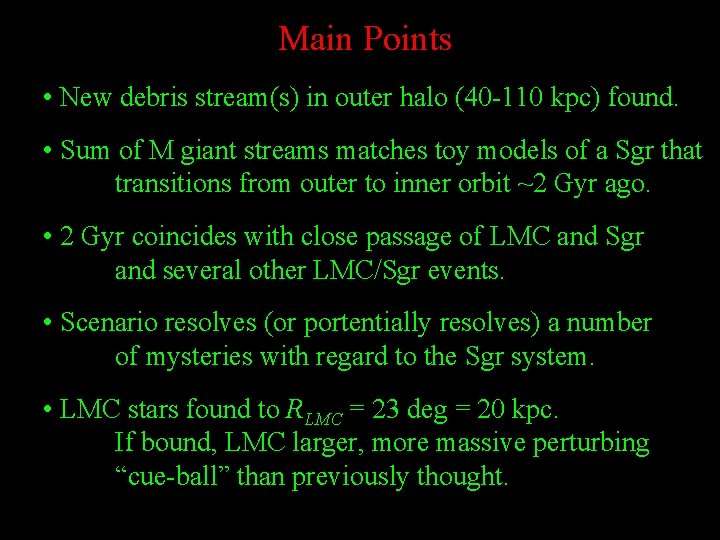
Main Points • New debris stream(s) in outer halo (40 -110 kpc) found. • Sum of M giant streams matches toy models of a Sgr that transitions from outer to inner orbit ~2 Gyr ago. • 2 Gyr coincides with close passage of LMC and Sgr and several other LMC/Sgr events. • Scenario resolves (or portentially resolves) a number of mysteries with regard to the Sgr system. • LMC stars found to RLMC = 23 deg = 20 kpc. If bound, LMC larger, more massive perturbing “cue-ball” than previously thought.