
THE LIFE CYCLE OF A STAR Objective I
THE LIFE CYCLE OF A STAR Objective: I will compare and contrast the life cycle of stars based on their mass.

What is a Star? • A star is ball of gas undergoing nuclear fusion • Stars give off large amounts of energy in the form of light and heat (electromagnetic radiation)

Formation of a Star • Stars are formed in a nebula, a very large cloud of gas and dust in space.

Protostars • Gravity causes dense areas of gas take on a definite shape and are called protostars.
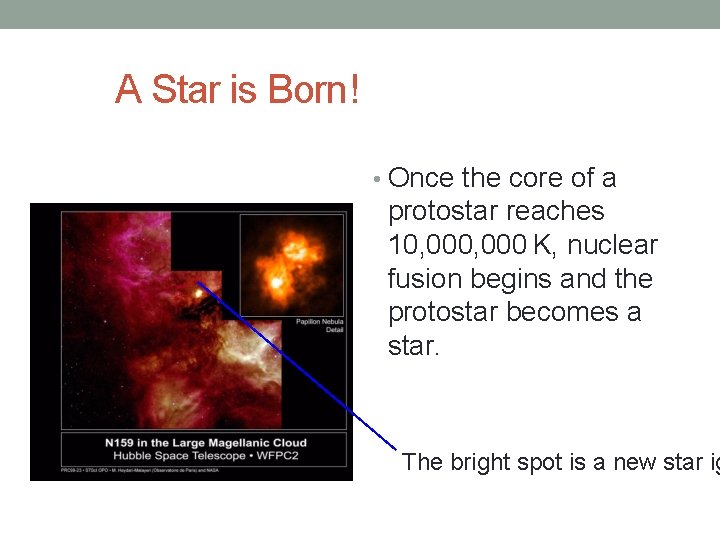
A Star is Born! • Once the core of a protostar reaches 10, 000 K, nuclear fusion begins and the protostar becomes a star. The bright spot is a new star ig

Nuclear Fusion • Nuclear Fusion is the process by which two nuclei combine to form a heavier element. • New stars initially will fuse hydrogen nuclei together to form helium.
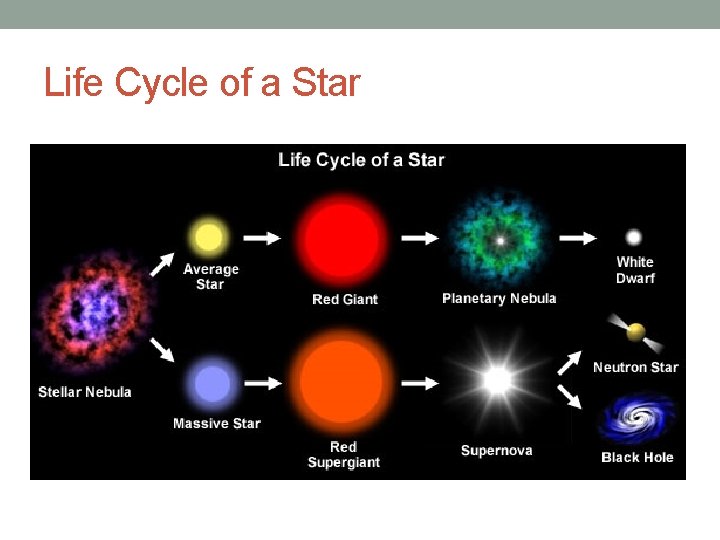
Life Cycle of a Star
Main Sequence Stars • Once nuclear fusion occurs, a star enters the main sequence • Stars live most of their life in the main sequence • In smaller stars, it takes about 10 billion years to consume all the hydrogen in the main sequence
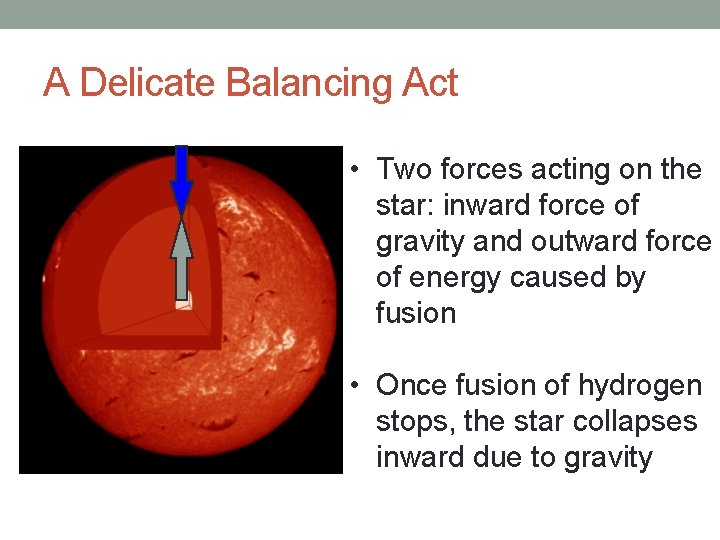
A Delicate Balancing Act • Two forces acting on the star: inward force of gravity and outward force of energy caused by fusion • Once fusion of hydrogen stops, the star collapses inward due to gravity
Red Giant • Collapsing outer layers cause core to heat up. • Fusion of helium into carbon begins. • Forces regain balance. • Outer shell expands greatly • Red Giants last for about 100 million years.
Unbalanced Forces (again) • When the Red Giant has fused all of the helium into carbon, the forces acting on the star are again unbalanced. • The massive outer layers of the star again rush into the core and rebound, generating staggering amounts of energy. • What happens next depends on how much mass the star has.
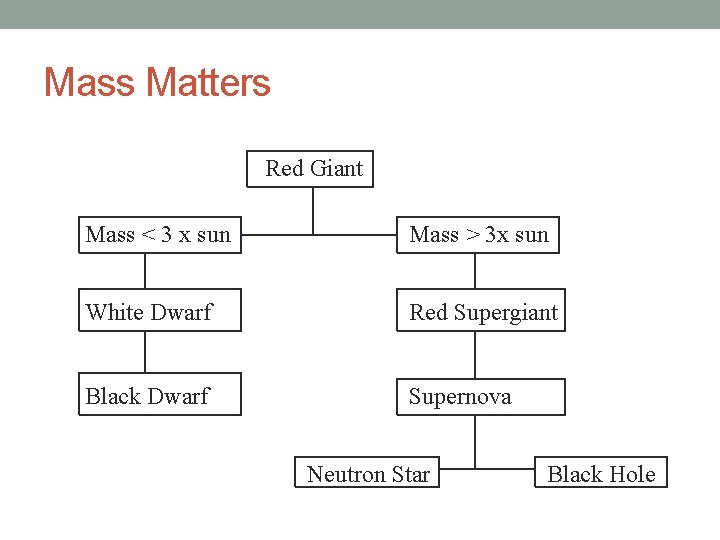
Mass Matters Red Giant Mass < 3 x sun Mass > 3 x sun White Dwarf Red Supergiant Black Dwarf Supernova Neutron Star Black Hole
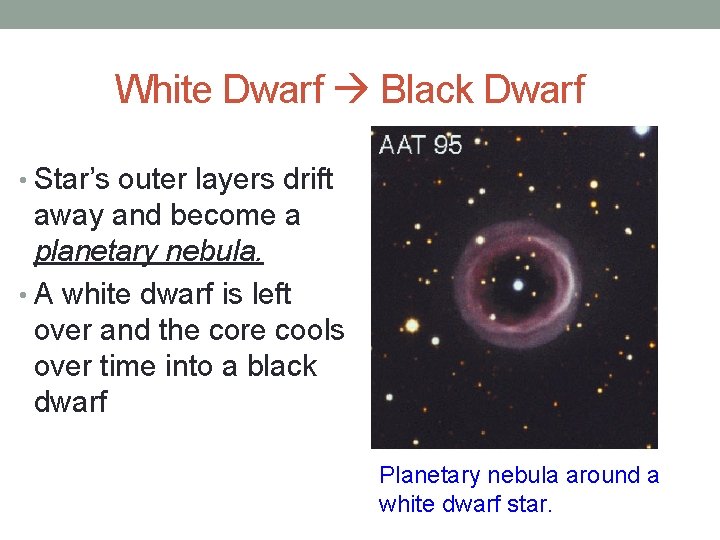
White Dwarf Black Dwarf • Star’s outer layers drift away and become a planetary nebula. • A white dwarf is left over and the core cools over time into a black dwarf Planetary nebula around a white dwarf star.
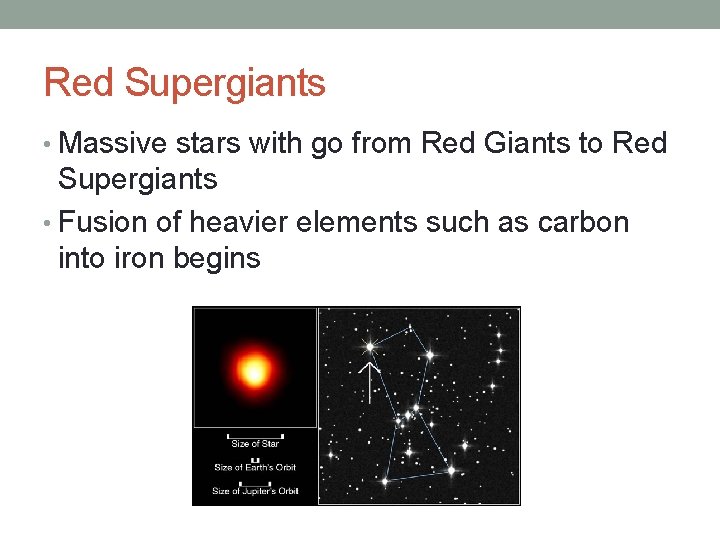
Red Supergiants • Massive stars with go from Red Giants to Red Supergiants • Fusion of heavier elements such as carbon into iron begins
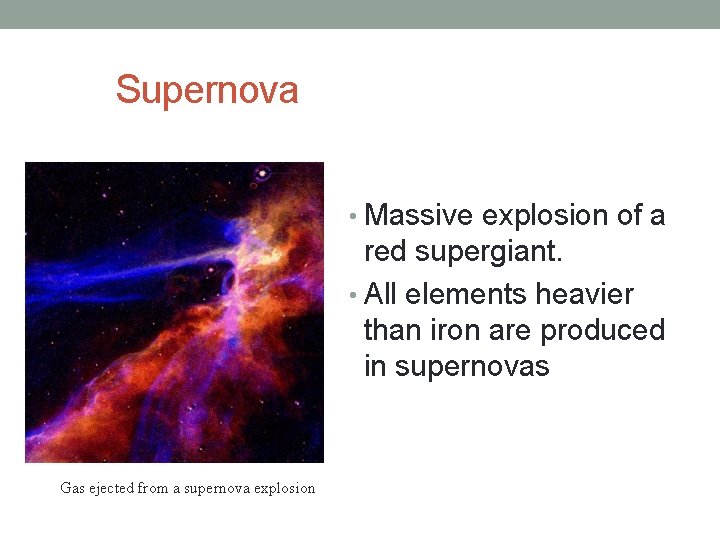
Supernova • Massive explosion of a red supergiant. • All elements heavier than iron are produced in supernovas Gas ejected from a supernova explosion
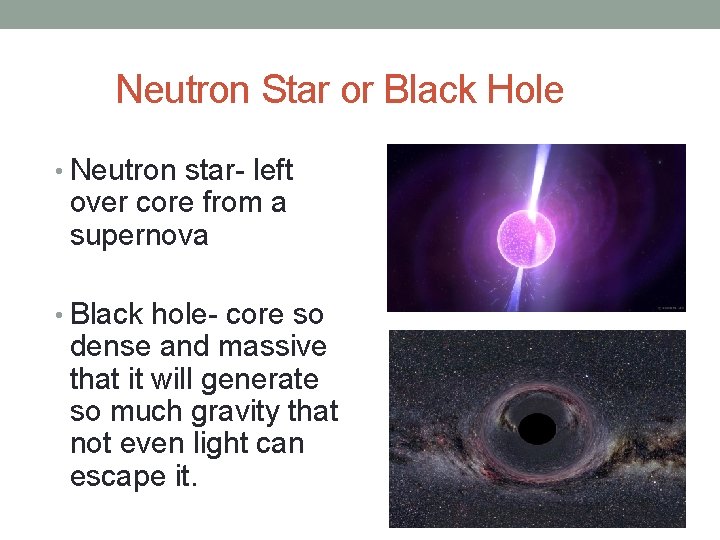
Neutron Star or Black Hole • Neutron star- left over core from a supernova • Black hole- core so dense and massive that it will generate so much gravity that not even light can escape it.
- Slides: 16