Whats happening in the Graveyard Shift Not covering
- Slides: 37
What’s happening in the Graveyard Shift? • Not covering everything in WCAG 2. 0 • Focusing on – some of the good points – … and some of the bad! • Looking at – Implications on design – How it can/might be adopted • Will describe imagery on screen • General discussion/bitching
Who’s who – Andy Clarke • The modfather, wasplike designer of note (and no taking the Mickey)
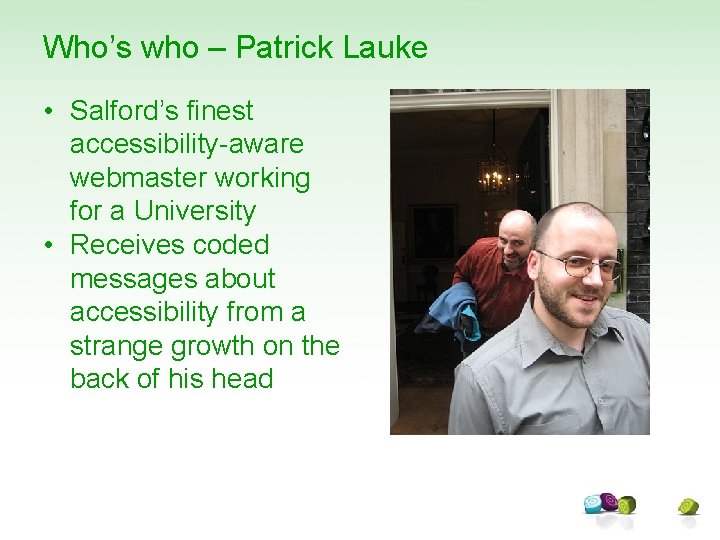
Who’s who – Patrick Lauke • Salford’s finest accessibility-aware webmaster working for a University • Receives coded messages about accessibility from a strange growth on the back of his head
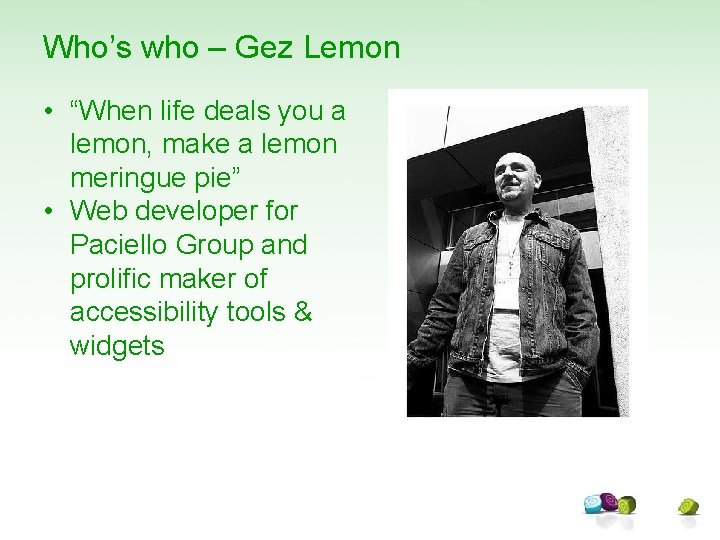
Who’s who – Gez Lemon • “When life deals you a lemon, make a lemon meringue pie” • Web developer for Paciello Group and prolific maker of accessibility tools & widgets
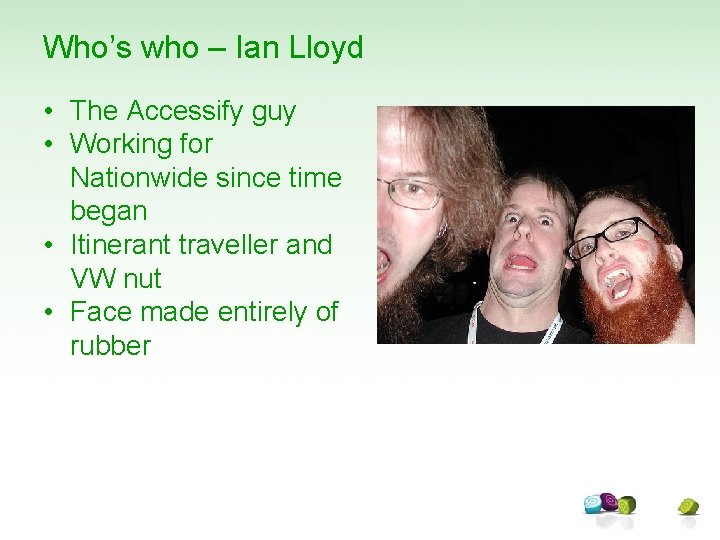
Who’s who – Ian Lloyd • The Accessify guy • Working for Nationwide since time began • Itinerant traveller and VW nut • Face made entirely of rubber
Wa. SP ATF • Either by chance or design, we are all ATF members – Wa. SP = Web Standards Project – ATF = Accessibility Task Force
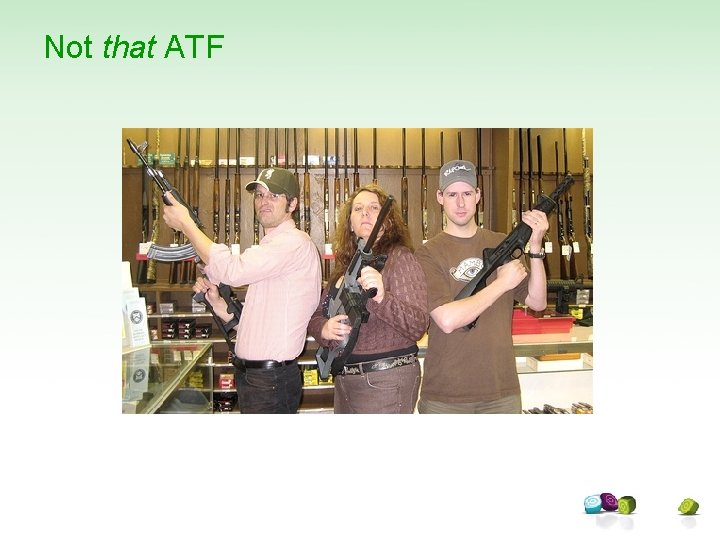
Not that ATF
WCAG – A brief history • Web Content Accessibility Guidelines = WCAG (or wuh-cag!) • Version 1. 0 released in 1999 – Ancient in Internet years – Much of it out-of-date/irrelevant • Other accessibility ‘standards’ (e. g. section 508) – WCAG too wide-reaching for some implementations – Note: PAS 78 *not* a variant of WCAG/508
WCAG 2. 0 – Philosophy behind the change • Technology-agnostic – not just guidelines for browsers – Non browser-specific terminology = generic terminology • P. O. U. R. Web site/page should be: – Perceivable (cater for sense deficiencies) – Operable (how you control items) – Understandable (language, jargon etc) – Robust (compatibility with current/future tech)
WCAG 1. 0 and WCAG 2. 0 compared • WCAG 1. 0 – 2. 1 – “Ensure that all information conveyed with color is also available without color, for example from context or markup” • WCAG 2. 0 – 1. 3. 2 – “Any information that is conveyed by color is also visually evident without color” Looks simple enough? Not always
WCAG 1. 0 and WCAG 2. 0 compared • WCAG 1. 0 – 13. 1 – “Clearly identify the target of each link” • WCAG 2. 0 – 2. 4. 4 – “Each link is programmatically associated with text from which its purpose can be determined” • Trans: “write meaningful link phrases” – ‘take a look at our product range’ rather than – ‘click here to view our products’”
WCAG 1. 0 and WCAG 2. 0 compared • WCAG 1. 0 – 3. 6 – “Mark up lists and list items properly” • WCAG 2. 0 – 1. 3. 1 – “Information and relationships conveyed through presentation can be programmatically determined and notification of changes to these is available to user agents, including assistive technologies”
WCAG 1. 0 and WCAG 2. 0 compared • Translation: “Oh crap, I’ve given up the will to live. Pass me a beer, I’m gonna watch telly instead”
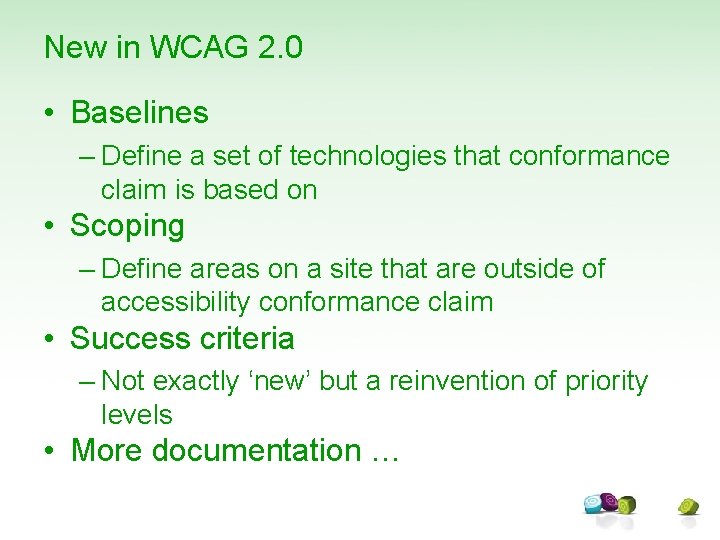
New in WCAG 2. 0 • Baselines – Define a set of technologies that conformance claim is based on • Scoping – Define areas on a site that are outside of accessibility conformance claim • Success criteria – Not exactly ‘new’ but a reinvention of priority levels • More documentation …
New documentation in WCAG 2. 0 • Hand-over to Patrick to explain some of the other documents, how they relate to each other, purposes of each other • Not bitching about them at this point … all in due course!
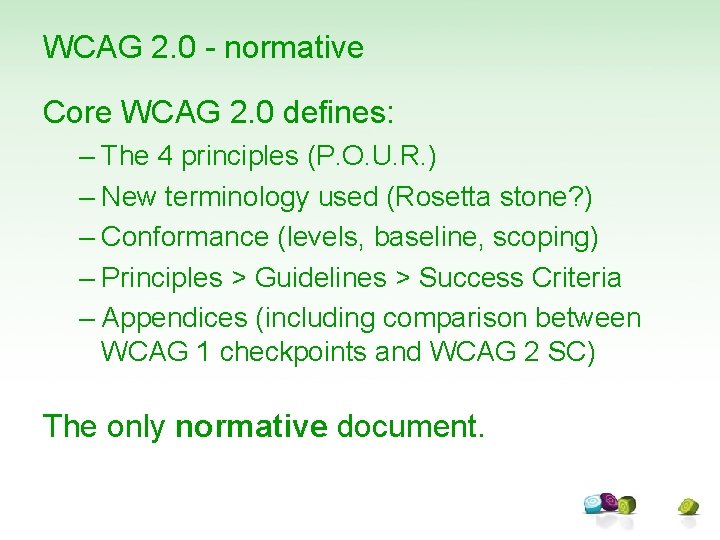
WCAG 2. 0 - normative Core WCAG 2. 0 defines: – The 4 principles (P. O. U. R. ) – New terminology used (Rosetta stone? ) – Conformance (levels, baseline, scoping) – Principles > Guidelines > Success Criteria – Appendices (including comparison between WCAG 1 checkpoints and WCAG 2 SC) The only normative document.
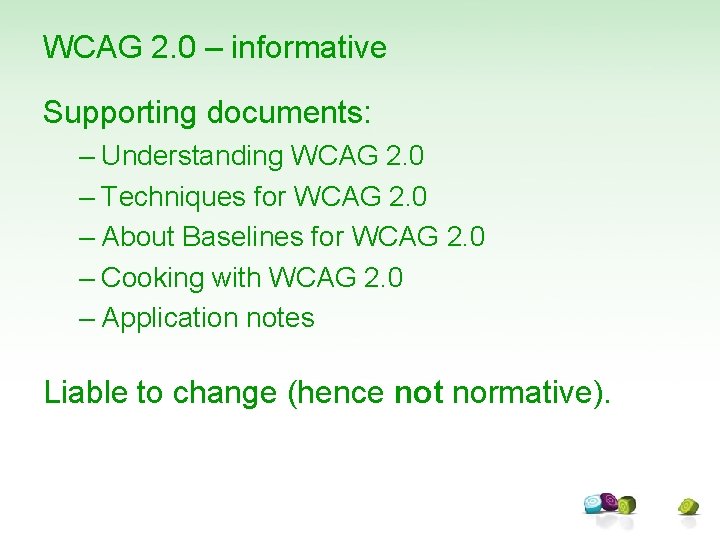
WCAG 2. 0 – informative Supporting documents: – Understanding WCAG 2. 0 – Techniques for WCAG 2. 0 – About Baselines for WCAG 2. 0 – Cooking with WCAG 2. 0 – Application notes Liable to change (hence not normative).
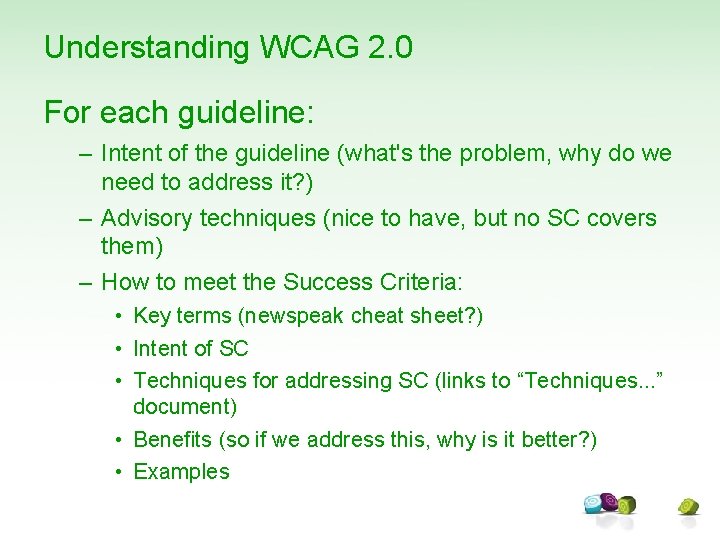
Understanding WCAG 2. 0 For each guideline: – Intent of the guideline (what's the problem, why do we need to address it? ) – Advisory techniques (nice to have, but no SC covers them) – How to meet the Success Criteria: • Key terms (newspeak cheat sheet? ) • Intent of SC • Techniques for addressing SC (links to “Techniques. . . ” document) • Benefits (so if we address this, why is it better? ) • Examples
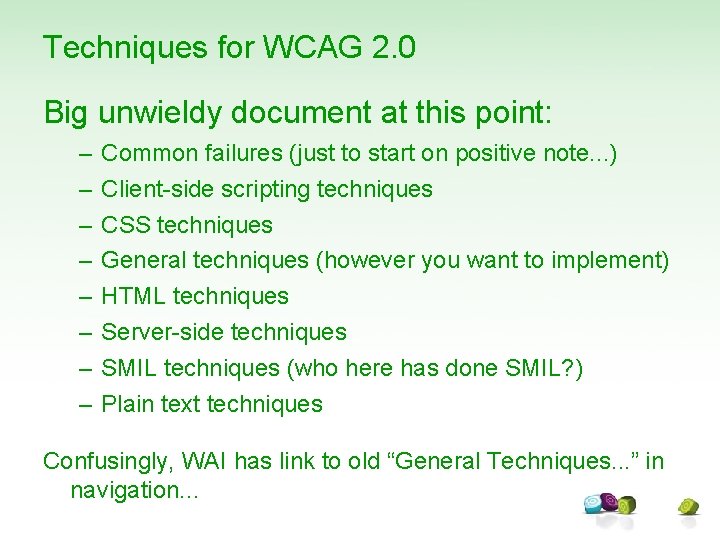
Techniques for WCAG 2. 0 Big unwieldy document at this point: – – – – Common failures (just to start on positive note. . . ) Client-side scripting techniques CSS techniques General techniques (however you want to implement) HTML techniques Server-side techniques SMIL techniques (who here has done SMIL? ) Plain text techniques Confusingly, WAI has link to old “General Techniques. . . ” in navigation. . .
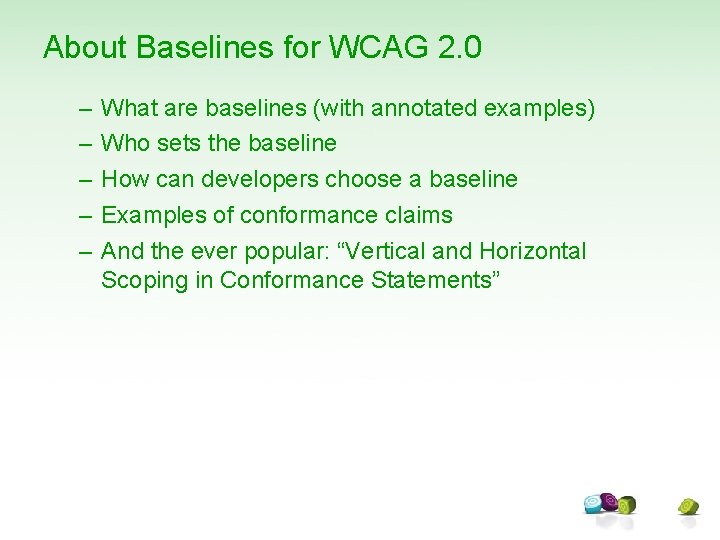
About Baselines for WCAG 2. 0 – – – What are baselines (with annotated examples) Who sets the baseline How can developers choose a baseline Examples of conformance claims And the ever popular: “Vertical and Horizontal Scoping in Conformance Statements”
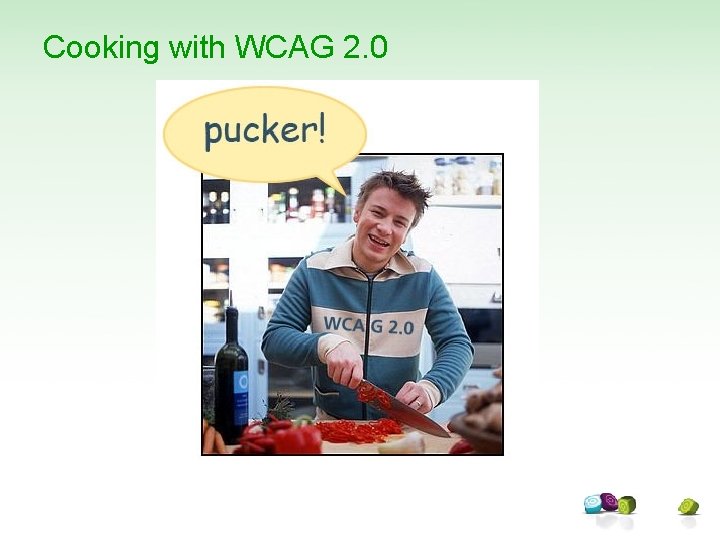
Cooking with WCAG 2. 0
Application notes “In the future [. . . ] Application Notes would provide detailed guidance for a specific topic [. . . ]. For example, an Application Note on forms would include WCAG 2. 0 success criteria, techniques, and strategies for developing accessible forms. ” Will be produced by Education and Outreach Working Group (EOWG)
Other WAI guidelines • Of course other parts of the accessibility equation need to be in place: – Authoring Tool Accessibility Guidelines (ATAG) – also currently 2. 0 WD and based on WCAG 2. 0 – User Agent Accessibility Guidelines (UAAG)
The Improvements in WCAG 2. 0 • Gez to pick out some of the improvements in WCAG 2. 0, possible with some examples?
What’s bad about WCAG 2. 0 • Beginning with Patrick • Then Andy • Then Ian
Language of WCAG 2. 0 • Requirements of WCAG 2. 0 “WCAG 2. 0 deliverables must address the needs of a variety of readers, including people who wish to: – – Create accessible, innovative Web sites. Create policies related to Web accessibility. Assess whether a Web site conforms to the guidelines. Develop authoring tools, user agents, or evaluation and repair tools. – Teach principles of accessible Web content. ”
Language of WCAG 2. 0 (cont. ) • WCAG 2. 0 itself “These informative documents are written to be used by a diverse audience, including but not limited to: – – – people who create Web content developers who write code quality assurance or accessibility evaluators policy makers managers users”
Language of WCAG 2. 0 (cont. ) – Why are the guidelines and documents currently so difficult to understand? – To remain tech-agnostic, invented a whole new language (full of sound and clatter, signifying nothing) – Even seasoned experts can't understand it – Programmatically determined? Authored unit? Authored content? Even. . . mechanism?
“Mechanism” in WCAG 2. 0 – “process or technique for achieving a result” – SC 2. 4. 1 A mechanism is available to bypass blocks of content that are repeated on multiple Web units. – On first reading: do I need to now add skip links to everything? – No, even just marking a navigation up as a list counts as a “mechanism”!?
Implementing WCAG 2. 0 – Study WCAG 2. 0, support documents, consult your friends on WAI WG – and some things may become clearer – University setup – central web team and devolved web authors – How can I expect web authors (not just professionals, but part-time lecturers, technicians, enthusiasts) to implement WCAG 2. 0? – “Here, read this. . . and this. . . see you in a few months once you master the secret art of the Wu-Kag-Clan”
Implementing WCAG 2. 0 (cont. ) – – How I implemented WCAG 1. 0 – never claim compliance Own interpretation (removed most “Until user agents. . . ”) And for WCAG 2. 0? Shawn Lawton Henry: “Go test with users - forget the specs” – Writing own interpretation of WCAG 2. 0, making it techspecific to our baseline and adding own interpretation/preferred method (“mechanism”? )
WCAG 2. 0 and the designer • Andy to cover off impact of some specific points on design – how will it adversely affect design, how might it improve design (standardising techniques that some designers have resisted til now? )
• Back to ian …
Mighty Joe Clarke (the 800 lb Gorilla) • To Hell with WCAG 2. 0 – Has alerted many to issues with WCAG 2. 0 (a good thing) – Seems to have been catalyst for ‘last call’ extension • WCAG Samurai – Closed group – A good or bad thing? – Could it derail WCAG 2. 0?
Summing up … • WCAG 2. 0 not yet a done deal – But only if you have your say • http: //tinyurl. com/hmtus (WCAG 2. 0 comment form) • Email to public-comments-wcag 20@w 3. org • You are allowed to criticise! – Non-participation in WCAG working group does not preclude you from having your say
So then … Any questions?