VERMINOUS PNEUMONIA VERMINOUS PNEUMONIA n Other names n






- Slides: 24
VERMINOUS PNEUMONIA
VERMINOUS PNEUMONIA n Other names: n Verminous Bronchitis. n Lungworm infestations.
Definition n VP is an acute, subacute or chronic infectious respiratory disease of ruminants and equines caused by nematode parasites characterized clinically by respiratory impairment including bronchitis and bronchopneumonia.
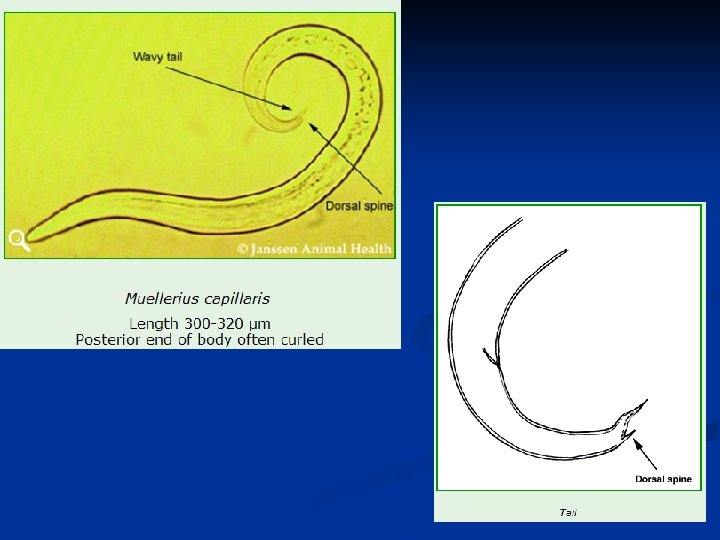
ETIOLOGY AND LIFE CYCLE n Family: Protostrongyloidae n Genera: Dictyocaulus & Metastongylus n n Thread like nematodes up to 100 mm long. All lungworms are species specific Cattle…. . D. viviparus n Sheep…. . D. filaria, Mullerius capillaries & Protostrongylus rufescences. n Equines……D. arnfieldi. n
Adult worm live in bronchi Eggs hatch in air passages or alimentary canal 1 st stage larvae passed with faeces Develop to 2 nd and 3 rd Stage larvae In ext. environ. Ingestion of 3 rd stage Larvae reach mesenteric LNs Become 4 th stage larvae Adult worm At bronchi for 7 weeks immunity Self cure After 3 -6 ws Mature worms laying eggs Portal vein circ. Heart Lung Migrate bronchi
ETIOLOGY AND LIFE CYCLE Penetration phase: 1 -7 days n Prepatent phase: 7 -25 days n Patent phase: 25 -55 days n Postpatent phase: 55 -70 days. n n M. capillaries & P. rufescences in sheep require intermediate host snail.
Epidemiology n Distribution: n World wide distributed.
n Sources and mode of transmission: q Ingestion of 3 rd stage larvae. q Calf ingests 25 -50 infective larvae/kg
Susceptible animals Ruminant animals. n Equines. n
Factors influencing susceptibility n Season: autumn and early winter. n Young ages are more susceptible n Calves 4 -5 m n Sheep 2 -18 m
E. value n Death during acute infection. n Inefficient feed conversion. n Drop in meat & wool production. n Costs of preventive & treatment programs.
Clinical signs Morbidity varies directly with the degree of infestation in grazing land. n Low mortality rate n
Clinical signs n Acute verminous pneumonia: n Rapid shallow respiration. n Frequent bronchial cough. n Slight nasal discharge. n Increased heart rate. n Fever. n Increased vesicular murmur and bronchial tones. n Dyspnoea
Clinical signs cont. , n Subacute & chronic verminous pneumonia: n. Diarrhea. n. Normal temperature. n. Paroxysms cough n. Consolidation and bronchitis ventrally. n. Marked emphysema dorsally.
PM Large numbers of adult worms in bronchi. n Lung edema and emphysema. n Wide spread areas of collapsed tissue. n
Diagnosis Field diagnosis: failure to respond to standard treatment for bacterial and viral pneumonia. n PM n Lab diagnosis: n n Fecal samples for detection of larvae.
Treatment q. Albendazole 3 -10 mg/kg q. Levamisole 8 mg/kg q. Ivermectine 0. 2 mg/kg
Vaccination n Two oral doses with a month apart. n The vaccine is an aqueous suspension of 1000 third stage-infective Dictyocaulus viviparus larvae partially inactivated by ionizing radiation.
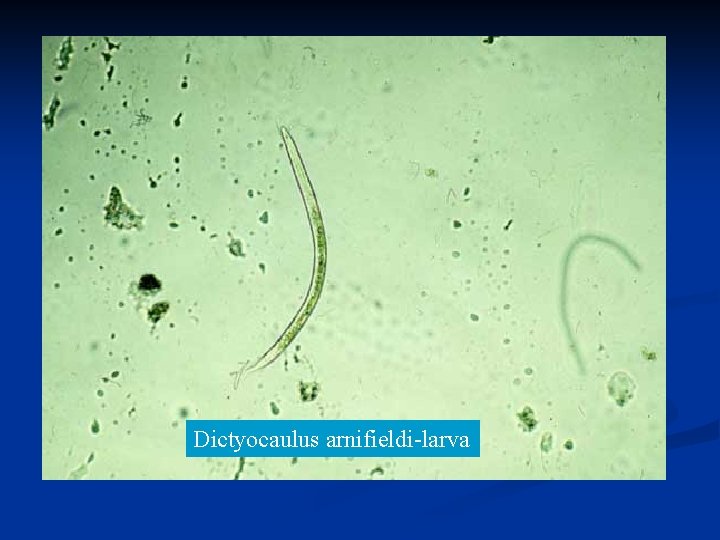
Dictyocaulus arnifieldi-larva
Dictyocaulus larva
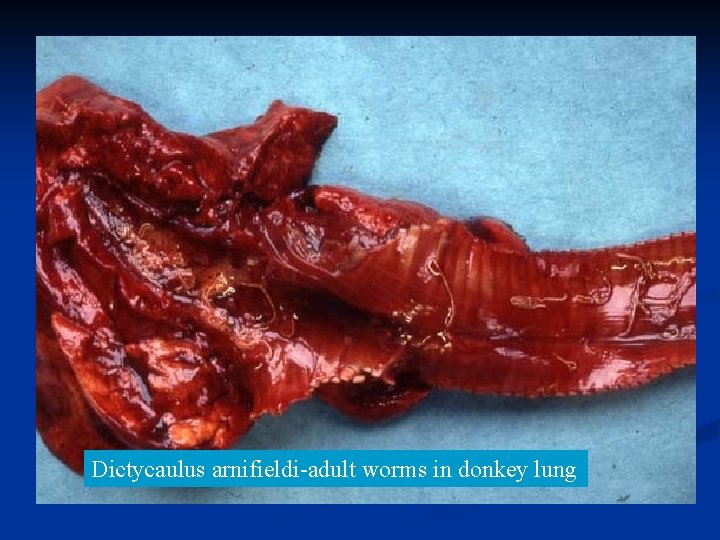
Dictycaulus arnifieldi-adult worms in donkey lung