
RESPIRATORY SYSTEM BLOCK Pathology Practical Prepared by Prof
RESPIRATORY SYSTEM BLOCK Pathology Practical Prepared by: • Prof. Ammar Al Rikabi • Dr. Sayed Al Esawy • Dr. Marie Mukhashin Head of Pathology Department: Dr. Abdulmalik
First Practical Session • • • Pathology Dept. Bronchiectasis Chronic Bronchitis Emphysema Lobar Pneumonia Bronchopneumonia Pulmonary Embolus & Infarction Respiratory
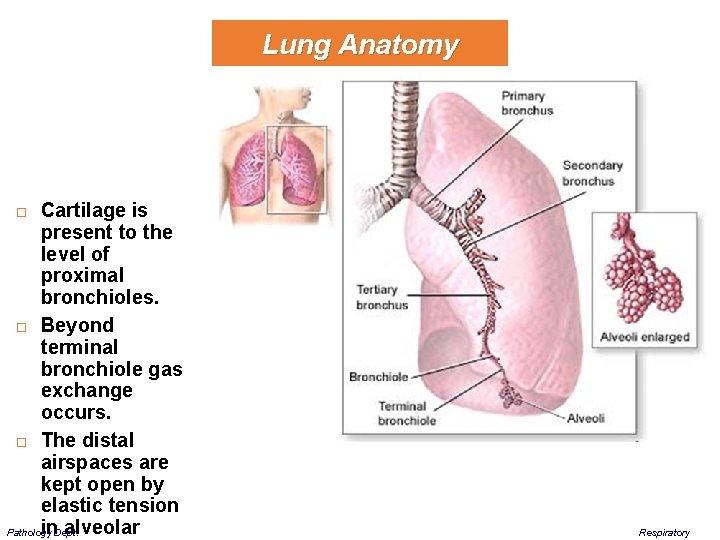
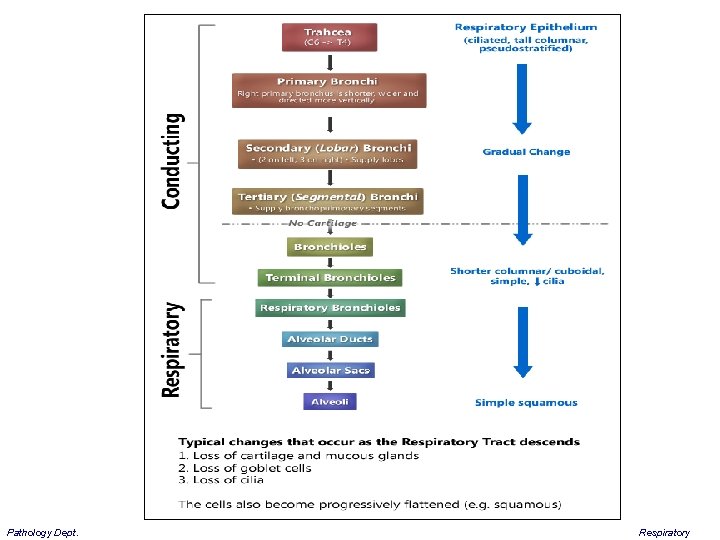
Lung Anatomy Cartilage is present to the level of proximal bronchioles. Beyond terminal bronchiole gas exchange occurs. The distal airspaces are kept open by elastic tension in. Dept. alveolar Pathology Respiratory
Pathology Dept. Respiratory
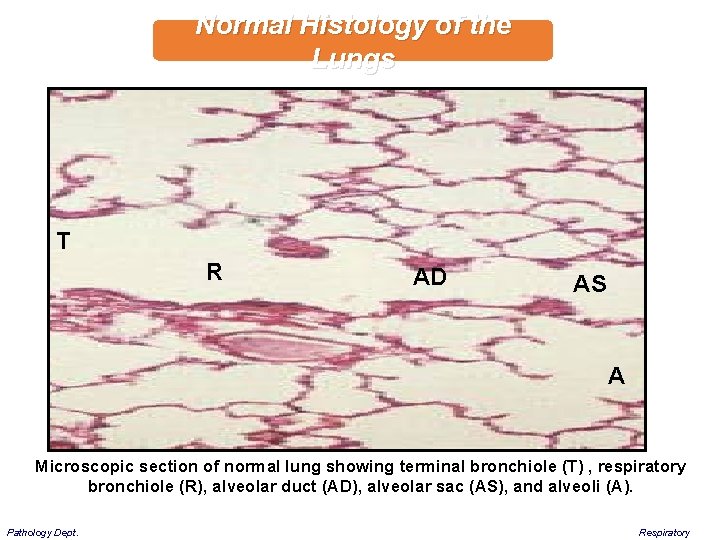
Normal Histology of the Lungs T R AD AS A Microscopic section of normal lung showing terminal bronchiole (T) , respiratory bronchiole (R), alveolar duct (AD), alveolar sac (AS), and alveoli (A). Pathology Dept. Respiratory
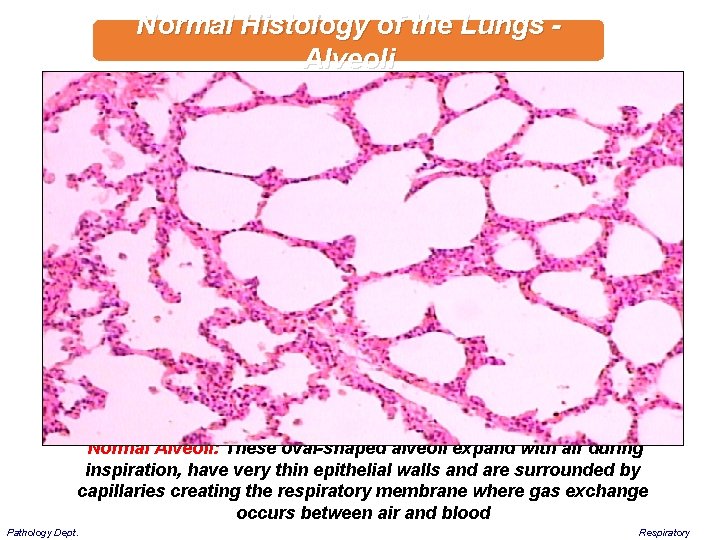
Normal Histology of the Lungs - Alveoli Normal Alveoli: These oval-shaped alveoli expand with air during inspiration, have very thin epithelial walls and are surrounded by capillaries creating the respiratory membrane where gas exchange occurs between air and blood Pathology Dept. Respiratory
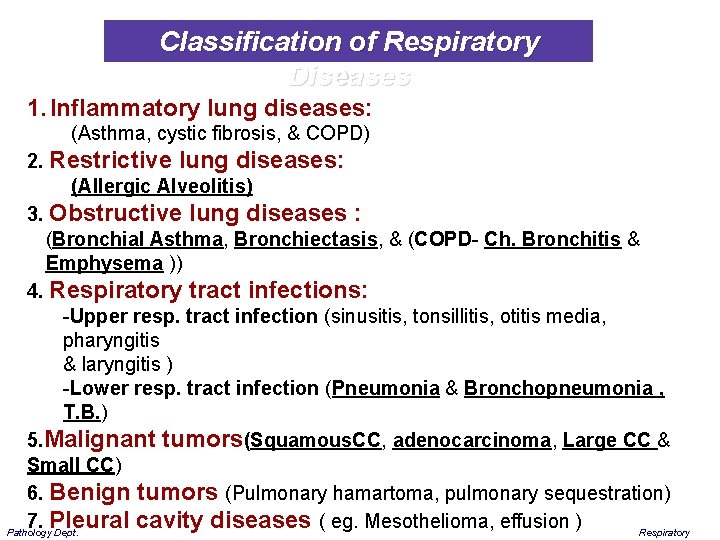
Classification of Respiratory Diseases 1. Inflammatory lung diseases: (Asthma, cystic fibrosis, & COPD) 2. Restrictive lung diseases: (Allergic Alveolitis) 3. Obstructive lung diseases : (Bronchial Asthma, Bronchiectasis, & (COPD- Ch. Bronchitis & Emphysema )) 4. Respiratory tract infections: -Upper resp. tract infection (sinusitis, tonsillitis, otitis media, pharyngitis & laryngitis ) -Lower resp. tract infection (Pneumonia & Bronchopneumonia , T. B. ) 5. Malignant tumors(Squamous. CC, adenocarcinoma, Large CC & Small CC) 6. Benign tumors (Pulmonary hamartoma, pulmonary sequestration) 7. Pleural cavity diseases ( eg. Mesothelioma, effusion ) Respiratory Pathology Dept.
OBSTRUCTIVE LUNG DISEASES 1. Bronchial Asthma 2. Bronchiectasis 3. COPD : (Chronic Bronchitis & Emphysema) Pathology Dept. Respiratory
1. BRONCHIAL ASTHMA Pathology Dept. Respiratory
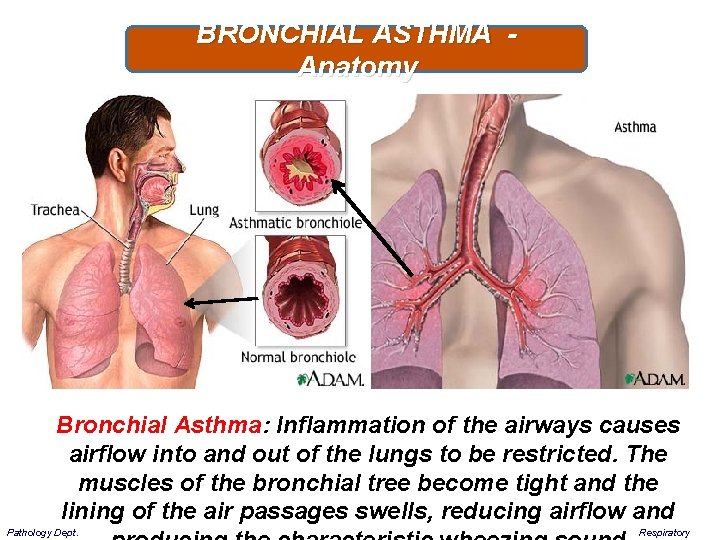
BRONCHIAL ASTHMA - Anatomy Bronchial Asthma: Inflammation of the airways causes airflow into and out of the lungs to be restricted. The muscles of the bronchial tree become tight and the lining of the air passages swells, reducing airflow and Pathology Dept. Respiratory
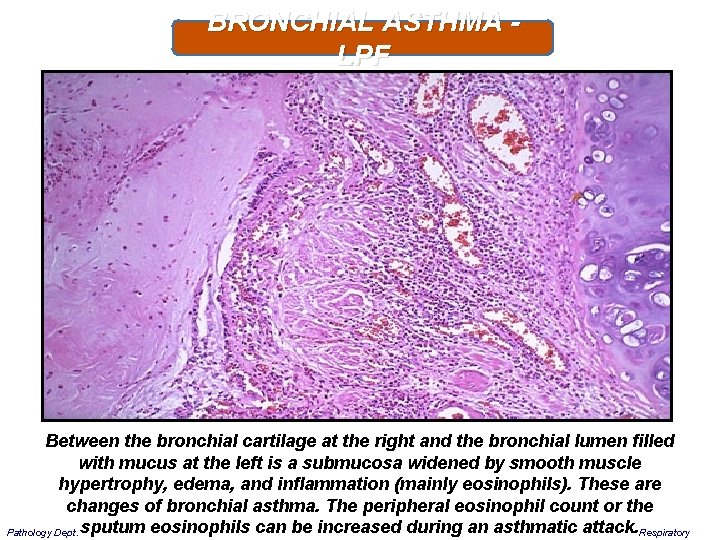
BRONCHIAL ASTHMA - LPF Between the bronchial cartilage at the right and the bronchial lumen filled with mucus at the left is a submucosa widened by smooth muscle hypertrophy, edema, and inflammation (mainly eosinophils). These are changes of bronchial asthma. The peripheral eosinophil count or the Pathology Dept. sputum eosinophils can be increased during an asthmatic attack. Respiratory
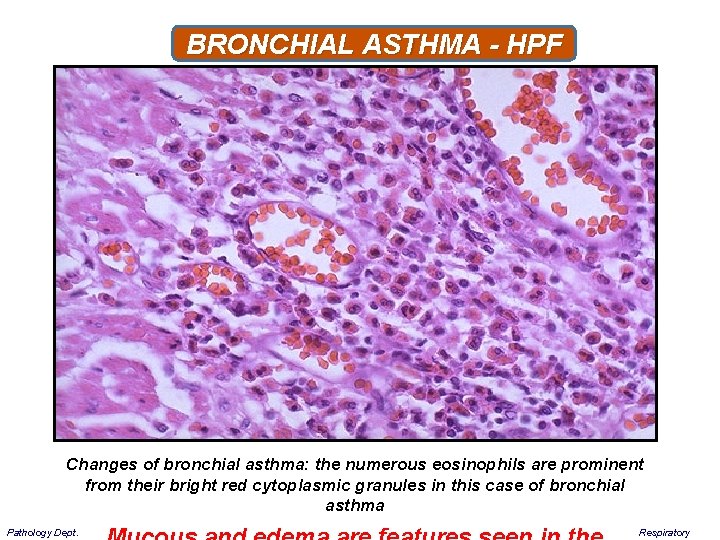
BRONCHIAL ASTHMA - HPF Changes of bronchial asthma: the numerous eosinophils are prominent from their bright red cytoplasmic granules in this case of bronchial asthma Pathology Dept. Respiratory
2. BRONCHIECTASIS Pathology Dept. Respiratory
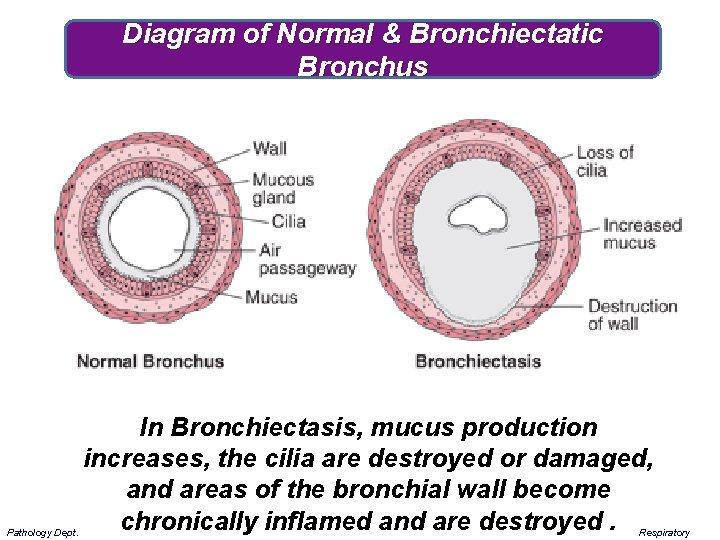
Diagram of Normal & Bronchiectatic Bronchus Pathology Dept. In Bronchiectasis, mucus production increases, the cilia are destroyed or damaged, and areas of the bronchial wall become chronically inflamed and are destroyed. Respiratory
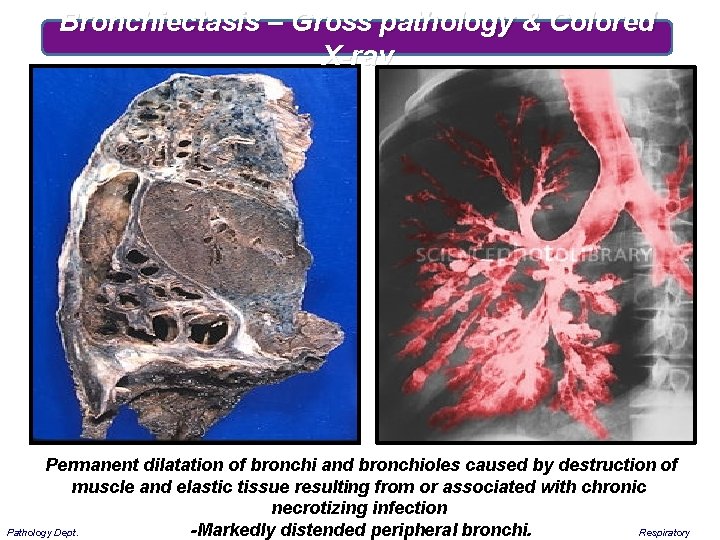
Bronchiectasis – Gross pathology & Colored X-ray Permanent dilatation of bronchi and bronchioles caused by destruction of muscle and elastic tissue resulting from or associated with chronic necrotizing infection -Markedly distended peripheral bronchi. Respiratory Pathology Dept.
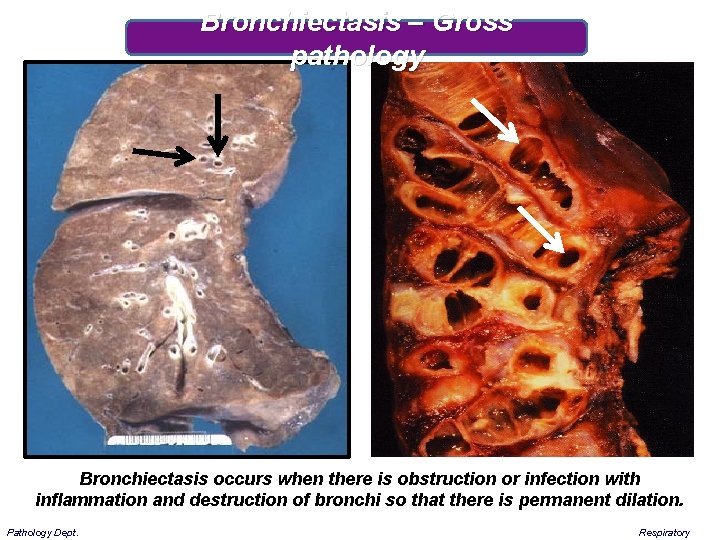
Bronchiectasis – Gross pathology Bronchiectasis occurs when there is obstruction or infection with inflammation and destruction of bronchi so that there is permanent dilation. Pathology Dept. Respiratory
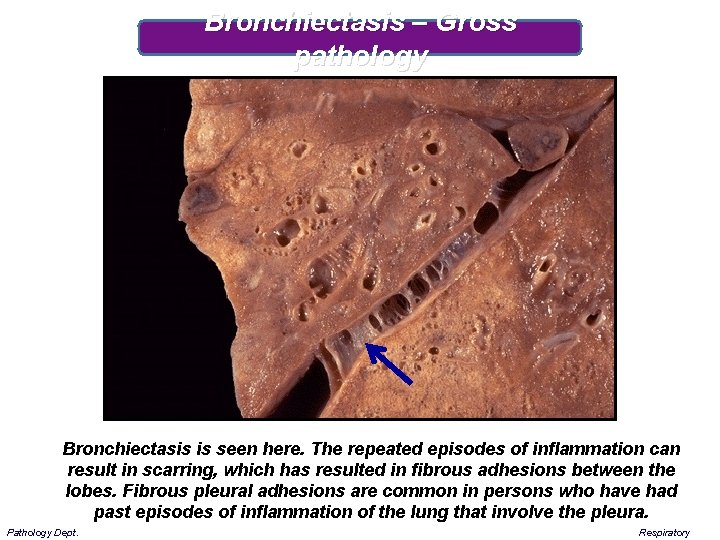
Bronchiectasis – Gross pathology Bronchiectasis is seen here. The repeated episodes of inflammation can result in scarring, which has resulted in fibrous adhesions between the lobes. Fibrous pleural adhesions are common in persons who have had past episodes of inflammation of the lung that involve the pleura. Pathology Dept. Respiratory
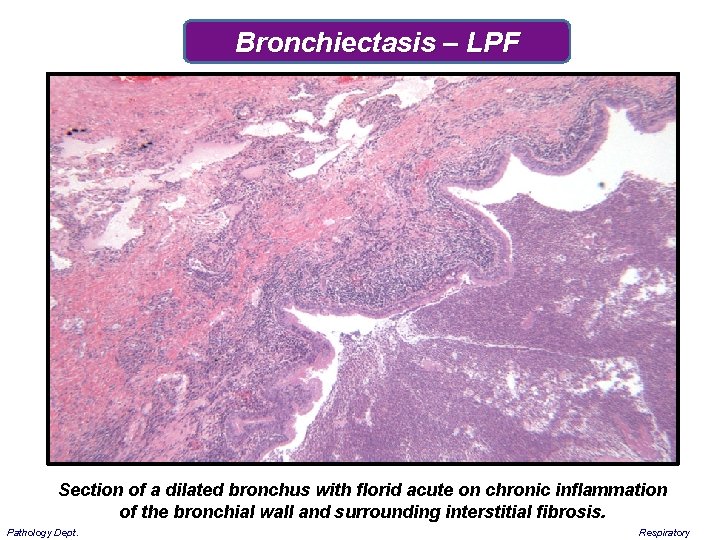
Bronchiectasis – LPF Section of a dilated bronchus with florid acute on chronic inflammation of the bronchial wall and surrounding interstitial fibrosis. Pathology Dept. Respiratory
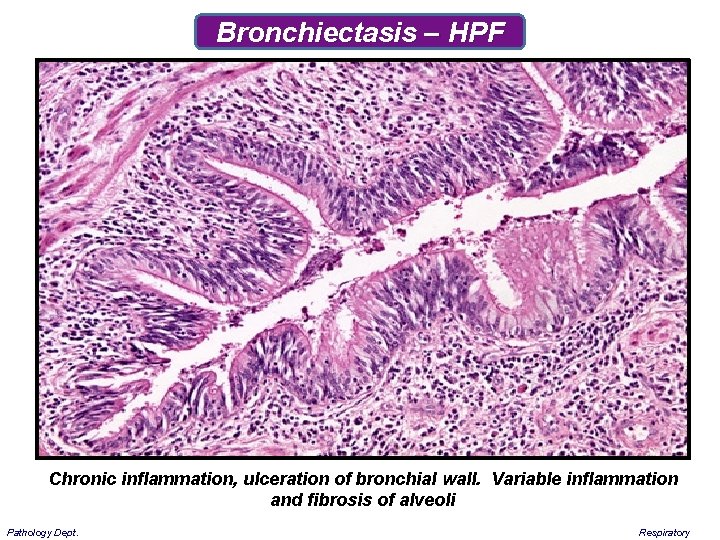
Bronchiectasis – HPF Chronic inflammation, ulceration of bronchial wall. Variable inflammation and fibrosis of alveoli Pathology Dept. Respiratory
Chronic Obstructive Pulmonary Diseases (COPD) also known as Chronic Obstructive Lung Disease (COLD), Chronic Obstructive Airway Disease (COAD), Chronic Obstructive Respiratory Disease (CORD) Include: 3. Chronic Bronchitis 4. Emphysema, a pair of commonly co-existing diseases of the lungs in which the airways narrow over time. Pathology Dept. Respiratory
3. CHRONIC BRONCHITIS Pathology Dept. Respiratory
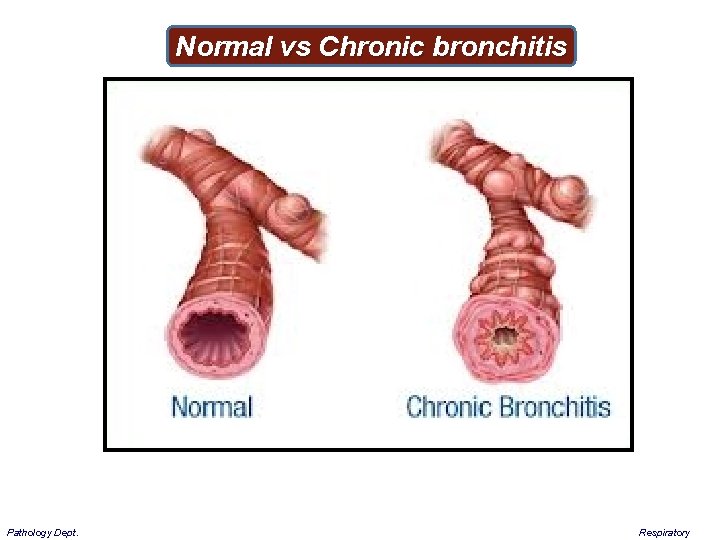
Normal vs Chronic bronchitis Pathology Dept. Respiratory
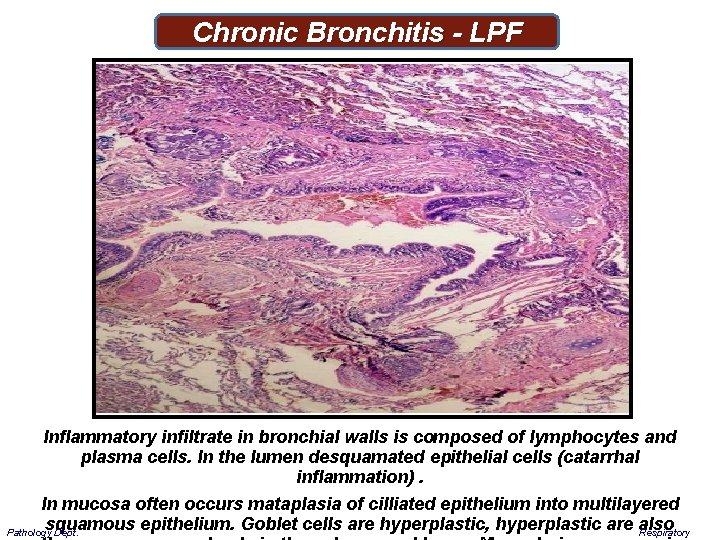
Chronic Bronchitis - LPF Inflammatory infiltrate in bronchial walls is composed of lymphocytes and plasma cells. In the lumen desquamated epithelial cells (catarrhal inflammation). In mucosa often occurs mataplasia of cilliated epithelium into multilayered squamous epithelium. Goblet cells are hyperplastic, hyperplastic are also Respiratory Pathology Dept.
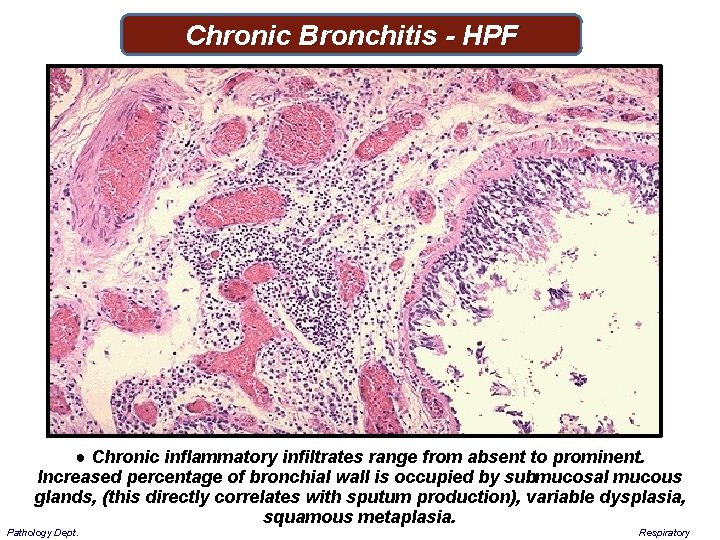
Chronic Bronchitis - HPF ● Chronic inflammatory infiltrates range from absent to prominent. Increased percentage of bronchial wall is occupied by submucosal mucous glands, (this directly correlates with sputum production), variable dysplasia, squamous metaplasia. Pathology Dept. Respiratory
4. EMPHYSEMA Pathology Dept. Respiratory
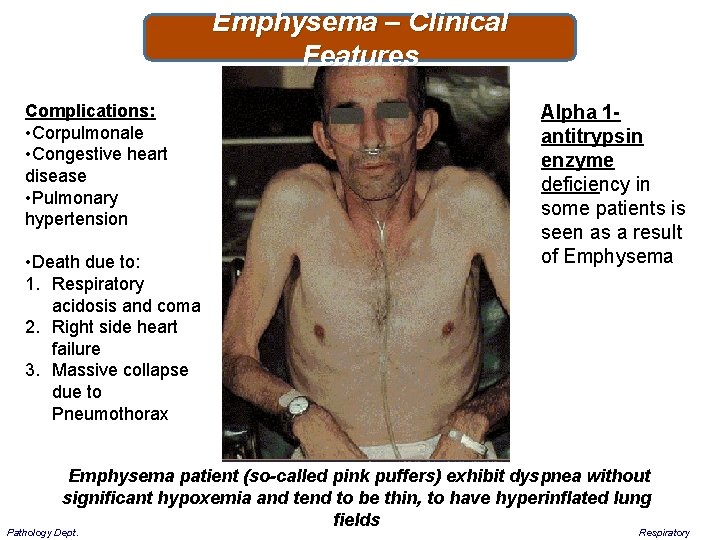
Emphysema – Clinical Features Complications: • Corpulmonale • Congestive heart disease • Pulmonary hypertension • Death due to: 1. Respiratory acidosis and coma 2. Right side heart failure 3. Massive collapse due to Pneumothorax Alpha 1 antitrypsin enzyme deficiency in some patients is seen as a result of Emphysema patient (so-called pink puffers) exhibit dyspnea without significant hypoxemia and tend to be thin, to have hyperinflated lung fields Pathology Dept. Respiratory
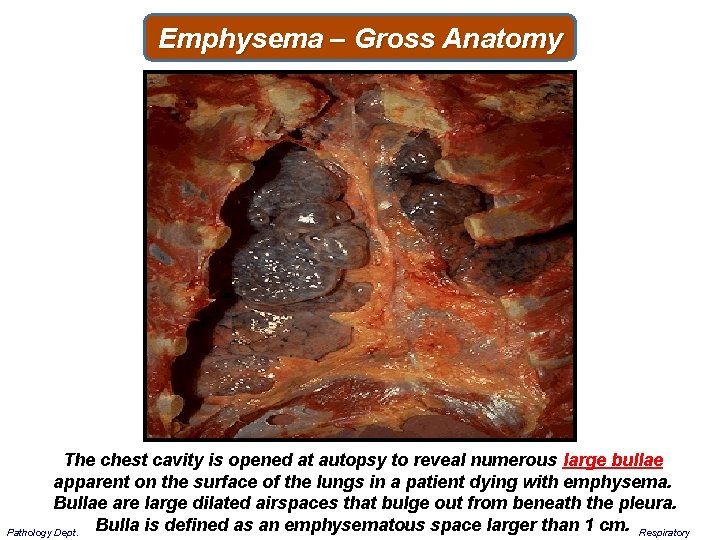
Emphysema – Gross Anatomy The chest cavity is opened at autopsy to reveal numerous large bullae apparent on the surface of the lungs in a patient dying with emphysema. Bullae are large dilated airspaces that bulge out from beneath the pleura. Bulla is defined as an emphysematous space larger than 1 cm. Respiratory Pathology Dept.
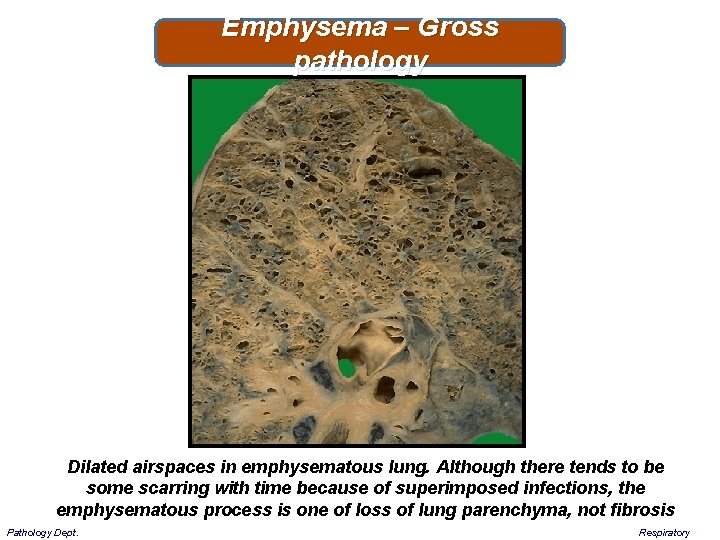
Emphysema – Gross pathology Dilated airspaces in emphysematous lung. Although there tends to be some scarring with time because of superimposed infections, the emphysematous process is one of loss of lung parenchyma, not fibrosis Pathology Dept. Respiratory
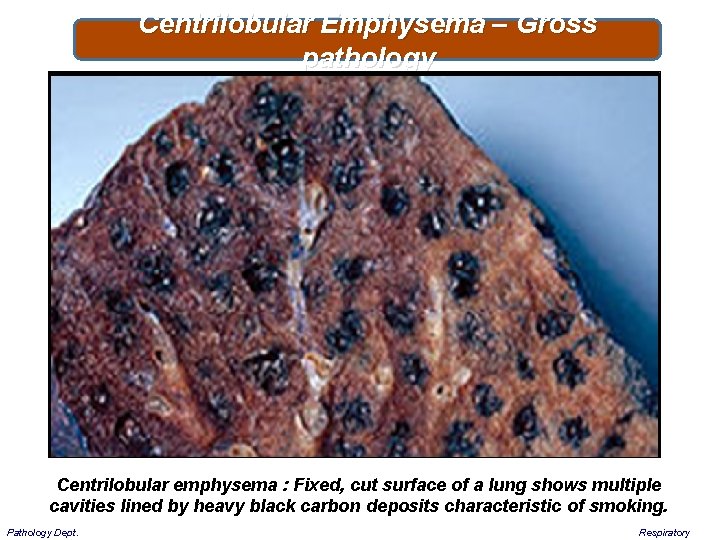
Centrilobular Emphysema – Gross pathology Centrilobular emphysema : Fixed, cut surface of a lung shows multiple cavities lined by heavy black carbon deposits characteristic of smoking. Pathology Dept. Respiratory
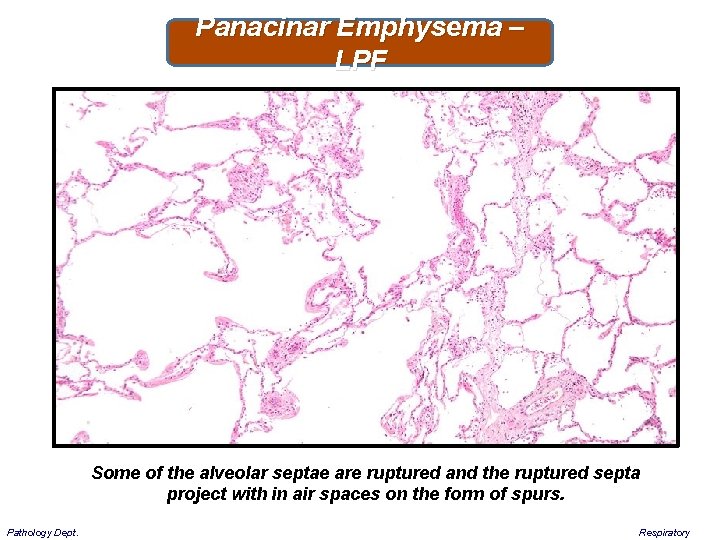
Panacinar Emphysema – LPF Some of the alveolar septae are ruptured and the ruptured septa project with in air spaces on the form of spurs. Pathology Dept. Respiratory
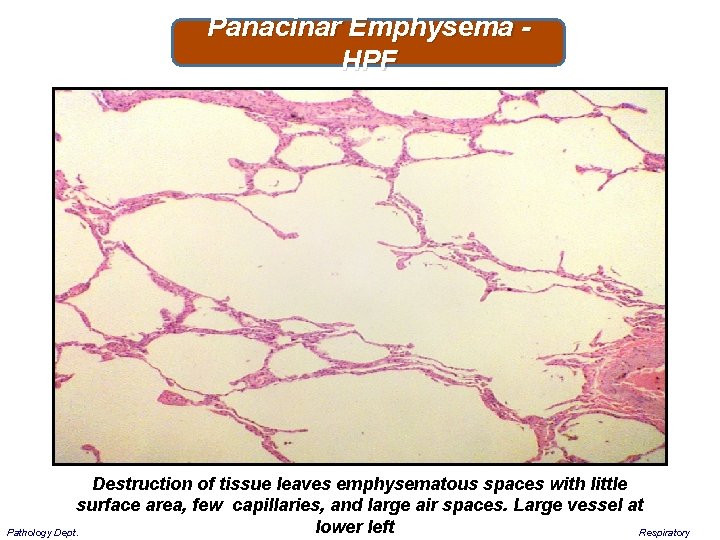
Panacinar Emphysema - HPF Destruction of tissue leaves emphysematous spaces with little surface area, few capillaries, and large air spaces. Large vessel at lower left Respiratory Pathology Dept.
LOWER RESPIRATORY TRACT INFECTIONS 1. Lobar Pneumonia Pathology Dept. Respiratory
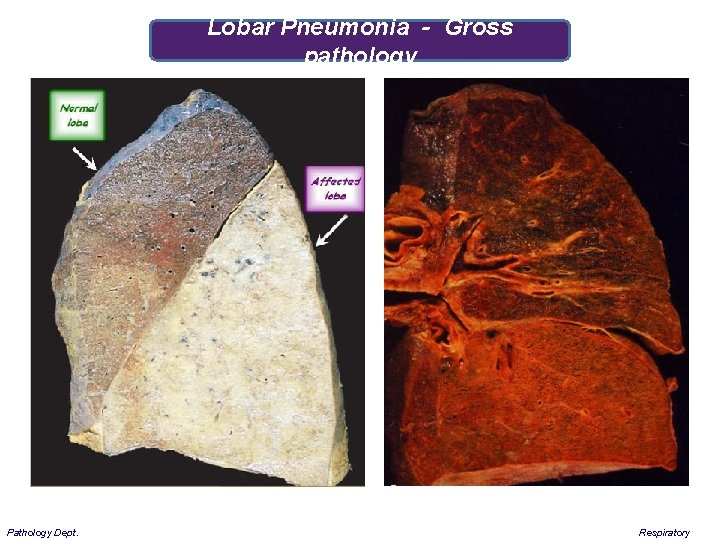
Lobar Pneumonia - Gross pathology Pathology Dept. Respiratory
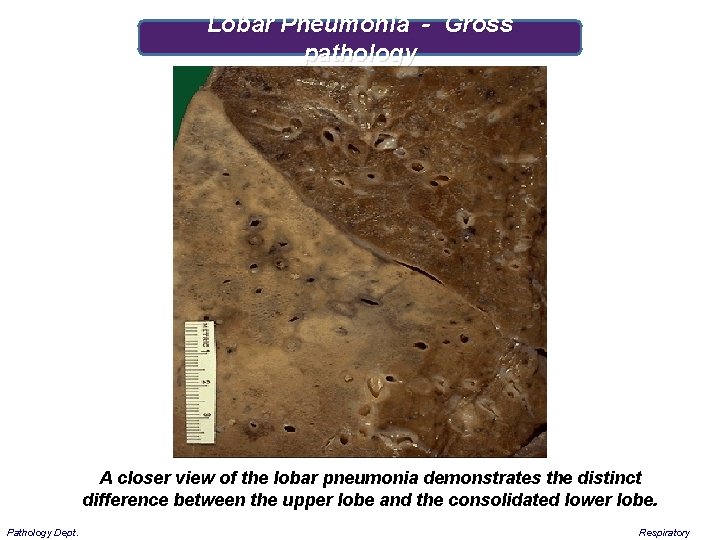
Lobar Pneumonia - Gross pathology A closer view of the lobar pneumonia demonstrates the distinct difference between the upper lobe and the consolidated lower lobe. Pathology Dept. Respiratory
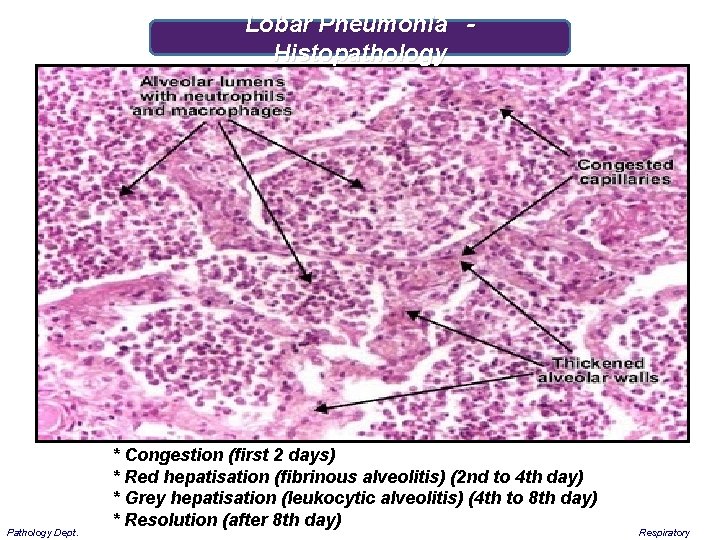
Lobar Pneumonia - Histopathology Pathology Dept. * Congestion (first 2 days) * Red hepatisation (fibrinous alveolitis) (2 nd to 4 th day) * Grey hepatisation (leukocytic alveolitis) (4 th to 8 th day) * Resolution (after 8 th day) Respiratory
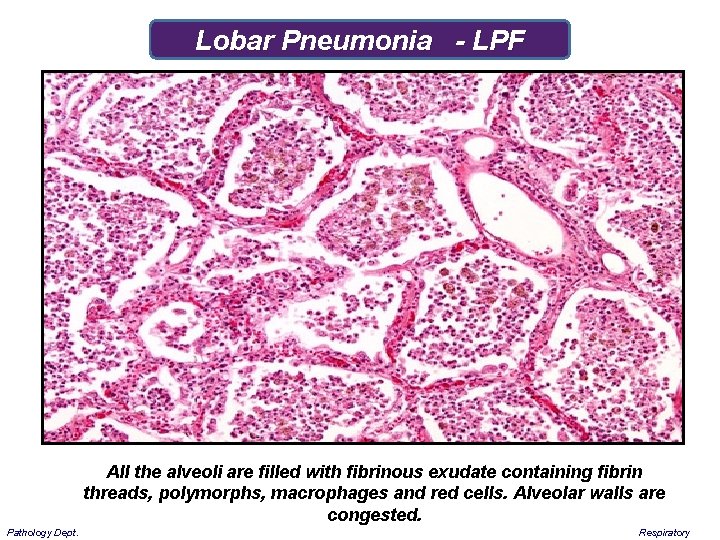
Lobar Pneumonia - LPF All the alveoli are filled with fibrinous exudate containing fibrin threads, polymorphs, macrophages and red cells. Alveolar walls are congested. Pathology Dept. Respiratory
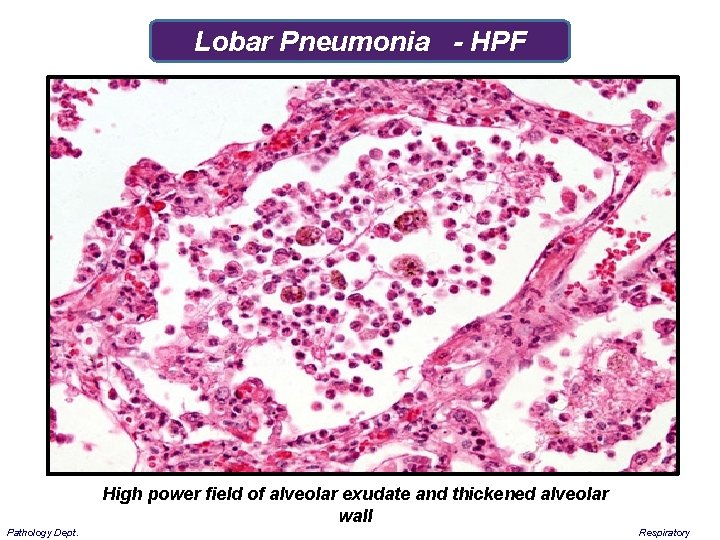
Lobar Pneumonia - HPF High power field of alveolar exudate and thickened alveolar wall Pathology Dept. Respiratory
2. Bronchopneumonia Pathology Dept. Respiratory
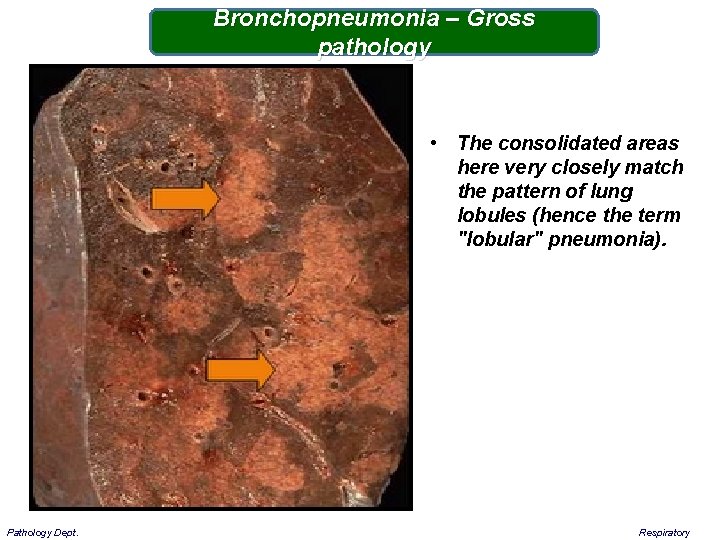
Bronchopneumonia – Gross pathology • The consolidated areas here very closely match the pattern of lung lobules (hence the term "lobular" pneumonia). Pathology Dept. Respiratory
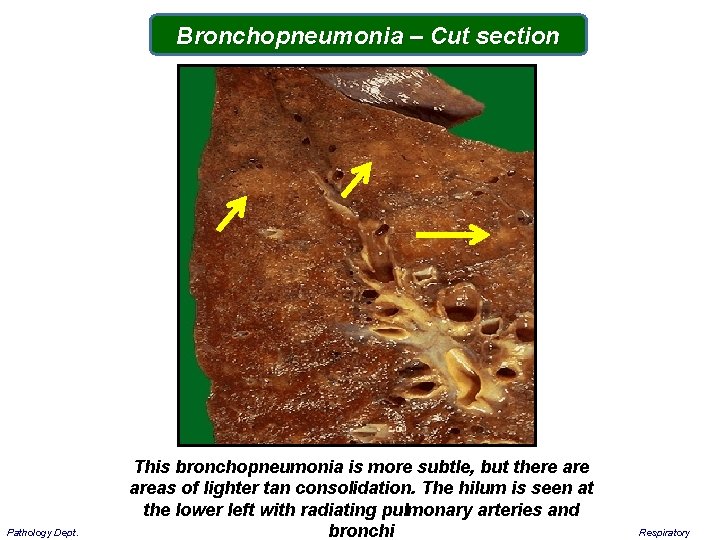
Bronchopneumonia – Cut section Pathology Dept. This bronchopneumonia is more subtle, but there areas of lighter tan consolidation. The hilum is seen at the lower left with radiating pulmonary arteries and bronchi Respiratory
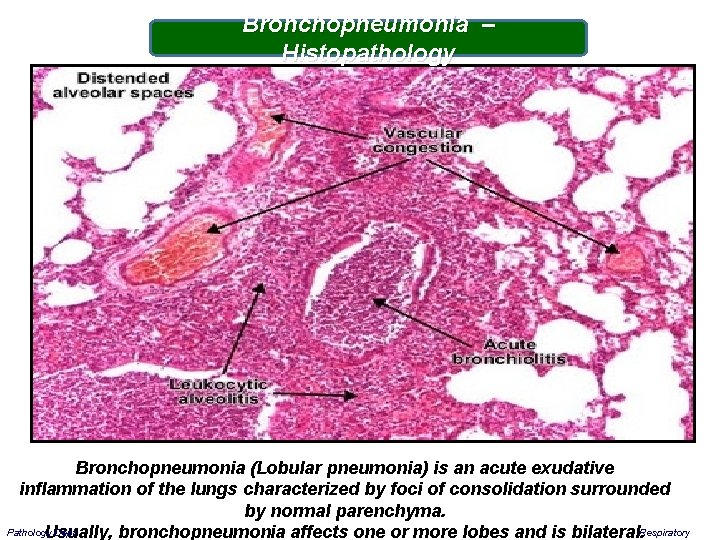
Bronchopneumonia – Histopathology Bronchopneumonia (Lobular pneumonia) is an acute exudative inflammation of the lungs characterized by foci of consolidation surrounded by normal parenchyma. Respiratory Pathology Dept. Usually, bronchopneumonia affects one or more lobes and is bilateral.
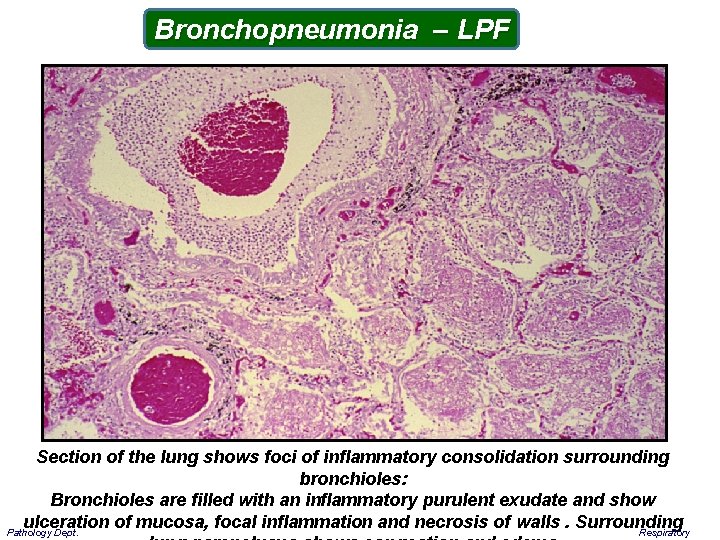
Bronchopneumonia – LPF Section of the lung shows foci of inflammatory consolidation surrounding bronchioles: Bronchioles are filled with an inflammatory purulent exudate and show ulceration of mucosa, focal inflammation and necrosis of walls. Surrounding Respiratory Pathology Dept.
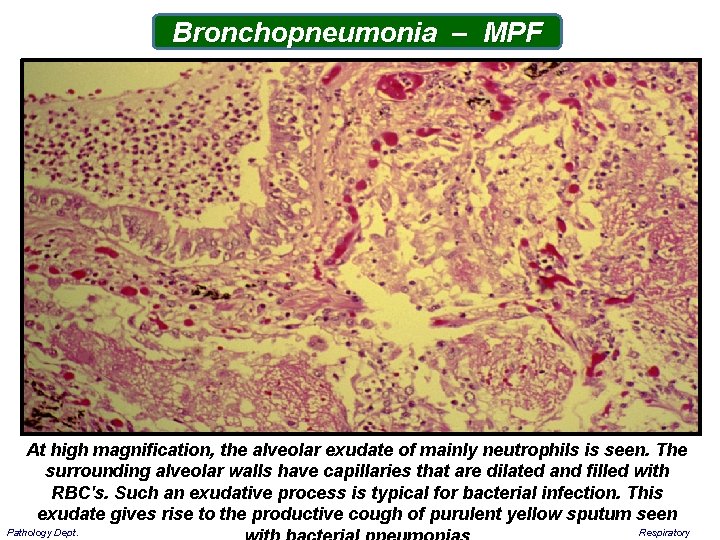
Bronchopneumonia – MPF At high magnification, the alveolar exudate of mainly neutrophils is seen. The surrounding alveolar walls have capillaries that are dilated and filled with RBC's. Such an exudative process is typical for bacterial infection. This exudate gives rise to the productive cough of purulent yellow sputum seen Pathology Dept. Respiratory
PULMONARY EMBOLUS AND INFARCTION Pathology Dept. Respiratory
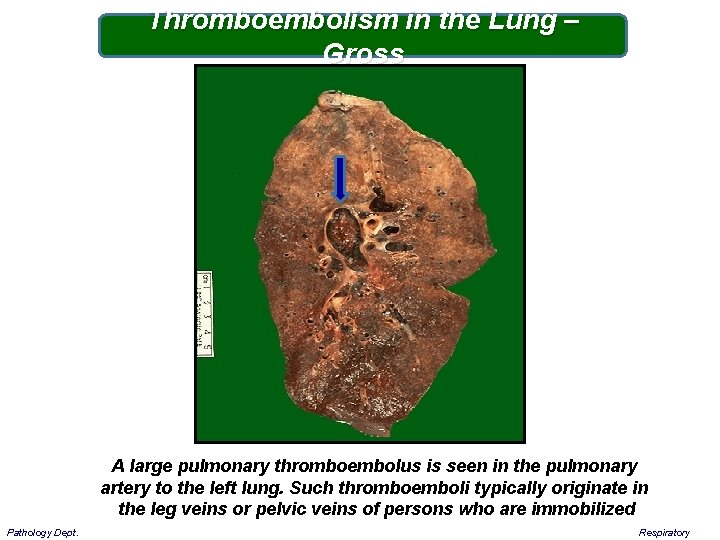
Thromboembolism in the Lung – Gross A large pulmonary thromboembolus is seen in the pulmonary artery to the left lung. Such thromboemboli typically originate in the leg veins or pelvic veins of persons who are immobilized Pathology Dept. Respiratory
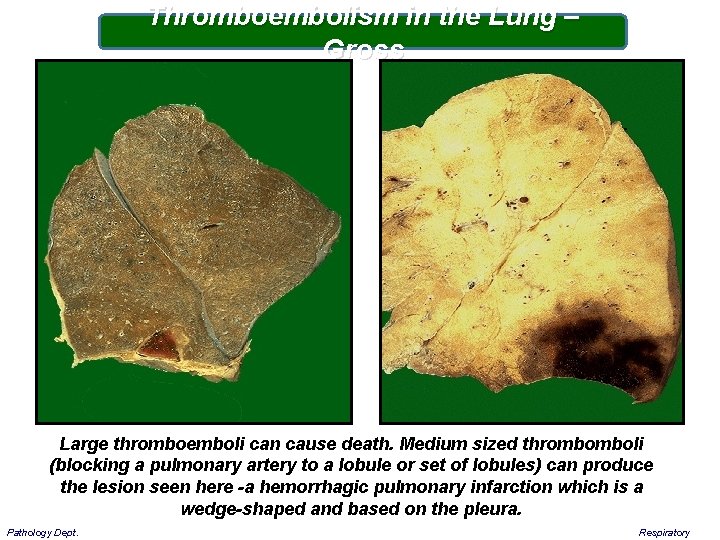
Thromboembolism in the Lung – Gross Large thromboemboli can cause death. Medium sized thrombomboli (blocking a pulmonary artery to a lobule or set of lobules) can produce the lesion seen here -a hemorrhagic pulmonary infarction which is a wedge-shaped and based on the pleura. Pathology Dept. Respiratory
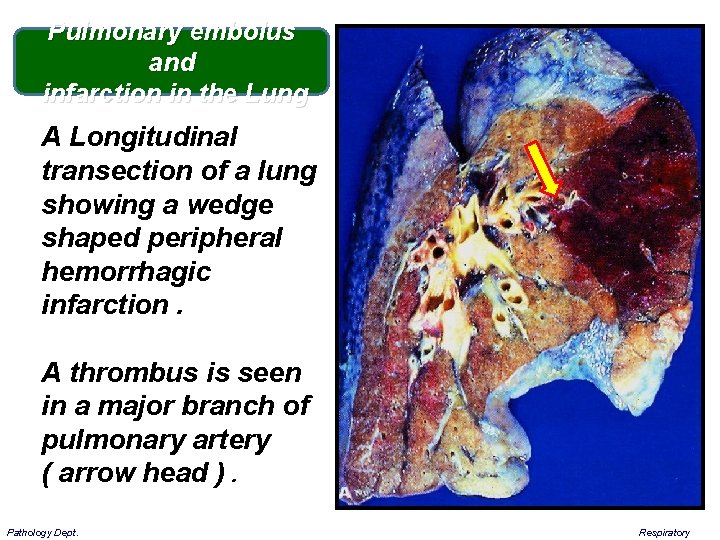
Pulmonary embolus and infarction in the Lung A Longitudinal transection of a lung showing a wedge shaped peripheral hemorrhagic infarction. A thrombus is seen in a major branch of pulmonary artery ( arrow head ). Pathology Dept. Respiratory
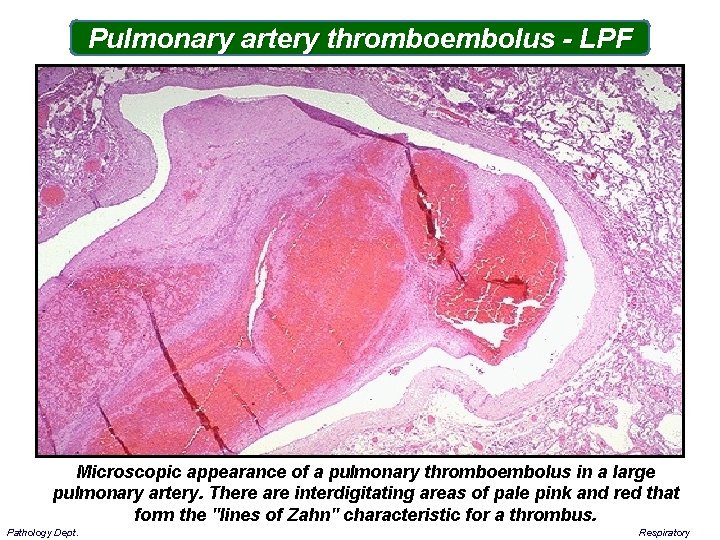
Pulmonary artery thromboembolus - LPF Microscopic appearance of a pulmonary thromboembolus in a large pulmonary artery. There are interdigitating areas of pale pink and red that form the "lines of Zahn" characteristic for a thrombus. Pathology Dept. Respiratory
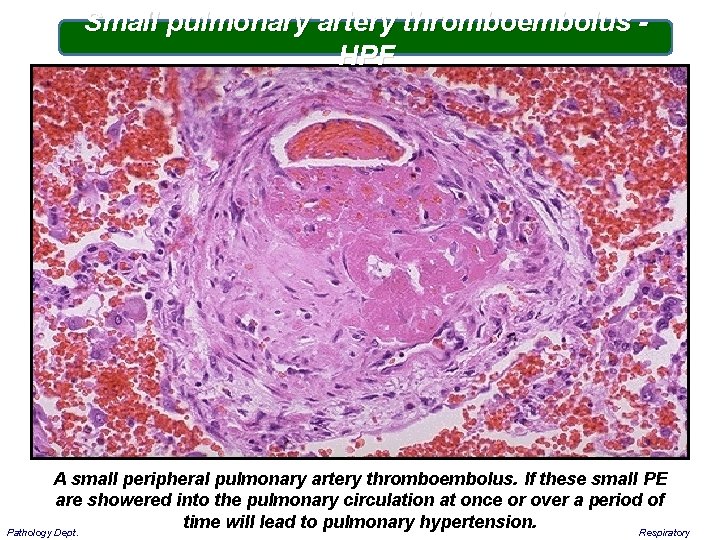
Small pulmonary artery thromboembolus - HPF A small peripheral pulmonary artery thromboembolus. If these small PE are showered into the pulmonary circulation at once or over a period of time will lead to pulmonary hypertension. Respiratory Pathology Dept.
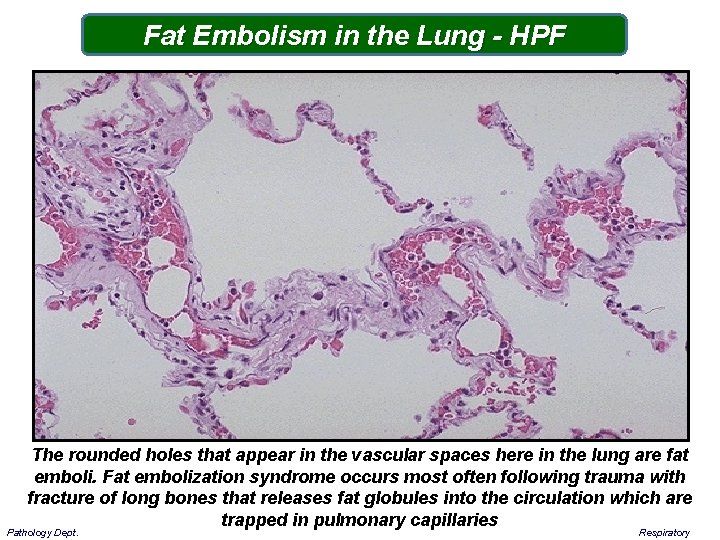
Fat Embolism in the Lung - HPF The rounded holes that appear in the vascular spaces here in the lung are fat emboli. Fat embolization syndrome occurs most often following trauma with fracture of long bones that releases fat globules into the circulation which are trapped in pulmonary capillaries Pathology Dept. Respiratory
- Slides: 50