UWM CIO Office Enterprise Information Architecture at University


- Slides: 24
UWM CIO Office Enterprise Information Architecture at University of Wisconsin-Milwaukee ITANA Face 2 Face/Minneapolis June 18, 2008 Michael Enstrom/Enterprise Data Architect 1
UWM CIO Office There are three areas of focus identified in UW-Milwaukee’s mission statement: • Academic excellence • Research excellence • Administrative excellence UWM has both 125 “centralized” and 100+ “decentralized” technology staff to support these areas of focus, providing a variety of solutions to a multitude of campus units, in each of these areas. Each has unique sets of needs. The need for a common frame-of-reference is essential, if we are to adequately meet our mission goals. 2
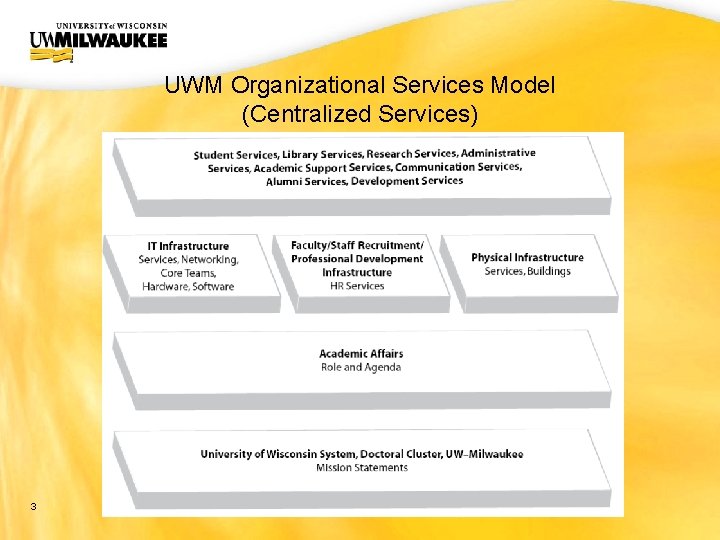
UWM CIO Office UWM Organizational Services Model (Centralized Services) 3
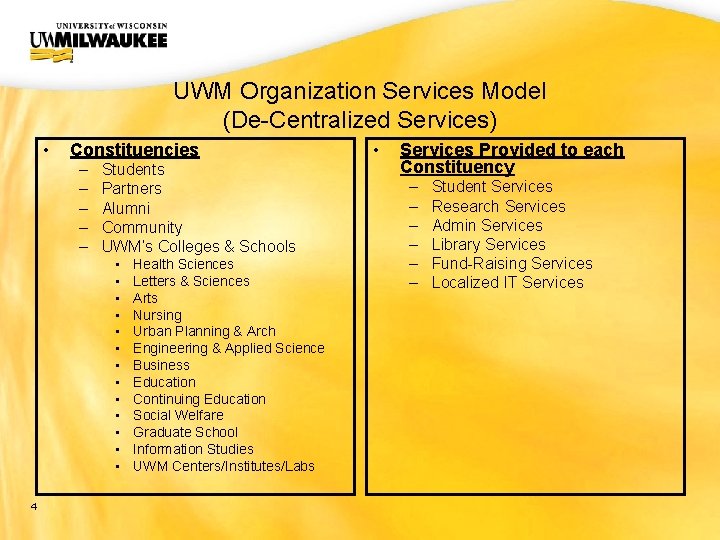
UWM CIO Office UWM Organization Services Model (De-Centralized Services) • Constituencies – – – Students Partners Alumni Community UWM’s Colleges & Schools • • • • 4 Health Sciences Letters & Sciences Arts Nursing Urban Planning & Arch Engineering & Applied Science Business Education Continuing Education Social Welfare Graduate School Information Studies UWM Centers/Institutes/Labs • Services Provided to each Constituency – – – Student Services Research Services Admin Services Library Services Fund-Raising Services Localized IT Services
UWM CIO Office The Challenge: Finding Common Ground • Centralized services support all University functions & provide shared services • Decentralized services focus on providing unique, specific services in their respective contexts • Contexts may differ, while underlying processes can be shared to mitigate duplication of services. 5
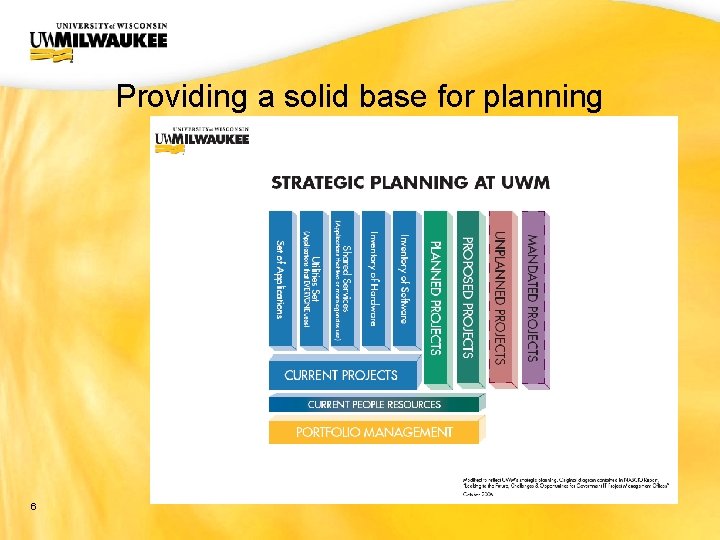
UWM CIO Office Providing a solid base for planning 6
UWM CIO Office History of UWM’s EA Team • Planning started in 2005 -2006 • Opportunity to Step back and re-assess what we do and how well we serve our campus • UW-Milwaukee collaborates with UW-System and other UW campuses to co-develop technological solutions where possible 7
UWM CIO Office How UWM’s EA Team formed • Newly-appointed CIO defined the vision • Target: to improve flow of information within (& between) UWM’s 3 Mission areas (academic, research and administrative) • CIO worked closely with Provost and Vice Chancellors to set UWM’s direction 8
UWM CIO Office First Steps: Activating the EA Team • Acquire/Re-Purpose Staff with EA experience • Define Scope of EA Team’s activities • Analyze current state, with strongest focus on developing our “future” state, rather than on “death by micro-documentation” • Plan EA Team’s strategy (iteratively!) 9
UWM CIO Office Who’s on the EA Team? • • 10 Chief Process Architect Enterprise Data Architect Operations Architect Application Integration Architect Security Architect Network Technology Architect Web Architect Deputy CIO
UWM CIO Office Foundations for EA team • Deep commitment to architecture team from both Provost and CIO • Recognition that the architect(s) don’t live solely in either IT Land or End-User Land. There’s a constant need to be able to shift between user’s and IT perspectives, at many different administrative levels. • Growing awareness & buy-in of business-unit Stakeholders in IT planning • Strong sense of “due diligence, ” tempered with the flexibility and willingness to adapt to new approaches 11
UWM CIO Office Identifying “Low-Hanging Fruit” • Identified “Architecture Principles” as a guide in four areas (“What we believe”) – – Business Data Application Development Technology • Developed “IT Guiding Principles” for centralized and decentralized IT-oriented staff (“How we’ll function”) • Ongoing collection of data/application/process inventories 12
UWM CIO Office Early Discoveries • Even if all the stars align, a solution is (at best) only as good as the depth of our understanding of a given problem. • The most common problem identified has been the misalignment of solutions with the issues those solutions were intended to resolve. • Root cause isn’t project management or architectural approach, it’s the lack of rigorous requirements management in the Higher Ed environment. 13
UWM CIO Office Initiatives • BPI methodology development • Process Management Office established • IIBA Requirements Mgmt training for both IT Staff & business-unit Stakeholders (develop a common language) • Adapting to “Emerging/Accepted/Best Practice” approach 14
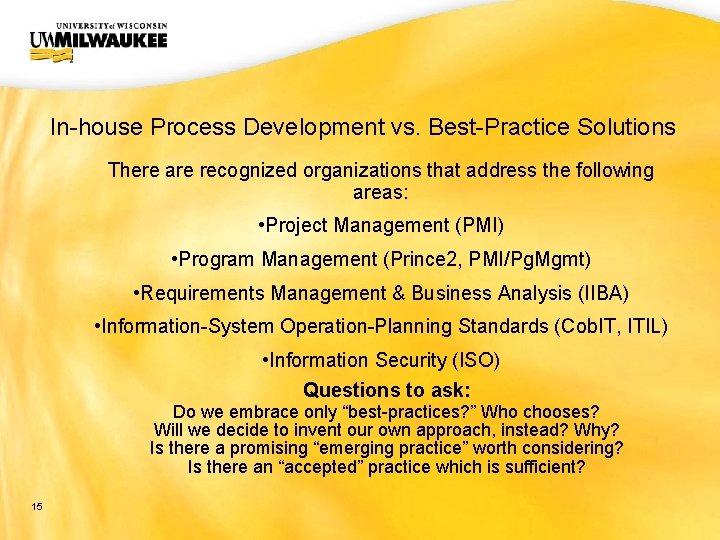
UWM CIO Office In-house Process Development vs. Best-Practice Solutions There are recognized organizations that address the following areas: • Project Management (PMI) • Program Management (Prince 2, PMI/Pg. Mgmt) • Requirements Management & Business Analysis (IIBA) • Information-System Operation-Planning Standards (Cob. IT, ITIL) • Information Security (ISO) Questions to ask: Do we embrace only “best-practices? ” Who chooses? Will we decide to invent our own approach, instead? Why? Is there a promising “emerging practice” worth considering? Is there an “accepted” practice which is sufficient? 15
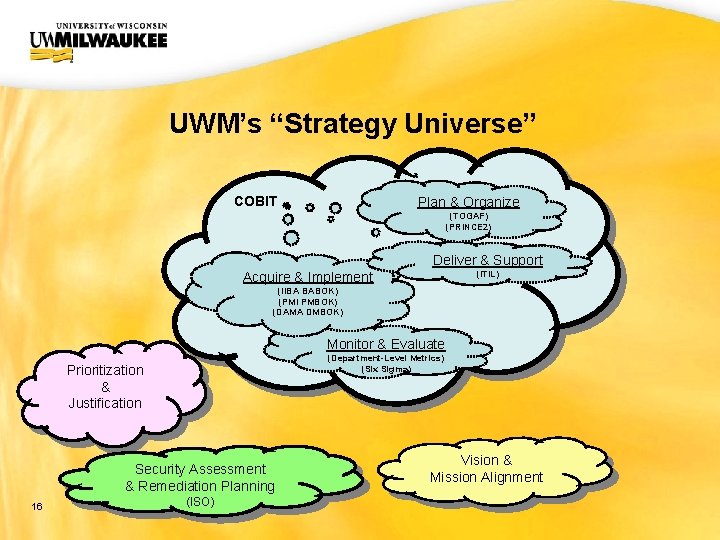
UWM CIO Office UWM’s “Strategy Universe” COBIT Plan & Organize (TOGAF) (PRINCE 2) Deliver & Support (ITIL) Acquire & Implement (IIBA BABOK) (PMI PMBOK) (DAMA DMBOK) Monitor & Evaluate (Department-Level Metrics) (Six Sigma) Prioritization & Justification Security Assessment & Remediation Planning 16 (ISO) Vision & Mission Alignment
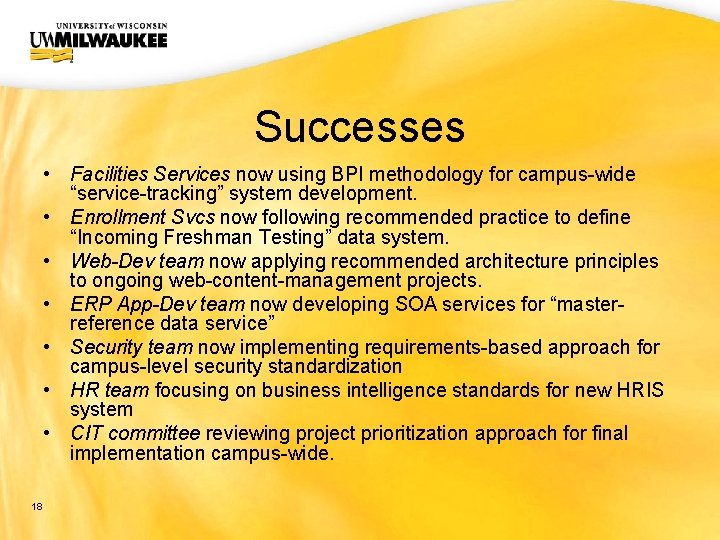
UWM CIO Office Successes • Facilities Services now using BPI methodology for campus-wide “service-tracking” system development. • Enrollment Svcs now following recommended practice to define “Incoming Freshman Testing” data system. • Web-Dev team now applying recommended architecture principles to ongoing web-content-management projects. • ERP App-Dev team now developing SOA services for “masterreference data service” • Security team now implementing requirements-based approach for campus-level security standardization • HR team focusing on business intelligence standards for new HRIS system • CIT committee reviewing project prioritization approach for final implementation campus-wide. 18
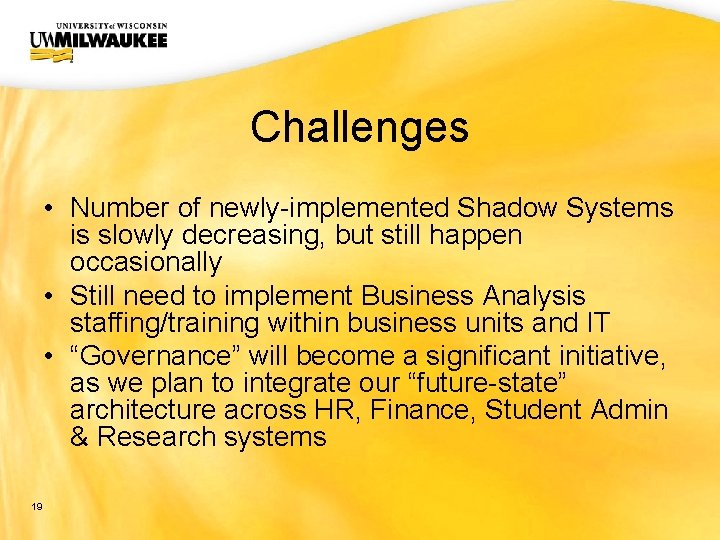
UWM CIO Office Challenges • Number of newly-implemented Shadow Systems is slowly decreasing, but still happen occasionally • Still need to implement Business Analysis staffing/training within business units and IT • “Governance” will become a significant initiative, as we plan to integrate our “future-state” architecture across HR, Finance, Student Admin & Research systems 19
UWM CIO Office What’s on our radar for next year? • • • People. Soft HRIS implementation Upgrading current People. Soft Student system Future PS Financial system retrofit Major Expansion of Campus to new facilities Requirements planning for new School of Public Health & School of Fresh Water Sciences • Formalizing EA processes and documentation methodology • Data Warehousing/Business Intelligence planning 20
UWM CIO Office State of The Architecture • UWM is expanding its campus and its infrastructure across the Greater Milwaukee area • Currently defining how we’ll deploy across three main geographical areas in SE Wisconsin • Expanded focus on Research Computing • Growing use of Data Warehousing • Shifting needs for Business Intelligence to accommodate newlydefined platforms and business processes • Adoption of new Information Security standards campus-wide • Consideration for legacy support in context of staff turnover • Summary: “Opportunity” exists, on many fronts! 21
UWM CIO Office Recommendations: initial EA Team formation • Focus on small steps • Develop communications with other University and College architecture peers • Publish successes often and widely • Communicate issues quickly, and share how you’ll address each issues • Develop and maintain executive buy-in 22
UWM CIO Office Summary of Process Improvement Approach 24
UWM CIO Office For More Information: IIBA Website www. theiiba. org Bruce Maas, UW-Milwaukee Chief Information Officer bmaas@uwm. edu Requirements Quest Website www. requirementsquest. com Michael Enstrom, UW-Milwaukee Enterprise Data Architect enstrom@uwm. edu Co. BIT website www. ISACA. org/Co. BIT Ed Melchior, UW-Milwaukee Chief Process Architect melchie@uwm. edu PMI website www. PMI. org DAMA website www. dama. org 25
UWM CIO Office Questions? 26