
Office of Enterprise Technology Agency Overview House State
- Slides: 30
Office of Enterprise Technology Agency Overview House State Government Finance Committee February 2, 2011
Agenda § Introduction § Agency Overview § Governance and Oversight § Security § Technology Services § Data Center Co-location § Enterprise Utility Communications and Collaboration § Closing Comments and Questions 2 02/02/2011
Agency Overview
OET’s Mission OET’s mission is to provide the leadership and services that improve government through the effective use of information technology. Our vision is to be the trusted leader in enterprise information technology for the State of Minnesota…and the provider of choice for IT services, direction, investments and standards for government IT. 4 02/02/2011
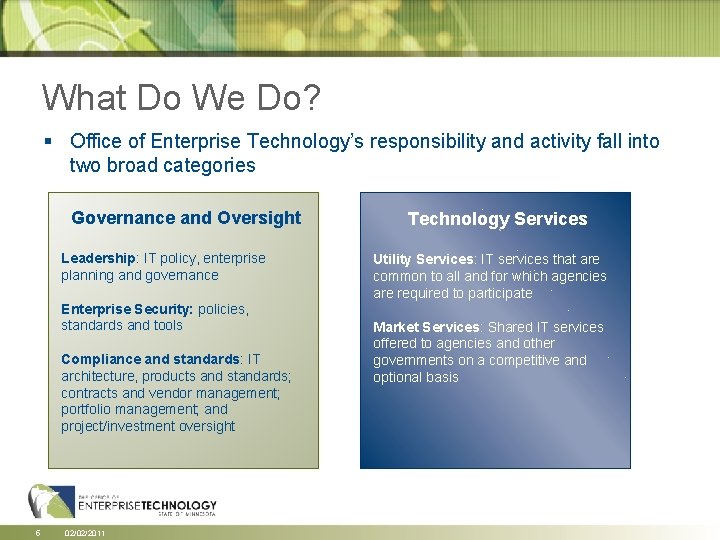
What Do We Do? § Office of Enterprise Technology’s responsibility and activity fall into two broad categories Governance and Oversight Leadership: IT policy, enterprise planning and governance Enterprise Security: policies, standards and tools Compliance and standards: IT architecture, products and standards; contracts and vendor management; portfolio management; and project/investment oversight 5 02/02/2011 Technology Services Utility Services: IT services that are common to all and for which agencies are required to participate Market Services: Shared IT services offered to agencies and other governments on a competitive and optional basis
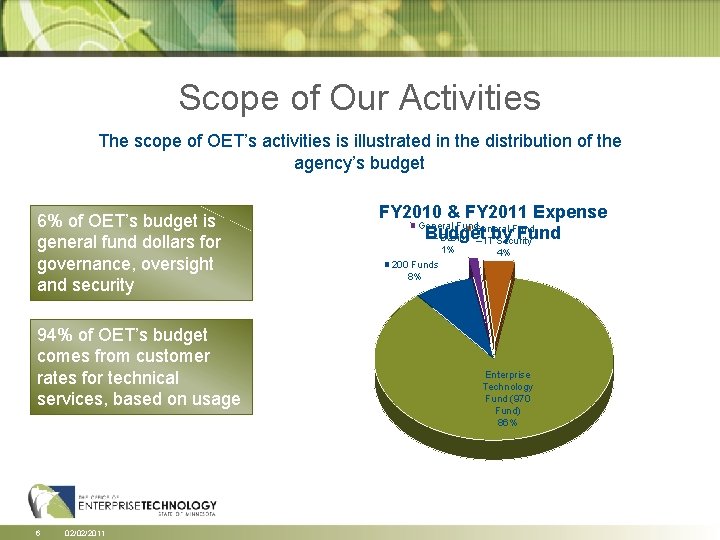
Scope of Our Activities The scope of OET’s activities is illustrated in the distribution of the agency’s budget 6% of OET’s budget is general fund dollars for governance, oversight and security 94% of OET’s budget comes from customer rates for technical services, based on usage 6 02/02/2011 FY 2010 & FY 2011 Expense General Fund Budget Fund – Basic – ITby Security 1% 4% 200 Funds 8% Enterprise Technology Fund (970 Fund) 86%
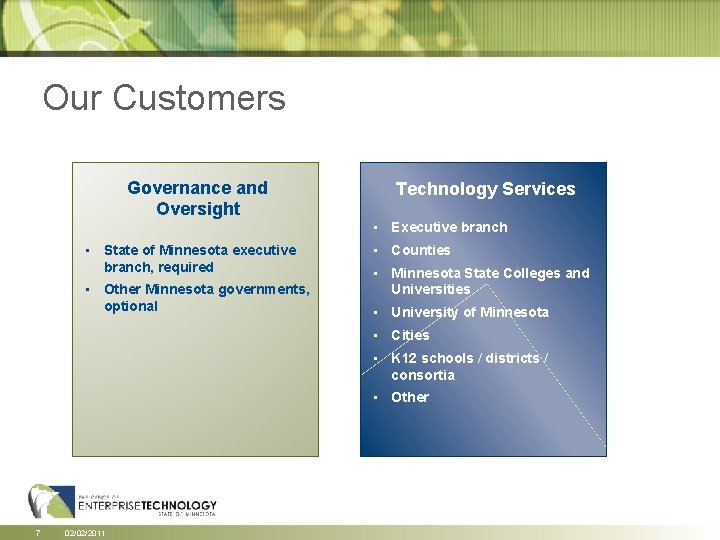
Our Customers Governance and Oversight • State of Minnesota executive branch, required • Other Minnesota governments, optional Technology Services • Executive branch • Counties • Minnesota State Colleges and Universities • University of Minnesota • Cities • K 12 schools / districts / consortia • Other 7 02/02/2011
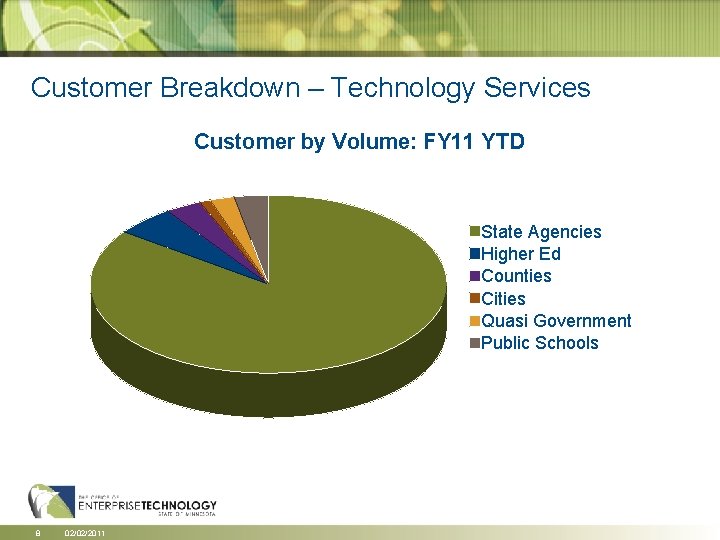
Customer Breakdown – Technology Services Customer by Volume: FY 11 YTD State Agencies Higher Ed Counties Cities Quasi Government Public Schools 8 02/02/2011
Governance
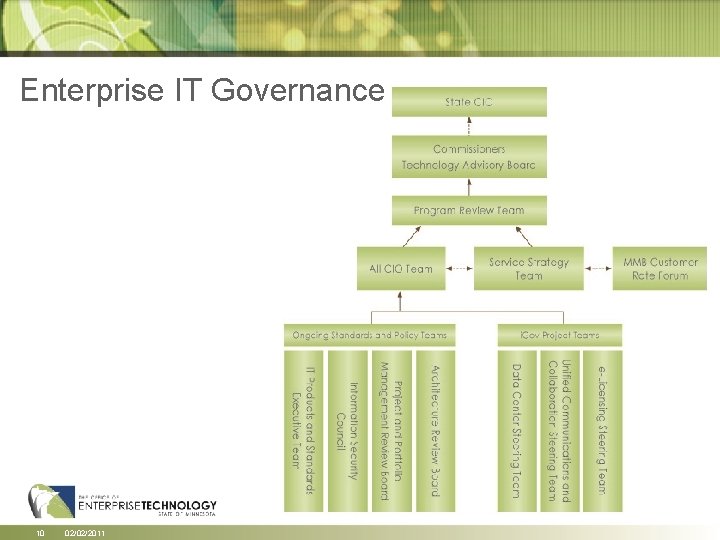
Enterprise IT Governance 10 02/02/2011
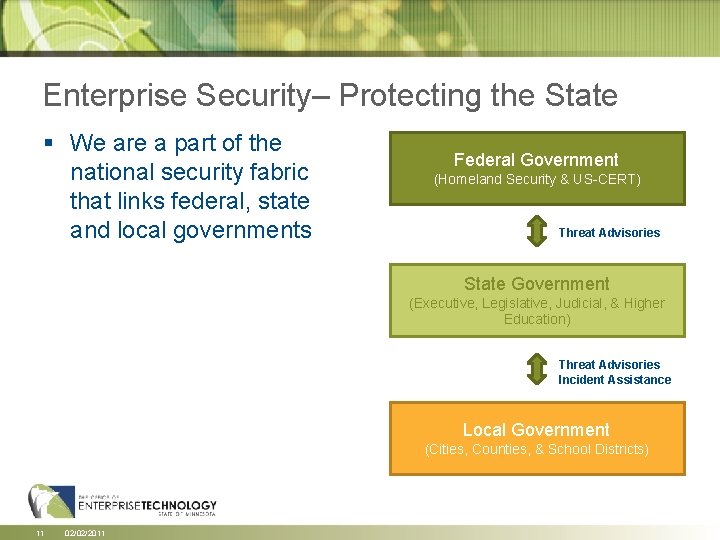
Enterprise Security– Protecting the State § We are a part of the national security fabric that links federal, state and local governments Federal Government (Homeland Security & US-CERT) Threat Advisories State Government (Executive, Legislative, Judicial, & Higher Education) Threat Advisories Incident Assistance Local Government (Cities, Counties, & School Districts) 11 02/02/2011
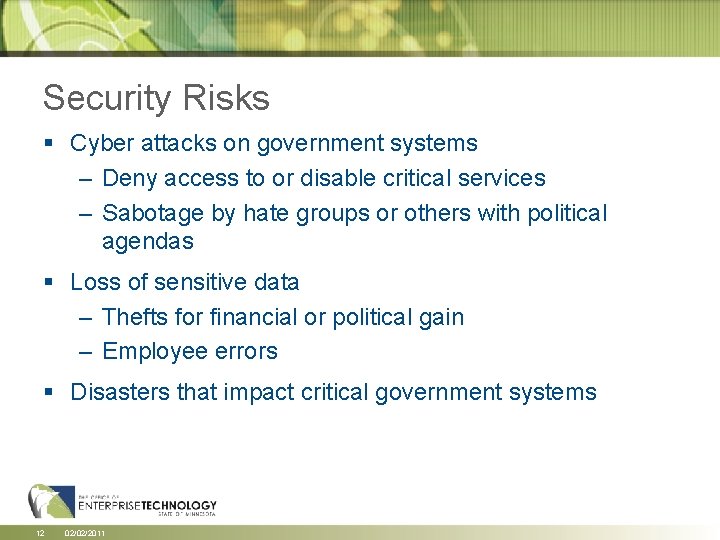
Security Risks § Cyber attacks on government systems – Deny access to or disable critical services – Sabotage by hate groups or others with political agendas § Loss of sensitive data – Thefts for financial or political gain – Employee errors § Disasters that impact critical government systems 12 02/02/2011
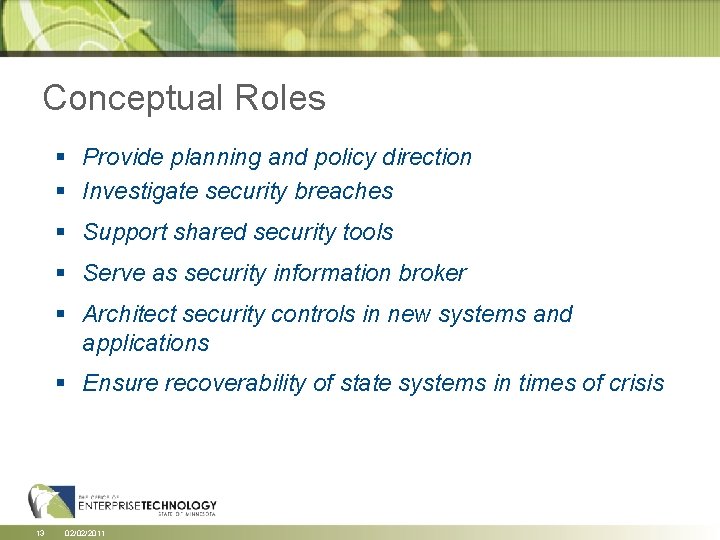
Conceptual Roles § Provide planning and policy direction § Investigate security breaches § Support shared security tools § Serve as security information broker § Architect security controls in new systems and applications § Ensure recoverability of state systems in times of crisis 13 02/02/2011
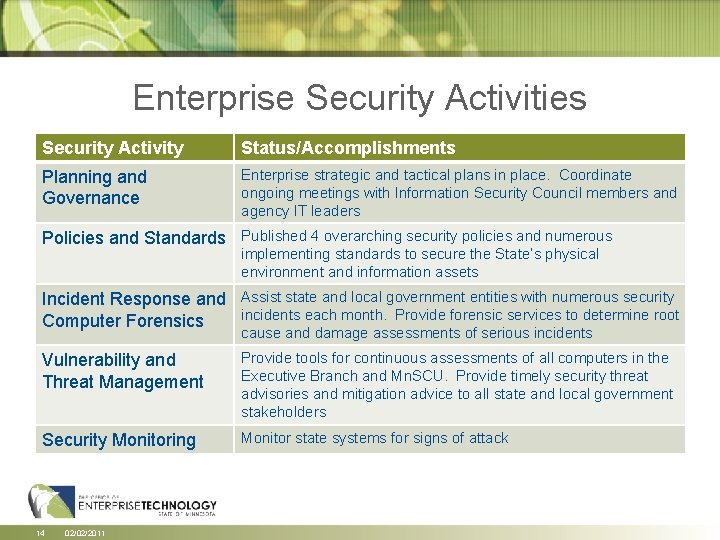
Enterprise Security Activities Security Activity Status/Accomplishments Planning and Governance Enterprise strategic and tactical plans in place. Coordinate ongoing meetings with Information Security Council members and agency IT leaders Policies and Standards Published 4 overarching security policies and numerous implementing standards to secure the State’s physical environment and information assets Incident Response and Assist state and local government entities with numerous security incidents each month. Provide forensic services to determine root Computer Forensics cause and damage assessments of serious incidents Vulnerability and Threat Management Provide tools for continuous assessments of all computers in the Executive Branch and Mn. SCU. Provide timely security threat advisories and mitigation advice to all state and local government stakeholders Security Monitoring Monitor state systems for signs of attack 14 02/02/2011
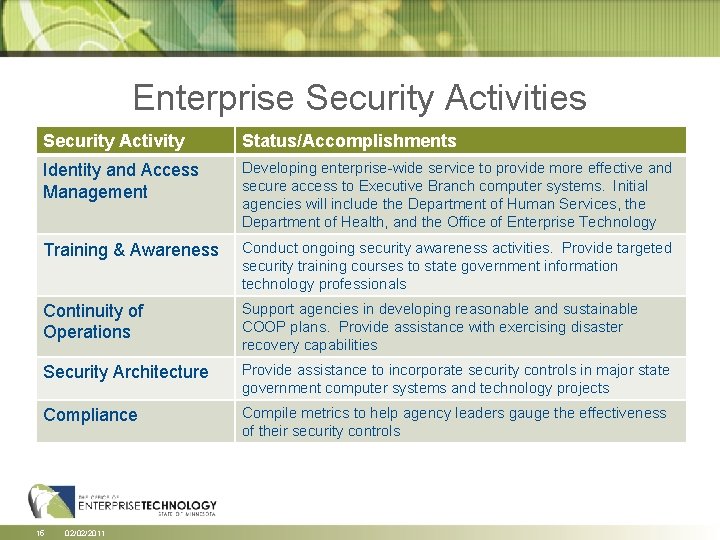
Enterprise Security Activities Security Activity Status/Accomplishments Identity and Access Management Developing enterprise-wide service to provide more effective and secure access to Executive Branch computer systems. Initial agencies will include the Department of Human Services, the Department of Health, and the Office of Enterprise Technology Training & Awareness Conduct ongoing security awareness activities. Provide targeted security training courses to state government information technology professionals Continuity of Operations Support agencies in developing reasonable and sustainable COOP plans. Provide assistance with exercising disaster recovery capabilities Security Architecture Provide assistance to incorporate security controls in major state government computer systems and technology projects Compliance Compile metrics to help agency leaders gauge the effectiveness of their security controls 15 02/02/2011
Technology Services
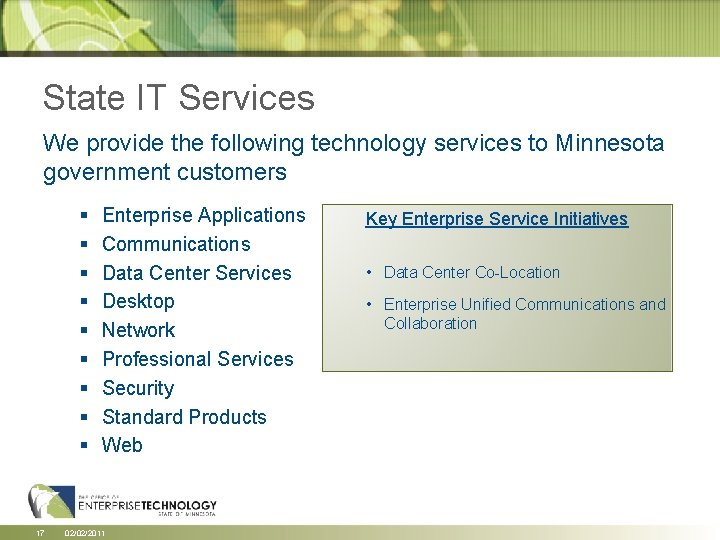
State IT Services We provide the following technology services to Minnesota government customers § § § § § 17 Enterprise Applications Communications Data Center Services Desktop Network Professional Services Security Standard Products Web 02/02/2011 Key Enterprise Service Initiatives • Data Center Co-Location • Enterprise Unified Communications and Collaboration
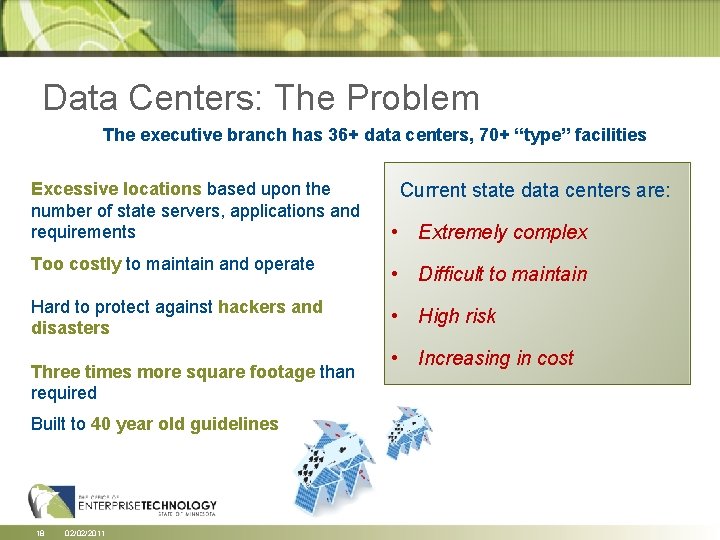
Data Centers: The Problem The executive branch has 36+ data centers, 70+ “type” facilities Excessive locations based upon the number of state servers, applications and requirements Too costly to maintain and operate Hard to protect against hackers and disasters Three times more square footage than required Built to 40 year old guidelines 18 02/02/2011 Current state data centers are: • Extremely complex • Difficult to maintain • High risk • Increasing in cost
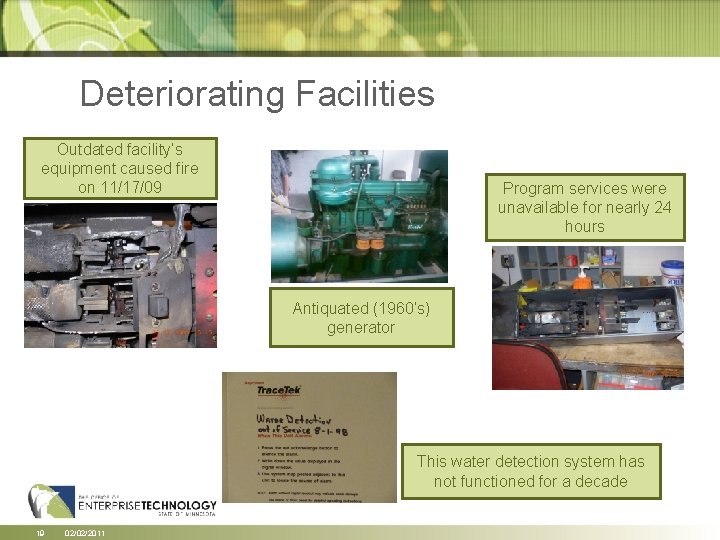
Deteriorating Facilities Outdated facility’s equipment caused fire on 11/17/09 Program services were unavailable for nearly 24 hours Antiquated (1960’s) generator This water detection system has not functioned for a decade 19 02/02/2011
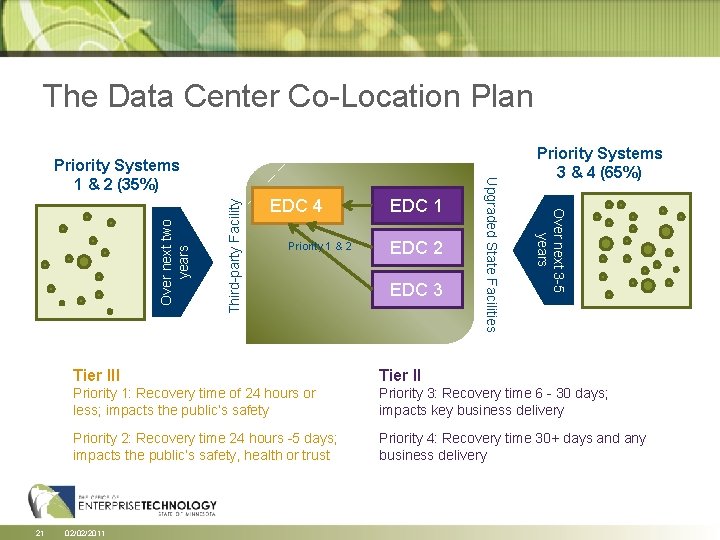
What is Co-location? § Agencies locate their data center servers, network, and storage equipment alongside other agencies in a shared facility § Facility’s building, power, and network bandwidth is provided § Co-location / facility is managed by OET § Agencies manage their own equipment/systems or hire those services from OET 20 02/02/2011
The Data Center Co-Location Plan Third-party Facility Over next two years Priority 1 & 2 EDC 1 EDC 2 EDC 3 Priority Systems 3 & 4 (65%) Over next 3 -5 years 21 EDC 4 Upgraded State Facilities Priority Systems 1 & 2 (35%) Tier III Tier II Priority 1: Recovery time of 24 hours or less; impacts the public’s safety Priority 3: Recovery time 6 - 30 days; impacts key business delivery Priority 2: Recovery time 24 hours -5 days; impacts the public’s safety, health or trust Priority 4: Recovery time 30+ days and any business delivery 02/02/2011
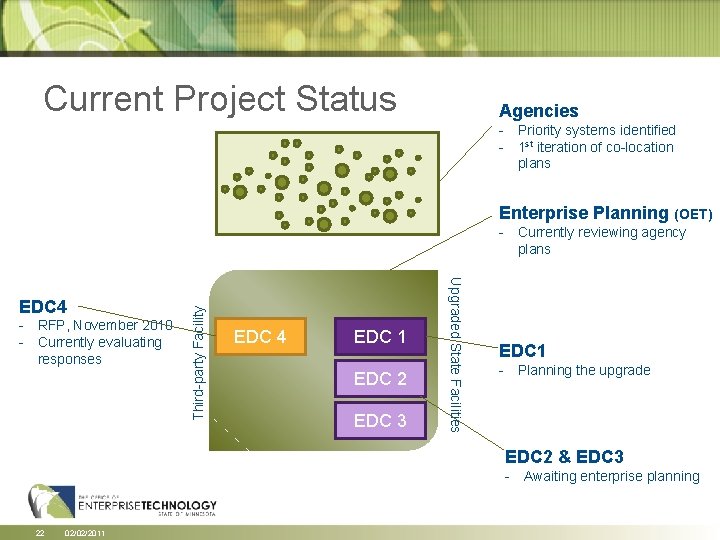
Current Project Status Agencies - Priority systems identified - 1 st iteration of co-location plans Enterprise Planning (OET) - RFP, November 2010 - Currently evaluating responses EDC 4 EDC 1 EDC 2 EDC 3 Upgraded State Facilities EDC 4 Third-party Facility - Currently reviewing agency plans EDC 1 - Planning the upgrade EDC 2 & EDC 3 - Awaiting enterprise planning 22 02/02/2011
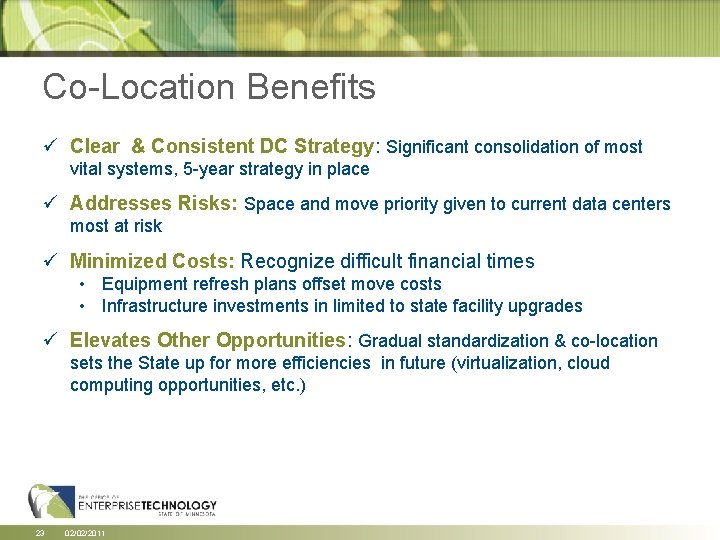
Co-Location Benefits ü Clear & Consistent DC Strategy: Significant consolidation of most vital systems, 5 -year strategy in place ü Addresses Risks: Space and move priority given to current data centers most at risk ü Minimized Costs: Recognize difficult financial times • Equipment refresh plans offset move costs • Infrastructure investments in limited to state facility upgrades ü Elevates Other Opportunities: Gradual standardization & co-location sets the State up for more efficiencies in future (virtualization, cloud computing opportunities, etc. ) 23 02/02/2011
Enterprise Unified Communications & Collaboration (EUCC) What is EUCC? § A Unified Communications and Collaboration (UCC) strategy and infrastructure promotes the effective use of various communication services and collaborative, web-based work spaces. The ability to communicate and collaborate with a broad range of interested parties is a key efficiency and productivity differentiator for state agencies. – Email – Web collaboration – Conferencing 24 02/02/2011
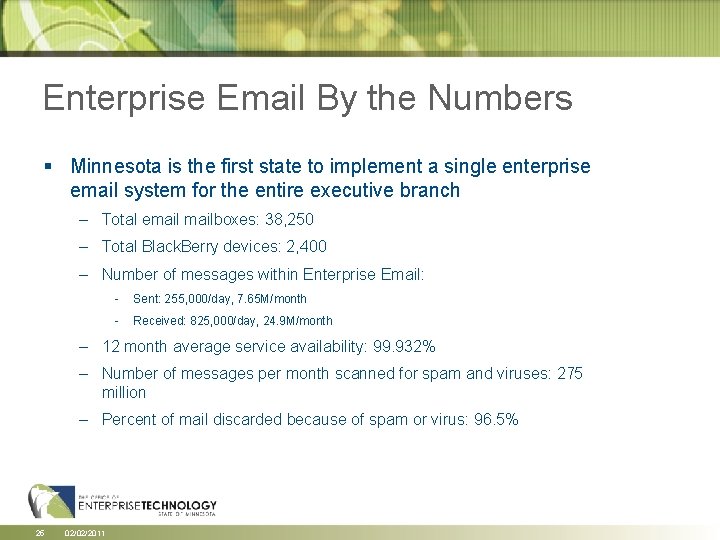
Enterprise Email By the Numbers § Minnesota is the first state to implement a single enterprise email system for the entire executive branch – Total emailboxes: 38, 250 – Total Black. Berry devices: 2, 400 – Number of messages within Enterprise Email: - Sent: 255, 000/day, 7. 65 M/month - Received: 825, 000/day, 24. 9 M/month – 12 month average service availability: 99. 932% – Number of messages per month scanned for spam and viruses: 275 million – Percent of mail discarded because of spam or virus: 96. 5% 25 02/02/2011
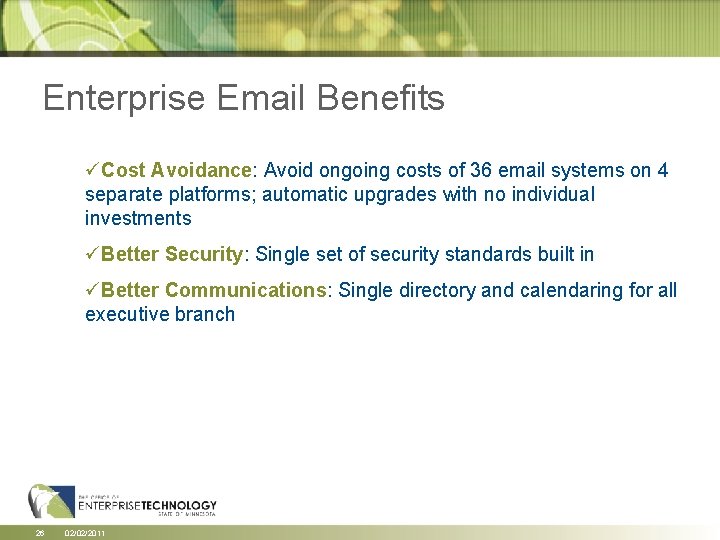
Enterprise Email Benefits üCost Avoidance: Avoid ongoing costs of 36 email systems on 4 separate platforms; automatic upgrades with no individual investments üBetter Security: Single set of security standards built in üBetter Communications: Single directory and calendaring for all executive branch 26 02/02/2011
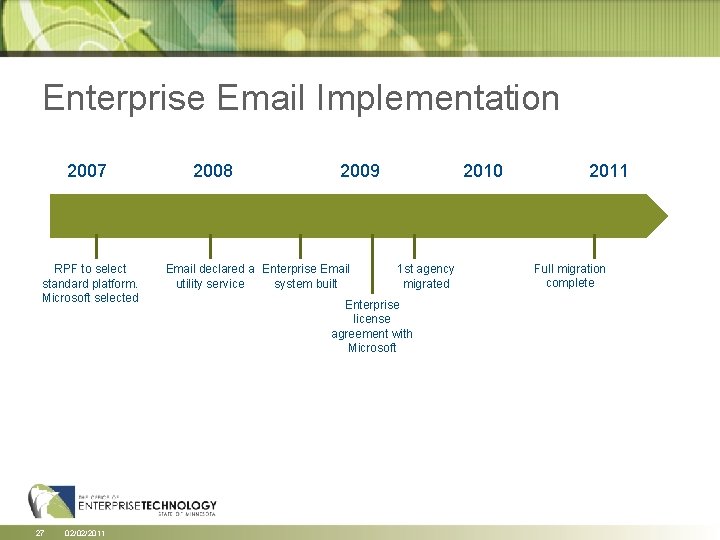
Enterprise Email Implementation 2007 RPF to select standard platform. Microsoft selected 27 02/02/2011 2008 2009 Email declared a Enterprise Email utility service system built 2010 1 st agency migrated Enterprise license agreement with Microsoft 2011 Full migration complete
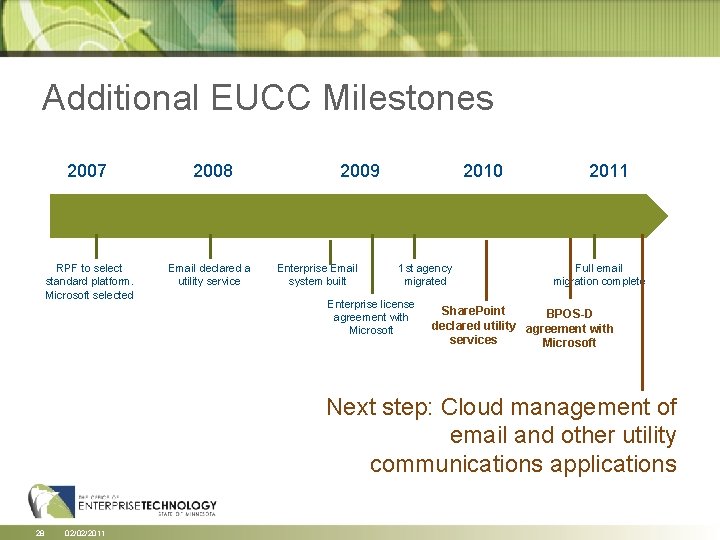
Additional EUCC Milestones 2007 2008 RPF to select standard platform. Microsoft selected Email declared a utility service 2009 Enterprise Email system built 2010 1 st agency migrated Enterprise license agreement with Microsoft 2011 Full email migration complete Share. Point BPOS-D declared utility agreement with services Microsoft Next step: Cloud management of email and other utility communications applications 28 02/02/2011
EUCC Service Benefits ü Increased efficiency of state workers (state, county, city, etc. ) ü Addresses business needs of state workers ü Enables cross-organization collaboration ü Creates a common toolset across State 29 02/02/2011
Questions?