UNCTADS ROLE IN FACILITATING THE INTEGRATION OF DEVELOPING

- Slides: 24
UNCTAD’S ROLE IN FACILITATING THE INTEGRATION OF DEVELOPING COUNTRIES IN THE GLOBAL DIGITAL ECONOMY Cécile Barayre Economic Affairs Officer, ICT Policy Section Science, Technology and ICT Branch Division on Technology and Logistics 2 Mars 2018 P 166 SHORT COURSES ON KEY ISSUES ON THE INTERNATIONAL ECONOMIC AGENDA Assessing the e. Trade readiness of the least developed countries for the promotion of sustainable development
From 1999 to UNCTAD 14 and beyond • 1999, Building Confidence, First United Nations Report on e-commerce • Strengthened or new UNCTAD activities under the Nairobi Maafikiano – “Strengthened” work on enhancing development gains from digital economy and e-commerce – Operationalizing the Intergovernmental Group of Experts on E-commerce and the Digital Economy • Launch of the e. Trade for all initiative “We welcome the formal unveiling of the e. Trade for All initiative at UNCTAD XIV. It provides a new approach to trade development through electronic exchanges by allowing developing countries to more easily navigate the supply of technical assistance for building capacity in e-commerce readiness and for donors to get a clear picture of programmes that they could fund. Nairobi Azimio
THREE PILLARS – THREE QUESTIONS • Research: – Information Economy Report – UNCTAD B 2 C E-Commerce Index – Stand alone publication • Consensus build: – Intergovernmental Group of Experts on ecommerce and the digital economy – UNCTAD E-commerce Week • Technical cooperation
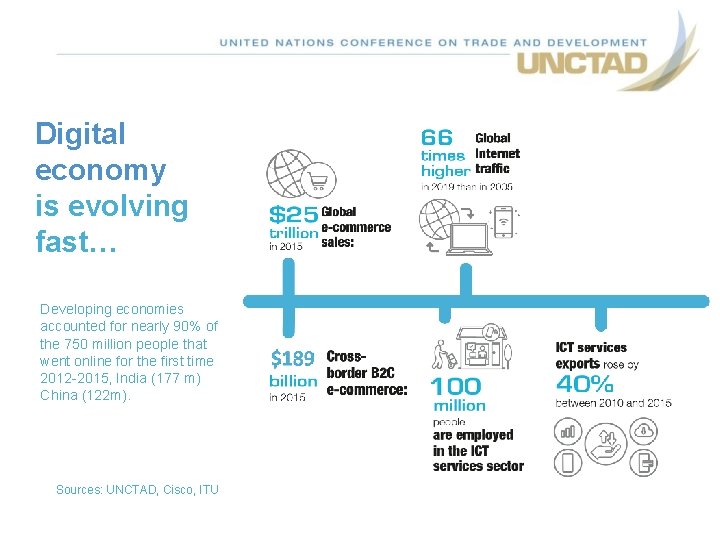
Digital economy is evolving fast… Developing economies accounted for nearly 90% of the 750 million people that went online for the first time 2012 -2015, India (177 m) China (122 m). Sources: UNCTAD, Cisco, ITU
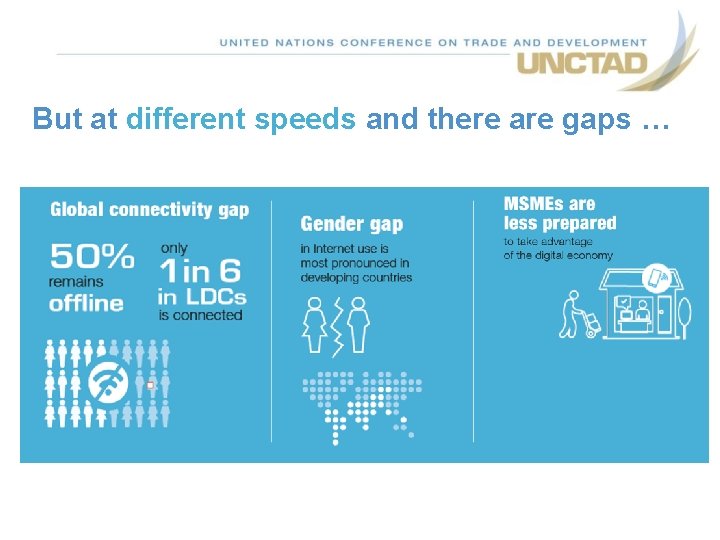
But at different speeds and there are gaps …
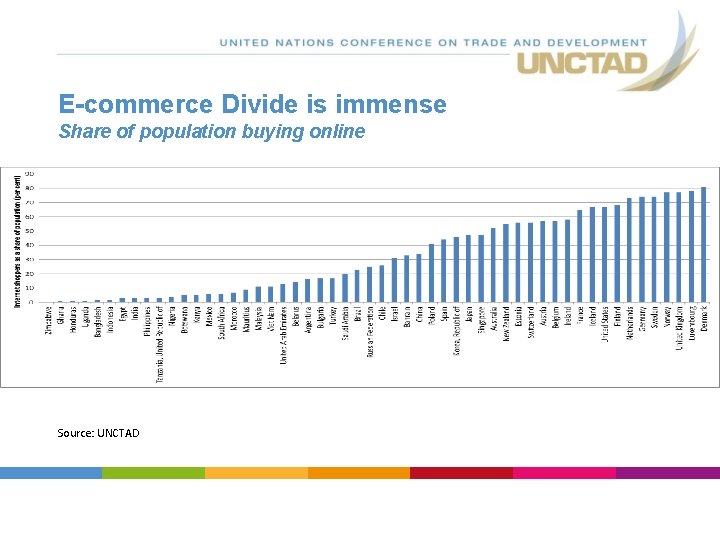
E-commerce Divide is immense Share of population buying online Source: UNCTAD
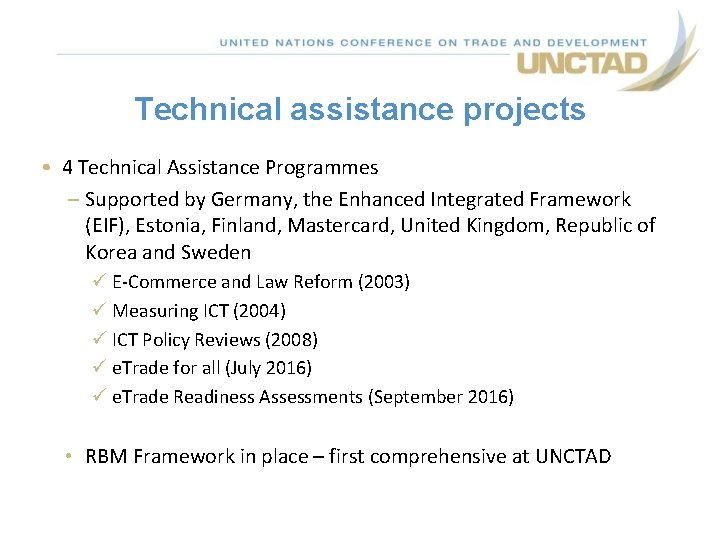
Technical assistance projects • 4 Technical Assistance Programmes – Supported by Germany, the Enhanced Integrated Framework (EIF), Estonia, Finland, Mastercard, United Kingdom, Republic of Korea and Sweden ü E-Commerce and Law Reform (2003) ü Measuring ICT (2004) ü ICT Policy Reviews (2008) ü e. Trade for all (July 2016) ü e. Trade Readiness Assessments (September 2016) • RBM Framework in place – first comprehensive at UNCTAD
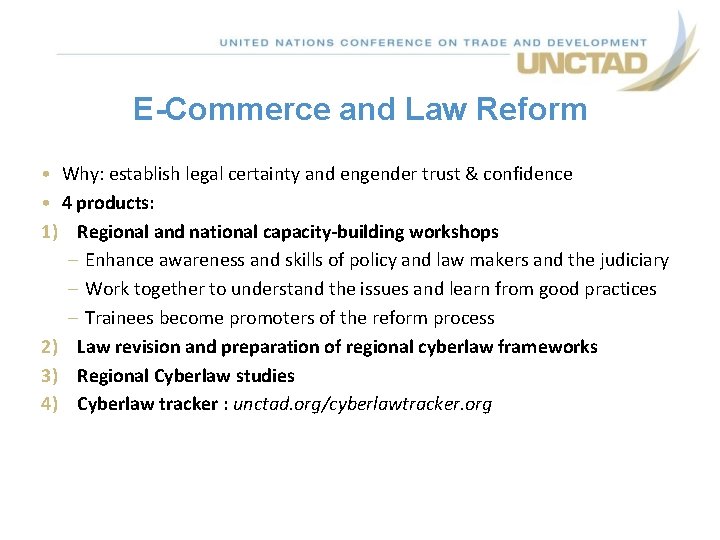
E-Commerce and Law Reform • Why: establish legal certainty and engender trust & confidence • 4 products: 1) Regional and national capacity-building workshops – Enhance awareness and skills of policy and law makers and the judiciary – Work together to understand the issues and learn from good practices – Trainees become promoters of the reform process 2) Law revision and preparation of regional cyberlaw frameworks 3) Regional Cyberlaw studies 4) Cyberlaw tracker : unctad. org/cyberlawtracker. org
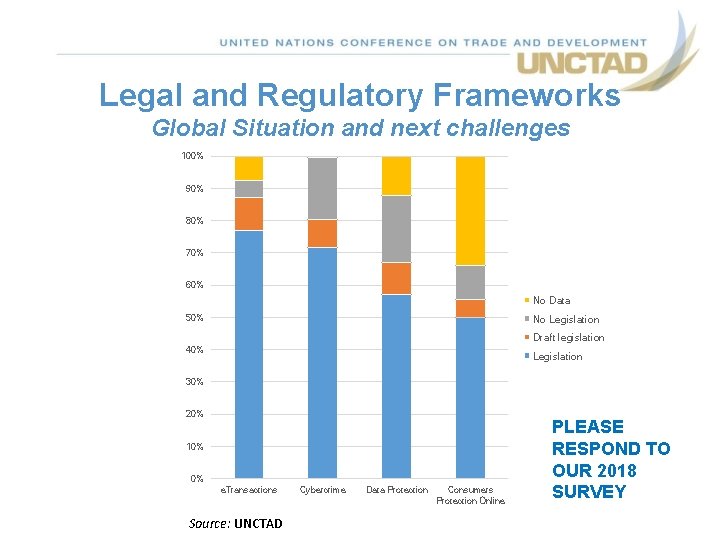
Legal and Regulatory Frameworks Global Situation and next challenges 100% 90% 80% 70% 60% No Data 50% No Legislation Draft legislation 40% Legislation 30% 20% 10% 0% e. Transactions Source: UNCTAD Cybercrime Data Protection Consumers Protection Online PLEASE RESPOND TO OUR 2018 SURVEY
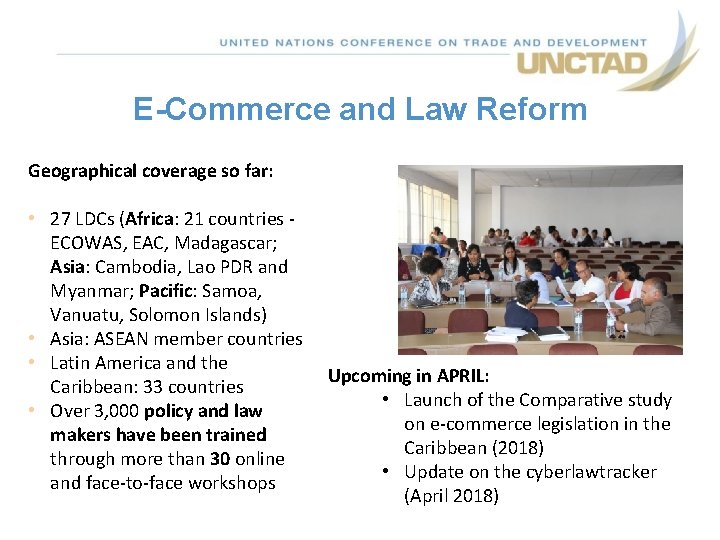
E-Commerce and Law Reform Geographical coverage so far: • 27 LDCs (Africa: 21 countries ECOWAS, EAC, Madagascar; Asia: Cambodia, Lao PDR and Myanmar; Pacific: Samoa, Vanuatu, Solomon Islands) • Asia: ASEAN member countries • Latin America and the Caribbean: 33 countries • Over 3, 000 policy and law makers have been trained through more than 30 online and face-to-face workshops Upcoming in APRIL: • Launch of the Comparative study on e-commerce legislation in the Caribbean (2018) • Update on the cyberlawtracker (April 2018)
Measuring the Information Economy • Relevant data essential for evidence-based policy making • Technical assistance to boost the capacity of national statistical systems to produce internationally comparable ICT indicators – – Advisory missions Regional training courses - build regional networks of ICT statisticians Training of trainers Training material • Data collection and publication: annual UNCTAD survey sent to all national statistical offices: unctadstat. unctad. org • Swedish International Development Cooperation Agency has supported UNCTAD and the Partnership in this area
Partnership on Measuring ICT 4 D • Started in 2004, at UNCTAD XI in Sao Paulo • To improve the availability and quality of ICT data and indicators to inform policy makers • How: by building consensus on common methodologies for core indicators
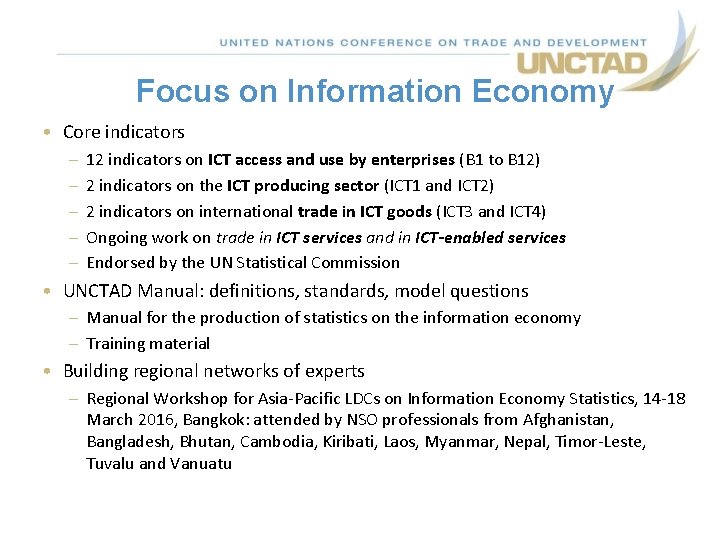
Focus on Information Economy • Core indicators – – – 12 indicators on ICT access and use by enterprises (B 1 to B 12) 2 indicators on the ICT producing sector (ICT 1 and ICT 2) 2 indicators on international trade in ICT goods (ICT 3 and ICT 4) Ongoing work on trade in ICT services and in ICT-enabled services Endorsed by the UN Statistical Commission • UNCTAD Manual: definitions, standards, model questions – Manual for the production of statistics on the information economy – Training material • Building regional networks of experts – Regional Workshop for Asia-Pacific LDCs on Information Economy Statistics, 14 -18 March 2016, Bangkok: attended by NSO professionals from Afghanistan, Bangladesh, Bhutan, Cambodia, Kiribati, Laos, Myanmar, Nepal, Timor-Leste, Tuvalu and Vanuatu
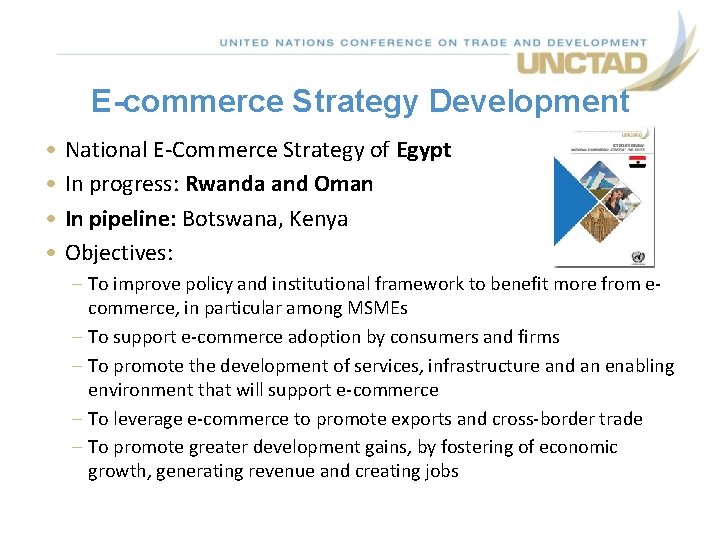
E-commerce Strategy Development • • National E-Commerce Strategy of Egypt In progress: Rwanda and Oman In pipeline: Botswana, Kenya Objectives: – To improve policy and institutional framework to benefit more from ecommerce, in particular among MSMEs – To support e-commerce adoption by consumers and firms – To promote the development of services, infrastructure and an enabling environment that will support e-commerce – To leverage e-commerce to promote exports and cross-border trade – To promote greater development gains, by fostering of economic growth, generating revenue and creating jobs
Purpose and scope of e. Trade for all Multi-stakeholder initiative to achieve significant improvements in the ability of countries to use and benefit from e-commerce by: – raising awareness of countries' unique opportunities, challenges and constraints to e-commerce; – mobilizing and rationalizing available financial and human resources for the implementation of projects that would address those challenges and constraints; and – strengthening coherence and synergies among partner activities to further the use and gains from e-commerce in developing countries.
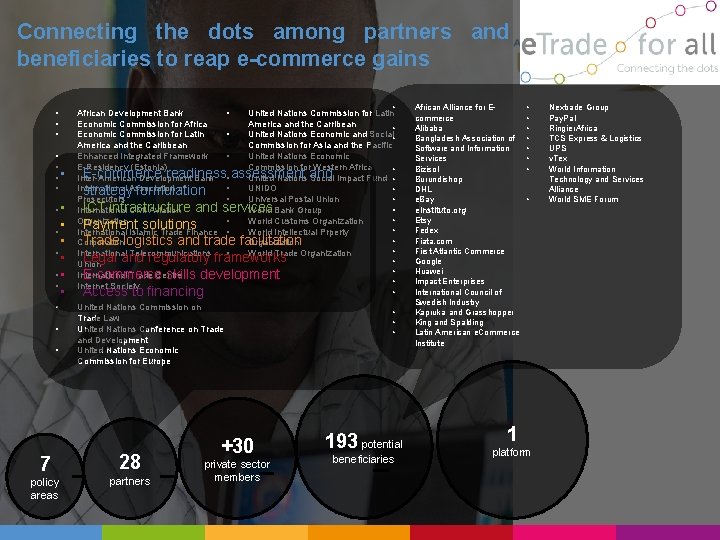
Connecting the dots among partners and beneficiaries to reap e-commerce gains • • • • • • 7 policy areas • African Development Bank • United Nations Commission for Latin Economic Commission for Africa America and the Carribean • Economic Commission for Latin • United Nations Economic and Social • America and the Caribbean Commission for Asia and the Pacific Enhanced Integrated Framework • United Nations Economic E-Residency (Estonia) Commission for Western Africa • E-commerce readiness assessment and Inter-American Development Bank • United Nations Social Impact Fund • International Association of • strategy formulation • UNIDO • Prosecutors • Universal Postal Union ICT infrastructure and services • International Civil Aviation • World Bank Group • Organization • World Customs Organization Payment solutions • International Islamic Trade Finance • World Intellectual Prperty • Trade logistics and trade facilitation Corporation Organization • International Telecommunications • World Trade Organization Legal and regulatory frameworks • Union • International Trade Centre E-commerce skills development • Internet Society • Access to financing United Nations Commission on Trade Law United Nations Conference on Trade and Development United Nations Economic Commission for Europe 28 partners +30 private sector members • • • 193 potential beneficiaries African Alliance for Ecommerce Alibaba Bangladesh Association of Software and Information Services Bizisol Burundishop DHL e. Bay • • einstituto. org Etsy Fedex Fiata. com First Atlantic Commerce Google Huawei Impact Enterprises International Council of Swedish Industry Kapruka and Grasshopper King and Spalding Latin American e. Commerce Institute 1 platform Nextrade Group Pay. Pal Ringier. Africa TCS Express & Logistics UPS v. Tex World Information Technology and Services Alliance World SME Forum
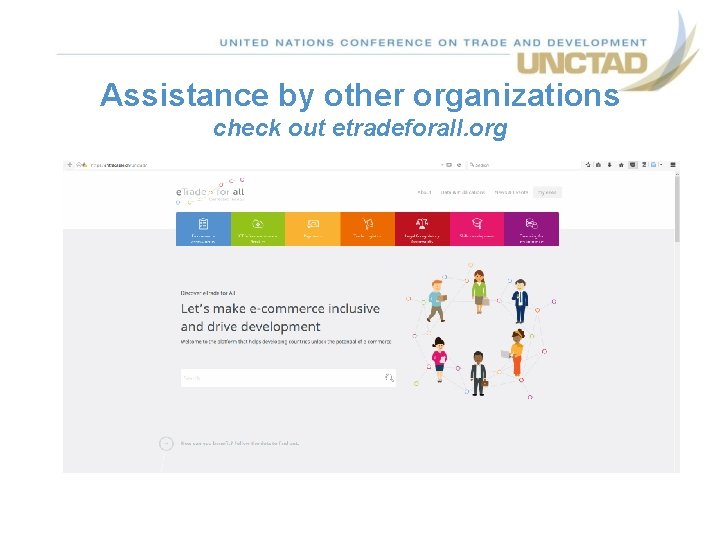
Assistance by other organizations check out etradeforall. org
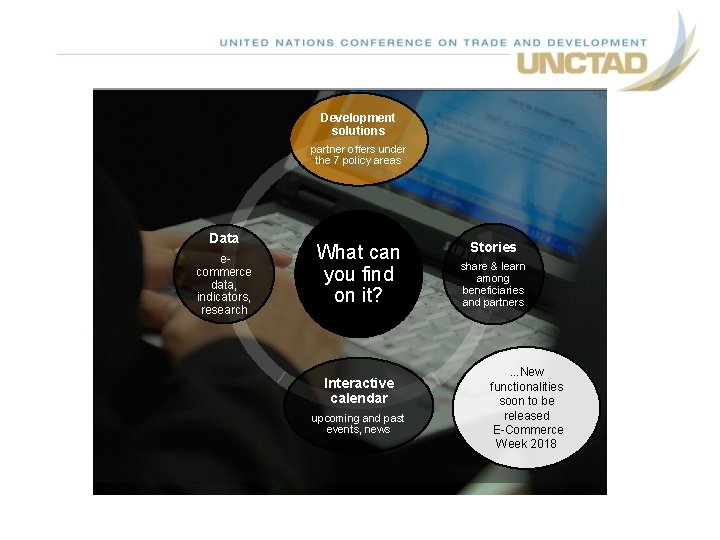
Development solutions partner offers under the 7 policy areas Data ecommerce data, indicators, research What can you find on it? Interactive calendar upcoming and past events, news Stories share & learn among beneficiaries and partners …New functionalities soon to be released E-Commerce Week 2018
Rapid e. Trade Readiness Assessments • Essential step for developing countries to raise awareness of ecommerce opportunities and challenges • Assessments can serve as basis for policies to harness the development potential of e-commerce • Focus on seven key policy areas of e. Trade for all • In each area, readiness gaps are identified that can be addressed through public and private partnerships • Lao PDR, Liberia and Myanmar; Senegal, Solomon Islands and Vanuatu • Requests: Afghanistan, Bangladesh, Burundi, Lesotho, Nuie, Malawi, Tanzania, Togo, Uganda, Zambia
Save the date! • E-COMMERCE WEEK 2018 16 -20 APRIL in GENEVA • Second session of the UNCTAD Intergovernmental Group of Experts (IGE) on E-commerce and the Digital Economy Key facts More than 1'000 participants in 2017 5 day-event including a 3 -day dedicated meetings of experts (IGE 2018) on leveraging platforms and digital entrepreneurship for development 1 High-Level conversation, e. Trade for all private partners meeting, networking opportunities … and much more…
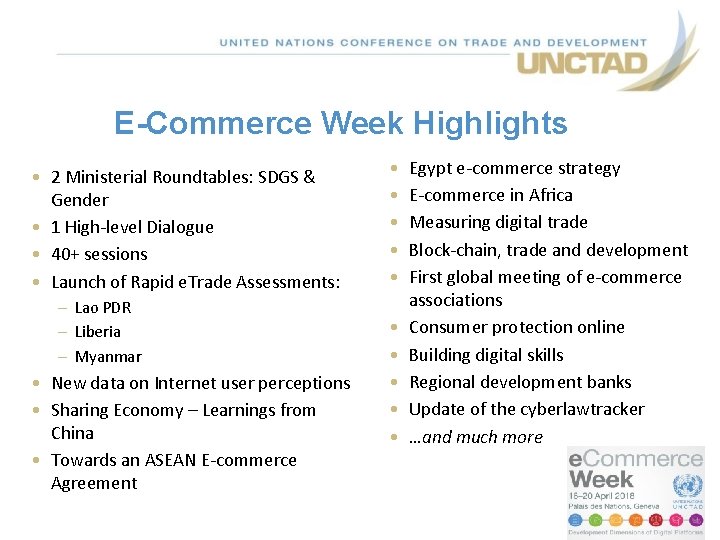
E-Commerce Week Highlights • 2 Ministerial Roundtables: SDGS & Gender • 1 High-level Dialogue • 40+ sessions • Launch of Rapid e. Trade Assessments: – Lao PDR – Liberia – Myanmar • New data on Internet user perceptions • Sharing Economy – Learnings from China • Towards an ASEAN E-commerce Agreement • • • Egypt e-commerce strategy E-commerce in Africa Measuring digital trade Block-chain, trade and development First global meeting of e-commerce associations Consumer protection online Building digital skills Regional development banks Update of the cyberlawtracker …and much more
Second session of UNCTAD IGE Discussion topics and guiding questions a) How can developing countries foster local platforms for domestic and cross-border e-commerce? b) What are the existing barriers related to international e-commerce platforms that developing countries, including the least developed countries, face and how can these barriers be overcome? c) What are some of the operational constraints that small and mediumsized businesses in developing countries face when setting up trade online, and how can they be overcome? d) What are the good practices that developed and developing countries, including the least developed countries, can learn from each other?
« Savoir où l'on veut aller, c'est très bien ; mais il faut encore montrer qu'on y va. » Emile Zola
Thank you for your attention!