Triangulation in Data Collection Police nonemergency callhandling THEORY
- Slides: 37
Triangulation in Data Collection: Police non-emergency call-handling THEORY AND METHOD IN EMPIRICAL DOCTORAL STUDIES IN LAW UNIVERSITY OF BIRMINGHAM. 15. 9. 2017 DR ANDREW STAFFORD SENIOR LECTURER IN CRIMINOLOGY UNIVERSITY OF GLOUCESTERSHIRE
Overview The study: Background and overview Methodology: A triangulated approach Making contact and call answering times Language used by call-handlers Explaining response activity to callers Lessons learned and continuing with this approach
The study
The police and the public The police rely on the ‘consent, assistance and cooperation of the public’ in order to operate effectively (Jackson et al. 2013, p. 2). People are more likely to cooperate with the police when they have confidence and trust in the police, and perceive the police to be legitimate. Contact with the police influences public confidence, trust and perceptions of police legitimacy.
Call-handling The police in England Wales receive 80 million calls a year for assistance from the general public (HMIC 2007) ‘[t]he majority of the public make their initial contact with the police through the telephony system, and first impressions count’ (Povey 2001, p. 154). Contacting the police to report a crime is the most common reason for contacting the police (Allen et al. 2006)
Landscape at the time So called ‘non-crime demand’ constitutes around four-fifths of all calls for police service Increased emphasis at the time on people contacting the police concerning the things that matter to them locally. Between March 2010 and September 2014, police officer numbers fell 11. 6%, while police staff numbers excluding PCSOs fell 20%(NAO, 2015).
Aims of study Qualitative exploratory examination of: call handling and reporting process the content of calls to the police what was recorded and how calls were responded to To identify: What matters to callers Determinants of satisfaction during contact with the police Impact of police systems and processes
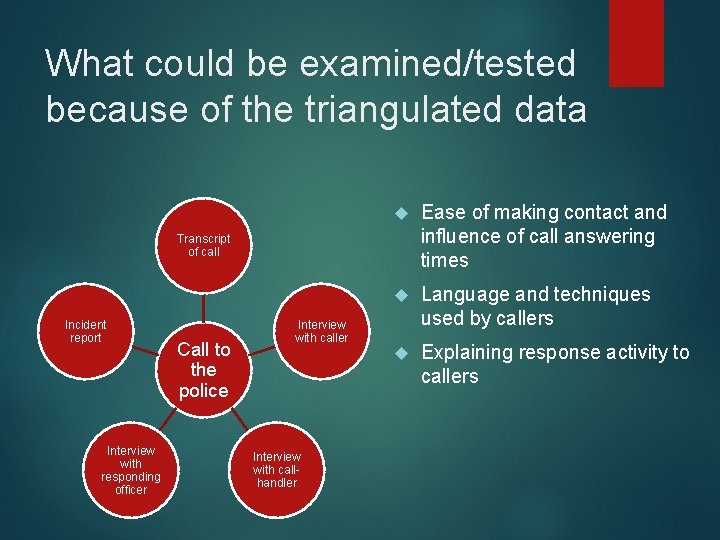
Overview of data Examination of database of 800 calls, showing duration and purpose Transcripts of 70 non-emergency calls to the police Interviews with the 70 members of the public who made these calls 30 interviews with the police call-handlers who dealt with some of these calls 20 interviews with the police officers who responded to some of these calls 10 interviews with call centre supervisors and senior managers in the Communications department Transcripts of crime reports for 50 of the calls in the sample
What could be examined/tested because of the triangulated data Ease of making contact and influence of call answering times Language and techniques used by callers Explaining response activity to callers Transcript of call Incident report Interview with responding officer Call to the police Interview with caller Interview with callhandler
Making contact and call answering times METHODOLOGY: A TRIANGULATED APPROACH
Making contact: perspectives of call-handlers and supervisors Studies have found callers to be dissatisfied with the amount of time taken to answer their call the police (Singer 2004; Home Office 2008) Call-handlers and supervisors at the participating Constabulary explained that callers would often have to wait for their calls to be answered. ‘We don’t reach performance targets [of answering calls in under 40 seconds] probably ever now’. (quote from call centre supervisor)
From the caller’s perspective Only four callers stated that they had a problem contacting the police, with another four stating that they had been kept on hold or that the police had taken a long time to answer their call (n = 70). The large majority of the sample noted that they found it relatively simple to contact the police and did not report a noteworthy period of hold before or during their call. Even the four callers who did recall a period of hold seemed to describe its length as acceptable, consisting of ‘about a minute if that’, ‘maybe 30 seconds if that’, ‘a bit, but not too long’ and ‘a short while, not too long’.
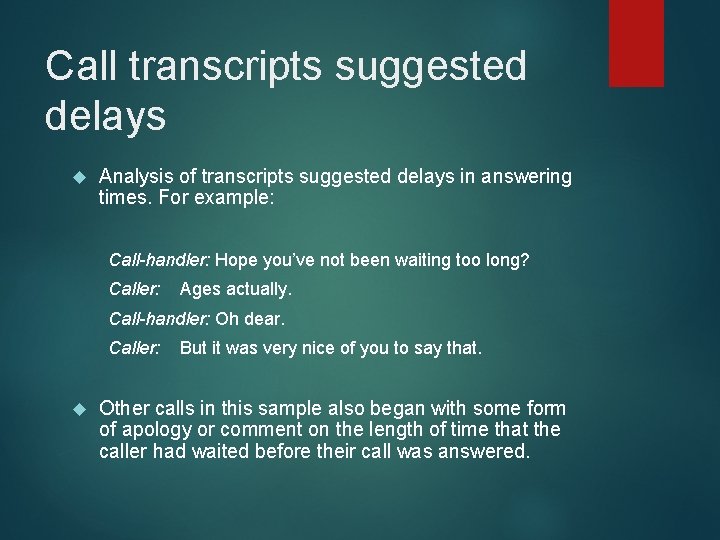
Call transcripts suggested delays Analysis of transcripts suggested delays in answering times. For example: Call-handler: Hope you’ve not been waiting too long? Caller: Ages actually. Call-handler: Oh dear. Caller: But it was very nice of you to say that. Other calls in this sample also began with some form of apology or comment on the length of time that the caller had waited before their call was answered.
Periods of hold/delays in answering didn’t appear to leave a lasting impression When the caller on the previous slide was asked whether they had experienced any problems trying to get through to the police, they responded ‘no’, explaining that they were kept on hold for only a ‘minor time, not long at all’. Although the call-handlers in these instances appeared to consider that time spent waiting warranted an apology, callers did not find this period of wait particularly memorable or significant.
Language used by callhandlers METHODOLOGY: A TRIANGULATED APPROACH
What is important to people? Tyler (2011, p. 258) argues that: ‘quality of treatment dominates people’s reactions to personal encounters with the police’. According to Skogan (2006, p. 104): ‘victims are less ‘outcome’-orientated than they are ‘process’ -orientated – that is, they are less concerned about someone being caught or (in many instances) getting stolen property back, than they are in how promptly and responsibly they are treated by the authorities. Police are judged by what physicians might call their ‘bedside manner’. Factors like how willing they are to listen to people’s stories and show concern for their plight are very important, as are their politeness, helpfulness and fairness. ’
Call-handling, language and social skills Waddington (1993) argues that empathy, interest, consideration and rapport are the requirements for a caring police response. Social skills are particularly important among callhandlers (Frenkel et al. 1998, Thompson et al. 2001) The way in which call-handlers communicate feeling and emotion to a caller can influence assessments of contact made by the latter (Ashforth and Humphrey 1993).
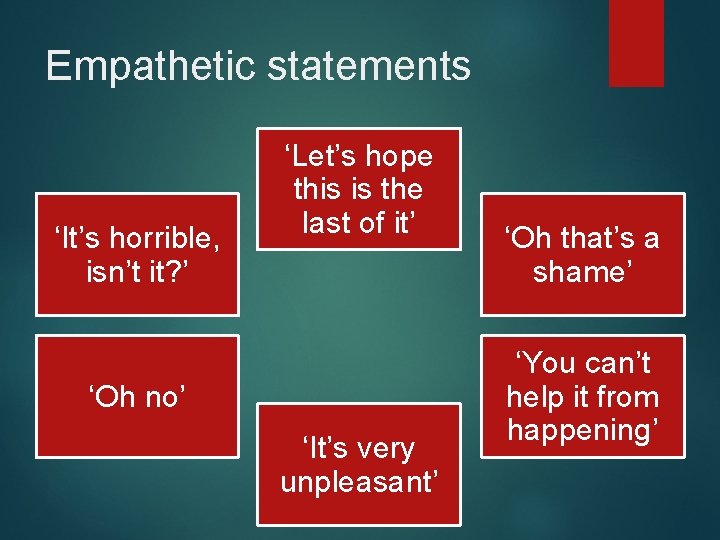
Empathetic statements ‘It’s horrible, isn’t it? ’ ‘Let’s hope this is the last of it’ ‘Oh no’ ‘It’s very unpleasant’ ‘Oh that’s a shame’ ‘You can’t help it from happening’
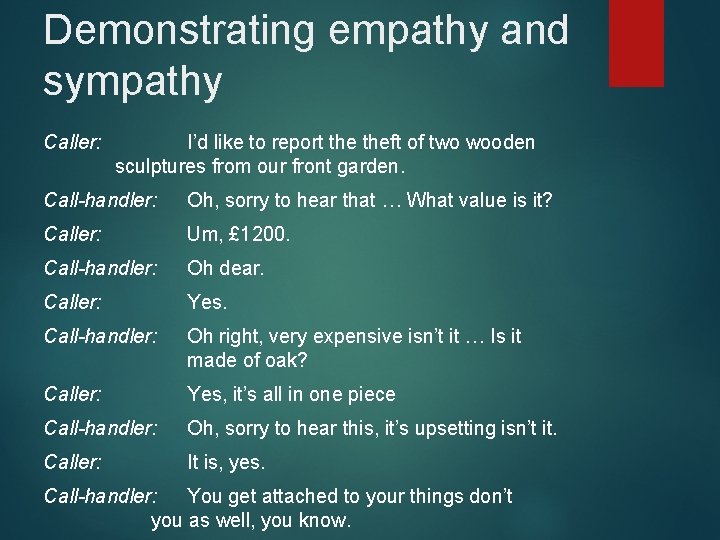
Demonstrating empathy and sympathy Caller: I’d like to report theft of two wooden sculptures from our front garden. Call-handler: Oh, sorry to hear that … What value is it? Caller: Um, £ 1200. Call-handler: Oh dear. Caller: Yes. Call-handler: Oh right, very expensive isn’t it … Is it made of oak? Caller: Yes, it’s all in one piece Call-handler: Oh, sorry to hear this, it’s upsetting isn’t it. Caller: It is, yes. Call-handler: You get attached to your things don’t you as well, you know.
What did the caller say about this call? When this caller was asked about this conversation, the caller stated that ‘[the call-handler] was just very helpful, she said “oh dear”, “that must be upsetting” or something like that, I mean she was sympathetic’. These details were memorable and recalled accurately
Establishing common ground and rapport A call-handler, when speaking to a caller who had reported damage to his car previously to the police (and who was annoyed at having received no updates about the investigation in to this), stated that: ‘I understand, it’s very frustrating, yes very frustrating, as you say it’s a lot of problems, and you just want it sorted out, and … even if you can make a claim against insurance you still have to pay … I can totally understand your frustration, this has been going on a long time and you obviously want. . . it done and dusted and sorted to your satisfaction don’t you, and that’s what should be happening, but I mean, as I said, I’d love to be able to just go down [to the caller’s local police station] and say “look you’ve got to speak to this man, because he’s frustrated”’.
What did the caller say about this call? When asked about this, the caller explained that the call-handler he spoke to: ‘was kind of on my side if you like, she was saying “I think it’s a little bit naughty that they haven’t got back to you, you’d think that somebody would have rang you up and just spoke to you and put your mind at rest”. ’ These details were memorable and recalled accurately
What was most important and memorable about the calls? The empathy, understanding, interest, sensitivity, politeness and willingness to engage in small talk displayed by call-handlers was most memorable for callers. Most helpful elements of calls often described as callhandler tone of voice, sensitivity and language rather than a specific act of assistance or the provision of information.
Explaining response activity to callers METHODOLOGY: A TRIANGULATED APPROACH
Providing information to the public The provision of information on crime and police activity has been shown to improve public opinion of the police (Chapman et al. 2002, Hohl et al. 2010, Quinton 2011, Barrett and Fletcher 2013). Studies have highlighted the importance that victims of crime place on the information that they receive from the police and on the quality and frequency of the updates they receive as a police investigation progresses (Coupe and Griffiths 1999, Robinson and Stroshine 2005, Elliott et al. 2012).
Non-emergency call-handling and explaining police response activity Call-handlers would usually provide information on next steps The Constabulary’s policy for responding to nonemergency incidents was that every caller would receive either: a phone call or visit from an officer or a letter from the constabulary Honesty and accuracy were seen as paramount, as was delivering information sensitively.
A response activity statement ‘Obviously what will happen now is I’ve recorded the crime and I’ll give your crime number so you can give it to the insurance company. This will be sent through to the District Allocation Unit, and if they think that there’s any line of enquiry that can be made somebody will be allocated, an officer will be allocated from your area to investigate this and that officer will be in touch with you within the next few days. They’ll need to contact you to let you know what’s going to happen. ’
Other response activity statements ‘Now, um, I think I’ve got enough to start the ball rolling with this … I’m not sure how far it will go, but it’s worth a try’. ‘Somebody from the local nick will be in touch with you’.
Challenge 1 - Other evidence, events and factors Factors outside the information that call-handlers record from callers can play a part in determining police response activity. Further information can become available after the initial phone call The call might refer to one incident which could subsequently be identified as one in a series of crimes
Other evidence, events and factors An officer stated that: ‘I’ll explain to [callers] “well, actually [a nonemergency call-handler is] not a police officer. They don’t know how to deal with this crime and they may have given you incorrect information”’. According to a senior officer in the Constabulary’s Communications department: ‘I think 12 -15% [of the calls received by the non-emergency call centre] a day are saying ‘where are you? I’ve called you, you said you were coming, you haven’t arrived’. Now some of that will be because something else has happened and we haven’t been able to get there, but some of that will be because when somebody took the initial call, without being sighted on the full picture, they’ve said ‘oh yeah, this is something we come round and see you about’, when it may not be. ’
Challenge 2 - Variation in response activity Call-handlers were aware that there was variation in how separate departments and local police teams within the constabulary responded to certain crimes. Different districts prioritise different things, spend budgets differently and deal with certain things in different ways. Workload and availability will vary dramatically between district teams also.
Where it went right (example from call to report theft from motor vehicle) Call-handler: I’ll let our CSI teams know. Normally they don’t tend to come out to theft from motor vehicles, but when offenders lever the doors out they manage to sometimes leave fingerprints out on the rubber seals that you as the vehicle owner would never touch that area of the car, so it’s possible that there could be something there. So I’ll let them know and if they want to attend they’ll give you a call to arrange that with yourself. Caller : Would that be this afternoon? Call-handler: Possibly, it does depend on what else is happening in that particular district. . . but they probably will ring you just to scope out whethere’s likely to be anything that they can look at on the vehicle, if they’ve got any interest in it. . . So if you don’t hear from them, it would suggest that they’re not coming, mainly because of other things that are happening on district at the moment.
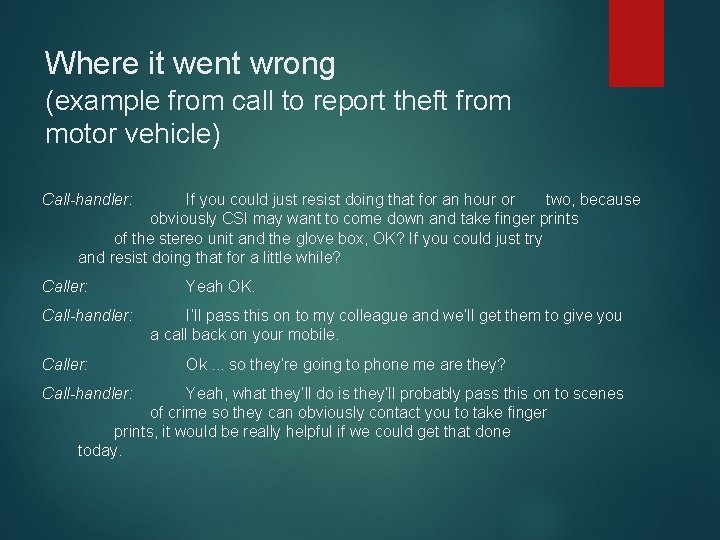
Where it went wrong (example from call to report theft from motor vehicle) Call-handler: If you could just resist doing that for an hour or two, because obviously CSI may want to come down and take finger prints of the stereo unit and the glove box, OK? If you could just try and resist doing that for a little while? Caller: Call-handler: Yeah OK. I’ll pass this on to my colleague and we’ll get them to give you a call back on your mobile. Ok. . . so they’re going to phone me are they? Yeah, what they’ll do is they’ll probably pass this on to scenes of crime so they can obviously contact you to take finger prints, it would be really helpful if we could get that done today.
Lessons learned and Continuing with this approach
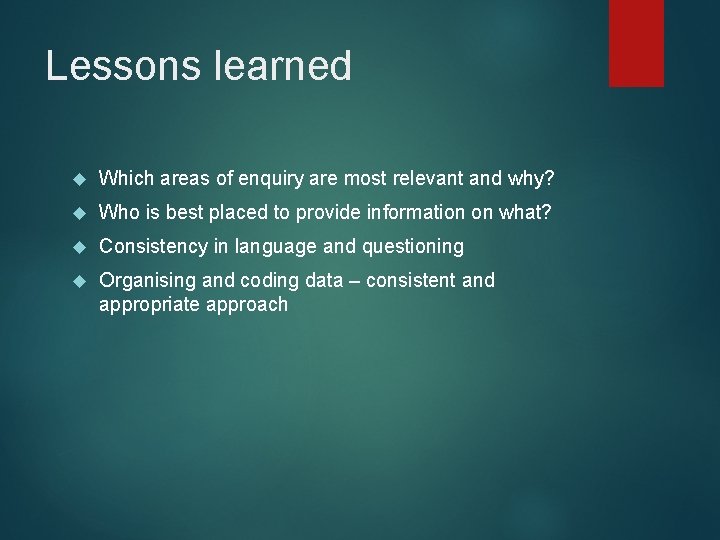
Lessons learned Which areas of enquiry are most relevant and why? Who is best placed to provide information on what? Consistency in language and questioning Organising and coding data – consistent and appropriate approach
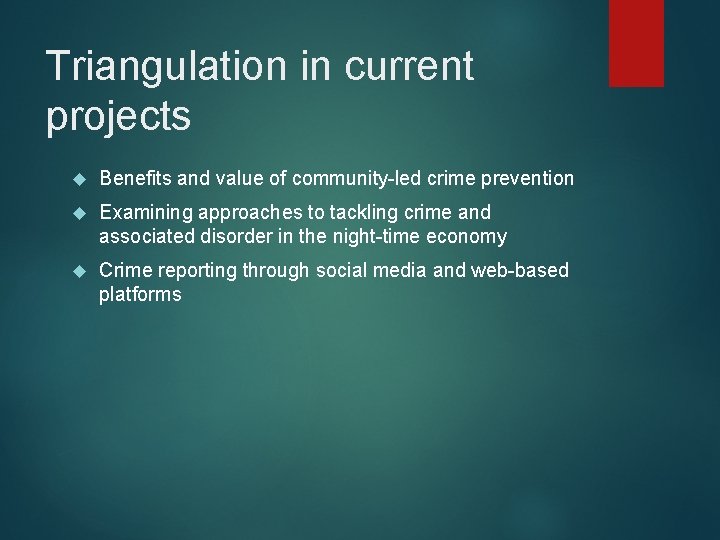
Triangulation in current projects Benefits and value of community-led crime prevention Examining approaches to tackling crime and associated disorder in the night-time economy Crime reporting through social media and web-based platforms
Contact Email: astafford 1@glos. ac. uk Twitter: @Andrewbstafford