
Bluetooth Positioning using RSSI and Triangulation Methods Speaker
Bluetooth Positioning using RSSI and Triangulation Methods Speaker : Shih-Chi Huang Advisor : Dr. Kai-Wei Ke 2013/12/09
Outline • Background • Introduction • Wireless Positioning Algorithms • Bluetooth Based Positioning • Designing The Positioning System • Positioning Results • Conclusion • References 2
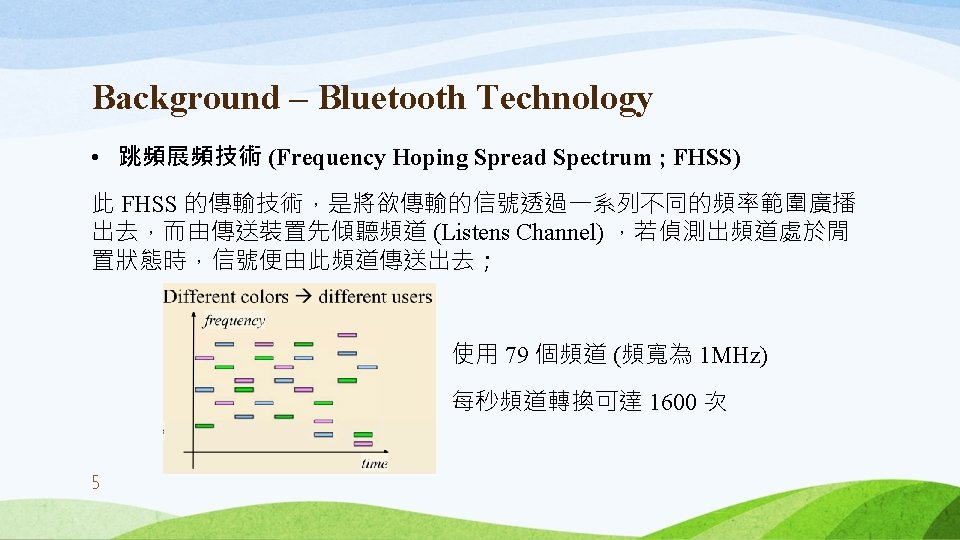
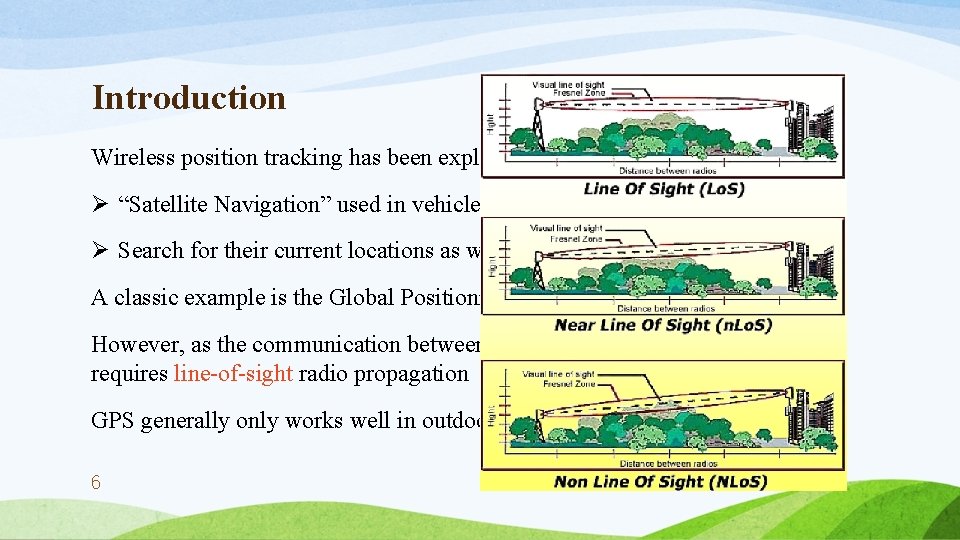
Introduction Wireless position tracking has been exploited in many areas. Ø “Satellite Navigation” used in vehicles Ø Search for their current locations as well as place-of-interest nearby A classic example is the Global Positioning System (GPS). However, as the communication between the satellites and GPS receivers requires line-of-sight radio propagation GPS generally only works well in outdoor environments. 6
Introduction (Cont. ) There have been increasing interests in researches for indoor position tracking. The aim is to develop applications. Ø low-cost Ø easy-to-deploy 7
Wireless Positioning Algorithms 1. Cell ID methods 2. Triangulation methods 3. Signal Strength methods 8
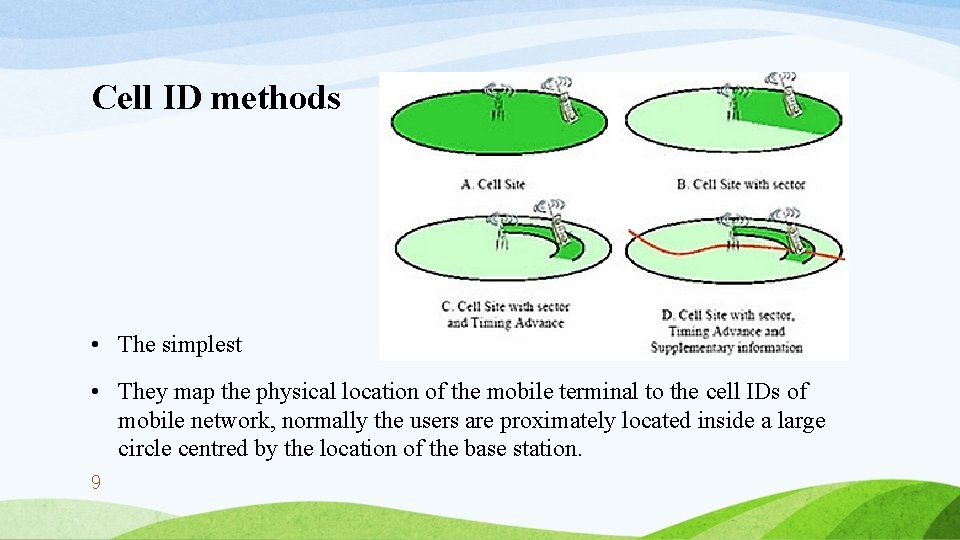
Cell ID methods • The simplest • They map the physical location of the mobile terminal to the cell IDs of mobile network, normally the users are proximately located inside a large circle centred by the location of the base station. 9
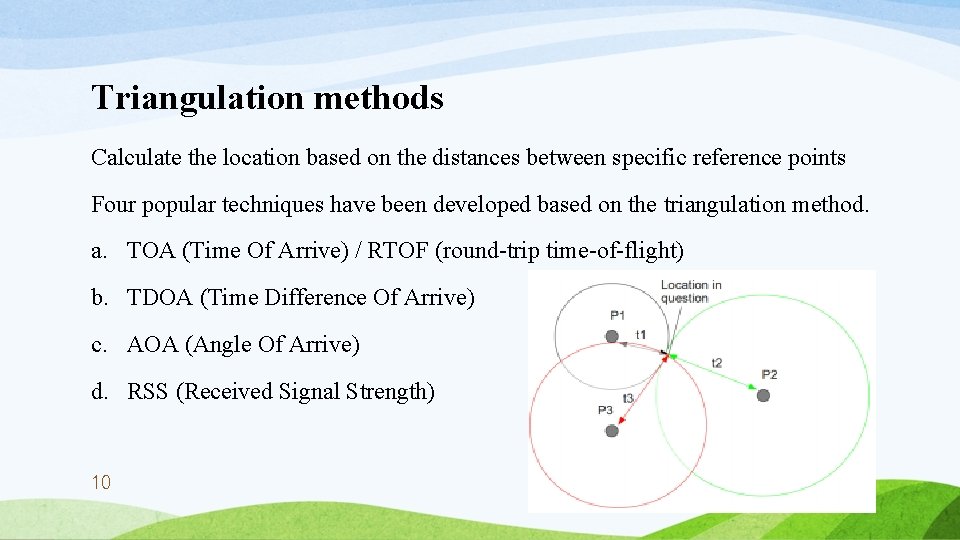
Triangulation methods Calculate the location based on the distances between specific reference points Four popular techniques have been developed based on the triangulation method. a. TOA (Time Of Arrive) / RTOF (round-trip time-of-flight) b. TDOA (Time Difference Of Arrive) c. AOA (Angle Of Arrive) d. RSS (Received Signal Strength) 10
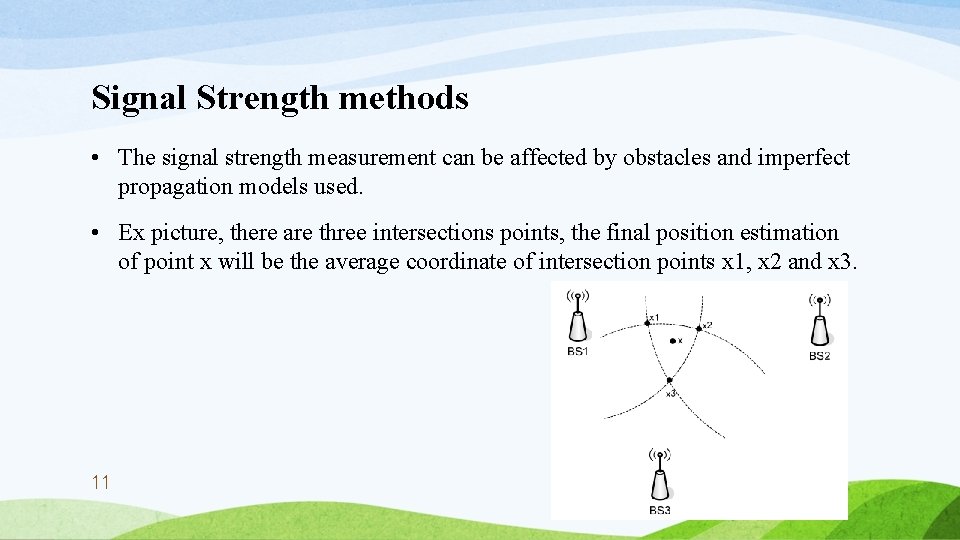
Signal Strength methods • The signal strength measurement can be affected by obstacles and imperfect propagation models used. • Ex picture, there are three intersections points, the final position estimation of point x will be the average coordinate of intersection points x 1, x 2 and x 3. 11

Triangulation methods – TOA/RTOF • TOA (Time Of Arrive) / RTOF (round-trip time-of-flight) • the time needed to transmit a signal from base station to mobile terminal (at the speed of light) is recorded and used for calculating the distance. • A disadvantage is that the device either has to have a big database with the sites’ geographic positions 12
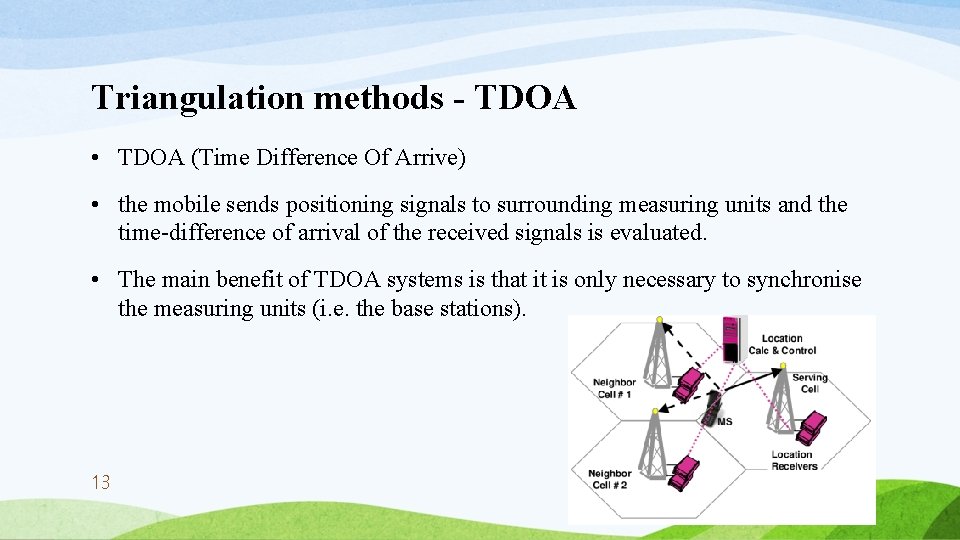
Triangulation methods - TDOA • TDOA (Time Difference Of Arrive) • the mobile sends positioning signals to surrounding measuring units and the time-difference of arrival of the received signals is evaluated. • The main benefit of TDOA systems is that it is only necessary to synchronise the measuring units (i. e. the base stations). 13
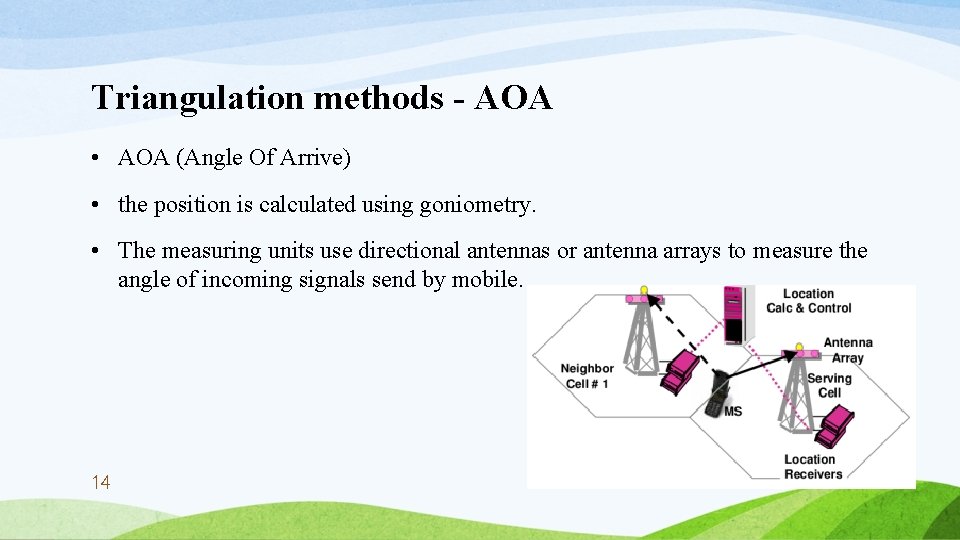
Triangulation methods - AOA • AOA (Angle Of Arrive) • the position is calculated using goniometry. • The measuring units use directional antennas or antenna arrays to measure the angle of incoming signals send by mobile. 14
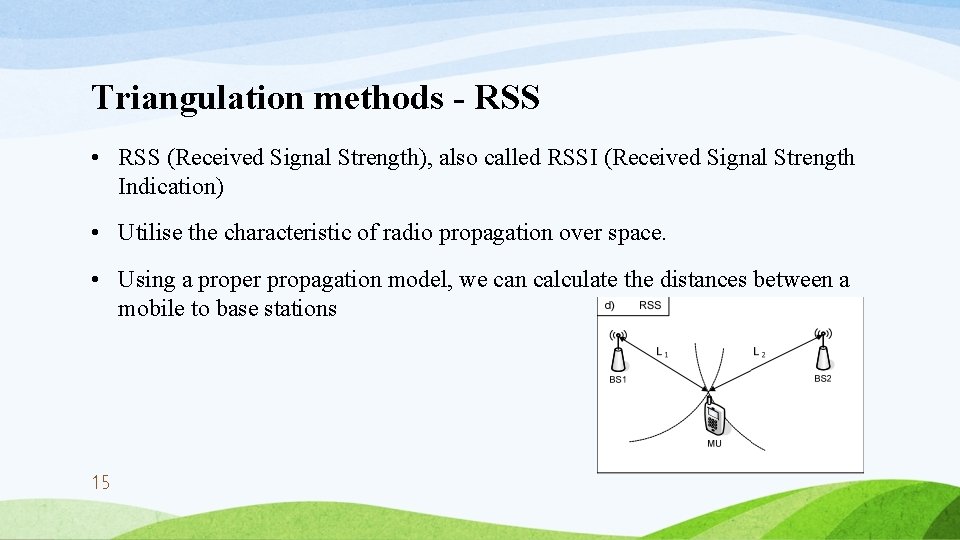
Triangulation methods - RSS • RSS (Received Signal Strength), also called RSSI (Received Signal Strength Indication) • Utilise the characteristic of radio propagation over space. • Using a proper propagation model, we can calculate the distances between a mobile to base stations 15
Bluetooth Based Positioning Bluetooth Compare to WIFI Has several advantages 1. Cost : the cost of Bluetooth chip is lower than Wi. Fi 2. Power consumption : Bluetooth consumes much lower power than Wi. Fi, Bluetooth uses a fifth of the power of Wi. Fi as it requires a lower transmission power and provides a mechanism for automatic power control. 16
Bluetooth Based Positioning (Cont. ) Compares to Wi. Fi, there are much fewer Bluetooth based positioning system. The reason is that compares to Wi. Fi, there are several technical hurdles to overcome for Bluetooth based positioning systems. Ø Bluetooth is designed for low cost communication, the Bluetooth standard lacks precise time synchronisation, therefore time based triangulation methods such as TOA, TDOA are difficult to implement. Ø Bluetooth is designed to be used in low footprint devices. Directional or array antennas are rarely used. There for it is difficult to use angle measurement methods like AOA. 17
Bluetooth Based Positioning (Cont. ) Ø RSSI reading is not well defined in Bluetooth standard. The RSSI reading is unreliable and device dependent, especially for early Bluetooth standard. However, since Bluetooth 2. 1, there is a new method to measure RSSI without connection. 18
Designing The Positioning System We found that Android is the perfect platform to implement. Why ? ? 1. Android is an open source mobile operation system (OS) that developed by Google. 2. It offers free API for developer to developing their own applications with accessing to different resources including the latest Bluetooth API. 3. The Java-style programming also makes Android an extendable and easy-tolearn developing platform. 19
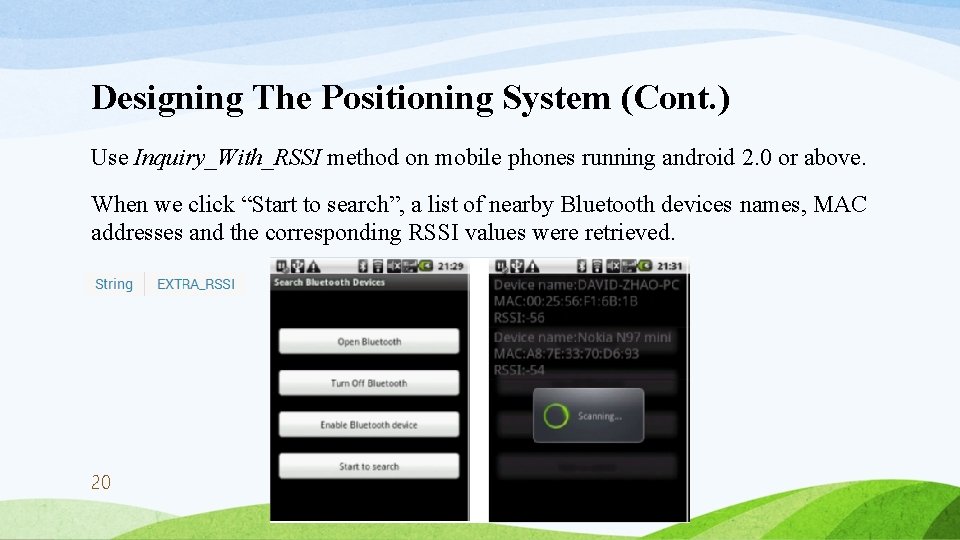
Designing The Positioning System (Cont. ) Use Inquiry_With_RSSI method on mobile phones running android 2. 0 or above. When we click “Start to search”, a list of nearby Bluetooth devices names, MAC addresses and the corresponding RSSI values were retrieved. 20
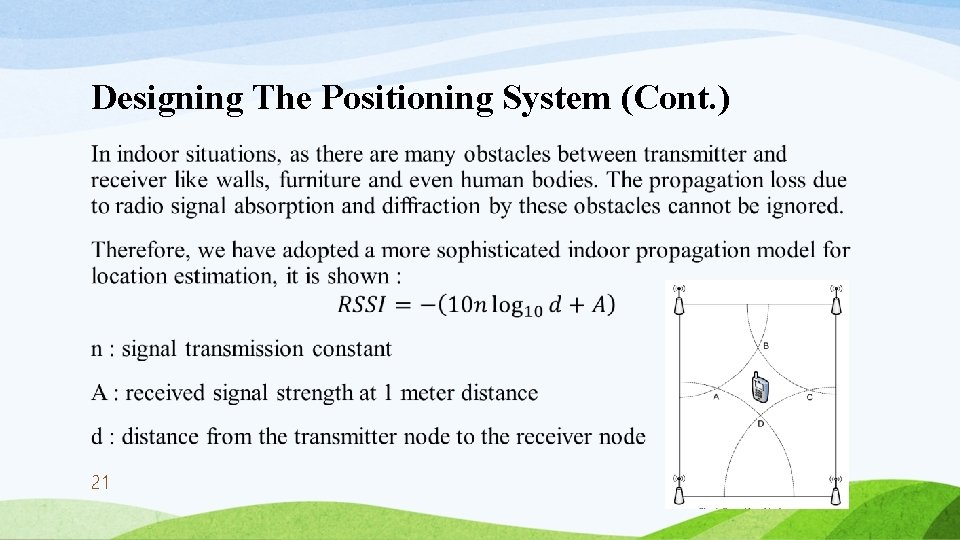
Designing The Positioning System (Cont. ) • 21
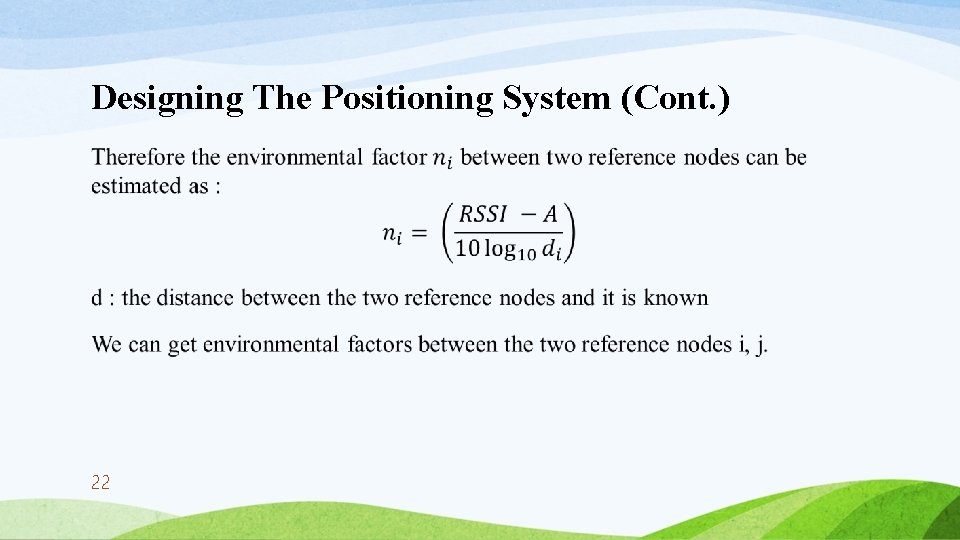
Designing The Positioning System (Cont. ) • 22
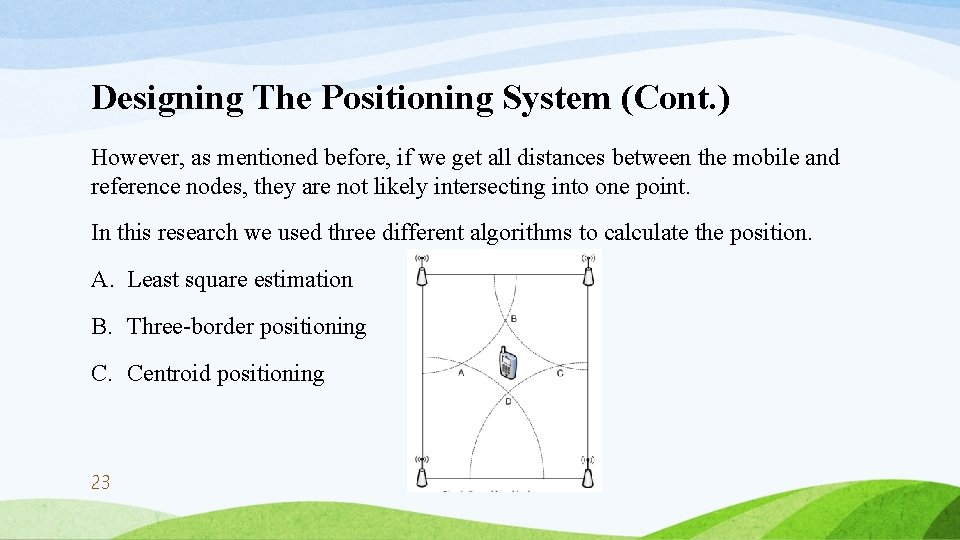
Designing The Positioning System (Cont. ) However, as mentioned before, if we get all distances between the mobile and reference nodes, they are not likely intersecting into one point. In this research we used three different algorithms to calculate the position. A. Least square estimation B. Three-border positioning C. Centroid positioning 23
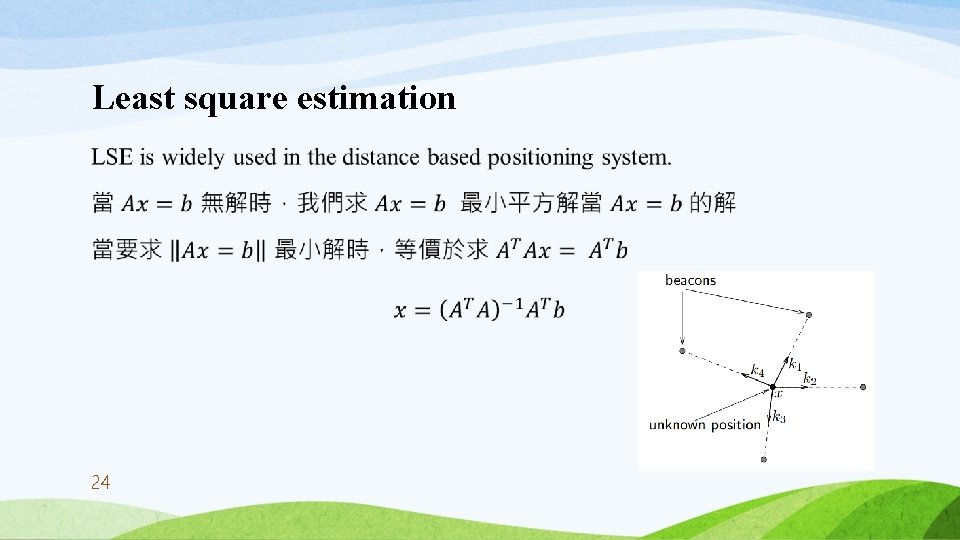
Least square estimation • 24
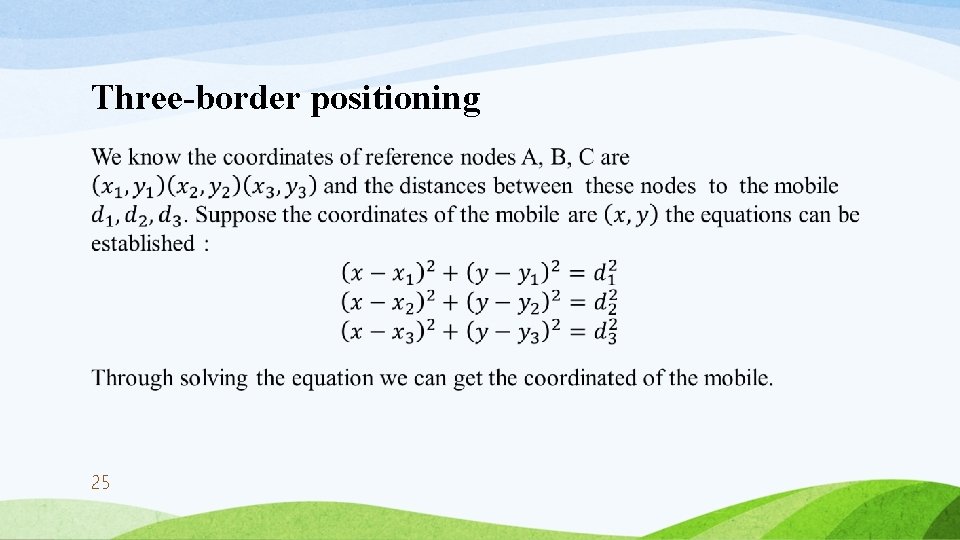
Three-border positioning • 25
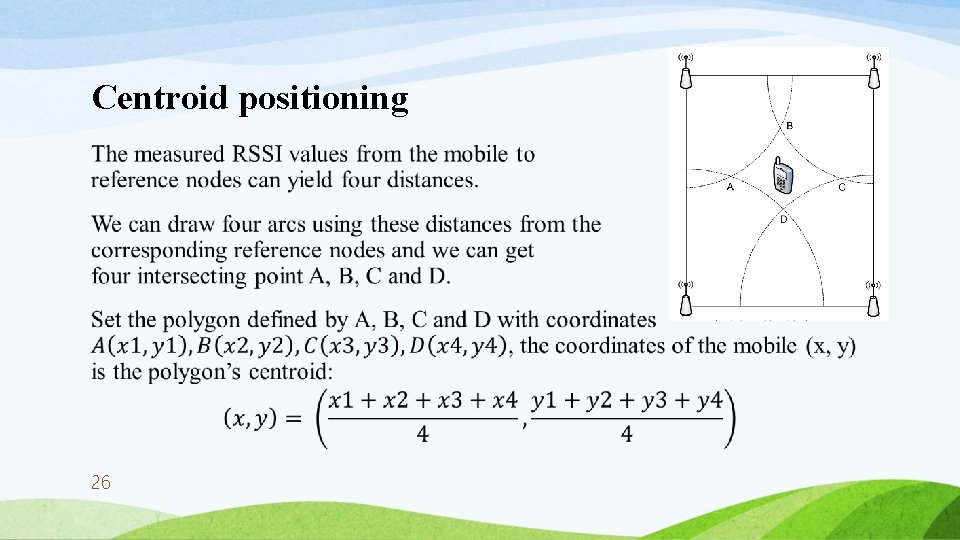
Centroid positioning • 26
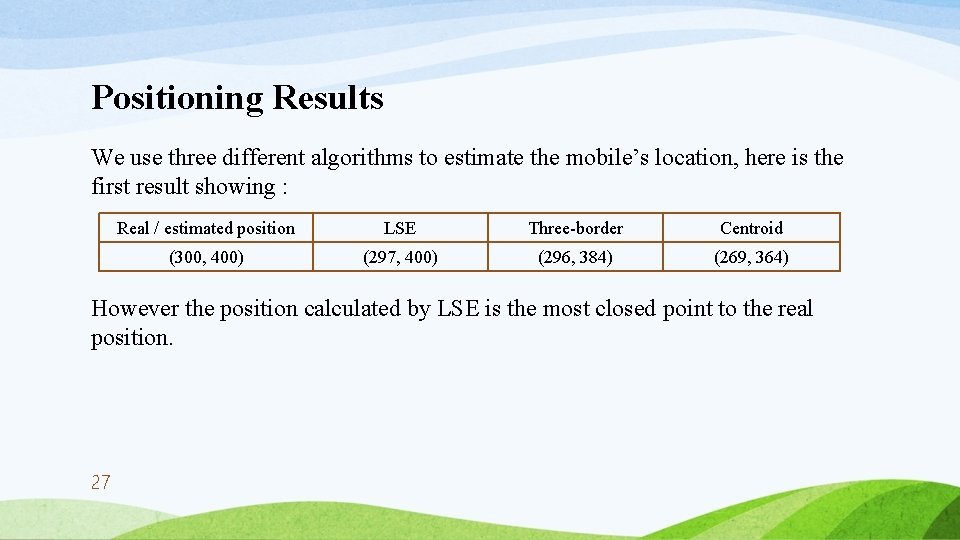
Positioning Results We use three different algorithms to estimate the mobile’s location, here is the first result showing : Real / estimated position LSE Three-border Centroid (300, 400) (297, 400) (296, 384) (269, 364) However the position calculated by LSE is the most closed point to the real position. 27
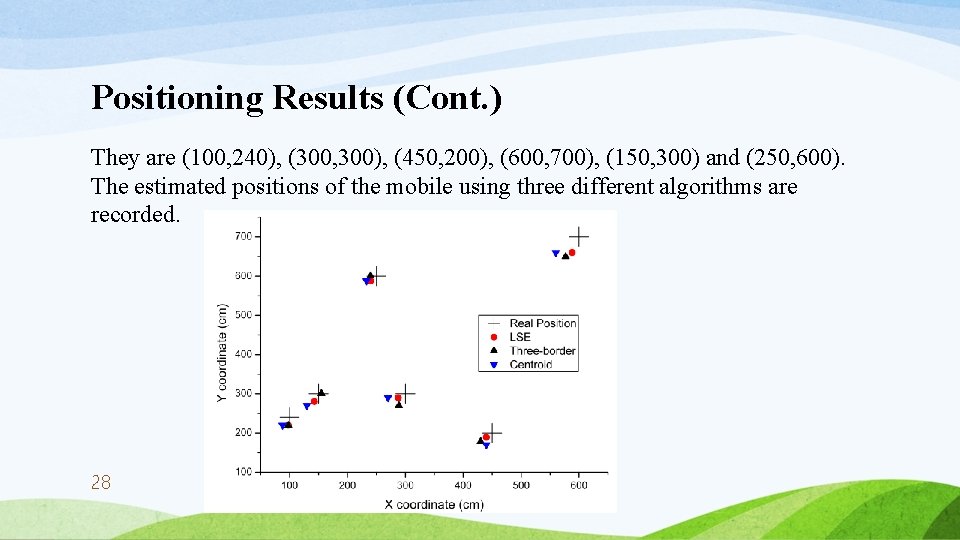
Positioning Results (Cont. ) They are (100, 240), (300, 300), (450, 200), (600, 700), (150, 300) and (250, 600). The estimated positions of the mobile using three different algorithms are recorded. 28
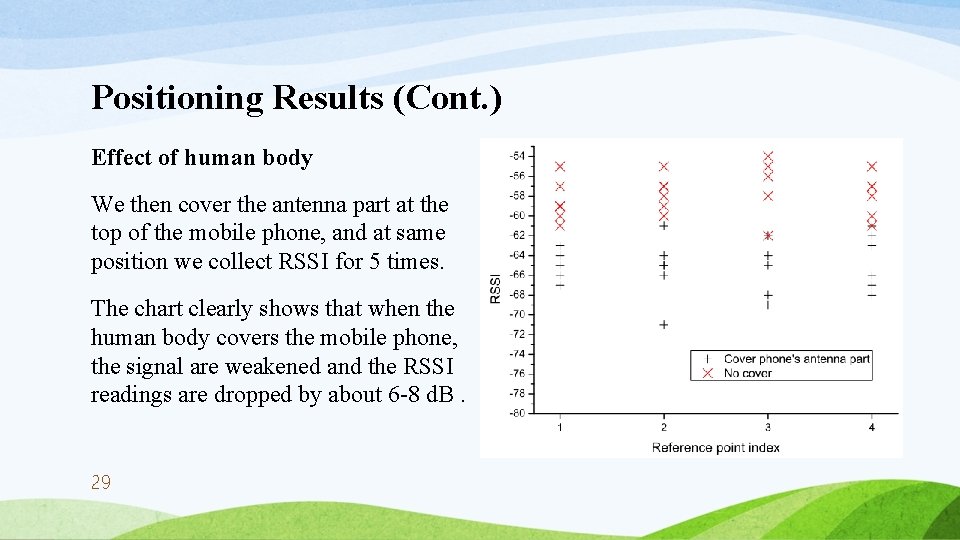
Positioning Results (Cont. ) Effect of human body We then cover the antenna part at the top of the mobile phone, and at same position we collect RSSI for 5 times. The chart clearly shows that when the human body covers the mobile phone, the signal are weakened and the RSSI readings are dropped by about 6 -8 d. B. 29
Conclusion In this work, we analysed different indoor wireless positioning methods, especially the RSS based Bluetooth positioning. After finding a proper propagation model, a RSS and triangulation based positioning scheme was defined and three distance based triangulation algorithms were implemented. Result analyses show that the RSS based triangulation positioning yields very good results. More work has been planned to extend this research to more complicated scenarios and with more algorithms. 30
References • Yapeng Wang ; Xu Yang ; Yutian Zhao ; Yue Liu ; Laurie Cuthbert, “Bluetooth Positioning using RSSI and Triangulation Methods”, 2013 IEEE 10 th Consumer Communications and Networking Conference (CCNC) • Wikipedia, http: //zh. wikipedia. org/wiki/Bluetooth • Jonas Willaredt, “Wi. Fi and Cell-ID based positioning - Protocols, Standards and Solutions” 31

Thanks for listening 32
- Slides: 32