Translation and ideology Lecture 3 Lesson Definitions of


- Slides: 69
Translation and ideology Lecture 3
Lesson • Definitions of ideology • Translation as mediation or intervention • Triggering of explicit and implicit values • Domestication / Foreignization • Feminist translation studies • Postcolonial translation studies Translation and ideology 2
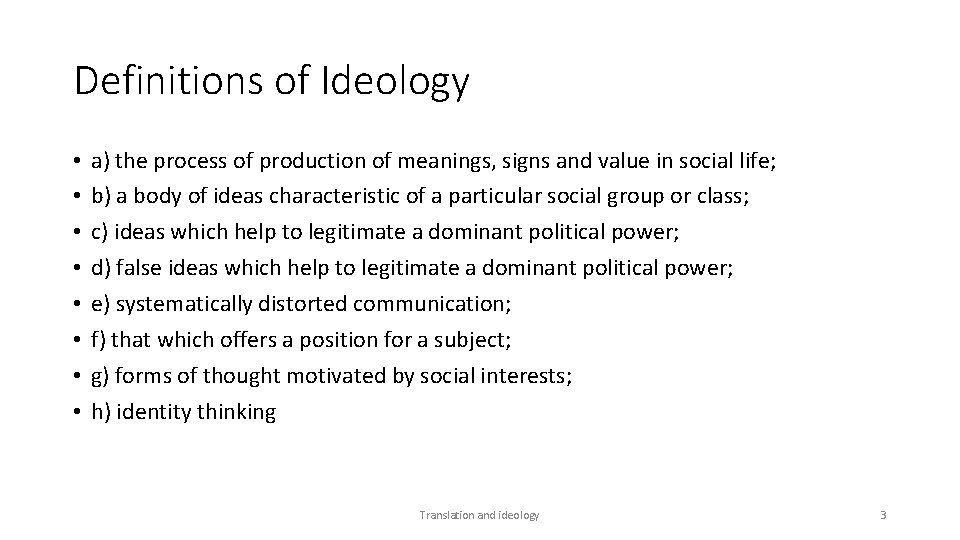
Definitions of Ideology • • a) the process of production of meanings, signs and value in social life; b) a body of ideas characteristic of a particular social group or class; c) ideas which help to legitimate a dominant political power; d) false ideas which help to legitimate a dominant political power; e) systematically distorted communication; f) that which offers a position for a subject; g) forms of thought motivated by social interests; h) identity thinking Translation and ideology 3
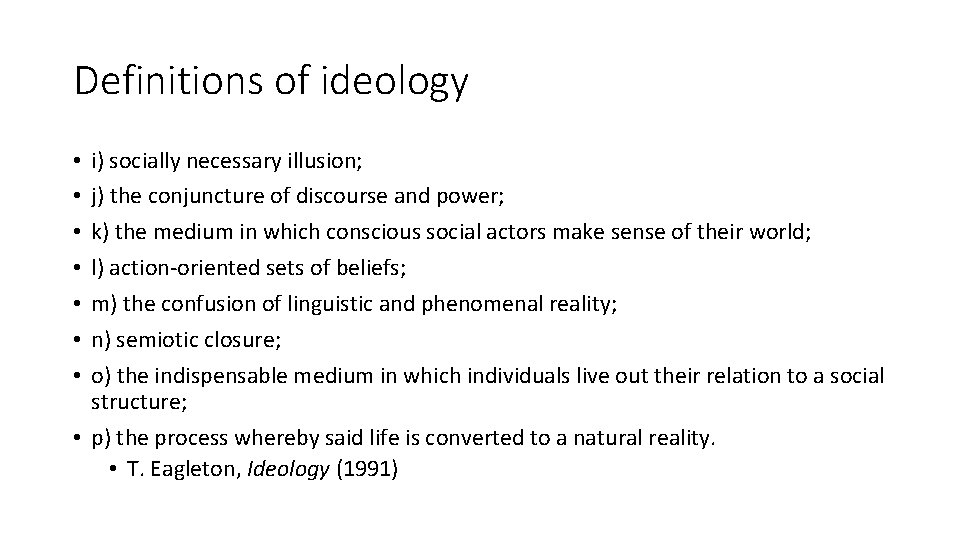
Definitions of ideology i) socially necessary illusion; j) the conjuncture of discourse and power; k) the medium in which conscious social actors make sense of their world; l) action-oriented sets of beliefs; m) the confusion of linguistic and phenomenal reality; n) semiotic closure; o) the indispensable medium in which individuals live out their relation to a social structure; • p) the process whereby said life is converted to a natural reality. • T. Eagleton, Ideology (1991) • •
Definition of ideology • Comte Destutt de Tracy (1796): ‘idéologie’ movement - new rationalist ‘science of ideas’ (Enlightenment) • Suppressed by Napoleon in 1803 Translation and ideology 5
Napoleon • It is to the doctrine of the ideologues — to this diffuse metaphysics, which in a contrived manner seeks to find the primary causes and on this foundation would erect the legislation of peoples, instead of adapting the laws to a knowledge of the human heart and of the lessons of history — to which one must attribute all the misfortunes which have befallen our beautiful France. • Napoleon Translation and ideology 6
Ideology (Marx) • Marx, in his preface to A contribution to the Critique of Political Economy: • ‘The distinction should always be made between the material transformation of the economic conditions of production. . . and the legal, political, religious, aesthetic or philosophic – in short, ideological – forms in which men become conscious of this conflict and fight it out’. Translation and ideology 7
Ideology (Engels) • ‘Ideology is a process accomplished by the so-called thinker consciously indeed but with a false consciousness. The real motives impelling him remain unknown to him, otherwise it would not be an ideological process at all. Hence he imagines false or apparent motives. Because it is a process of thought he derives both its form and its content from pure thought, either his own or his predecessors’. • Friedrich Engels, Letter to Mehring (1893) Translation and ideology 8
Zizek • ‘The most elementary definition of ideology is probably the well-known phrase from Marx’s Capital: ‘Sie wissen das nicht, aber sie tun es —‘they do not know it, but they are doing it’. The very concept of ideology implies a kind of basic, constitutive naïveté: the misrecognition of its own presuppositions, of its own effective conditions, a distance, a divergence between so-called social reality and our distorted representation, our false consciousness of it’. • Slavoj Žižek, "Cynicism as a Form of Ideology" [from The Sublime Object of Ideology (London; New York: Verso, 1989), pp. 28 -30. ] Translation and ideology 9
Ideologies and truth • ‘Few of “us” (in the West or elsewhere) describe our own belief systems or convictions as “ideologies”. On the contrary, Ours is the Truth, Theirs is the Ideology”’. • Teun Van Dijk, Ideology: a multidisciplinary approach (1998), 2. Translation and ideology 10
Ideology of translations • ‘The ideology of a translation resides not simply in the text translated, but in the voicing and stance of the translator, and in its relevance to the receiving audience. These latter features are affected by the place of enunciation of the translator: indeed they are part of what we mean by the “place” of enunciation, for that “place” is an ideological positioning as well as a geographical or temporal one’ • Maria Tymoczko, ‘Ideology and the position of the translator’, in Maria Calzada Perez, ed. , Apropos of ideology (2003) Translation and ideology 11
Ideology and language • ‘The link between language and ideology is central. Critical linguistics considers that language ‘reproduces’ ideology and the asymmetrical power relations that exist between writer and reader’. • Jeremy Munday, ‘Translation and ideology’, The Translator (2007) Translation and ideology 12
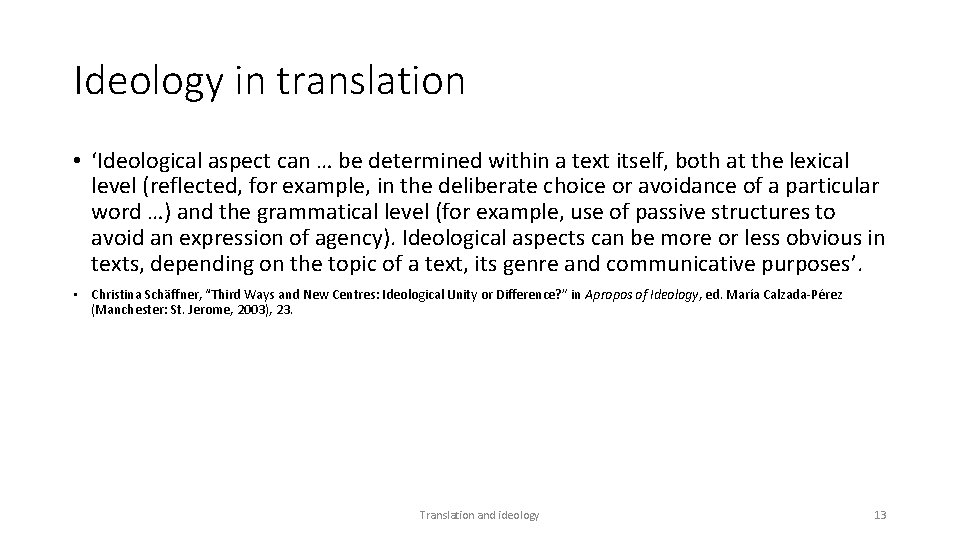
Ideology in translation • ‘Ideological aspect can … be determined within a text itself, both at the lexical level (reflected, for example, in the deliberate choice or avoidance of a particular word …) and the grammatical level (for example, use of passive structures to avoid an expression of agency). Ideological aspects can be more or less obvious in texts, depending on the topic of a text, its genre and communicative purposes’. • Christina Schäffner, “Third Ways and New Centres: Ideological Unity or Difference? ” in Apropos of Ideology, ed. María Calzada-Pérez (Manchester: St. Jerome, 2003), 23. Translation and ideology 13
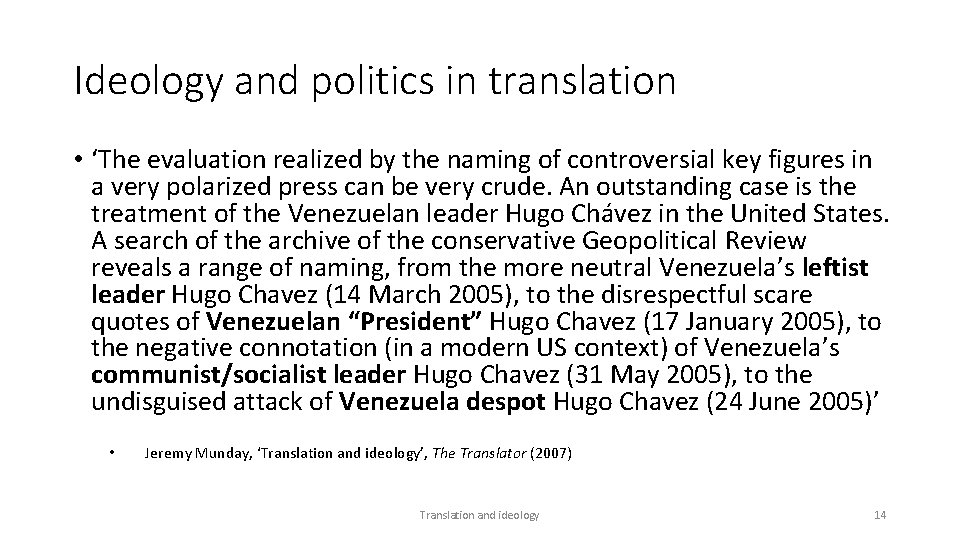
Ideology and politics in translation • ‘The evaluation realized by the naming of controversial key figures in a very polarized press can be very crude. An outstanding case is the treatment of the Venezuelan leader Hugo Chávez in the United States. A search of the archive of the conservative Geopolitical Review reveals a range of naming, from the more neutral Venezuela’s leftist leader Hugo Chavez (14 March 2005), to the disrespectful scare quotes of Venezuelan “President” Hugo Chavez (17 January 2005), to the negative connotation (in a modern US context) of Venezuela’s communist/socialist leader Hugo Chavez (31 May 2005), to the undisguised attack of Venezuela despot Hugo Chavez (24 June 2005)’ • Jeremy Munday, ‘Translation and ideology’, The Translator (2007) Translation and ideology 14
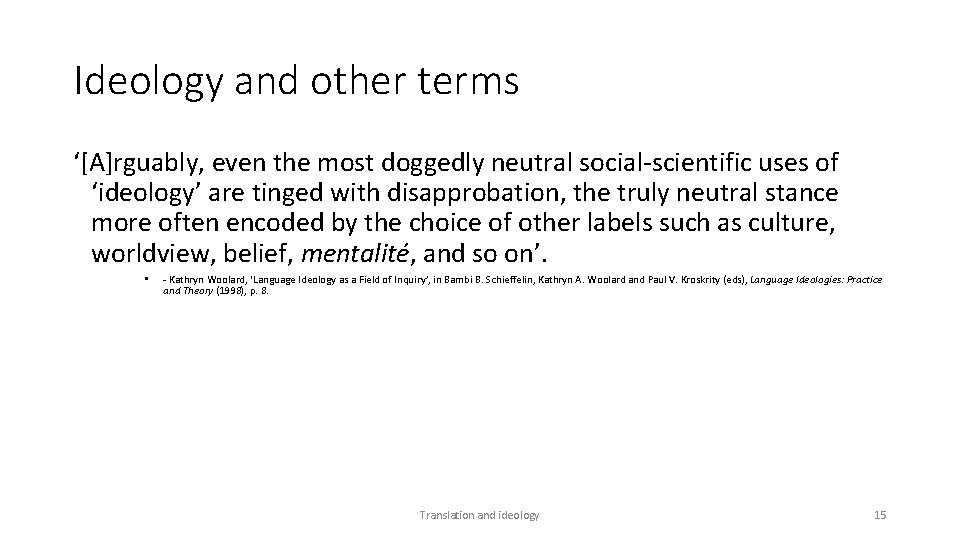
Ideology and other terms ‘[A]rguably, even the most doggedly neutral social-scientific uses of ‘ideology’ are tinged with disapprobation, the truly neutral stance more often encoded by the choice of other labels such as culture, worldview, belief, mentalité, and so on’. • - Kathryn Woolard, ‘Language Ideology as a Field of Inquiry’, in Bambi B. Schieffelin, Kathryn A. Woolard and Paul V. Kroskrity (eds), Language Ideologies: Practice and Theory (1998), p. 8. Translation and ideology 15
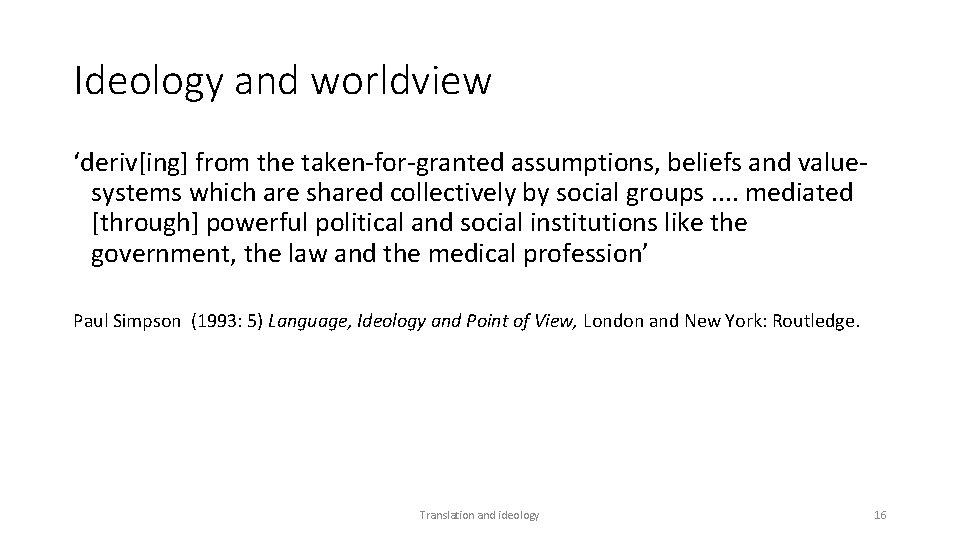
Ideology and worldview ‘deriv[ing] from the taken-for-granted assumptions, beliefs and valuesystems which are shared collectively by social groups. . mediated [through] powerful political and social institutions like the government, the law and the medical profession’ Paul Simpson (1993: 5) Language, Ideology and Point of View, London and New York: Routledge. Translation and ideology 16
Ideology (Lefevere) • ‘the conceptual grid that consists of opinions and attitudes deemed acceptable in a certain society at a certain time and through which readers and translators approach text’. • Andre Lefevere, Constructing cultures (1998), p. 48. Translation and ideology 17
Ideology v. culture • ‘Is all human activity ideologically motivated? When is something ‘ideology’ rather than just ‘culture’, and what is the difference between the two? ’ • P. Fawcett and J. Munday, ‘Ideology’, Encyclopedia of Translation Studies Translation and ideology 18
Ideological position • ‘Since we are always required when translating to take a position relative to other cultures and languages, we must as well remain ever vigilant as to the nature of the position assumed’. - Penrod, Lynn K. (1993) ‘Translating Hélène Cixous: French Feminism(s) and Anglo. American Feminist Theory’, TTR 6(2): 39– 54. Translation and ideology 19
Translation and religious ideology • ‘The practice of translation was for a long time, and in some cases remains, deeply implicated in religious ideology’ (Munday) • William Tyndale, Etienne Dolet • Rushdie’s Satanic Verses (1988) Translation and ideology 20
William Tyndale, 1494 -1536 • English scholar whose translation of the Bible was the first to be published in England • Convicted of heresy and treason • He was strangled and burned at the stake, on orders of Henry VIII Translation and ideology 21
Etienne Dolet, 1509 -1546 • ‘First martyr of the Renaissance’ • Translated the New Testament • Condemned by theological faculty of the Sorbonne, tortured, and burned at the stake. Translation and ideology 22
Salman Rushdie, The Satanic Verses (1988) • • Hitoshi Igarashi, Rushdie's Japanese translator, was stabbed to death Ettore Capriolo, the Italian translator, seriously injured in another knife attack William Nygaard, the publisher in Norway, was shot and injured Aziz Nesin, the Turkish translator, was the target of a massacre in Turkey that left 37 dead in an arson attack on a hotel. Translation and ideology 23
Ideology (Baker) • ‘As well as (and perhaps even more so than) the textual practices of translation, ideology reveals itself in recontextualization, the use of paratextual devices such as prefaces and other material which frame the text’, and in the policy choices of those who control the publication process (Baker) Translation and ideology 24
Paratexts (Genette) • Peritexts • Titles, subtitles, pseudonyms, forewords, dedications, prefaces, epilogues, cover and blurb • Epitext • Marketing and promotional material, book reviews Translation and ideology 25
Ideological manipulation • ‘In the most obvious cases of ideological manipulation, there is a concerted policy: thus, in Germany from 1933 to 1945 there was a clear ideology behind the selection of texts, with a high number of Scandinavian and Flemish/Dutch texts translated because of the feeling of kinship the Nazis considered they shared with the German Volk’ (Munday) Translation and ideology 26
What is your own ideology? • What are your assumptions, beliefs, and value-systems? • Religion, socio-economic class, race, nationality, language, gender, sexuality Translation and ideology 27
Translation as a form of ‘mediation’ or ‘intervention’ “…the extent to which translators [or interpreters] intervene in the transfer process, feeding their own knowledge and beliefs into their processing of a text” Basil Hatim and Ian Mason (1997: 147) The Translator as Communicator , London and New York: Routledge Translation and ideology 28
In what ways is the translator ‘invisible’? • Where is the translator’s name? • Is there the translator’s name • Does he/she own the copyright? Translation and ideology 29
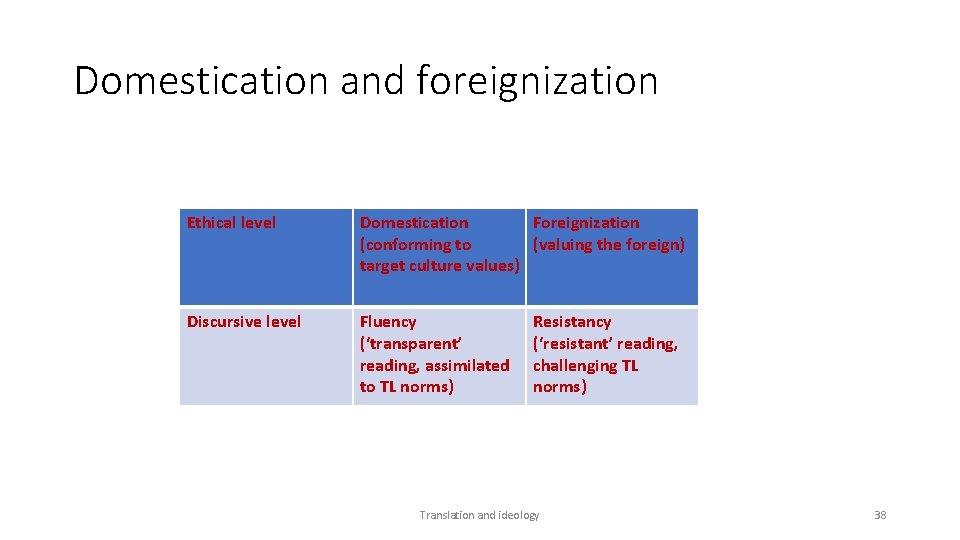
Domestication and foreignization • The terms ‘domestication’ and ‘foreignization’ indicate fundamentally ethical attitudes towards a foreign text and culture, ethical effects produced by the choice of a text for translation and by the strategy devised to translate it, whereas the terms like ‘fluency’ and ‘resistancy’ indicate fundamentally discursive features of translation strategies in relation to the reader’s cognitive processing’. • L. Venuti, 2008, p. 19 Translation and ideology 30
Venuti • ‘A translator can not only choose a foreign text that is marginal in the targetlanguage culture, but translate it with a canonical discourse (e. g. transparency). Or a translator can choose a foreign text that is canonical in the target-language culture, but translate it with a marginal discourse (e. g. archaism). In this foreignizing practice of translation, the value of a foreign text or a discursive strategy is contingent on the cultural situation in which the translation is made’. • L. Venuti, The Translator’s Invisibility, 310. Translation and ideology 31
Invisibility of translation • 1) invisibility of translator [e. g. , no traces of translator in fluent translations] • 2) invisibility of translator [e. g. , omission of translator’s name, etc] • 3) invisibility of translation in target cultures
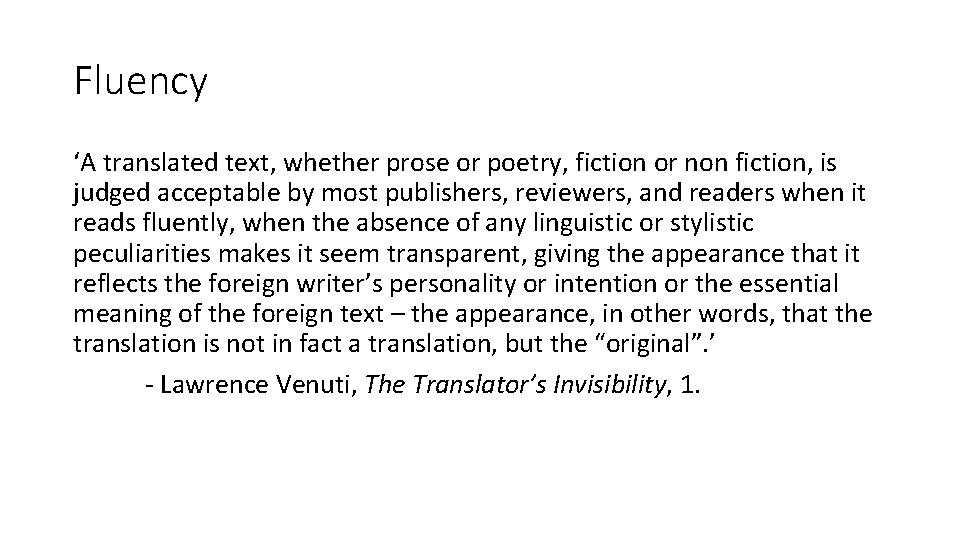
Fluency ‘A translated text, whether prose or poetry, fiction or non fiction, is judged acceptable by most publishers, reviewers, and readers when it reads fluently, when the absence of any linguistic or stylistic peculiarities makes it seem transparent, giving the appearance that it reflects the foreign writer’s personality or intention or the essential meaning of the foreign text – the appearance, in other words, that the translation is not in fact a translation, but the “original”. ’ - Lawrence Venuti, The Translator’s Invisibility, 1.
Fluency • ‘The more fluent the translation, the more invisible the translator, and, presumably, the more visible the writer or meaning of the foreign text’. • Venuti, 2.
Fluent translations • Reviewers of translations constantly note ‘fluency’, ‘naturalness’. • A ‘fluent’ translation is ‘modern’ (not ‘archaic); ‘widely used’; ‘standard’ (not colloquial); no foreign words; no switching between American and British idioms
The regime of fluent translating • ‘Under the regime of fluent translating, the translator works to make his or her work “invisible”, producing the illusory effect o transparency that simultaneously masks its status as an illusion: the translated tet seems ‘natural’, i. e. , not translated’. • Venuti, 5.
Translator’s invisibility • ‘The translator’s invisibility is thus a weird self-annihilation that undoubtedly reinforces its marginal status in Anglo-American culture’. • Venuti, 8.
Domestication and foreignization Ethical level Domestication Foreignization (conforming to (valuing the foreign) target culture values) Discursive level Fluency (‘transparent’ reading, assimilated to TL norms) Resistancy (‘resistant’ reading, challenging TL norms) Translation and ideology 38
Features of ‘foreignization’ • Close adherence to source text structure and syntax (with abundant calques) • Mixture of archaisms and colloquialisms • Use of different language varieties (e. g. , American and British English) Translation and ideology 39
(Re)naming • • Terrorist or freedom-fighter? Peking > Beijing Bombay > Mumbai Montreal or Montréal? Londonderry or Derry? Malvinas or Falklands? Ayer’s Rock or Uluru? Serbo-Croat > Serbian/Croatian Translation and ideology 40
北京 (Beijing / Peking) • A question of transliteration • Peking was the name used by Western missionaries starting four centuries ago • Beijing was the official pinyin name post-WW 2 • Very important for those who are not Chinese – but this difference is noticed by native Chinese speakers on a day to day basis Translation and ideology 41
Bombay v. Mumbai • ‘When did Bombay become Mumbai? • Officially, in 1995. That year, the right-wing Hindu nationalist party Shiv Sena won elections in the state of Maharashtra and presided over a coalition that took control of the state assembly. After the election, the party announced that the port city had been renamed after the Hindu goddess Mumbadevi, the city's patron deity. Federal agencies, local businesses, and newspapers were ordered to adopt the change’ • Christopher Beam, Slate Magazine Translation and ideology 42
Montreal or Montréal • ‘According to Section 63 of Quebec's French Language Charter, the name of a business must be in French. But it hasn't generally been applied to trademarked names’ • ‘Some companies have taken steps to change their name — like Kentucky Fried Chicken, which is known in Quebec as "Poulet Frit Kentucky. ” But others, like Walmart and Best Buy, have set up shop under the same name that appears elsewhere in the world’ (cbc. ca) Translation and ideology 43
Londonderry v. Derry • Derry (nationalists); Londonderry (unionists) • The Guardian: ‘use Derry and Co Derry’ • The Times: ‘Londonderry, but Derry City Council’ • BBC: ‘The BBC’s policy is to refer it as Londonderry the first time it is mentioned and Derry the second’ Translation and ideology 44
Malvinas or Falklands • ‘Argentina says it has a right to the islands, which it calls the Malvinas, because it inherited them from the Spanish crown in the early 1800 s. It has also based its claim on the islands' proximity to the South American mainland’ • ‘Britain rests its case on its long-term administration of the Falklands and on the principle of self-determination for the islanders, who are almost all of British descent’ • Bbc. co. uk Translation and ideology 45
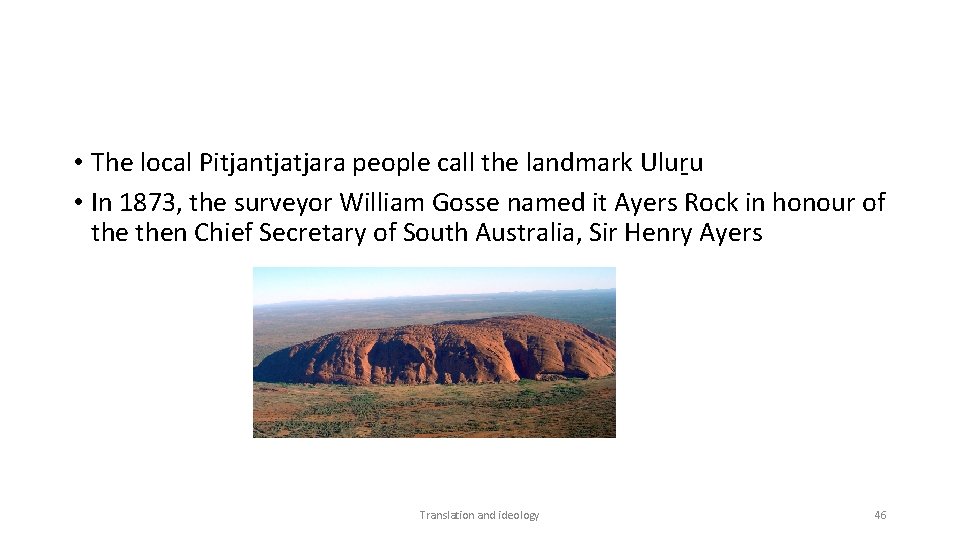
• The local Pitjantjatjara people call the landmark Uluṟu • In 1873, the surveyor William Gosse named it Ayers Rock in honour of then Chief Secretary of South Australia, Sir Henry Ayers Translation and ideology 46
Serbo-Croatian • Commonly referred to languages spoken in the former Yugoslavia • Now often distinguished: Serbian, Croatian, Bosnian, Montenegrin Translation and ideology 47
Explicit expression of value London is cosmopolitan, trendy and exciting, a truly wonderful place to visit. The city combines old-fashioned charm and cuttingedge fashion. Quiet courtesy and a great deal of fun. (Time. Out/HSBC Miniguide to London). Translation and ideology 48
Implicit expression of value All of these characteristics will be revealed as you wander from museum to gallery, down Victorian arcades and busy streets, across vast parks and along cobbled streets. The contrasts are endless: next to every historical sight, there’s a skyscraper gleaming with the wealth of modern life. Discovering these contrasts is one of the city’s great pleasures. (Time. Out/HSBC Miniguide to London) Translation and ideology 49
Translation depends on languages sharing similar cultural values… The concept of old • old Masters (grandi maestri) • antique art (arte antiquariato) • fine art (belle arti) • oude Kunst = old Masters, old art, ancient art, fine art Translation and ideology 50
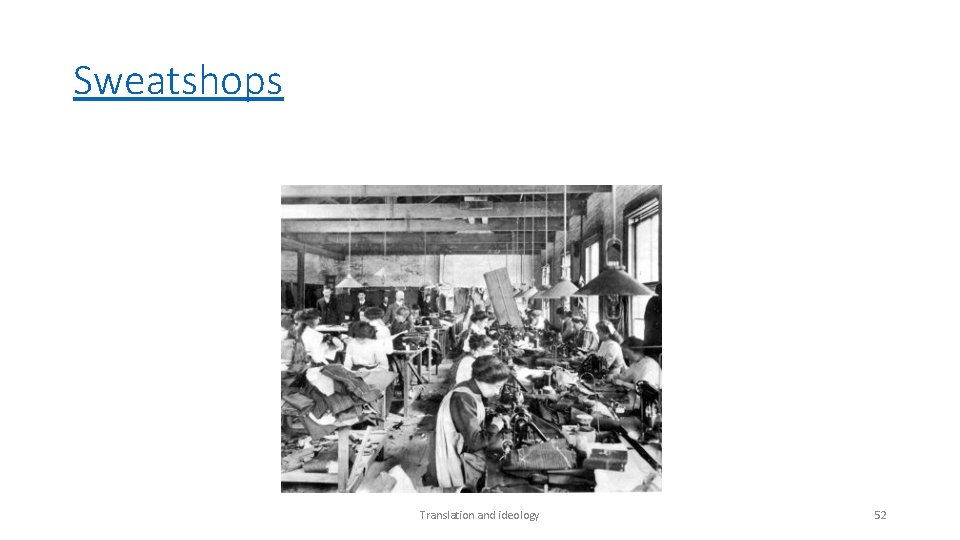
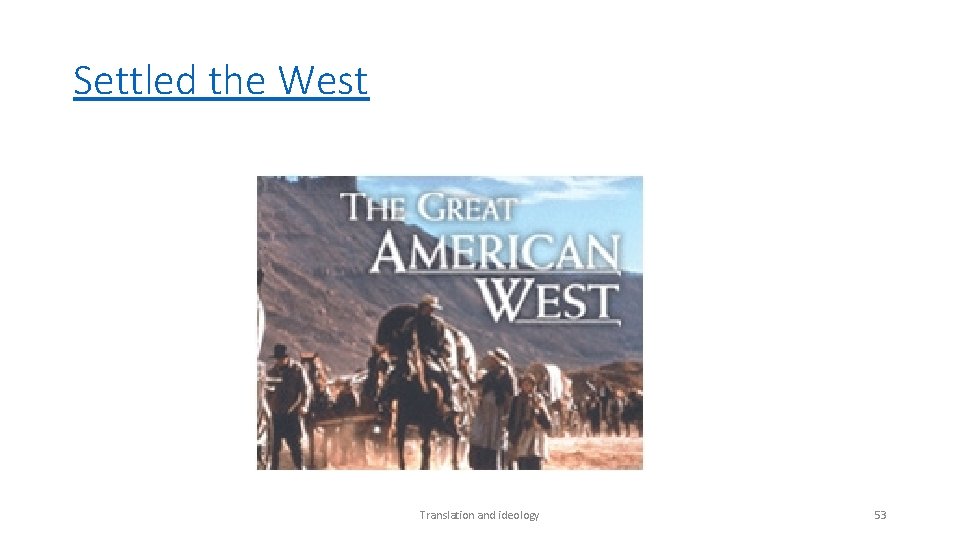
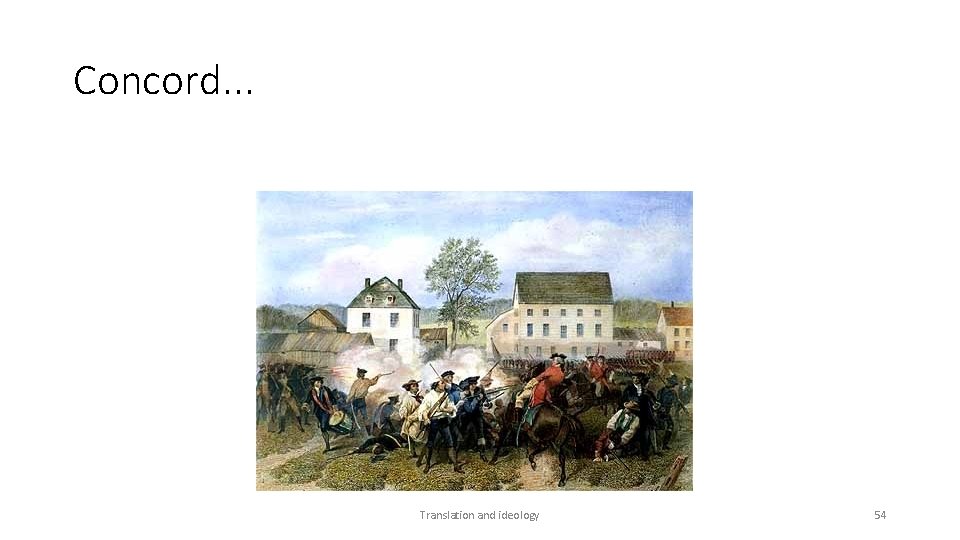
Problems of implicit value - in non-core vocabulary and metaphor For us, they toiled in sweatshops and settled the West, endured the lash of the whip and plowed the hard earth - in allusions For us, they fought and died. . . in places like Concord and Gettysburg, Normandy and Khe Sanh. Translation and ideology 51
Sweatshops Translation and ideology 52
Settled the West Translation and ideology 53
Concord. . . Translation and ideology 54
Truth status of translation ‘The essence of translation’s ideological intervention is that the selections made during the translation process (not only by the translator but by all those involved, including those who decide the choice of texts to translate) are potentially determined by ideologically-based strategies governed by those who wield power. These can be uncovered by analysing the various target text selections that impact on the target text reader who, nevertheless, generally and crucially reads the text as though it were a transparent, unmediated rendering of the original, more or less unaware (or at least willingly suspending the knowledge) that it is a translated text. The perceived truth status of the words of the TT may only be uncovered if ST and TT and their paratextual framings are compared side by side, even if the motivation for any shifts may remain open to conjecture. ’ Fawcett & Munday, ‘Ideology’ Translation and ideology 55
Anne Frank • ‘There is no greater enmity in the world than that between the Germans and Jews’ • ‘There is no greater enmity in the world than that between these Germans and the Jews’ • ‘A book you want to sell well in Germany should not contain insults directed at Germans’ (German translator) Translation and ideology 56
Aristophanes: Lysistrata: ‘Take him by the []’ • membrum virale • leg • nose • handle • prick • life-lines • penis Translation and ideology 57
Influence at different levels • Censorship (and self-censorship) • Word choice (Aristophanes’ Lysistrata – ‘take him by the. . ) • Editing (Anne Frank – ‘these Germans’) • Status of translation (Venuti’s invisibility and domestication) • Acceptability of translation (Venuti - translation flows) Translation and ideology 58
Feminist translation studies “For feminist translation, fidelity is to be directed toward neither the author nor the reader, but toward the writing project – a project in which both writer and translator participate. ” Sherry Simon (1996: 1) Translation and Gender, London and New York: Routledge. Translation and ideology 59
Feminist translation studies • ‘Revisionist studies of the Bible have shown that translations have traditionally hardened Christian attitudes against women, interpreting these ancient texts ‘creatively’ in order to define women as the root of evil (Korsak 1994/1995, 2005) or as untrustworthy and incapable (Stanton 1898/1985), and casting the human male in the image of a male God’ • Luise Von Flotow, ‘Gender and sexuality’, Encyclopedia of Translation Studies Translation and ideology 60
Feminist translation studies • ‘The case of Simone de Beauvoir in English translation provides many examples of intellectual and literary censorship (Simons 1983; von Flotow 2000 a) that has truncated and misrepresented her thought, making her work appear confused, conventionally patriarchal, unpalatable, and hardly relevant to late twentieth century readers. English translations of Beauvoir also provide excellent examples of censored sexuality in translation: 1950 s male translators working in the US simply excised her daunting descriptions of awkward contraceptive contraptions and erotic love scenes’ • Luise Von Flotow, ‘Gender and sexuality’, Encyclopedia of Translation Studies Translation and ideology 61
Feminist translation studies • ‘Translations can be shown to be sensitive to such manifestations of gender, exaggerate them or ignore and obscure them. Often, the translation effects discerned through such analyses provide clues about the cultural and political literary climate of the translating culture, or can be understood as a facet of this climate’ • Luise Von Flotow, ‘Gender and sexuality’, Encyclopedia of Translation Studies Translation and ideology 62
Postcolonial translation studies • The hybridity of postcolonial writing and translation • Challenge concepts of western translation theory (text, author, unproblematic meaning) • Translation not a humanistic enterprise but is linked to colonial domination Translation and ideology 63
Postcolonial translation studies • ‘Translation from dominated cultures not only informs and empowers the colonizers but also serves to interpellate the colonized into colonial subjects (Niranjana 1992). As a form of representation, translation constructs a whole set of orientalist images of dominated cultures, images which come to function as ‘realities’ for both dominant and dominated peoples. This is accomplished through various means’: • The choice of translation materials • The orientalist paradigm of translation • Fluent, domesticating translations • Wang Hui, ‘Postcolonial approaches’, Encyclopedia of Translation Studies Translation and ideology 64
Postcolonial translation studies • Translations produced in this orientalist or philological tradition, identified by Tymoczko as ‘the norm for translating the native texts of minority and non. Western cultures’ (1999 a: 269), have the potential of ‘constructing a posture of esthetic … and … cultural imperialism’ because through them ‘the literature of other cultures is reduced to non-literature and segments of world literature come to be represented by non-literature’, leading to ‘the sort of judgment about non. Western cultures. • Wang Hui, ‘Postcolonial approaches’, Encyclopedia of Translation Studies Translation and ideology 65
Postcolonial translation studies • Translations produced in this orientalist or philological tradition, identified by Tymoczko as ‘the norm for translating the native texts of minority and non-Western cultures’ (1999 a: 269), have the potential of ‘constructing a posture of esthetic … and … cultural imperialism’ because through them ‘the literature of other cultures is reduced to non-literature and segments of world literature come to be represented by non-literature’, leading to ‘the sort of judgment about non-Western literatures epitomized in Macaulay’s infamous remarks that he had not found an Orientalist “who could deny that a single shelf of a good European library was worth the whole native culture of India and Arabia”. ’ • Wang Hui, ‘Postcolonial approaches’, Encyclopedia of Translation Studies Translation and ideology 66
‘Thick’ translation • ‘Thick’ translation: ‘seeks to locate a text (i. e. the translation) in a rich cultural and linguistic context in order to promote, in the target language culture, a fuller understanding and a deeper respect of the culture of the Other’ • Cheung, Martha (2004/2007) ‘On Thick Translation as a Mode of Cultural Representation’ Translation and ideology 67
Conclusion • ‘Ideological translation strategies can often only be inferred when one accounts for dominant translation norms prevalent at certain periods in history (Toury 1995). Social norms underlie correctness notions which have a certain regulatory function. Correctness notions are inextricably linked to specific values and ideas shared by groups and communities, which attests to their largely ideological function. One well-known example is a dominant translation style during 17 th and 18 th century France, when foreign-language material tended to be fit as closely as possible into the French literary system. ’ • Stefan Baumgarten, ‘Ideology and translation’, Handbook of Translation Studies Online Translation and ideology 68
Translation and equality • Translation ‘is not an innocent, transparent activity but is highly charged with significance at every stage; it rarely, if ever, involves a relationship of equality between texts, authors or systems’. • S. Bassnett and H. Trivedi, Postcolonial translation: theory and practice (1999) Translation and ideology 69