
Ideology and the Culture Industry Dr Anna Feigenbaum
Ideology and the Culture Industry Dr. Anna Feigenbaum COM 316 – Week 4
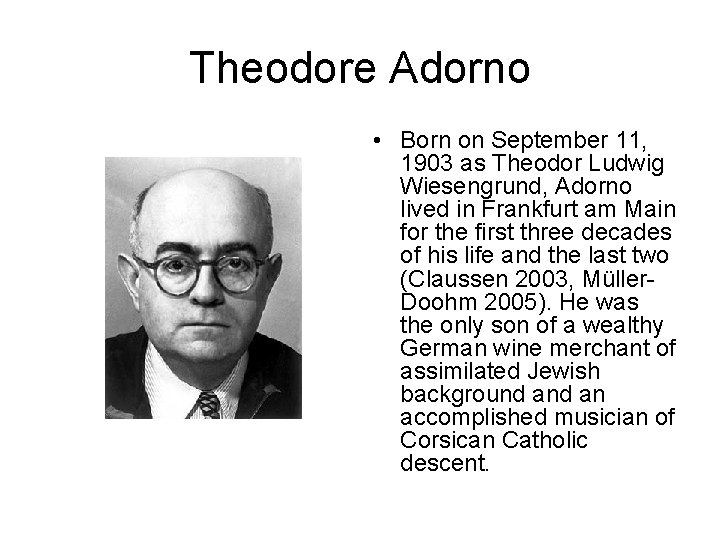
Theodore Adorno • Born on September 11, 1903 as Theodor Ludwig Wiesengrund, Adorno lived in Frankfurt am Main for the first three decades of his life and the last two (Claussen 2003, Müller. Doohm 2005). He was the only son of a wealthy German wine merchant of assimilated Jewish background an accomplished musician of Corsican Catholic descent.
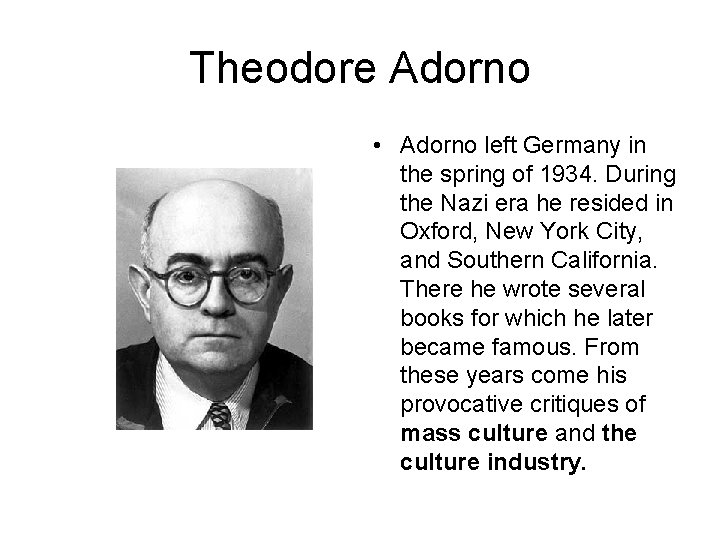
Theodore Adorno • Adorno left Germany in the spring of 1934. During the Nazi era he resided in Oxford, New York City, and Southern California. There he wrote several books for which he later became famous. From these years come his provocative critiques of mass culture and the culture industry.
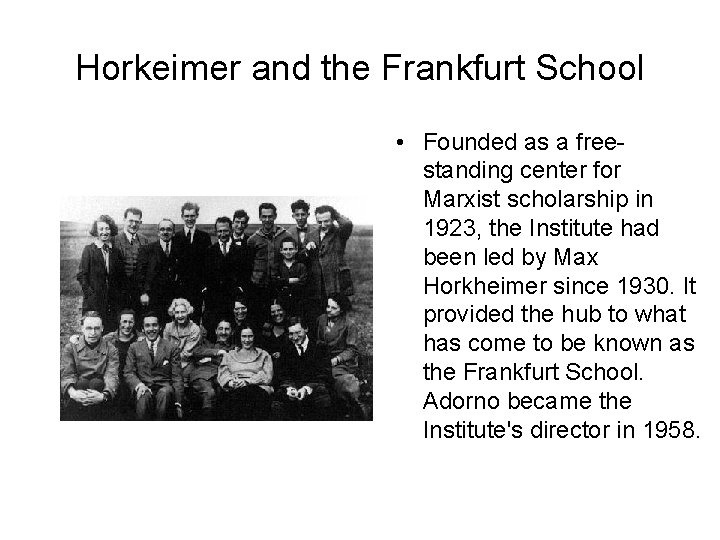
Horkeimer and the Frankfurt School • Founded as a freestanding center for Marxist scholarship in 1923, the Institute had been led by Max Horkheimer since 1930. It provided the hub to what has come to be known as the Frankfurt School. Adorno became the Institute's director in 1958.
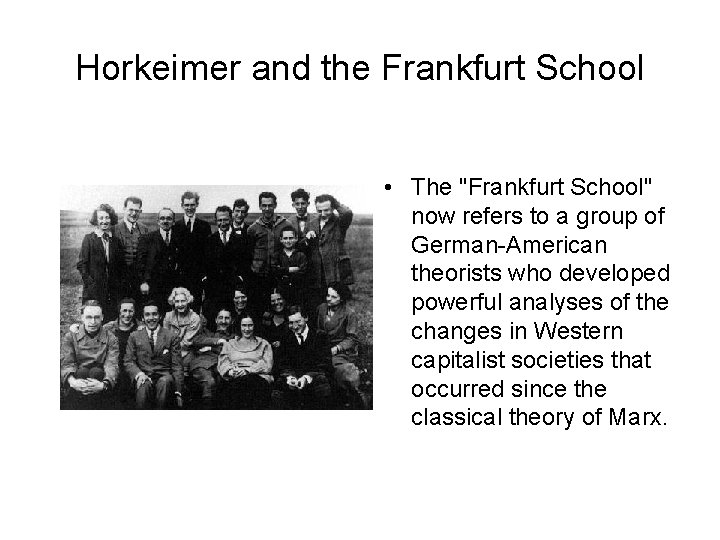
Horkeimer and the Frankfurt School • The "Frankfurt School" now refers to a group of German-American theorists who developed powerful analyses of the changes in Western capitalist societies that occurred since the classical theory of Marx.
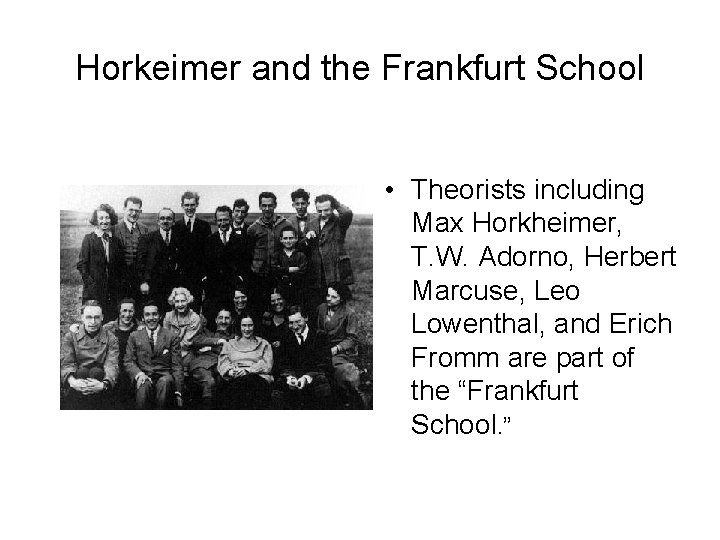
Horkeimer and the Frankfurt School • Theorists including Max Horkheimer, T. W. Adorno, Herbert Marcuse, Leo Lowenthal, and Erich Fromm are part of the “Frankfurt School. ”
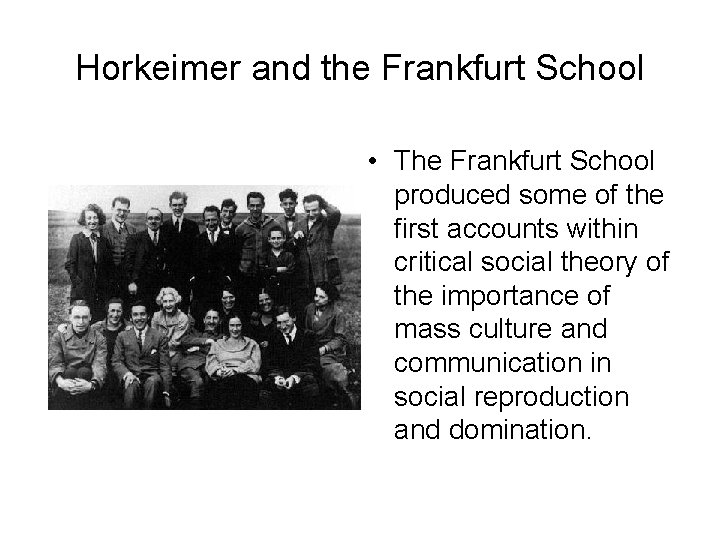
Horkeimer and the Frankfurt School • The Frankfurt School produced some of the first accounts within critical social theory of the importance of mass culture and communication in social reproduction and domination.
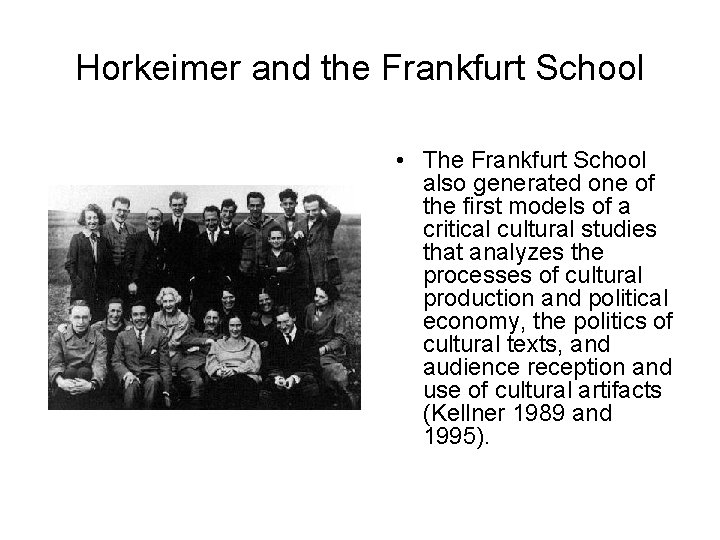
Horkeimer and the Frankfurt School • The Frankfurt School also generated one of the first models of a critical cultural studies that analyzes the processes of cultural production and political economy, the politics of cultural texts, and audience reception and use of cultural artifacts (Kellner 1989 and 1995).
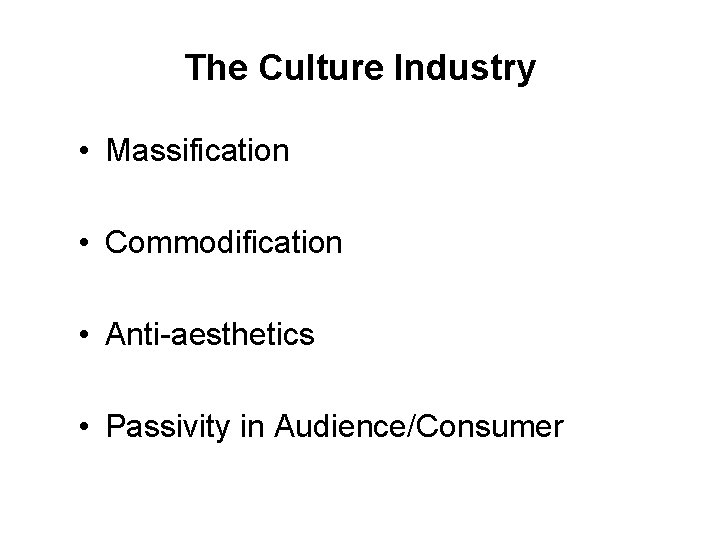
The Culture Industry • Massification • Commodification • Anti-aesthetics • Passivity in Audience/Consumer
- Slides: 9