The rise of Euroscepticism in Central and Eastern




- Slides: 18
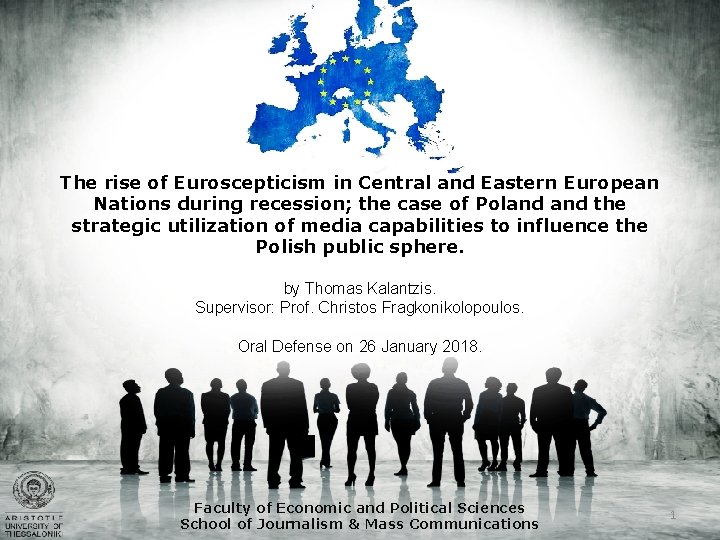
The rise of Euroscepticism in Central and Eastern European Nations during recession; the case of Poland the strategic utilization of media capabilities to influence the Polish public sphere. by Thomas Kalantzis. Supervisor: Prof. Christos Fragkonikolopoulos. Oral Defense on 26 January 2018. Faculty of Economic and Political Sciences School of Journalism & Mass Communications 1
Theme Analysis The rise of Euroscepticism in Central and Eastern European Nations during recession; the case of Poland the strategic utilization of media capabilities to influence the Polish public sphere. 2
Agenda • Literature Review • Scope of the Dissertation • European Unification European Enlargement European Integration • The rise of Euroscepticism • The case of Poland Euroscepticism in Poland The media utilization • Discussion 3
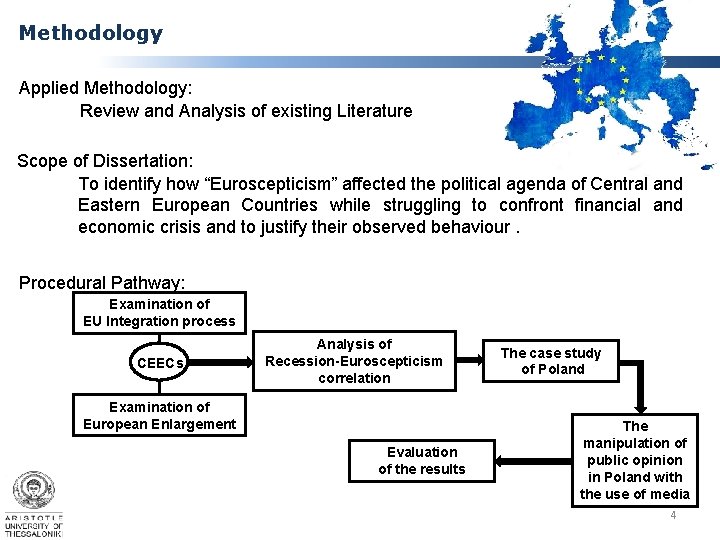
Methodology Applied Methodology: Review and Analysis of existing Literature Scope of Dissertation: To identify how “Euroscepticism” affected the political agenda of Central and Eastern European Countries while struggling to confront financial and economic crisis and to justify their observed behaviour. Procedural Pathway: Examination of EU Integration process CEECs Analysis of Recession-Euroscepticism correlation Examination of European Enlargement Evaluation of the results The case study of Poland The manipulation of public opinion in Poland with the use of media 4
The European Enlargement towards CEECs When: Why: Major Implications: Inter-Government Conference, Copenhagen, 1993 (12 Central-Eastern European Countries) Economics (reformation of global market) Regional and National Politics Supranational Politics Budget Issues Voting Issues “Big Step” factor 5
The European Integration of CEECs Why: Ensure stability of democratic political regimes Long-term economic planning Coordinate common Foreign Affairs policy and Defence issues How: Neo-functionalism Multi-level Governance New Institutionalism Liberal Intergovernmentalism Major Implications: All approaches should be merged as one Competing Identities (European-National) Democratic values are conceptualized differently per member state European citizens, currently, not feel being part of the “team” and being left behind 6
Rise of Euroscepticism in CEECs The “Great Recession” Global Economic Crisis (The Great Recession) Systemic Crisis characterized of complexity 10 8 6 4 2 0 -2 -4 -6 -8 Most affected Countries Worldwide (GDP progress %): World Central and Eastern European Countries Common Wealth and Independent Countries 2005 2006 2007 2008 2009 2010 8
Rise of Euroscepticism in CEECs The “Great Recession” Consequences: Financial deficit High financing needs Increase of debt Vulnerable negotiating position Change in total exports between Q 3 2008 and Q 3 2009 (%). Nation Total Exports Bulgaria -6. 7 Estonia -9. 6 Latvia -14. 7 Lithuania -16. 5 Czech Republic -7. 7 Hungary -6. 9 Poland -9. 0 Romania -3. 7 9
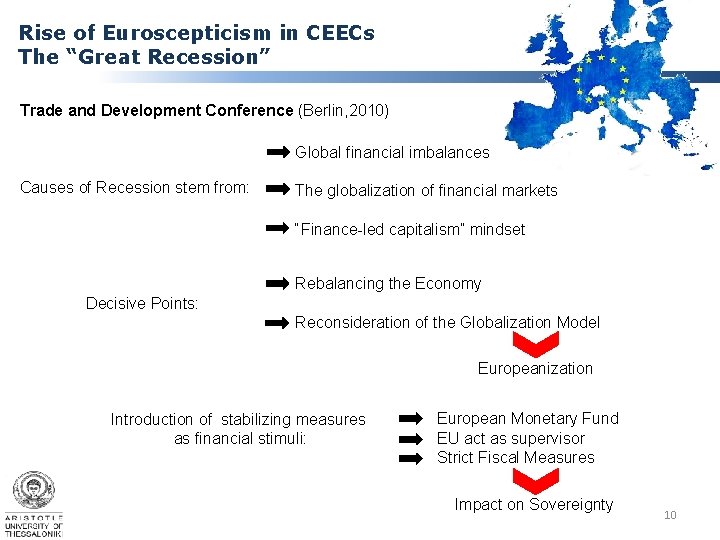
Rise of Euroscepticism in CEECs The “Great Recession” Trade and Development Conference (Berlin, 2010) Global financial imbalances Causes of Recession stem from: The globalization of financial markets “Finance-led capitalism” mindset Rebalancing the Economy Decisive Points: Reconsideration of the Globalization Model Europeanization Introduction of stabilizing measures as financial stimuli: European Monetary Fund EU act as supervisor Strict Fiscal Measures Impact on Sovereignty 10
Rise of Euroscepticism in CEECs Attitude towards the European concept(%) Sentiment of Negativity 50 Skeptic Attitude Euroscepticism 45 40 National Identity 35 Main Causes of 30 Euroscepticism: 25 The image of “Punitive Europe” Fairly Positive Lack of unified democratic standards Very Positive Don’t Know Falling short to their expectations Fairly Negative 20 Neutral 15 10 Types of Hard Euroscepticism: 5 0 Very Negative Nationalist Type Euro-critic Type Soft Populist Type 2003 2005 2007 2008 2010 2011 2013 2014 11
Rise of Euroscepticism in CEECs Euroscepticism has become a solid ideology. Positive View towards EU. 12
CEECs Political Field Overview The Collision of Euroscepticism and Europeanization in CEECs. Liberalism The three party-based dimensions of Euroscepticism: Traditionalism Left-Populism 13
Case Study: Poland Elections of October 2015: Civic Platform Polish People’s Party Pro EU Liberal-Democratic Why a unique case: Law and Justice (Pi. S) Euroscepticism Traditionalism Nationalism One of the most Europhile nations (Public Opinion) Managed to gain a leading role in Eastern European Economy One of the high ranking benefitted offor EU EU budget Neutralnations or Positive Opinion (%). Benefitsfrom EU high ranking nations) Benefits EU Budget. (most high ranking nations) Polish Government: Presents Sovereignty as “hot topic” Adopts soft Euroscepticism Polish PM Beata Szyzlo: Demanded, the flag of European Union, to be removed from the press conference podium. 14
Case Study: Poland Why Euroscepticism: Avoidance of completing integration requirements as promulgated while taking advantage of capital inflows (e. g. Agriculture and Rural Development, CAP) Due to the incompetence of EU elites to confront political challenges Gain leading role among CEECs and Eastern Europe Promote National Interests Intervention of Polish Catholic Church in political life Polish Foreign Affairs Strategy: Remain active member of Common Security and Defense Policy Flagship of Eastern Partnership (Ea. P) Degrade European Enlargement and Promote Ea. P and Visegràd Group Enter the Monetary Union (common currency) under conditions EU’s Energy and Climate Policy (largest coal producer). Dependent to Russia. 15
Case Study: Poland The Utilization of Mass media Susceptibility of audiences to media exposure Persuasion and manipulation of masses Biased form of Communication “Propaganda” Pi. S managed to transform the strong will of public opinion: Europeanization Repolonization “Repolonization starts from the media sector, in order to remove harmful foreign influence“ Jarosław Kaczyński (Pi. S ex-leader and current MP) How: By employing “selective media exposure” or “congeniality bias” Process attitudes, beliefs and perceptions “Cognitive Equilibrium” 16
Discussion: Future Implications Political crisis rooted in: Euroscepticism Unknown pathogenic deficiencies of EU The collision of European Integration process with National Identity EU researchers expect Euroscepticism, in CEECs , to grow during the next decade. Future issues identified: EU will have to clarify the level and the type of interrelations among its member nations Deter the hegemonic tendency of Brussels EU will be challenged to shape a new concept of Europe, differentiated of the one visualized during the early 1990 s. 18
Discussion: Recommendations Uniqueness of each member nation should be considered further. Introduction of “Nested Identity”. European identity should not delete the National one. Efforts on Democratization process should be intensified and common. 19
Questions Thank you for your attention. 20