
Language ideologies and education Todays agenda negotiable Ideologies
Language ideologies and education
Today’s agenda (negotiable) ✘ Ideologies in general ✘ Language ideologies and pedagogy 2
hello! I am Dr. Mara Barbosa, an assistant professor of Spanish at Texas A&M Corpus Christi. My research interests lie broadly in language attitudes and ideologies and critical pedagogy. I am especially interested in how language minority speakers both reinforce and resist ideologies serving dominant groups’ interests, and how pedagogical practices may act as liberating forces for minority groups. You can reach me at mara. barbosa@tamucc. edu 3
1. Ideologies in general 4
“ collection of shared and normative beliefs (generally not rooted in facts and science) spread in a community in which different groups are in a position of inequality. Ideologies are created to justify and maintain inequity and social injustice (Morris, 2009) 5
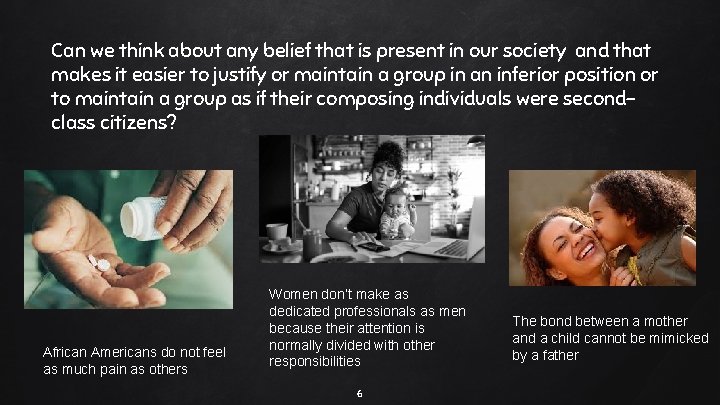
Can we think about any belief that is present in our society and that makes it easier to justify or maintain a group in an inferior position or to maintain a group as if their composing individuals were secondclass citizens? African Americans do not feel as much pain as others Women don’t make as dedicated professionals as men because their attention is normally divided with other responsibilities 6 The bond between a mother and a child cannot be mimicked by a father
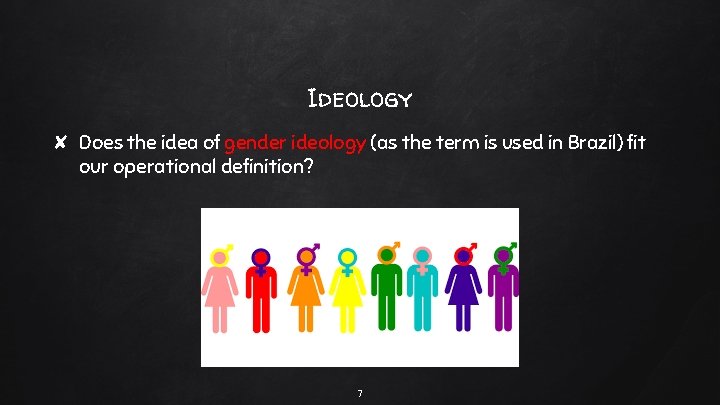
Ideology ✘ Does the idea of gender ideology (as the term is used in Brazil) fit our operational definition? 7
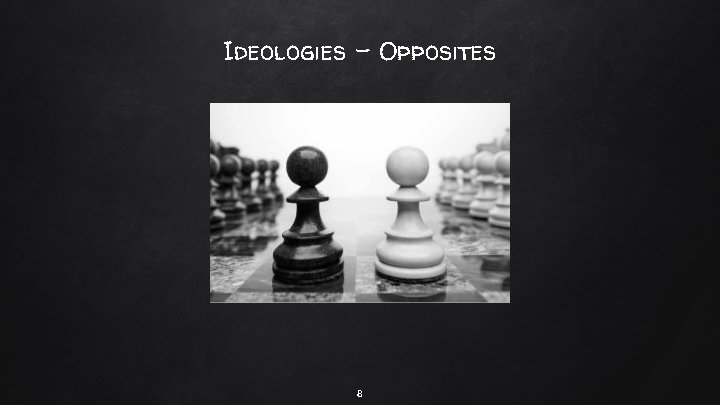
Ideologies – Opposites 8
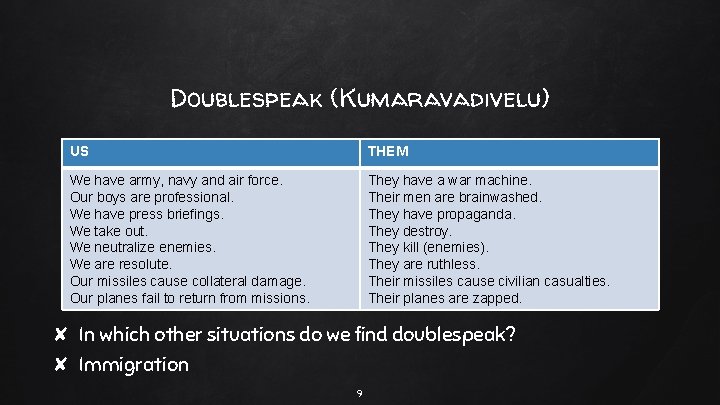
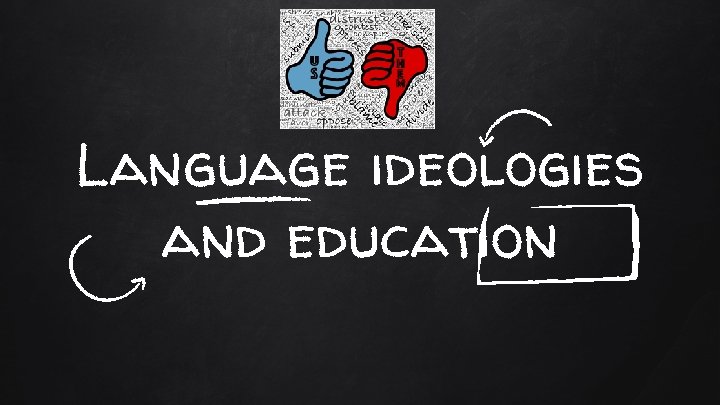
Doublespeak (Kumaravadivelu) US THEM We have army, navy and air force. Our boys are professional. We have press briefings. We take out. We neutralize enemies. We are resolute. Our missiles cause collateral damage. Our planes fail to return from missions. They have a war machine. Their men are brainwashed. They have propaganda. They destroy. They kill (enemies). They are ruthless. Their missiles cause civilian casualties. Their planes are zapped. ✘ In which other situations do we find doublespeak? ✘ Immigration 9
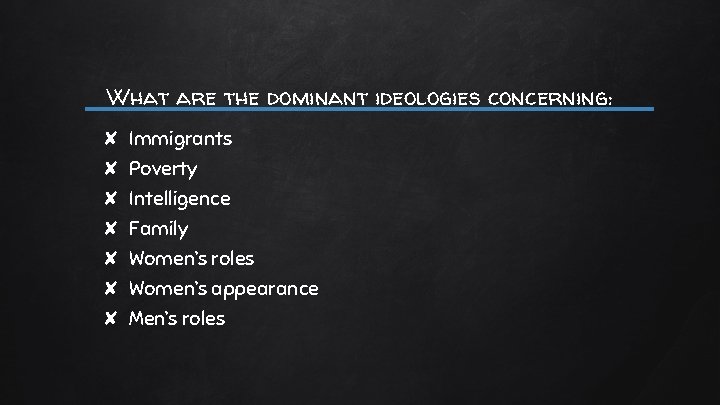
What are the dominant ideologies concerning: ✘ Immigrants ✘ ✘ ✘ Poverty Intelligence Family Women’s roles Women’s appearance Men’s roles
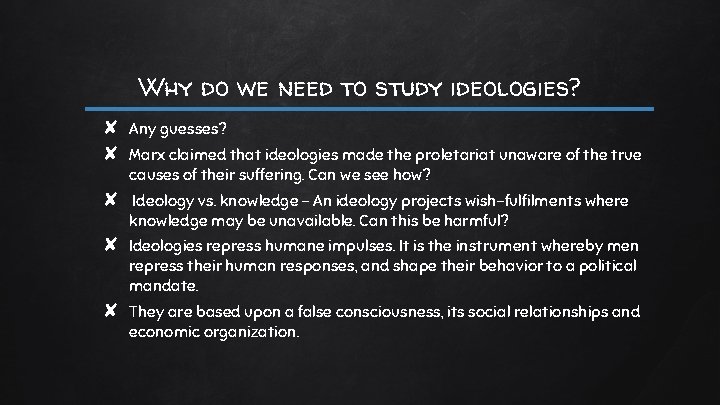
Why do we need to study ideologies? ✘ Any guesses? ✘ Marx claimed that ideologies made the proletariat unaware of the true causes of their suffering. Can we see how? ✘ Ideology vs. knowledge - An ideology projects wish-fulfilments where knowledge may be unavailable. Can this be harmful? ✘ Ideologies repress humane impulses. It is the instrument whereby men repress their human responses, and shape their behavior to a political mandate. ✘ They are based upon a false consciousness, its social relationships and economic organization.
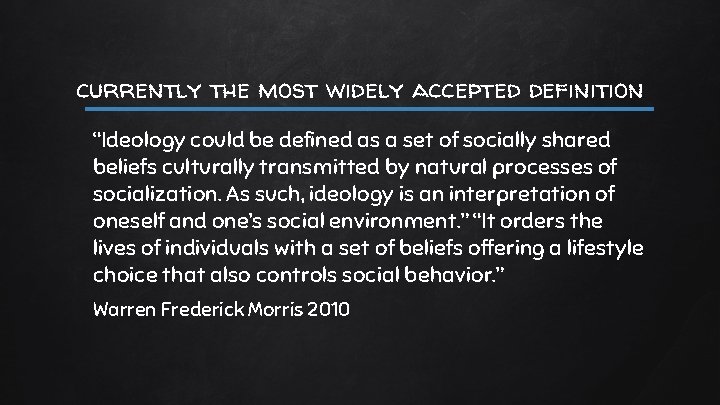
currently the most widely accepted definition “Ideology could be defined as a set of socially shared beliefs culturally transmitted by natural processes of socialization. As such, ideology is an interpretation of oneself and one’s social environment. ” “It orders the lives of individuals with a set of beliefs offering a lifestyle choice that also controls social behavior. ” Warren Frederick Morris 2010
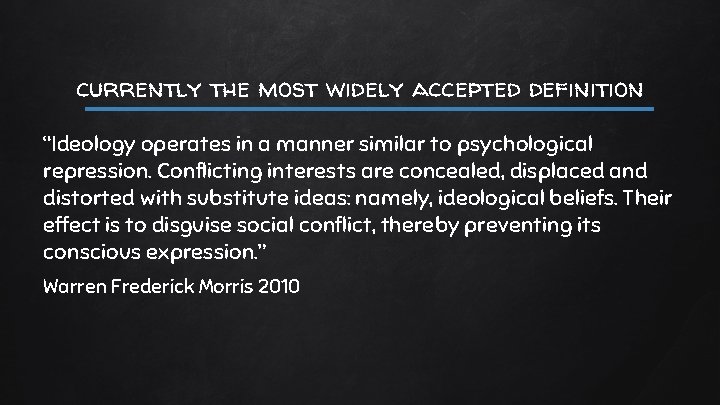
currently the most widely accepted definition “Ideology operates in a manner similar to psychological repression. Conflicting interests are concealed, displaced and distorted with substitute ideas: namely, ideological beliefs. Their effect is to disguise social conflict, thereby preventing its conscious expression. ” Warren Frederick Morris 2010
2. Language ideologies 14
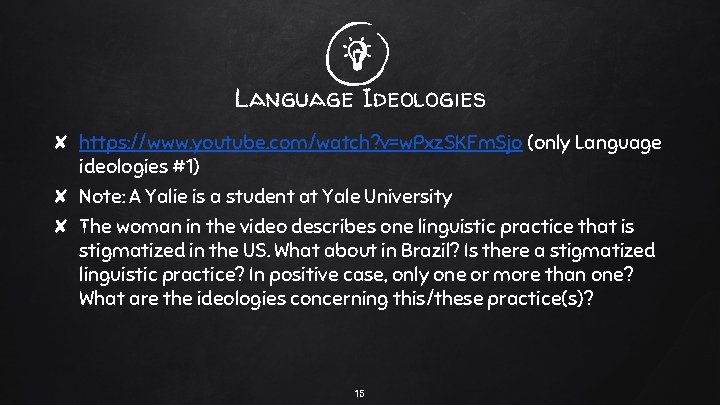
Language Ideologies ✘ https: //www. youtube. com/watch? v=w. Pxz. SKFm. Sjo (only Language ideologies #1) ✘ Note: A Yalie is a student at Yale University ✘ The woman in the video describes one linguistic practice that is stigmatized in the US. What about in Brazil? Is there a stigmatized linguistic practice? In positive case, only one or more than one? What are the ideologies concerning this/these practice(s)? 15
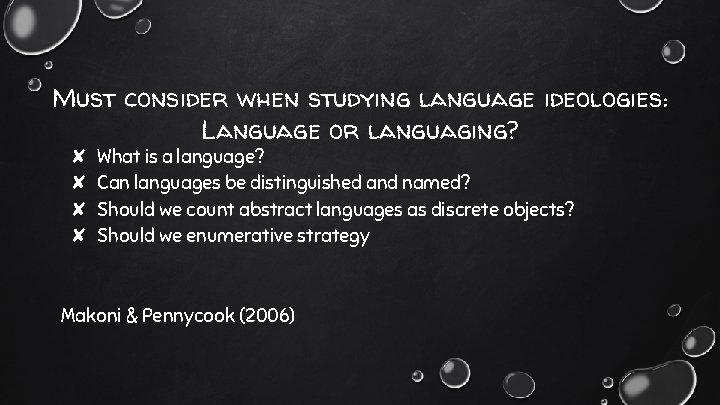
Must consider when studying language ideologies: Language or languaging? ✘ ✘ What is a language? Can languages be distinguished and named? Should we count abstract languages as discrete objects? Should we enumerative strategy Makoni & Pennycook (2006)
Language or languaging? ✘ A major aspect of the British colonial project in India was to turn Indian languages, culture and knowledge into objects of European knowledge to invent an India not in Britain’s image, but in Britain’s ideal of what India should look like ✘ In colonized societies, the colonizers projected “indigenous languages” onto putative (assumed) speakers. These “languages” were often experienced as mixtures of local and foreign discourses Makoni & Pennycook (2006)
Language or languaging? ✘ The construction of language in such cases might have inhibited rather than facilitated literacy. When the constructed languages were introduced into local communities, they had the effects of creating, and at times accentuating, social differences. Since the constructed languages could be acquired only through formal education, frequently coupled with Christianity, those who had acquired them tended to have a higher social status than those who were not exposed to them. Makoni & Pennycook (2006)
Language or languaging? ✘ Linguists create the objects of their analysis through the nature and type of metadiscursive regimes that deploy in the analysis. Makoni & Pennycook (2006)
Language ideologies ✘ Based on what we learned about ideologies and on your knowledge about language structure and use, how would you define language ideologies?
Language ideologies ✘ Language ideology studies: aim to understand how language may be understood differently in different contexts ✘ Language ideologies = regimes (rules) of language ✘ There are no grounds to postulate the existence of languages as separate entities Makoni & Pennycook (2006)
Language ideologies ✘ Unless we actively engage with the history of invention of languages, with the process by which these inventions are maintained, with the political imperative to work towards their disinvention and with the reformulation of basic concepts in linguistics and applied linguistics, we will continue to do damage to speech communities and deny those people education al opportunities. Makoni & Pennycook (2006)
Language ideologies ✘ What would language education look like if we no longer posited the artificial existence of separate languages?
Most Commonly-Studied Language Ideologies ✘ The standard language ideology ✘ ✘ ✘ The hierarchy of languages The one-nation-one-language ideology The mother tongue ideology The purist language ideology Others? 24
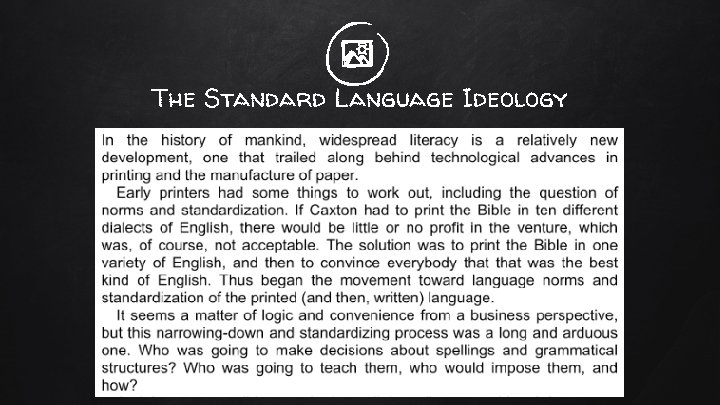
The Standard Language Ideology 25
The Standard Language Ideology ✘ Note: standard language is a form of language that is idealized. Non -linguists define it as the most widely accepted and understood among speakers of a language in a specific area. Sociolinguists, however, are still debating the parameters of such crucial terms as prestige, education, and standard (see Coupland 2000: 623 and Milroy 2004 a cited in Lippi-Green 2012). 26
3. Language Ideologies and Pedagogy 27

Sharing time (Romaine, 2001) Black student tells a story.
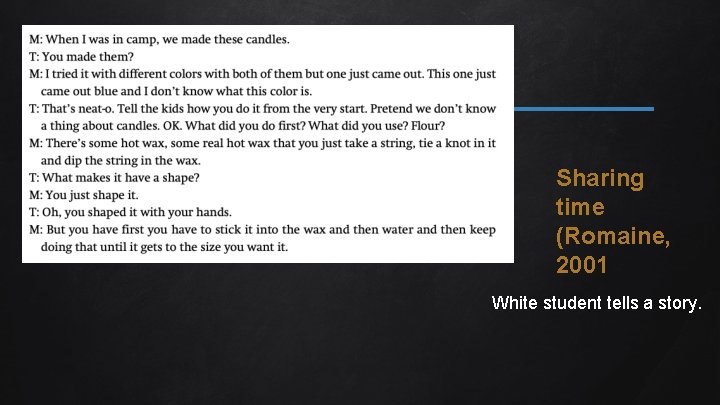
Sharing time (Romaine, 2001 White student tells a story.
What about if we allowed students to use whatever linguistic resources to build knowledge? 30
Language ideologies and translanguaging Language ideologies Translanguaging A collection of shared and normative beliefs about language (generally not rooted in facts and science) spread in a community in which its composing groups are in a position of inequality. Language ideologies are created to justify and maintain inequity and social injustice Translanguaging refers to an approach to the study of the observable practices of bilinguals (García, 2009). When bilinguals translanguage, they make use of the linguistic resources they have developed and that are appropriate for the specific communicative act they are performing. This natural linguistic practice of bilinguals is complex, dynamic and sensitive to context. ✘ https: //www. youtube. com/watch? v=i. NOtmn 2 UTz. I 31
Translanguaging Dynamic, complex and sensitive to context. 32
Translanguaging pedagogy A pedagogical approach whereby teachers build bridges from bilinguals’ language practices and the language practices desired in formal school settings. 33
Translanguaging classroom A classroom in which students may deploy their full linguistic repertoires, and not just the particular practices that are officially used for instructional purposes in that space. 34
Translanguaging at school When translanguaging is not allowed in schools, bilingual students or students whose linguistic practices are not standard are placed at a disadvantage because they are assessed on only a portion of their linguistic repertoires and are taught in ways that do not fully leverage their language resources. 35
Ways to allow students to translanguage + Present information using the target or standard + + + language Have students discuss using their own linguistic resources Have them answer some questions also using their own linguistic resources Have them write a more detailed piece in the target or standard language 36
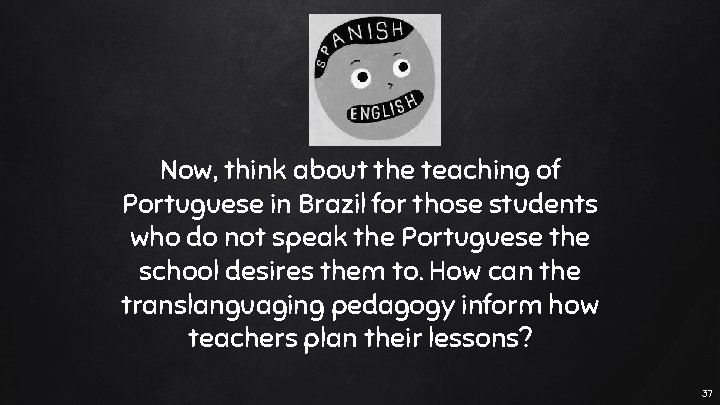
“ Now, think about the teaching of Portuguese in Brazil for those students who do not speak the Portuguese the school desires them to. How can the translanguaging pedagogy inform how teachers plan their lessons? 37
¿Questions and Comments? 38
39
40
41
42
mara. barbosa@tamucc. edu 43
- Slides: 43