Transition to College and Career Ready Assessment English











- Slides: 62
Transition to College and Career Ready Assessment English Language Arts Text-Dependent Analysis 1
Nebraska Department of Education • Valorie Foy- Director of Assessment valorie. foy@nebraska. gov • Erin Kunkle- Writing Director erin. kunkle@nebraska. gov 2
Table Introductions 3
Purpose of Today and Tomorrow • Provide information about the schedule for transition from Ne. SA-Reading to Ne. SAEnglish Language Arts • Familiarize educators with Text-Dependent Analysis (TDA) • Familiarize educators with the Text. Dependent Analysis (TDA) rubric through scoring sample responses • Address any questions on TDA 4
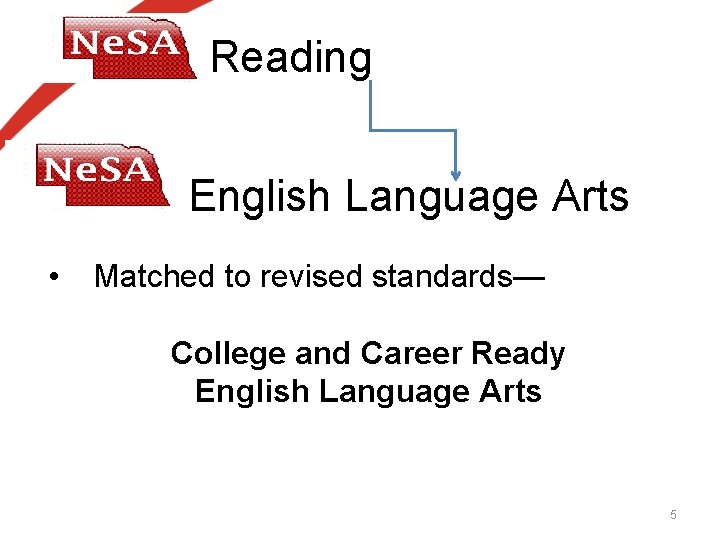
Reading English Language Arts • Matched to revised standards— College and Career Ready English Language Arts 5
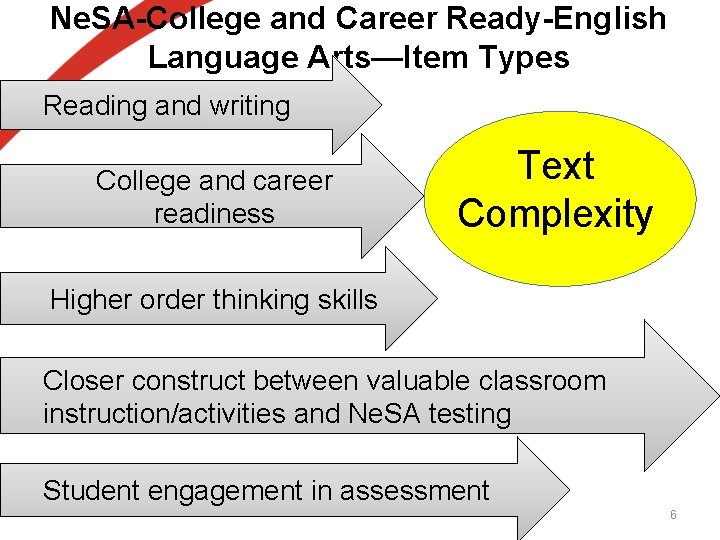
Ne. SA-College and Career Ready-English Language Arts—Item Types Reading and writing College and career readiness Text Complexity Higher order thinking skills Closer construct between valuable classroom instruction/activities and Ne. SA testing Student engagement in assessment 6
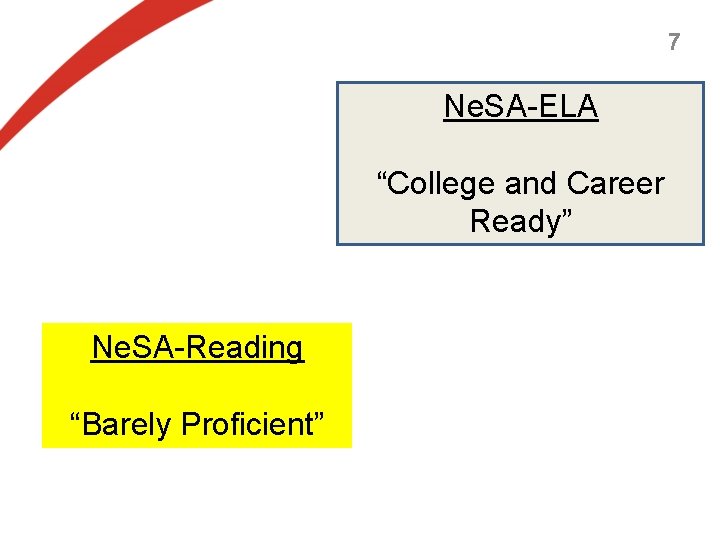
7 Ne. SA-ELA “College and Career Ready” Ne. SA-Reading “Barely Proficient”
Ne. SA-English Language Arts New Item Types 8
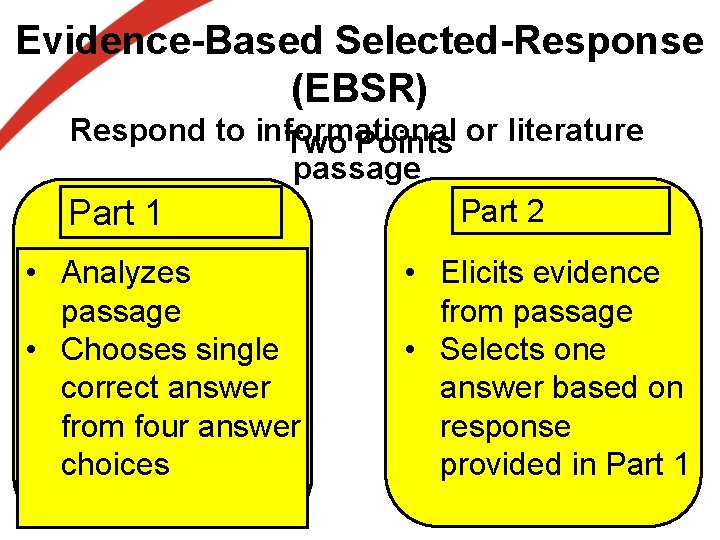
Evidence-Based Selected-Response (EBSR) Respond to informational or literature Two Points passage Part 2 Part 1 • Analyzes passage • Chooses single correct answer from four answer choices • Elicits evidence from passage • Selects one answer based on response provided in Part 1 9
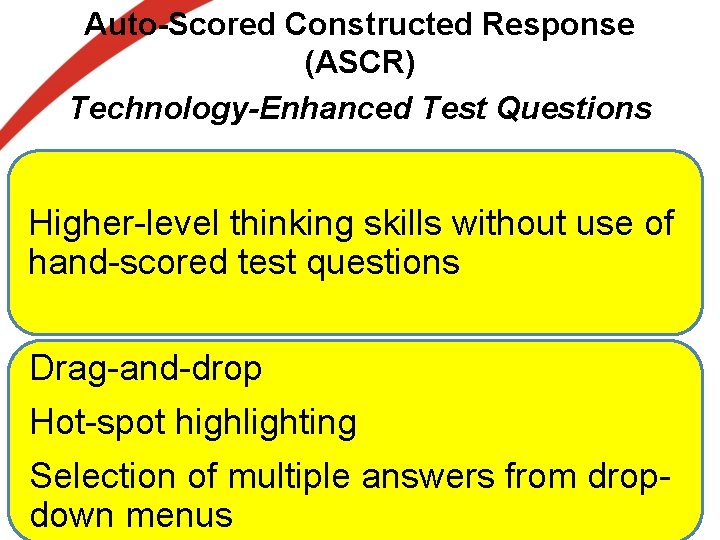
Auto-Scored Constructed Response (ASCR) Technology-Enhanced Test Questions Higher-level thinking skills without use of hand-scored test questions Drag-and-drop Hot-spot highlighting Selection of multiple answers from dropdown menus 10
Sample Stand-Alone Writing Items 11
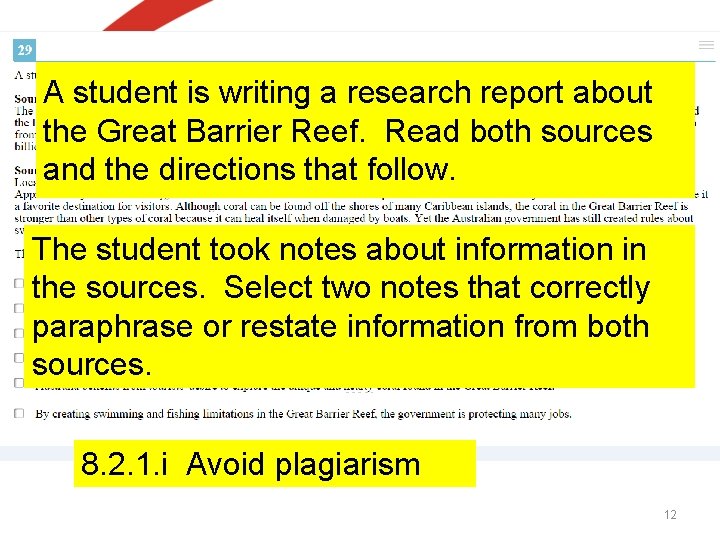
A student is writing a research report about the Great Barrier Reef. Read both sources and the directions that follow. The student took notes about information in the sources. Select two notes that correctly paraphrase or restate information from both sources. 8. 2. 1. i Avoid plagiarism 12
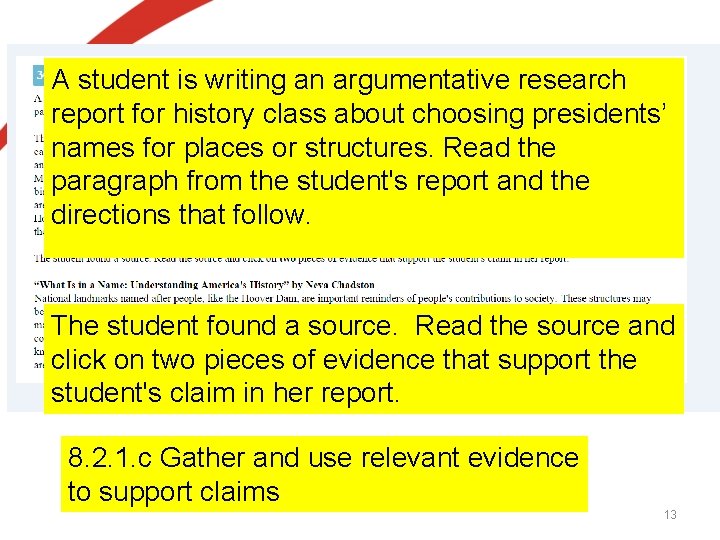
A student is writing an argumentative research report for history class about choosing presidents’ names for places or structures. Read the paragraph from the student's report and the directions that follow. The student found a source. Read the source and click on two pieces of evidence that support the student's claim in her report. 8. 2. 1. c Gather and use relevant evidence to support claims 13
Reading English Language Arts 2016
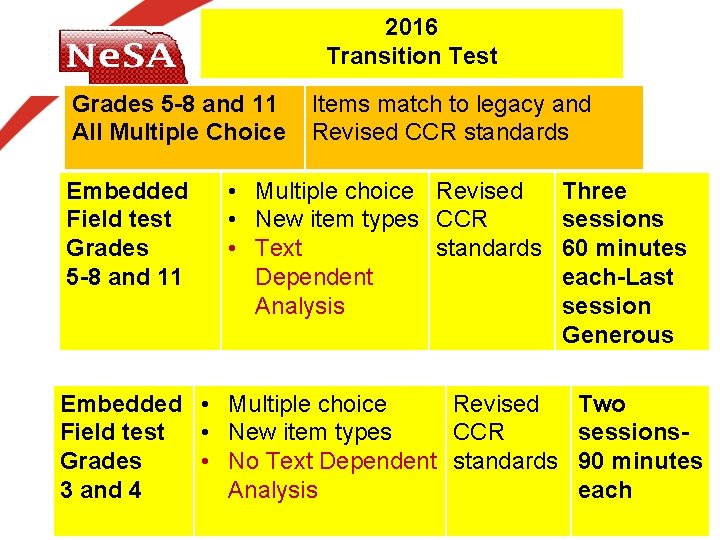
2016 Transition Test Grades 5 -8 and 11 All Multiple Choice Embedded Field test Grades 5 -8 and 11 Items match to legacy and Revised CCR standards • Multiple choice Revised • New item types CCR • Text standards Dependent Analysis Embedded • Multiple choice Revised Field test • New item types CCR Grades • No Text Dependent standards 3 and 4 Analysis Three sessions 60 minutes each-Last session Generous Two sessions 90 minutes each
Importance of Field Testing Students’ Best Efforts Accurate Field Test Results You Make Never Purchased Items The Nebraska Difference Items for Nebraska Students 16
English Language Arts Transition Materials for School Districts 17
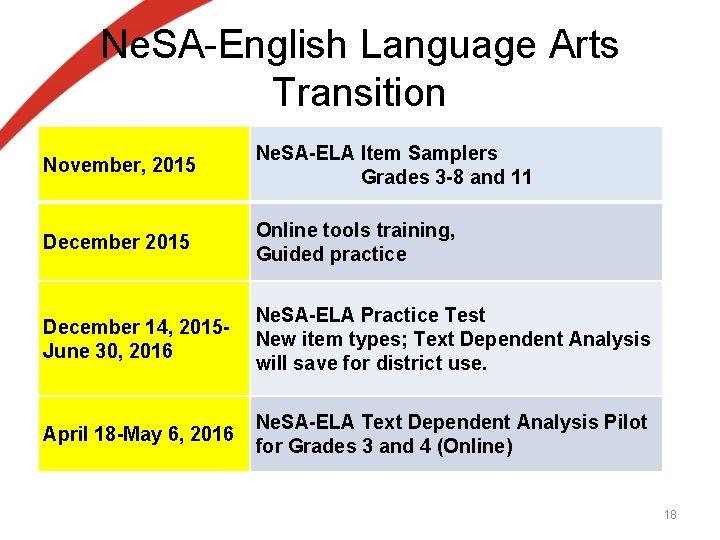
Ne. SA-English Language Arts Transition November, 2015 Ne. SA-ELA Item Samplers Grades 3 -8 and 11 December 2015 Online tools training, Guided practice December 14, 2015 June 30, 2016 Ne. SA-ELA Practice Test New item types; Text Dependent Analysis will save for district use. April 18 -May 6, 2016 Ne. SA-ELA Text Dependent Analysis Pilot for Grades 3 and 4 (Online) 18
English Language Arts All online Same exceptions for online testing as currently allowed
Accommodations 20
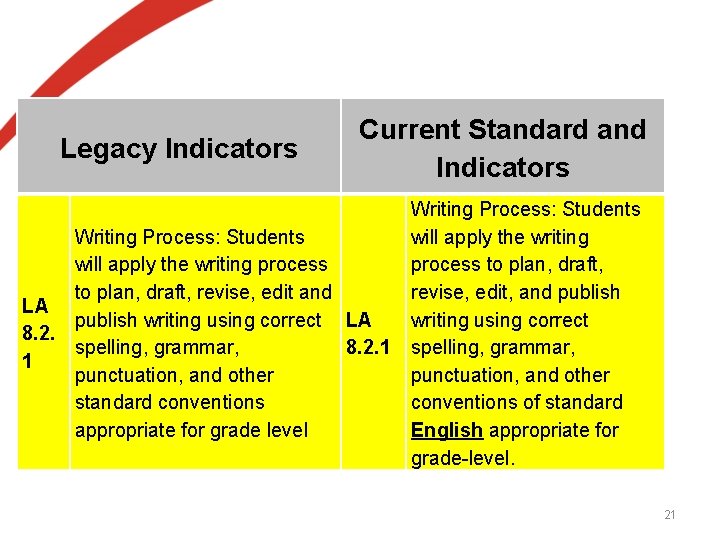
Legacy Indicators Current Standard and Indicators Writing Process: Students will apply the writing process to plan, draft, revise, edit and LA publish writing using correct LA 8. 2. spelling, grammar, 8. 2. 1 1 punctuation, and other standard conventions appropriate for grade level Writing Process: Students will apply the writing process to plan, draft, revise, edit, and publish writing using correct spelling, grammar, punctuation, and other conventions of standard English appropriate for grade-level. 21
Ne. SA Approved Accommodations Document • See last page of the Ne. SA Approved Accommodations document for additional clarifications for Ne. SA-Field testing. 22
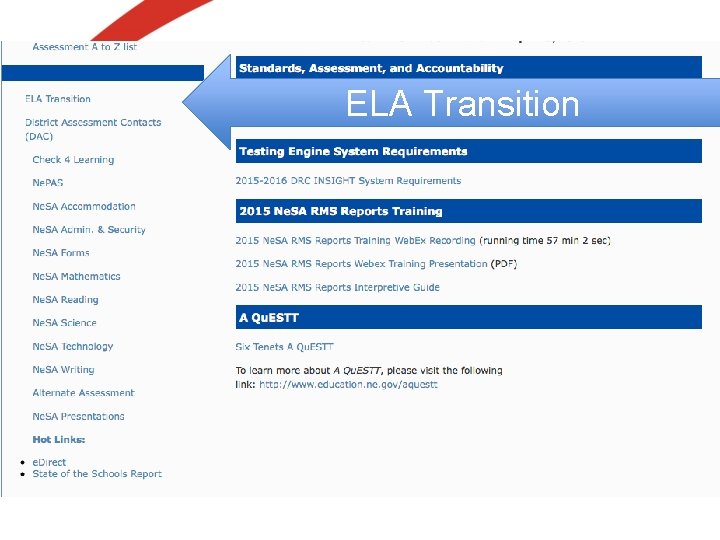
ELA Transition
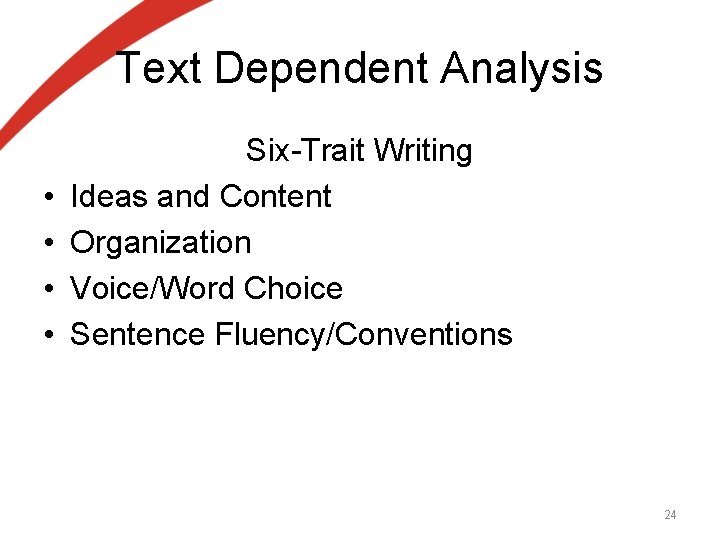
Text Dependent Analysis • • Six-Trait Writing Ideas and Content Organization Voice/Word Choice Sentence Fluency/Conventions 24
Standards Activity 25
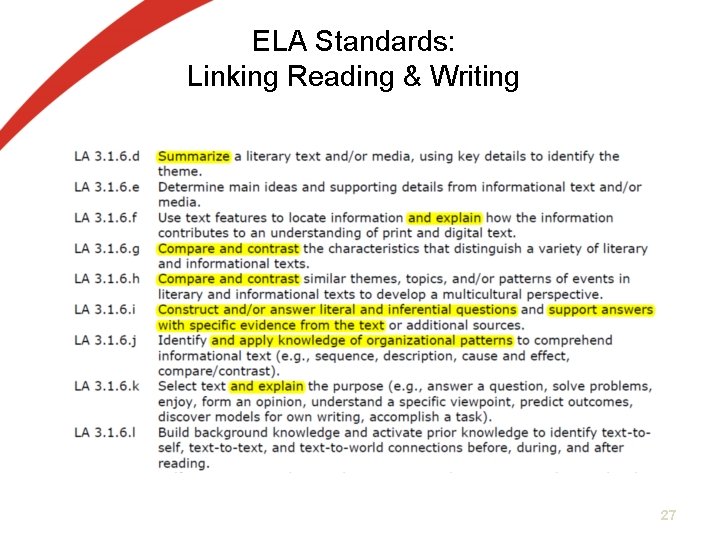
ELA Standards: Linking Reading & Writing • Which Reading standards/indicators could be better addressed if a student provided their response in writing? • Which Writing standards/indicators likely require students to read text in order to create a writing response? • How might the integration between reading and writing impact how we assess the new CCR ELA Standards? 26
ELA Standards: Linking Reading & Writing 27
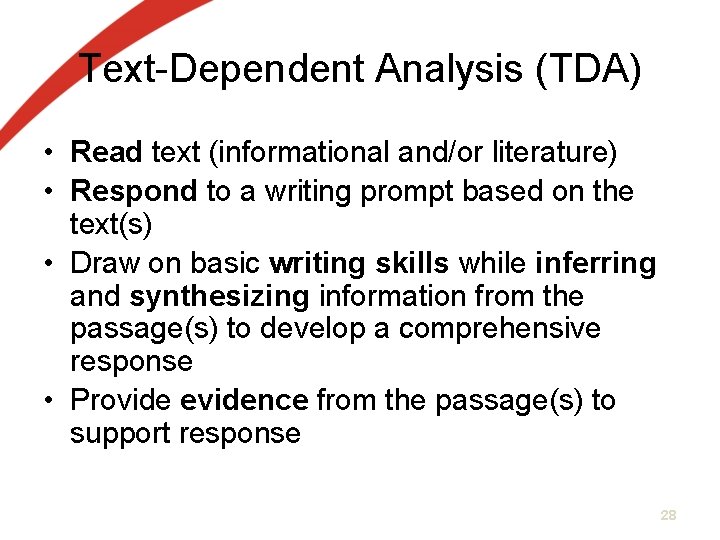
Text-Dependent Analysis (TDA) • Read text (informational and/or literature) • Respond to a writing prompt based on the text(s) • Draw on basic writing skills while inferring and synthesizing information from the passage(s) to develop a comprehensive response • Provide evidence from the passage(s) to support response 28
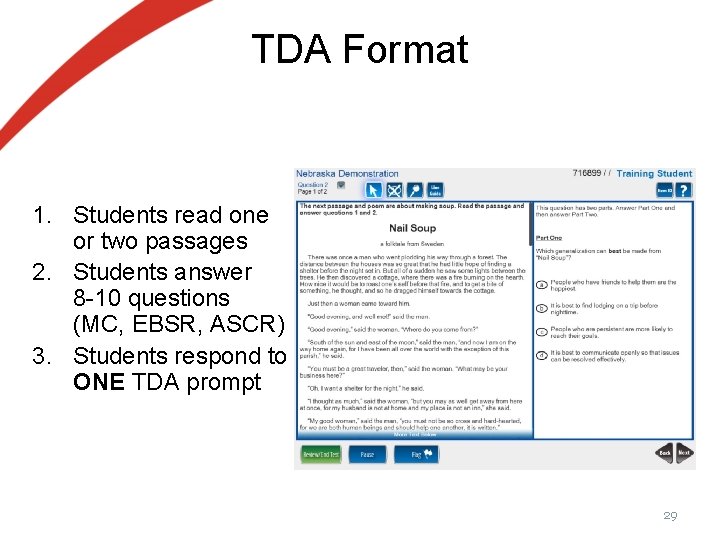
TDA Format 1. Students read one or two passages 2. Students answer 8 -10 questions (MC, EBSR, ASCR) 3. Students respond to ONE TDA prompt 29
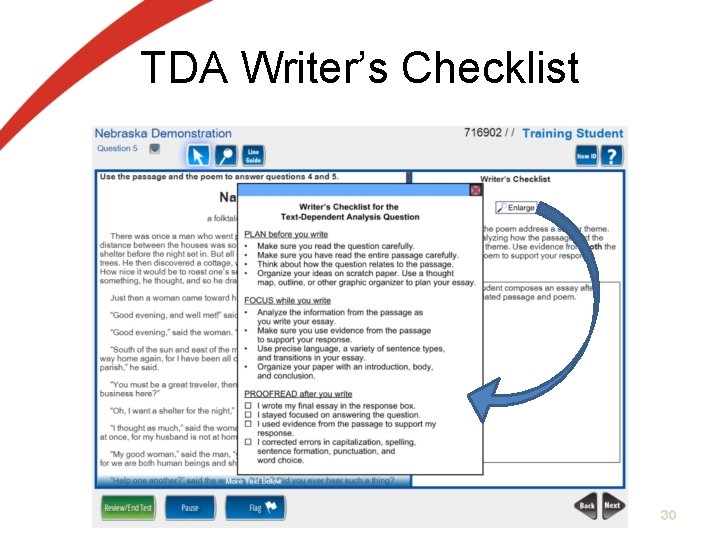
TDA Writer’s Checklist 30
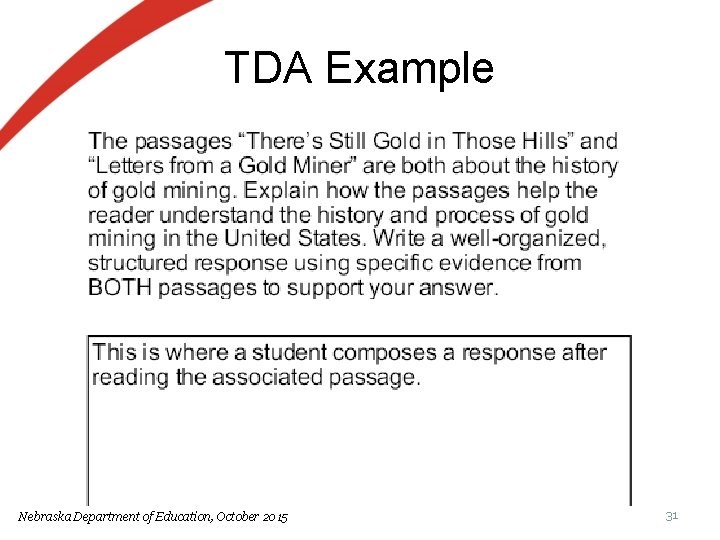
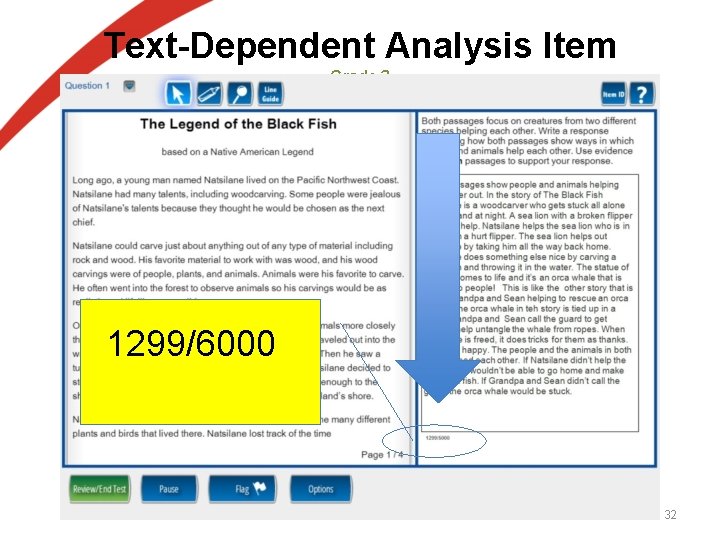
TDA Example Nebraska Department of Education, October 2015 31
Text-Dependent Analysis Item Grade 3 1299/6000 32
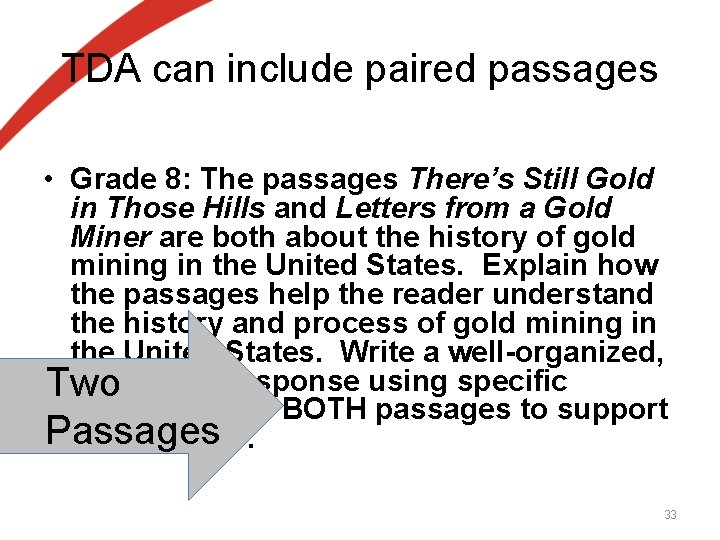
TDA can include paired passages • Grade 8: The passages There’s Still Gold in Those Hills and Letters from a Gold Miner are both about the history of gold mining in the United States. Explain how the passages help the reader understand the history and process of gold mining in the United States. Write a well-organized, structured response using specific Two evidence from BOTH passages to support Passages your answer. 33
TDA Prompt Format 1. Set up/Lead in naming passage 2. Prompt 3. “Write a well-organized, structured response using specific evidence from the (passage/poem/story) to support your answer. ” 34
TDA Prompt Guidelines – No “pop quizzes” – Goes beyond what has been considered typical grade level complexity – Road Map vs. Road Signs – Prompts will elicit various modes of writing 35
Examples & Non-Examples Not Text-Dependent Analysis Give three examples of how Both passages tell about ways animals sleep in different ways. that different animals sleep in the wild. Explain why animals sleep in different ways. Identify the literary devices the author uses in the story. Provide evidence from the story in your response. Mood is the feeling or emotion that a reader experiences from a poem or story. Explain how the poet’s word choice helps create mood throughout the poem. 36
TDA Rubric Development: Process • Written by a group of 25 Nebraska educators • Grounded in the College & Career Ready ELA Standards • Reviewed by the Assessment & Accountability Advisory • Reviewed by 60+ DACs • Incorporates Feedback from October ELA Transition Workshops 37
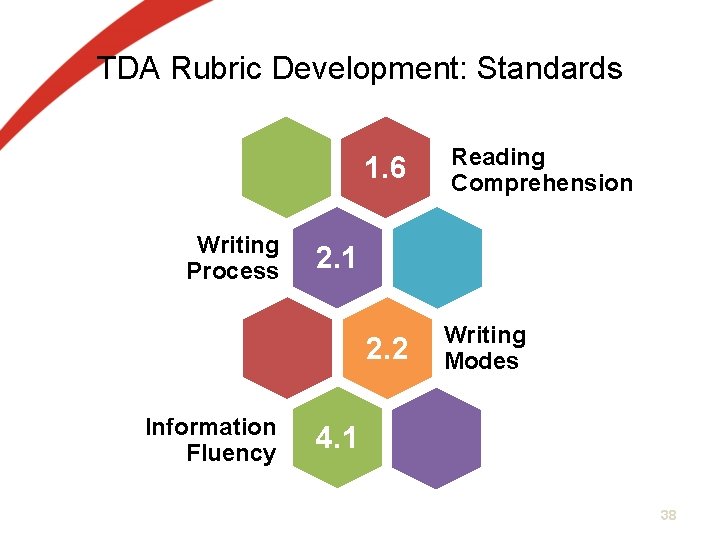
TDA Rubric Development: Standards 1. 6 Writing Process 2. 1 2. 2 Information Fluency Reading Comprehension Writing Modes 4. 1 38
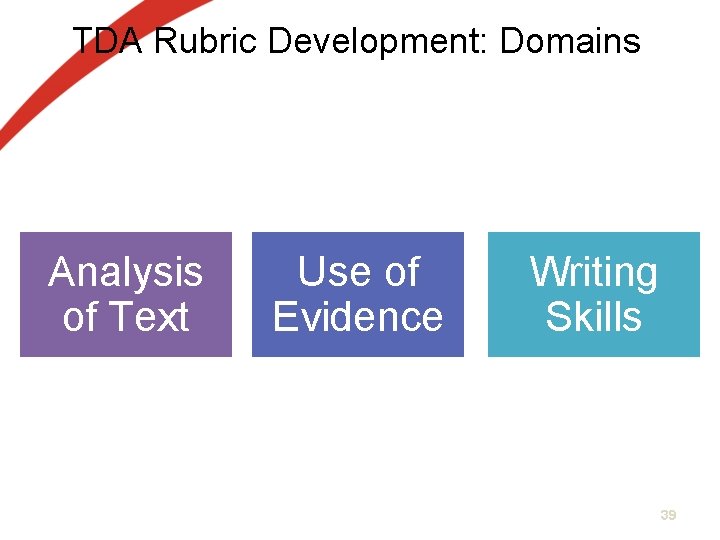
TDA Rubric Development: Domains Analysis of Text Use of Evidence Writing Skills 39
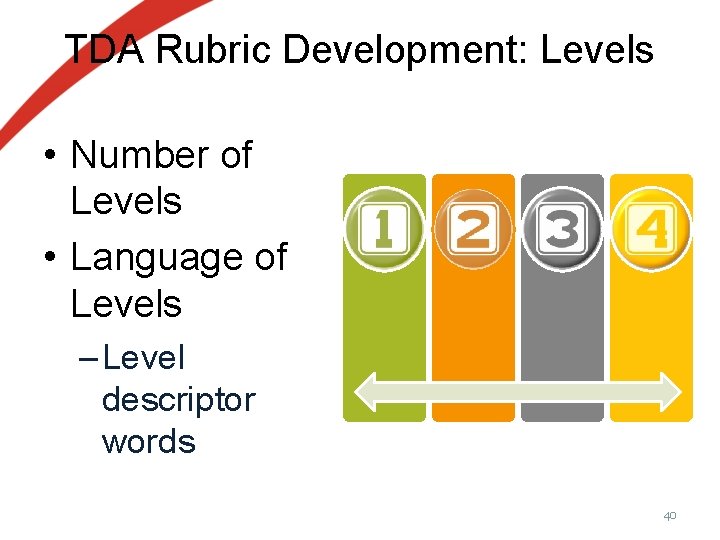
TDA Rubric Development: Levels • Number of Levels • Language of Levels – Level descriptor words 40
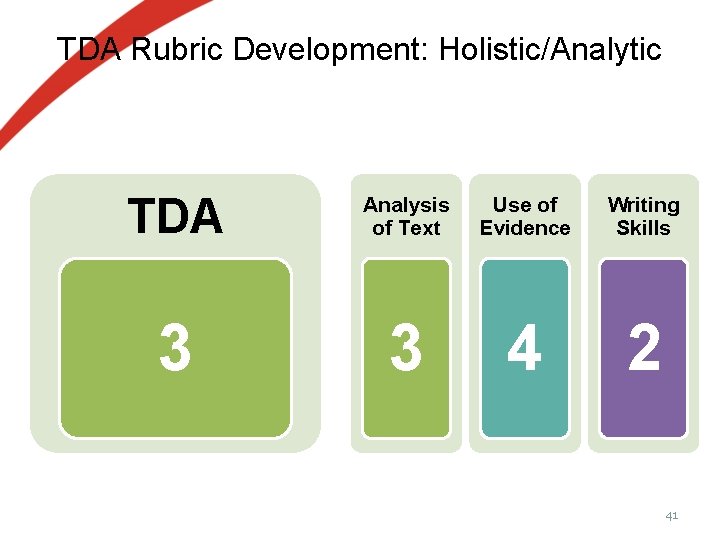
TDA Rubric Development: Holistic/Analytic TDA Analysis of Text Use of Evidence Writing Skills 3 3 4 2 41
Writing Scoring at DRC • Rangefinders selected annotated in Nebraska by Nebraska Educators • DRC hires room leaders--on site in Minnesota • DRC hires graders—on site in Minnesota— approx 40 -50 per grade level • Graders train for two days • Graders must pass two practice sets(essays scored by Nebraska graders) • Graders are back-checked by room leaders 42
Writing Scoring at DRC • Nebraska Department of Education is present the entire time • NDE makes decisions, i. e. Essay on topic? • Questions are answered using evidence from Nebraska Rangefinding • No set number of essays to read per hour • All scorers are together for scoring 43
Scoring of Text-Dependent Analysis • Nebraska educators select and annotate the rangefinders • Current plan—Single score on 4 point rubric-Holistic-DRC • Analysis this spring—if scored twice, how closely do scores correlate—Scoring by Nebraska educators • Verifications? ? 44
TDA Rubric • Highlight/underline the significant words in each bullet. – Which skill(s) does each bullet address? – How is the bullet differentiated at each level (1, 2, 3, 4)? 45
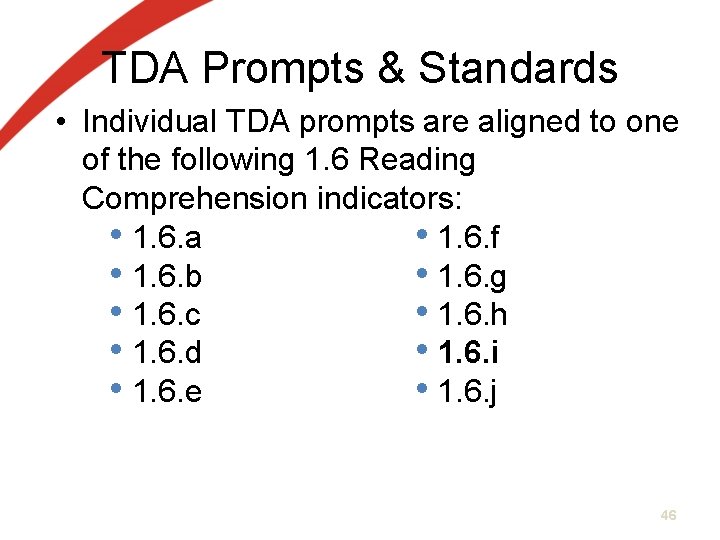
TDA Prompts & Standards • Individual TDA prompts are aligned to one of the following 1. 6 Reading Comprehension indicators: • 1. 6. a • 1. 6. f • 1. 6. b • 1. 6. g • 1. 6. h • 1. 6. c • 1. 6. i • 1. 6. d • 1. 6. j • 1. 6. e 46
Effective Analysis of Text • Answers the question (1. 6. _) • Shows they understood the texts (1. 6) • Addresses literal and inferential meanings in the texts (1. 6. i) 47
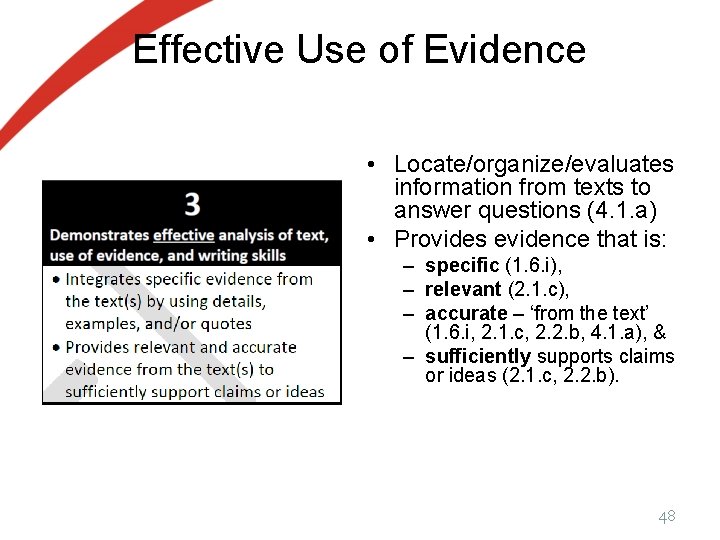
Effective Use of Evidence • Locate/organize/evaluates information from texts to answer questions (4. 1. a) • Provides evidence that is: – specific (1. 6. i), – relevant (2. 1. c), – accurate – ‘from the text’ (1. 6. i, 2. 1. c, 2. 2. b, 4. 1. a), & – sufficiently supports claims or ideas (2. 1. c, 2. 2. b). 48
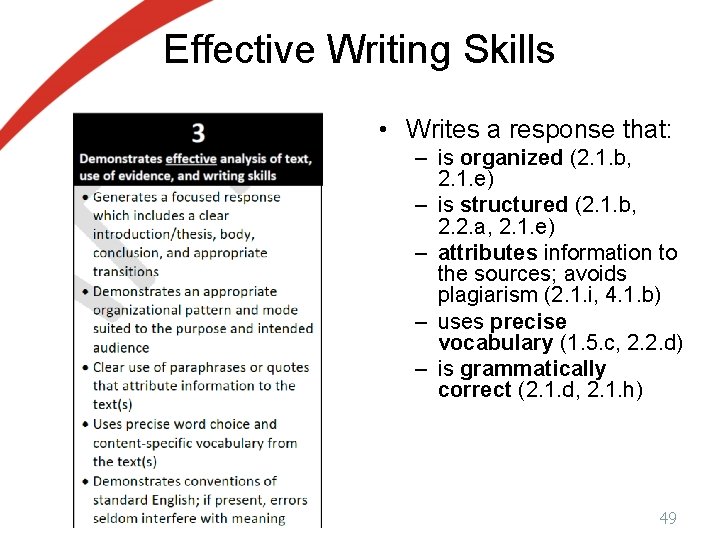
Effective Writing Skills • Writes a response that: – is organized (2. 1. b, 2. 1. e) – is structured (2. 1. b, 2. 2. a, 2. 1. e) – attributes information to the sources; avoids plagiarism (2. 1. i, 4. 1. b) – uses precise vocabulary (1. 5. c, 2. 2. d) – is grammatically correct (2. 1. d, 2. 1. h) 49
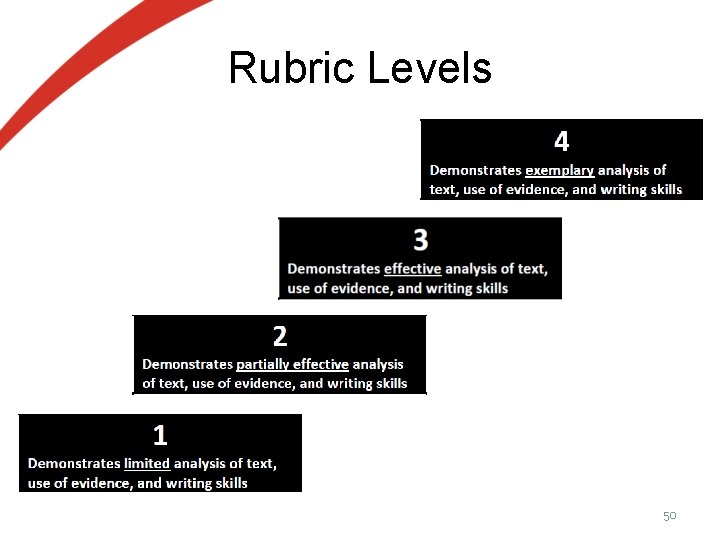
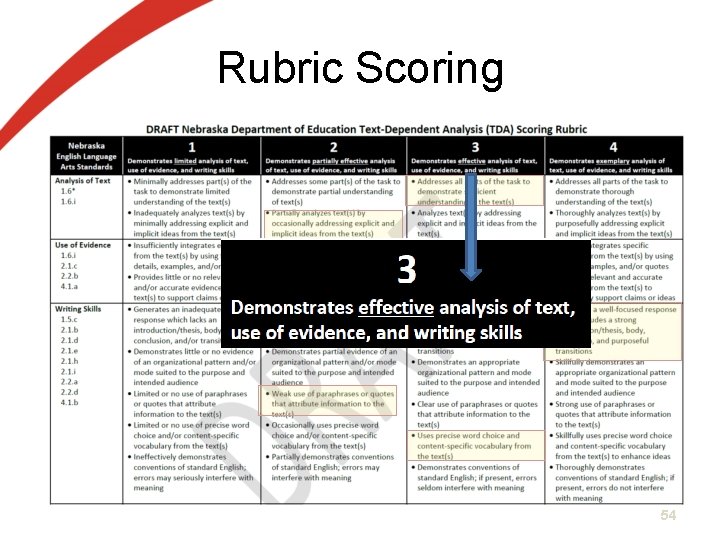
Rubric Levels 50
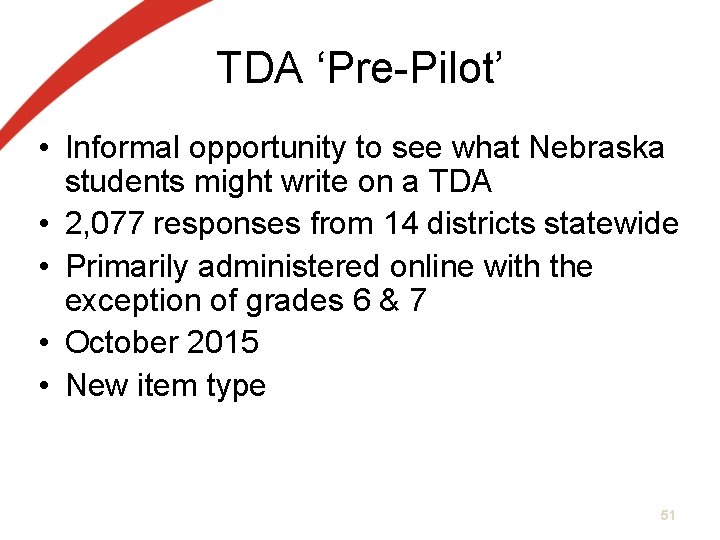
TDA ‘Pre-Pilot’ • Informal opportunity to see what Nebraska students might write on a TDA • 2, 077 responses from 14 districts statewide • Primarily administered online with the exception of grades 6 & 7 • October 2015 • New item type 51
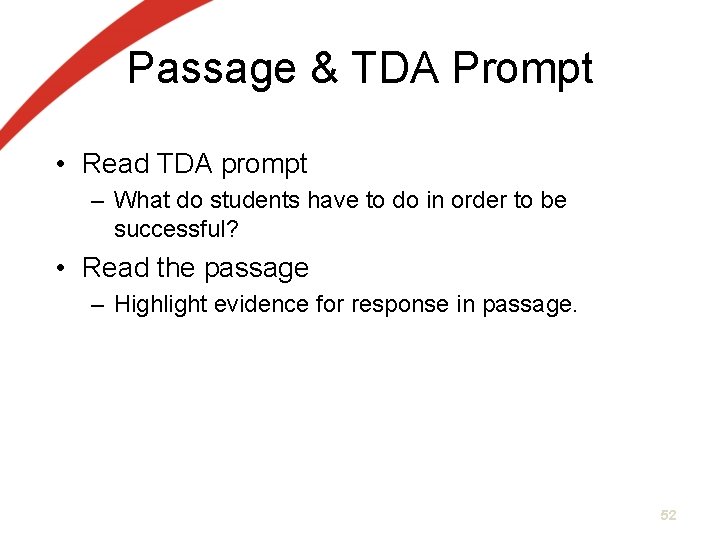
Passage & TDA Prompt • Read TDA prompt – What do students have to do in order to be successful? • Read the passage – Highlight evidence for response in passage. 52
Sampler Score Examples • Read Sample A – Score independently using the TDA rubric 53
Rubric Scoring 54
Sampler Score Examples • Read Sample A – Score independently using the TDA rubric • Table discussion: • What are the strengths & weaknesses of the response? • Overall does the response demonstrate effective analysis of text, use of evidence, and writing skills? • Review annotations • Record comments on Sample Response Score Sheet (Pink) 55
Sampler Score Examples • Read Samples B, C, & D – Score independently – Review annotations • Table discussion: • What are the strengths & weaknesses of each response? • What are the differences between the 1 and 2? 2 and 3? 3 and 4? • Record comments on Sample Response Score Sheet (Pink) 56
Score Sample Responses • Read Samples E, F, G, H, I – Score independently • Table discussion • What are the strengths & weakness of each response? • Where does the response fall on each aspect of the rubric? Record scores and annotation comments on Sample Response Score Sheet (Pink) 57
Teaching Points • Read Sample J – Score independently Table discussion: • What are the strengths & weaknesses of the response? • What questions might you ask when conferencing with the student to guide them to effectively revise their response? Record scores and annotation comments on Sample Response Score Sheet (Pink) 58
Table Discussion • What are your overall observations about the student writing? • What did students do well? • What are some common student misconceptions or areas of need? • Did anything surprise you about what students wrote? • What might be some of your next steps? 59
TDA Resources • NDE Statewide Assessment ELA Transition Webpage – Rubric & Writer’s Checklist – TDA Prompt Guidelines – Grade Level Samplers- Coming Soon! – Grade Level Sample Response Packets (with Nebraska educator annotations)- Coming Soon! • Ne. SA-ELA Practice Test with TDA- December 14 60
Q & A 61
Feedback • ELA Transition: valorie. foy@Nebraska. gov • TDA feedback directly on handouts OR email: Erin. Kunkle@Nebraska. gov • Feedback Form 62