Resources and Strategies for Effectively Implementing the Transition
- Slides: 20
Resources and Strategies for Effectively Implementing the Transition Assessment Requirements of IDEA Presented by: Mary Morningstar, Ph. D. Arizona 9 th Annual Transition Conference September 21 -23, 2009 mmorningstar@ku. edu www. transitioncoalition. org Training package copyright by the Transition Coalition 2008 © for the Missouri Department of Elementary and Secondary Education. December, 2008. For more information about this training package, please contact: Dr. Mary Morningstar, mmorningstar@ku. edu
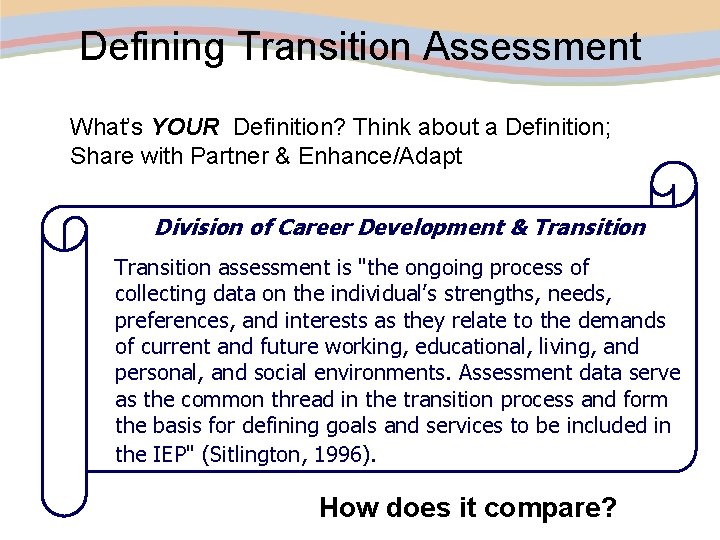
Defining Transition Assessment What’s YOUR Definition? Think about a Definition; Share with Partner & Enhance/Adapt Division of Career Development & Transition assessment is "the ongoing process of collecting data on the individual’s strengths, needs, preferences, and interests as they relate to the demands of current and future working, educational, living, and personal, and social environments. Assessment data serve as the common thread in the transition process and form the basis for defining goals and services to be included in the IEP" (Sitlington, 1996). How does it compare?
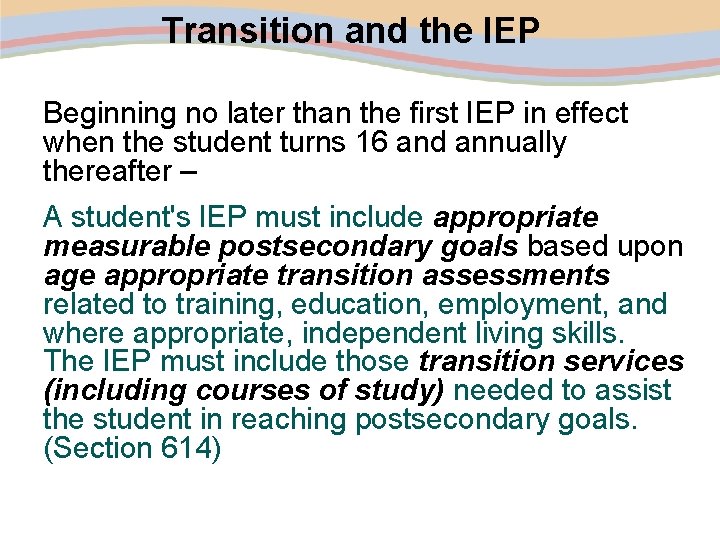
Transition and the IEP Beginning no later than the first IEP in effect when the student turns 16 and annually thereafter – A student's IEP must include appropriate measurable postsecondary goals based upon age appropriate transition assessments related to training, education, employment, and where appropriate, independent living skills. The IEP must include those transition services (including courses of study) needed to assist the student in reaching postsecondary goals. (Section 614)
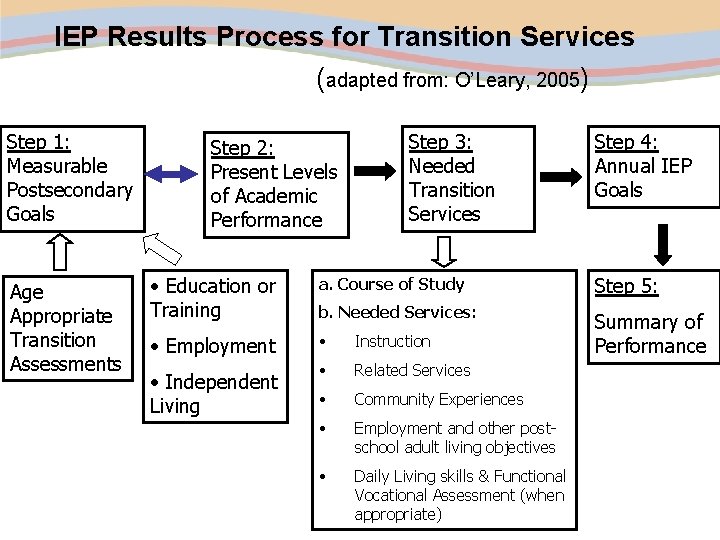
IEP Results Process for Transition Services (adapted from: O’Leary, 2005) Step 1: Measurable Postsecondary Goals Age Appropriate Transition Assessments Step 2: Present Levels of Academic Performance Step 3: Needed Transition Services Step 4: Annual IEP Goals • Education or Training a. Course of Study Step 5: b. Needed Services: • Employment • Instruction Summary of Performance • Related Services • Community Experiences • Employment and other postschool adult living objectives • Daily Living skills & Functional Vocational Assessment (when appropriate) • Independent Living
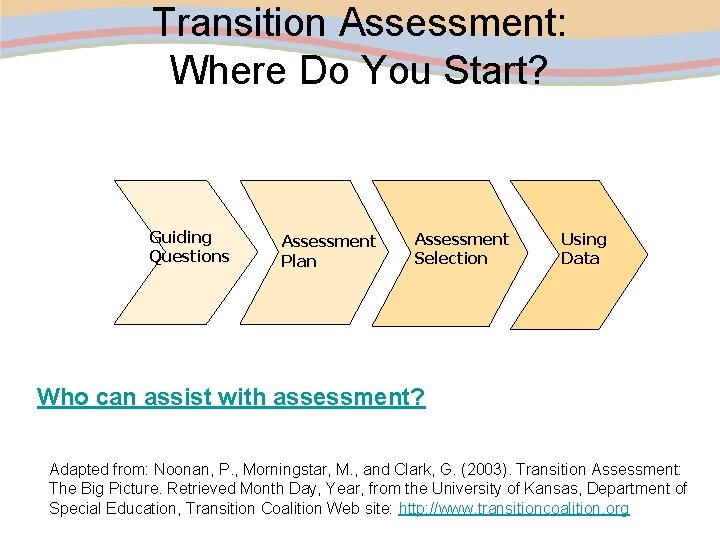
Transition Assessment: Where Do You Start? Guiding Questions Assessment Plan Assessment Selection Using Data Who can assist with assessment? Adapted from: Noonan, P. , Morningstar, M. , and Clark, G. (2003). Transition Assessment: The Big Picture. Retrieved Month Day, Year, from the University of Kansas, Department of Special Education, Transition Coalition Web site: http: //www. transitioncoalition. org
Activity: Assessment Planning • Identify who can assist with the assessment process
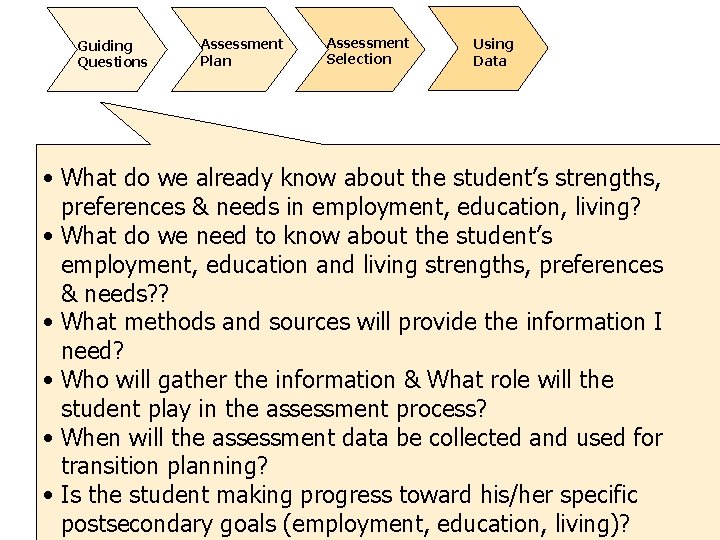
Guiding Questions Assessment Plan Assessment Selection Using Data • What do we already know about the student’s strengths, preferences & needs in employment, education, living? • What do we need to know about the student’s employment, education and living strengths, preferences & needs? ? • What methods and sources will provide the information I need? • Who will gather the information & What role will the student play in the assessment process? • When will the assessment data be collected and used for transition planning? • Is the student making progress toward his/her specific postsecondary goals (employment, education, living)?
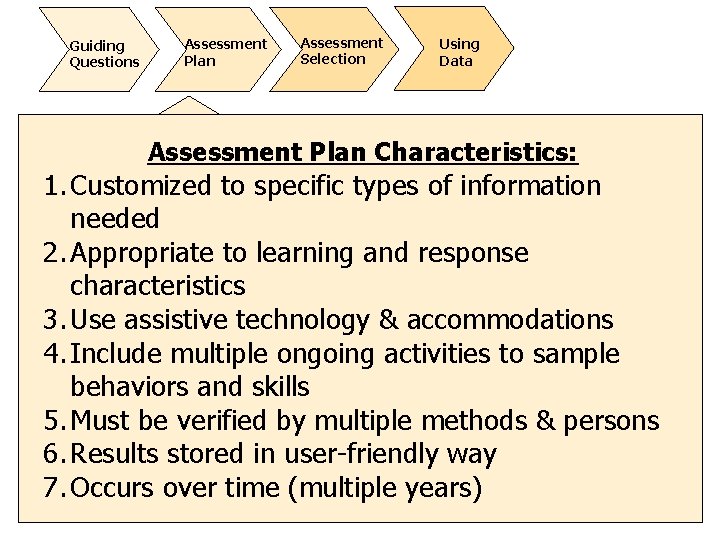
Guiding Questions Assessment Plan Assessment Selection Using Data Assessment Plan Characteristics: 1. Customized to specific types of information needed 2. Appropriate to learning and response characteristics 3. Use assistive technology & accommodations 4. Include multiple ongoing activities to sample behaviors and skills 5. Must be verified by multiple methods & persons 6. Results stored in user-friendly way 7. Occurs over time (multiple years)
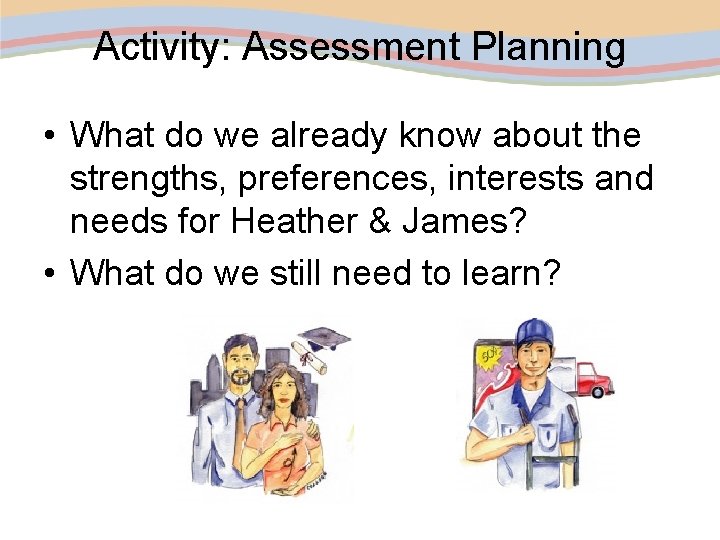
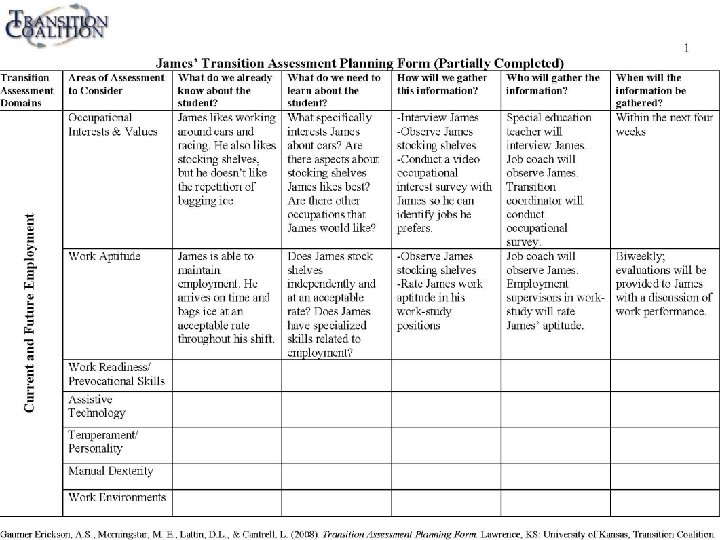
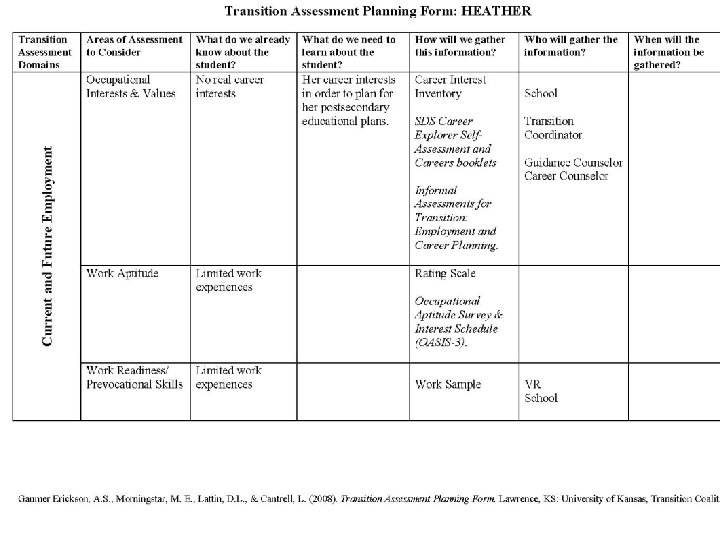
Activity: Assessment Planning • What do we already know about the strengths, preferences, interests and needs for Heather & James? • What do we still need to learn?
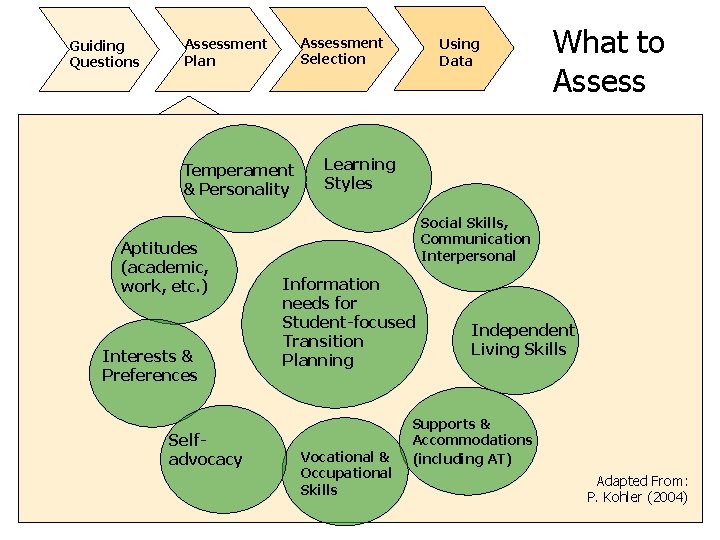
Guiding Questions Assessment Selection Assessment Plan Temperament & Personality Aptitudes (academic, work, etc. ) Interests & Preferences Selfadvocacy Using Data What to Assess Learning Styles Social Skills, Communication Interpersonal Information needs for Student-focused Transition Planning Vocational & Occupational Skills Independent Living Skills Supports & Accommodations (including AT) Adapted From: P. Kohler (2004)
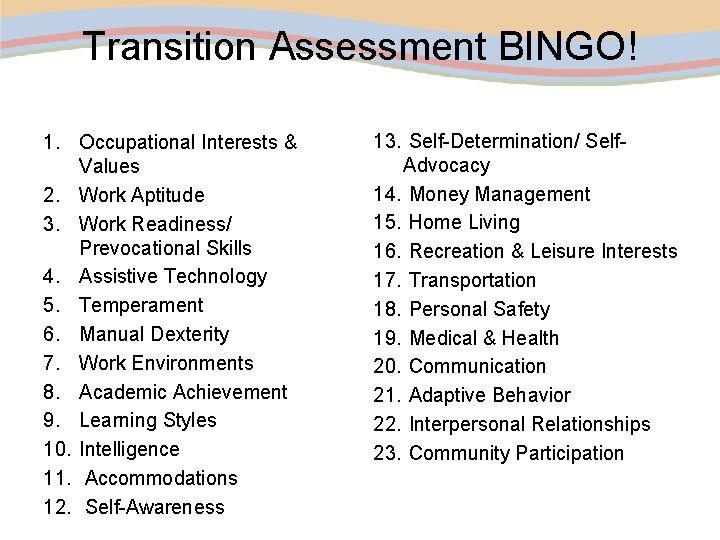
Transition Assessment BINGO! 1. Occupational Interests & Values 2. Work Aptitude 3. Work Readiness/ Prevocational Skills 4. Assistive Technology 5. Temperament 6. Manual Dexterity 7. Work Environments 8. Academic Achievement 9. Learning Styles 10. Intelligence 11. Accommodations 12. Self-Awareness 13. Self-Determination/ Self. Advocacy 14. Money Management 15. Home Living 16. Recreation & Leisure Interests 17. Transportation 18. Personal Safety 19. Medical & Health 20. Communication 21. Adaptive Behavior 22. Interpersonal Relationships 23. Community Participation
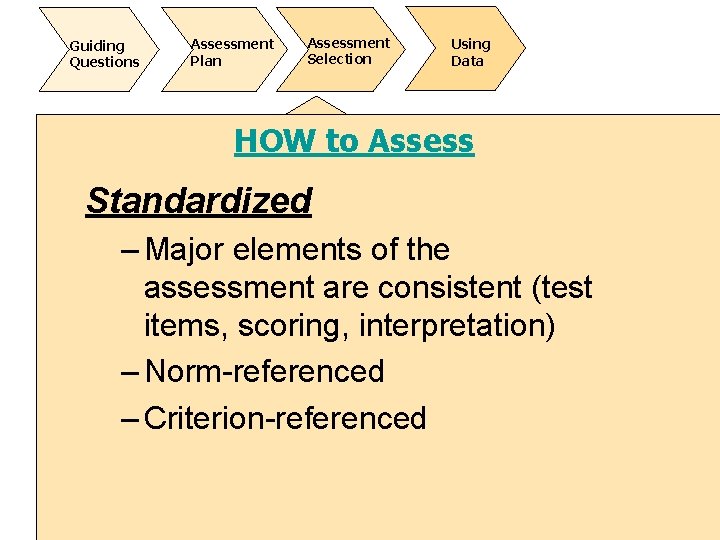
Guiding Questions Assessment Plan Assessment Selection Using Data HOW to Assess Standardized – Major elements of the assessment are consistent (test items, scoring, interpretation) – Norm-referenced – Criterion-referenced
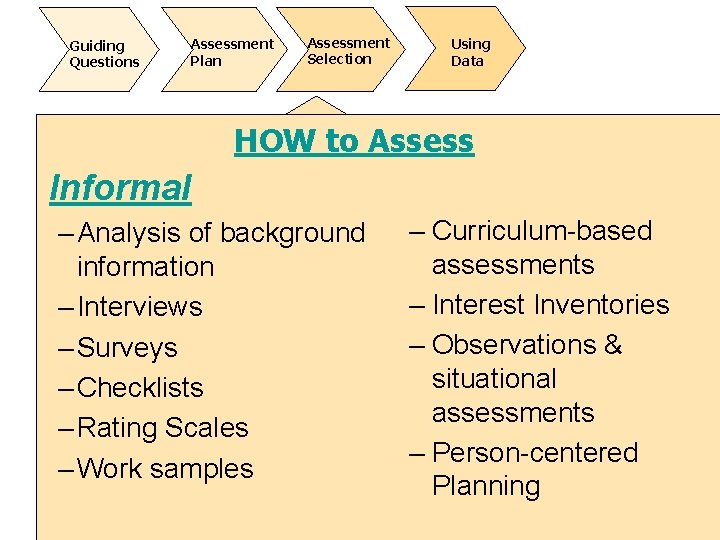
Guiding Questions Assessment Plan Assessment Selection Using Data HOW to Assess Informal – Analysis of background information – Interviews – Surveys – Checklists – Rating Scales – Work samples – Curriculum-based assessments – Interest Inventories – Observations & situational assessments – Person-centered Planning
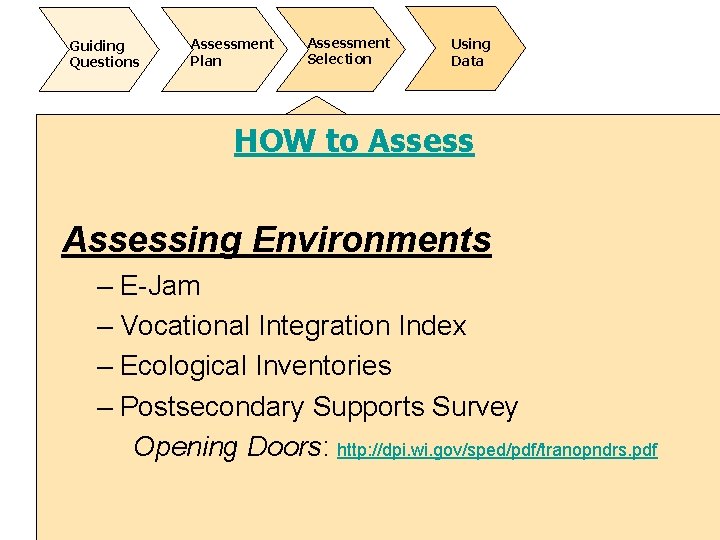
Guiding Questions Assessment Plan Assessment Selection Using Data HOW to Assessing Environments – E-Jam – Vocational Integration Index – Ecological Inventories – Postsecondary Supports Survey Opening Doors: http: //dpi. wi. gov/sped/pdf/tranopndrs. pdf
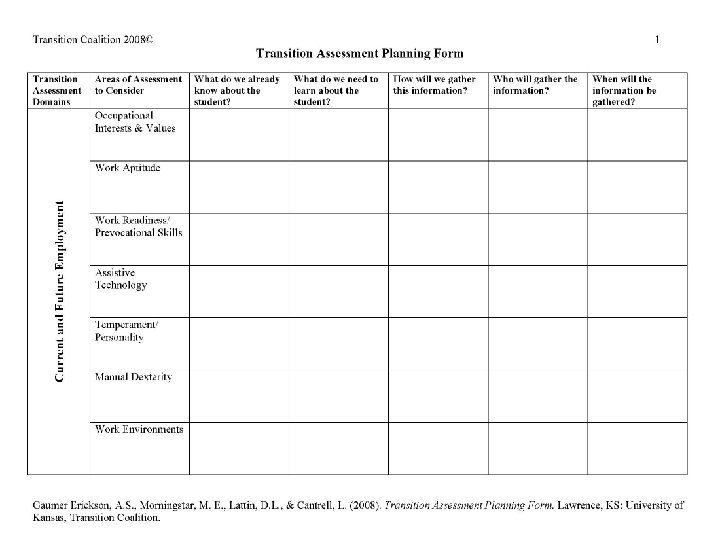
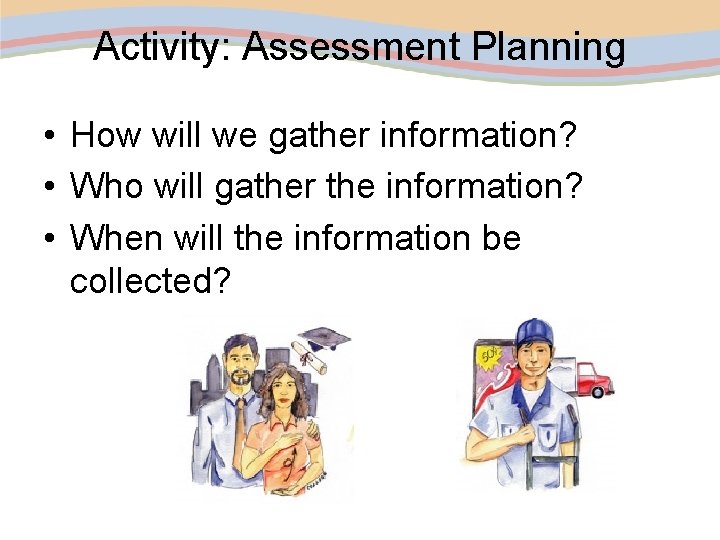
Activity: Assessment Planning • How will we gather information? • Who will gather the information? • When will the information be collected?
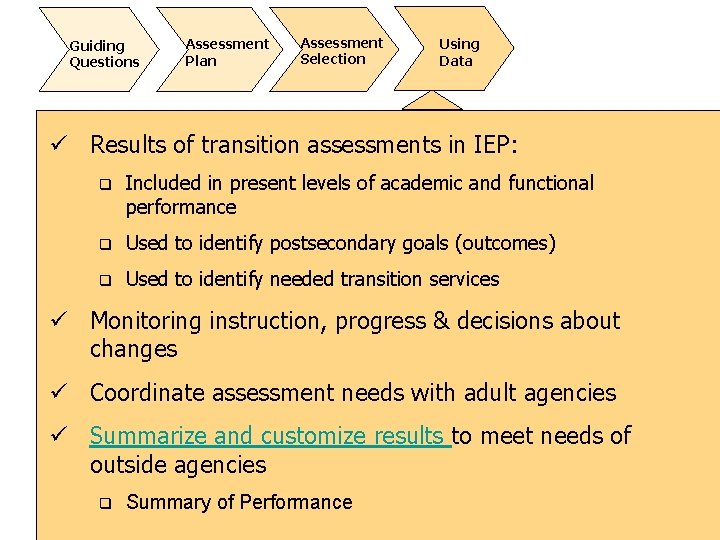
Guiding Questions Assessment Plan Assessment Selection Using Data ü Results of transition assessments in IEP: q Included in present levels of academic and functional performance q Used to identify postsecondary goals (outcomes) q Used to identify needed transition services ü Monitoring instruction, progress & decisions about changes ü Coordinate assessment needs with adult agencies ü Summarize and customize results to meet needs of outside agencies q Summary of Performance
Overriding Theme “A well planned and executed assessment that results in a well-balanced understanding of a student’s performance is one of the most important contributions to generating critical objectives, effective instruction, and meaningful outcomes. ” (Giles & Clark, 2001, pg. 80)