TRAINING SYSTEM AT STATISTICS LITHUANIA Kristina Liutkiene Human
- Slides: 29
TRAINING SYSTEM AT STATISTICS LITHUANIA Kristina Liutkiene Human Resources Management Division Statistics Lithuania Budapest, 5– 7 September 2012 Workshop on Human Resources Management and Training www. stat. gov. lt
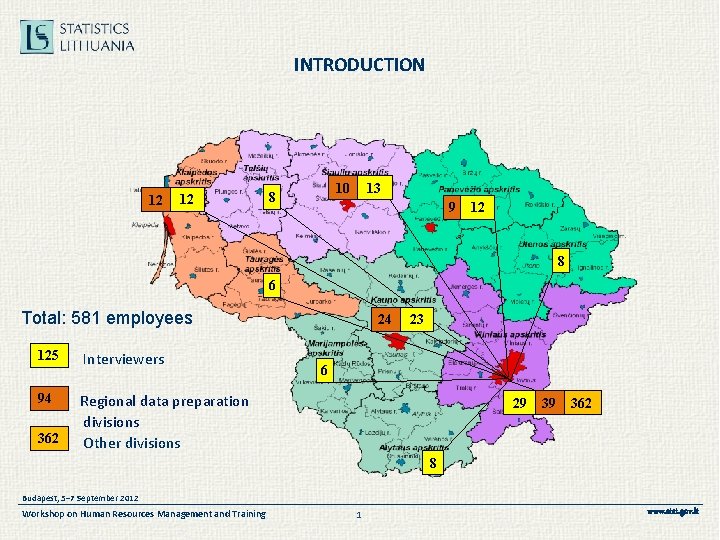
INTRODUCTION 12 12 10 8 13 9 12 8 6 Total: 581 employees 125 Interviewers 94 Regional data preparation divisions 362 Other divisions 24 23 6 29 39 362 8 Budapest, 5– 7 September 2012 Workshop on Human Resources Management and Training 1 www. stat. gov. lt
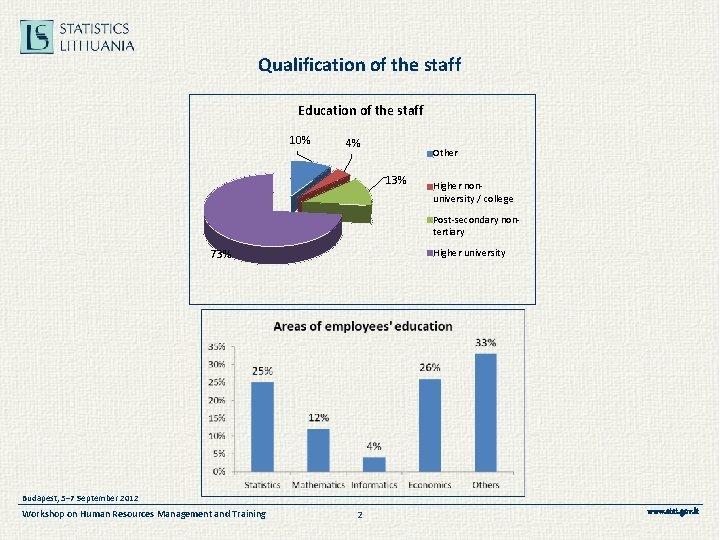
Qualification of the staff Education of the staff 10% 4% Other 13% Higher nonuniversity / college Post-secondary nontertiary Higher university 73% Budapest, 5– 7 September 2012 Workshop on Human Resources Management and Training 2 www. stat. gov. lt
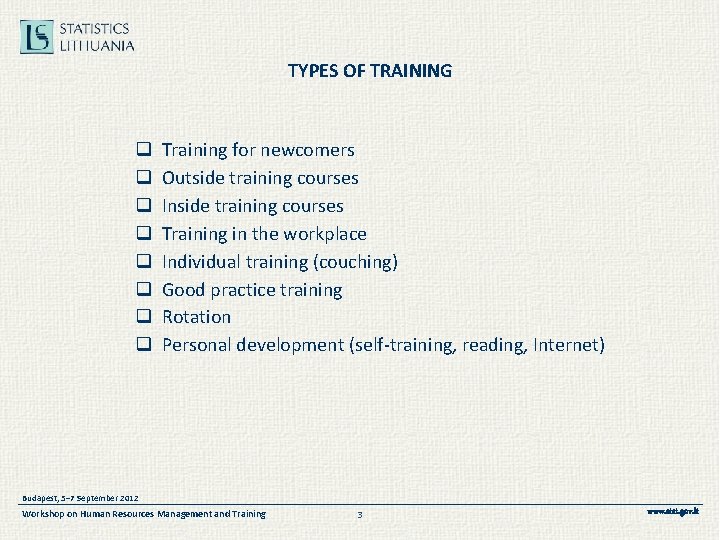
TYPES OF TRAINING q q q q Training for newcomers Outside training courses Inside training courses Training in the workplace Individual training (couching) Good practice training Rotation Personal development (self-training, reading, Internet) Budapest, 5– 7 September 2012 Workshop on Human Resources Management and Training 3 www. stat. gov. lt
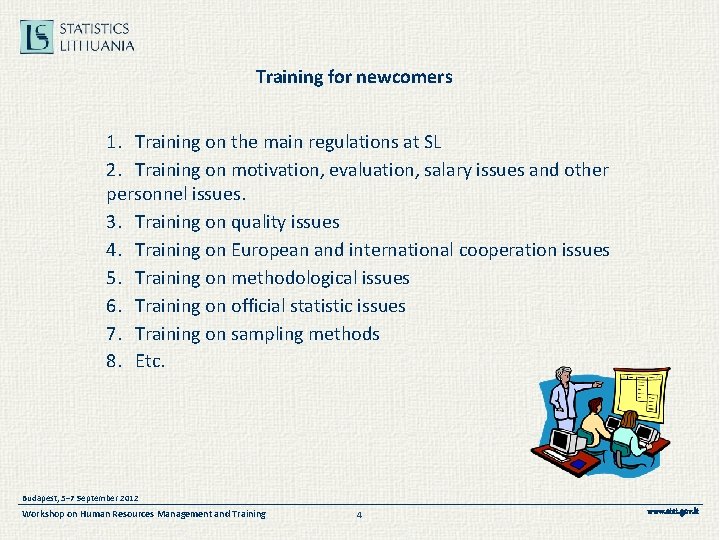
Training for newcomers 1. Training on the main regulations at SL 2. Training on motivation, evaluation, salary issues and other personnel issues. 3. Training on quality issues 4. Training on European and international cooperation issues 5. Training on methodological issues 6. Training on official statistic issues 7. Training on sampling methods 8. Etc. Budapest, 5– 7 September 2012 Workshop on Human Resources Management and Training 4 www. stat. gov. lt
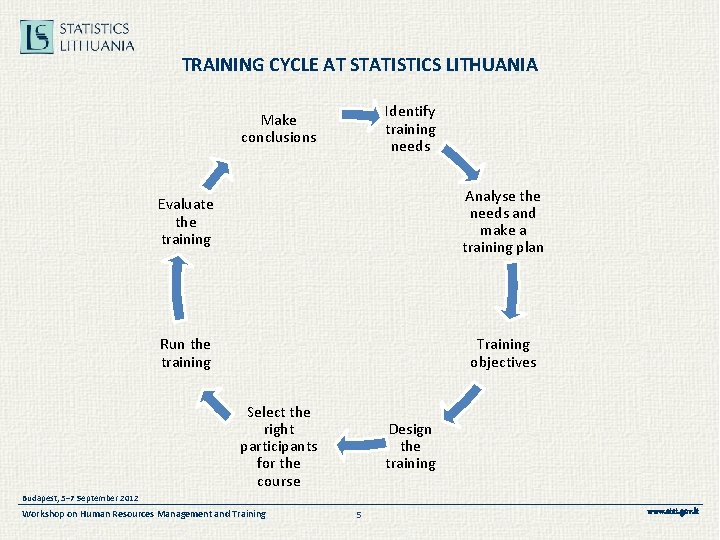
TRAINING CYCLE AT STATISTICS LITHUANIA Identify training needs Make conclusions Evaluate the training Analyse the needs and make a training plan Run the training Training objectives Select the right participants for the course Design the training Budapest, 5– 7 September 2012 Workshop on Human Resources Management and Training 5 www. stat. gov. lt
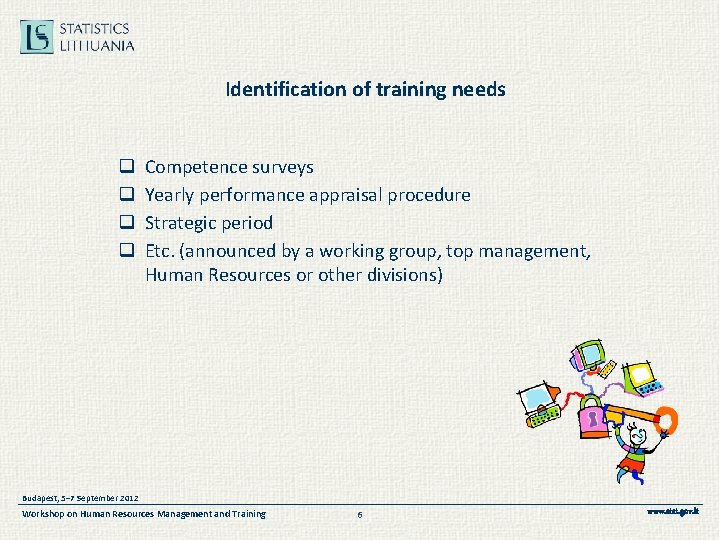
Identification of training needs q q Competence surveys Yearly performance appraisal procedure Strategic period Etc. (announced by a working group, top management, Human Resources or other divisions) Budapest, 5– 7 September 2012 Workshop on Human Resources Management and Training 6 www. stat. gov. lt
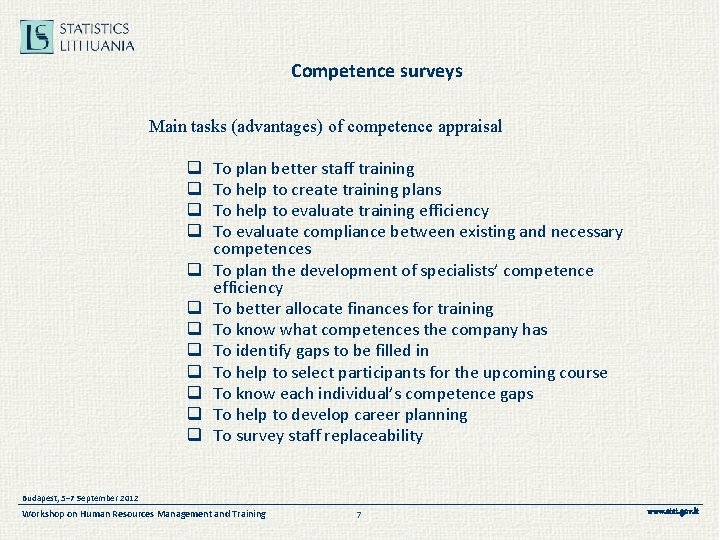
Competence surveys Main tasks (advantages) of competence appraisal q q q To plan better staff training To help to create training plans To help to evaluate training efficiency To evaluate compliance between existing and necessary competences To plan the development of specialists’ competence efficiency To better allocate finances for training To know what competences the company has To identify gaps to be filled in To help to select participants for the upcoming course To know each individual’s competence gaps To help to develop career planning To survey staff replaceability Budapest, 5– 7 September 2012 Workshop on Human Resources Management and Training 7 www. stat. gov. lt
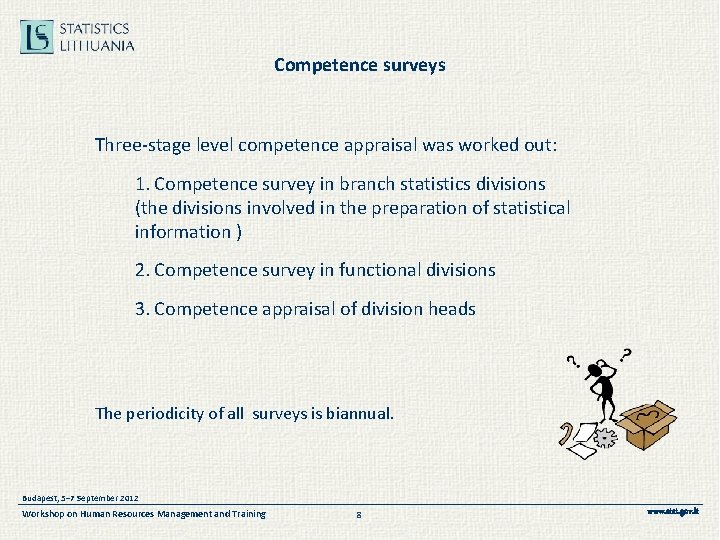
Competence surveys Three-stage level competence appraisal was worked out: 1. Competence survey in branch statistics divisions (the divisions involved in the preparation of statistical information ) 2. Competence survey in functional divisions 3. Competence appraisal of division heads The periodicity of all surveys is biannual. Budapest, 5– 7 September 2012 Workshop on Human Resources Management and Training 8 www. stat. gov. lt
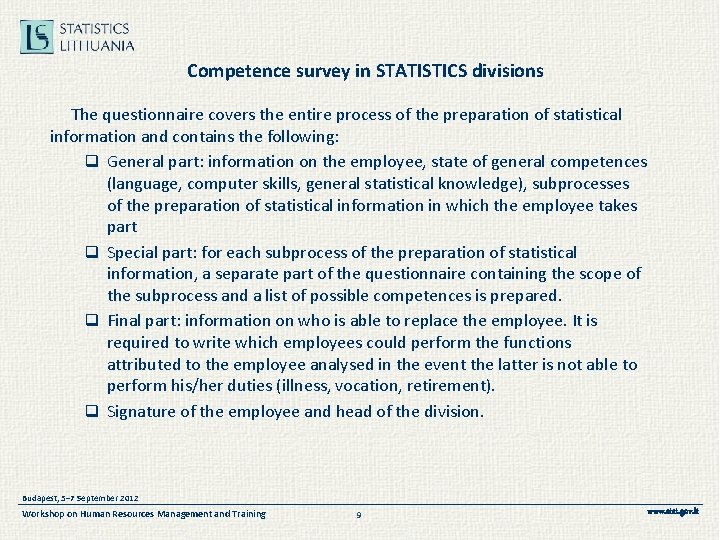
Competence survey in STATISTICS divisions The questionnaire covers the entire process of the preparation of statistical information and contains the following: q General part: information on the employee, state of general competences (language, computer skills, general statistical knowledge), subprocesses of the preparation of statistical information in which the employee takes part q Special part: for each subprocess of the preparation of statistical information, a separate part of the questionnaire containing the scope of the subprocess and a list of possible competences is prepared. q Final part: information on who is able to replace the employee. It is required to write which employees could perform the functions attributed to the employee analysed in the event the latter is not able to perform his/her duties (illness, vocation, retirement). q Signature of the employee and head of the division. Budapest, 5– 7 September 2012 Workshop on Human Resources Management and Training 9 www. stat. gov. lt
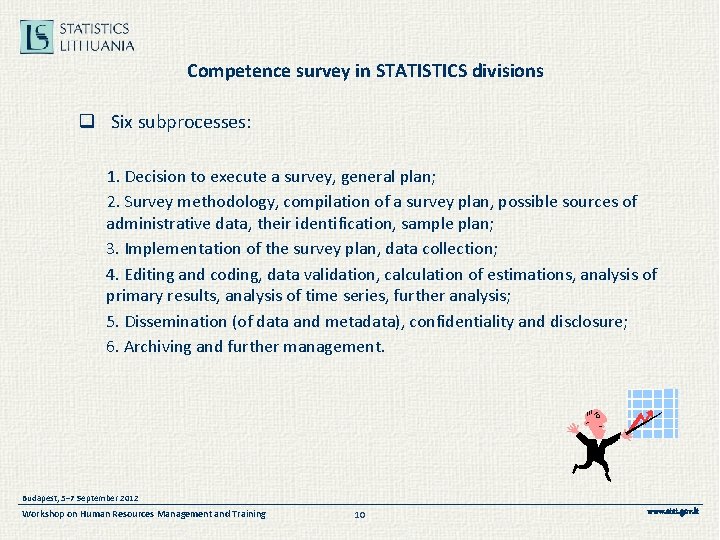
Competence survey in STATISTICS divisions q Six subprocesses: 1. Decision to execute a survey, general plan; 2. Survey methodology, compilation of a survey plan, possible sources of administrative data, their identification, sample plan; 3. Implementation of the survey plan, data collection; 4. Editing and coding, data validation, calculation of estimations, analysis of primary results, analysis of time series, further analysis; 5. Dissemination (of data and metadata), confidentiality and disclosure; 6. Archiving and further management. Budapest, 5– 7 September 2012 Workshop on Human Resources Management and Training 10 www. stat. gov. lt
Competence survey in STATISTICS divisions A scale from 1 to 4 is used for the evaluation q q 1 – not competent; 2 – slightly competent; 3 – partly competent; 4 – competent. Budapest, 5– 7 September 2012 Workshop on Human Resources Management and Training 11 www. stat. gov. lt
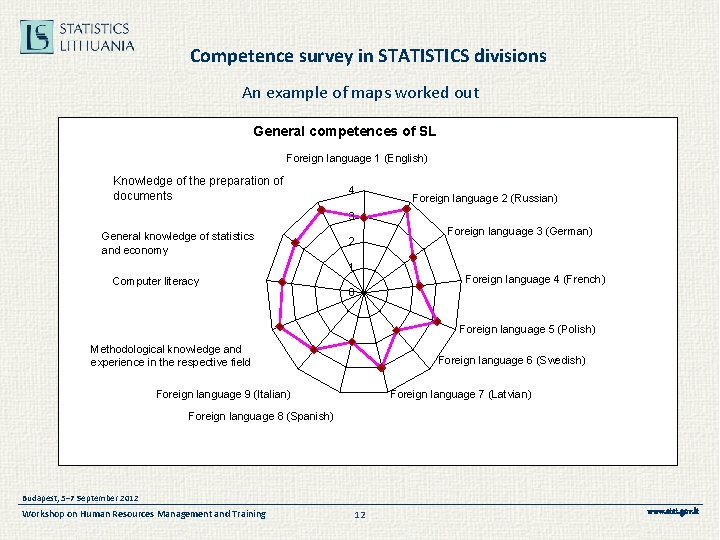
Competence survey in STATISTICS divisions An example of maps worked out General competences of SL Foreign language 1 (English) Knowledge of the preparation of documents 4 Foreign language 2 (Russian) 3 General knowledge of statistics and economy 2 Foreign language 3 (German) 1 Computer literacy Foreign language 4 (French) 0 Foreign language 5 (Polish) Methodological knowledge and experience in the respective field Foreign language 6 (Swedish) Foreign language 9 (Italian) Foreign language 7 (Latvian) Foreign language 8 (Spanish) Budapest, 5– 7 September 2012 Workshop on Human Resources Management and Training 12 www. stat. gov. lt
Competence survey in ADMINISTRATION divisions The questionnaire consists of six main competence areas: q q q Language skills Computer literacy Legal knowledge Administrative capacities Knowledge on quality management Other knowledge and skills necessary to implement activities described in the position description Budapest, 5– 7 September 2012 Workshop on Human Resources Management and Training 13 www. stat. gov. lt
Competence survey in ADMINISTRATION divisions The same scale as for the survey in branch statistics divisions was chosen for the evaluation of competences: q 1 – not competent q 2 – slightly competent q 3 – partly competent q 4 – competent However, since the activities of different functional divisions are quite specific, another scale for evaluation was added to determine the priorities of the competences: ü 1 st priority – competence is needed permanently ü 2 nd priority – competence is needed often ü 3 rd priority – competence is needed seldom ü 4 th priority – competence is not needed Budapest, 5– 7 September 2012 Workshop on Human Resources Management and Training 14 www. stat. gov. lt
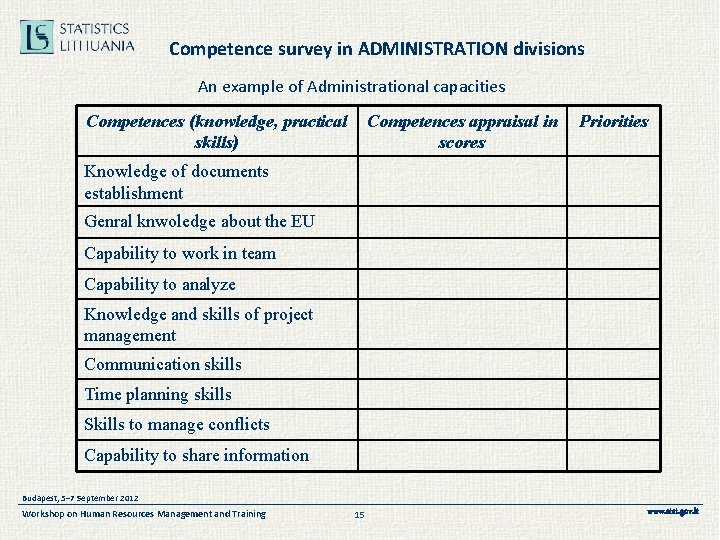
Competence survey in ADMINISTRATION divisions An example of Administrational capacities Competences (knowledge, practical skills) Competences appraisal in scores Priorities Knowledge of documents establishment Genral knwoledge about the EU Capability to work in team Capability to analyze Knowledge and skills of project management Communication skills Time planning skills Skills to manage conflicts Capability to share information Budapest, 5– 7 September 2012 Workshop on Human Resources Management and Training 15 www. stat. gov. lt
Competence appraisal of DIVISION HEADS The questionnaire consists of seven main management competence areas: q. Communication q. Leadership q. Adaptability q. Relationships q. Tasks performance q. Productivity q. Development of employees q. Personal developments Budapest, 5– 7 September 2012 Workshop on Human Resources Management and Training 16 www. stat. gov. lt
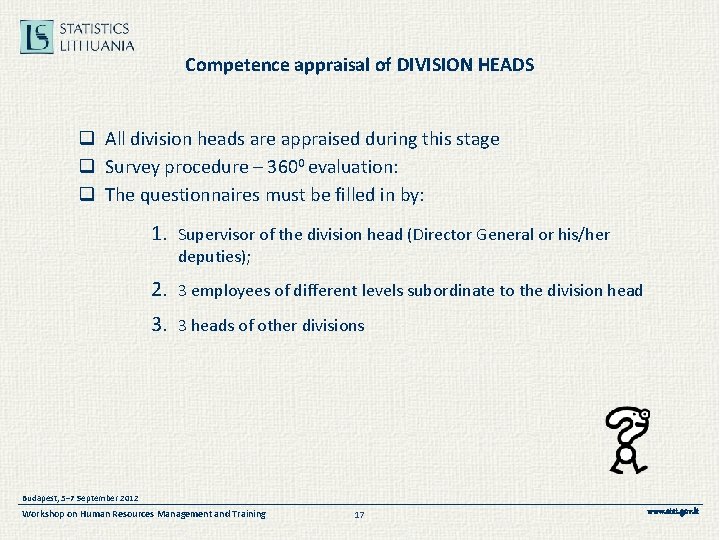
Competence appraisal of DIVISION HEADS q All division heads are appraised during this stage q Survey procedure – 3600 evaluation: q The questionnaires must be filled in by: 1. Supervisor of the division head (Director General or his/her deputies); 2. 3 employees of different levels subordinate to the division head 3. 3 heads of other divisions Budapest, 5– 7 September 2012 Workshop on Human Resources Management and Training 17 www. stat. gov. lt
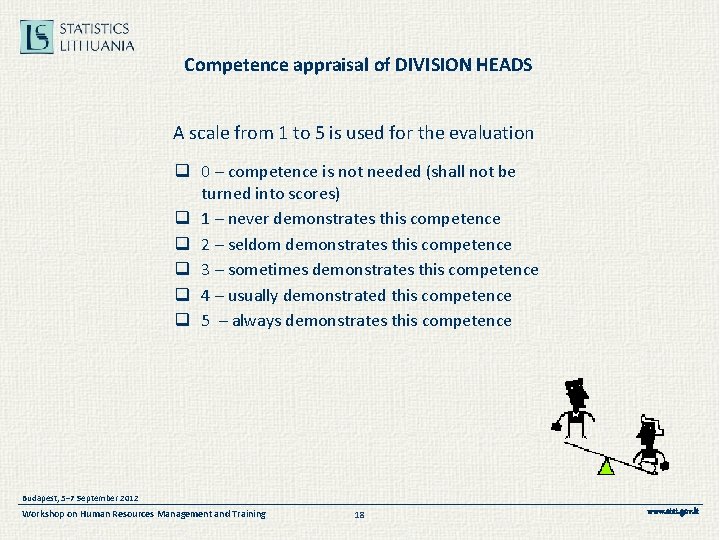
Competence appraisal of DIVISION HEADS A scale from 1 to 5 is used for the evaluation q 0 – competence is not needed (shall not be turned into scores) q 1 – never demonstrates this competence q 2 – seldom demonstrates this competence q 3 – sometimes demonstrates this competence q 4 – usually demonstrated this competence q 5 – always demonstrates this competence Budapest, 5– 7 September 2012 Workshop on Human Resources Management and Training 18 www. stat. gov. lt
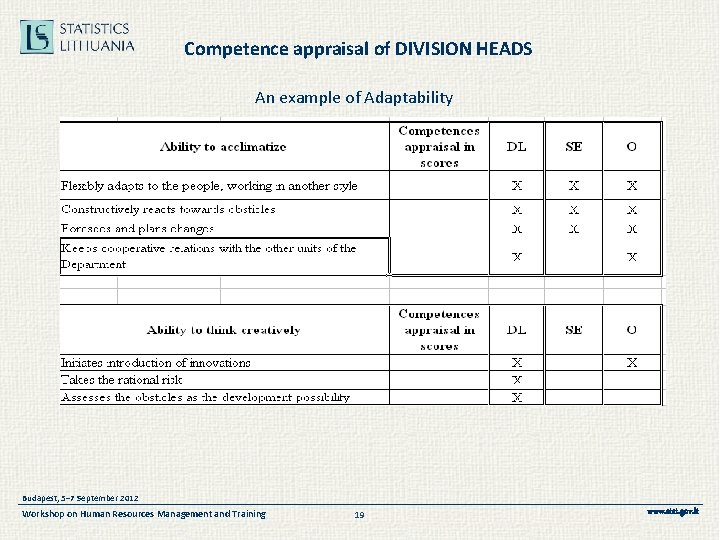
Competence appraisal of DIVISION HEADS An example of Adaptability Budapest, 5– 7 September 2012 Workshop on Human Resources Management and Training 19 www. stat. gov. lt
Surveys outcomes General maps of competences for Statistics Lithuania worked out Maps for each division separately worked out Each individual’s competences found out Identification of personal development needs worked out General maps including appraisals of all heads by different competences produced q Maps for each division head worked out q Two competence development lists worked out: q q q 1. A list of priority competences to be improved 2. A list of competences recommended for improvement Budapest, 5– 7 September 2012 Workshop on Human Resources Management and Training 20 www. stat. gov. lt
DEVELOPEMENT OF A TRAINING PLAN q All employees of SL together with their direct supervisors fill in the Competence Appraisal Questionnaire once in a two-year period. q The Human Resources Division, responsible for training, analyses the questionnaires and makes lists of prioritized and recommended training. q All employees have a performance appraisal interview at the begging of the next year with their supervisor, and both of them agree on the training needs to fulfil the weak areas of the employee. q All other needs are finalized and put in a training list with the financial allocation. q The list training plan is discussed in a special working group. q The final training plan is drawn up. q Director General approves the final training plan. Training plans should correlate with the strategic goals of Statistics Lithuania. Budapest, 5– 7 September 2012 Workshop on Human Resources Management and Training 21 www. stat. gov. lt
SELECTION OF PARTICIPANTS FOR THE COURCES q q From competence appraisal surveys; Announced by direct supervisors and division heads; Announced by the Human Resources Division; Announced by working groups or commissions. Budapest, 5– 7 September 2012 Workshop on Human Resources Management and Training 22 www. stat. gov. lt
TRAINING EFFICIENCY The objective of training efficiency evaluation – to assess whether the employees apply the knowledge and practical skills gained in the training courses organised by Statistics Lithuania when performing the functions assigned to them. We have two-stage training evaluation questionnaires: 1. Primary training efficiency evaluation questionnaire: must be filled in immediately after the end of the training course 2. Secondary training efficiency evaluation questionnaire: must be filled in in 3 months after the end of the training course. Budapest, 5– 7 September 2012 Workshop on Human Resources Management and Training 23 www. stat. gov. lt
Structure of the PRIMARY training efficiency evaluation questionnaire The questionnaire consists of four parts: 1. General information on the training course and its participant. 2. Closed questions that must be answered when evaluating the training course by points from 5 (excellent) to 1 (no opinion), and closed questions that must be answered “Yes” or “No”. 3. The third part includes 2 open questions: 1) The training course participant indicates what specific knowledge and skills gained in the training course s/he will be able to use while performing the functions assigned to him/her. 2) Recommendations on the improvement of the course (not obligatory). 4. The reason why the participant took part in the training course. Budapest, 5– 7 September 2012 Workshop on Human Resources Management and Training 24 www. stat. gov. lt
Structure of the SECONDARY training efficiency evaluation questionnaire Consists of four parts: 1. General information on the training course and its participant. 2. The training course participant indicates whether s/he applied the knowledge and skills gained during the training course in practice when performing the functions assigned to him/her (“Yes” or “No”). 3. The third part is filled in in case the training course participant has chosen the answer “Yes” in the second part. It is stated in brief what knowledge and skills have been applied when performing the functions assigned. 4. The fourth part is filled in by the direct supervisor of the participant in case s/he has chosen the answer “No” in the first part. It is indicated in brief why, in the opinion of the direct supervisor, the participant could not use the knowledge and skills gained in the training course in performing the functions assigned to him/her. In case a division head participated in the training course, s/he fills in the third part of the questionnaire him/herself. Budapest, 5– 7 September 2012 Workshop on Human Resources Management and Training 25 www. stat. gov. lt
Outcomes and results All the information received from the questionnaires is used by the Human Resources Division and a working group for the identification of training needs and development of annual training plans as auxiliary material in the development of training plans, selection of potential training service providers, creation of trining context, etc. Budapest, 5– 7 September 2012 Workshop on Human Resources Management and Training 26 www. stat. gov. lt
INVOLVEMENT OF EMPLOYEES q. Bank of ideas q. Staff satisfaction (opinion) survey q. Internal website (LAN) q. Questions and Answers section q. Staff turnover questionnaire q. Non-financial incentives q. Open days (with top management) q. Internal communication working group q. Meetings q. Time reporting system Budapest, 5– 7 September 2012 Workshop on Human Resources Management and Training 27 www. stat. gov. lt
THANK YOU FOR YOUR ATTENTION Budapest, 5– 7 September 2012 Workshop on Human Resources Management and Training 28 www. stat. gov. lt