Topic 2 Mechanics 2 2 Forces Essential idea
- Slides: 48
Topic 2: Mechanics 2. 2 – Forces Essential idea: Classical physics requires a force to change a state of motion, as suggested by Newton in his laws of motion. Nature of science: (1) Using mathematics: Isaac Newton provided the basis for much of our understanding of forces and motion by formalizing the previous work of scientists through the application of mathematics by inventing calculus to assist with this. (2) Intuition: The tale of the falling apple describes simply one of the many flashes of intuition that went into the publication of Philosophiæ Naturalis Principia Mathematica in 1687.
Topic 2: Mechanics 2. 2 – Forces Understandings: • Objects as point particles • Free-body diagrams • Translational equilibrium • Newton’s laws of motion • Solid friction
Topic 2: Mechanics 2. 2 – Forces Applications and skills: • Representing forces as vectors • Sketching and interpreting free-body diagrams • Describing the consequences of Newton’s first law for translational equilibrium • Using Newton’s second law quantitatively and qualitatively • Identifying force pairs in the context of Newton’s third law • Solving problems involving forces and determining resultant force • Describing solid friction (static and dynamic) by coefficients of friction
Topic 2: Mechanics 2. 2 – Forces Guidance: • Students should label forces using commonly accepted names or symbols (for example: weight or force of gravity or mg) • Free-body diagrams should show scaled vector lengths acting from the point of application • Examples and questions will be limited to constant mass • mg should be identified as weight • Calculations relating to the determination of resultant forces will be restricted to one- and two-dimensional situations
Topic 2: Mechanics 2. 2 – Forces Data booklet reference: • F = ma • Ff ≤ µs. R • F f = µ d. R Theory of knowledge: • Classical physics believed that the whole of the future of the universe could be predicted from knowledge of the present state. To what extent can knowledge of the present give us knowledge of the future?
Topic 2: Mechanics 2. 2 – Forces Utilization: • Motion of charged particles in fields (see Physics subtopics 5. 4, 6. 1, 11. 1, 12. 2) • Application of friction in circular motion (see Physics sub-topic 6. 1) • Construction (considering ancient and modern approaches to safety, longevity and consideration of local weather and geological influences) • Biomechanics (see Sports, exercise and health science SL sub-topic 4. 3)
Topic 2: Mechanics 2. 2 – Forces Aims: • Aims 2 and 3: Newton’s work is often described by the quote from a letter he wrote to his rival, Robert Hooke, which states: “What Descartes did was a good step. You have added much [in] several ways. If I have seen a little further it is by standing on the shoulders of Giants. ” This quote is also inspired, this time by writers who had been using versions of it for at least 500 years before Newton’s time. • Aim 6: experiments could include (but are not limited to): verification of Newton’s second law; investigating forces in equilibrium; determination of the effects of friction.
Topic 2: Mechanics 2. 2 – Forces Representing forces as vectors A ______ is a ______ measured in _____. One force we are very familiar with is the force of gravity, also known as the _______. The very concepts of push and pull imply direction. Thus ___________. The direction of the weight is ______ toward the center of the earth. If you have a weight of 90 Newtons (or 90 N), your weight can be expressed as a vector: 90 N, down. We will show later that weight has the formula where g = -9. 8 m s -2 weight and m is the mass in kg
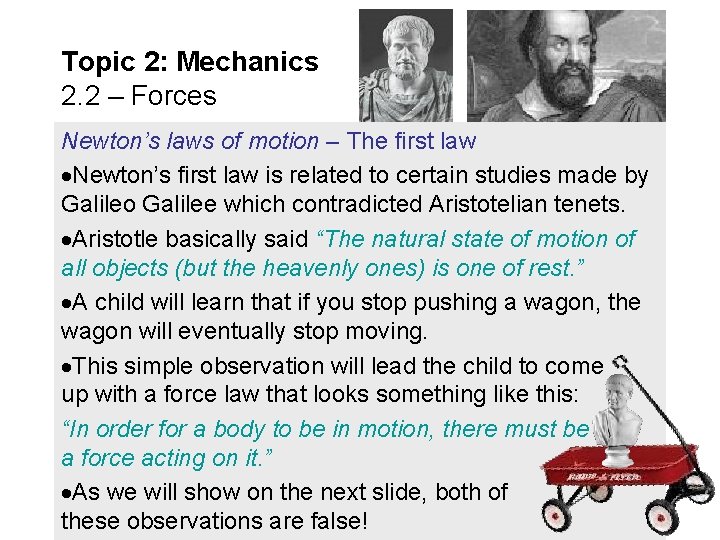
Topic 2: Mechanics 2. 2 – Forces Newton’s laws of motion – The first law Newton’s first law is related to certain studies made by Galileo Galilee which contradicted Aristotelian tenets. Aristotle basically said “The natural state of motion of all objects (but the heavenly ones) is one of rest. ” A child will learn that if you stop pushing a wagon, the wagon will eventually stop moving. This simple observation will lead the child to come up with a force law that looks something like this: “In order for a body to be in motion, there must be a force acting on it. ” As we will show on the next slide, both of these observations are false!
Topic 2: Mechanics 2. 2 – Forces Inertia will only change if there is a force. Newton’s laws of motion – The first law Here’s how Galileo (1564 -1642) thought: If I give a cart a push on a smooth, level surface, it will eventually stop. What can I do to increase the distance it rolls without pushing it harder or changing the slope? If I can minimize the friction, it’ll go farther. In fact, he reasoned, if I eliminate the friction altogether the cart will roll forever! Galileo called the tendency of an object to not change its state of motion _____.
Topic 2: Mechanics 2. 2 – Forces A body’s velocity will only change if there is a net force acting on it. Describing the consequences of Newton’s first law for translational equilibrium Newton’s first law is drawn from his concept of net force and Galileo’s concept of inertia. Newton’s first law says that _________________________________. In his words. . . “Every body continues in its state of rest, or of uniform motion in a straight line, unless it is compelled to change that state by forces impressed thereon. ” In symbols. . . Newton’s first law ______________________
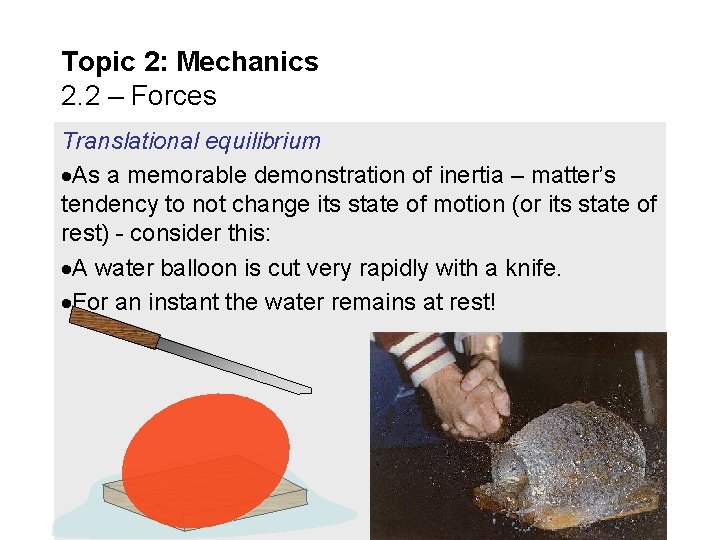
Topic 2: Mechanics 2. 2 – Forces Translational equilibrium As a memorable demonstration of inertia – matter’s tendency to not change its state of motion (or its state of rest) - consider this: A water balloon is cut very rapidly with a knife. For an instant the water remains at rest!
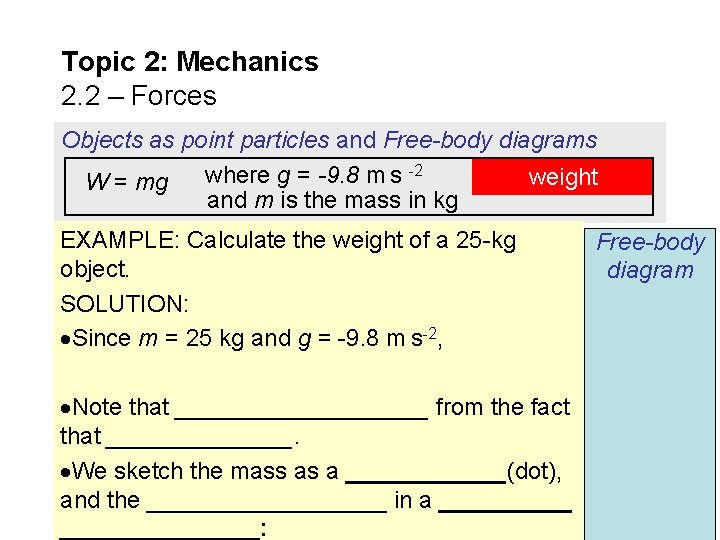
Topic 2: Mechanics 2. 2 – Forces Objects as point particles and Free-body diagrams -2 where g = -9. 8 m s weight W = mg and m is the mass in kg EXAMPLE: Calculate the weight of a 25 -kg object. SOLUTION: Since m = 25 kg and g = -9. 8 m s-2, Note that __________ from the fact that _______. We sketch the mass as a ______(dot), and the _________ in a _______________: Free-body diagram
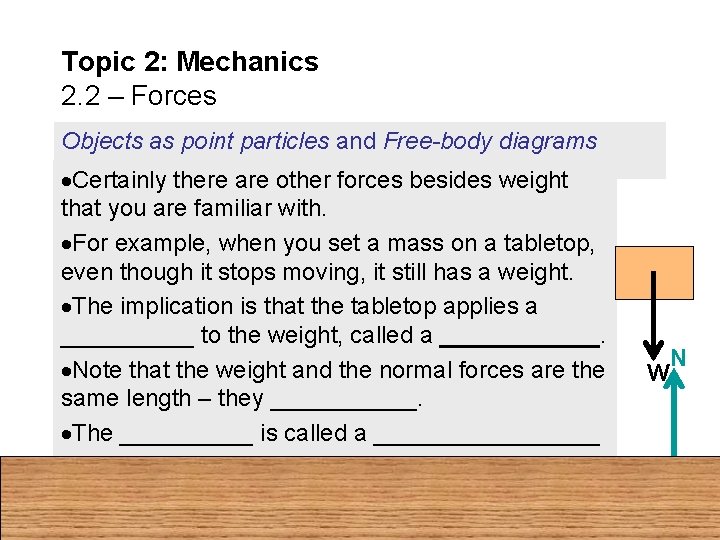
Topic 2: Mechanics 2. 2 – Forces Objects as point particles and Free-body diagrams Certainly there are other forces besides weight that you are familiar with. For example, when you set a mass on a tabletop, even though it stops moving, it still has a weight. The implication is that the tabletop applies a _____ to the weight, called a ______. Note that the weight and the normal forces are the same length – they ______. The _____ is called a _________ N W
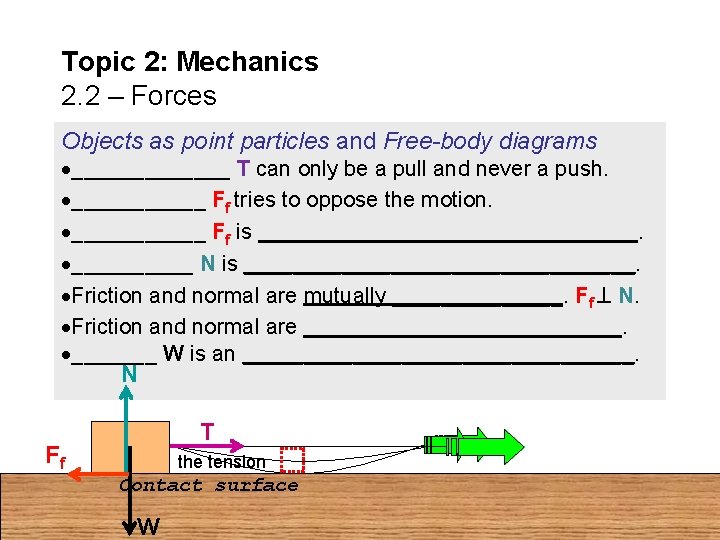
Topic 2: Mechanics 2. 2 – Forces Objects as point particles and Free-body diagrams _______ T can only be a pull and never a push. ______ Ff tries to oppose the motion. ______ Ff is ________________. _____ N is ________________. Friction and normal are mutually _______. Ff N. Friction and normal are _____________. _______ W is an ________________. N T Ff the tension Contact surface W
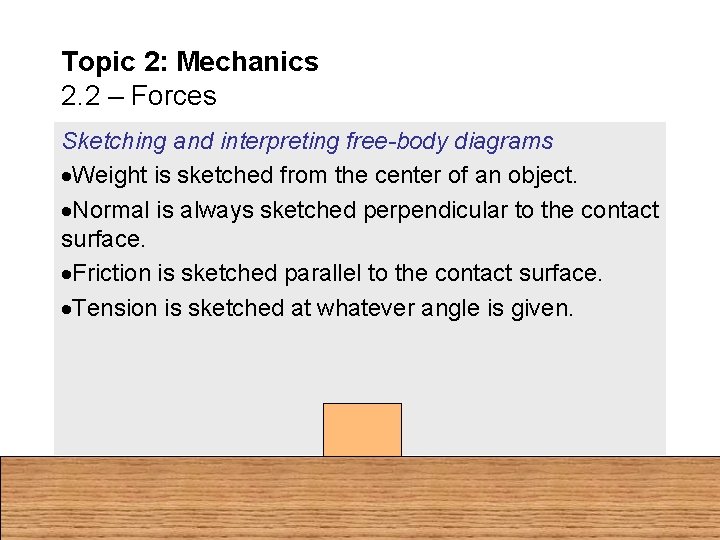
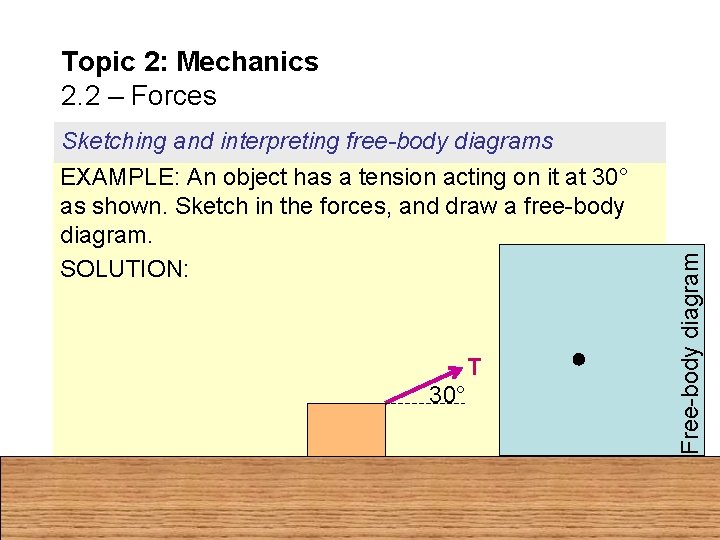
Topic 2: Mechanics 2. 2 – Forces Sketching and interpreting free-body diagrams Weight is sketched from the center of an object. Normal is always sketched perpendicular to the contact surface. Friction is sketched parallel to the contact surface. Tension is sketched at whatever angle is given.
Topic 2: Mechanics 2. 2 – Forces EXAMPLE: An object has a tension acting on it at 30° as shown. Sketch in the forces, and draw a free-body diagram. SOLUTION: T 30° Free-body diagram Sketching and interpreting free-body diagrams
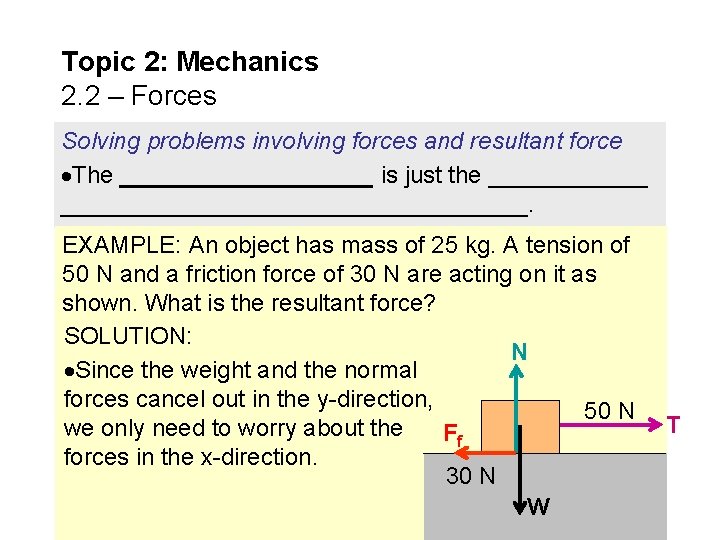
Topic 2: Mechanics 2. 2 – Forces Solving problems involving forces and resultant force The __________ is just the ________________________. EXAMPLE: An object has mass of 25 kg. A tension of 50 N and a friction force of 30 N are acting on it as shown. What is the resultant force? SOLUTION: N Since the weight and the normal forces cancel out in the y-direction, 50 N we only need to worry about the Ff forces in the x-direction. 30 N W T
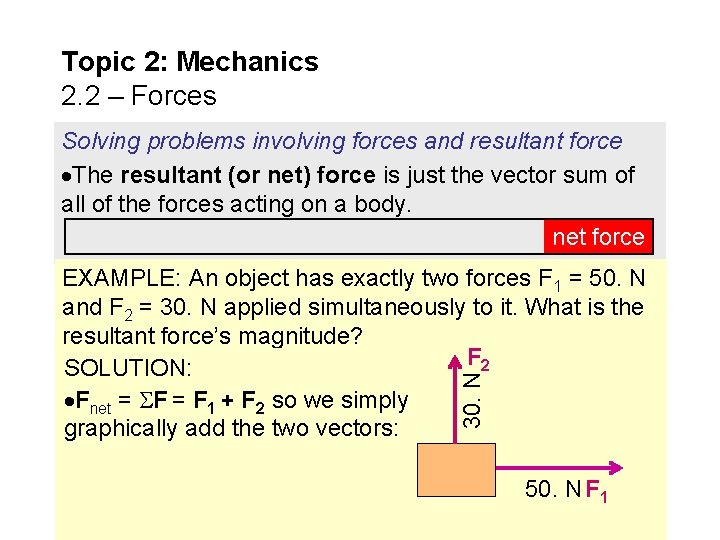
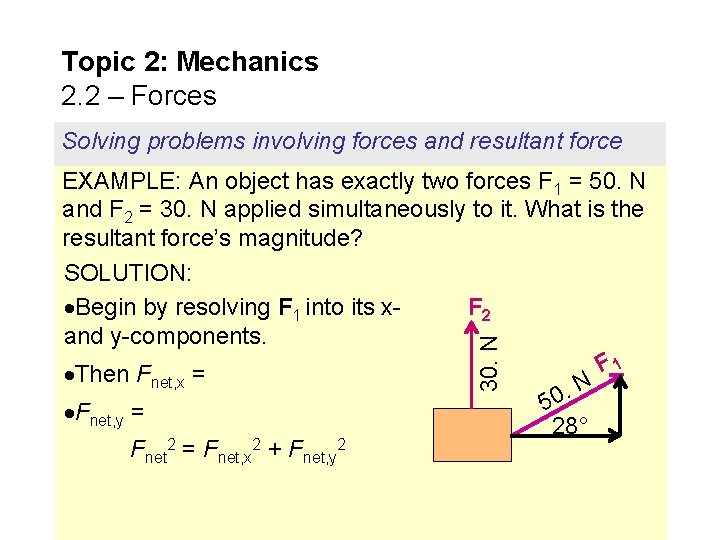
Topic 2: Mechanics 2. 2 – Forces Solving problems involving forces and resultant force The resultant (or net) force is just the vector sum of all of the forces acting on a body. net force 30. N EXAMPLE: An object has exactly two forces F 1 = 50. N and F 2 = 30. N applied simultaneously to it. What is the resultant force’s magnitude? F 2 SOLUTION: Fnet = F 1 + F 2 so we simply graphically add the two vectors: 50. N F 1
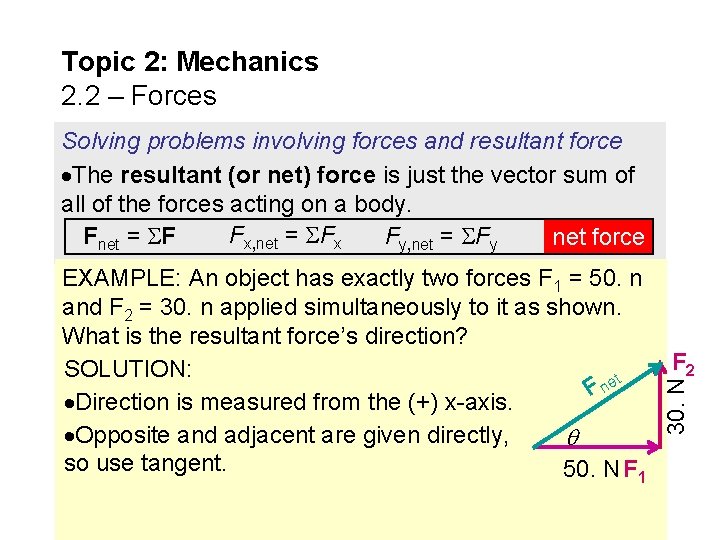
Topic 2: Mechanics 2. 2 – Forces Solving problems involving forces and resultant force The resultant (or net) force is just the vector sum of all of the forces acting on a body. Fx, net = Fx Fnet = F Fy, net = Fy net force F 2 30. N EXAMPLE: An object has exactly two forces F 1 = 50. n and F 2 = 30. n applied simultaneously to it as shown. What is the resultant force’s direction? SOLUTION: t F ne Direction is measured from the (+) x-axis. Opposite and adjacent are given directly, so use tangent. 50. N F 1
Topic 2: Mechanics 2. 2 – Forces Solving problems involving forces and resultant force 30. N EXAMPLE: An object has exactly two forces F 1 = 50. N and F 2 = 30. N applied simultaneously to it. What is the resultant force’s magnitude? SOLUTION: Begin by resolving F 1 into its x. F 2 and y-components. F 1 Then Fnet, x =. N 0 5 Fnet, y = 28° Fnet 2 = Fnet, x 2 + Fnet, y 2
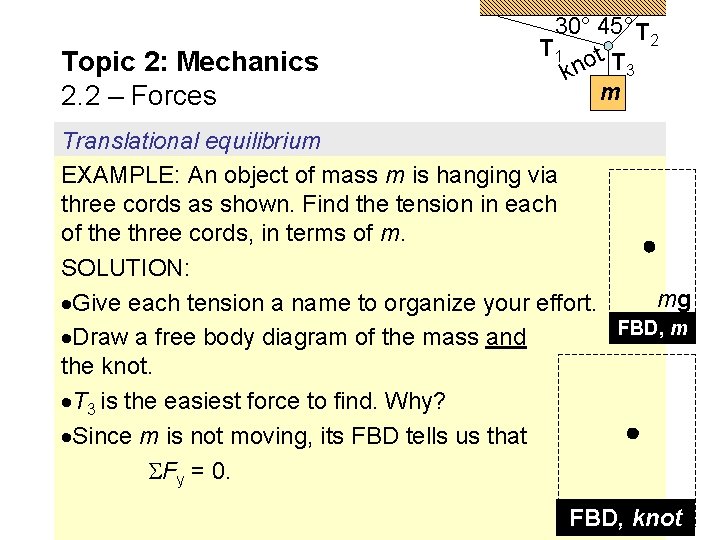
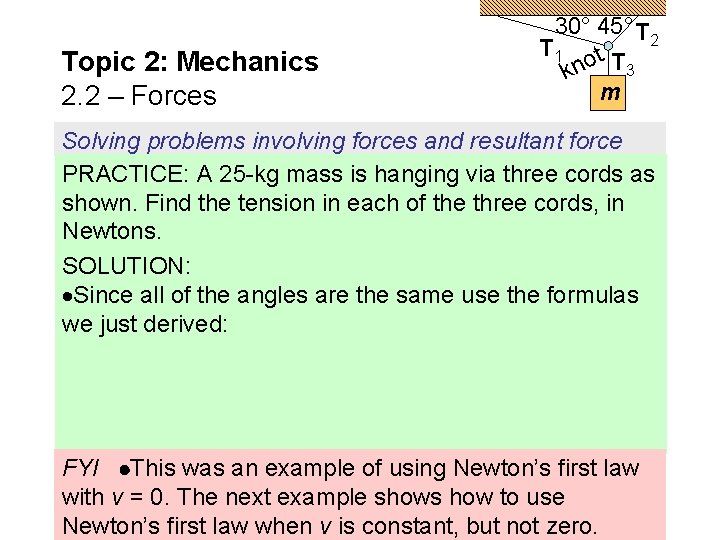
Topic 2: Mechanics 2. 2 – Forces 30° 45° T 2 T 1 t. T o n 3 k m Translational equilibrium EXAMPLE: An object of mass m is hanging via three cords as shown. Find the tension in each of the three cords, in terms of m. SOLUTION: mg Give each tension a name to organize your effort. FBD, m Draw a free body diagram of the mass and the knot. T 3 is the easiest force to find. Why? Since m is not moving, its FBD tells us that Fy = 0. FBD, knot
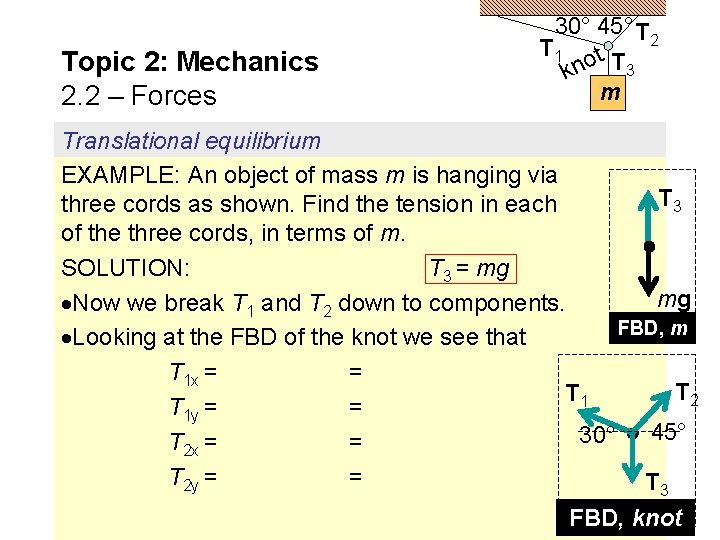
Topic 2: Mechanics 2. 2 – Forces 30° 45° T 2 T 1 t. T o n 3 k m Translational equilibrium EXAMPLE: An object of mass m is hanging via T 3 three cords as shown. Find the tension in each of the three cords, in terms of m. SOLUTION: T 3 = mg mg Now we break T 1 and T 2 down to components. FBD, m Looking at the FBD of the knot we see that T 1 x = = T 2 T 1 y = = 30° 45° T 2 x = = T 2 y = = T 3 FBD, knot
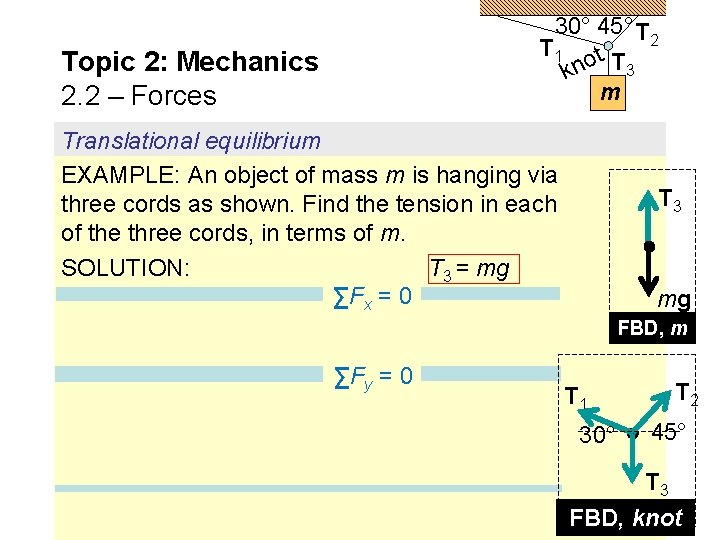
30° 45° T 2 T 1 t. T o n 3 k m Topic 2: Mechanics 2. 2 – Forces Translational equilibrium EXAMPLE: An object of mass m is hanging via three cords as shown. Find the tension in each of the three cords, in terms of m. SOLUTION: T 3 = mg ∑Fx = 0 T 3 mg FBD, m ∑Fy = 0 T 2 T 1 30° 45° T 3 FBD, knot
Topic 2: Mechanics 2. 2 – Forces 30° 45° T 2 T 1 t. T o n 3 k m Solving problems involving forces and resultant force PRACTICE: A 25 -kg mass is hanging via three cords as shown. Find the tension in each of the three cords, in Newtons. SOLUTION: Since all of the angles are the same use the formulas we just derived: FYI This was an example of using Newton’s first law with v = 0. The next example shows how to use Newton’s first law when v is constant, but not zero.
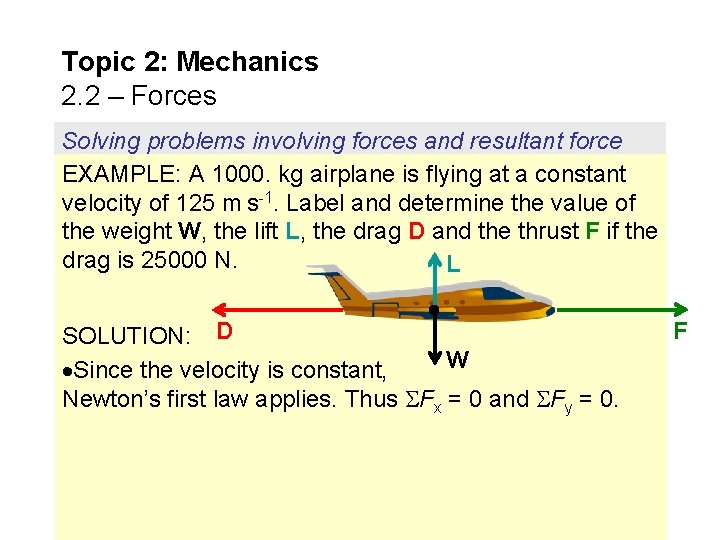
Topic 2: Mechanics 2. 2 – Forces Solving problems involving forces and resultant force EXAMPLE: A 1000. kg airplane is flying at a constant velocity of 125 m s-1. Label and determine the value of the weight W, the lift L, the drag D and the thrust F if the drag is 25000 N. L SOLUTION: D W Since the velocity is constant, Newton’s first law applies. Thus Fx = 0 and Fy = 0. F
Topic 2: Mechanics 2. 2 – Forces Newton’s laws of motion – The second law Newton reasoned: ________________________________ Newton knew (as we also know) that a change in velocity is an acceleration. So Newton then asked himself: “How is the sum of the forces related to the acceleration? ” Here is what Newton said: _________________________________ The bigger the force the bigger the acceleration, and the bigger the mass the smaller the acceleration. Newton’s second law
Topic 2: Mechanics 2. 2 – Forces Newton’s laws of motion – The second law Fnet = ma (or F = ma ) Newton’s second law Looking at the form F = ma note that _____________. But if ________________. Thus Newton’s first law is just a special case of his second – namely, when the acceleration is zero. FYI The condition ______ can is thus the ____________________, just as ____ is.
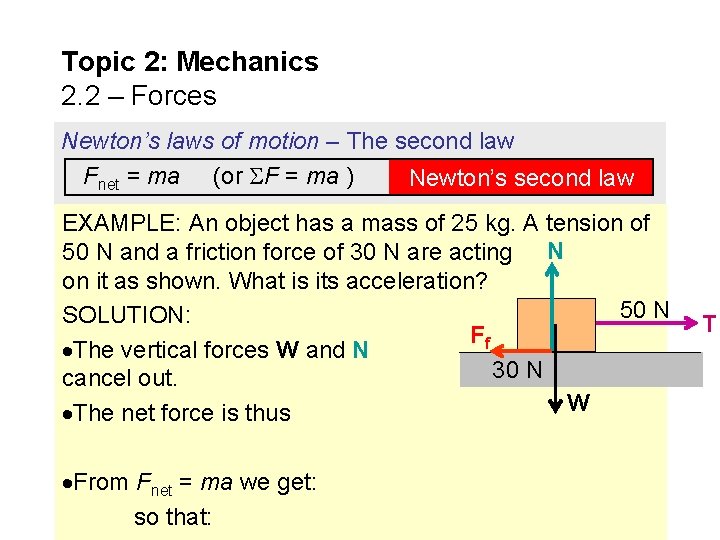
Topic 2: Mechanics 2. 2 – Forces Newton’s laws of motion – The second law Fnet = ma (or F = ma ) Newton’s second law EXAMPLE: An object has a mass of 25 kg. A tension of 50 N and a friction force of 30 N are acting N on it as shown. What is its acceleration? 50 N SOLUTION: Ff The vertical forces W and N 30 N cancel out. W The net force is thus From Fnet = ma we get: so that: T
Topic 2: Mechanics 2. 2 – Forces Newton’s laws of motion – The second law Fnet = ma (or F = ma ) Newton’s second law PRACTICE: Use F = ma to show that the formula for weight is correct. SOLUTION:
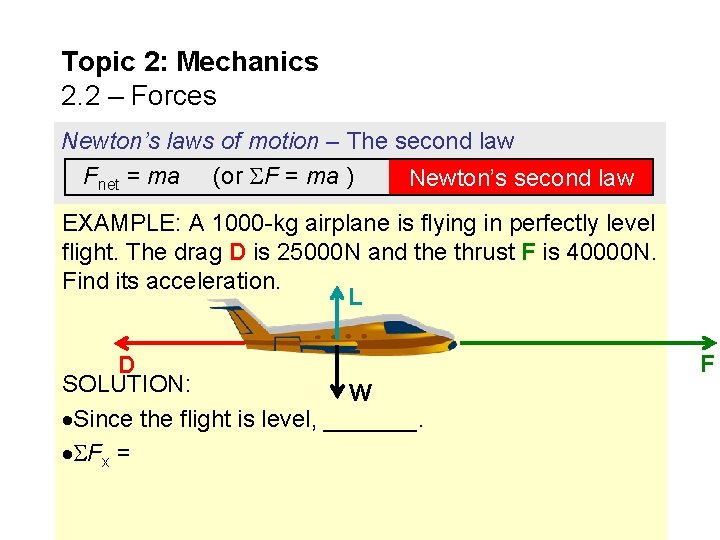
Topic 2: Mechanics 2. 2 – Forces Newton’s laws of motion – The second law Fnet = ma (or F = ma ) Newton’s second law EXAMPLE: A 1000 -kg airplane is flying in perfectly level flight. The drag D is 25000 N and the thrust F is 40000 N. Find its acceleration. L D SOLUTION: W Since the flight is level, _______. Fx = F
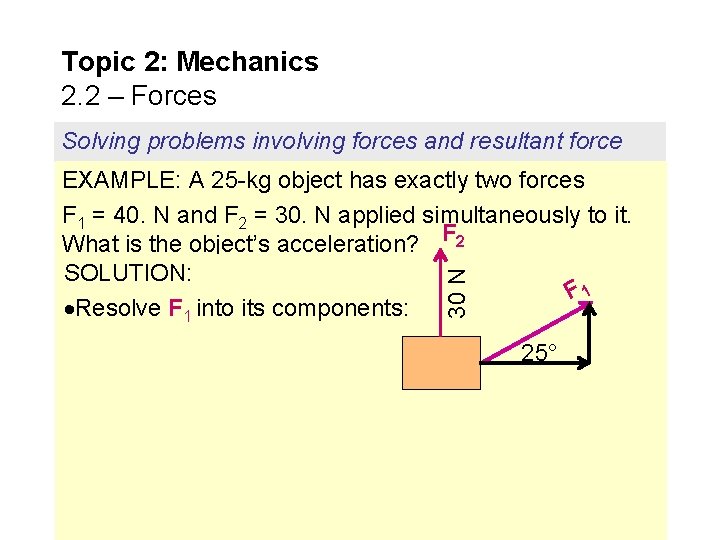
Topic 2: Mechanics 2. 2 – Forces Solving problems involving forces and resultant force 30 N EXAMPLE: A 25 -kg object has exactly two forces F 1 = 40. N and F 2 = 30. N applied simultaneously to it. What is the object’s acceleration? F 2 SOLUTION: F 1 Resolve F 1 into its components: 25°
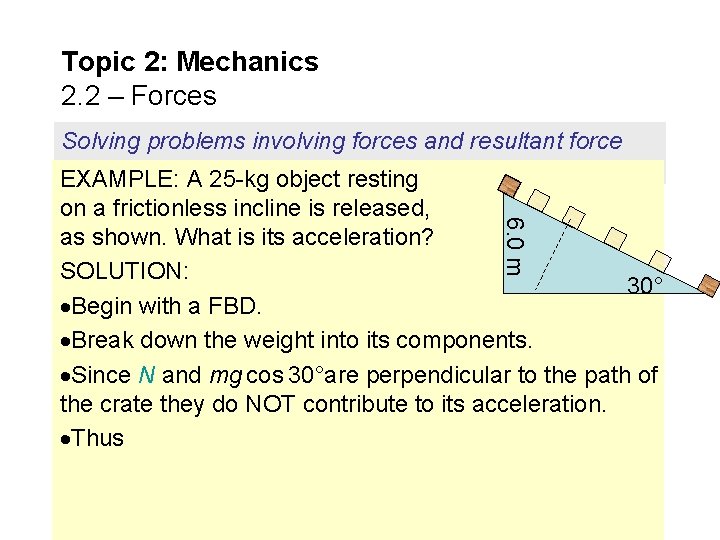
Topic 2: Mechanics 2. 2 – Forces Solving problems involving forces and resultant force 6. 0 m EXAMPLE: A 25 -kg object resting on a frictionless incline is released, as shown. What is its acceleration? SOLUTION: 30° Begin with a FBD. Break down the weight into its components. Since N and mg cos 30°are perpendicular to the path of the crate they do NOT contribute to its acceleration. Thus
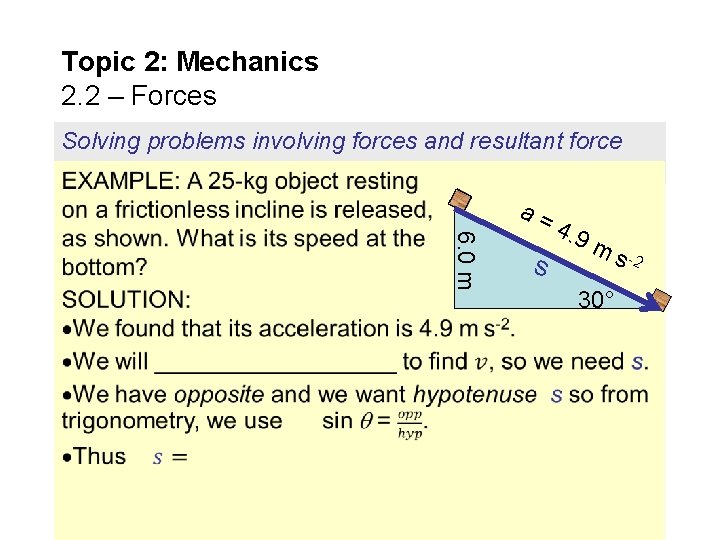
Topic 2: Mechanics 2. 2 – Forces Solving problems involving forces and resultant force a= 6. 0 m s 4. 9 ms- 2 30°
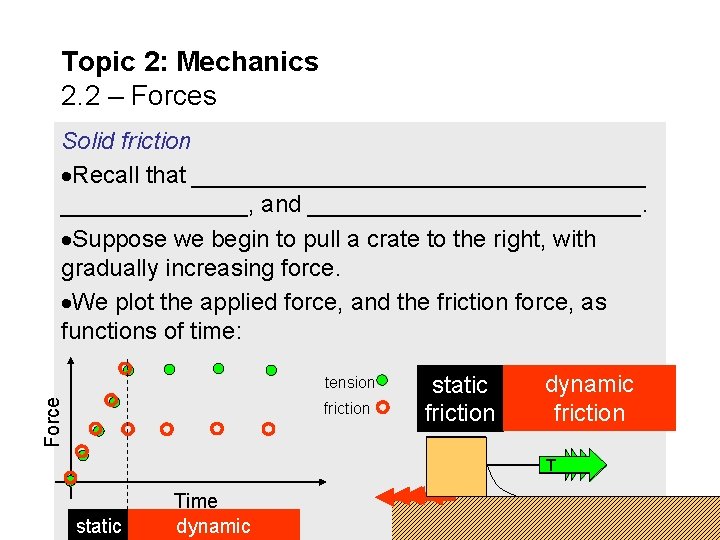
Topic 2: Mechanics 2. 2 – Forces Solid friction Recall that _________________, and _____________. Suppose we begin to pull a crate to the right, with gradually increasing force. We plot the applied force, and the friction force, as functions of time: Force tension friction static Time dynamic static friction f dynamic friction T
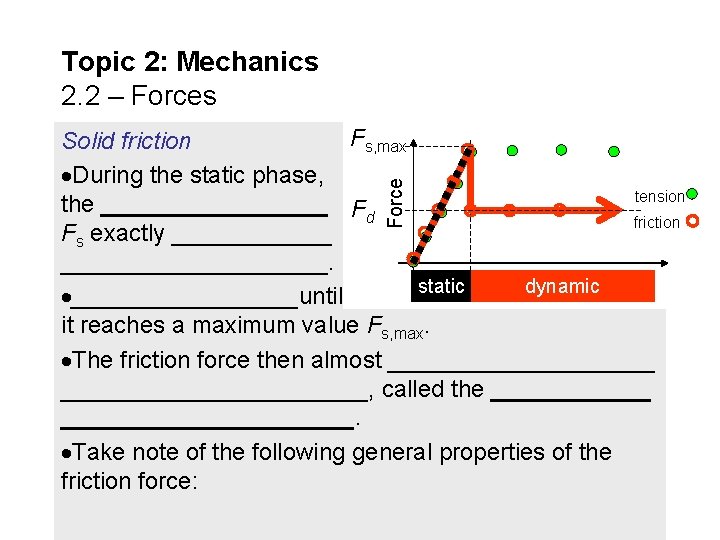
Topic 2: Mechanics 2. 2 – Forces Force Fs, max Solid friction During the static phase, tension the _________ Fd friction Fs exactly ________________. Time static dynamic _________until it reaches a maximum value Fs, max. The friction force then almost _______________________, called the _________________. Take note of the following general properties of the friction force:
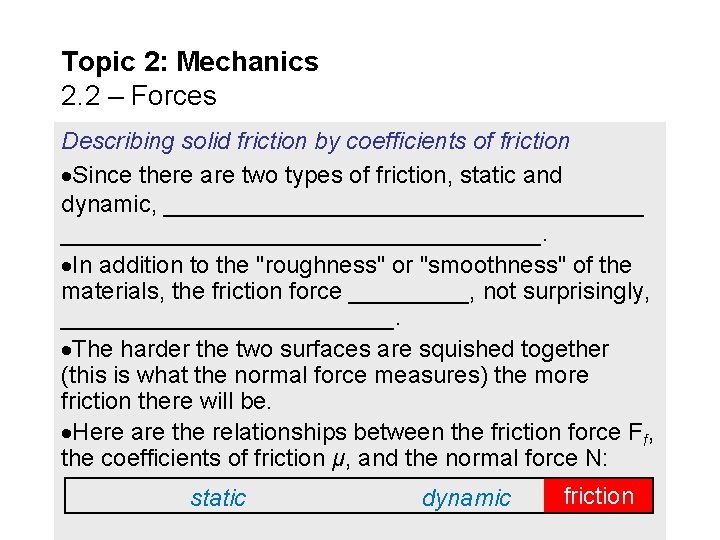
Topic 2: Mechanics 2. 2 – Forces Describing solid friction by coefficients of friction Since there are two types of friction, static and dynamic, ____________________________________. In addition to the "roughness" or "smoothness" of the materials, the friction force _____, not surprisingly, _____________. The harder the two surfaces are squished together (this is what the normal force measures) the more friction there will be. Here are the relationships between the friction force Ff, the coefficients of friction μ, and the normal force N: static dynamic friction
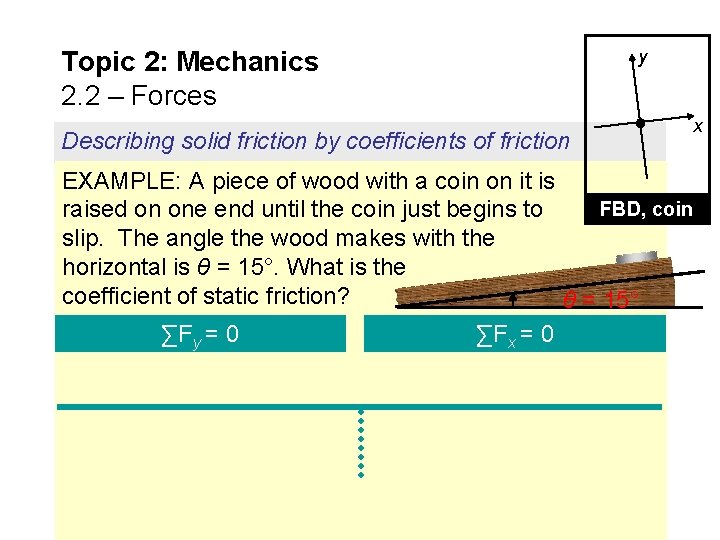
Topic 2: Mechanics 2. 2 – Forces Describing solid friction by coefficients of friction y x EXAMPLE: A piece of wood with a coin on it is FBD, coin raised on one end until the coin just begins to slip. The angle the wood makes with the horizontal is θ = 15°. What is the coefficient of static friction? θ = 15° ∑Fy = 0 ∑Fx = 0
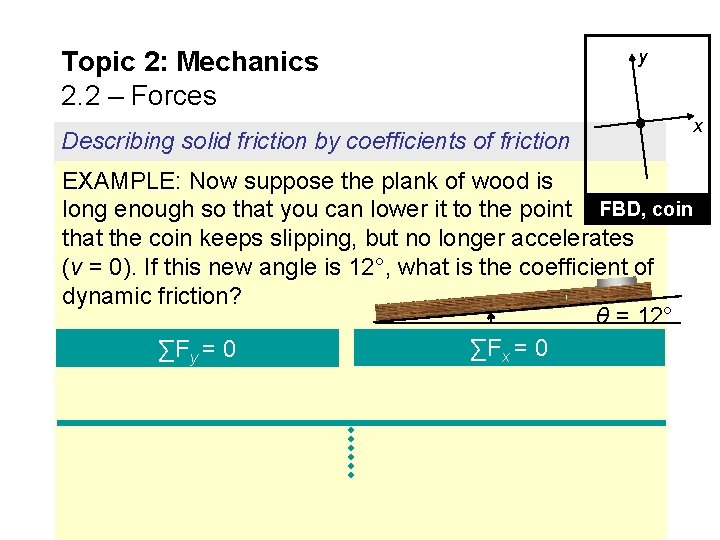
Topic 2: Mechanics 2. 2 – Forces Describing solid friction by coefficients of friction y x EXAMPLE: Now suppose the plank of wood is long enough so that you can lower it to the point FBD, coin that the coin keeps slipping, but no longer accelerates (v = 0). If this new angle is 12°, what is the coefficient of dynamic friction? θ = 12° ∑Fx = 0 ∑Fy = 0
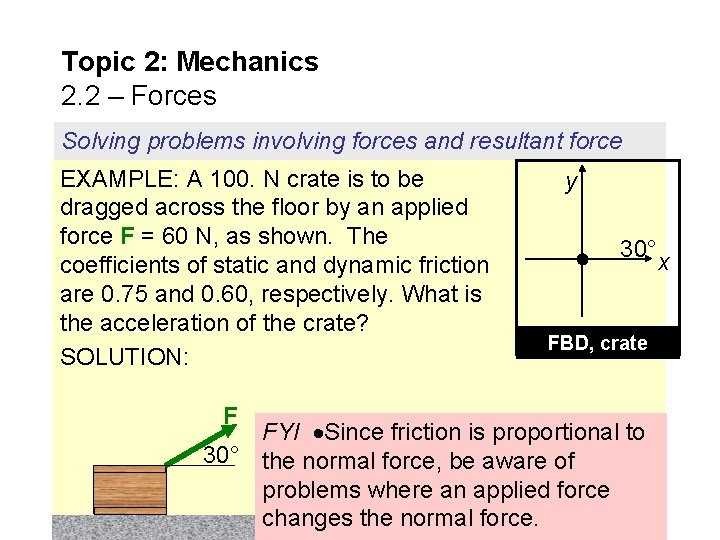
Topic 2: Mechanics 2. 2 – Forces Solving problems involving forces and resultant force EXAMPLE: A 100. N crate is to be dragged across the floor by an applied force F = 60 N, as shown. The coefficients of static and dynamic friction are 0. 75 and 0. 60, respectively. What is the acceleration of the crate? SOLUTION: F y 30° FBD, crate FYI Since friction is proportional to 30° the normal force, be aware of problems where an applied force changes the normal force. x
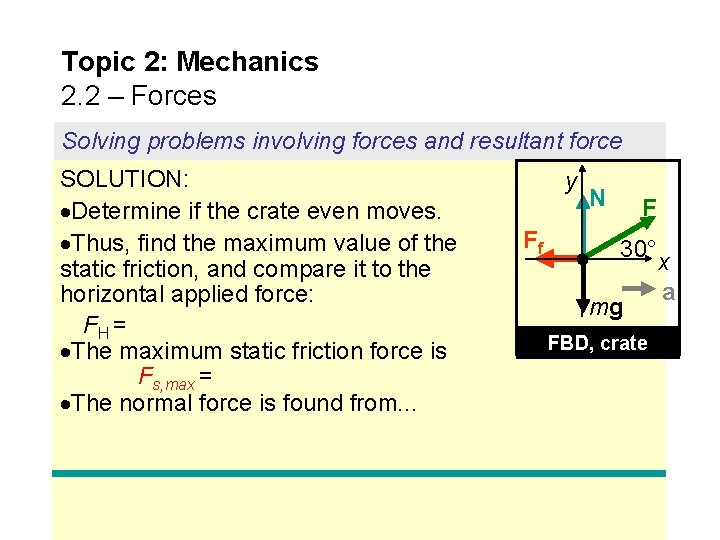
Topic 2: Mechanics 2. 2 – Forces Solving problems involving forces and resultant force SOLUTION: Determine if the crate even moves. Thus, find the maximum value of the static friction, and compare it to the horizontal applied force: FH = The maximum static friction force is Fs, max = The normal force is found from. . . y Ff N F 30° mg FBD, crate x a
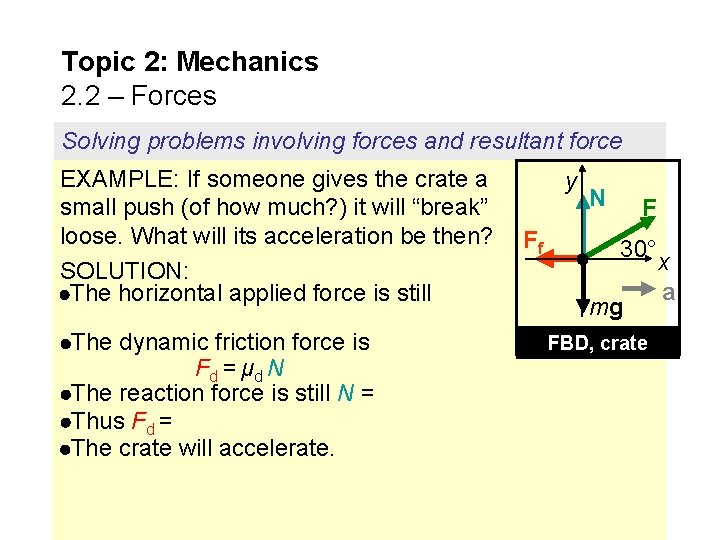
Topic 2: Mechanics 2. 2 – Forces Solving problems involving forces and resultant force EXAMPLE: If someone gives the crate a small push (of how much? ) it will “break” loose. What will its acceleration be then? SOLUTION: The horizontal applied force is still The dynamic friction force is Fd = μd N The reaction force is still N = Thus Fd = The crate will accelerate. y Ff N F 30° mg FBD, crate x a
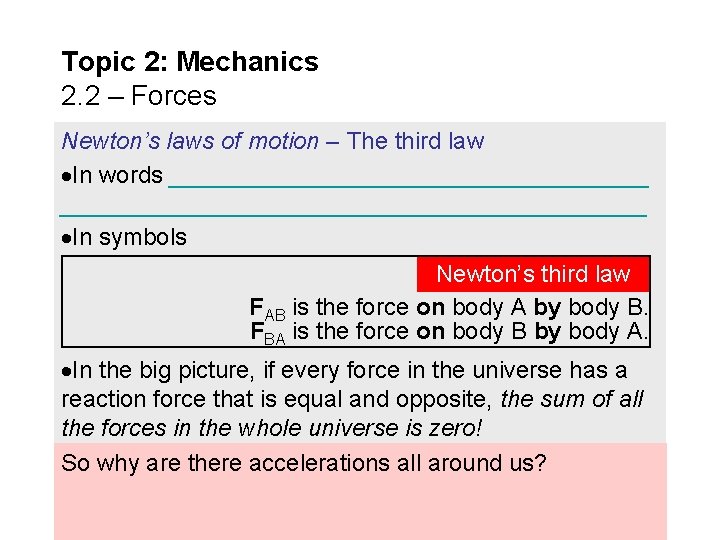
Topic 2: Mechanics 2. 2 – Forces Newton’s laws of motion – The third law In words ________________________________________ In symbols Newton’s third law FAB is the force on body A by body B. FBA is the force on body B by body A. In the big picture, if every force in the universe has a reaction force that is equal and opposite, the sum of all the forces in the whole universe is zero! So why are there accelerations all around us?
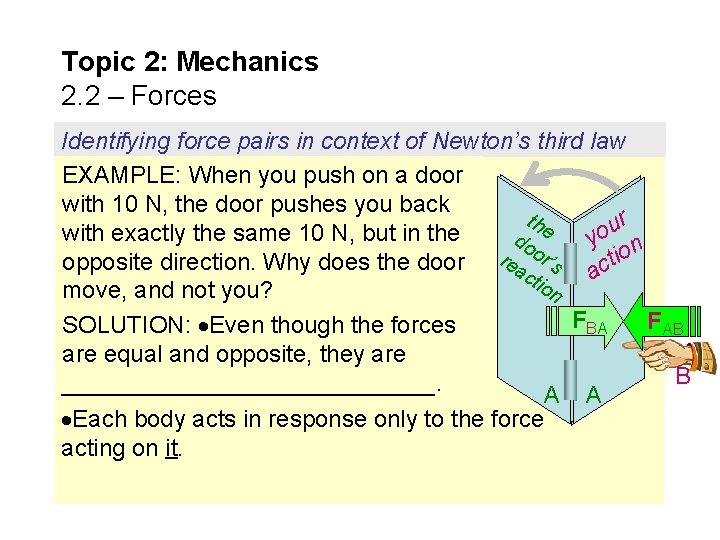
Topic 2: Mechanics 2. 2 – Forces Identifying force pairs in context of Newton’s third law EXAMPLE: When you push on a door with 10 N, the door pushes you back the r u o with exactly the same 10 N, but in the do y n or o i r t ’ e opposite direction. Why does the door ac s ac tio n move, and not you? FBA FAB SOLUTION: Even though the forces are equal and opposite, they are B ______________. A A Each body acts in response only to the force acting on it.
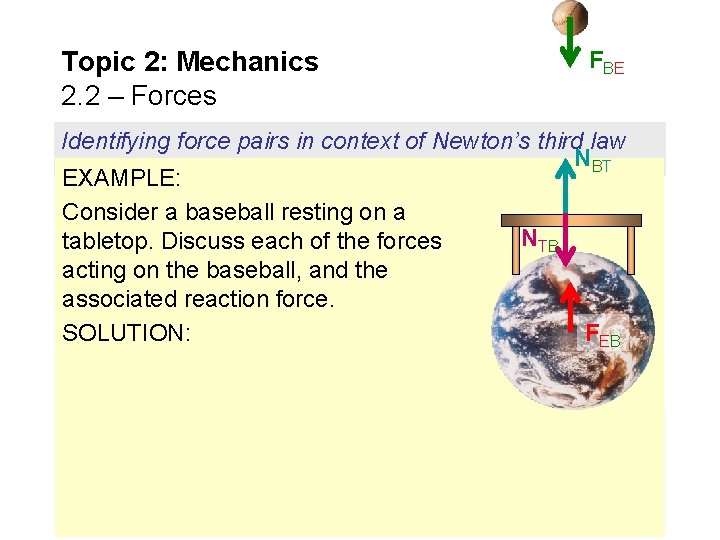
Topic 2: Mechanics 2. 2 – Forces FBE Identifying force pairs in context of Newton’s third law NBT EXAMPLE: Consider a baseball resting on a NTB tabletop. Discuss each of the forces acting on the baseball, and the associated reaction force. SOLUTION: FEB
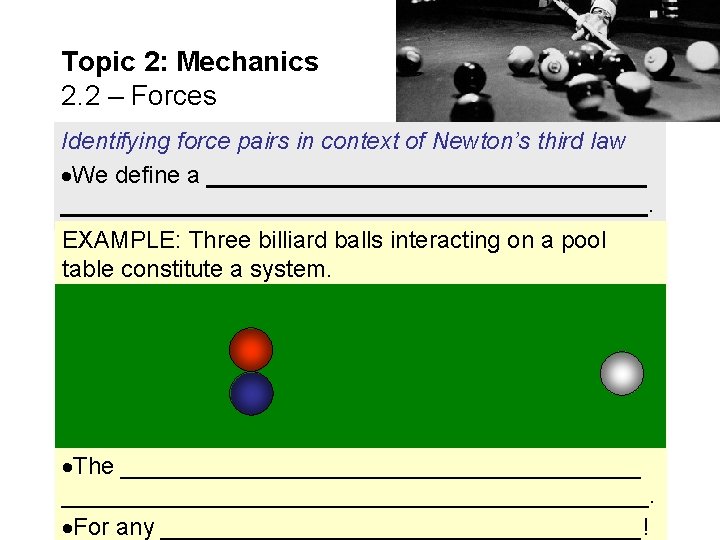
Topic 2: Mechanics 2. 2 – Forces Identifying force pairs in context of Newton’s third law We define a _______________________________________. EXAMPLE: Three billiard balls interacting on a pool table constitute a system. The ____________________________________________. For any __________________!
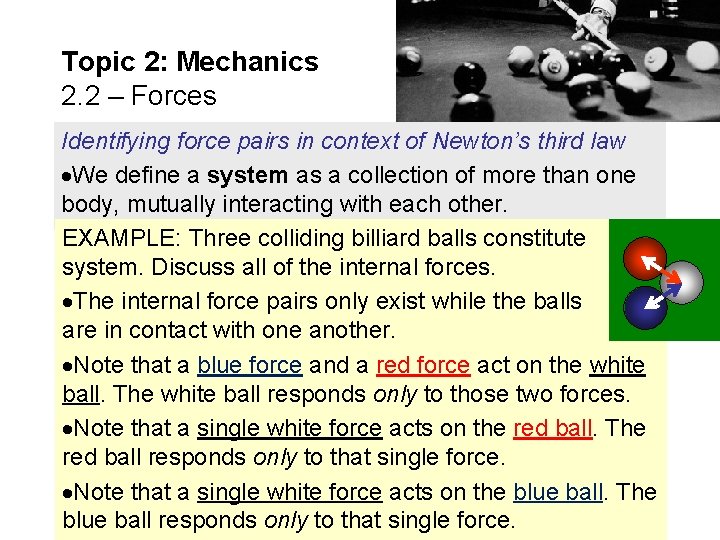
Topic 2: Mechanics 2. 2 – Forces Identifying force pairs in context of Newton’s third law We define a system as a collection of more than one body, mutually interacting with each other. EXAMPLE: Three colliding billiard balls constitute a system. Discuss all of the internal forces. The internal force pairs only exist while the balls are in contact with one another. Note that a blue force and a red force act on the white ball. The white ball responds only to those two forces. Note that a single white force acts on the red ball. The red ball responds only to that single force. Note that a single white force acts on the blue ball. The blue ball responds only to that single force.
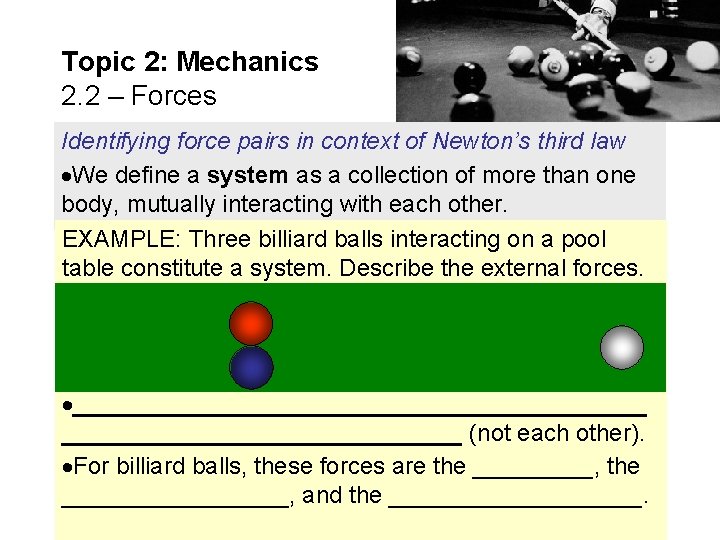
Topic 2: Mechanics 2. 2 – Forces Identifying force pairs in context of Newton’s third law We define a system as a collection of more than one body, mutually interacting with each other. EXAMPLE: Three billiard balls interacting on a pool table constitute a system. Describe the external forces. ______________________ (not each other). For billiard balls, these forces are the _____, the _________, and the __________.