
Overview of WIDA Standards and Assessments for International

- Slides: 64
Overview of WIDA Standards and Assessments for International Contexts ECIS November 22, 2014 Nice, France Jesse Markow Director-State Relations and Strategic Development WIDA Dr. Christine Wilson EAL Specialist for the American School of London © 2014 Board of Regents of the University of Wisconsin System, on behalf of the WIDA Consortium www. wida. us
WIDA Consortium Standards Adoption: FL, ID, & PR 36 WIDA States represent approximately 1, 500, 000 ELLs 2 © 2014 Board of Regents of the University of Wisconsin System, on behalf of the WIDA Consortium www. wida. us
International School Consortium The WIDA International Schools Consortium (WISC) is a network of international schools that use WIDA's research-based standards and assessments. This network is managed by WIDA’s non-profit partner, the Wisconsin Center for Education Products and Services (WCEPS), and provides support across the spectrum of international school needs. https: //wisc. wceps. org/ 3 © 2014 Board of Regents of the University of Wisconsin System, on behalf of the WIDA Consortium www. wida. us
What Undergirds WIDA’s Language Development Standards? Its research-based Language Development Principles The construct of academic language Theoretical foundations Its CAN DO Philosophy 4 © 2014 Board of Regents of the University of Wisconsin System, on behalf of the WIDA Consortium www. wida. us
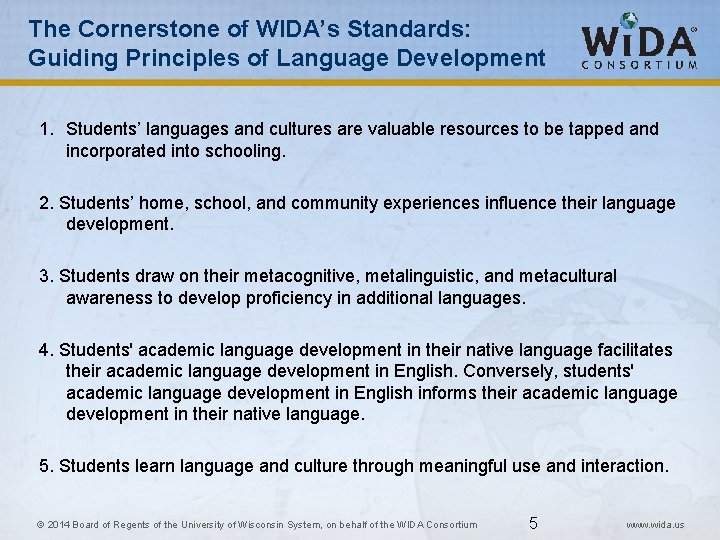
The Cornerstone of WIDA’s Standards: Guiding Principles of Language Development 1. Students’ languages and cultures are valuable resources to be tapped and incorporated into schooling. 2. Students’ home, school, and community experiences influence their language development. 3. Students draw on their metacognitive, metalinguistic, and metacultural awareness to develop proficiency in additional languages. 4. Students' academic language development in their native language facilitates their academic language development in English. Conversely, students' academic language development in English informs their academic language development in their native language. 5. Students learn language and culture through meaningful use and interaction. 5 © 2014 Board of Regents of the University of Wisconsin System, on behalf of the WIDA Consortium www. wida. us
The Cornerstone of WIDA’s Standards: Guiding Principles of Language Development 6. Students use language in functional and communicative ways that vary according to context. 7. Students develop language proficiency in listening, speaking, reading, and writing interdependently, but at different rates and in different ways. 8. Students’ development of academic language and academic content knowledge are inter-related processes. 9. Students' development of social, instructional, and academic language, a complex and long-term process, is the foundation for their success in school. 10. Students’ access to instructional tasks requiring complex thinking is enhanced when linguistic complexity and instructional support match their levels of language proficiency. 6 © 2014 Board of Regents of the University of Wisconsin System, on behalf of the WIDA Consortium www. wida. us
Academic Language The single most important determinant of academic success (Frances, et. al, 2006) The language of school used to acquire newer and deeper understanding of content subjects (Gottlieb, Katz, & Ernst. Slavit, 2009) Academic language is the hidden curriculum of school (Christie, 1985) 7 © 2014 Board of Regents of the University of Wisconsin System, on behalf of the WIDA Consortium www. wida. us
Our Language Framework is Built on the Work of Systemic Functional Linguists One cannot “do” science with everyday language (Halliday, 1993). Language learning is represented by multifaceted and multidimensional language competencies within systemic frameworks (Gibbons, 2006) Learning content means learning the language of that content area (Schleppegrell, 2004) 8 © 2014 Board of Regents of the University of Wisconsin System, on behalf of the WIDA Consortium www. wida. us
CAN DO Philosophy WIDA embraces inclusion and equity with its CAN DO philosophy. We focus our attention on expanding students' academic language by building on the inherent resources of English language learners (ELLs) and accentuating the positive efforts of educators. 9 © 2014 Board of Regents of the University of Wisconsin System, on behalf of the WIDA Consortium www. wida. us
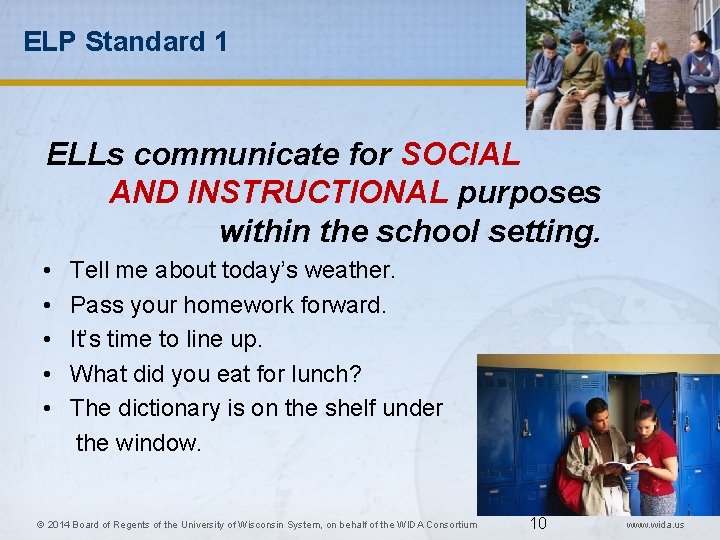
ELP Standard 1 ELLs communicate for SOCIAL AND INSTRUCTIONAL purposes within the school setting. • Tell me about today’s weather. • Pass your homework forward. • It’s time to line up. • What did you eat for lunch? • The dictionary is on the shelf under the window. 10 © 2014 Board of Regents of the University of Wisconsin System, on behalf of the WIDA Consortium www. wida. us
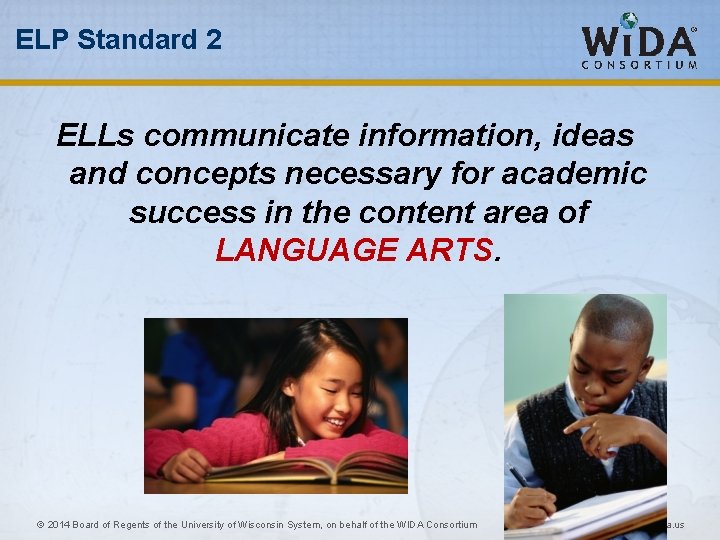
ELP Standard 2 ELLs communicate information, ideas and concepts necessary for academic success in the content area of LANGUAGE ARTS. 11 © 2014 Board of Regents of the University of Wisconsin System, on behalf of the WIDA Consortium www. wida. us
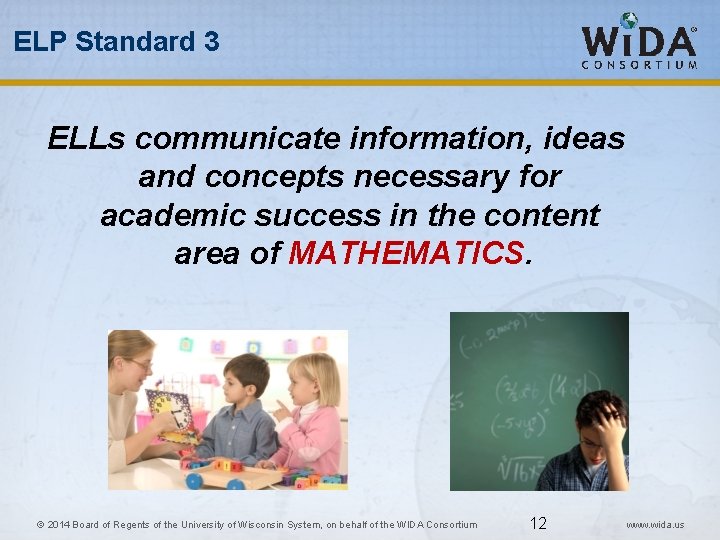
ELP Standard 3 ELLs communicate information, ideas and concepts necessary for academic success in the content area of MATHEMATICS. 12 © 2014 Board of Regents of the University of Wisconsin System, on behalf of the WIDA Consortium www. wida. us
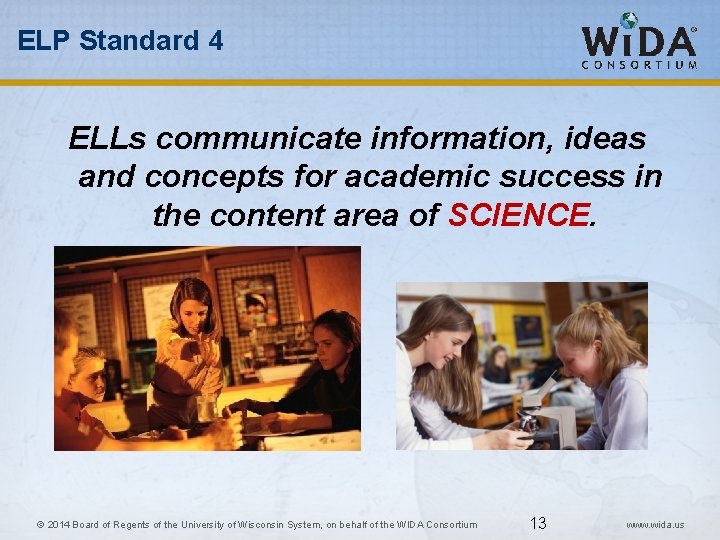
ELP Standard 4 ELLs communicate information, ideas and concepts for academic success in the content area of SCIENCE. 13 © 2014 Board of Regents of the University of Wisconsin System, on behalf of the WIDA Consortium www. wida. us
ELP Standard 5 ELLs communicate information, ideas and concepts for academic success in the content area of SOCIAL STUDIES. 14 © 2014 Board of Regents of the University of Wisconsin System, on behalf of the WIDA Consortium www. wida. us
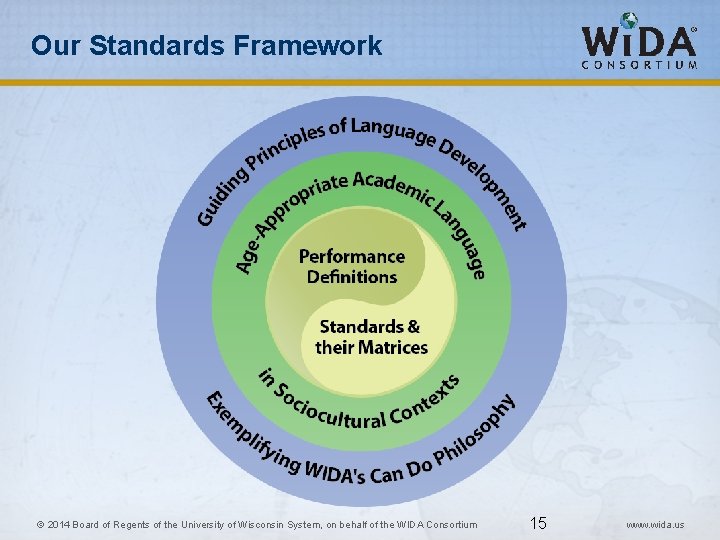
Our Standards Framework 15 © 2014 Board of Regents of the University of Wisconsin System, on behalf of the WIDA Consortium www. wida. us
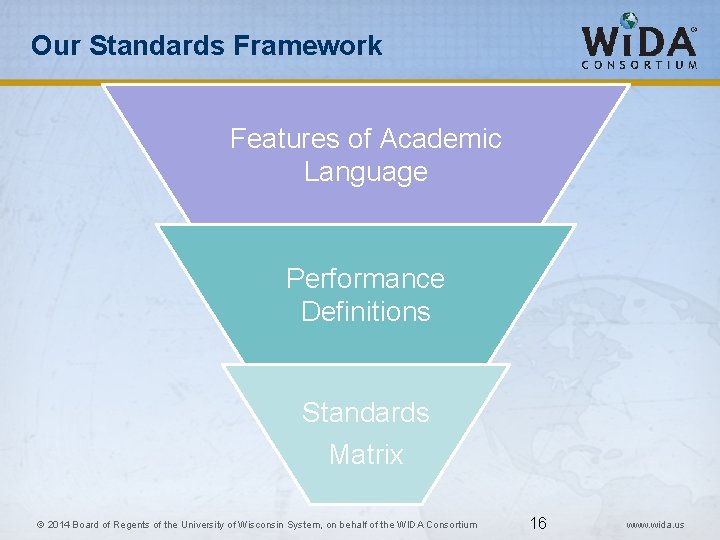
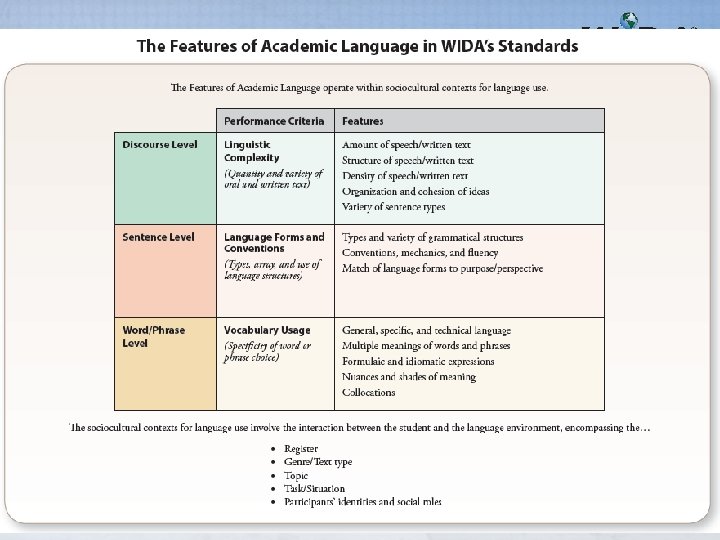
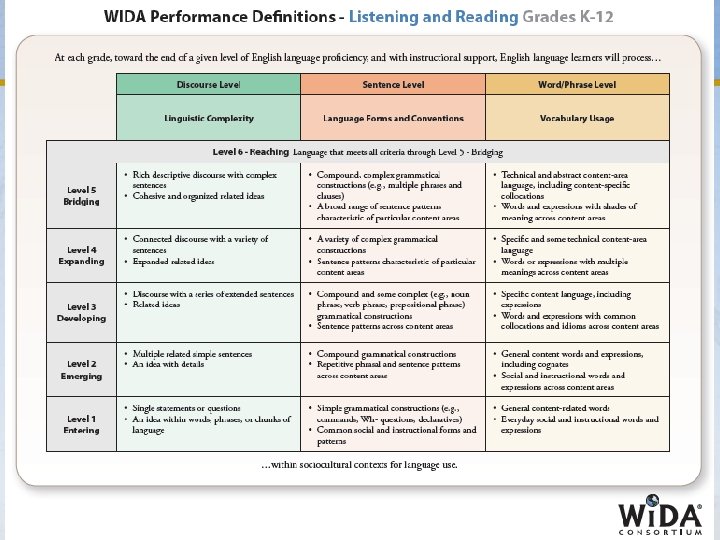
Our Standards Framework Features of Academic Language Performance Definitions Standards Matrix 16 © 2014 Board of Regents of the University of Wisconsin System, on behalf of the WIDA Consortium www. wida. us
17 © 2014 Board of Regents of the University of Wisconsin System, on behalf of the WIDA Consortium www. wida. us
18 © 2014 Board of Regents of the University of Wisconsin System, on behalf of the WIDA Consortium www. wida. us
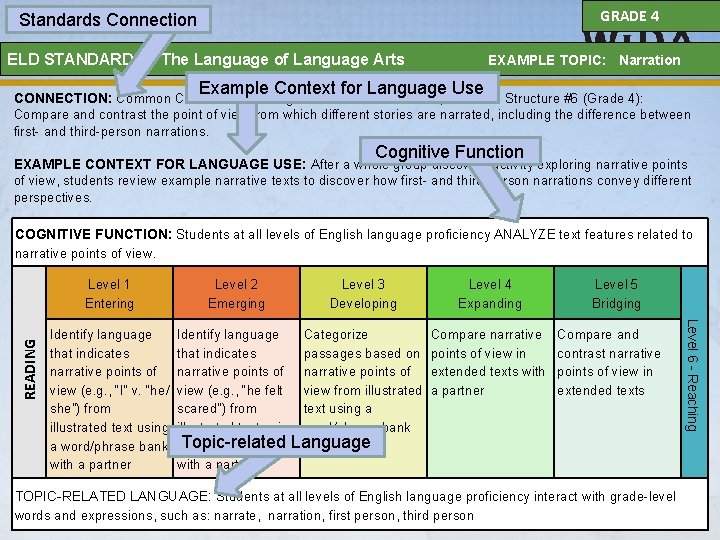
GRADE 4 Standards Connection ELD STANDARD 2 - The Language of Language Arts EXAMPLE TOPIC: Narration Example Context for Language Use CONNECTION: Common Core State Reading Standards for Literature, Craft and Structure #6 (Grade 4): Compare and contrast the point of view from which different stories are narrated, including the difference between first- and third-person narrations. Cognitive Function EXAMPLE CONTEXT FOR LANGUAGE USE: After a whole group discovery activity exploring narrative points of view, students review example narrative texts to discover how first- and third-person narrations convey different perspectives. COGNITIVE FUNCTION: Students at all levels of English language proficiency ANALYZE text features related to narrative points of view. Level 2 Emerging Level 3 Developing Level 4 Expanding Level 5 Bridging Identify language Categorize Compare narrative that indicates passages based on points of view in narrative points of extended texts with view (e. g. , “I” v. “he/ view (e. g. , “he felt view from illustrated a partner she”) from scared”) from text using a illustrated text using word/phrase bank Topic-related Language a word/phrase bank with a partner Compare and contrast narrative points of view in extended texts TOPIC-RELATED LANGUAGE: Students at all levels of English language proficiency interact with grade-level words and expressions, such as: narrate, narration, first person, third person 19 © 2014 Board of Regents of the University of Wisconsin System, on behalf of the WIDA Consortium www. wida. us Level 6 - Reaching READING Level 1 Entering
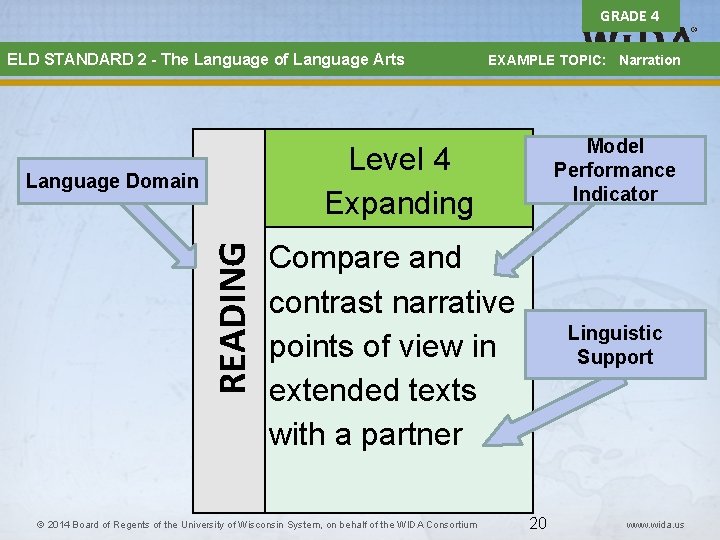
GRADE 4 ELD STANDARD 2 - The Language of Language Arts EXAMPLE TOPIC: Narration Model Performance Indicator Level 4 Expanding READING Language Domain Compare and contrast narrative points of view in extended texts with a partner 20 Linguistic Support © 2014 Board of Regents of the University of Wisconsin System, on behalf of the WIDA Consortium www. wida. us
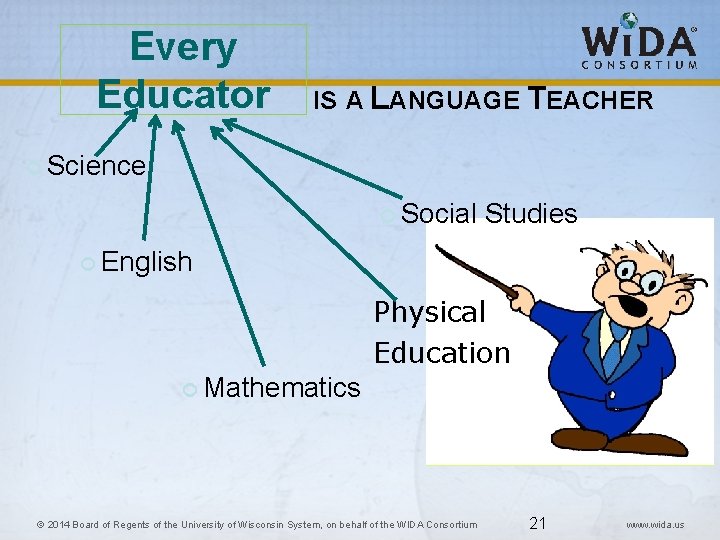
Every Educator IS A LANGUAGE TEACHER Science Social Studies English Physical Education Mathematics 21 © 2014 Board of Regents of the University of Wisconsin System, on behalf of the WIDA Consortium www. wida. us
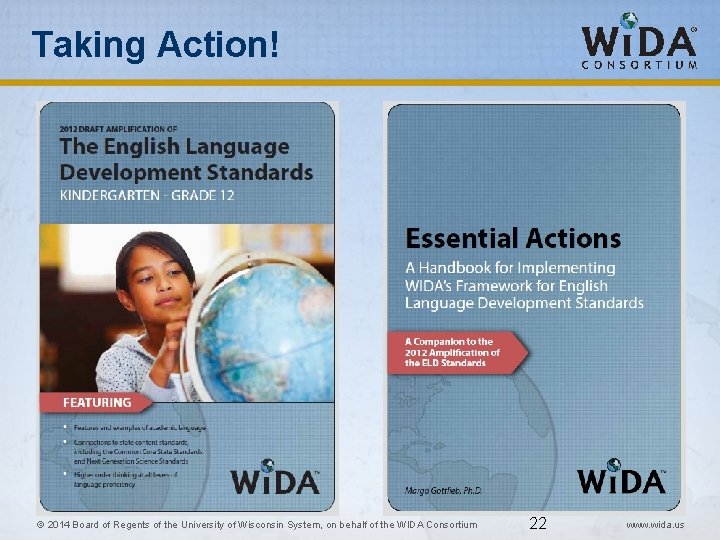
Taking Action! 22 © 2014 Board of Regents of the University of Wisconsin System, on behalf of the WIDA Consortium www. wida. us
Essential Actions Handbook • 15 Actions • Research-based Evidence for each Action • A Representation of each Action in the WIDA Standards Framework • Putting each Action into Practice • Educator Vignettes • Discussion Questions 23 © 2014 Board of Regents of the University of Wisconsin System, on behalf of the WIDA Consortium www. wida. us
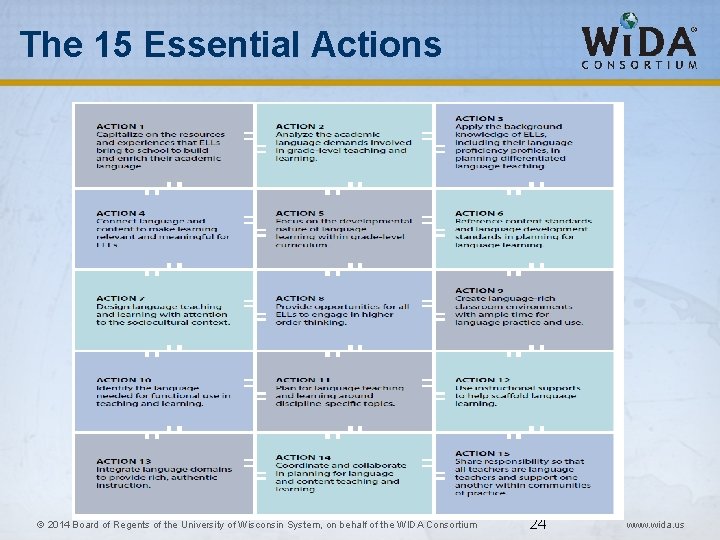
The 15 Essential Actions 24 © 2014 Board of Regents of the University of Wisconsin System, on behalf of the WIDA Consortium www. wida. us
In the Field: American School in London 25 © 2014 Board of Regents of the University of Wisconsin System, on behalf of the WIDA Consortium www. wida. us
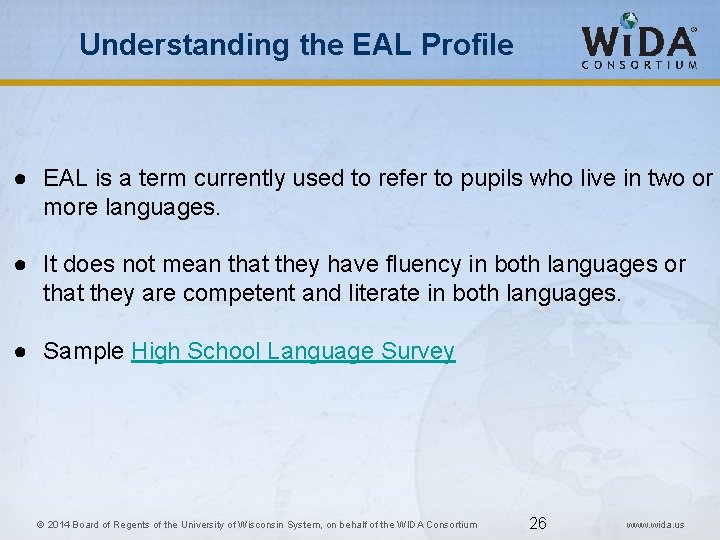
Understanding the EAL Profile ● EAL is a term currently used to refer to pupils who live in two or more languages. ● It does not mean that they have fluency in both languages or that they are competent and literate in both languages. ● Sample High School Language Survey 26 © 2014 Board of Regents of the University of Wisconsin System, on behalf of the WIDA Consortium www. wida. us
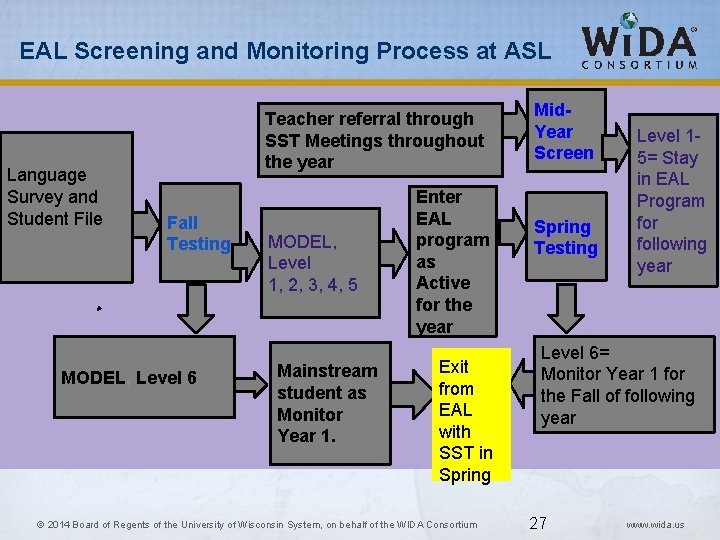
EAL Screening and Monitoring Process at ASL Teacher referral through SST Meetings throughout the year v Language Survey and Student File Fall Testing MODEL, Level 6 MODEL, Level 1, 2, 3, 4, 5 Mainstream student as Monitor Year 1. Enter EAL program as Active for the year Exit from EAL with SST in Spring Mid. Year Screen Spring Testing Level 15= Stay in EAL Program for following year Level 6= Monitor Year 1 for the Fall of following year 27 © 2014 Board of Regents of the University of Wisconsin System, on behalf of the WIDA Consortium www. wida. us
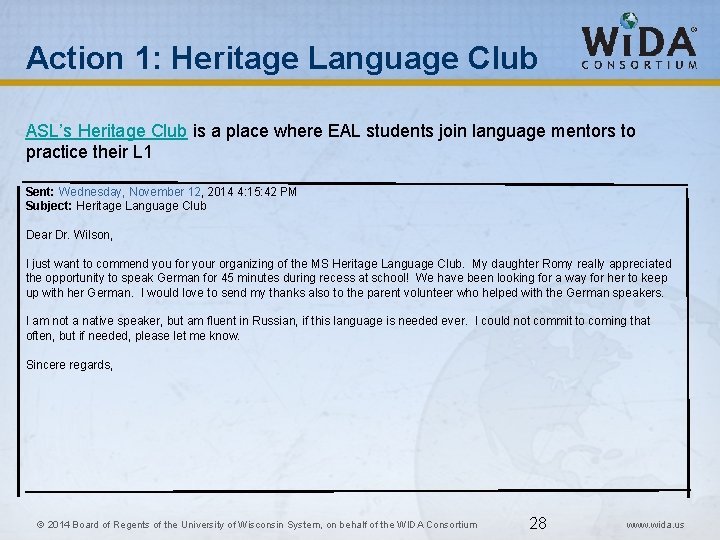
Action 1: Heritage Language Club ASL’s Heritage Club is a place where EAL students join language mentors to practice their L 1 Sent: Wednesday, November 12, 2014 4: 15: 42 PM Subject: Heritage Language Club Dear Dr. Wilson, I just want to commend you for your organizing of the MS Heritage Language Club. My daughter Romy really appreciated the opportunity to speak German for 45 minutes during recess at school! We have been looking for a way for her to keep up with her German. I would love to send my thanks also to the parent volunteer who helped with the German speakers. I am not a native speaker, but am fluent in Russian, if this language is needed ever. I could not commit to coming that often, but if needed, please let me know. Sincere regards, 28 © 2014 Board of Regents of the University of Wisconsin System, on behalf of the WIDA Consortium www. wida. us
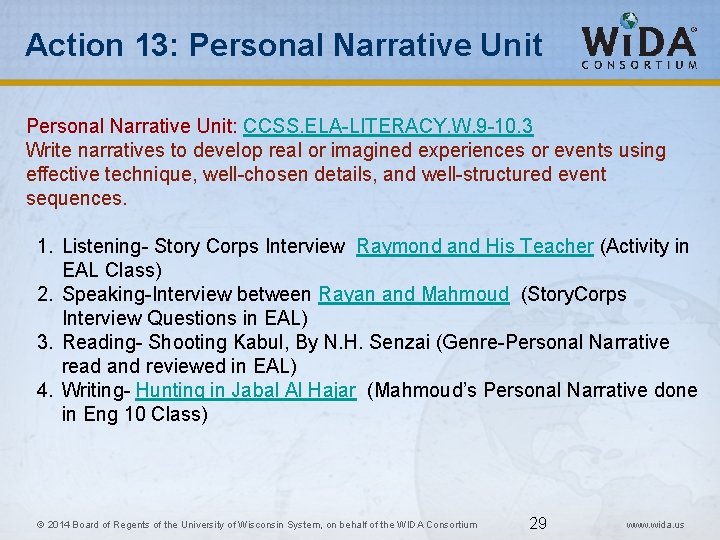
Action 13: Personal Narrative Unit: CCSS. ELA-LITERACY. W. 9 -10. 3 Write narratives to develop real or imagined experiences or events using effective technique, well-chosen details, and well-structured event sequences. 1. Listening- Story Corps Interview Raymond and His Teacher (Activity in EAL Class) 2. Speaking-Interview between Rayan and Mahmoud (Story. Corps Interview Questions in EAL) 3. Reading- Shooting Kabul, By N. H. Senzai (Genre-Personal Narrative read and reviewed in EAL) 4. Writing- Hunting in Jabal Al Hajar (Mahmoud’s Personal Narrative done in Eng 10 Class) 29 © 2014 Board of Regents of the University of Wisconsin System, on behalf of the WIDA Consortium www. wida. us
Action 10: EAL Focus on Genres ● EAL Specialist works collaboratively with mainstream teachers to support EAL student in mainstream classes ● MS/HS Pull-out support - 80 minute class periods every other day ● Genre-based focus for reading and writing tied to mainstream curriculum ● EAL Haiku Page highlight language functions of genres 30 © 2014 Board of Regents of the University of Wisconsin System, on behalf of the WIDA Consortium www. wida. us
Action 4: Student e-Portfolios ● Students create a digital e-portfolio of final draft pieces ● Pages reflect the genres and skills practiced in the class: personal narrative, book reviews, news reports, scientific argumentation, test questions/short answers, procedural and persuasive texts, identity texts, research papers ● Captures growth over four skill areas-reading, writing, speaking, listening- from fall to spring ● Highlights students’ interests and hobbies 31 © 2014 Board of Regents of the University of Wisconsin System, on behalf of the WIDA Consortium www. wida. us
Evidence of Learning From Fall to Spring of 2013 -2014/MS&HS ● ● ● Wr. AP/ERB Scores= increased by one rating point WIDA Scores= Average improved by one PL Anecdotal reports of improved writing in class assignments. More confidence at Harkness Table Final Grades in English-language dependent classes B or above (World Civ, Biology, English, Humanities) ● Improved Spelling Inventory Scores (move min. 1 level up) 32 © 2014 Board of Regents of the University of Wisconsin System, on behalf of the WIDA Consortium www. wida. us
WIDA Assessments 33 © 2014 Board of Regents of the University of Wisconsin System, on behalf of the WIDA Consortium www. wida. us
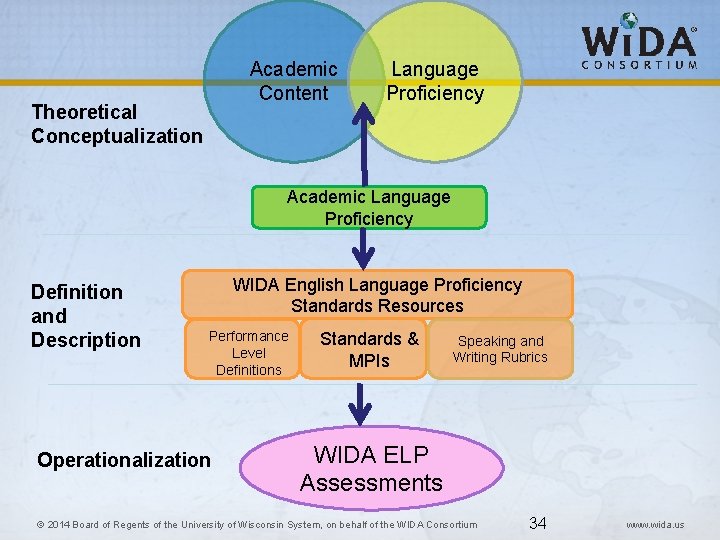
Academic Content Theoretical Conceptualization Language Proficiency Academic Language Proficiency Definition and Description WIDA English Language Proficiency Standards Resources Performance Level Definitions Operationalization Standards & MPIs Speaking and Writing Rubrics WIDA ELP Assessments 34 © 2014 Board of Regents of the University of Wisconsin System, on behalf of the WIDA Consortium www. wida. us
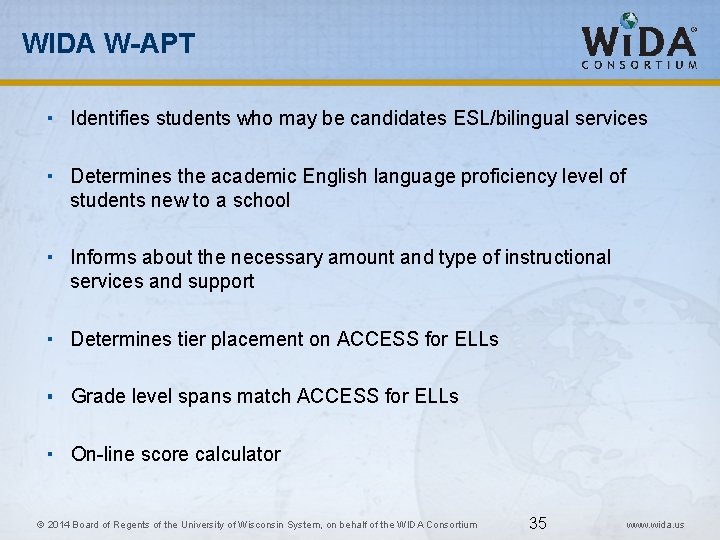
WIDA W-APT Identifies students who may be candidates ESL/bilingual services Determines the academic English language proficiency level of students new to a school Informs about the necessary amount and type of instructional services and support Determines tier placement on ACCESS for ELLs Grade level spans match ACCESS for ELLs On-line score calculator 35 © 2014 Board of Regents of the University of Wisconsin System, on behalf of the WIDA Consortium www. wida. us
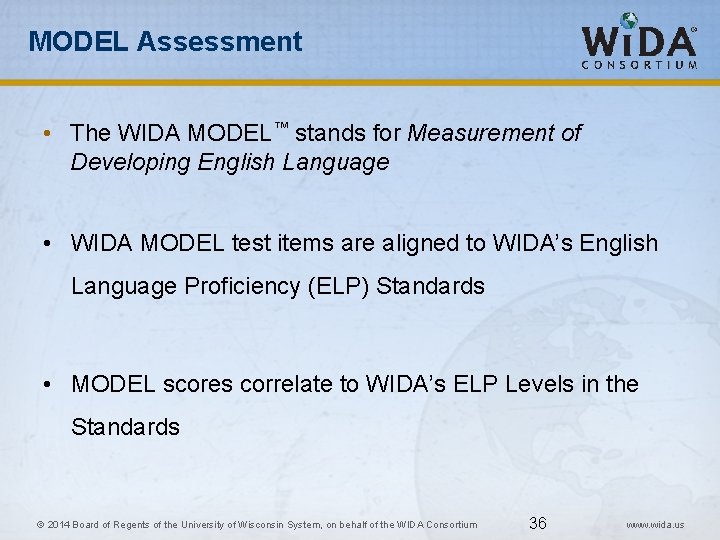
MODEL Assessment • The WIDA MODEL™ stands for Measurement of Developing English Language • WIDA MODEL test items are aligned to WIDA’s English Language Proficiency (ELP) Standards • MODEL scores correlate to WIDA’s ELP Levels in the Standards 36 © 2014 Board of Regents of the University of Wisconsin System, on behalf of the WIDA Consortium www. wida. us
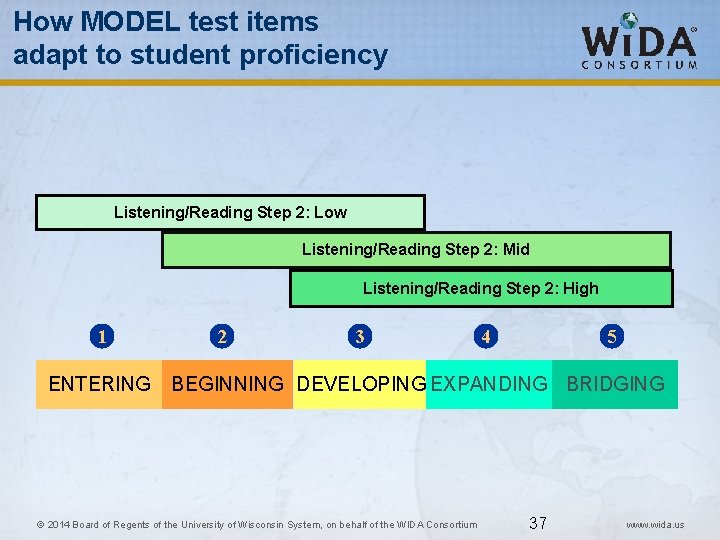
How MODEL test items adapt to student proficiency Listening/Reading Step 2: Low Listening/Reading Step 2: Mid Listening/Reading Step 2: High 1 ENTERING 2 3 4 5 BEGINNING DEVELOPING EXPANDING BRIDGING 37 © 2014 Board of Regents of the University of Wisconsin System, on behalf of the WIDA Consortium www. wida. us
MODEL Item Features Reading Listening Writing Speaking 38 © 2014 Board of Regents of the University of Wisconsin System, on behalf of the WIDA Consortium www. wida. us
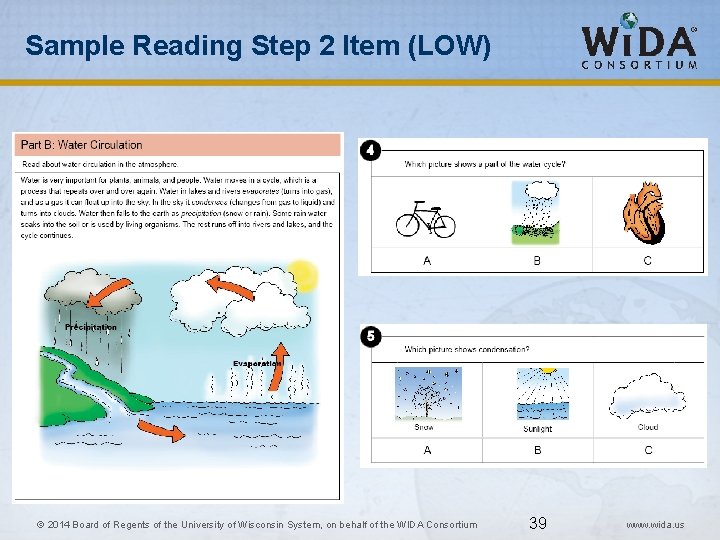
Sample Reading Step 2 Item (LOW) 39 © 2014 Board of Regents of the University of Wisconsin System, on behalf of the WIDA Consortium www. wida. us
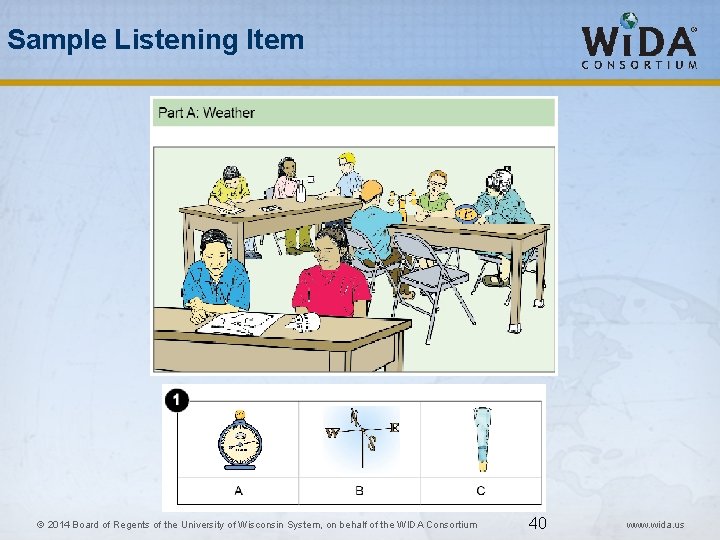
Sample Listening Item 40 © 2014 Board of Regents of the University of Wisconsin System, on behalf of the WIDA Consortium www. wida. us
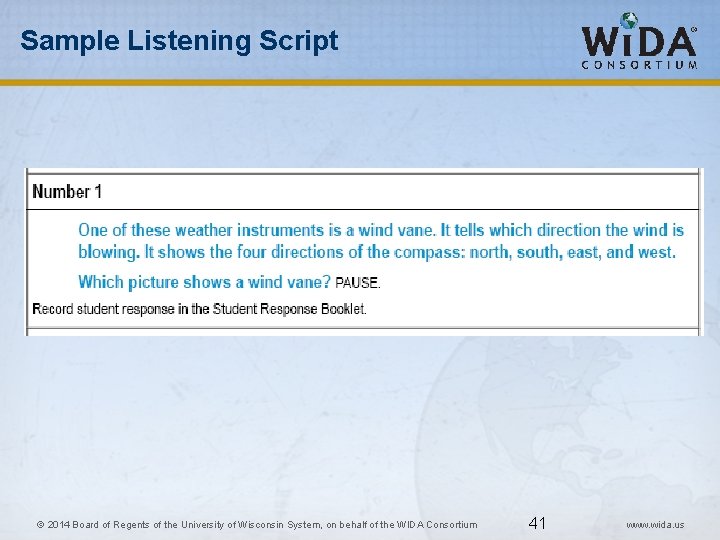
Sample Listening Script 41 © 2014 Board of Regents of the University of Wisconsin System, on behalf of the WIDA Consortium www. wida. us
Testing Materials Speaking and Listening Student Test Booklet Reading Student Test Booklet Test Administrator Script Test Administration Manual Student Response Booklet Summary Score Sheet 42 © 2014 Board of Regents of the University of Wisconsin System, on behalf of the WIDA Consortium www. wida. us
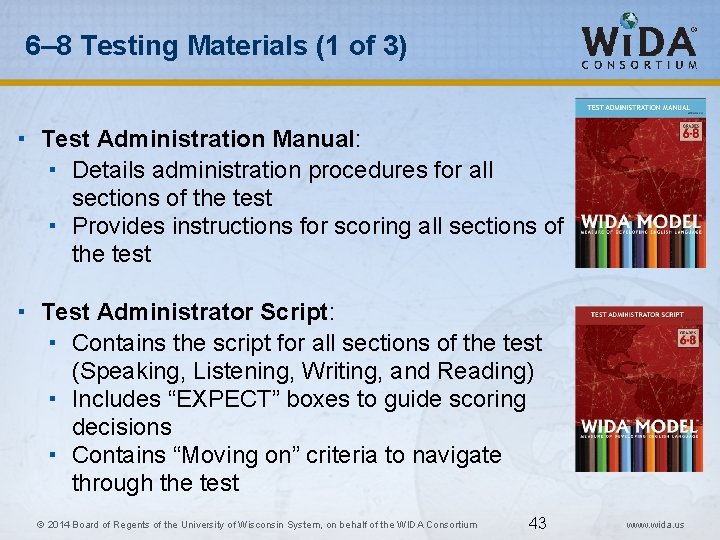
6– 8 Testing Materials (1 of 3) Test Administration Manual: Details administration procedures for all sections of the test Provides instructions for scoring all sections of the test Test Administrator Script: Contains the script for all sections of the test (Speaking, Listening, Writing, and Reading) Includes “EXPECT” boxes to guide scoring decisions Contains “Moving on” criteria to navigate through the test 43 © 2014 Board of Regents of the University of Wisconsin System, on behalf of the WIDA Consortium www. wida. us
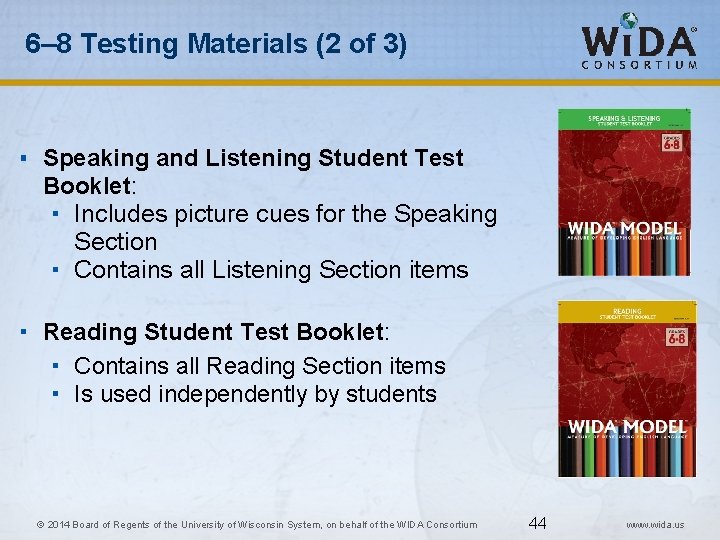
6– 8 Testing Materials (2 of 3) Speaking and Listening Student Test Booklet: Includes picture cues for the Speaking Section Contains all Listening Section items Reading Student Test Booklet: Contains all Reading Section items Is used independently by students 44 © 2014 Board of Regents of the University of Wisconsin System, on behalf of the WIDA Consortium www. wida. us
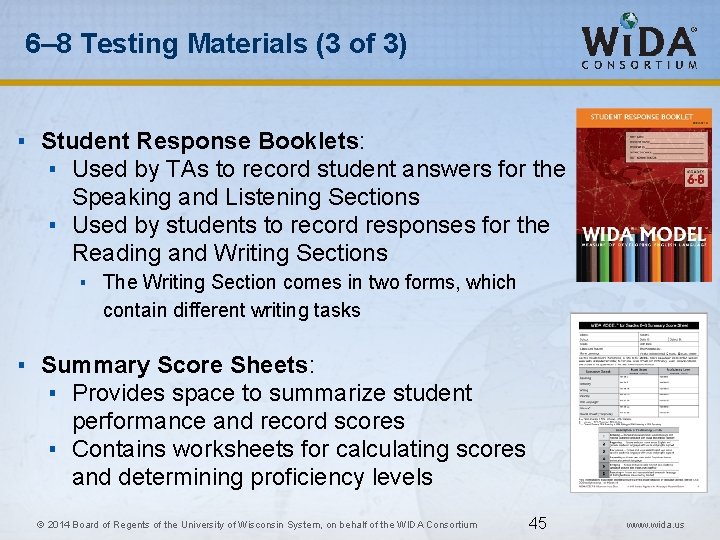
6– 8 Testing Materials (3 of 3) Student Response Booklets: Used by TAs to record student answers for the Speaking and Listening Sections Used by students to record responses for the Reading and Writing Sections The Writing Section comes in two forms, which contain different writing tasks Summary Score Sheets: Provides space to summarize student performance and record scores Contains worksheets for calculating scores and determining proficiency levels 45 © 2014 Board of Regents of the University of Wisconsin System, on behalf of the WIDA Consortium www. wida. us
MODEL Kindergarten Test All components individually administered All components adaptive — stop a test component when child reaches his/her ceiling All responses, except for Writing section, recorded by TA TA scores all components, including Writing, during administration Averages 30 minutes per student for all components 46 © 2014 Board of Regents of the University of Wisconsin System, on behalf of the WIDA Consortium www. wida. us
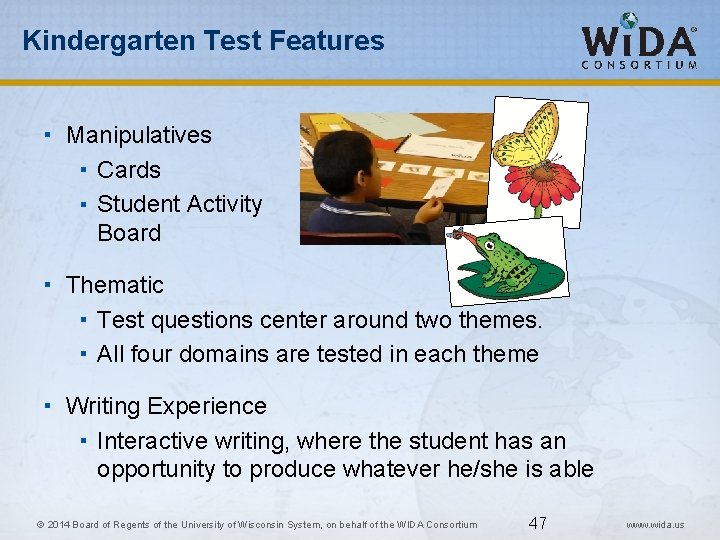
Kindergarten Test Features Manipulatives Cards Student Activity Board Thematic Test questions center around two themes. All four domains are tested in each theme Writing Experience Interactive writing, where the student has an opportunity to produce whatever he/she is able 47 © 2014 Board of Regents of the University of Wisconsin System, on behalf of the WIDA Consortium www. wida. us
Interpreting WIDA MODEL Results 48 © 2014 Board of Regents of the University of Wisconsin System, on behalf of the WIDA Consortium www. wida. us
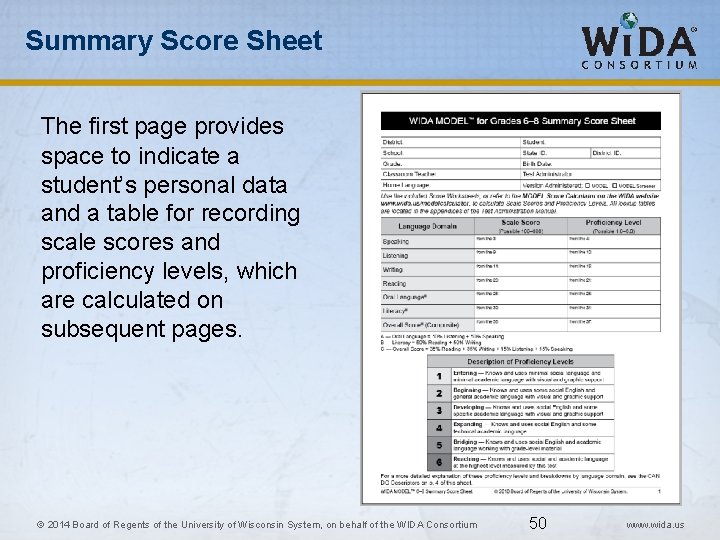
Summary Score Sheet § § § The Summary Score Sheet provides space and instructions for determining: § A student’s performance by domain § A student’s overall/composite proficiency level The Test Administrator must: § Transfer the student’s raw scores from the Student Response Booklet into the Summary Score Sheet § Use the Summary Score Sheet and Lookup tables located in the appendices of the Test Administration Manual to determine Scale Scores and Proficiency Levels An automatic score calculator is also available at www. wida. us/modelcalculator 49 © 2014 Board of Regents of the University of Wisconsin System, on behalf of the WIDA Consortium www. wida. us
Summary Score Sheet The first page provides space to indicate a student’s personal data and a table for recording scale scores and proficiency levels, which are calculated on subsequent pages. 50 © 2014 Board of Regents of the University of Wisconsin System, on behalf of the WIDA Consortium www. wida. us
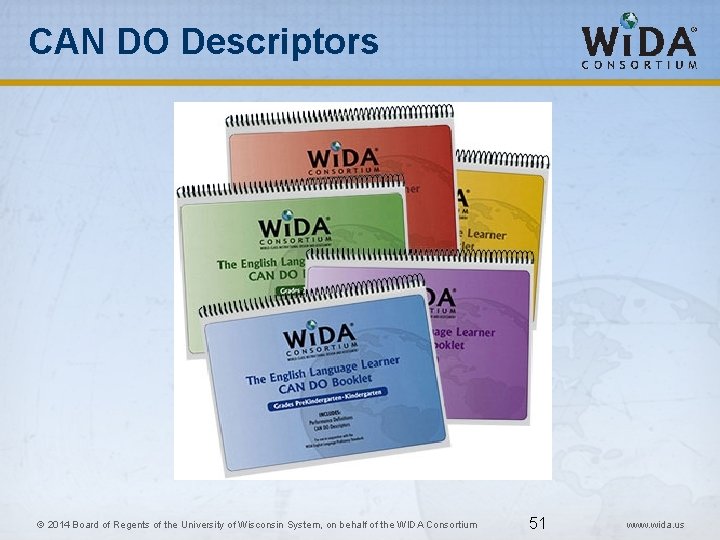
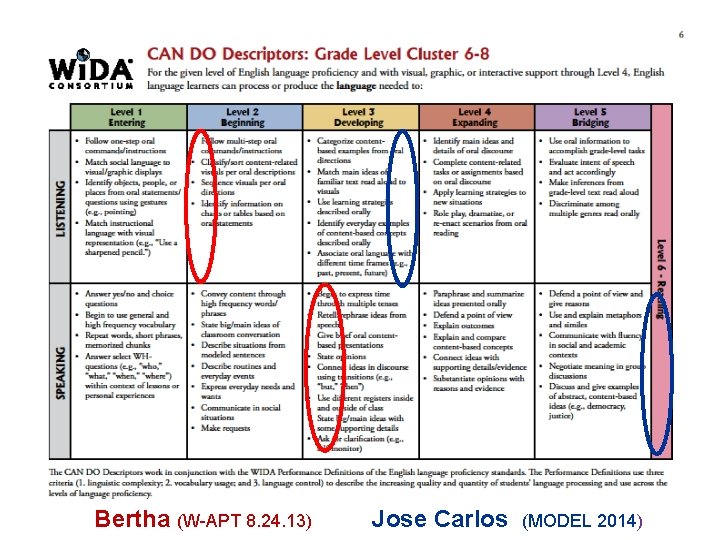
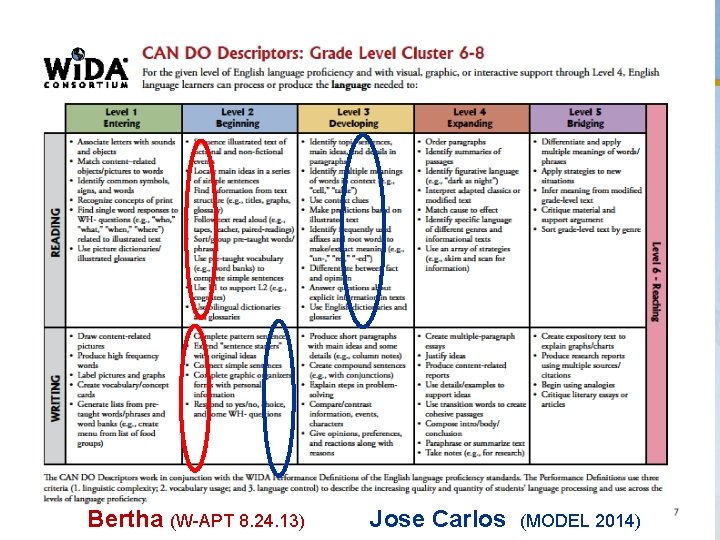
CAN DO Descriptors 51 © 2014 Board of Regents of the University of Wisconsin System, on behalf of the WIDA Consortium www. wida. us
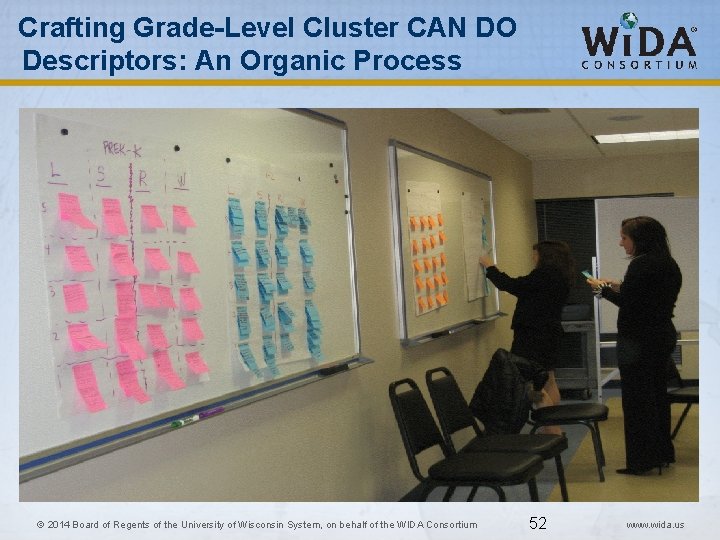
Crafting Grade-Level Cluster CAN DO Descriptors: An Organic Process 52 © 2014 Board of Regents of the University of Wisconsin System, on behalf of the WIDA Consortium www. wida. us
Examples of CAN DO Descriptors Level 2 Beginning Provide information using graphic organizers Generate lists of words/phrases from banks or walls Complete modeled sentence starters (e. g. , “I like ____. ”) Describe people, places or objects from illustrated examples and models 53 © 2014 Board of Regents of the University of Wisconsin System, on behalf of the WIDA Consortium www. wida. us
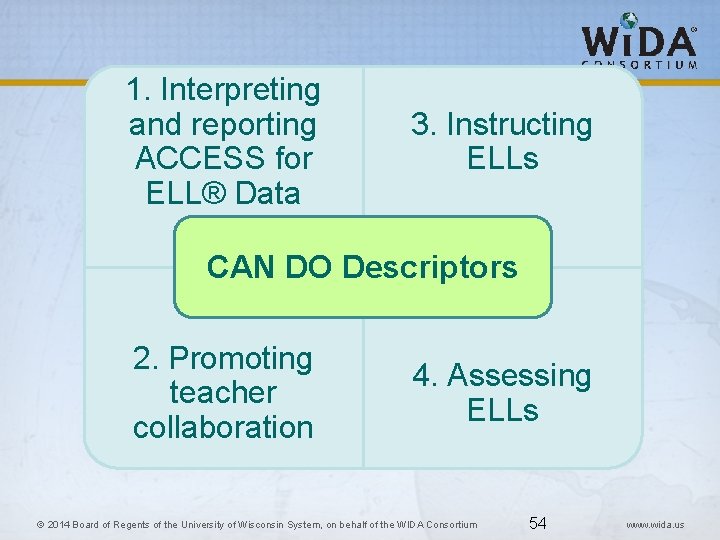
1. Interpreting and reporting ACCESS for ELL® Data 3. Instructing ELLs CAN DO Descriptors 2. Promoting teacher collaboration 4. Assessing ELLs 54 © 2014 Board of Regents of the University of Wisconsin System, on behalf of the WIDA Consortium www. wida. us
WIDA Consortium / Bertha (W-APT 8. 24. 13) Jose Carlos (MODEL 2014) 55 © 2014 Board of Regents of the University of Wisconsin System, on behalf of the WIDA Consortium www. wida. us
Bertha (W-APT 8. 24. 13) Jose Carlos (MODEL 2014) 56 © 2014 Board of Regents of the University of Wisconsin System, on behalf of the WIDA Consortium www. wida. us
Professional Development 57 © 2014 Board of Regents of the University of Wisconsin System, on behalf of the WIDA Consortium www. wida. us
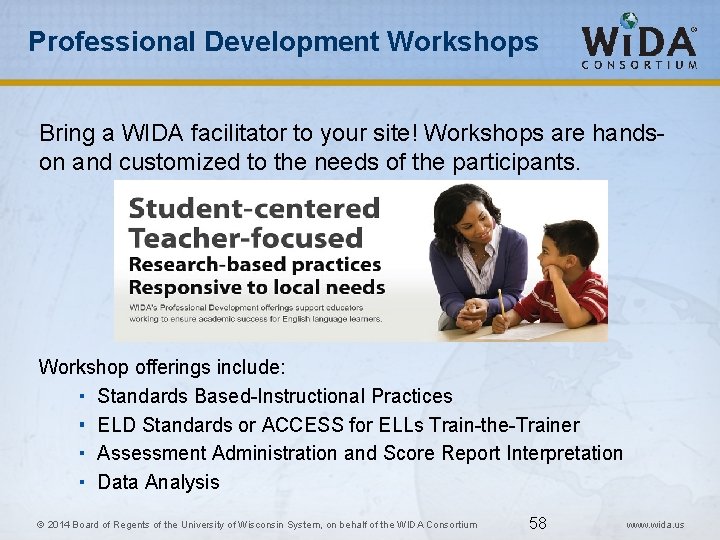
Professional Development Workshops Bring a WIDA facilitator to your site! Workshops are handson and customized to the needs of the participants. Workshop offerings include: Standards Based-Instructional Practices ELD Standards or ACCESS for ELLs Train-the-Trainer Assessment Administration and Score Report Interpretation Data Analysis 58 © 2014 Board of Regents of the University of Wisconsin System, on behalf of the WIDA Consortium www. wida. us
PD in International Contexts New Delhi Ho Chi Minh City Brasilia Moscow Seoul Taiwan Chennai Bangkok 59 © 2014 Board of Regents of the University of Wisconsin System, on behalf of the WIDA Consortium www. wida. us
WIDA International Summer Academy Promoting collaboration in designing curriculum, instruction, and assessment using WIDA resources in international settings July, 2015; Madison, WI Exact dates to be announced 60 © 2014 Board of Regents of the University of Wisconsin System, on behalf of the WIDA Consortium www. wida. us
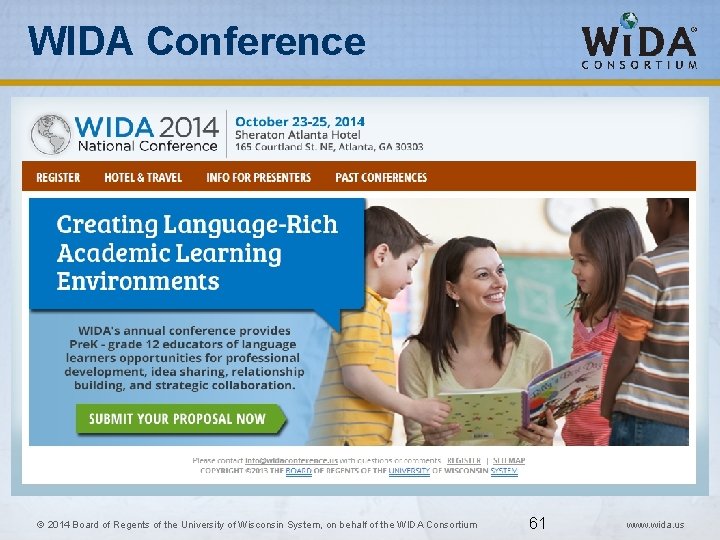
WIDA Conference 61 © 2014 Board of Regents of the University of Wisconsin System, on behalf of the WIDA Consortium www. wida. us
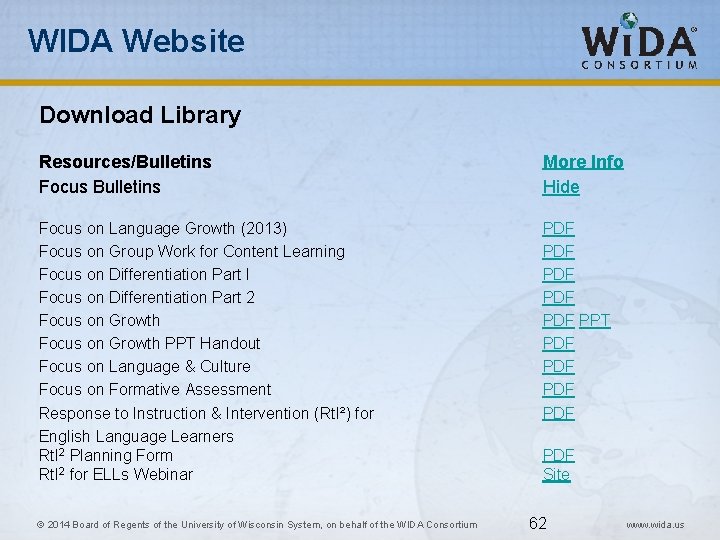
WIDA Website Download Library Resources/Bulletins Focus Bulletins More Info Hide Focus on Language Growth (2013) Focus on Group Work for Content Learning Focus on Differentiation Part I Focus on Differentiation Part 2 Focus on Growth PPT Handout Focus on Language & Culture Focus on Formative Assessment Response to Instruction & Intervention (Rt. I²) for English Language Learners Rt. I 2 Planning Form Rt. I 2 for ELLs Webinar PDF PDF PDF PPT PDF PDF PDF Site 62 © 2014 Board of Regents of the University of Wisconsin System, on behalf of the WIDA Consortium www. wida. us
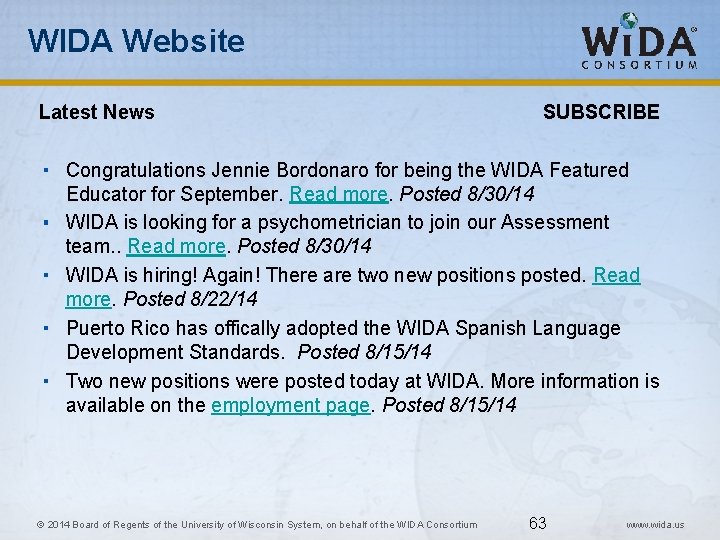
WIDA Website Latest News SUBSCRIBE Congratulations Jennie Bordonaro for being the WIDA Featured Educator for September. Read more. Posted 8/30/14 WIDA is looking for a psychometrician to join our Assessment team. . Read more. Posted 8/30/14 WIDA is hiring! Again! There are two new positions posted. Read more. Posted 8/22/14 Puerto Rico has offically adopted the WIDA Spanish Language Development Standards. Posted 8/15/14 Two new positions were posted today at WIDA. More information is available on the employment page. Posted 8/15/14 63 © 2014 Board of Regents of the University of Wisconsin System, on behalf of the WIDA Consortium www. wida. us
Comments or Questions? For more information, please contact Jesse Markow markow@wisc. edu Jamie Quanbeck, WIDA International School Consortium jamie@wceps. org Dr. Christine Wilson christine_wilson@asl. org 64 © 2014 Board of Regents of the University of Wisconsin System, on behalf of the WIDA Consortium www. wida. us