Titian 1553 Danae conceived the hero Perseus when


- Slides: 36
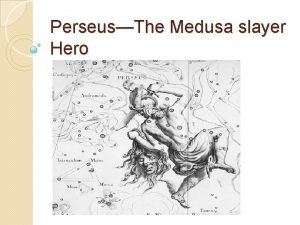
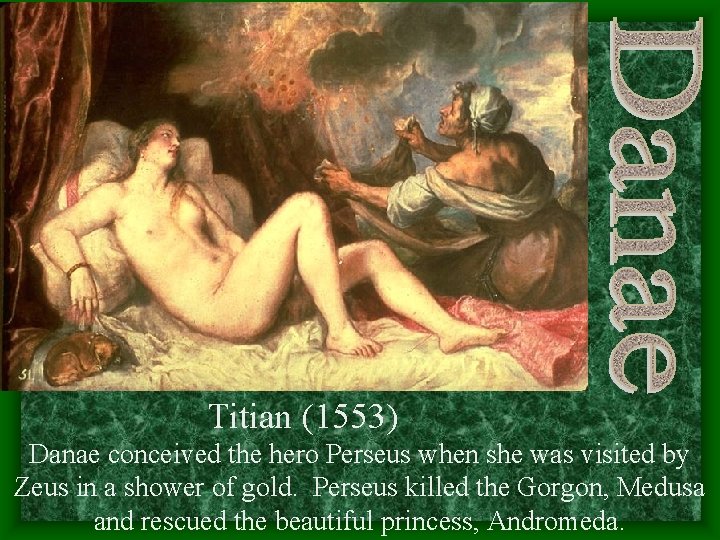
Titian (1553) Danae conceived the hero Perseus when she was visited by Zeus in a shower of gold. Perseus killed the Gorgon, Medusa and rescued the beautiful princess, Andromeda.
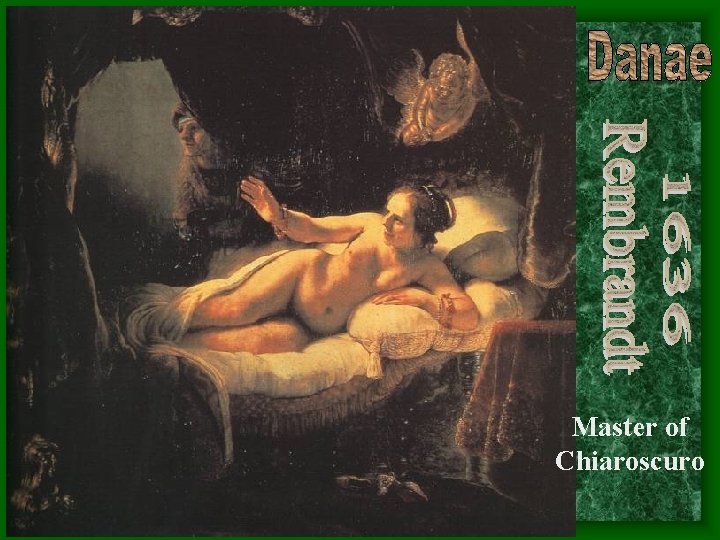
Master of Chiaroscuro
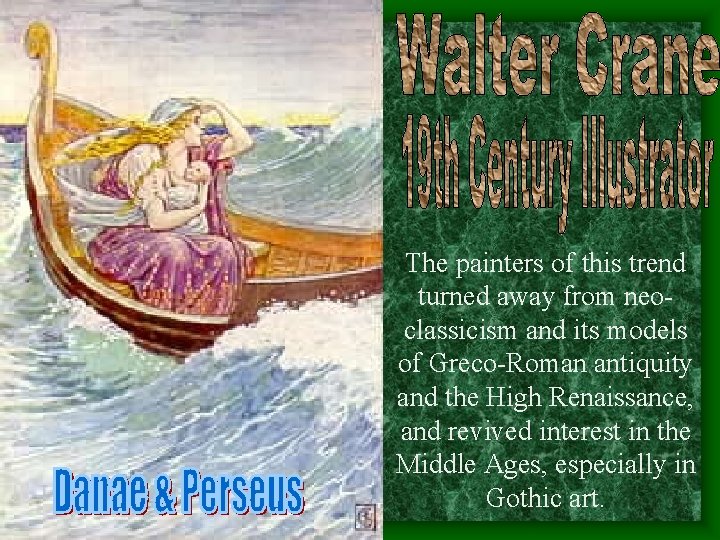
The painters of this trend turned away from neoclassicism and its models of Greco-Roman antiquity and the High Renaissance, and revived interest in the Middle Ages, especially in Gothic art.
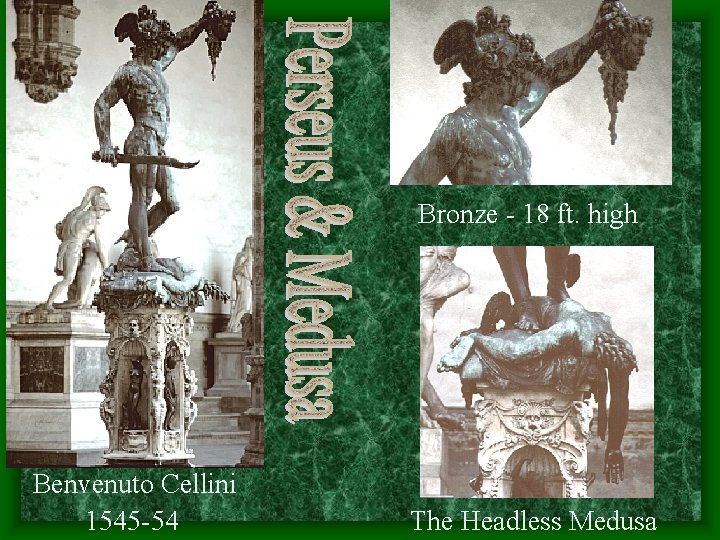
Bronze - 18 ft. high Benvenuto Cellini 1545 -54 The Headless Medusa
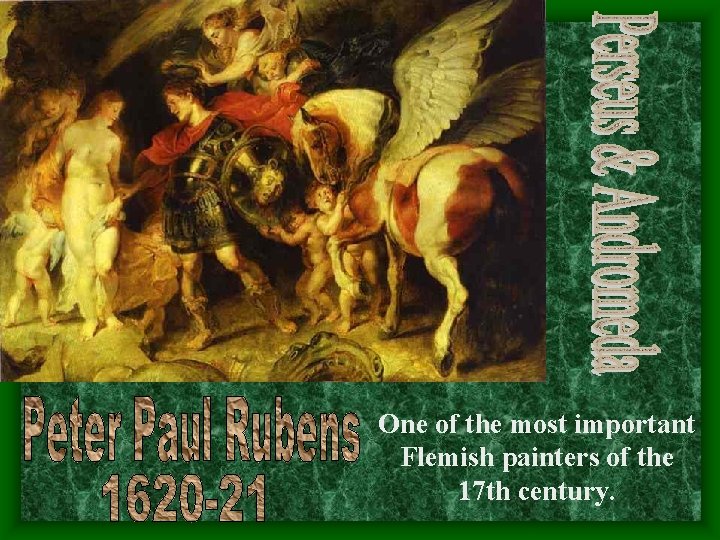
One of the most important Flemish painters of the 17 th century.
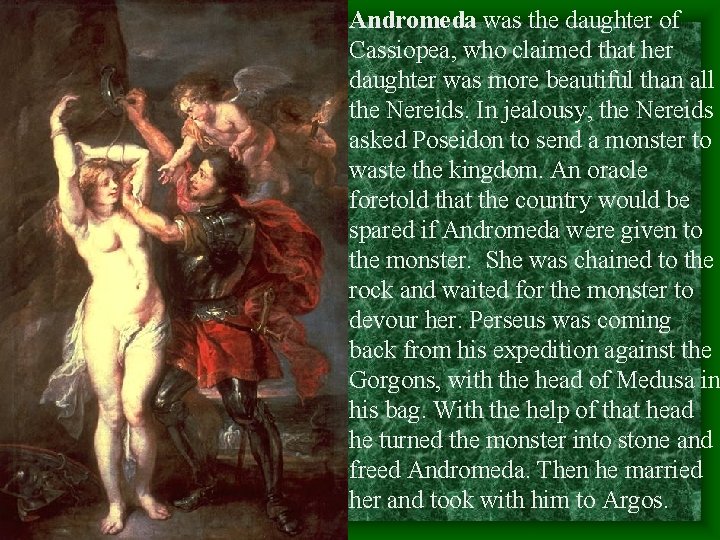
Andromeda was the daughter of Cassiopea, who claimed that her daughter was more beautiful than all the Nereids. In jealousy, the Nereids asked Poseidon to send a monster to waste the kingdom. An oracle foretold that the country would be spared if Andromeda were given to the monster. She was chained to the rock and waited for the monster to devour her. Perseus was coming back from his expedition against the Gorgons, with the head of Medusa in his bag. With the help of that head he turned the monster into stone and freed Andromeda. Then he married her and took with him to Argos.
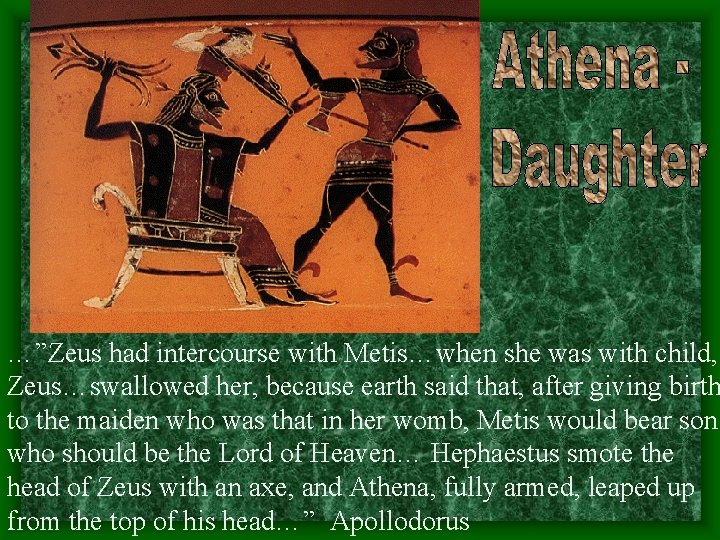
…”Zeus had intercourse with Metis…when she was with child, Zeus…swallowed her, because earth said that, after giving birth to the maiden who was that in her womb, Metis would bear son who should be the Lord of Heaven… Hephaestus smote the head of Zeus with an axe, and Athena, fully armed, leaped up from the top of his head…” Apollodorus
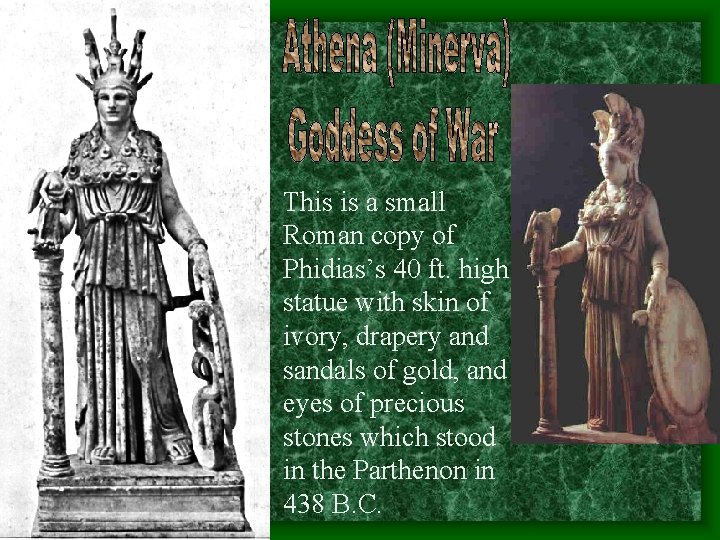
This is a small Roman copy of Phidias’s 40 ft. high statue with skin of ivory, drapery and sandals of gold, and eyes of precious stones which stood in the Parthenon in 438 B. C.
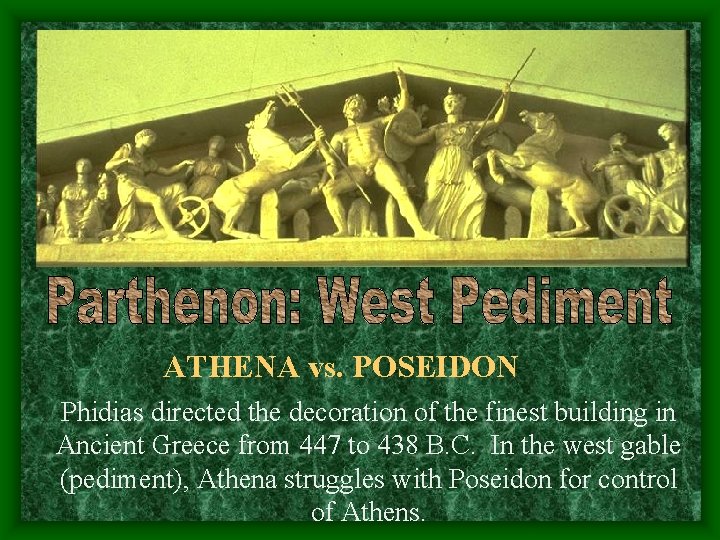
ATHENA vs. POSEIDON Phidias directed the decoration of the finest building in Ancient Greece from 447 to 438 B. C. In the west gable (pediment), Athena struggles with Poseidon for control of Athens.
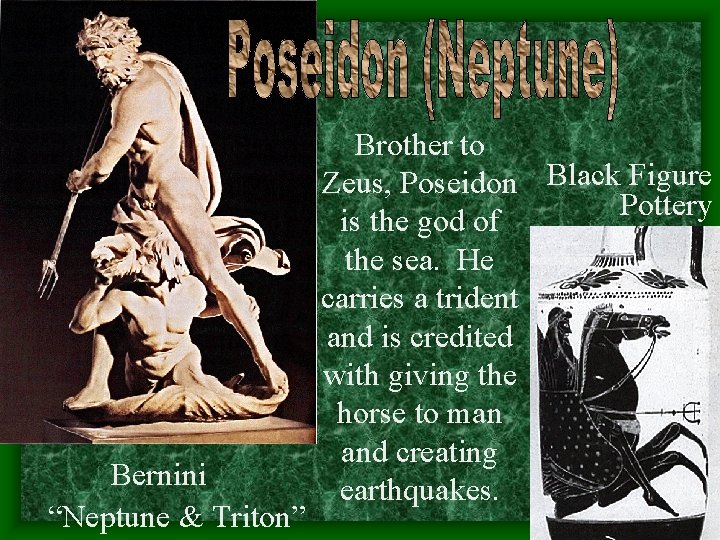
Bernini “Neptune & Triton” Brother to Zeus, Poseidon Black Figure Pottery is the god of the sea. He carries a trident and is credited with giving the horse to man and creating earthquakes.
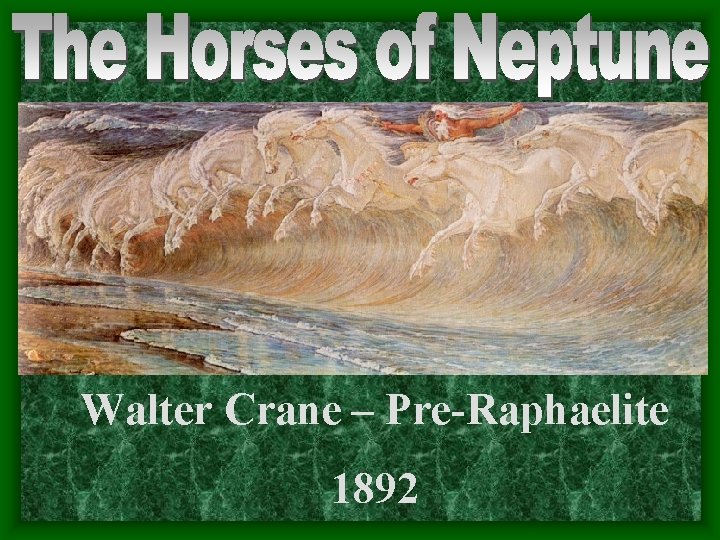
Walter Crane – Pre-Raphaelite 1892
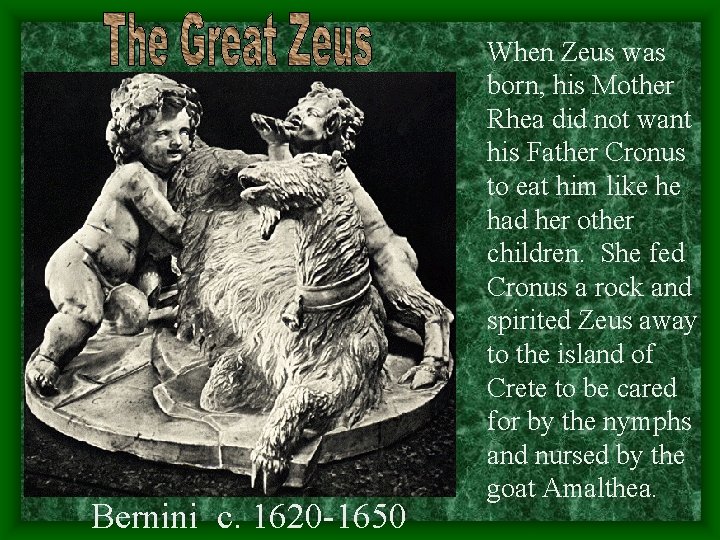
Bernini c. 1620 -1650 When Zeus was born, his Mother Rhea did not want his Father Cronus to eat him like he had her other children. She fed Cronus a rock and spirited Zeus away to the island of Crete to be cared for by the nymphs and nursed by the goat Amalthea.
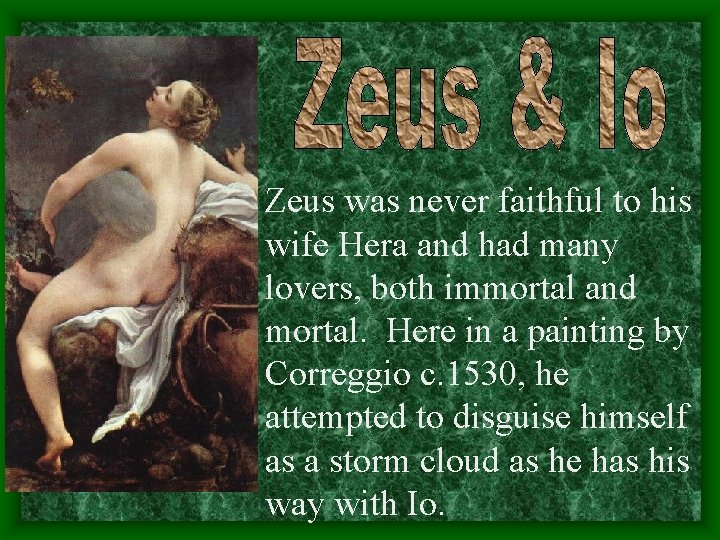
Zeus was never faithful to his wife Hera and had many lovers, both immortal and mortal. Here in a painting by Correggio c. 1530, he attempted to disguise himself as a storm cloud as he has his way with Io.
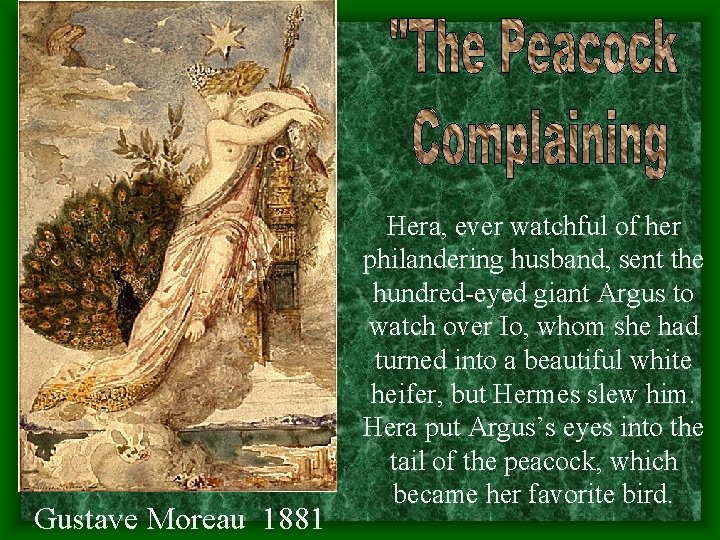
Gustave Moreau 1881 Hera, ever watchful of her philandering husband, sent the hundred-eyed giant Argus to watch over Io, whom she had turned into a beautiful white heifer, but Hermes slew him. Hera put Argus’s eyes into the tail of the peacock, which became her favorite bird.
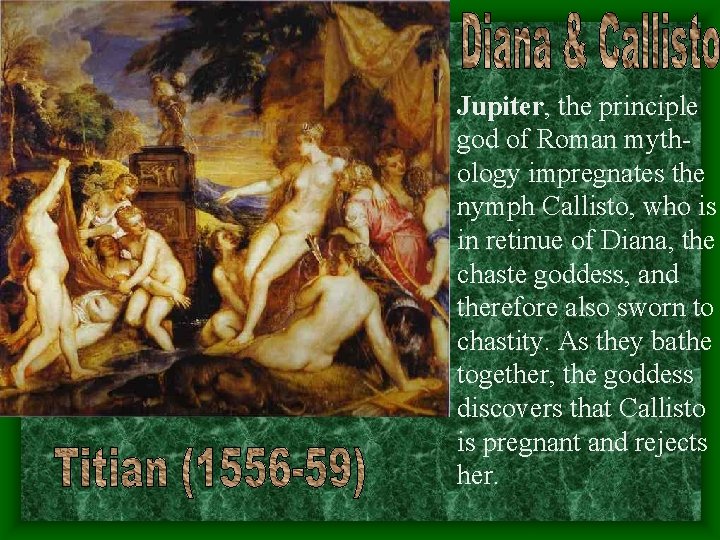
Jupiter, the principle god of Roman mythology impregnates the nymph Callisto, who is in retinue of Diana, the chaste goddess, and therefore also sworn to chastity. As they bathe together, the goddess discovers that Callisto is pregnant and rejects her.
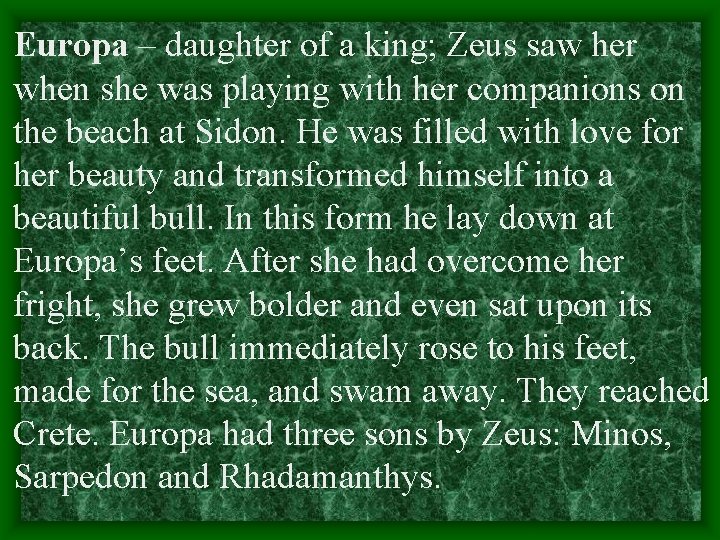
Europa – daughter of a king; Zeus saw her when she was playing with her companions on the beach at Sidon. He was filled with love for her beauty and transformed himself into a beautiful bull. In this form he lay down at Europa’s feet. After she had overcome her fright, she grew bolder and even sat upon its back. The bull immediately rose to his feet, made for the sea, and swam away. They reached Crete. Europa had three sons by Zeus: Minos, Sarpedon and Rhadamanthys.
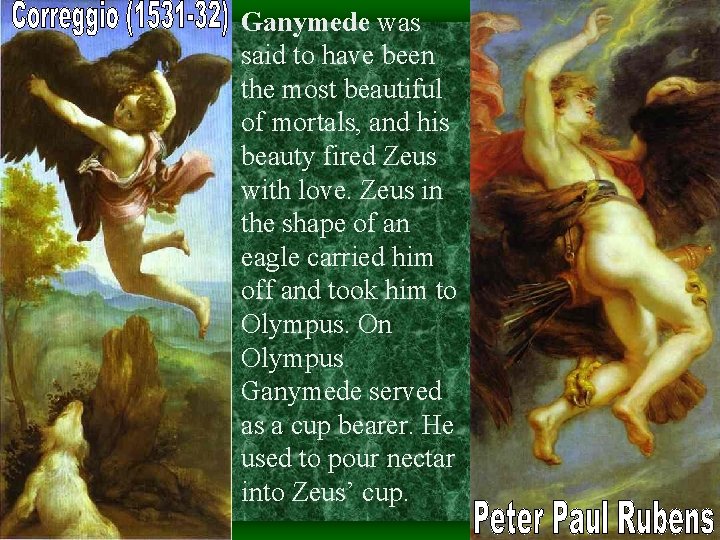
Ganymede was said to have been the most beautiful of mortals, and his beauty fired Zeus with love. Zeus in the shape of an eagle carried him off and took him to Olympus. On Olympus Ganymede served as a cup bearer. He used to pour nectar into Zeus’ cup.
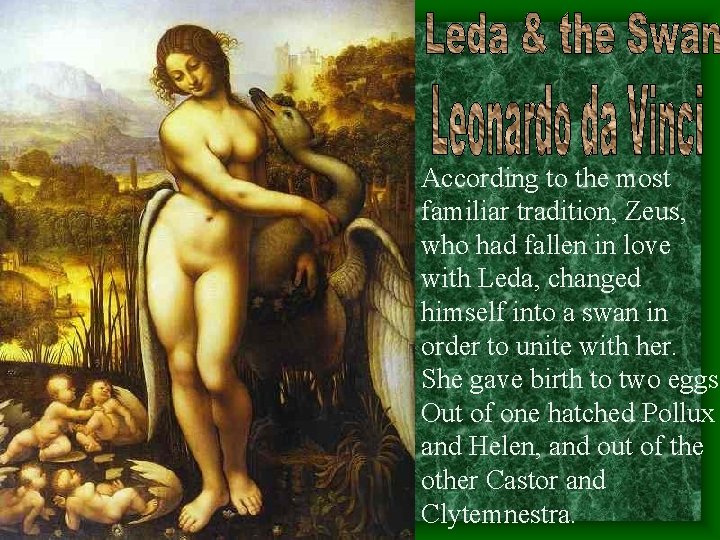
According to the most familiar tradition, Zeus, who had fallen in love with Leda, changed himself into a swan in order to unite with her. She gave birth to two eggs. Out of one hatched Pollux and Helen, and out of the other Castor and Clytemnestra.
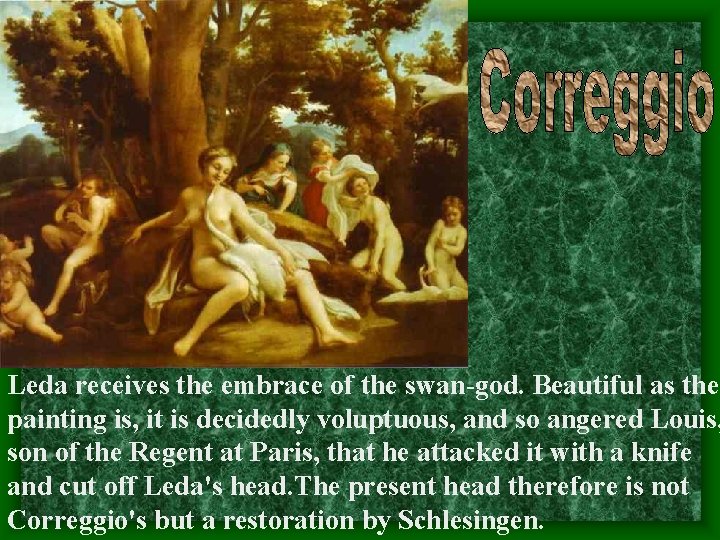
Leda receives the embrace of the swan-god. Beautiful as the painting is, it is decidedly voluptuous, and so angered Louis, son of the Regent at Paris, that he attacked it with a knife and cut off Leda's head. The present head therefore is not Correggio's but a restoration by Schlesingen.
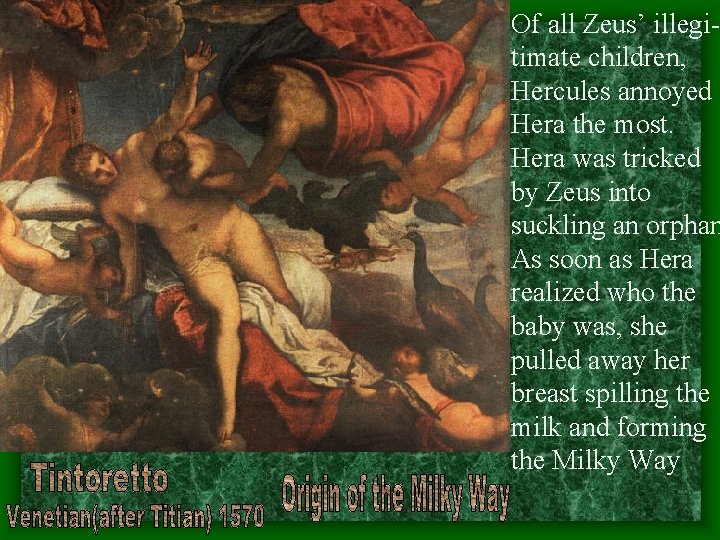
Of all Zeus’ illegitimate children, Hercules annoyed Hera the most. Hera was tricked by Zeus into suckling an orphan As soon as Hera realized who the baby was, she pulled away her breast spilling the milk and forming the Milky Way
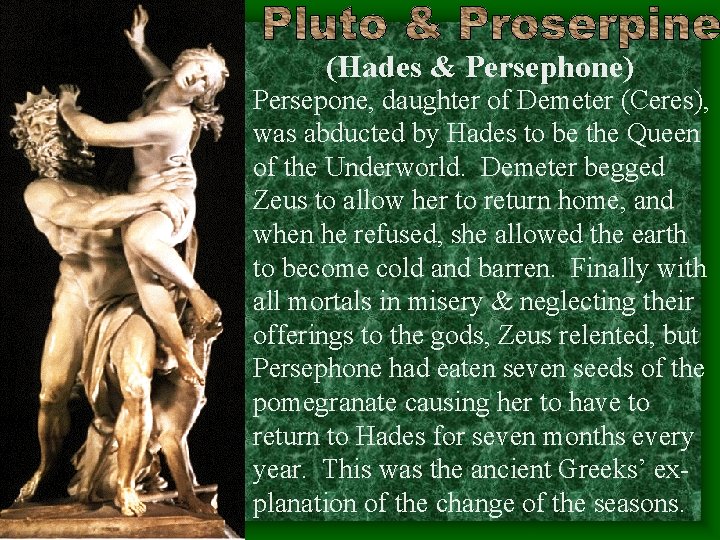
(Hades & Persephone) Persepone, daughter of Demeter (Ceres), was abducted by Hades to be the Queen of the Underworld. Demeter begged Zeus to allow her to return home, and when he refused, she allowed the earth to become cold and barren. Finally with all mortals in misery & neglecting their offerings to the gods, Zeus relented, but Persephone had eaten seven seeds of the pomegranate causing her to have to return to Hades for seven months every year. This was the ancient Greeks’ explanation of the change of the seasons.
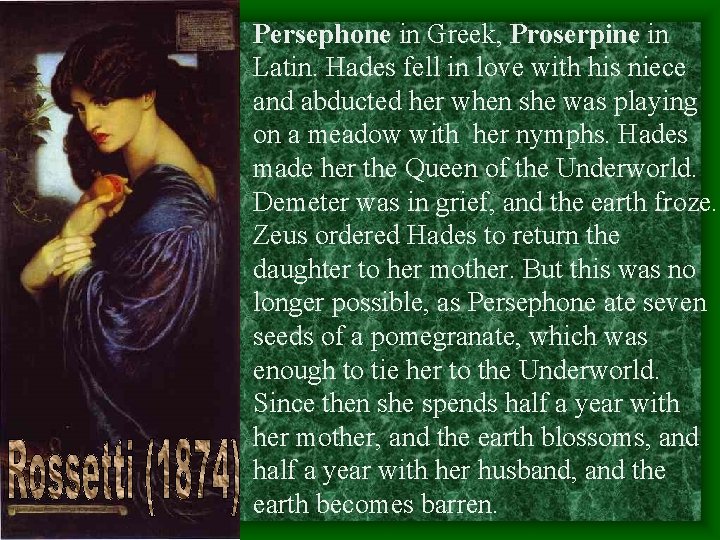
Persephone in Greek, Proserpine in Latin. Hades fell in love with his niece and abducted her when she was playing on a meadow with her nymphs. Hades made her the Queen of the Underworld. Demeter was in grief, and the earth froze. Zeus ordered Hades to return the daughter to her mother. But this was no longer possible, as Persephone ate seven seeds of a pomegranate, which was enough to tie her to the Underworld. Since then she spends half a year with her mother, and the earth blossoms, and half a year with her husband, and the earth becomes barren.
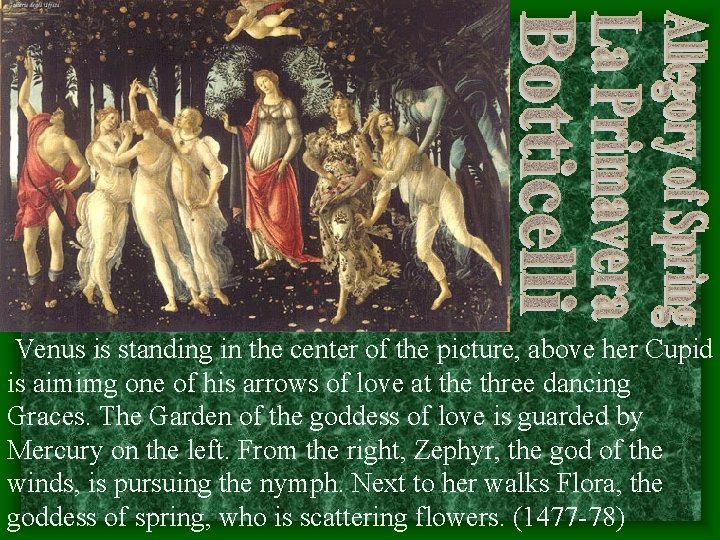
Venus is standing in the center of the picture, above her Cupid is aimimg one of his arrows of love at the three dancing Graces. The Garden of the goddess of love is guarded by Mercury on the left. From the right, Zephyr, the god of the winds, is pursuing the nymph. Next to her walks Flora, the goddess of spring, who is scattering flowers. (1477 -78)
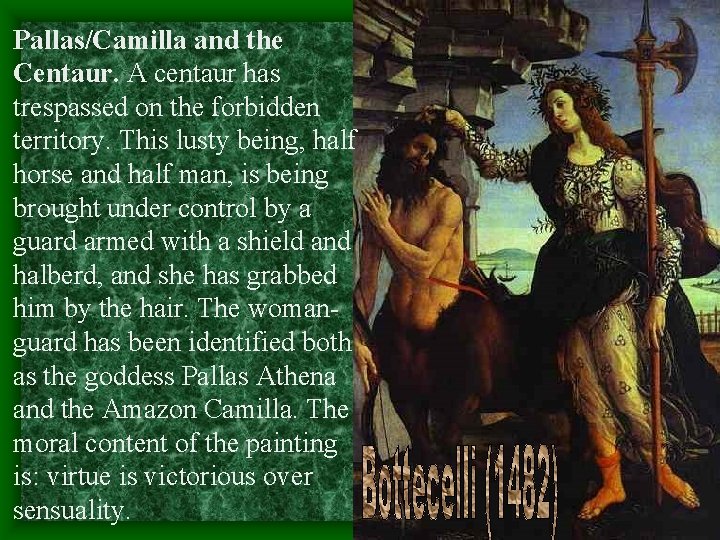
Pallas/Camilla and the Centaur. A centaur has trespassed on the forbidden territory. This lusty being, half horse and half man, is being brought under control by a guard armed with a shield and halberd, and she has grabbed him by the hair. The womanguard has been identified both as the goddess Pallas Athena and the Amazon Camilla. The moral content of the painting is: virtue is victorious over sensuality.
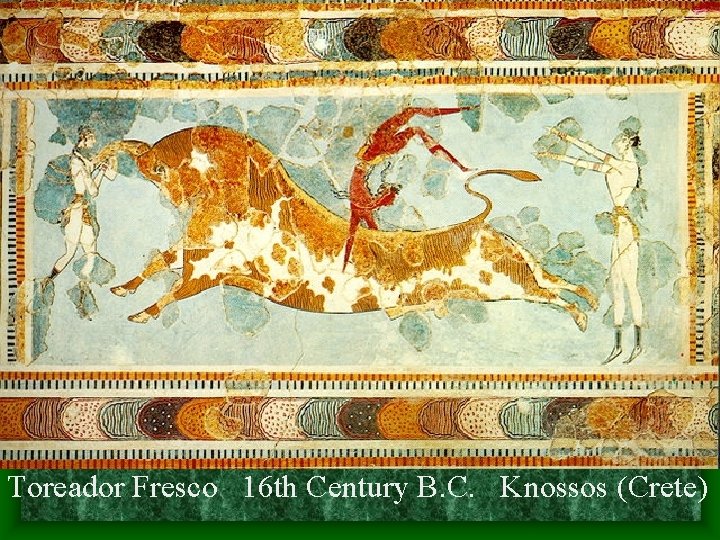
Toreador Fresco 16 th Century B. C. Knossos (Crete)
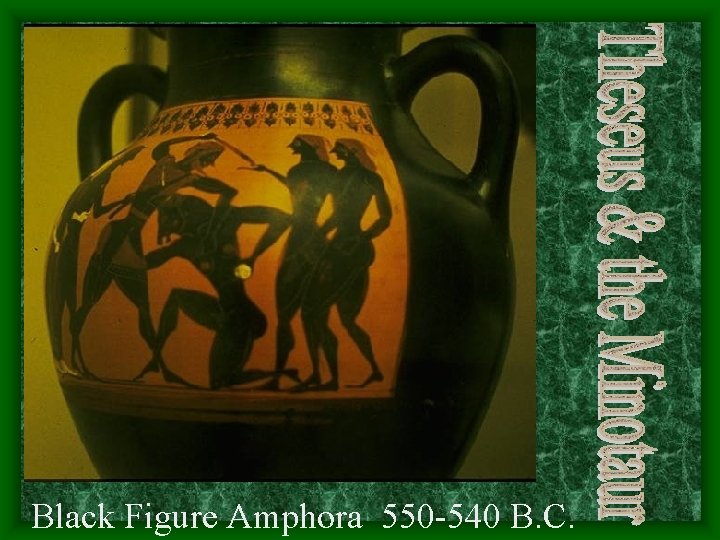
Black Figure Amphora 550 -540 B. C.
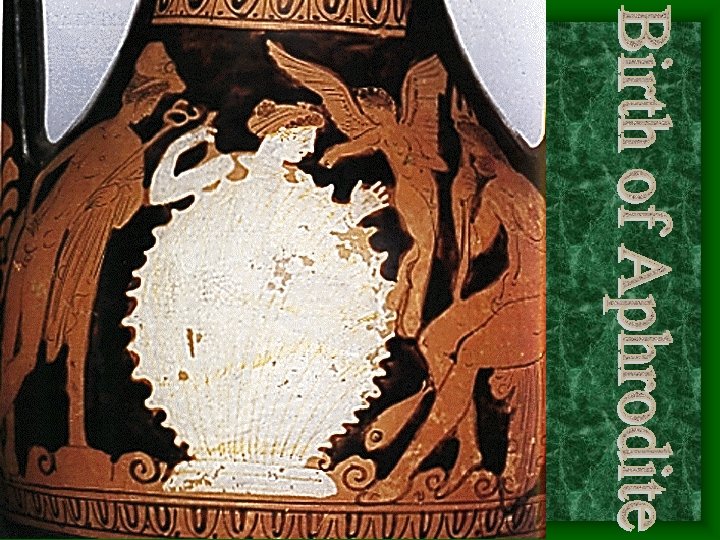
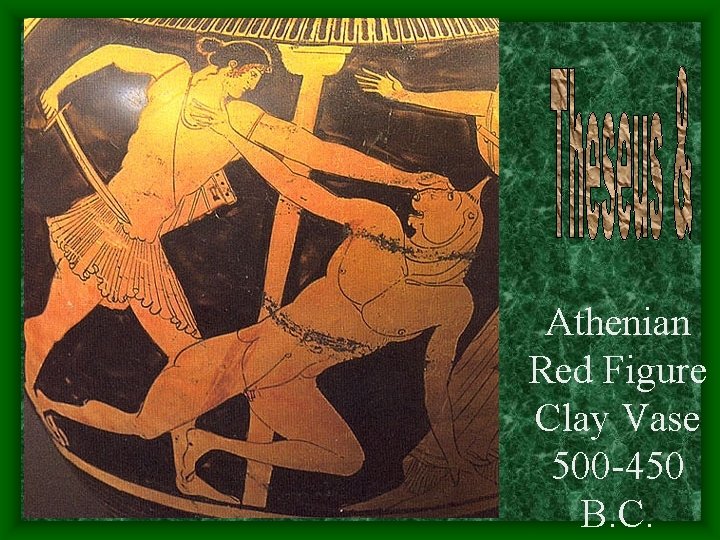
Athenian Red Figure Clay Vase 500 -450 B. C.
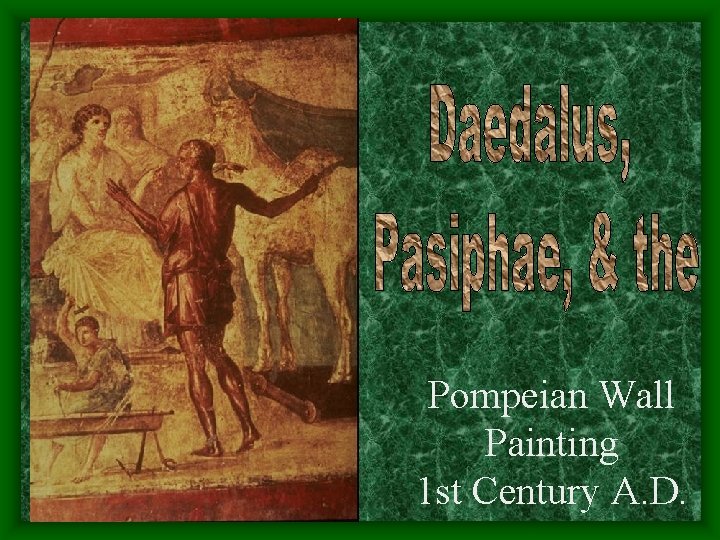
Pompeian Wall Painting 1 st Century A. D.
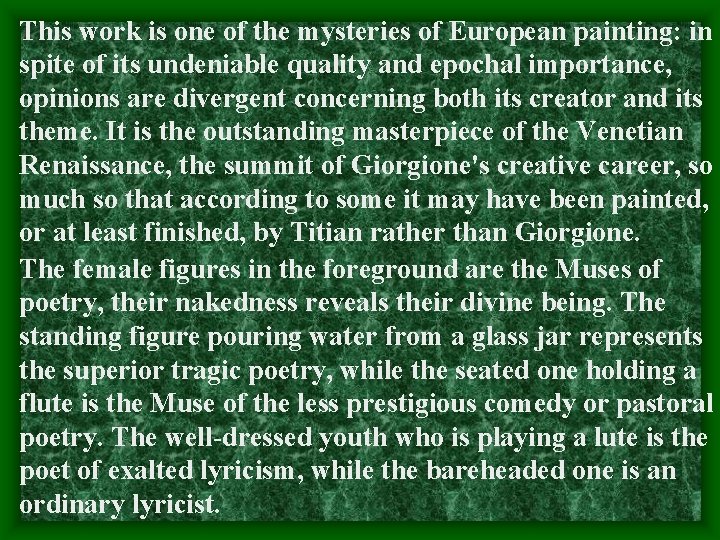
This work is one of the mysteries of European painting: in spite of its undeniable quality and epochal importance, opinions are divergent concerning both its creator and its theme. It is the outstanding masterpiece of the Venetian Renaissance, the summit of Giorgione's creative career, so much so that according to some it may have been painted, or at least finished, by Titian rather than Giorgione. The female figures in the foreground are the Muses of poetry, their nakedness reveals their divine being. The standing figure pouring water from a glass jar represents the superior tragic poetry, while the seated one holding a flute is the Muse of the less prestigious comedy or pastoral poetry. The well-dressed youth who is playing a lute is the poet of exalted lyricism, while the bareheaded one is an ordinary lyricist.
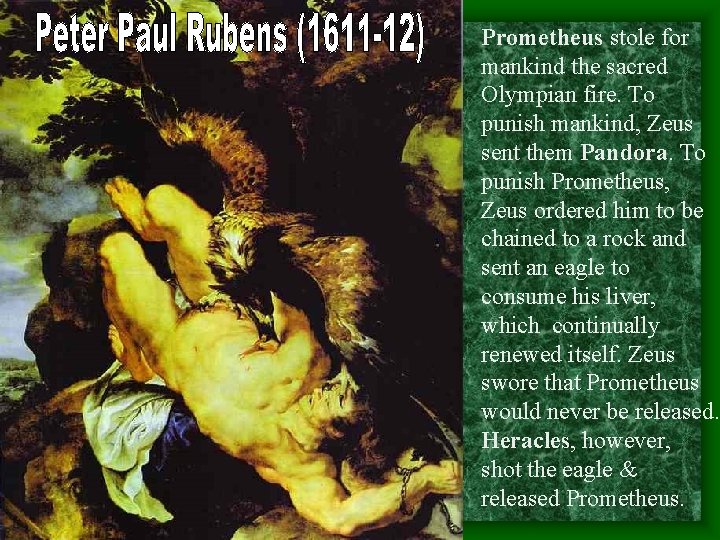
Prometheus stole for mankind the sacred Olympian fire. To punish mankind, Zeus sent them Pandora. To punish Prometheus, Zeus ordered him to be chained to a rock and sent an eagle to consume his liver, which continually renewed itself. Zeus swore that Prometheus would never be released. Heracles, however, shot the eagle & released Prometheus.