Tim Stemwedel PresidentFounder CALIFORNIA ORGANIC FERTILIZERS INC LIQUID
- Slides: 37
Tim Stemwedel, President/Founder CALIFORNIA ORGANIC FERTILIZERS, INC. LIQUID ORGANIC FERTILIZERS
LIQUID ORGANIC FERTILIZERS Can a Liquid Organic Fertilizer meet the NOP Rules?
LIQUID ORGANIC FERTILIZERS Can a Liquid Organic Fertilizer meet the NOP Rules? What can they be made from?
LIQUID ORGANIC FERTILIZERS Can a Liquid Organic Fertilizer meet the NOP Rules? What can they be made from? How high of an analysis can be achieved?
LIQUID ORGANIC FERTILIZERS Can a Liquid Organic Fertilizer meet the NOP Rules? What can they be made from? How high of an analysis can be achieved? How can you tell if a product is legitimate?
LIQUID ORGANIC FERTILIZERS Can a Liquid Organic Fertilizer meet the NOP Rules? YES! ; )
LIQUID ORGANIC FERTILIZERS Can a Liquid Organic Fertilizer meet the NOP Rules? YES! ; ) Do I believe they always meet the NOP Rules?
LIQUID ORGANIC FERTILIZERS Can a Liquid Organic Fertilizer meet the NOP Rules? YES! ; ) Do I believe they always meet the NOP Rules? No : (
LIQUID ORGANIC FERTILIZERS What are the NOP Rules for Fertilizer? Allowed Materials: Plant or animal materials that have not been chemically extracted, processed or treated. (protein, kelp, etc. ) Mined Minerals with a few exceptions. Mixtures or Blends that create a chemical reaction are not allowed. Example: Citric Acid mixed with rock phosphate.
LIQUID ORGANIC FERTILIZERS What can they be Made From? Fish Animal Proteins Plant Proteins Manure, compost Guano Minerals By-Products
LIQUID ORGANIC FERTILIZERS How high of an analysis can be achieved?
LIQUID ORGANIC FERTILIZERS How high of an analysis can be achieved? Answer: Depends upon the Technology and the Raw Materials
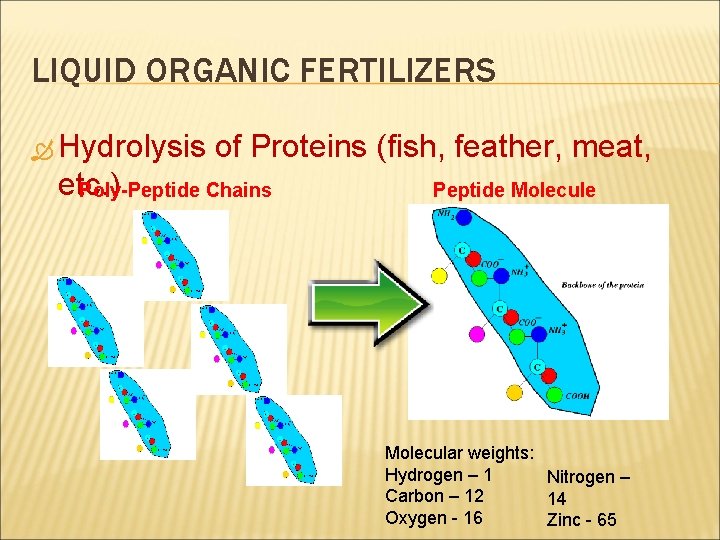
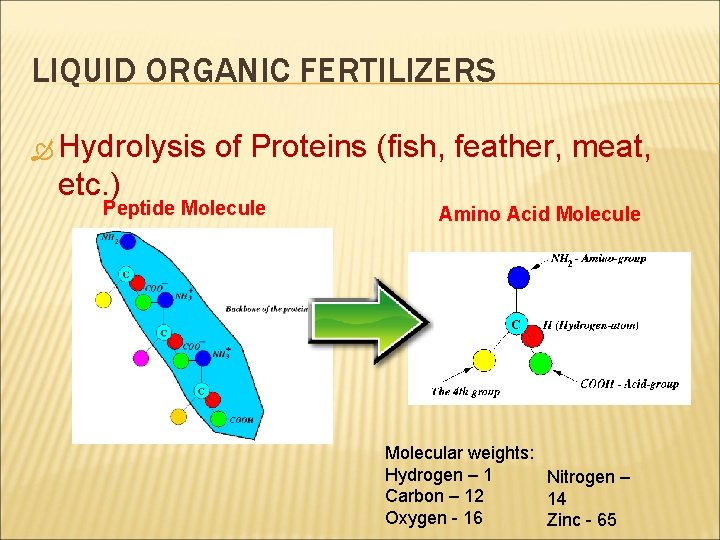
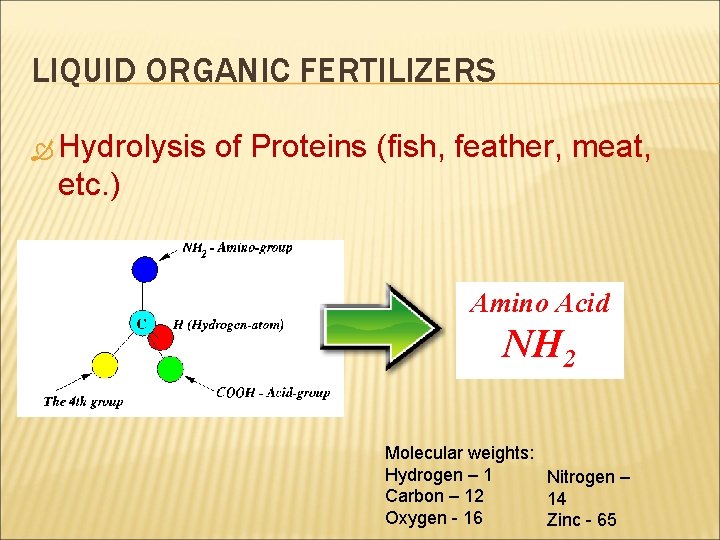
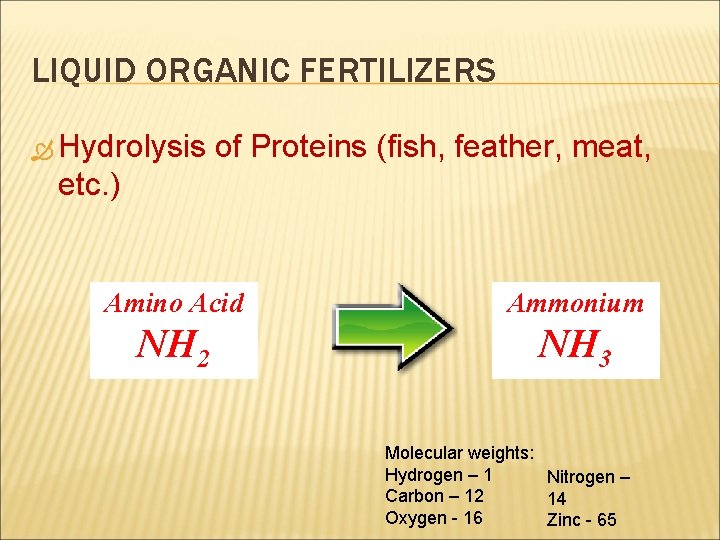
LIQUID ORGANIC FERTILIZERS How high of an analysis can be achieved? Protein Based Fertilizers Fish Meal, Fish Solubles, Plant Proteins, Feather Meal, Blood Meal, etc. Maximum: 9% Nitrogen Economic Range: 4 -7% Nitrogen Technical Information: Enzyme hydrolysis of proteins creates soluble peptides, amino acids, amines and ammonia. The total percent of Nitrogen depends upon the degree of hydrolysis AND the purity of the base product. Higher analysis generally requires the separation of the soluble fraction from the insoluble (via filter, centrifuge, etc. ) and subsequent concentration. Ammonia (NH 3) creation from Amine (NH 2) Hydrolysis results in an elevated p. H product (base). Products with high ammonia levels and a neutral p. H, need to explain how the neutral p. H exists without the addition of an acid. (A Base and an Acid create a chemical reaction which is not allowed under NOP Rule). (Fish emulsions are exempt by NOP Rule)
LIQUID ORGANIC FERTILIZERS Hydrolysis of Proteins (fish, feather, meat, etc. ) Poly-Peptide Chains Peptide Molecular weights: Hydrogen – 1 Nitrogen – Carbon – 12 14 Oxygen - 16 Zinc - 65
LIQUID ORGANIC FERTILIZERS Hydrolysis of Proteins (fish, feather, meat, etc. ) Peptide Molecule Amino Acid Molecule Molecular weights: Hydrogen – 1 Nitrogen – Carbon – 12 14 Oxygen - 16 Zinc - 65
LIQUID ORGANIC FERTILIZERS Hydrolysis of Proteins (fish, feather, meat, etc. ) Amino Acid NH 2 Molecular weights: Hydrogen – 1 Nitrogen – Carbon – 12 14 Oxygen - 16 Zinc - 65
LIQUID ORGANIC FERTILIZERS Hydrolysis of Proteins (fish, feather, meat, etc. ) Amino Acid Ammonium NH 2 NH 3 Molecular weights: Hydrogen – 1 Nitrogen – Carbon – 12 14 Oxygen - 16 Zinc - 65
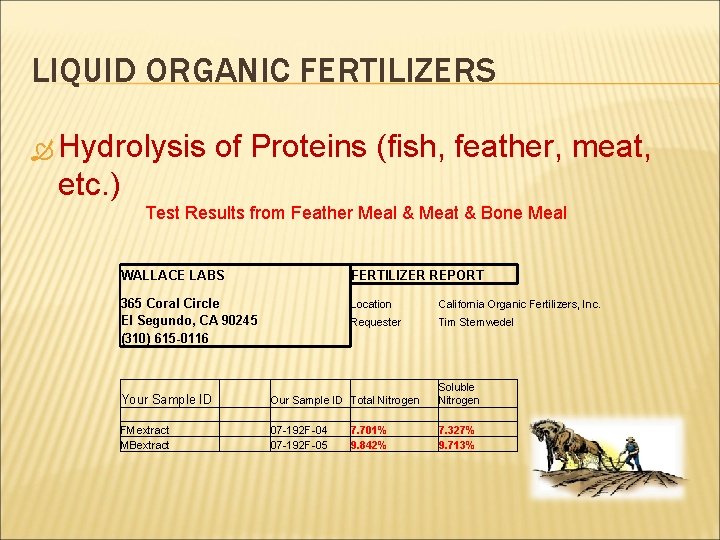
LIQUID ORGANIC FERTILIZERS Hydrolysis of Proteins (fish, feather, meat, etc. ) Test Results from Feather Meal & Meat & Bone Meal WALLACE LABS FERTILIZER REPORT 365 Coral Circle El Segundo, CA 90245 (310) 615 -0116 Location California Organic Fertilizers, Inc. Requester Tim Stemwedel Total Nitrogen 7. 701% 9. 842% Soluble Nitrogen 7. 327% 9. 713% Your Sample ID FMextract MBextract Our Sample ID 07 -192 F-04 07 -192 F-05
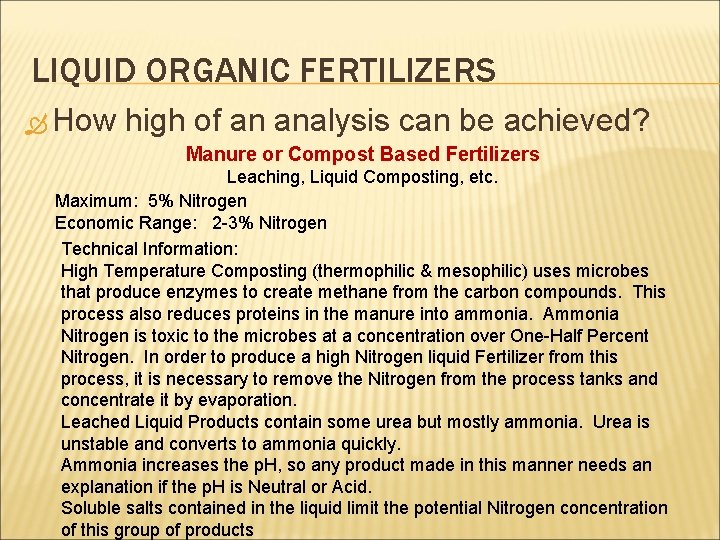
LIQUID ORGANIC FERTILIZERS How high of an analysis can be achieved? Manure or Compost Based Fertilizers Leaching, Liquid Composting, etc. Maximum: 5% Nitrogen Economic Range: 2 -3% Nitrogen Technical Information: High Temperature Composting (thermophilic & mesophilic) uses microbes that produce enzymes to create methane from the carbon compounds. This process also reduces proteins in the manure into ammonia. Ammonia Nitrogen is toxic to the microbes at a concentration over One-Half Percent Nitrogen. In order to produce a high Nitrogen liquid Fertilizer from this process, it is necessary to remove the Nitrogen from the process tanks and concentrate it by evaporation. Leached Liquid Products contain some urea but mostly ammonia. Urea is unstable and converts to ammonia quickly. Ammonia increases the p. H, so any product made in this manner needs an explanation if the p. H is Neutral or Acid. Soluble salts contained in the liquid limit the potential Nitrogen concentration of this group of products
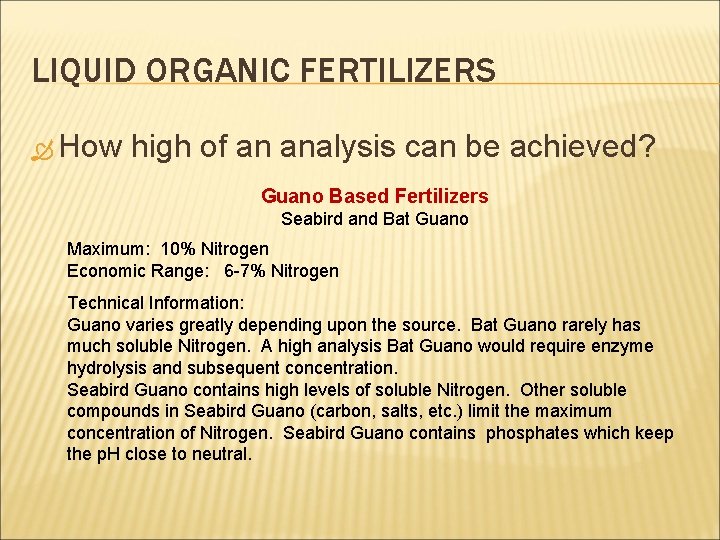
LIQUID ORGANIC FERTILIZERS How high of an analysis can be achieved? Guano Based Fertilizers Seabird and Bat Guano Maximum: 10% Nitrogen Economic Range: 6 -7% Nitrogen Technical Information: Guano varies greatly depending upon the source. Bat Guano rarely has much soluble Nitrogen. A high analysis Bat Guano would require enzyme hydrolysis and subsequent concentration. Seabird Guano contains high levels of soluble Nitrogen. Other soluble compounds in Seabird Guano (carbon, salts, etc. ) limit the maximum concentration of Nitrogen. Seabird Guano contains phosphates which keep the p. H close to neutral.
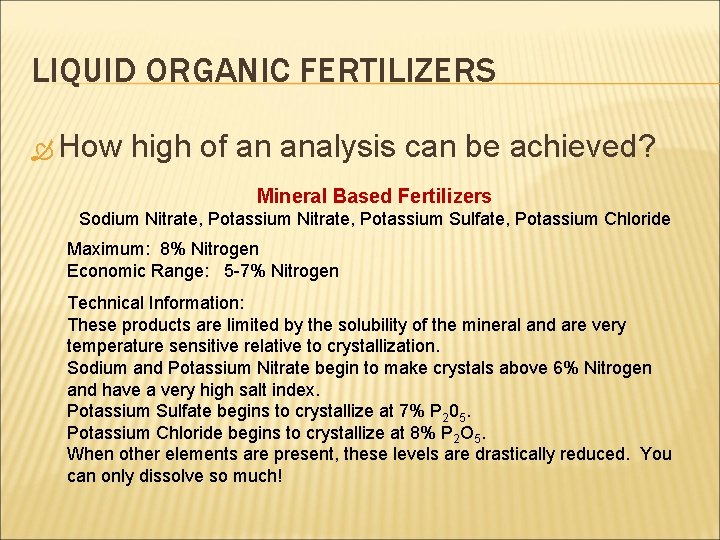
LIQUID ORGANIC FERTILIZERS How high of an analysis can be achieved? Mineral Based Fertilizers Sodium Nitrate, Potassium Sulfate, Potassium Chloride Maximum: 8% Nitrogen Economic Range: 5 -7% Nitrogen Technical Information: These products are limited by the solubility of the mineral and are very temperature sensitive relative to crystallization. Sodium and Potassium Nitrate begin to make crystals above 6% Nitrogen and have a very high salt index. Potassium Sulfate begins to crystallize at 7% P 205. Potassium Chloride begins to crystallize at 8% P 2 O 5. When other elements are present, these levels are drastically reduced. You can only dissolve so much!
LIQUID ORGANIC FERTILIZERS How high of an analysis can be achieved? By-Product Based Fertilizers Molasses, Raffinate, Vinasses, Fermentation Wastes, etc. Maximum: 9% Nitrogen Economic Range: 5 -7% Nitrogen Technical Information: These Products are waste streams from various manufacturing production processes such as Molasses Sugar Depletion, MSG, Lysine, Soy Sauce, Alcohol, Pharmaceuticals, Pesticides, etc. Almost all of these processes require the addition of Chemicals, GMOs, Cation Exchange Resins, Nitrogen, Phosphate, or other non-NOP compliant materials. Standard Molasses (sugar containing) contains approximately 0. 5% Nitrogen.
LIQUID ORGANIC FERTILIZERS How do you determine if a product is 1. What are the raw materials? legitimate? 2. Does the raw material have enough N to support the product? 3. Does the manufacturer have inventories of the raw materials? 4. Is there publicly available technology to support the claims? 5. How secretive is the manufacturer regarding how and where it is made? 6. Is the process under patent protection? 7. Is there a production facility to support the production? 8. Where is the production facility? 9. Is the product Imported? Why? 10. Is the value consistent with competitive products? 11. Has the product been evaluated by your certifier, OMRI or WSDA? 12. Is it a By-Product? Of what? 13. Is the basic chemistry or bio-chemistry sound? 14. What does a third-party lab test divulge? 15. What else is in the product? Salt content? 16. Are Liquid Organic Fertilizers Safe and free of bad beasties? 17. What if WSDA or OMRI says it is ok?
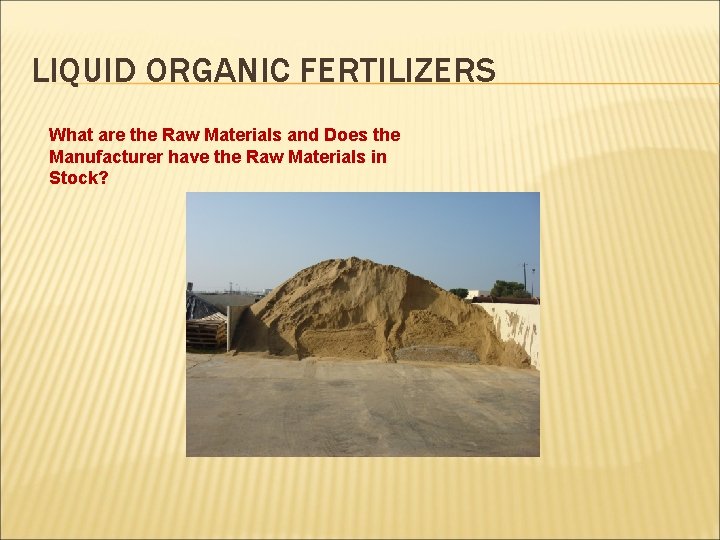
LIQUID ORGANIC FERTILIZERS What are the Raw Materials and Does the Manufacturer have the Raw Materials in Stock?
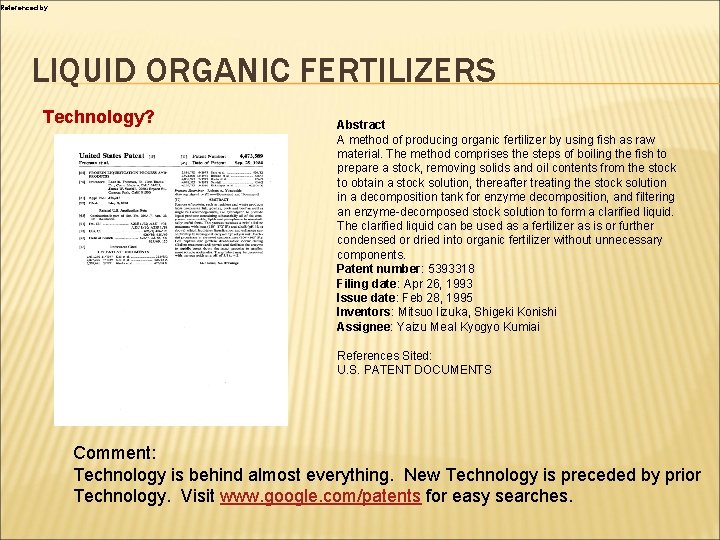
Referenced by LIQUID ORGANIC FERTILIZERS Technology? Abstract A method of producing organic fertilizer by using fish as raw material. The method comprises the steps of boiling the fish to prepare a stock, removing solids and oil contents from the stock to obtain a stock solution, thereafter treating the stock solution in a decomposition tank for enzyme decomposition, and filtering an enzyme-decomposed stock solution to form a clarified liquid. The clarified liquid can be used as a fertilizer as is or further condensed or dried into organic fertilizer without unnecessary components. Patent number: 5393318 Filing date: Apr 26, 1993 Issue date: Feb 28, 1995 Inventors: Mitsuo Iizuka, Shigeki Konishi Assignee: Yaizu Meal Kyogyo Kumiai References Sited: U. S. PATENT DOCUMENTS Comment: Technology is behind almost everything. New Technology is preceded by prior Technology. Visit www. google. com/patents for easy searches.
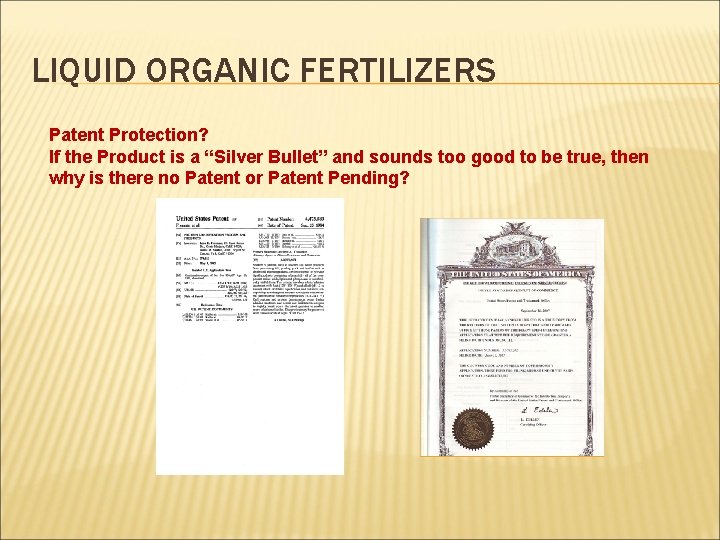
LIQUID ORGANIC FERTILIZERS Patent Protection? If the Product is a “Silver Bullet” and sounds too good to be true, then why is there no Patent or Patent Pending?
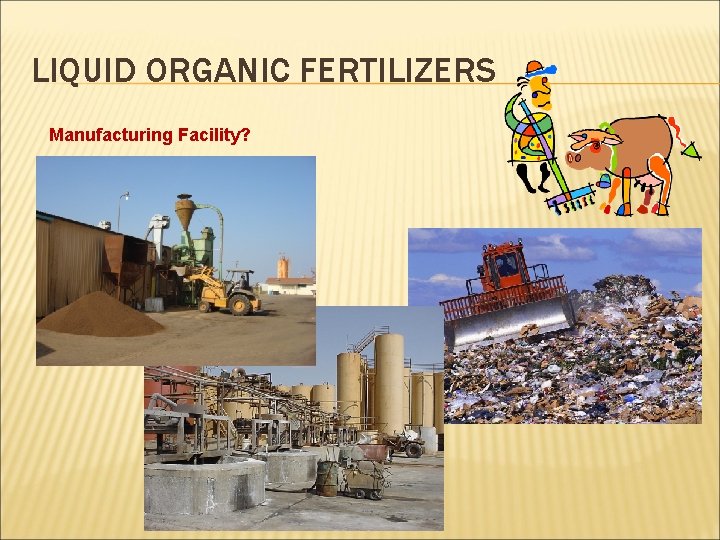
LIQUID ORGANIC FERTILIZERS Manufacturing Facility?
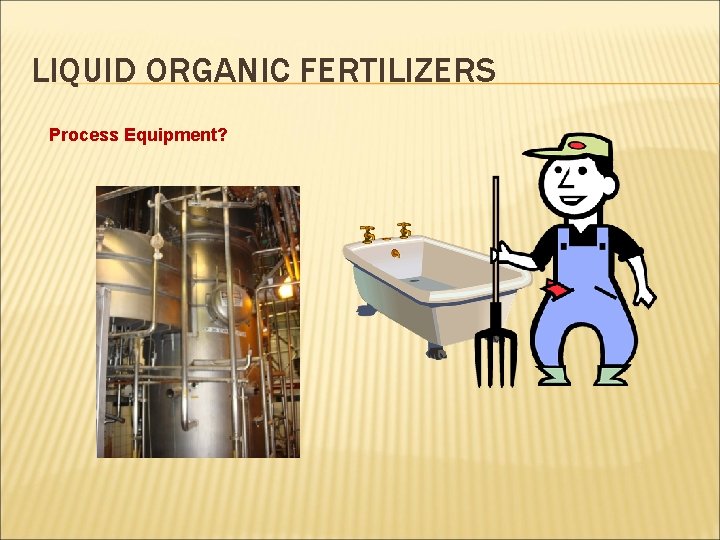
LIQUID ORGANIC FERTILIZERS Process Equipment?
LIQUID ORGANIC FERTILIZERS Where is the Production Facility?
LIQUID ORGANIC FERTILIZERS Is the Product Imported and Why? Why is the product not sold in the country of origin? Why do we need to import it? How can the product be Price competitive with USA made products?
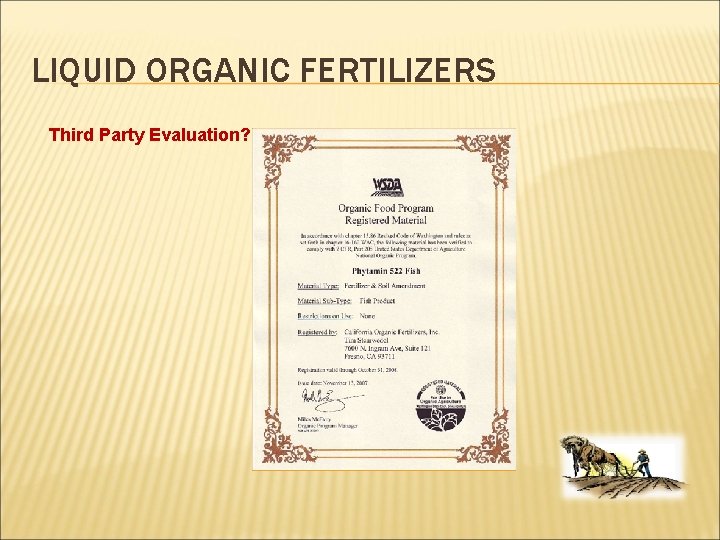
LIQUID ORGANIC FERTILIZERS Third Party Evaluation?
LIQUID ORGANIC FERTILIZERS Is it a By-Product? From the production of what? Fish Meal Production? Probably OK Lysine Production? Probably not OK Betaine Production? Probably not OK Sugar Depletion of Molasses? Probably not ok In General: By-Products are the result of the production of another product that is most likely not organic. Therefore, little concern is placed upon limiting the use of processes which disqualify the by-product as suitable for Organic Fertilizer use.
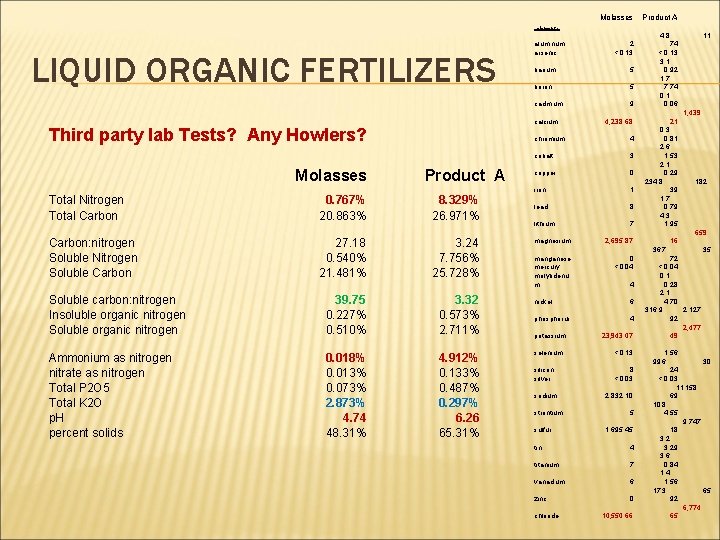
Molasses Product A elements LIQUID ORGANIC FERTILIZERS aluminum arsenic barium boron cadmium calcium Third party lab Tests? Any Howlers? chromium cobalt Molasses Total Nitrogen Total Carbon Product A 0. 767% 20. 863% 8. 329% 26. 971% 27. 18 0. 540% 21. 481% 3. 24 7. 756% 25. 728% Soluble carbon: nitrogen Insoluble organic nitrogen Soluble organic nitrogen 39. 75 0. 227% 0. 510% 3. 32 0. 573% 2. 711% Ammonium as nitrogen nitrate as nitrogen Total P 2 O 5 Total K 2 O p. H percent solids 0. 018% 0. 013% 0. 073% 2. 873% 4. 74 48. 31% 4. 912% 0. 133% 0. 487% 0. 297% 6. 26 65. 31% Carbon: nitrogen Soluble Nitrogen Soluble Carbon copper iron lead lithium magnesium manganese mercury molybdenu m nickel phosphorus potassium selenium silicon silver sodium strontium sulfur tin titanium vanadium zinc chloride 4. 8 11. 2 74 < 0. 13 3. 1 5 0. 92 1. 7 5 7. 74 0. 1 9 0. 06 1, 439. 4, 238. 68 21 0. 3 4 0. 81 2. 6 3 1. 53 2. 1 0 0. 29 234. 8 182. 1 39 1. 7 8 0. 79 4. 3 7 1. 95 659. 2, 695. 87 16 36. 7 35. 0 72 < 0. 04 0. 1 4 0. 28 2. 1 6 4. 70 316. 9 2, 127. 4 92 2, 477. 23, 943. 07 49 < 0. 13 1. 56 99. 6 30. 8 24 < 0. 03 11, 158. 2, 832. 10 69 10. 8 5 4. 55 9, 747. 1, 695. 45 18 3. 2 4 3. 29 3. 6 7 0. 84 1. 4 6 1. 56 17. 3 65. 0 92 6, 774. 10, 550. 66 65
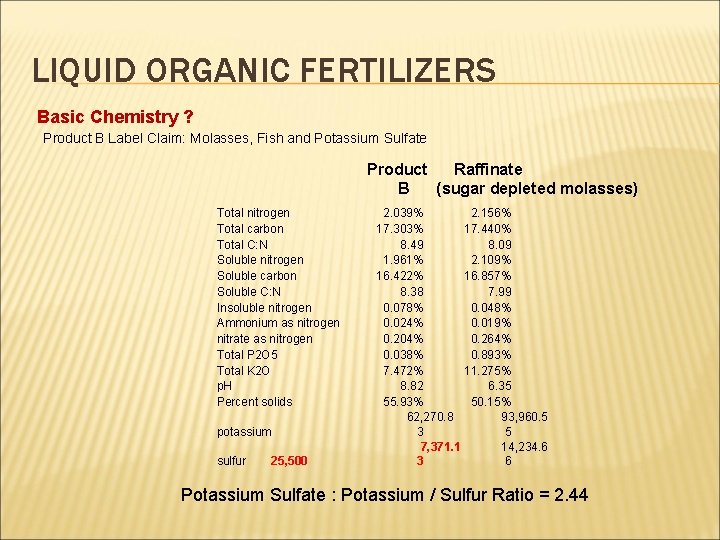
LIQUID ORGANIC FERTILIZERS Basic Chemistry ? Product B Label Claim: Molasses, Fish and Potassium Sulfate Product Raffinate B (sugar depleted molasses) Total nitrogen Total carbon Total C: N Soluble nitrogen Soluble carbon Soluble C: N Insoluble nitrogen Ammonium as nitrogen nitrate as nitrogen Total P 2 O 5 Total K 2 O p. H Percent solids potassium sulfur 25, 500 2. 039% 2. 156% 17. 303% 17. 440% 8. 49 8. 09 1. 961% 2. 109% 16. 422% 16. 857% 8. 38 7. 99 0. 078% 0. 048% 0. 024% 0. 019% 0. 204% 0. 264% 0. 038% 0. 893% 7. 472% 11. 275% 8. 82 6. 35 55. 93% 50. 15% 62, 270. 8 93, 960. 5 3 5 7, 371. 1 14, 234. 6 3 6 Potassium Sulfate : Potassium / Sulfur Ratio = 2. 44
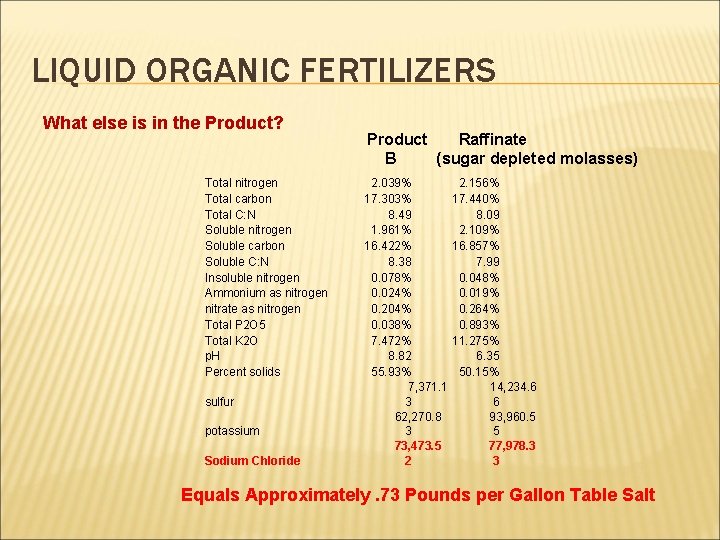
LIQUID ORGANIC FERTILIZERS What else is in the Product? Total nitrogen Total carbon Total C: N Soluble nitrogen Soluble carbon Soluble C: N Insoluble nitrogen Ammonium as nitrogen nitrate as nitrogen Total P 2 O 5 Total K 2 O p. H Percent solids sulfur potassium Sodium Chloride Product Raffinate B (sugar depleted molasses) 2. 039% 17. 303% 8. 49 1. 961% 16. 422% 8. 38 0. 078% 0. 024% 0. 204% 0. 038% 7. 472% 8. 82 55. 93% 7, 371. 1 3 62, 270. 8 3 73, 473. 5 2 2. 156% 17. 440% 8. 09 2. 109% 16. 857% 7. 99 0. 048% 0. 019% 0. 264% 0. 893% 11. 275% 6. 35 50. 15% 14, 234. 6 6 93, 960. 5 5 77, 978. 3 3 Equals Approximately. 73 Pounds per Gallon Table Salt
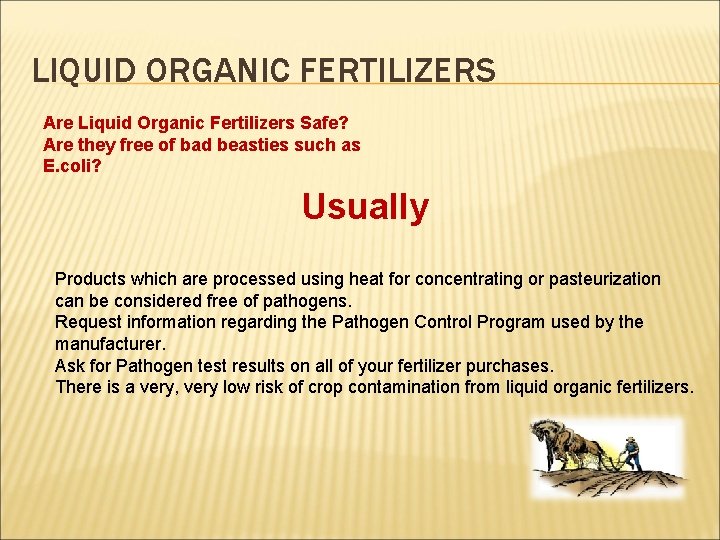
LIQUID ORGANIC FERTILIZERS Are Liquid Organic Fertilizers Safe? Are they free of bad beasties such as E. coli? Usually Products which are processed using heat for concentrating or pasteurization can be considered free of pathogens. Request information regarding the Pathogen Control Program used by the manufacturer. Ask for Pathogen test results on all of your fertilizer purchases. There is a very, very low risk of crop contamination from liquid organic fertilizers.
LIQUID ORGANIC FERTILIZERS What if OMRI or WSDA says the Product is OK? Is their approval “good enough”? Can you lose your Organic Certification? Who will incur the potential Loss?