This work is licensed under a Creative Commons




- Slides: 34
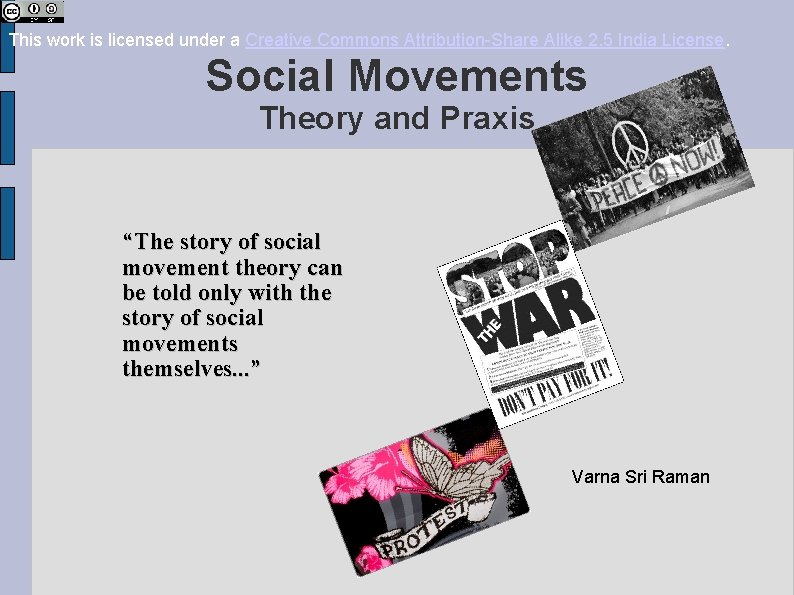
This work is licensed under a Creative Commons Attribution-Share Alike 2. 5 India License. Social Movements Theory and Praxis “The story of social movement theory can be told only with the story of social movements themselves. . . ” Varna Sri Raman
Introduction Social movements are a type of group action. They are large-scale informal groupings of individuals and/or organizations focused on specific social or political issues. They intend to bring about social change. Three normative core components of social movement theory: Political Opportunities Mobilizing Structures Framing Processes
Methodology We have tried to analyze the existing body of social movement theory in order understand: Where are the people who constitute a social movement from? How do they come together? How do they share a similar view of the world in circumstances that compel them to political action? In what ways does the nature of a social movement affect the future development of a social movement?
Methodology II We also look at the following key areas: Theoretical aspects The importance of the study of social movements The definition and classification of social movements Various social movement theories An analytical discussion and interpretation of social movement literature Opportunities for further research in social movement theory
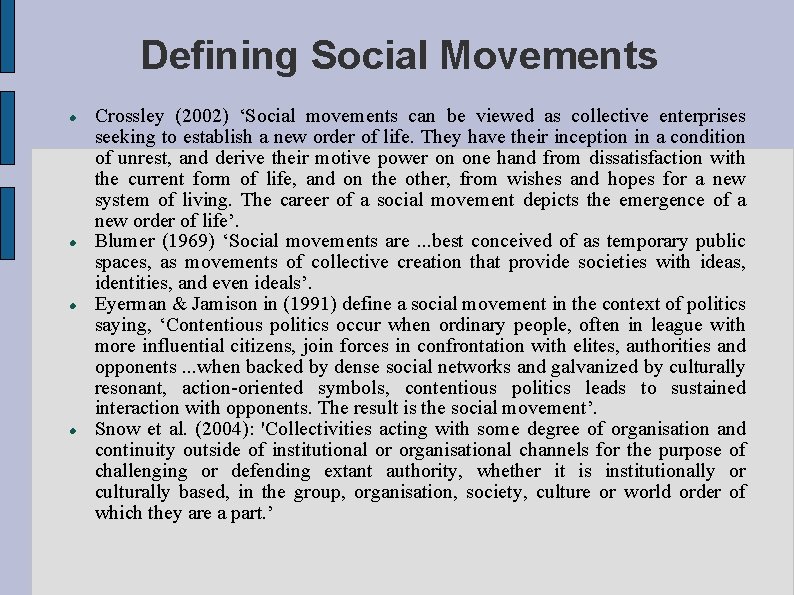
Defining Social Movements Crossley (2002) ‘Social movements can be viewed as collective enterprises seeking to establish a new order of life. They have their inception in a condition of unrest, and derive their motive power on one hand from dissatisfaction with the current form of life, and on the other, from wishes and hopes for a new system of living. The career of a social movement depicts the emergence of a new order of life’. Blumer (1969) ‘Social movements are. . . best conceived of as temporary public spaces, as movements of collective creation that provide societies with ideas, identities, and even ideals’. Eyerman & Jamison in (1991) define a social movement in the context of politics saying, ‘Contentious politics occur when ordinary people, often in league with more influential citizens, join forces in confrontation with elites, authorities and opponents. . . when backed by dense social networks and galvanized by culturally resonant, action-oriented symbols, contentious politics leads to sustained interaction with opponents. The result is the social movement’. Snow et al. (2004): 'Collectivities acting with some degree of organisation and continuity outside of institutional or organisational channels for the purpose of challenging or defending extant authority, whether it is institutionally or culturally based, in the group, organisation, society, culture or world order of which they are a part. ’
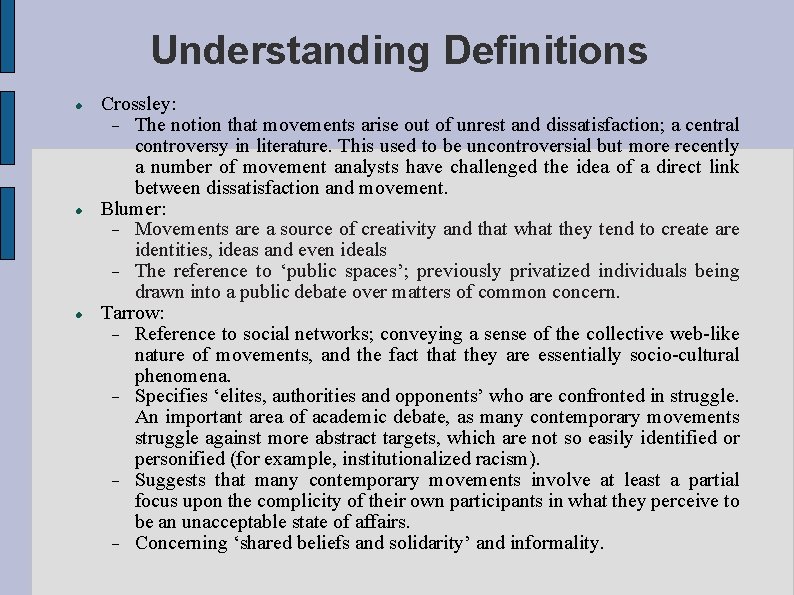
Understanding Definitions Crossley: The notion that movements arise out of unrest and dissatisfaction; a central controversy in literature. This used to be uncontroversial but more recently a number of movement analysts have challenged the idea of a direct link between dissatisfaction and movement. Blumer: Movements are a source of creativity and that what they tend to create are identities, ideas and even ideals The reference to ‘public spaces’; previously privatized individuals being drawn into a public debate over matters of common concern. Tarrow: Reference to social networks; conveying a sense of the collective web-like nature of movements, and the fact that they are essentially socio-cultural phenomena. Specifies ‘elites, authorities and opponents’ who are confronted in struggle. An important area of academic debate, as many contemporary movements struggle against more abstract targets, which are not so easily identified or personified (for example, institutionalized racism). Suggests that many contemporary movements involve at least a partial focus upon the complicity of their own participants in what they perceive to be an unacceptable state of affairs. Concerning ‘shared beliefs and solidarity’ and informality.
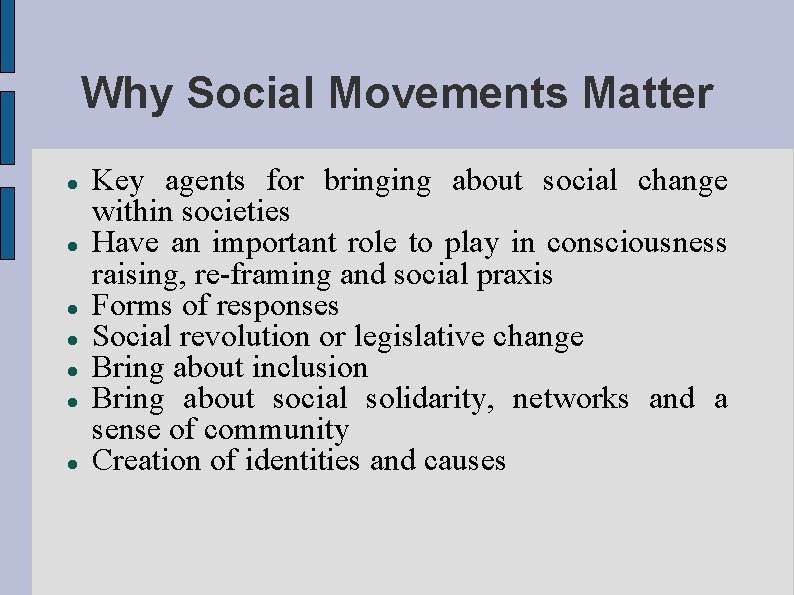
Why Social Movements Matter Key agents for bringing about social change within societies Have an important role to play in consciousness raising, re-framing and social praxis Forms of responses Social revolution or legislative change Bring about inclusion Bring about social solidarity, networks and a sense of community Creation of identities and causes
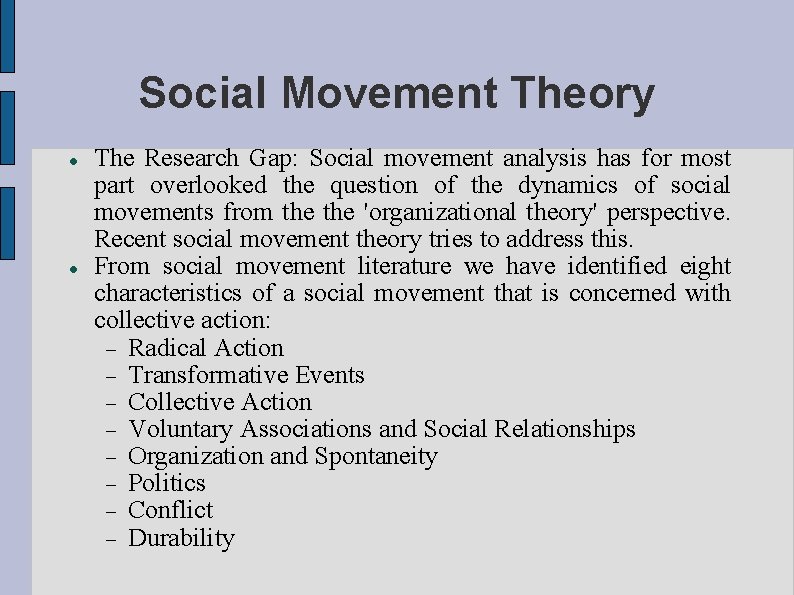
Social Movement Theory The Research Gap: Social movement analysis has for most part overlooked the question of the dynamics of social movements from the 'organizational theory' perspective. Recent social movement theory tries to address this. From social movement literature we have identified eight characteristics of a social movement that is concerned with collective action: Radical Action Transformative Events Collective Action Voluntary Associations and Social Relationships Organization and Spontaneity Politics Conflict Durability
Schools of Social Movement Theory Collective behavior and social movements research was the dominant school from the 1940 s to the early 1960 s-focused on the role of emotion and non-rational behavior. Resource mobilization and political process theories in the 1970 s and 1980 s rejected this emphasis on the emotionality of the crowd and applied a new focus on rational action and structural opportunities for movement emergence. 1990 s- New Social Movements theorists set movements in their social and historical context, shifting the focus yet again to cultural issues (identity, meanings and beliefs) and ‘framing’ processes.
Collective Behavior and Social Movements Research (CBSM) Emotions and non-rational behavior The imagery of the emotional crowd Movement emergence a a reflex response to ‘grievances', ‘ deprivations', ‘ anomie’, ‘structural strains’ and other forms of hardship. Focuses on protest movements Objective hardships necessary and a sufficient cause of protest and movement formation. Shaped in part by the fascist movements in Germany, Italy and Japan Portrays the irrational, volatile and deviant dimensions of movements Social movements classified as ‘mob psychology’ and collective hysteria Gave prominence to emotional dimension Ignored the ‘political’ nature of social movements
Resource Mobilization and Political Process Theories RM researches began to reject the earlier emotional bias and applied a new focus on ‘mobilizing structures’ and rational, calculative, opportunistic collective action. Asserts that there cannot be a movement without adequate organization and resources Structural network Rational agents/actors Precludes origin and distribution of preferences, movement identities and culture and role of emotion. Five-fold Typology of resources: Moral (legitimacy, solidarity, support) Cultural (cultural bonds, products) Social and Organizational (infrastructure and networks) Human (labour, experience, skills) Material resources (financial and physical capital)
New Social Movements Research To identify key movement clusters, main structural tensions etc. Understands movements within an understanding of society Focus on cultural issues and framing processes Cultural forms as language Shared culture, ideas, interpretations etc A movement is a cultural enterprise and succeeds if it has cultural resonance The importance of interactive social processes Societies change and with them the sources of social strains
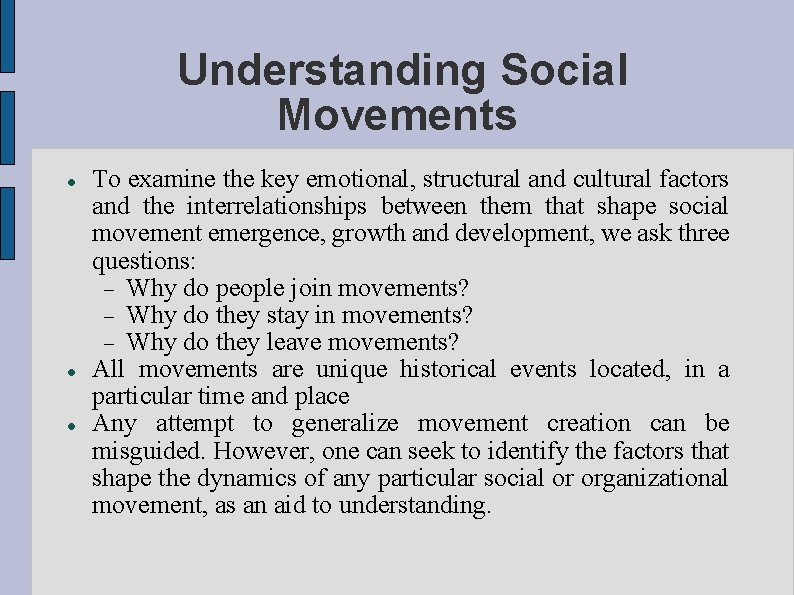
Understanding Social Movements To examine the key emotional, structural and cultural factors and the interrelationships between them that shape social movement emergence, growth and development, we ask three questions: Why do people join movements? Why do they stay in movements? Why do they leave movements? All movements are unique historical events located, in a particular time and place Any attempt to generalize movement creation can be misguided. However, one can seek to identify the factors that shape the dynamics of any particular social or organizational movement, as an aid to understanding.
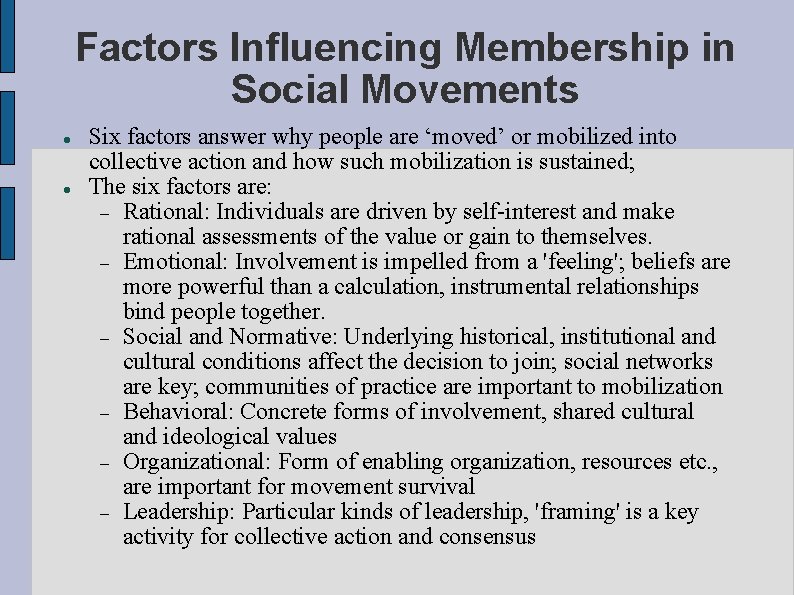
Factors Influencing Membership in Social Movements Six factors answer why people are ‘moved’ or mobilized into collective action and how such mobilization is sustained; The six factors are: Rational: Individuals are driven by self-interest and make rational assessments of the value or gain to themselves. Emotional: Involvement is impelled from a 'feeling'; beliefs are more powerful than a calculation, instrumental relationships bind people together. Social and Normative: Underlying historical, institutional and cultural conditions affect the decision to join; social networks are key; communities of practice are important to mobilization Behavioral: Concrete forms of involvement, shared cultural and ideological values Organizational: Form of enabling organization, resources etc. , are important for movement survival Leadership: Particular kinds of leadership, 'framing' is a key activity for collective action and consensus
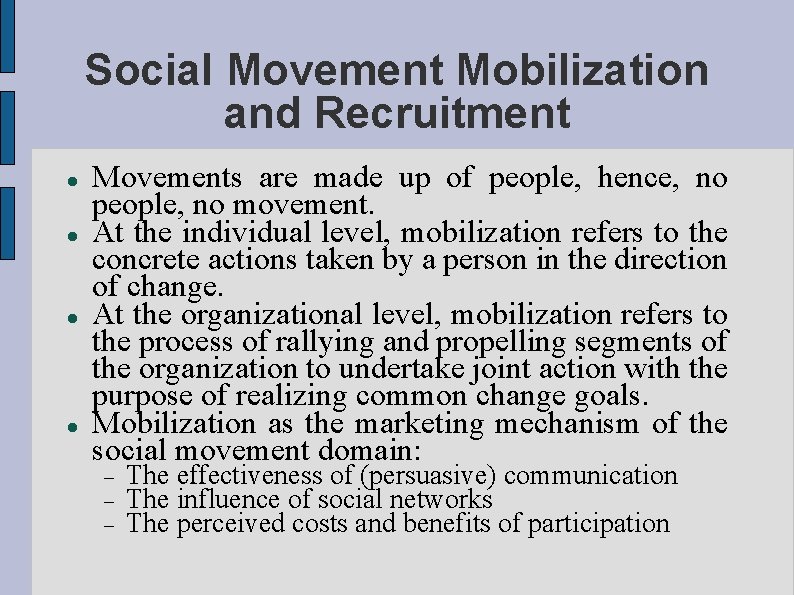
Social Movement Mobilization and Recruitment Movements are made up of people, hence, no people, no movement. At the individual level, mobilization refers to the concrete actions taken by a person in the direction of change. At the organizational level, mobilization refers to the process of rallying and propelling segments of the organization to undertake joint action with the purpose of realizing common change goals. Mobilization as the marketing mechanism of the social movement domain: The effectiveness of (persuasive) communication The influence of social networks The perceived costs and benefits of participation
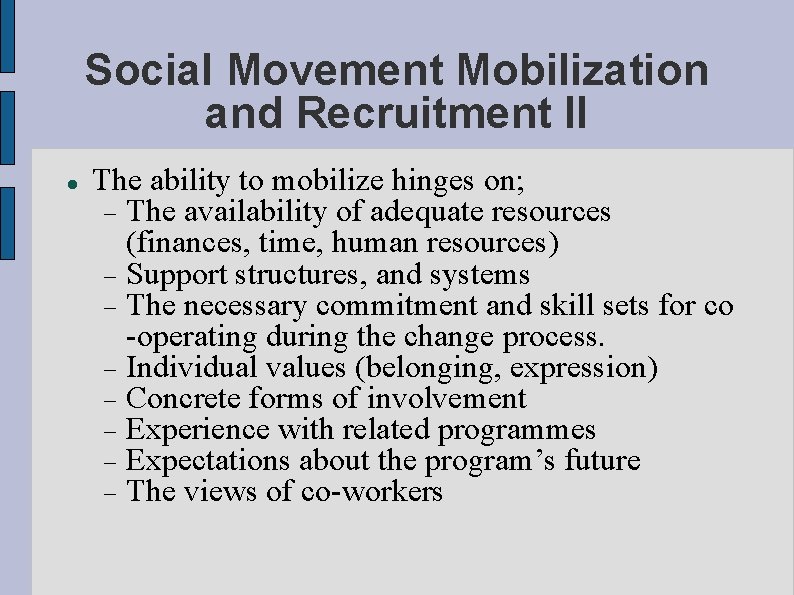
Social Movement Mobilization and Recruitment II The ability to mobilize hinges on; The availability of adequate resources (finances, time, human resources) Support structures, and systems The necessary commitment and skill sets for co -operating during the change process. Individual values (belonging, expression) Concrete forms of involvement Experience with related programmes Expectations about the program’s future The views of co-workers
Social Movement Dynamics The dynamics and interrelationships between emotion, structure and culture and the way the one reinforces or undermines the other Each one is a lever for mobilization and collective action and in combination they add up to very powerful combined force The way one might go about ‘creating’ a movement depends upon whichever theory one favors and chooses to privilege, and / or exactly what type of movement one is striving to ‘create’
Some Key Questions Do movements have to arise out of unrest and deep grievance or can they emerge through discernible and coherent, yet decentralized and organized, shifts in thinking, acting and perceiving which do not entail any form of ‘protest’? Why do people join movements and why and how do they become ‘activists’? What is the appropriate model of leadership for a movement? Why do ‘near movements’ like health care coalitions, community networks, collaboratives, and communities of practice just fall short of a movement, where people are fired into taking action collectively?
Some Thoughts… In many developing societies; People are poor and uneducated Intimidated by authoritarian governments Social movements face particularly stiff obstacles to organization International attention and support have often been necessary to protect these movements In developed nations; Basic human rights are more likely to be guaranteed Articulate middle class with a sense of political efficacy The success of a social movement is more assured
Some Thoughts The meaning of contentious collective action has itself always been open to contention. It is within this limitation that ‘social movements’ can be defined. There appears to be a general assumption in the development discourse that these social movements are the natural allies of development agencies working on issues of poverty, exclusion and sustainable development, despite this general ‘consensus’ there is a considerable lack of clarity surrounding the definition of the term ‘social movement’. One reason why it has proved difficult to provide a clear definition of a social movement, is because they are by nature, shifting entities. The essence, however, of a social movement is resistance. The focus on rights is one of the factors that sets developing country social movements apart from their contemporary movements in Western contexts.
Some Thoughts The term ‘social movement’ has been used to describe widely varying forms of collective action. Studies of various forms of collective action have used the label ‘social movement’ in cases where the term national campaign or international advocacy network would be much more appropriate. There are similarities amongst these organizational forms, in which groups of individuals coalesce around a pertinent issue and demand redress. But these campaigns and networks are already a level removed from the grassroots where, real, social movements are to be found.
Some Thoughts Another set of collective actors sometimes referred to in the literature as ‘social movements’, are groups of individuals, very often women, who join forces to ensure livelihoods for their families. A more appropriate term for this type of mobilization would be ‘consumption based organization. These groups react against a status quo they regard as unacceptable, their activities centre around service provision, The stamp of a social movement is precisely its refusal to provide services and resolution that this should be the role of the state. On the other hand, entities that are clearly social movements can also call themselves NGOs. In some cases this has been a way to get; Recognition in dealings with local authorities To have the right to organize at all.
Some Thoughts The development and social change ideal is per se political, with its goals of fundamental social change and demands for equity. Social movements then are characterised by the overt politicisation of their aims. They ‘struggle to integrate previously excluded groups and issues into local or national politics’ [i] A social movement could also be understood as community mobilization around the political implications of a local problem Social movement challenges to the status quo are generally highly vocal, and members very often posit themselves in clear opposition to government or other elites and their policies.
Some Thoughts Movements may very often oppose government, but they are equally dependent upon it to redress certain wrongs or bestow rights. Their strategic interaction with the state brings movements clearly into the realm of the political. Social movements are much more fluid than their counterparts, and above all reactive, as their actions and goals respond to the vagaries of local and national politics, or the flexibility of global capital. Perhaps most crucial for a definition of social movements, however, is the issue of membership. Social movements are their members. In contrast, theoretically (and sometimes in practice) other development agencies can consist of just one person. It would be hard to imagine a social movement composed of a single individual. Social movements are highly dependent on their members who they must keep mobilized and committed. In this sense, movements must elicit a high level of loyalty from their individual members who in turn bestow the movement with legitimacy.
Some Thoughts Three defining factors set social movements apart from other development agencies: The importance of their membership – very often the most marginal sectors of society who are already mobilised. Their radical nature which makes them responsive, reactive and often highly innovative. Their perceived ‘authenticity’ and closeness to the grassroots.
Some Thoughts The fourth general characteristic of social movements is their organizational fluidity. Social movements are evolutionary by nature and can rise, fall and disappear in response to changing political circumstances and levels of success or failure. Not all social movements disappear after success or failure, in some cases an organizational form that started life as a social movement can emerge as an NGO, or an NGO-like entity, called the SMO (Social Movement Organization). The transition to an institutionalised status can, however, be problematic if it occurs as an unintended consequence of donor support for a radical movement, or without the prior knowledge or consent of its members
Some Thoughts Social movements are a window to some of the developing world’s most pressing issues and most innovative actors. The willingness of social movements to take risks and find new ways of alleviating poverty and exclusion, despite and inspite of upsetting their own governments and supporters is a very powerful tool for social change. It is important for other institutionalised agents of social change to address whethere are ways of partnering grassroots social movements without a subsequent diminution of their radical nature and potential challenge to the status quo, rather than simply ignoring the issue
Some Thoughts Yet another aspect that deserves further exploration is recognition of identities in social movements. In the language of social movement process theories, recognition struggles concern the intersection of collective identities and the field of collective action. Social movement theory has had far more to say about “struggles” (collective action/ contentious politics) than how they are aided or hindered by recognition of the identities of participants, beneficiaries, interested bystanders and adversaries.
Last Words Our normative study of social movement theory, despite being normative is relevant to understanding the role of social movements in India and other parts of the nonwestern world. It is very clear that new social movements are specific to a post-modern society, a society in which the major part of the workforce is educated, skilled and white-collar. However, the dominance of state structures, market forces and communications - the things that social movements must oppose - are clearly present in societies, which cannot yet be called post-modern. This domination is a global process.
Last Words Theories constructed for the west are concerned with movements, which focus on the quality of life, rather than the matters concerning the material aspects of life. The movements’ actors are often those in the middle class. In non-western countries, where the material aspects are still a problem, many social movements are still about bread and butter issues, particularly access to resources. The actors involved in many cases are the underprivileged, the marginalized, workers and poor farmers. The use of the term new social movements may not be appropriate. This may explain the decline of its use in recent years. In several studies of social movements in the third world, researchers use the term “popular movement” instead.
Last Words Social movements hope that democratic structures will remove oppression, allow participation, and hence overcome many of the inequalities and injustices in the society and economy. However, the more recent Indian experience suggests that faith in democratic process - within the current global context - is likely to be illusory. The reality has been that even after the democratic system has been established, people still do not have full participation While theories of resource mobilization and political process offer no tools for understanding the origin and role of popular movements, they may be of use in the analysis of organization, strategy, reasons for failures or success, and impact on political change.
Last Words We need to look at the roles of actors in these areas: Influencing human rights discourses Policy and practice Promoting development, Environmental protection Governance Organizing labor. Eight factors are crucial for the success or failure of a social movement: Cultural continuity Medium tension Effective mobilization A normal age and sex structure A favorable ecology Network ties Secularization, and Adequate socialization
Last Words Social movements of the last three decades are challenging both the established structures of power and the dominant visions of society. They are also changing the very nature of civil society and its traditional relationship with the state and the market and altering social and cultural relations in the everyday lives of millions of people. Research must be able to offer an overview of the struggles of peasants, indigenous peoples, women, and defenders of ecological spaces, which are reclaiming their commons and demanding greater local autonomy, environmental and gender justice, and more accountability from state and other national and global economic actors, while challenging conventionally held beliefs on nation, democracy, ecology and justice.
Thank you! Any Questions?